


Monk
Stillness before the storm — the body as weapon, the breath as shield, and discipline as the path to impossible power
What Is a Monk?
The monk exists to prove that the body alone is enough. In a world bristling with enchanted swords, eldritch pacts, and divine miracles, the monk walks in with empty hands and proceeds to punch a dragon unconscious. That is the fantasy: not that violence requires special tools, but that a person who has achieved total mastery of themselves doesn't need anything the world didn't already give them.
At its heart, the monk class channels the martial-arts hero archetype — the figure who moves faster than the eye can track, deflects arrows with an open palm, and runs up walls because they've trained their body past the point where physics feels like making suggestions. This isn't the strength-based power of the barbarian or the technical precision of the fighter. The monk's power comes from within, fueled by an internal energy that most editions call ki (or, in the 2024 revision, discipline). It's spiritual athleticism: a bridge between the physical and the metaphysical.
What makes the monk fantasy resonate is that it frames power as earned rather than given. A warlock makes a pact. A sorcerer is born special. A cleric prays and receives. The monk woke up before dawn every day for twenty years and punched a wooden post until their knuckles became weapons. There is something deeply satisfying about a character whose supernatural abilities come from nothing more exotic than relentless, brutal self-improvement.
“The sword is an extension of the arm. The arm is an extension of the will. The monk simply removes the middleman.”
— Monastery proverb
Literary & Mythological Origins
The D&D monk draws from a deep well of Eastern martial arts mythology, Western pulp fiction, and 1970s pop culture. The most direct ancestor is the Shaolin monk tradition — Buddhist warrior-monks whose training regimens allegedly produced superhuman feats of endurance, speed, and pain resistance. Whether historical Shaolin monks could actually shatter stone with their hands is beside the point; the legend is potent enough to have spawned an entire class.
Bruce Lee's films in the early 1970s were the catalyst that brought martial arts into the Western cultural mainstream. His philosophy of Jeet Kune Do — formless, adaptable, drawing from every style — maps directly onto the D&D monk's versatility. The timing matters: the monk appeared in the original D&D Supplement II (Blackmoor, 1975) at the peak of the kung fu movie craze. Gary Gygax and Brian Blume weren't drawing from centuries of Buddhist philosophy so much as channeling the excitement of a culture newly obsessed with martial arts cinema.
Beyond cinema, the monk archetype draws from wuxia literature — the Chinese genre of martial-arts heroes who achieve supernatural abilities through cultivation and training. Characters in novels like Jin Yong's Conderta Heroes series run on water, strike pressure points to paralyze opponents, and channel internal energy (qi) into devastating techniques. The D&D monk's Stunning Strike, ki abilities, and high-level features like Quivering Palm are wuxia powers translated into tabletop mechanics. The Japanese martial arts tradition contributes the figure of the ascetic warrior — the yamabushi mountain monks, the sohei warrior-monks of feudal Japan, and the disciplined samurai who treated combat as a spiritual practice.
Key Literary and Mythological Influences
| Source | Era | Contribution to the Archetype |
|---|---|---|
| Shaolin monastery tradition | c. 500 CE onward | Unarmed combat mastery, ascetic discipline, the warrior-monk concept |
| Wuxia literature (Jin Yong et al.) | 1950s-1970s | Qi cultivation, supernatural martial techniques, pressure-point strikes |
| Bruce Lee films | 1971-1973 | Adaptive fighting style, philosophy of formlessness, mainstream Western exposure |
| Kung Fu (TV series) | 1972-1975 | The wandering monk archetype, Eastern philosophy in Western settings |
| Remo Williams (The Destroyer) | 1971 onward | Western character mastering Eastern arts, Sinanju as a super-martial-art |
| Japanese sohei / yamabushi | c. 900-1600 CE | Militant monastic orders, spiritual warfare, mountain asceticism |
The D&D monk is a collage of Eastern traditions filtered through Western pop culture. The blend is imperfect, but the fantasy it produces is irresistible.
Evolution Across Editions
The monk has been part of D&D since nearly the beginning, but its journey through editions has been rougher than most classes. It appeared in Supplement II: Blackmoor (1975) as a sub-class of cleric — an odd pairing that reflected the designers' association of monks with religious orders rather than martial artists. That original monk could stun opponents, dodge missiles, and eventually kill with a single touch (the ancestor of Quivering Palm), but it was awkwardly grafted onto a system built around swords and sorcery.
First edition's monk in the Players Handbook (1978) refined the concept but kept it weird. Monks gained thief abilities like stealth and wall-climbing, had strict alignment requirements (Lawful only), and followed a bizarre advancement system where high-level monks had to defeat existing monks of the same level to advance. Second edition (1989) dropped the monk entirely — the class was considered too Eastern for the game's predominantly Western European flavor. It survived only as an optional kit in supplemental material.
Third edition (2000) brought the monk back as a core class and established the template that persists today: ki points as a resource, flurry of blows for extra attacks, scaling unarmed damage, and a suite of supernatural movement abilities. The 3e monk was loved for flavor but often criticized for mechanical weakness — its multiple ability score dependencies (MAD problem) and underwhelming damage compared to full martial classes made it a challenging optimization target. Fifth edition (2014) streamlined the monk with a cleaner ki system and monastic traditions as subclasses, while the 2024 revision rebranded ki as discipline points and significantly buffed the class's damage output and survivability.
Supplement II: Blackmoor
First appearance as a cleric sub-class. Stun attacks, missile deflection, and the deadly Quivering Palm at high levels
1st Edition Players Handbook
Refined as its own class with thief-like abilities, strict Lawful alignment, and a level-advancement combat system
2nd Edition
Monk removed from core rules. Survives only as an optional fighter kit in supplemental books
D&D 3rd Edition
Returns as a core class. Ki pool, Flurry of Blows, scaling unarmed strike, and Stunning Fist established as defining features
D&D 5th Edition
Streamlined ki system, Monastic Traditions as subclasses. Way of the Open Hand, Shadow, and Four Elements at launch
Baldur's Gate 3
Open Hand, Shadow, and Four Elements brought to life in real-time combat. Stunning Strike becomes a dominant tactical tool
D&D 2024 Revision
Ki rebranded as Focus Points. Martial arts die and Stunning Strike overhauled. Significant buffs to damage scaling and class features
Ki, Martial Arts, and Unarmored Movement
Everything the monk does revolves around two resources: ki points (called Focus Points in the 2024 rules) and the martial arts die. Ki is an internal energy pool equal to your monk level, refreshed on a short rest. You spend ki to fuel your signature abilities — Flurry of Blows (two bonus unarmed strikes for 1 ki), Patient Defense (Dodge as a bonus action for 1 ki), and Step of the Wind (Disengage or Dash as a bonus action for 1 ki). The monk's turn-to-turn decision-making is about managing this pool: burn it aggressively for burst damage or conserve it for defensive flexibility.
The martial arts die starts at d4 and scales to d12 at level 17 (d10 at 17 in 2014 rules), replacing the damage of your unarmed strikes and monk weapons. This scaling is the monk's signature progression — your fists literally become more dangerous as you level. Combined with Flurry of Blows, a monk can make four attacks per turn at level 5 (two from the Attack action via Extra Attack, two from Flurry), all using Dexterity for attack and damage rolls. The monk is one of the few classes that wants Dexterity as its primary combat stat while fighting in melee.
Unarmored Defense (10 + Dex + Wis) and Unarmored Movement (a speed bonus scaling from +10 to +30 feet) define the monk's combat style. You don't wear armor. You don't stand still. You flow through the battlefield like water, striking where the enemy is weakest and retreating before retaliation lands. At higher levels, Evasion lets you take zero damage on successful Dex saves (half on failure), Stillness of Mind ends charmed and frightened conditions at will, and Diamond Soul grants proficiency in all saving throws. The monk doesn't become invulnerable — they become untouchable.
- Martial Arts (unarmed strikes use Dex, bonus action unarmed strike)
- Ki Points (equal to monk level, short rest recovery)
- Flurry of Blows (1 ki: two bonus unarmed strikes)
- Unarmored Defense (10 + Dex + Wis)
- Unarmored Movement (+10 ft scaling to +30 ft)
- Stunning Strike (1 ki: target must save or be stunned)
- Evasion (Dex saves: success = 0 damage, fail = half)
- Diamond Soul (proficiency in all saves at level 14)
Ki points refresh on a short rest, making monks one of the best short-rest classes. Stunning Strike DC = 8 + proficiency + Wisdom modifier.
- Martial Arts (improved scaling, martial arts die reaches d12)
- Focus Points (replaces ki, same recovery)
- Flurry of Blows (improved, scales with level)
- Uncanny Metabolism (regain Focus Points and hit points on initiative)
- Stunning Strike (reworked, applies on Flurry hits)
- Deflect Attacks (expanded from Deflect Missiles to all damage types)
- Superior Defense (level 18 resistance while Focus Points remain)
- Epic Boon at level 19
The 2024 monk is widely considered the most improved class in the revision. Uncanny Metabolism and expanded Deflect Attacks solve the resource starvation and survivability issues of the 2014 version.
The monk is the most MAD (multiple ability score dependent) class in D&D. You need Dexterity for attacks, AC, and saves. You need Wisdom for AC, ki save DC, and class features. You need Constitution to survive being in melee with no armor. This three-stat hunger means monks feel tight at early levels but become extremely well-rounded by tier 3 when ability scores catch up. The 2024 revision eases this somewhat by improving the class's baseline features.
Ki and the Action Economy
The monk's defining design tension is not damage versus defense or melee versus range. It is ki points versus the action economy. Every turn, the monk faces decisions that no other martial class confronts: Flurry of Blows for two extra attacks, or Patient Defense for the Dodge action, or Step of the Wind for disengage and doubled jump distance? Stunning Strike on a hit, burning a ki point for a chance to lock down a target? Each option costs the same resource, and the monk never has enough of it.
This resource tension is what makes monks feel fundamentally different from fighters and barbarians at the table, even though all three are melee martial classes. A fighter's Action Surge recharges on a short rest and costs nothing else. A barbarian's rage is essentially free once activated. The monk pays for every enhancement, every turn, from a pool that starts small and grows slowly. At level 5, you have 5 ki points. Flurry of Blows on every turn of a 4-round combat costs 4 of them. One Stunning Strike attempt costs another. You are broke before the second encounter.
Experienced monk players learn ki triage: the art of spending just enough to matter without running dry before the adventuring day ends. The general rule is that Stunning Strike is your most impactful ki spend because a stunned target loses its turn entirely, but it targets Constitution saves — the strongest save for most monsters. Smart monks save Stunning Strike for targets they have observed failing Constitution saves, or for high-priority targets where one round of lockdown justifies the risk of a wasted point.
The 2024 revision addressed the ki economy directly. Monks now recover ki points on a short rest more efficiently, and several features that previously cost ki are now free. The result is a monk that feels less like a resource manager and more like the fluid martial artist the class was always meant to be. But the core tension remains: you will always have more things you want to do with ki than ki to do them with, and that forced prioritization is what makes the monk a thinking person's martial class.
The Archetype in Practice
Playing a monk well means thinking like a skirmisher, not a brawler. You have the speed to reach backline threats — enemy spellcasters, archers, commanders — that heavily armored allies cannot. You have Stunning Strike to shut down a single critical target. You have Patient Defense to survive a round surrounded by enemies and Step of the Wind to escape when things turn bad. The monk's role is surgical disruption: you go where you're needed most and make problems disappear.
The challenge of playing a monk is resource management. Ki points are scarce at low levels — a level 3 monk has only 3 ki points, and Flurry of Blows, Stunning Strike, Patient Defense, and Step of the Wind all compete for them. Burning through ki in the first encounter of a day leaves you with nothing but basic attacks for the rest. The best monk players develop an instinct for when to spend and when to hold, treating ki like a gambler treats chips — investing when the odds are good, folding when they're not.
Monks also demand positional awareness. Your AC is lower than a fighter's or paladin's, and your d8 hit die means you can't absorb punishment the way a barbarian can. But your speed advantage is enormous — by level 10, you're moving 50 feet per turn without spending any resources. You can engage, attack, and reposition in ways that slower characters simply cannot replicate. The monk fights like a boxer, not a wrestler: get in, land your shots, get out before the counterattack lands.

Way of the Open Hand
The Open Hand monk is the purest expression of the martial artist fantasy. Your Flurry of Blows gains additional effects — you can knock targets prone, push them 15 feet, or prevent them from taking reactions. At level 6, your unarmed strikes count as magical. At level 11, Wholeness of Body lets you heal yourself. And at level 17, Quivering Palm lets you set a lethal vibration in a creature's body that you can trigger later to deal 10d10 necrotic damage or drop them to 0 hit points on a failed save. It's the Five Point Palm Exploding Heart Technique from Kill Bill, and it's as dramatic as it sounds.
Way of Shadow
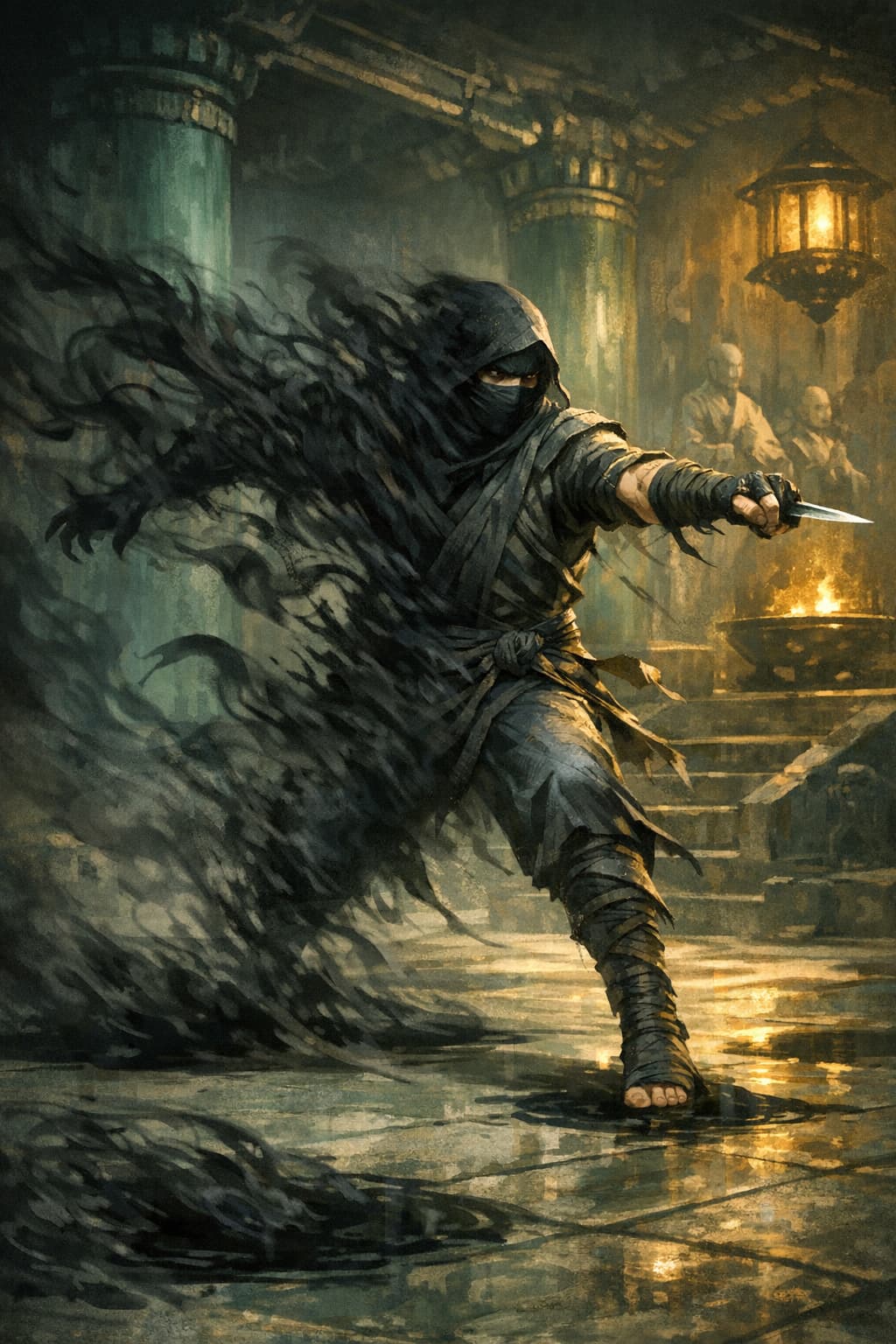
The Shadow monk is a ninja by any other name. You gain the ability to cast darkness, darkvision, pass without trace, and silence using ki points — no spell slots required. At level 6, Shadow Step lets you teleport between dim light and darkness as a bonus action, gaining advantage on your next attack. This transforms the monk from a front-line skirmisher into a stealth operative who appears from nowhere, strikes, and vanishes. Shadow monks excel in campaigns with intrigue, infiltration, and urban adventure where their teleportation and stealth magic create options no other martial class can match.

Way of the Kensei
Published in Xanathar's Guide to Everything, the Kensei bridges the gap between monk and fighter by turning chosen weapons into extensions of the monk's martial arts. You select kensei weapons — potentially including longbows, longswords, or whips — and they gain monk weapon properties. Agile Parry boosts your AC when you make an unarmed strike alongside weapon attacks, and Sharpen the Blade lets you add up to +3 to weapon attack and damage rolls using ki. The Kensei is for players who love the monk's speed and philosophy but want the feel of a master swordfighter rather than a bare-knuckle brawler.
Monastic Traditions
The monk's subclass design has a wider range of quality than most classes. The 2014 Player's Handbook shipped with three Monastic Traditions — Open Hand, Shadow, and Four Elements — and the gap between the best and worst was immediately obvious. Open Hand was elegant and effective. Shadow was flavorful and mechanically distinct. Four Elements was almost universally panned for its punishing ki costs, turning the monk into a bad spellcaster who also couldn't afford to use their core abilities.
Subsequent supplements addressed the problem by adding subclasses that leaned into specific fantasies rather than trying to bolt spellcasting onto a martial frame. Kensei made weapon mastery the focus. Sun Soul gave ranged ki blasts (the Dragon Ball Z monk). Drunken Master turned evasion into an art form. Long Death created a death-obsessed monk who grew harder to kill with every soul they claimed. The variety is impressive, even if not every option is equally balanced.
The 2024 revision trimmed the launch selection to four subclasses — Open Hand, Shadow, the Elements (a significantly reworked Four Elements), and Mercy — each redesigned to be competitive with one another. Way of Mercy, originally from Tasha's Cauldron of Everything, proved so popular that it earned a core slot, giving the monk a healer/necrotic damage hybrid that fills a unique niche no other class can replicate.
Monk Subclasses Across Editions and Supplements
| Subclass | Source | Core Fantasy |
|---|---|---|
| Way of the Open Hand | PHB 2014 / 2024 / BG3 | The consummate martial artist — enhanced Flurry, self-healing, and the lethal Quivering Palm |
| Way of Shadow | PHB 2014 / 2024 / BG3 | Ninja arts — darkness magic, shadow teleportation, stealth mastery |
| Way of the Four Elements | PHB 2014 / BG3 | Elemental bending via ki — fire, water, earth, air techniques (ki-hungry in 2014) |
| Way of the Elements | PHB 2024 | Reworked elemental monk with improved action economy and reduced ki costs |
| Way of Mercy | Tasha's / PHB 2024 | Hands that heal and harm — necrotic touch attacks and ki-powered healing |
| Way of the Kensei | Xanathar's | Weapon master — chosen weapons become monk weapons with unique defensive and offensive ki techniques |
| Way of the Drunken Master | Xanathar's | Unpredictable evasion — free Disengage on Flurry, redirect missed attacks, impossible agility |
| Way of the Sun Soul | Xanathar's | Ranged ki blasts and radiant area attacks — the energy-projectile martial artist |
| Way of the Long Death | Sword Coast AG | Death obsession — gain temp HP from nearby deaths, frighten enemies, cheat death with ki |
| Way of the Astral Self | Tasha's | Manifest spectral arms and visage — Wisdom-based attacks, expanded reach, astral projection |
| Way of the Ascendant Dragon | Fizban's | Draconic ki techniques — breath weapons, elemental damage, frightful presence, spectral dragon wings |
The monk's subclass library is one of the game's broadest. Whether you want to be a ninja, a healer, a bender, or a dragon disciple, there is a monastic tradition for it.
Roleplaying & Personality
The biggest pitfall in roleplaying a monk is making them a stoic automaton. Yes, monastic training implies discipline — but discipline is not the absence of emotion; it's the mastery of it. A monk who has achieved inner peace should be the most emotionally present person at the table, not the least. They've done the work to understand their feelings, which means they can express anger without being consumed by it, feel grief without drowning in it, and experience joy without grasping at it. That's not boring — that's fascinating.
Consider what drove your monk to the monastery in the first place. Were they an orphan raised by the order? A noble's child sent away for education? A former soldier seeking peace after atrocity? A street urchin who discovered discipline could replace the chaos of poverty? The monastery is the monk's backstory crucible — everything they are was forged there, and everything they struggle with was either created or suppressed by that environment.
The monk's relationship with the material world creates rich roleplaying opportunities. Most monastic orders de-emphasize wealth and possessions, which puts the monk in interesting tension with the adventuring life — a life built on accumulating treasure. Does your monk share their gold freely? Send it back to the monastery? Feel guilty about enjoying a fine meal? Or have they moved past asceticism into a philosophy that embraces experience rather than denying it? There's no wrong answer, but there should be an answer.
Physicality is the monk's native language. Where a wizard explains a concept with words and a bard with metaphor, the monk explains it with a demonstration. They stretch when thinking, meditate when stressed, and express admiration for an opponent's skill mid-combat. The monk's body is not just a weapon — it's their primary mode of engaging with the world, and roleplaying that physicality brings the class to life.
In your setting, who teaches monks? Are monasteries common institutions like universities, or are they remote and secretive? Do different orders compete for students, guard techniques jealously, or share knowledge freely? The answers determine whether a monk is a recognizable professional (like a knight) or a mysterious figure whose abilities provoke suspicion. Consider also: can ki be learned by anyone with sufficient discipline, or does it require a specific spiritual gift?
Monasteries and Martial Orders
Monastic orders are among the most versatile organizations in fantasy worldbuilding. They can be contemplative communities focused on enlightenment, militant orders that train warriors for a cause, scholarly institutions preserving forbidden knowledge, or secret societies operating behind the scenes of political power. Each type produces a different kind of monk with different values, skills, and conflicts.
The relationship between monasteries and the broader world varies enormously by setting and campaign. Some orders are deeply integrated into society — running hospitals, teaching children, mediating disputes. Others are deliberately isolated, hidden in mountain peaks or deep forests, interacting with the outside world only when absolutely necessary. And some are actively antagonistic, viewing the secular world as corrupt and positioning themselves as an alternative to it. A monk's attitude toward non-monks often reflects their order's stance.
Inter-order politics can drive entire campaigns. If two monasteries teach contradictory philosophies of ki, do they debate in academic forums or settle it with martial tournaments? If a monk leaves one order for another, is that a spiritual journey or a betrayal? If a monastery is destroyed, do its surviving monks scatter and lose their traditions, or do they carry the teachings forward as a diaspora? These questions create conflict, motivation, and worldbuilding depth that goes far beyond 'punch things good.'
Contemplative Orders
Silent communities in remote locations — mountain peaks, island temples, deep caverns. Emphasis on meditation, self-perfection, and understanding the nature of ki. Members rarely leave, and when they do, it is because the world has intruded upon the monastery's peace. These monks are calm, curious, and often bewildered by the priorities of mundane society. They see combat as a last resort and view their martial abilities as a side effect of spiritual development rather than its purpose.
Militant Traditions
Warrior monasteries that train monks specifically for combat — bodyguards of holy sites, defenders against extraplanar threats, or the martial arm of a religious institution. Members train obsessively, spar constantly, and view fighting as a form of prayer. These monks are disciplined, mission-oriented, and sometimes dangerously single-minded. They leave the monastery not to find themselves but to fulfill a duty, and they measure their worth by the threats they neutralize.
Simple Weapons and the Empty Hand
The monk's relationship with equipment is defined by what they don't need. No armor, no shield, no enchanted greatsword. A monk's most valuable possessions are their training and their body, and the class is mechanically designed to make gear optional rather than essential. That said, monks do benefit from certain items, and the right equipment choices can meaningfully improve their effectiveness.
Monk weapons are a specific category: shortswords and any simple melee weapon without the two-handed or heavy property. In practice, this means quarterstaffs (versatile, can be used two-handed for d8 damage), shortswords (finesse, good for dual-wielding aesthetics), and daggers or spears. The 2024 revision expands monk weapons to include martial weapons with specific properties, opening up options like scimitars and whips. What matters is that the weapon uses your martial arts die when it exceeds the weapon's normal damage die.
Magic items that enhance a monk's natural abilities are highly prized. Bracers of Defense (+2 AC while unarmored), an Insignia of Claws (+1 to unarmed strike attacks and damage), and Boots of Speed (double movement for the already-fastest class) are all exceptional. The Eldritch Claw Tattoo from Tasha's Cauldron is tailor-made for monks, granting +1 to unarmed strikes and a once-per-day 15-foot reach extension with force damage. But perhaps the most thematic monk item is nothing magical at all — a prayer bead necklace, a worn training staff, or a set of bandages wrapped around scarred knuckles.
Iconic Monk Equipment
| Item | Type | Why It Works |
|---|---|---|
| Quarterstaff | Weapon | Versatile d8 damage; the classic monk weapon. Simple, effective, visually iconic |
| Bracers of Defense | Magic item (rare) | +2 AC while unarmored — directly enhances the monk's defense without breaking their aesthetic |
| Eldritch Claw Tattoo | Magic item (uncommon) | +1 unarmed strikes, once/day 15-ft reach with bonus force damage. Built for monks |
| Insignia of Claws | Magic item (uncommon) | +1 to unarmed attacks and damage. Simple, always-on enhancement for fists |
| Boots of Speed | Magic item (rare) | Double movement speed. On a class that already moves 50+ feet per turn, this is absurd |
| Necklace of Prayer Beads | Magic item (rare) | Wisdom-based casting synergizes with monk stats. Healing and support without multiclassing |
| Wrapped hand bindings | Flavor | No mechanical effect, but nothing says "I punch things professionally" more clearly |
Multiclass Synergies
Monk multiclassing is a trap for the unprepared and a treasure for the informed. The class's heavy dependence on multiple ability scores means that adding another class's stat requirements can stretch your character impossibly thin. But when the synergies align — particularly with other Wisdom- or Dexterity-based classes — the results can be spectacular.
The fundamental tension is that monks need monk levels. Your martial arts die, ki pool, Unarmored Movement, and subclass features all scale with monk level. Every level spent in another class is a level those features don't improve. This means monk multiclasses work best as either a deep monk with a shallow dip into something else, or a deep something-else with a shallow dip into monk for martial arts and ki basics.
Armor is the other complication. Wearing armor disables both Unarmored Defense and Unarmored Movement, which means multiclassing into a heavy-armor class wastes two of the monk's core features. Stick to classes that either don't care about armor (like Rogue) or actively benefit from being unarmored (like certain subclasses of other classes). The builds that work tend to double down on the monk's strengths — speed, burst damage, and saves — rather than trying to shore up weaknesses.
Strong Combinations
Monk/Rogue: One of the best martial multiclasses in the game. Monks can use Dexterity for unarmed strikes and shortswords, qualifying for Sneak Attack. A single Rogue level gives expertise in two skills and Sneak Attack 1d6. Deeper dips unlock Cunning Action (redundant with Step of the Wind but free), Evasion (which the monk gets anyway), and subclass features. Shadow Monk/Assassin is a devastating ambush build. Monk/Ranger: Wisdom synergy, fighting style, and Hunter's Mark all complement the monk's multi-attack style. Gloom Stalker's first-turn extra attack stacks with Flurry of Blows for explosive openers. Monk/Fighter: Action Surge for four attacks plus Flurry on one turn. Fighting Style adds consistent damage. Short-rest synergy between ki and Action Surge makes the combo shine in dungeon crawls.
Interesting Dips
Monk/Cleric (1-2 levels): Wisdom synergy is natural. A single level of Cleric gives armor proficiency you won't use but also healing spells, a domain feature, and ritual casting. War Domain adds bonus attacks. Peace or Twilight domains offer powerful support features. Monk/Druid: Stars Druid's Starry Form works while unarmored and gives bonus healing or ranged attacks powered by Wisdom. Spores Druid adds temp HP and necrotic damage to melee. Neither requires armor. Monk 1/Any Caster X: A single monk level on a caster gives Unarmored Defense (useful for Wisdom casters), martial arts for opportunity attacks, and a minor melee option. Niche but fun on a Druid or Cleric who wants to feel less fragile in melee.
Building Your Character
The monk's ability score priorities are clear but demanding: Dexterity first, Wisdom second, Constitution third. Dexterity drives your attacks, damage, AC, initiative, and the game's most common saving throw. Wisdom powers your ki save DC (for Stunning Strike and subclass features), contributes to AC via Unarmored Defense, and fuels Perception and Insight — skills that any frontline character desperately needs. Constitution keeps you alive with a d8 hit die in melee range.
Race selection should prioritize Dexterity and Wisdom bonuses, though the 2024 rules let you place ability score increases wherever you want. Thematically, Wood Elves are a natural fit — Dex and Wis bonuses, extra speed that stacks with Unarmored Movement, and Mask of the Wild for stealth. Humans (Variant) offer a first-level feat, which is huge for a feat-hungry class. Aarakocra bring flight, creating a truly untouchable mobile striker. Tortle monks are a fun inversion — their natural AC of 17 means you can dump Dexterity and focus on Wisdom, creating a grapple-focused Strength monk.
Feat selection depends on what your monk needs. Mobile is exceptional — extra speed and the ability to avoid opportunity attacks from creatures you've attacked means you never get pinned down. Sentinel lets you lock down enemies, turning the monk from a hit-and-run striker into a sticky defender. Lucky patches the monk's one weakness: occasionally failing the saves that keep you in the fight. Alert guarantees you act first, which is where the monk's speed advantage is most impactful. And Crusher (for unarmed strike builds) adds free forced movement on every hit, giving you battlefield control without spending ki.
Dexterity 16, Wisdom 16, Constitution 14. Grab a quarterstaff and 10 darts. Take the Hermit or Acolyte background for Wisdom skills. At level 3, choose Way of the Open Hand if you want reliable damage and control, Way of Shadow if you want stealth and mobility, or Way of Mercy if you want to heal allies and harm undead. Prioritize Dexterity to 20 first, then Wisdom. You're a precision instrument — trust the training.
Famous Monks in Fiction
The monk archetype reaches across every corner of fiction, from ancient Chinese mythology to modern fighting games, because the fantasy of punching a god unconscious with your bare hands is genuinely universal. What makes these characters resonate is not just their martial prowess but the philosophy underneath it — the idea that mastery of the self can produce power that rivals any magic, any weapon, any supernatural gift. The best fictional monks are not just fighters who happen to use fists; they are characters whose fighting style is inseparable from who they are.
Video games have given us some of the most enduring monk characters in popular culture. Tifa Lockhart from Final Fantasy VII is arguably the most iconic martial artist in gaming — a character who fights gods and world-ending threats with nothing but her fists and the people she loves. Liu Kang from Mortal Kombat distilled the Shaolin monk fantasy into a competitive fighting game icon, complete with dragon-fire kicks and a tournament arc that has persisted across three decades of sequels. In the tabletop space, Beauregard Lionett from Critical Role brought the monk to life as a brawling investigator whose Cobalt Soul training was as much about extracting information as it was about throwing punches.
The deepest roots of the fictional monk trace back to Sun Wukong — the Monkey King from Journey to the West — who is literally the original "monk who punches gods." His influence echoes through every martial arts character who channels spiritual energy into impossible physical feats. Aang from Avatar: The Last Airbender reimagined the monk as a pacifist whose spiritual training grants control over the elements, proving that the archetype can anchor a story about restraint and responsibility as compellingly as one about violence. Ip Man, the Wing Chun grandmaster immortalized in Donnie Yen's film series, bridges the gap between real-world martial arts history and fantasy, reminding us that the monk class draws from traditions that are very much alive.
Iconic Monks Across Fiction
| Character | Source | Why They Matter |
|---|---|---|
| Tifa Lockhart | Final Fantasy VII | The martial artist who fights gods with her fists — iconic across three decades of gaming and proof that monks can anchor a story's emotional core |
| Sun Wukong (Monkey) | Journey to the West | The original monk who punches gods, literally. His journey from trickster to enlightened warrior established the template for every ki-powered martial artist |
| Aang | Avatar: The Last Airbender | Reimagined the monk as a pacifist whose spiritual discipline grants supernatural power — proving the archetype works for stories about restraint, not just violence |
| Liu Kang | Mortal Kombat | The Shaolin tournament fighter who distilled the monk fantasy into competitive gaming — dragon-fire kicks, flawless discipline, and an eternal champion arc |
| Beauregard Lionett | Critical Role | Marisha Ray's Cobalt Soul monk showed that the class could be a brawling investigator — extracting information with fists as effectively as with questions |
| Ip Man | Ip Man film series | Wing Chun grandmaster who bridges real-world martial arts history and fantasy, reminding us that the monk class draws from living traditions |
| Chen Stormstout | World of Warcraft: Mists of Pandaria | The wandering brewmaster who introduced an entire MMO playerbase to the monk class — jovial, philosophical, and devastatingly effective |
Across RPGs & Video Games
The monk appears in nearly every RPG system, but the way each game interprets the archetype reveals fascinating differences in design philosophy. D&D 5e builds the monk around ki points and Stunning Strike — a resource-management puzzle where every point spent is a tactical commitment. Pathfinder 2e replaces ki with stances (Crane, Dragon, Tiger, and more), turning the monk into a style-switcher whose power comes from choosing the right form for the right moment. World of Warcraft splits the archetype into three specializations that each explore a different reading of "martial artist," from damage dealer to tank to healer.
What separates monk implementations across systems is how they handle the tension between spiritual power and physical combat. D&D treats ki as a pool you spend and recover — a finite resource that gates your best abilities. Diablo III's monk uses Spirit, a rapidly regenerating resource that encourages constant ability use rather than conservation, creating a rhythm-game feel where you chain abilities in fluid combos. Fighting games like Street Fighter take the most literal approach: the monk archetype (Ryu, Akuma, Chun-Li) is defined entirely by execution — precise inputs, combo timing, and the player's own mastery of the character's moveset. In a way, fighting games are the purest expression of the monk fantasy because the player's skill literally becomes the character's power.
The monk also has a unique cross-genre presence that other D&D classes lack. While the fighter and wizard map cleanly onto their genre equivalents, the monk straddles martial arts media, spiritual fiction, and superhero narratives. Final Fantasy's monks — Sabin suplexing a train in FF6, Tifa's Limit Breaks in FF7, Yang's disciplined strength in FF4 — emphasize raw physical power. Pathfinder 2e's stance system emphasizes adaptability and style. And WoW's Mistweaver spec proves that the monk archetype can extend beyond combat into healing, using the same internal energy that powers a punch to mend a wound.
The Monk Archetype Across Game Systems
| Franchise | Class / Role | Key Mechanic | Key Distinction |
|---|---|---|---|
| D&D 5e | Monk | Ki points, Martial Arts die, Stunning Strike, Unarmored Movement | Resource-management puzzle; ki scarcity forces meaningful choices every turn |
| Pathfinder 2e | Monk | Stances (Crane, Dragon, Tiger, etc.), Flurry of Blows built in | Style-switching replaces ki; considered one of the strongest martial classes in the system |
| World of Warcraft | Monk | Windwalker (DPS), Brewmaster (tank), Mistweaver (healer); Chi resource | Three specs prove the monk archetype can tank and heal, not just deal damage |
| Diablo III | Monk | Spirit resource, Mantras (group buffs), combination strikes | Rapid resource regeneration creates a fluid combo rhythm rather than careful conservation |
| Final Fantasy | Monk | Fist weapons, high HP, Blitz / Limit Breaks | Sabin (FF6), Tifa (FF7), Yang (FF4) — raw physical power expressed through spectacular techniques |
| Street Fighter / Fighting Games | Martial artist archetype | Precise inputs, combo execution, hadouken / shoryuken | The purest monk fantasy — the player's own skill literally becomes the character's power |
Every system that includes a monk is making a statement about whether martial arts power comes from spiritual cultivation, physical training, or both. The answer shapes the entire class.
The Monk at the Table
The monk's defining tactical asset is mobility, and the players who get the most out of the class are the ones who treat that speed as a strategic tool rather than just a bigger number on a grid. A monk with 50 feet of movement and Step of the Wind can reach any point on most battle maps in a single turn. That means the monk can bypass the front line to reach enemy spellcasters, sprint to a downed ally with a healing kit, or kite a dangerous melee threat away from the party's squishier members. The question is never "can the monk get there?" — it's "should the monk go there, and can they survive what happens next?"
The speed differential between monks and the rest of the party creates a unique tactical dynamic that both players and DMs need to manage. A monk who sprints ahead becomes isolated, and isolation kills characters with d8 hit dice and no armor. The best monk players learn to use their speed in bursts — close distance, strike, use the rest of their movement to retreat to a position where allies can support them. Stunning Strike is the linchpin: landing a stun on a key target lets the monk survive being in a dangerous position by ensuring the most dangerous enemy near them simply cannot act. When it works, the monk looks like the most brilliant tactician at the table. When it doesn't, they look like they sprinted into a meat grinder.
For Dungeon Masters, the monk player is asking you for one thing above all else: encounters with space. A single room with a cluster of enemies is fine for the fighter, but the monk needs multiple areas to move through, elevation to exploit, and objectives that reward being somewhere the rest of the party can't easily reach. Split the encounter across two rooms connected by a hallway. Put the enemy archer on a rooftop. Place the hostage behind a locked door that the monk can reach with wall-running while the rest of the party holds the main threat. When you design encounters that reward mobility and positioning, the monk player will thank you — and they'll make the fight more interesting for everyone else at the table.
Build encounters that reward the monk's mobility: use multi-room layouts where the monk can split off to handle a secondary threat, elevated positions that only the monk can reach without climbing checks, and enemies spread across the battlefield rather than clustered in a single group. Place high-priority targets (spellcasters, archers, fleeing messengers) at the edges of the map where the monk's speed creates a genuine advantage. Avoid open, flat arenas with a single enemy group — these neutralize the monk's greatest strength and reduce the class to a worse fighter with fewer hit points.
The Class in World-Building
Building monks into your world means deciding what ki actually is. Is it a natural energy that flows through all living things, like the Force in Star Wars? Is it a divine gift channeled through disciplined practice? Is it a pseudo-scientific phenomenon — bioelectric energy that the body can learn to focus and project? The answer shapes everything: how common monks are, how the world perceives them, whether their abilities can be studied or only transmitted through tradition.
Monasteries need a reason to exist in your setting, and that reason creates story hooks. A monastery built to guard a sealed evil justifies why its monks are trained to fight — and what happens when the seal weakens. A monastery founded by a legendary martial artist preserves specific techniques and might send students into the world to test them. A monastery that functions as a university offers education to anyone who can pass the entrance trials and produces monks who see their abilities as practical skills rather than spiritual gifts.
The cultural context of monk characters shapes how NPCs react to them. In a setting based on East Asian cultures, monks may be respected figures — teachers, healers, protectors. In a Western medieval setting, a person who can punch through walls and run up vertical surfaces is going to provoke fear, awe, or suspicion depending on how well the culture understands ki. Consider whether your setting has a vocabulary for what monks do or whether they're considered sorcerers, saints, or simply impossible.
The most compelling worldbuilding choice is making monastic traditions matter beyond mechanics. If the Way of the Open Hand and the Way of Shadow are not just subclass options but actual philosophical schools with centuries of history, rivalry, and internal debate, then a monk's choice of tradition becomes a statement about who they are and what they believe. The Open Hand monk who encounters a Shadow monk isn't just meeting someone with different abilities — they're meeting someone who answered the fundamental questions of their shared art differently, and that difference creates tension, respect, or conflict without any outside antagonist required.
“A monk does not learn to fight. A monk learns to listen — to the rhythm of their own heartbeat, to the flow of energy in every living thing, to the silence between breaths where the universe whispers its secrets. The fighting is what happens when someone interrupts the listening.”
— Grandmaster Saiyo, Order of the Still Water
FAQ
Common Questions
A monk is a martial class built around unarmed combat, supernatural speed, and an internal energy resource called ki (or Focus Points in the 2024 rules). Monks fight without armor or weapons, using disciplined training to turn their bodies into lethal instruments. They can stun enemies, deflect projectiles, run on walls, and eventually resist nearly all forms of harm. The class draws from East Asian martial arts traditions, wuxia fiction, and kung fu cinema.
Ki is a point-based resource equal to your monk level that refreshes on a short or long rest. You spend ki to power abilities like Flurry of Blows (1 ki for two bonus unarmed strikes), Patient Defense (1 ki to Dodge as a bonus action), Step of the Wind (1 ki to Disengage or Dash as a bonus action), and Stunning Strike (1 ki to attempt to stun a target you hit). In the 2024 revision, ki is renamed to Focus Points but functions similarly, with some abilities gaining improved scaling.
Way of the Open Hand is widely regarded as the strongest 2014 subclass, with enhanced Flurry of Blows, self-healing, and the devastating Quivering Palm capstone. Way of Mercy (from Tasha's Cauldron) is excellent for its combination of healing and necrotic damage. Way of Shadow is outstanding in campaigns with stealth and infiltration. In the 2024 revision, all four core subclasses (Open Hand, Shadow, Elements, Mercy) are competitive. In Baldur's Gate 3, Open Hand dominates due to Stunning Strike synergy.
Stunning Strike is the monk's most debated feature. In the 2014 rules, spending 1 ki to potentially stun a target (forcing a Constitution save) is extremely powerful when it works — a stunned creature loses its turn, and all attacks against it have advantage. The problem is that many high-CR monsters have strong Constitution saves, making it unreliable at high levels. Monks often burn through their entire ki pool fishing for stuns. The 2024 revision reworks Stunning Strike to only trigger on Flurry of Blows hits and changes it to a Constitution save against your ki save DC, maintaining its power but limiting how often you can attempt it per turn.
The 2014 monk has three common criticisms: multiple ability score dependency (needing high Dex, Wis, and Con), ki starvation at low levels (too many abilities competing for too few points), and lower damage output compared to other martial classes at higher levels. The d8 hit die combined with no armor also makes monks fragile in sustained melee. However, monks bring unique utility — unmatched mobility, Stunning Strike, Evasion, and Diamond Soul — that raw damage comparisons miss. The 2024 revision addresses most of these complaints with improved martial arts die scaling, Uncanny Metabolism for resource recovery, and expanded Deflect Attacks.
Any race with Dexterity and Wisdom bonuses is mechanically ideal. Wood Elves are a classic choice with Dex/Wis bonuses and extra speed. Variant Humans offer a crucial first-level feat. Aarakocra bring flight for a devastating mobile striker. Kenku have Dex and Wis. Under the 2024 flexible ability score rules, race choice becomes more about flavor — Tabaxi monks gain double-speed sprints, Goblin monks can Disengage for free (freeing up ki), and Tortle monks with 17 natural AC can dump Dex and build an unusual Strength-based grappler.
Monks excel as mobile strikers and disruptors. Their unmatched speed lets them bypass front lines to target enemy spellcasters and archers. Stunning Strike can neutralize a boss for a critical round. Patient Defense makes them emergency tanks. They struggle with sustained high damage, area-of-effect, and raw hit points compared to fighters and barbarians. The ideal party pairs a monk with a tanky front-liner (to absorb aggro), a healer (to compensate for the d8 hit die), and a controller (to set up advantageous positioning the monk can exploit).
Monks can absolutely use weapons. Monk weapons include shortswords and any simple melee weapon that isn't two-handed or heavy — quarterstaffs, daggers, handaxes, javelins, and spears all qualify. When you use a monk weapon, you can use Dexterity for attack and damage rolls and substitute your martial arts die if it exceeds the weapon's normal damage die. The 2024 revision expands this to include martial weapons with specific properties. Subclasses like the Kensei further expand weapon options to include longswords, longbows, and other martial weapons.