

Fantasy is the oldest genre and the most abused. Every culture has its myths, its monsters, its heroes journeying into darkness. That deep resonance is why fantasy works so well at the table. It's also why so much fantasy world-building falls flat.
The problem isn't a lack of imagination. It's too much of the wrong kind. GMs pile on elves and dragons and ancient prophecies without asking what any of it means for the people living there. They draw elaborate maps of kingdoms that function like medieval Europe with the serial numbers filed off. They build magic systems that exist to give players cool powers rather than to shape how their world actually works.
You can do better. Fantasy world-building succeeds when every element serves double duty: it creates wonder and it creates consequences. Your magic system should generate adventure hooks. Your political factions should force hard choices. Your monsters should tell us something about the world that birthed them.
This guide will challenge some assumptions you might have about fantasy world-building. Some of it will feel like permission to ignore "best practices" that never worked in the first place.
The Tolkien Problem
Everyone copies Tolkien. Almost no one copies the right things.
What people take: elves in forests, dwarves in mountains, a dark lord in a dark tower, hobbits (or halflings, for legal reasons) in pastoral shires, rangers brooding handsomely, wizards being cryptic.
What Tolkien actually did: spent decades building languages and letting cultures grow from how those languages worked, grounded his history in millennia of detailed events that shaped present-day politics, made his magic mysterious and costly and rare, understood that the "great deeds" his heroes performed were actually small acts of mercy and endurance rather than displays of power.
The Tolkien most people imitate is the Peter Jackson films. Those films are excellent, but they're an action-adventure interpretation of a melancholy book about loss, memory, and the courage of ordinary people against forces beyond their comprehension.
When you fill your world with Tolkien's furniture without his depth, you get settings where elves exist because elves are supposed to exist. Where the Dark Lord wants to conquer everything because that's what Dark Lords do. Where ancient ruins dot the landscape but nobody thinks about who built them or why they fell.
The fix isn't avoiding Tolkien's influence. It's asking harder questions. Why do the elves live in that forest? What happened to make them withdraw from human affairs? If your dark lord wants power, what specifically does he want to do with it? If there are ancient ruins everywhere, what catastrophe left them, and why hasn't anyone rebuilt?
You don't need Tolkien's decades of linguistic development. You need his commitment to asking "why" until the answers reveal something true about your world.
Magic Systems: Rules vs. Wonder
Brandon Sanderson popularized the distinction between hard and soft magic systems. Hard magic has clear rules the reader understands; soft magic remains mysterious. Both approaches work. The problems start when you don't know which one you're using.
Hard magic systems create puzzle-box narratives. If your players know that allomancers burn metals for specific powers, they can strategize around those rules. They can spot when an enemy is burning pewter and plan accordingly. The magic becomes a tactical element, almost like technology with different physics.
Soft magic systems create atmosphere and wonder. When Gandalf does something magical, you don't know exactly what he can and can't do. That uncertainty makes him feel powerful and mysterious. It also means Tolkien can't have Gandalf solve problems with magic without it feeling like a cheat. So Gandalf mostly doesn't. He offers wisdom, fights when cornered, and occasionally does something unexplained and wondrous.
The trap most GMs fall into: treating magic as soft when it's narratively convenient (the villain's sorcery is incomprehensibly powerful) and hard when players want to use it (actually, your spell can't do that because of rule 47b). This feels arbitrary and frustrating.
Pick your approach and commit. If you want hard magic, define the rules and let players exploit them creatively. If you want soft magic, keep it rare and costly and never let it be the easy solution to problems. You can have both in the same world. Divine magic might be mysterious while arcane magic follows strict rules. But be consistent within each type.
The "magic solves everything" trap deserves special attention. If healing magic exists and is accessible, why does anyone stay injured? If divination works, why do mysteries exist? If teleportation is possible, why do armies march? These questions aren't nitpicking. They're opportunities. Your answers will make your world feel real.
Gods and Cosmology
Fantasy gods tend to fall into two failure modes: they're either completely absent (mentioned in prayers but never relevant) or they're superheroes in the sky (showing up constantly, directly intervening, making mortal agency feel pointless).
Active gods raise stakes but lower agency. If the God of Justice will smite evildoers, why do the characters need to do anything? If gods regularly intervene, the world becomes a chessboard where mortals are pawns in divine games. Some players find this epic. Others find it disempowering.
Distant gods preserve mortal agency but can feel irrelevant. If the gods never do anything observable, why do people worship them? This is actually closer to how real-world religion often works, but it can make your clerics feel like they're LARPing while the wizard does real magic.
The sweet spot: gods whose influence is real but indirect. They answer prayers through circumstances rather than miracles. They empower champions but don't control them. They have their own conflicts that spill over into mortal affairs in ways mortals might not recognize. Divine magic works, but the gods' ultimate purposes remain mysterious.
Pantheons often feel like checklists because GMs design them that way. God of war, god of love, god of death, god of commerce. Check, check, check, check. The gods have domains but no personalities, histories, or relationships that matter.
Better pantheons have gods with conflicting agendas that create campaign material. The god of civilization and the god of wilderness aren't just different portfolios; they're locked in an eternal cold war that shapes how their followers interact. The god of the sun and the god of secrets despise each other, and that enmity filters down to their churches, creating faction conflict your players can navigate.
Cosmology should drive plot, not just exist as background lore. If there are outer planes, who wants to open gates to them and why? If souls go somewhere after death, that raises questions about necromancy, undead, and what it means to bring someone back. If primordial chaos exists beyond the ordered world, something is probably trying to let it in.
Societies That Don't Feel Medieval
The "vaguely European medieval" setting is fantasy's default because Tolkien wrote in that mode and everyone followed. But Tolkien was a medievalist who understood that period deeply. Most imitators recreate a Renaissance Faire version: kings in castles, knights on horses, peasants in hovels, with indoor plumbing and modern social attitudes awkwardly grafted on.
You have options. Your fantasy world can draw from any historical period or culture. It can be entirely invented. The key is internal consistency and thinking through implications.
If you're going medieval European, commit to what that means. The church (or your equivalent) holds enormous power. Nobility isn't just about wealth; it's about legal rights peasants don't have. Travel is dangerous and slow. Information moves at the speed of a horse. Most people never travel more than a few miles from where they were born. These constraints shape what kinds of stories are possible.
Non-feudal power structures open different possibilities. A city-state ruled by merchant princes creates different conflicts than a hereditary monarchy. A theocracy where priests interpret divine will has different politics than a realm where the strongest warrior rules. An empire held together by magical communication networks works differently than one relying on roads and riders.
Monocultures are lazy worldbuilding. You know the template: the elf kingdom where all elves act elfy, the dwarf hold where all dwarves are gruff and mine, the human kingdoms that are all basically the same except one is "the evil one." Real cultures have internal diversity, regional variation, class differences, generational conflicts. Your fantasy cultures should too.
A useful exercise: for any culture in your world, identify at least three internal factions that disagree about something important. Conservative elves vs. reformers. Mountain dwarves who want isolation vs. traders who want engagement with the surface. This immediately makes every culture more interesting and gives players choices to make within societies, not just between them.
Monsters Beyond the Stat Block
Here's an uncomfortable truth: most dragons in fantasy games aren't scary. They're challenging encounters. They have high hit points and dangerous breath weapons and valuable hoards. Players approach them as obstacles to overcome, loot to acquire.
Real dragons should be terrifying. Not because of their stat block, but because of what they represent. A creature that has lived for millennia, that watched your kingdom rise from nothing, that considers your king's grandfather a recent memory. A predator so far above you on the food chain that fighting it is like a mouse attacking an eagle.
The fix isn't making dragons mechanically harder. It's making them matter. A dragon that has goals, history, and a personality is scarier than one that's just guarding treasure. What does it want? What agreements has it made with local powers? What happens to the region's politics if it dies? What happens if it gets angry?
This applies to all monsters. The shambling undead horde is a combat encounter. The fact that those undead are the soldiers who died defending this pass three hundred years ago, still fighting a war that ended, still following orders from a commander who became a lich rather than accept defeat? That's a story.
Monsters as worldbuilding means asking where they come from and what ecological or magical niche they fill. If owlbears exist, something created them or they evolved. Either answer tells you something about your world. If trolls regenerate, that has implications for troll society and how other cultures deal with them. If demons can be summoned, someone is summoning them, and someone else is trying to stop them.
The ecology question gets mocked, but it matters. Not because you need to explain what dragons eat (magic, presumably), but because thinking through implications makes your world feel real. A world where monsters exist should be shaped by their existence. People build differently if trolls raid. Trade routes shift if a dragon claims a mountain pass. Religions form around the threat of demons.
The Map Problem
Your map probably doesn't make sense, and that's fine, but you should know why.
Common mistakes: rivers that split (rivers join, they don't split except in deltas), mountain ranges that form perfect borders (mountains are wide and messy, not neat lines), forests that exist in the middle of deserts (forests need water), cities in locations that make no sense strategically or economically.
Real geography shapes history. Civilizations form around rivers because water enables agriculture and transportation. Mountain passes become strategic chokepoints and sites of fortresses. Coastal cities become trading powers. Swamps and deserts become barriers that keep cultures separate long enough to develop differently.
When your map follows geographic logic, history writes itself. Why is there a fortress here? Because it guards the only pass through those mountains. Why are these two kingdoms rivals? Because they both want control of that river's mouth. Why did this empire fall? Because a drought made their heartland uninhabitable.
This doesn't mean you need a geology degree. It means spending ten minutes thinking about water sources, defensible positions, and trade routes. It means asking why a city is where it is and having an answer.
When not to map: detailed maps can become prisons. Once you've drawn the map, changing it feels like cheating. If you're running a sandbox where exploration matters, sure, map it out. If you're running a narrative campaign where the specifics of geography don't matter much, consider keeping things loose. "The capital is a few weeks' travel from the frontier" gives you flexibility that "the capital is exactly 340 miles northeast" doesn't.
Maps can also mislead players into thinking geography matters when it doesn't for your campaign. If you're running political intrigue in a single city, an elaborate continent map suggests a scope you're not delivering.
Dark Lords and Better Villains
Sauron works in The Lord of the Rings because Sauron isn't really the antagonist. The Ring is. Sauron is a looming threat that provides urgency, but the actual conflict is internal: can Frodo resist the Ring's corruption? Will the fellowship hold together? The dark lord template fails when you make him the actual antagonist because there's nothing interesting about a being of pure evil who wants to conquer everything for unspecified evil reasons.
Your villains need actual goals beyond "power" or "destruction." What does your dark lord want to do with the world once he conquers it? If the answer is "rule it," that's not a goal, that's a state. What does ruling it let him do? What problem is he trying to solve through tyranny?
Better villain archetypes for fantasy:
The revolutionary who's right about the problems but wrong about the solutions. The current order is unjust. His rebellion would replace it with something worse. Players must navigate between a flawed status quo and a destructive alternative.
The immortal who's lost perspective. After a thousand years, she's stopped seeing individual mortals as people. Her plans would benefit humanity in aggregate while destroying countless individuals. She's not evil; she's operating on a timescale that makes mortal concerns seem petty.
The builder who doesn't care about costs. He's going to create something magnificent: a perfect city, an empire of peace, an end to all suffering. The sacrifices required are unfortunate but necessary. Every atrocity serves a genuine vision.
The mirror. She wants exactly what the players want, but got there first and won't share. If the players are seeking an artifact, she's seeking the same artifact for the same reasons. The conflict isn't good vs. evil; it's competing goods.
Any of these can be defeated or negotiated with or even convinced they're wrong. That's what makes them interesting. Sauron can only be destroyed. That's fine for Tolkien's purposes, but it limits your storytelling options.
Making It Playable
All this worldbuilding means nothing if it doesn't translate to good sessions. Here's how to make your fantasy world work at the table.
Campaign frameworks that work:
The quest structure remains effective because it provides clear goals while allowing flexibility in how players achieve them. The key is making the quest matter to the world, not just the players. "Retrieve the artifact" is weak. "Retrieve the artifact before the duke's wizard does, because whoever holds it controls succession to the throne" connects player action to world consequence.
The sandbox gives players agency to choose their adventures, but requires preparation. You need enough developed locations, factions, and hooks that players always have interesting options. The Locations framework can help you build modular content that works regardless of where players go.
The political campaign makes factions the content. Players navigate relationships, build alliances, undermine enemies. This requires well-developed factions with clear goals, resources, and conflicts. It works best with players who enjoy social interaction over combat.
The exploration campaign focuses on discovering the unknown: unmapped regions, ancient ruins, new cultures. This requires a world with genuine mysteries that reward investigation. It works well with the sense of wonder fantasy offers.
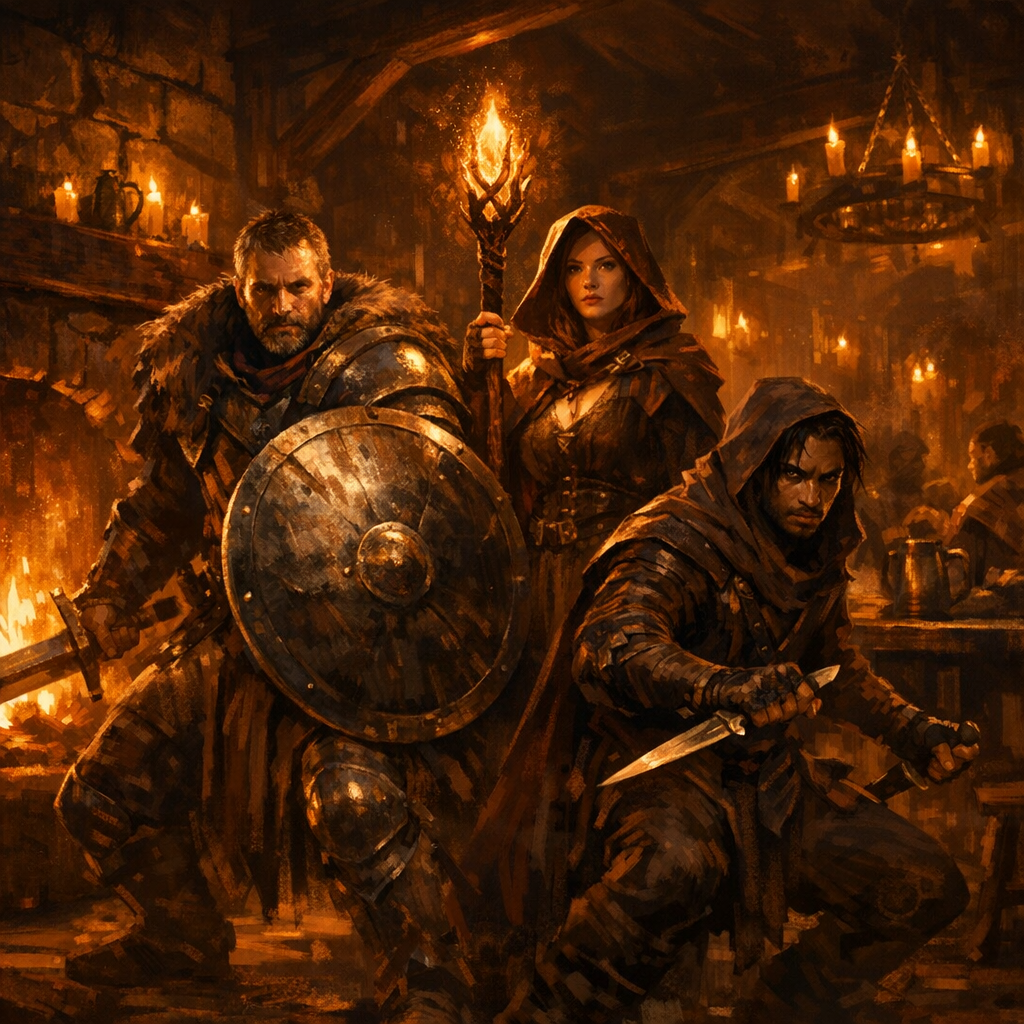
The tavern start isn't inherently bad. It's just overused. If you're starting in a tavern, make the tavern interesting. Who owns it? What factions drink here? What rumors circulate? A tavern in a world you've built well becomes a window into that world, not just a spawn point.
The quest board works because it gives players agency while keeping prep manageable. But quest boards should reflect your world. A guild that posts bounties has its own agenda. The jobs available tell players what's happening in the region. "Kill the goblins" is lazy. "The Merchant Guild offers 50 gold for clearing the old mine, but they won't say what they want the mine for" creates hooks.
When you need inspiration for how NPCs and factions connect to your players, explore Characters for approaches that make supporting cast feel like part of a living world. For species design that goes beyond stat blocks, see our guides on Elves, Dwarves, and Aarakocra, or browse the full Species hub. And if you want to make magic items feel significant rather than just useful, check Magic Items for ways to give loot narrative weight.
For fantasy that overlaps with other genres, consider how Horror elements can deepen your dark fantasy campaigns. And if your magic system leans toward rigorous rules and world-changing technology, Sci-Fi offers useful parallels for thinking through implications.
The goal isn't to implement every idea here. It's to make choices that serve your table. Some groups want deep political intrigue. Others want to kick down dungeon doors. Both are valid. The world-building that matters is the world-building that makes your specific campaign work.