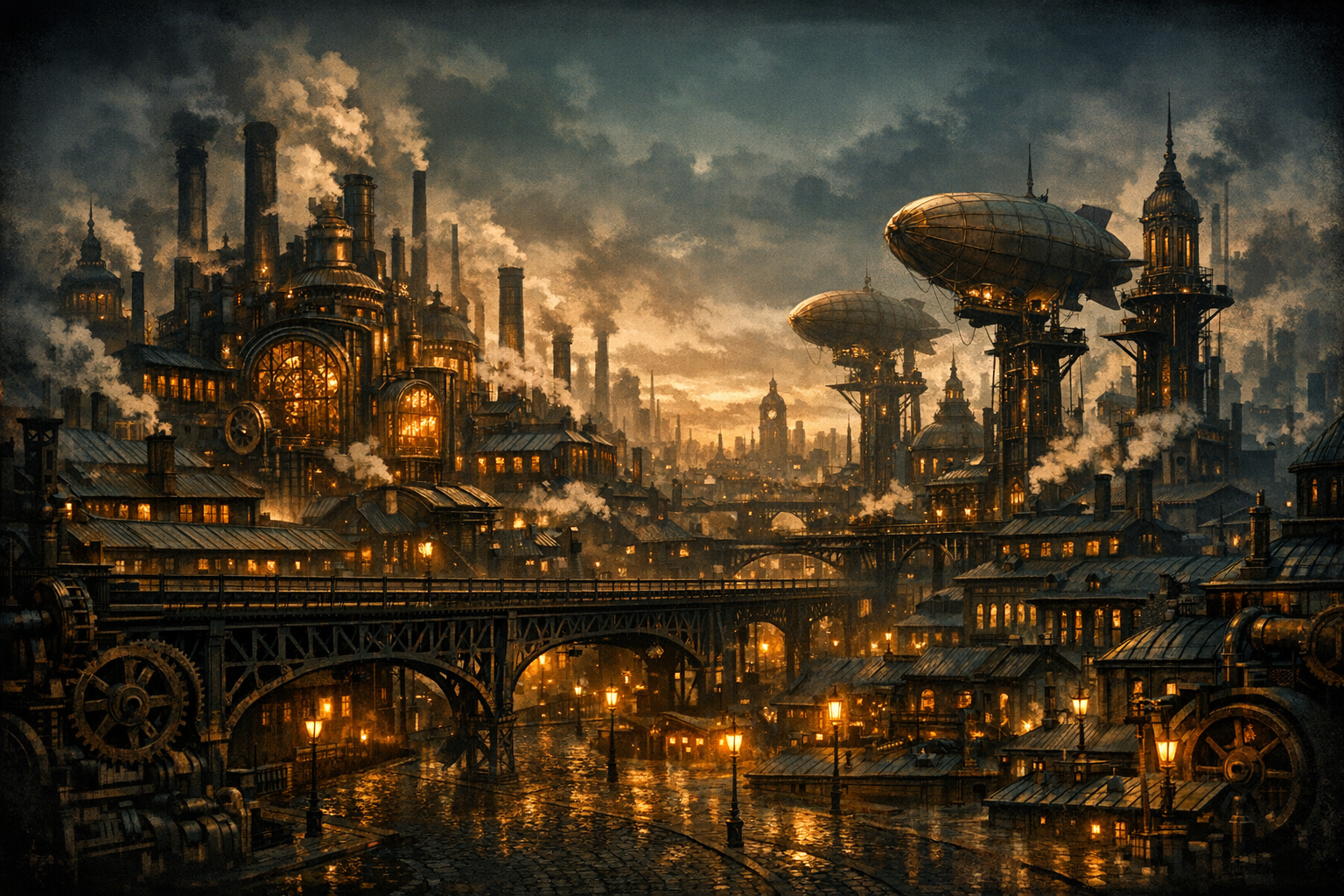


Steampunk gets a bad reputation because so much of it is just aesthetics. Glue some gears on it and call it steampunk. But beneath the goggles and brass, there's a genre with something to say.
Real steampunk asks: what if the Victorian era's technological optimism had been justified? What if steam power and clockwork could have built the future the Victorians imagined? And more importantly, who would that future serve?
The answers to those questions determine whether your steampunk campaign has substance or whether it's just a costume party. Because the Victorian era wasn't a neutral time. It was an age of empire, exploitation, and rigid class hierarchy. When you build a world using that era as your foundation, you inherit all of it. What you do with that inheritance is what makes your steampunk mean something.
This guide is for GMs who want their steampunk to be more than pretty machines. We'll cover the technology, the society, the conflicts, and how to bring it all together at the table. Along the way, we'll challenge some assumptions about what the genre can be.
The Victorian Foundation
You're not obligated to use Earth's history. Plenty of steampunk settings create secondary worlds with Victorian aesthetics but no actual Victoria. But if you do use the historical period, knowing what you're working with helps.
The Victorian era (roughly 1837-1901) was a time of rapid change. Industrialization transformed how people lived and worked. The British Empire reached its greatest extent. Scientific discoveries challenged religious certainty. Cities exploded in population, creating both opportunity and squalor. Class distinctions were legally and socially enforced. Women had limited legal rights. Children worked in factories.
When you choose this era, you inherit its tensions. The optimism of technological progress alongside the misery of those crushed by industry. The refinement of the upper classes alongside the brutal conditions of the lower. The confidence of empire alongside the violence required to maintain it.
Some GMs want to soften these edges, creating a Victorian era that's all afternoon tea and gentleman adventurers. That's valid, but understand what you're removing. The tensions of the real period provide drama. A steampunk world without class conflict is missing one of its most powerful story engines.
The alternate timeline question: if you're running alternate history, when does your timeline diverge? A common approach: someone invented something that actually works. Babbage's analytical engine functions and can be manufactured. A new power source makes steam infinitely more efficient. Clockwork can be made small and precise enough to do what electronics do for us. Identify your divergence point and think through its implications.
What changes aren't just technological. If difference engines exist, the information age starts a century early. If airships are practical, geography matters differently. If clockwork prosthetics work, attitudes toward disability shift. The best steampunk settings follow implications beyond the obvious.
The Punk Part Most People Forget
The word is steam-punk, not steam-aesthetic. The punk matters, and most steampunk media ignores it.
Punk means resistance to power. Punk means anger at systems that exploit and oppress. Punk means people at the margins fighting for space and dignity. When you add punk to steam, you're not just describing a fashion sense. You're making a political claim about where your sympathies lie.
In a steampunk setting, who builds the machines? Workers in dangerous factories. Who mines the coal that powers them? Children, often. Who benefits from the technology? Largely the wealthy. Who is displaced when a new invention makes their skills obsolete? The poor.
Steampunk vs. steam-aesthetic: steam-aesthetic is the airship adventure where dashing heroes save the empire. The conflict is external. Pirates or rebels or foreign powers threaten the established order, and the protagonists defend it. This can be fun, but it's not punk.
Steampunk puts protagonists in conflict with the established order. Your characters are the workers organizing against the factory owners. The inventors whose creations are stolen by powerful interests. The colonized peoples fighting against empire. The women and minorities who refuse to accept the limitations society places on them.
Class warfare in brass and copper: the Victorian era had a robust tradition of labor organizing, socialist thought, and resistance to industrial capitalism. Your steampunk campaign can include Luddites smashing machines that took their jobs, unions striking for safer conditions, anarchists plotting against the aristocracy, and reformers pushing for change within the system.
Who the protagonists oppose matters. If your players are agents of the crown protecting the empire, that's one kind of game. If they're revolutionaries trying to bring it down, that's another. Neither is wrong, but know which one you're running.
Technology That Makes Sense
Steampunk technology doesn't have to follow real physics, but it should follow consistent rules within your setting. Otherwise, you get arbitrary capabilities that undermine stakes.
The "one impossible thing" approach: identify one technological breakthrough that makes your setting work, and derive everything else from that. Maybe it's a super-efficient steam engine. Maybe it's clockwork that can be made microscopic. Maybe it's a new element with useful properties. Whatever it is, it should be specific enough to have limits.
Having limits is crucial. If steam technology can do anything, nothing has stakes. Establish what your technology can't do. Miniaturization might be impossible. Energy storage might be a problem. Certain materials might be required and rare. These constraints create adventure opportunities.
Steam logic: real steam power has limitations. Boilers take time to heat up. Steam engines are heavy relative to their output. Coal is bulky and dirty. You don't have to replicate these limitations exactly, but your technology should have some equivalent constraints. Maybe analytical engines need time to calculate. Maybe clockwork requires winding. Maybe everything needs maintenance that can fail at dramatic moments.
Why consistency matters: when players understand how the technology works, they can make meaningful decisions about using it. They can plan heists around the limitations of security automatons. They can exploit the weaknesses of enemy machines. Arbitrary technology removes agency.
That doesn't mean you need an engineering degree. Broad strokes are fine. "Clockwork soldiers are strong but slow" is enough. "Airships can't fly in storms" is enough. Players need just enough understanding to make decisions, not complete technical specifications.
Airships: The Genre's Crutch
Everyone loves airships. They're visually striking, they enable travel, they provide mobile adventure platforms. Steampunk leans on them constantly.
Here's why they work: airships create freedom of movement without the problems of ships or trains. Ships need water. Trains need tracks. Airships go anywhere. They also create a vertical element that ground-based travel lacks. You can be above the clouds, looking down at the world, fundamentally separated from it.
Airships as social spaces: a ship has a captain, a crew, passengers with different purposes. It's a closed environment where characters are stuck together for the duration of the voyage. That's useful for drama. Conflicts can't be walked away from. Everyone's business becomes everyone else's.
When airships don't work: when they become a magic solution to all travel problems. When every adventure requires one. When the setting is really about airship crews and nothing else. Airships should open possibilities, not dominate the campaign.
Alternatives to consider: trains have their own aesthetic appeal and create linear journeys with stops. Difference engine networks might allow communication and even teleportation. Clockwork carriages could enable personal transport. Underground tunnels might connect cities. Not every steampunk setting needs airships at all.
If you do use airships, make them costly. Fuel isn't free. Docking fees in major cities might be prohibitive. Pirates might be a real threat. Weather might ground you for days. The airship should be an advantage but also a responsibility that creates its own problems.
Empire and Its Discontents
The Victorian era was the height of European colonialism. The British Empire covered a quarter of the globe. Other European powers competed for whatever was left. This history is inseparable from the period, and ignoring it is a choice with implications.
The colonial elephant in the room: much of Victorian wealth came from empire. The tea, the cotton, the rubber, the spices. The cheap labor. The markets forced open by gunboat diplomacy. A steampunk setting that includes wealthy Victorian societies without addressing where that wealth came from is erasing something significant.
Options for engagement: you can critique empire directly, making its injustices visible and giving colonized peoples agency and perspective. You can create alternate history where empire never happened or happened differently. You can set your campaign in a colonized nation, centering resistance rather than imperial adventure. You can focus on settings where colonialism isn't directly relevant.
What you shouldn't do: use exotic locations as backdrop for white heroes' adventures without engaging with the colonial context. Have colonized peoples exist only as obstacles, servants, or mystical aids. Pretend the wealth and power of your Victorian-coded society came from nowhere.
Writing against empire: some of the most interesting steampunk centers resistance. Characters from colonized nations using stolen technology against their colonizers. Indigenous engineers outpacing European inventors. Uprisings that succeed because the empire's own tools are turned against it.
This isn't about imposing modern politics on historical settings. The Victorian era had critics of empire. It had abolitionists and anti-imperialists and people who saw clearly what was wrong with the system they lived in. You're not being anachronistic by including such perspectives.
Mad Science and Its Costs
The inventor is steampunk's iconic figure. The person who understands the machines, who creates new possibilities, who shapes the world through ingenuity. Mad science takes this further: the inventor who pushes past what's safe or sane.
The inventor archetype comes in flavors. The gentleman scientist working in his private laboratory. The working-class mechanic who understands machines intuitively. The corporate inventor whose creations belong to someone else. The rogue experimenter operating outside legal bounds. Each implies different relationships to power and society.
Progress as horror: the mad scientist tradition recognizes that invention can be monstrous. Frankenstein is the template. The creation that exceeds the creator's intentions, that has consequences no one foresaw, that raises questions better left unasked. In steampunk, this might be the automaton that develops consciousness, the weapon that can't be controlled, the experiment that changes the inventor in terrible ways.
For Horror elements in steampunk, mad science provides easy entry points. The laboratory that shouldn't be opened. The invention that's gone wrong. The thing that used to be the professor. Gothic horror and steampunk share Victorian roots, and combining them produces campaigns where wonder and dread intermingle.
Hubris and consequences should be mechanical, not just narrative. The experimental device has a chance to malfunction. The untested procedure might have side effects. Pushing boundaries should mean accepting risks. Otherwise, invention becomes just another form of power without cost.
The tension between progress and cost defines the genre's moral landscape. Technology can improve lives, but whose lives? At what expense? The pollution that chokes industrial cities is a cost. The workers maimed by unsafe machines are a cost. The traditions and communities destroyed by rapid change are a cost. Good steampunk doesn't pretend progress is free.
Etiquette as Mechanics
Victorian society ran on elaborate rules of behavior. Who could speak to whom, how to address someone of different rank, proper dress for each occasion, the rituals of calling cards and social introductions. This seems arbitrary from a modern perspective, but it was deeply meaningful to people who lived it.
Social systems that matter: in a society where etiquette is serious business, violating it has consequences. Being rude to the wrong person closes doors. Being properly introduced opens them. Knowing which fork to use might determine whether you're accepted in society. This creates a minigame of social navigation alongside the adventure.
Class and manners: etiquette enforces class boundaries. The working-class character who doesn't know proper behavior is immediately identified as not belonging, no matter how they dress. The aristocrat who ignores etiquette signals that normal rules don't apply to them. Characters can use manners as tools, deliberately breaking rules to send messages.
When to make it gameable: if your campaign involves social maneuvering among the upper classes, detailed etiquette creates stakes and challenges. If your campaign is mostly about exploring ruins and fighting automatons, detailed etiquette is just an obstacle. Match the mechanical weight to how much it matters in your story.
Keep it concrete. Instead of generic "etiquette rolls," give players specific rules they need to follow. Don't mention business at dinner. Always wait to be introduced. Never refuse a lady's request for a dance. Specific rules are memorable and let players engage deliberately rather than rolling against abstractions.
Making It Playable
Campaign frameworks for steampunk:
The expedition model sends characters to explore, investigate, or acquire something in dangerous territory. This might be archaeological, scientific, or mercenary. The expedition provides structure: preparation, journey, arrival, complication, resolution. It's flexible and supports many tones from adventure serial to horror.
The guild campaign centers on an organization. Characters might be members of an inventors' guild, a mercenary company, an explorers' society, a criminal organization. The guild provides connections, resources, and obligations. Adventures come from guild business, rivals, and internal politics.
The revolution campaign makes changing society the goal. Characters might be labor organizers, anarchist conspirators, reformers working within the system, or colonial rebels. The campaign follows escalating action toward a climax that transforms the setting.
The mystery campaign uses steampunk's analytical engines and forensic technology to solve crimes. Like Victorian detective fiction, but with better tools and stranger crimes. What murders become possible when automaton servants can be reprogrammed? What theft when difference engines can crack any code?
Mixing mystery and adventure: steampunk supports investigation and action comfortably. The mystery reveals what the threat is and where to find it. The adventure addresses the threat directly. A session might begin with examining evidence and end with a chase across rooftops.
For thematic connections, Western campaigns share steampunk's concern with frontiers and expansion. Both genres feature technology transforming societies, new territories opening, old ways dying. A weird west setting with steampunk technology is a natural hybrid.
Horror and steampunk combine when progress has terrible costs. Mad science is inherently gothic. Industrial pollution creates body horror. The automaton factory might be haunted by the ghosts of workers it killed. Don't let the adventure-serial tone of mainstream steampunk limit your imagination.
The genre has range. It can be light adventure, swashing buckles and escaping in airships. It can be social drama, navigating class and empire. It can be horror, confronting what industry creates. It can be revolution, fighting for a better world. What matters is that you choose your tone deliberately and build your setting to support it.