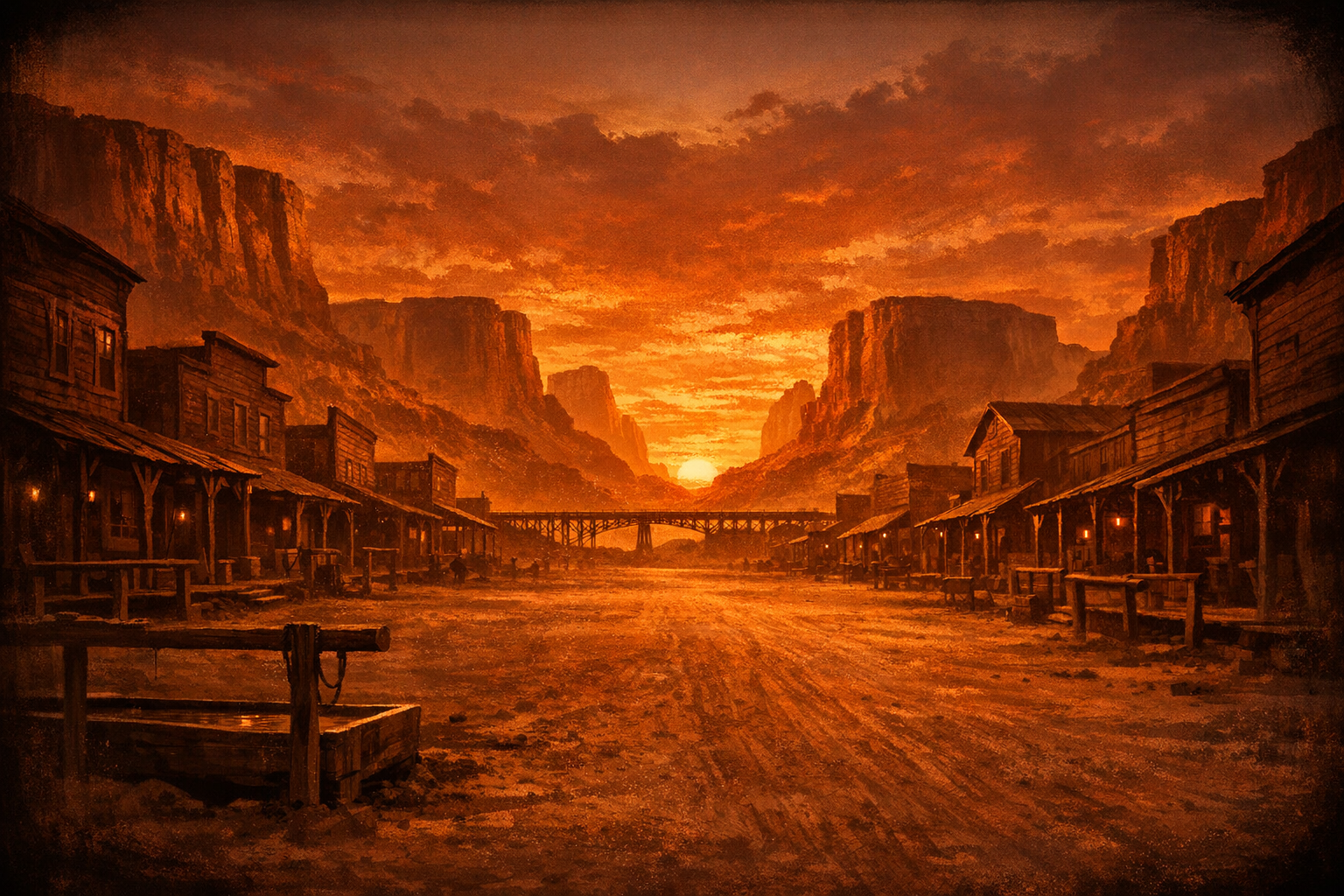

The Western isn't about cowboys. It isn't about six-shooters or stagecoach robberies or showdowns at high noon. Those are the furniture. The Western is about thresholds.
Every Western takes place at a border between worlds. Civilization and wilderness. Law and chaos. The past and the future. Characters in Westerns stand on that line, pulled in both directions, forced to choose. The frontier isn't just a place. It's the last moment before choices become permanent, before the railroad arrives and everything changes.
This is what makes the Western perfect for tabletop RPGs. Your players aren't heroes saving a world that will endure. They're people living through a transition, making choices that shape what comes next. Every decision matters because the West won't stay wild for long.
The Western Is About Endings
Here's what most Western campaigns get wrong: they treat the setting as a playground rather than a graveyard.
The classic Western is elegiac. It mourns something passing away. The open range is being fenced. The gunfighter's skills are becoming obsolete. The old codes of honor can't survive contact with civilization's bureaucracy and law. Even victory tastes like loss because winning means hastening the end of the world that made winning possible.
This isn't grimdark nihilism. The Western contains real heroism and genuine hope. But that hope is bittersweet. Shane rides off wounded, possibly dying. The Wild Bunch goes down in glory because there's no place left for men like them. Even victories in Westerns tend to be last stands.
For your campaign, this means establishing what's ending. The cattle drives are finishing because railroads make them obsolete. The frontier towns are being connected to the wider world, their independence dissolving. The players' way of life, whatever it is, won't last.
This gives weight to everything they do. Every adventure becomes part of a larger story of change. Every choice for violence or peace nudges the world toward different futures. The campaign isn't about maintaining a status quo. It's about deciding what the new world looks like.
Not every session needs to hammer this theme. But keeping it as subtext makes the genre work. Without it, you're just playing a medieval game with different weapons.
The Town: Your Campaign's Heart
Every Western needs a town because the town is where the tension lives.
In fantasy, adventurers pass through settlements on their way to dungeons. In Westerns, the settlement is the dungeon. A town of 200 people where everyone knows everyone, where grudges fester and secrets barely stay hidden, where the balance of power is always precarious. That's your campaign engine.
The essential locations matter because they're where different kinds of scenes happen:
The saloon is neutral ground. Everyone drinks there. Information flows. Deals get made. Trouble starts but usually doesn't finish because too many people are watching. Your saloon needs a bartender who knows everything and says little, at least one back room where private conversations happen, and a regular cast of locals who react to your players' presence.
The sheriff's office represents whatever law exists. Maybe it's an honest man trying to do right. Maybe it's corrupt muscle for whoever runs the town. Maybe it's empty because no one wants the job. What your sheriff's office looks like tells players what kind of town this is and what kind of campaign you're running.
The general store is where you learn what the town needs. What goods are scarce reveals trade routes and dangers. What people buy on credit reveals the economy. The storekeeper knows everyone's business because they see what everyone purchases.
The church matters even if your players aren't religious. It represents community, morality, the civilizing force the frontier half-resists. The preacher might be the only educated person for fifty miles. Sunday might be the only day folks aren't working. What happens at church tells you what the town values.
But beyond the standard buildings, your town needs problems. Not adventure hooks. Problems. The well is running dry. The ranchers and the farmers are fighting over water rights. Someone's kid went missing last month. The railroad surveyor is in town and everyone has different feelings about what that means.
Towns work as campaign hearts because they give players something to care about. Random wilderness encounters are fine, but defending a town full of people they know matters more than protecting strangers.
Character Archetypes That Actually Work
The Western has strong archetypes, but strong doesn't mean simple. Here's how to use them:
The gunfighter is someone for whom violence is both gift and curse. They're good at killing. That skill has shaped their life, attracting trouble, defining how people see them, limiting what they can become. The interesting question isn't how fast their draw is. It's what they want besides the gun.
In play, gunfighter characters need a reason to be in your town. Are they trying to leave their past behind? Passing through on business? Hired by someone with money? Each answer creates different story pressures. And they need something they want more than another notch on their gun. Peace, maybe. Or forgiveness. Or just enough money to disappear somewhere new.
The lawman lives in the gap between law and justice. The law says one thing. What's right might say another. A good sheriff character grapples with that tension constantly. Do you arrest the man who killed the rancher who was stealing his water? Do you enforce the eviction notice that will destroy a family? Law is simple. Justice is complicated.
Lawman characters in player hands need autonomy from the legal system. A sheriff who always follows orders isn't interesting. Neither is one who always ignores them. The conflict between duty and conscience is where the drama lives.
The outlaw with a code sounds like a cliché because it's been done poorly so often. But it works when the code creates real constraints. Your outlaw won't steal from people who can't afford to lose it. That matters when the only stagecoach carrying money is also carrying the medicine the town needs. They won't kill unless threatened. That matters when someone threatens them slowly, ambiguously, in ways that don't clearly justify violence.
The "mysterious stranger" is lazy. It's a non-character. Having no past and no apparent motivation isn't intriguing. It's boring. If you want to play someone reserved and secretive, fine, but you still need to know who they are even if other players don't.
Homesteaders and townsfolk deserve mention because not everyone in a Western is a gunfighter. The farmer trying to protect his land, the shopkeeper caught between powerful interests, the doctor who patches up both sides of every fight. These characters lack the glamour of shootists but often face harder choices.
Violence in the Western
Violence in Westerns should feel different than violence in other genres. It's not heroic. It's tragic.
Watch classic Westerns. The violence is quick, brutal, often regretted. Men die from wounds that fester because there's no doctor within two days' ride. Gunfights end in seconds after minutes or hours of tension. The aftermath matters as much as the act. Someone has to bury the bodies. Someone has to tell the widow.
For your table, this means restraint. Not less violence necessarily, but more weight to it. A single death should matter more than a dozen kills in a fantasy dungeon.
The showdown structure works for climactic moments. Two people (or groups) who can't settle things any other way, facing each other across a dusty street. The tension before anyone draws. The single moment that decides everything.
To run a good showdown, slow time down. Describe the wind, the watching townspeople, the sun in someone's eyes. Let players declare their intentions but don't resolve them instantly. Build to the moment when everything happens at once. Then make the consequences immediate and real.
Body counts matter in Westerns in ways they don't in other genres. A character who's killed a dozen people has a reputation. People know the name. That reputation follows them, closing doors and opening others. It shapes how every NPC reacts before a word is spoken.
If you're running a Western where combat is frequent and casual, you're actually running an action game with a Western skin. That's fine if it's what your table wants. But you're losing something essential to the genre.
The Land Wants to Kill You
The Western landscape isn't scenery. It's an antagonist.
Deserts that kill the unprepared. Mountains that trap travelers in snowdrifts for months. Rivers that flood without warning. Distances so vast that help is always days away. The land doesn't care about your players. That indifference makes it dangerous.
Travel in Westerns should feel consequential. In fantasy, weeks of travel get handwaved. In Westerns, travel is story. The water's running low and there's no town for forty miles. The horse threw a shoe and the only blacksmith is back the way you came. Bandits might work this stretch of road, or they might not. You won't know until you're too far in to turn back.
Build encounters around terrain and weather, not just hostile NPCs. Lost in a box canyon. A flash flood while crossing the river. A dust storm that blinds the horses. These create tension without requiring combat.
The spaces between towns matter because isolation changes everything. In town, there are witnesses, consequences, social pressure. Out in the wilderness, it's just your character and whoever else is there. Promises can be broken. Laws don't apply. The isolation reveals who people really are.
This is why so many Western stories involve journeys. The trip from one town to another strips away civilization's protections. By the time characters arrive somewhere, they know things about each other they couldn't learn any other way.
Handling Indigenous Peoples
The Western genre has a terrible history with its portrayal of Native Americans. Decades of films and novels used indigenous peoples as faceless enemies, obstacles to be overcome, or noble savages existing only to help or hinder white protagonists. This is harmful and boring.
You have several options, and you should think carefully about which fits your table.
You can set your campaign in a context that minimizes contact. Not all Western stories involve Native American characters. A cattle town dealing with rustlers and railroad interests might not engage with indigenous issues directly.
You can treat indigenous nations as political entities with their own interests, alliances, and internal conflicts. The Comanche, the Apache, the Sioux, the Lakota were not interchangeable. They had different cultures, different histories with American expansion, different relationships with each other. If you include Native American factions, do the research to portray them as peoples rather than props.
You can acknowledge the injustice directly. Your setting can include characters who know they're participating in something wrong, who grapple with their complicity, who work against it in ways small or large. This requires maturity from your table but can produce powerful stories.
What you shouldn't do: use Native Americans as convenient enemies, reduce them to mystical stereotypes, or pretend the genocide didn't happen while using its setting.
If you're not confident handling this material well, focus your campaign elsewhere. There's plenty of Western story space that doesn't require you to portray cultures you don't understand.
Weird West: When to Add the Strange
Weird West settings add supernatural elements to the frontier: magic, monsters, steampunk technology, undead, demons. Done well, this expands your possibilities without losing the genre's core. Done poorly, it becomes fantasy in cowboy hats.
What the supernatural adds: fresh threats that frontier pragmatism can't easily solve, mystery in a genre that tends toward straightforward conflicts, new kinds of specialists who have roles beyond gunfighting.
What it takes away: the groundedness that makes Western stakes feel real, the focus on human conflicts and moral choices, the specific historical resonance that gives the genre weight.
The balance point: the supernatural should complicate your Western, not replace it. If your campaign becomes primarily about fighting demons, the Western setting is just a coat of paint. If the town's problems are still water rights and railroad expansion, but there's also something wrong out at the old Miller place, now you're cooking.
Deadlands remains the gold standard for Weird West gaming because it keeps the Western front and center. The supernatural exists, and it's terrifying, but the day-to-day conflicts are still about land, law, revenge, and survival. The weird makes the West more dangerous, not different.
For Horror elements in your Weird West, remember that frontier isolation amplifies dread. Help is days away. No one will hear you scream. The emptiness that makes the West dangerous for normal reasons makes it worse when something unnatural stalks the canyon lands.
For Steampunk Westerns, focus on how technology changes the power balance. Weird science weapons mean someone has an advantage. Who? New machines might be replacing old ways of life even faster than the railroad. Inventions attract attention from powerful interests who want to control them.
Making It Playable
Campaign frameworks for Westerns:
The town-based campaign keeps your players in one location with evolving problems. Threats come to them. They build relationships with locals. Events escalate over sessions from minor disputes to existential crises for the community. This works well for groups who like character development and returning NPCs.
The journey campaign sends players from point A to point B with complications along the way. Escort the cattle herd to market. Transport the prisoner to stand trial. Get the medicine to the settlement before the fever takes more children. Each session presents new obstacles, and the destination provides a satisfying ending point.
The revenge campaign gives one or more characters a wrong to right. Someone killed their family, stole their land, ruined their reputation. The campaign follows their pursuit of justice or vengeance, with complications along the way. This works well for short campaigns with clear endpoints.
The occupation campaign puts players in roles with built-in conflicts: lawmen, bounty hunters, Pinkerton agents, cavalry scouts. The job provides adventure hooks. The moral complexity comes from what the job asks them to do.
Session structures that work:
Start with normalcy. Let players exist in the town before trouble arrives. This establishes what's at stake when trouble comes.
Escalate through failed solutions. The first approach doesn't work. The second makes things worse. By the time violence happens, it feels earned.
End with consequences. What changed? Who remembers what the players did? How has the town's situation shifted?
The one-shot vs. campaign question matters more in Westerns than most genres. The Western has natural story endings in ways that fantasy quest campaigns don't. A showdown is a climax. After it, something is over. If you're running a longer campaign, you need new sources of tension, which often means new arrivals, new threats, new complications in an ongoing situation.
One-shots work beautifully for Westerns precisely because the genre has such clear structures. A town has a problem. Strangers arrive. After conflict and complication, the problem is resolved or the town is destroyed. Credits roll. Your table might enjoy a series of loosely connected one-shots more than a continuous campaign.