


William Gibson wrote Neuromancer in 1984 on a manual typewriter. He imagined a world of global computer networks, corporate dominance, extreme wealth inequality, and technology that both liberated and enslaved. Forty years later, we're living in a low-resolution version of that future.
This is cyberpunk's problem and its power. The genre's predictions came true, which makes it uncomfortably relevant and hard to make feel like fiction. When your players check their phones and see targeted ads based on conversations they had near their devices, the surveillance state isn't speculative anymore. When the richest people on Earth have more wealth than most nations, corporate dystopia isn't imaginary.
Running cyberpunk in 2024 means grappling with this. You can't treat it as pure escapism when it's basically social realism with better special effects.
But that relevance is also why cyberpunk matters. The genre gives you tools to process the present by exaggerating it. The surveillance is total. The corporations are officially governments. The inequality is vertical, literally, with the rich living above the clouds while the poor never see sunlight. By pushing current reality further, you create distance that lets players engage with issues that might be too close for comfort otherwise.
High Tech, Low Life: The Core Tension
The formula sounds simple: advanced technology plus social decay. But most cyberpunk campaigns get the balance wrong. They go all chrome and forget the gutter.
You see it constantly. The characters have cyber-eyes and neural interfaces and monofilament whips, and they use this gear to do heists in gleaming corporate towers. Which is fun, but it's actually a high-tech heist genre, not cyberpunk. Cyberpunk requires the lowlife. The street. The desperation that makes people sell pieces of themselves for rent money.
Here's a test for your campaign: do your characters need money? Not want it for better gear. Need it. For food, for shelter, for the maintenance fees on the cyberware that's keeping them alive. If your characters are comfortable, you're not running cyberpunk. You might be running a perfectly good Sci-Fi game with cyberpunk aesthetics, but the punk part is missing.
The low life isn't just poverty. It's precarity. It's knowing that one bad job, one medical emergency, one corporate grudge could end everything. It's having skills that are valuable but being disposable anyway. It's the gap between what technology could provide and what the system actually delivers.
Your world should make players feel this. The technology to end hunger exists, but people starve because there's no profit in feeding them. The medical technology to extend life indefinitely exists, but only for those who can pay. The Net contains all human knowledge, but accessing it without corporate permission is a crime.
The City as Character
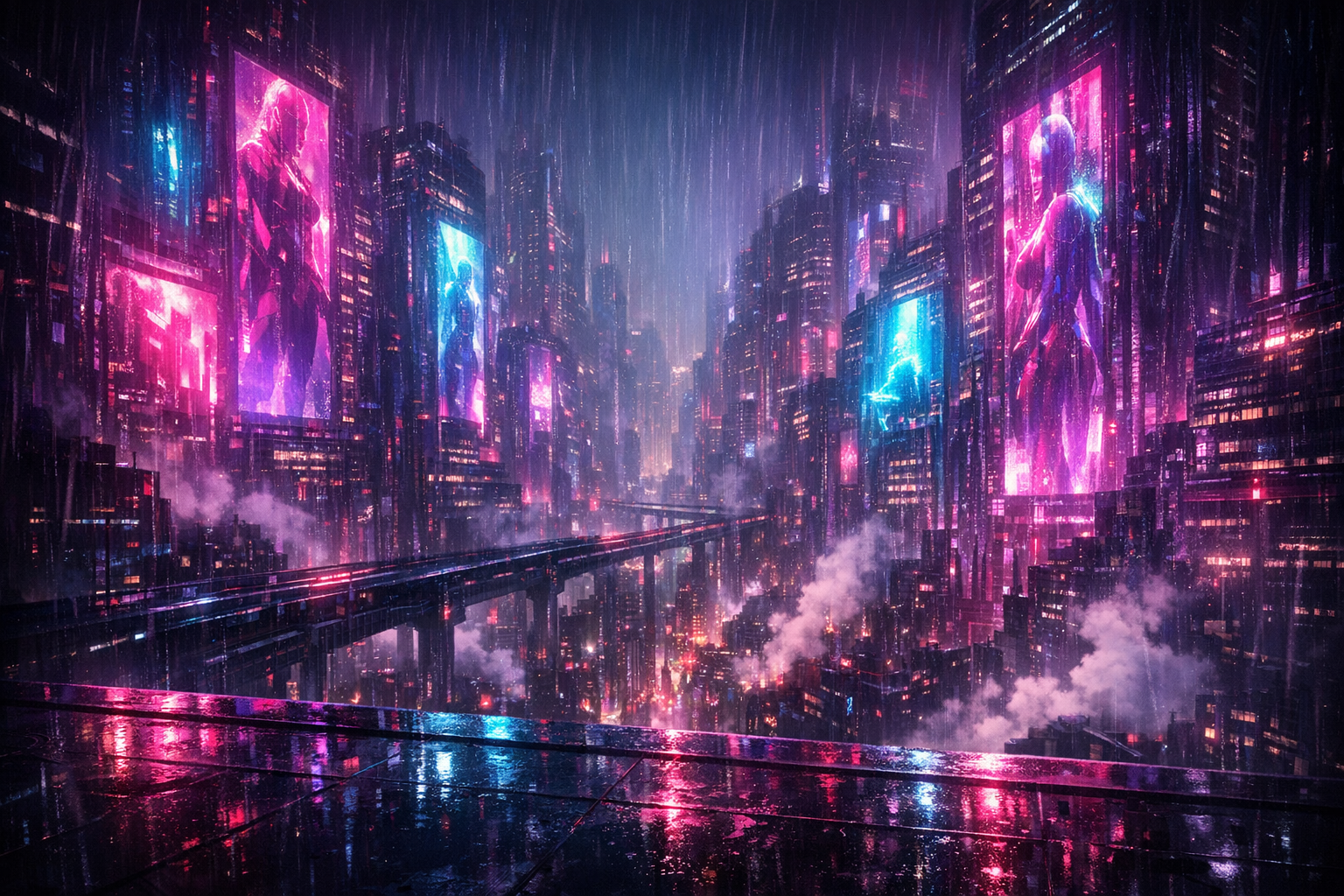
Cyberpunk happens in cities. Not just any cities. Megacities. Sprawls. Vertical accumulations of humanity stacked on humanity, where you can spend your whole life within a few square miles and never run out of things to discover.
The verticality matters. Cyberpunk cities build up because they've run out of room to build out. The rich live at the top, above the smog, in towers that never touch the ground except through private elevators. The poor live at the bottom, in the shadows of those towers, in structures that were basements before the city grew over them. The middle levels are where most people exist, neither in the light nor the dark, just in the gray.
This stratification isn't just economic. It's physical. When you say a character is "moving up in the world," you might mean it literally. The view from someone's apartment window tells you their whole life story.
Districts need personalities. Not just different color palettes. Different economies, cultures, dangers. The corporate zone is clean and surveilled and requires the right credentials to enter. The manufacturing district never sleeps, machines humming through cycles that pause for nothing human. The entertainment district sells everything, including things that shouldn't be for sale. The residential arcologies pack people into efficient cubes and charge them for the privilege.
The streets matter in cyberpunk because that's where the genre's name comes from. Street punks. Street samurai. The street finds its own uses for things. When you're running a cyberpunk game, the street isn't just the space between buildings. It's where the unofficial economy operates, where people who've fallen out of the system survive, where the news doesn't report and the cops don't patrol.
Give your streets life. Vendors selling food of questionable origin. Buskers with synthesizers wired directly into their nervous systems. Gangs marking territory with AR tags only visible to those with the right implants. People sleeping in doorways because there's nowhere else. This is the world your characters move through. Make it feel populated and real.
Corporations: Beyond Cartoonish Evil
Corporations make perfect cyberpunk antagonists. They're powerful, impersonal, and genuinely terrifying if you think about them correctly. But most games treat them as video game bosses. Defeat the CEO, and the whole thing collapses. That's not how corporations work.
A megacorp isn't a person. It's a system. It has thousands of employees, most of whom consider themselves good people doing their jobs. It has internal factions competing for resources and influence. It has inertia that keeps it moving in directions no individual controls. It has emergent behaviors that nobody intended but everybody enables.
When your players take a job against Arasaka or Militech or whatever corp dominates your setting, they're not fighting a villain. They're fighting a machine made of people. Some of those people are actively malicious. Most are just following incentives. The system produces harm regardless of individual intentions.
This makes corporations scarier than any single antagonist could be. You can kill a person. You can't kill an organizational structure. Cut off one head and the shareholders appoint another. Destroy one facility and insurance covers the rebuild. Expose one scandal and the PR department manages it.
The complicity problem makes this personal for characters. Your fixer gets jobs from corps. Your ripperdoc uses corporate-manufactured parts. Your character's cyberware probably came from a company that does terrible things. Everyone in the cyberpunk world is entangled with corporate power, even people fighting against it.
Use this. When the players take a job for the "good" corp against the "bad" corp, make them realize both are bad. When they try to live outside the system, show them how impossible that is. The punk in cyberpunk isn't about defeating corporations. It's about maintaining human dignity while trapped in systems designed to extract it.
The Net: Running Hacking That Doesn't Suck
Hacking in tabletop games has a classic problem: the netrunner goes off into their own minigame while everyone else waits. The solutions vary, but the problem is real. Here's how to handle it.
Option one: abstract it. The hacker doesn't literally navigate cyberspace in real-time. They make rolls that represent preparation and execution that happened off-screen. "I already compromised their security last week" is a legitimate approach that keeps the action focused on the physical team while acknowledging the hacker's contribution.
Option two: integrate it. The hacker is in cyberspace while the team is in meat-space, but they're doing the same mission simultaneously. The hacker disables cameras while the infiltrators sneak past. The hacker opens doors while the team fights through. Both actions happen at the same time, and you cut between them like an action movie. This requires tight scene framing but keeps everyone engaged.
Option three: make it physical. The hacker needs to physically access a terminal to do the real work. Now they're with the team, facing the same dangers, just using different tools. The network dive happens at the table, but it's a room in the dungeon, not a separate dimension.
What doesn't work: long solo sequences where one player explores a virtual dungeon while four other players browse their phones. If your hacker's gameplay is incompatible with your other players' gameplay, something's structurally wrong with how you're running the game.
The visual representation of cyberspace matters for tone. Gibson's original vision was geometric and abstract. Later interpretations made it more literal, like a virtual city. Some games keep it purely mechanical, just rolls without narration. Pick an approach that fits your table and commit to it.
Chrome and Meat
Cyberware is cyberpunk's core image: humans improved, modified, augmented, replaced piece by piece with machine parts. But cyberware means different things depending on how you frame it.
Cyberware as power fantasy: more capability, better stats, cool abilities. This is the default game interpretation. Get chrome, get strong. The more metal you've got, the more badass you are.
Cyberware as class marker: the rich have seamless biotechnological improvements that look completely natural. The poor have obvious, clunky replacements that mark them as modified. Your chrome doesn't just give you abilities; it signals your economic status to everyone who sees you.
Cyberware as body horror: you're replacing yourself with machines. Each augmentation is a little death, a piece of your original self traded for capability. Maybe there's a mechanical cost (cyberpsychosis, humanity loss). Maybe it's purely narrative. Either way, the chrome comes with existential weight.
Cyberware as liberation: your body is yours to modify. Gender, ability, appearance, capability. All customizable. The technology that corporations use for control also enables radical self-determination. Transhumanism isn't dystopian for everyone.
Most cyberpunk games blend these interpretations, but knowing which ones you're emphasizing helps players understand what kind of game you're running. A campaign about the horrors of losing yourself to chrome plays very differently than one about gleefully upgrading beyond human limitations.
For body horror specifically, check how Horror approaches physical transformation and loss of self. The techniques translate directly to cyberpsychosis and the alienation of becoming machine.
The Street Finds Its Own Uses
Bruce Sterling's famous line captures something essential: technology doesn't determine its own use. The corporations design tech for one purpose. The street repurposes it for another.
This is where the punk comes back in. The resistance to corporate power isn't necessarily organized or ideological. It's practical. People taking tools designed to control them and using those tools to survive, to fight back, to create spaces the system can't reach.
Subcultures matter in cyberpunk because they represent these pockets of resistance. Not political parties. Not rebel armies. Groups of people who've found ways to live that corporate monoculture hasn't absorbed yet. Gangs, yes, but also art scenes, hacker collectives, religious communities, ethnic enclaves that maintain traditions the mainstream forgot.
Your campaign should include subcultures the players can belong to or encounter. Give each one a distinct aesthetic, economy, values, and relationship to corporate power. Some are in active resistance. Some just want to be left alone. Some are being co-opted and don't realize it yet.
The punk in cyberpunk isn't just an aesthetic. It's a stance. It's refusing to accept that the system is inevitable, that there's no alternative, that the best you can hope for is comfortable complicity. Even if resistance is futile, choosing to resist means something.
Updating the Genre
Gibson wrote about the anxieties of the 1980s: Japanese corporate dominance, the emerging internet, the Reagan-era wealth gap. Those specific anxieties have evolved. Your cyberpunk game should probably evolve with them.
What 80s cyberpunk got wrong: Japan didn't become the dominant economic power. The internet became social media rather than virtual reality. Cyberspace turned out to be boring rectangles and text, not gleaming geometric palaces.
What still resonates: corporate power, wealth inequality, surveillance, the transformation of identity through technology, the feeling that the future isn't evenly distributed.
New anxieties to incorporate: AI that actually works (and takes jobs), social media's fracturing of shared reality, climate change making parts of the world uninhabitable, gig economy precarity, algorithmic control of behavior.
A 2024 cyberpunk setting might look different than an 80s one. The megacorps are tech companies and logistics firms, not zaibatsus. The surveillance is voluntary, people posting their lives for followers. The hackers are fighting algorithms, not human security guards. The climate's wrecked, and the rich have climate-controlled arcologies while the poor bake.
You don't have to update. Classic cyberpunk aesthetics work fine. But if your players know more about TikTok than William Gibson, meeting them where they are might work better.
Making It Playable
Campaign frameworks for cyberpunk:
The crew structure works: a team of specialists who take jobs for fixers. This is the default because it's flexible. The fixer provides missions. The crew executes them. Complications arise. Downtime happens. Repeat. It's episodic enough to accommodate absences and integrated enough to build ongoing relationships.
What jobs to offer: extraction (rescue or kidnap, depending who's asking), acquisition (steal the thing), elimination (kill the person), investigation (find the truth), delivery (get the item there), sabotage (break the thing). Each job type implies different specialists and different challenges.
Consequences matter in cyberpunk. Blow a job, and your rep suffers. Kill the wrong person, and someone comes looking for revenge. Get captured, and the corporation owns you now. Success brings attention, which brings bigger jobs and bigger threats.
The economy should feel real. Characters need to pay rent, maintain cyberware, buy gear. Jobs should pay enough to survive, not enough to thrive. The gap between "comfortable" and "wealthy" should feel vast and mostly uncrossable. Keep them hungry.
Build a relationship web. The fixer who gives jobs. The ripperdoc who installs chrome. The bartender who knows things. The cop who sometimes looks the other way. The rival crew that's after the same jobs. The corporate manager who's secretly sympathetic. These recurring characters turn a series of jobs into a story.
Let players have a home base. An apartment, a workshop, a regular booth at a dive bar. Somewhere that feels like theirs in a world where everything is owned by someone else. Give them something to protect, and you have stakes beyond the job at hand.