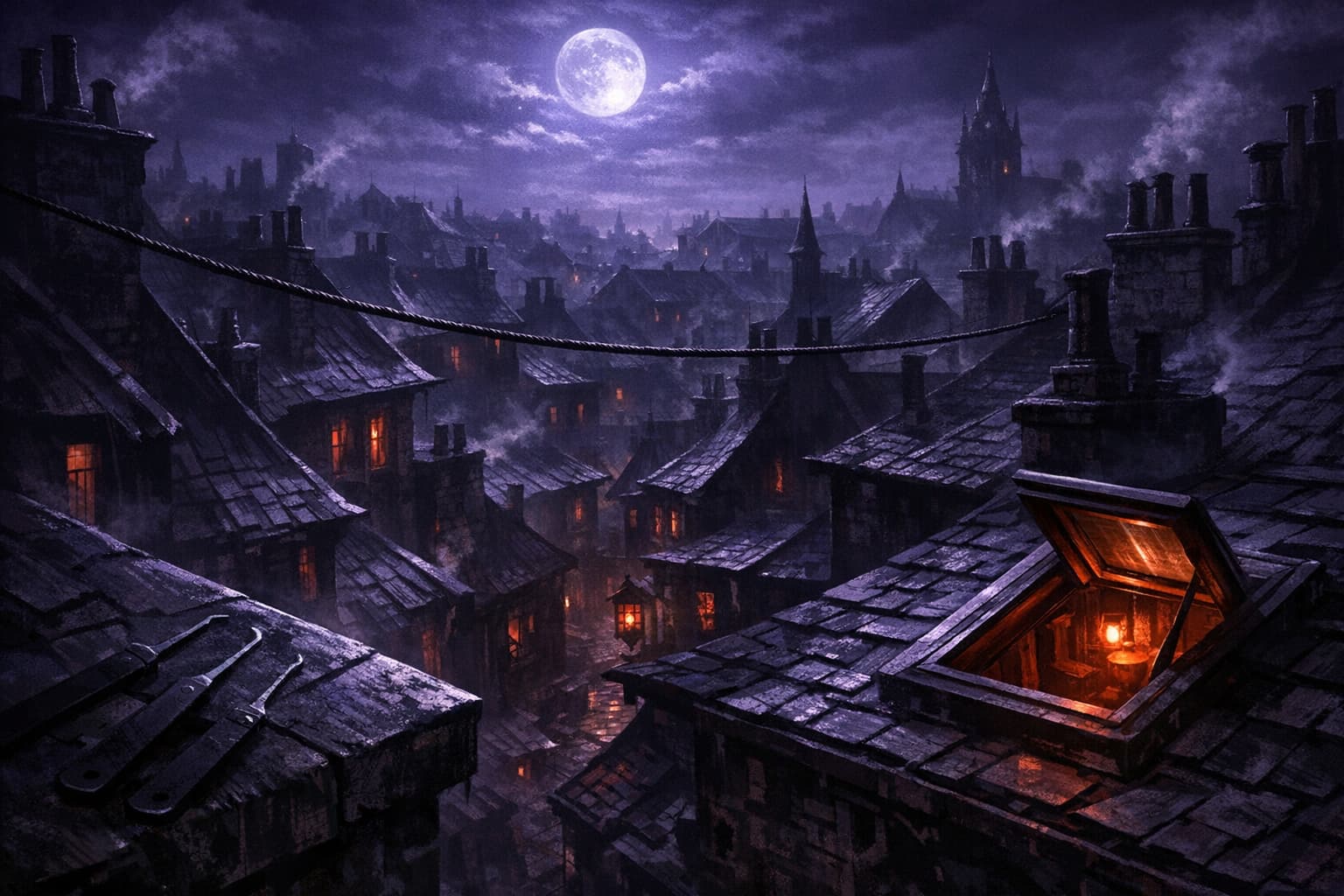
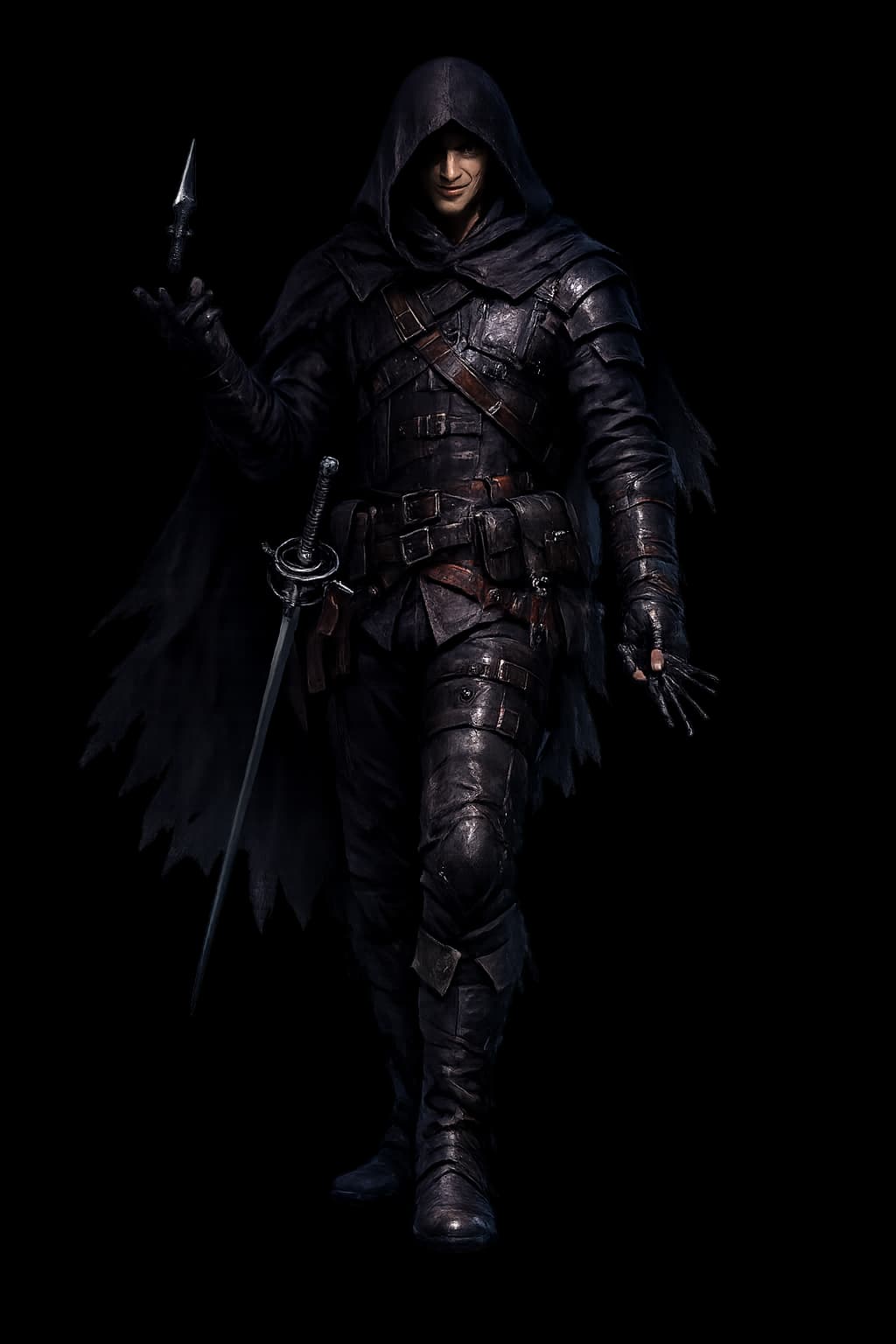

Rogue
The knife you never see, the lock that opens itself, the smile that hides everything worth hiding
What Is a Rogue?
The rogue exists to prove that the most dangerous person in the room is rarely the strongest. While the fighter trusts steel and the wizard trusts arcane formulae, the rogue trusts information — who's guarding the door, which floorboard creaks, where the merchant keeps the real ledger. The rogue fantasy isn't about being weak and compensating. It's about understanding that power comes in forms that brute force can't detect, let alone counter.
At its heart, the rogue class represents mastery of the space between rules. Every system has gaps — legal systems, security systems, combat formations, social hierarchies — and the rogue lives in those gaps. They don't break walls; they find the door someone forgot to lock. They don't overpower guards; they become the person the guards weren't told to stop. The rogue's superpower is noticing what everyone else overlooks.
This fantasy resonates because most people spend their lives following the prescribed path. Go to school. Get the job. Follow the rules. The rogue asks what would happen if someone simply chose a different path — not through rebellion or rage, but through cleverness. The rogue doesn't hate the system. The rogue understands the system better than anyone, which is precisely why the system can't contain them.
There's also something deeply appealing about competence expressed through precision rather than power. The rogue doesn't swing a greatsword in a wide arc hoping to hit something. They wait, watch, and place a single strike exactly where it will matter most. Sneak Attack isn't a bigger hammer — it's a scalpel. And the satisfaction of a scalpel, when it's placed perfectly, exceeds anything a hammer can deliver.
“A locked door is just an unopened invitation. A guarded vault is just a puzzle with a prize. The world is full of things people think are safe, and I find that incredibly generous of them.”
— Unattributed — found scratched inside an empty strongbox
Literary & Mythological Origins
The rogue archetype is arguably older than civilization itself. Trickster figures appear in virtually every mythological tradition — Loki in Norse myth, Anansi in West African folklore, Coyote in Indigenous American stories, Hermes in Greek mythology. These figures share a common trait: they solve problems through wit and misdirection rather than strength or divine authority. They steal fire from the gods, outwit giants, and talk their way out of consequences that would crush anyone playing by the rules.
In literature, the rogue crystallized through several traditions simultaneously. The picaresque novel — a Spanish invention of the 16th century — followed clever, low-born protagonists navigating corrupt societies through guile. Robin Hood gave the archetype a moral dimension: stealing isn't wrong if you steal from the right people. Arsene Lupin, Maurice Leblanc's gentleman-thief created in 1905, elevated the rogue to aristocratic elegance, proving that larceny could be art. Fritz Leiber's Gray Mouser, debuting in 1939 alongside Fafhrd, is perhaps the most direct ancestor of the D&D rogue — a small, quick, witty thief-swordsman navigating a world built for bigger, stronger people.
The influence of real-world criminal tradition shouldn't be overlooked either. Medieval guilds of thieves and beggars, whether historical or legendary, provided the template for the thieves' guilds that populate virtually every fantasy setting. The idea that criminals might organize, maintain codes of conduct, and operate as a shadow society parallel to legitimate governance is endlessly fertile ground for storytelling. The rogue isn't just a person — they're a representative of an entire hidden world.
Key Literary and Mythological Influences
| Source | Era | Contribution to the Archetype |
|---|---|---|
| Hermes / Loki / Anansi | Ancient mythology | The trickster god — cunning over strength, theft as clever art, deception as survival |
| Robin Hood | c. 1300s ballads | Moral theft, the outlaw hero, skill with ranged weapons and disguise |
| Picaresque novels | 1550s onward | Low-born protagonists surviving by wits in corrupt systems, the lovable scoundrel |
| Arsene Lupin (Leblanc) | 1905 | Gentleman-thief, heist as performance art, charm as weapon |
| The Gray Mouser (Leiber) | 1939 | D&D's direct ancestor — small, fast, witty thief-swordsman partnered with a larger warrior |
| Bilbo Baggins (Tolkien) | 1937 | The reluctant burglar, stealth as small-person survival, the magic ring as rogue tool |
Leiber's Gray Mouser and Tolkien's Bilbo were both created in the late 1930s — the rogue archetype was ready for the tabletop before the tabletop existed.
Evolution Across Editions
The rogue has one of the most fascinating evolutionary arcs in D&D history, starting under a completely different name. In the original 1974 game (OD&D), the class didn't exist at all — there were Fighting Men, Magic-Users, and Clerics. The Thief was added in Supplement I: Greyhawk (1975), credited to Gary Switzer's houserules and formalized by Gary Gygax. This made the Thief the first class ever added to D&D after the original three, establishing a precedent that classes could — and should — cover more than just combat and magic.
That original Thief was defined almost entirely by skill percentages. You had a flat chance to Open Locks, Find Traps, Move Silently, Hide in Shadows, Pick Pockets, Hear Noise, and Climb Walls. These percentages started miserably low (a 1st-level Thief had a 15% chance to Open Locks) and improved slowly. The backstab mechanic — the ancestor of Sneak Attack — existed but required attacking from behind with surprise, making it situational rather than central. The Thief was fragile, unreliable, and mechanically frustrating at low levels, but the fantasy was compelling enough to keep players coming back.
Second edition (1989) rebranded the class as the Thief/Rogue and introduced a crucial innovation: the ability to customize your skill percentages by distributing points among them. This was revolutionary for a game that had historically offered zero character customization within a class. It also introduced the concept of Thief Kits — essentially proto-subclasses like the Swashbuckler, Assassin, and Bounty Hunter — that previewed the archetype system that would become standard decades later.
Third edition (2000) completed the transformation. The class was officially renamed Rogue, shedding the criminal-only connotation. Sneak Attack replaced backstab with a much more generous trigger — you dealt extra damage whenever an ally was adjacent to your target or whenever you had advantage (called flanking in 3e). The rogue also became the undisputed skill monkey, receiving more skill points per level than any other class. This edition established the rogue's dual identity: deadly in combat through precision, and indispensable outside combat through sheer versatility.
Supplement I: Greyhawk
The Thief debuts as the fourth D&D class. Percentage-based skills, backstab from surprise, d4 hit die. The archetype enters the game.
AD&D 1st Edition
Thief formalized with the Assassin as a sub-class. Backstab requires surprise and rear positioning. Skills remain percentage-based.
AD&D 2nd Edition
Rebranded as Thief/Rogue with customizable skill point allocation. Kits add Swashbuckler, Assassin, and more as proto-subclasses.
D&D 3rd Edition
Officially renamed Rogue. Sneak Attack replaces backstab with flanking trigger. Massive skill point allocation makes the rogue the definitive skill class.
D&D 5th Edition
Sneak Attack triggers from advantage or adjacent ally. Cunning Action adds bonus-action Dash/Disengage/Hide. Expertise doubles proficiency on chosen skills. Roguish Archetypes debut.
D&D 2024 (5.5e)
Steady Aim added as base class feature. Weapon Mastery provides Nick for dual-wielding. Cunning Strike converts Sneak Attack dice into special effects.
Sneak Attack and Cunning Action
Sneak Attack is the rogue's heartbeat. Once per turn, when you hit with a finesse or ranged weapon and have advantage on the attack (or an ally is within 5 feet of your target), you deal extra damage — starting at 1d6 at level 1 and scaling to 10d6 at level 19. This mechanic is frequently misunderstood by new players and DMs alike. It doesn't require stealth or surprise. It doesn't require attacking from behind. The name is misleading; what it actually represents is the rogue's ability to exploit any opening, any moment of distraction, to place a devastating strike. A rogue fighting side-by-side with a fighter in broad daylight qualifies for Sneak Attack every single turn.
Cunning Action is what separates the rogue from every other martial class in terms of battlefield mobility. As a bonus action, you can Dash, Disengage, or Hide. This sounds simple until you realize the tactical implications: you can attack, then Disengage and walk away without provoking opportunity attacks. You can Dash to close distance and still attack. You can Hide after attacking to gain advantage on your next turn's Sneak Attack. Cunning Action doesn't make the rogue hit harder — it makes the rogue impossible to pin down, a skirmisher who chooses every engagement on their own terms.
Expertise lets you double your proficiency bonus on two skills at level 1 and two more at level 6. This is the quiet superpower that makes rogues indispensable outside of combat. A rogue with Expertise in Perception and Stealth isn't just good at those skills — they're operating on a different plane from everyone else. By high levels, a rogue's Expertise skills are so reliable that they border on supernatural. A level 11 rogue with 20 Dexterity and Expertise in Stealth has a minimum Stealth check of 19 with Reliable Talent — they literally cannot roll below that.
Evasion and Uncanny Dodge round out the defensive toolkit. Evasion turns Dexterity saving throw successes into zero-damage results and failures into half damage — the rogue simply dodges the fireball entirely. Uncanny Dodge halves the damage from one attack per round as a reaction. Combined with the rogue's natural tendency to stay mobile and avoid the front line, these features make rogues surprisingly survivable despite their modest d8 hit die.
- Sneak Attack (1d6 scaling to 10d6)
- Expertise (double proficiency on chosen skills)
- Thieves' Cant (secret criminal language)
- Cunning Action (bonus-action Dash/Disengage/Hide)
- Uncanny Dodge (halve one attack's damage)
- Evasion (Dex saves: success = 0 damage, fail = half)
- Reliable Talent (minimum 10 on proficient skill checks)
- Blindsense, Slippery Mind, Elusive, Stroke of Luck
Sneak Attack requires a finesse or ranged weapon and either advantage or an adjacent ally. Triggers once per turn, not once per round.
- Sneak Attack (enhanced scaling)
- Expertise (unchanged)
- Thieves' Cant (unchanged)
- Cunning Action (now includes Steady Aim)
- Cunning Strike (trade Sneak Attack dice for status effects)
- Uncanny Dodge (unchanged)
- Evasion (unchanged)
- Reliable Talent, Subtle Strikes, Epic Boon at 19
The 2024 revision adds Weapon Mastery (Nick for dual-wielding), Cunning Strike to convert Sneak Attack dice into poison, trip, or disarm effects, and Steady Aim as a built-in bonus-action advantage source.
Sneak Attack's once-per-turn limit (not once-per-round) is a deliberate design choice. It means rogues can potentially trigger Sneak Attack on opportunity attacks during other creatures' turns. This interaction is rules-legal and important for multiclass builds, reaction-based strategies, and understanding the rogue's true damage ceiling. The rogue's sustained DPR is competitive with other martial classes precisely because Sneak Attack scales so aggressively.
The Archetype in Practice
Playing a rogue well means understanding that your job isn't to stand in the middle of combat and trade blows. Your job is to be the most efficient creature on the battlefield — dealing maximum damage per action while taking as little as possible in return. The rogue's combat loop is elegant: get advantage (through hiding, ally positioning, or class features), land Sneak Attack, then use Cunning Action to reposition or vanish. Rinse, repeat. You won't have the fighter's action economy or the paladin's nova damage, but you'll have the most reliable single-hit damage in the game, every single turn, without spending any resources.
Outside combat is where the rogue truly shines. Expertise and Reliable Talent mean the rogue is the best in the party at whatever they choose to be best at — and it isn't close. Need to scout ahead? The rogue's Stealth is untouchable. Need to talk your way past guards? Expertise in Persuasion or Deception makes social encounters trivial. Need to find traps, pick locks, or disable security? The rogue was literally designed for this. A well-built rogue solves problems the rest of the party doesn't even notice exist.
Thief Archetype
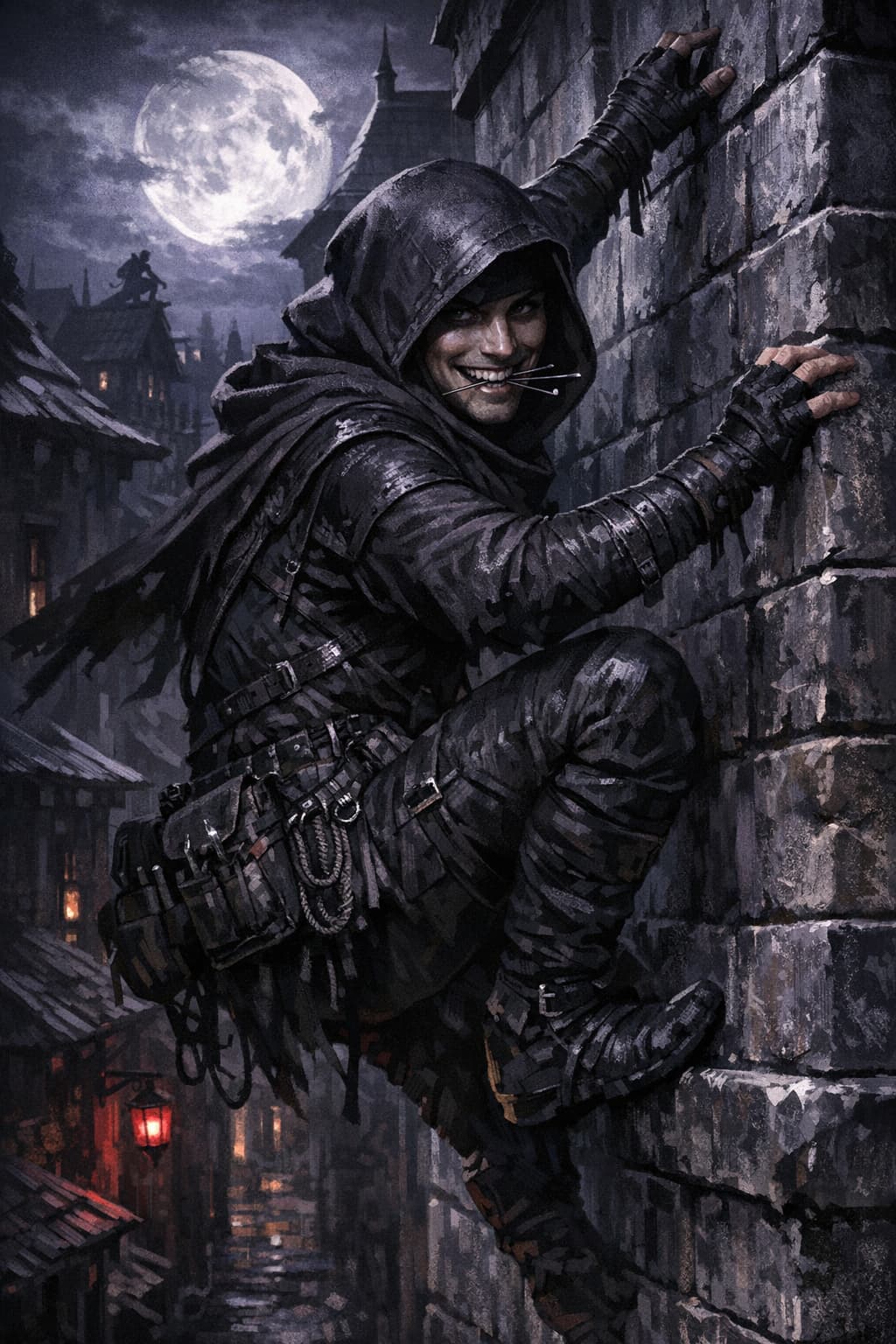
The Thief is the original rogue fantasy distilled to its purest form. Fast Hands lets you use Cunning Action to pick locks, disarm traps, or use objects as a bonus action — turning the rogue into a one-person heist crew operating at double speed. Second-Story Work adds climbing speed and longer jumps, making vertical space your personal domain. At higher levels, Use Magic Device lets you ignore class, race, and level requirements on magic items, turning the rogue into the most versatile magic item user in the game. The Thief doesn't get flashy combat upgrades because it doesn't need them — it gets access to everything else.
Assassin Archetype
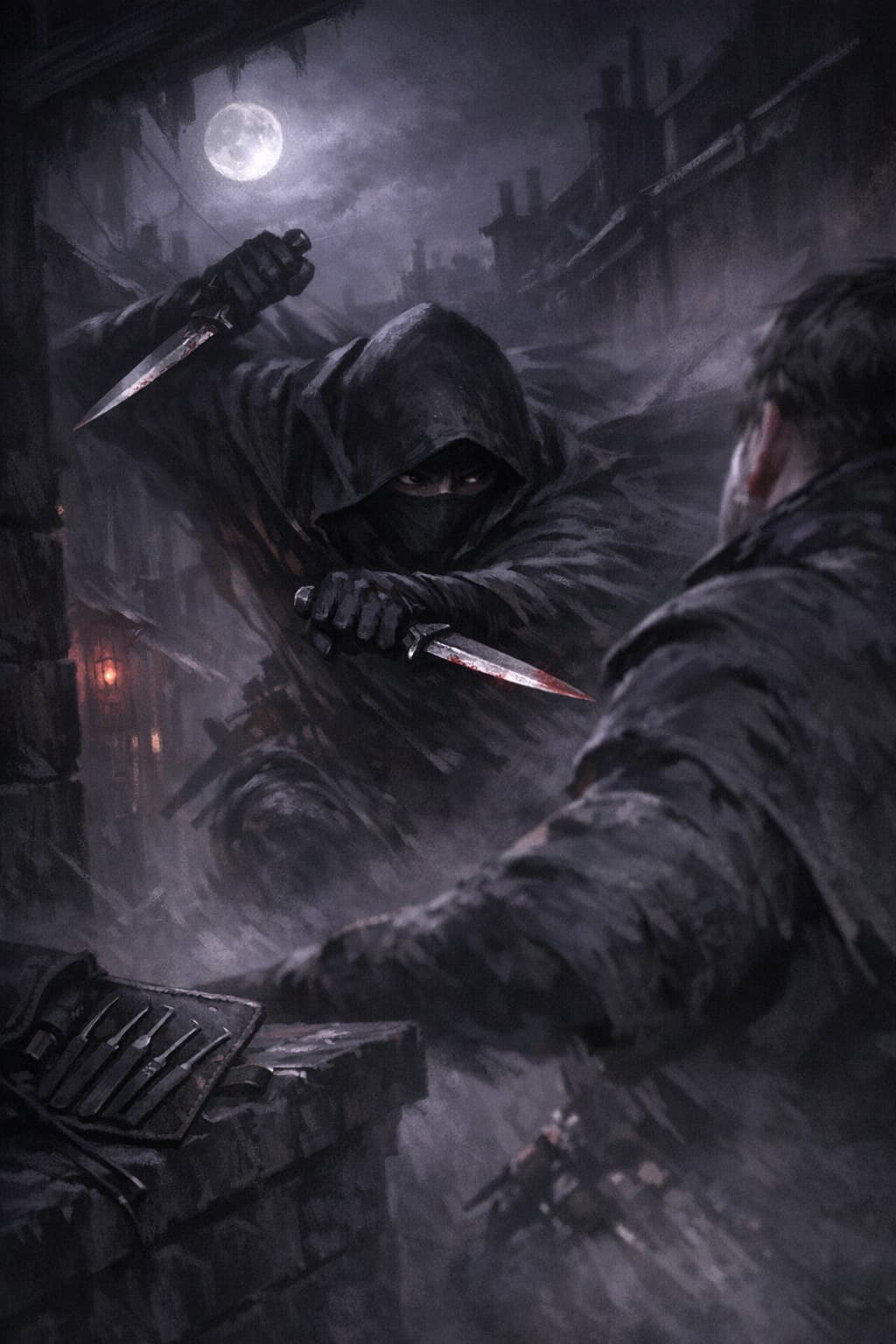
The Assassin is the rogue at its most lethal and its most controversial. Assassinate grants advantage against creatures that haven't acted yet in combat, and any hit against a surprised creature is an automatic critical — which means double Sneak Attack dice. At level 3, a well-positioned Assassin can deal more damage in a single hit than some classes manage in an entire encounter. The catch is that Assassinate depends entirely on winning initiative and achieving surprise, which makes the subclass frustratingly inconsistent. When it works, it's the most cinematic moment at the table. When it doesn't, you're a rogue with fewer features than your peers.
Arcane Trickster
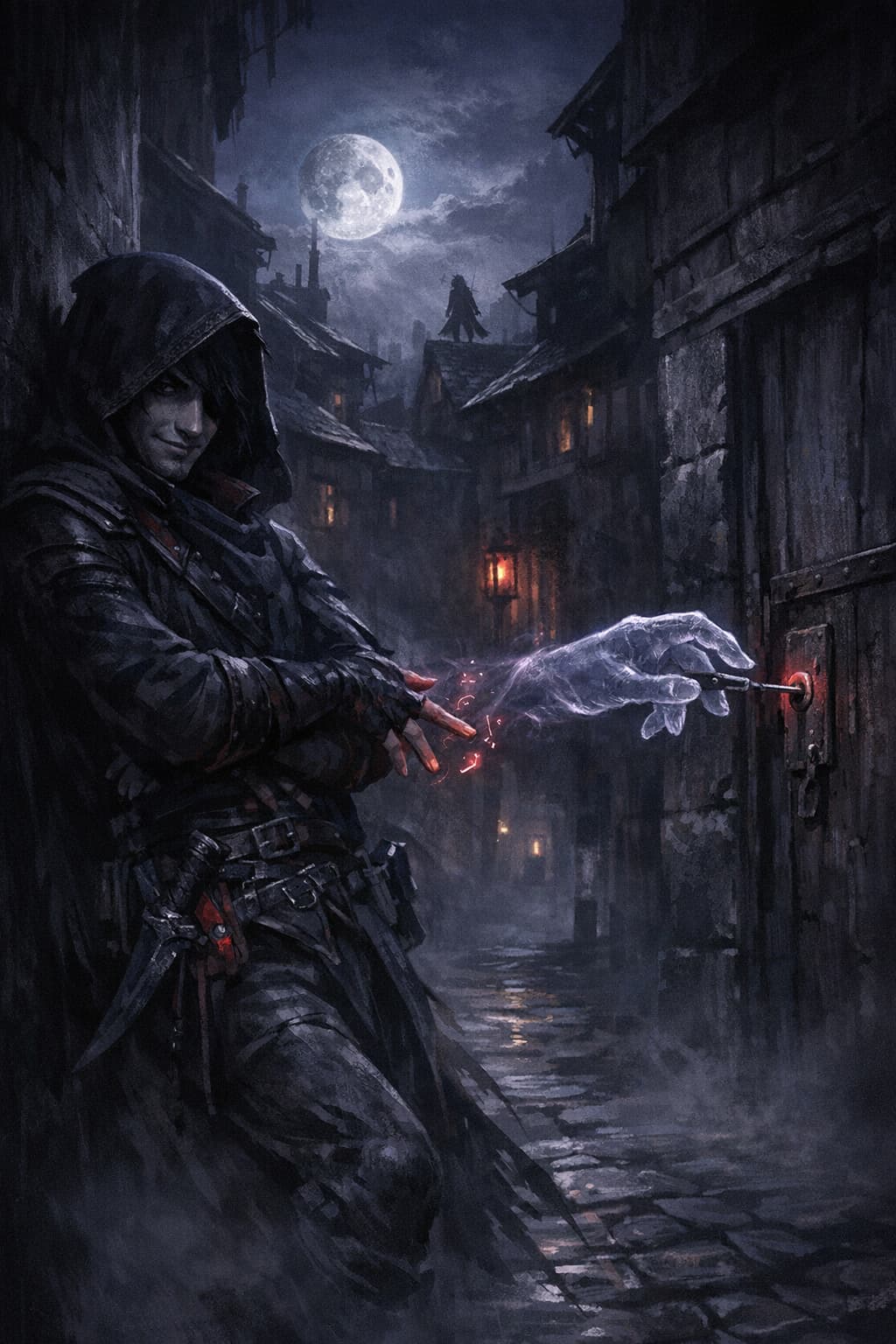
The Arcane Trickster answers the question: what if a rogue could also cast spells? Drawing from the Wizard spell list (primarily Enchantment and Illusion), the Arcane Trickster adds magical versatility to the rogue's already impressive toolkit. Mage Hand Legerdemain makes an invisible Mage Hand that can pick pockets, manipulate objects, and pick locks at range — essentially giving the rogue 30 feet of invisible, untraceable reach. Find Familiar provides a permanent scouting companion. Shadow Blade (from later spell access) creates a weapon that deals psychic damage and grants advantage in dim light. The Arcane Trickster doesn't become a wizard — they become a rogue with just enough magic to be even more unfair.
Roguish Archetypes
The rogue's subclass roster is one of the most diverse in D&D, ranging from mundane skill mastery to supernatural shadow magic. Every subclass redefines what it means to be precise, what it means to exploit an opening, and what the rogue's relationship with the shadows actually entails. The Thief exploits the action economy. The Assassin exploits surprise. The Arcane Trickster exploits magic. The Swashbuckler exploits one-on-one positioning. Each is a fundamentally different answer to the same question: how does the rogue win?
Fifth edition launched with three Roguish Archetypes — Thief, Assassin, and Arcane Trickster — and supplements expanded the list significantly. The Sword Coast Adventurer's Guide introduced the Swashbuckler and Mastermind, while Xanathar's Guide added the Inquisitive, Scout, and Phantom (originally the Revived). Tasha's Cauldron brought the Soulknife, giving the rogue psychic blades that need no weapon at all. Each supplement pushed the rogue further from its criminal origins toward a broader concept of precision and expertise.
In Baldur's Gate 3, the rogue is represented by Thief, Assassin, and Arcane Trickster. The Thief's extra bonus action per turn makes it arguably the strongest subclass in the digital adaptation, enabling combinations that pen-and-paper players can only dream about. The Assassin's surprise-dependent features translate better to the video game format where ambush tactics are more consistently achievable.
Rogue Subclasses Across Editions and Supplements
| Subclass | Source | Core Fantasy |
|---|---|---|
| Thief | PHB 2014 / BG3 | Speed and object mastery; Fast Hands for bonus-action item use, Use Magic Device at high levels |
| Assassin | PHB 2014 / BG3 | Ambush specialist; automatic crits on surprised targets, infiltration and poison expertise |
| Arcane Trickster | PHB 2014 / BG3 | Rogue-wizard hybrid; invisible Mage Hand, Illusion/Enchantment spells, magical misdirection |
| Swashbuckler | SCAG / Xanathar's | Duelist and charmer; free Disengage after attacking, Sneak Attack in one-on-one fights, Charisma-based initiative |
| Mastermind | SCAG / Xanathar's | Manipulator and tactician; bonus-action Help at 30 feet, identity forgery, political intrigue specialist |
| Inquisitive | Xanathar's | Detective and truth-seeker; bonus-action Insight to enable Sneak Attack, supernatural perception |
| Scout | Xanathar's | Wilderness operative; reaction movement when enemies approach, Nature/Survival expertise, skirmisher tactics |
| Phantom | Tasha's | Death-touched rogue; Sneak Attack damages a second target, soul trinkets, ghost walk at higher levels |
| Soulknife | Tasha's | Psychic operative; conjures psychic blades as weapons, telepathic communication, Psi-Bolstered Knack for skill checks |
The Swashbuckler solved the rogue's biggest pain point — needing an ally nearby for Sneak Attack — making it one of the most popular subclasses in organized play.
Roleplaying & Personality
The most common rogue roleplaying mistake is playing them as antisocial loners who steal from the party. This isn't edgy — it's boring, and it makes the game worse for everyone at the table. The rogue fantasy isn't about being a selfish jerk. It's about being the person who sees what others miss, who solves problems from angles nobody considered, and who values the team precisely because they understand how rare genuine trust is. The best rogues are fiercely loyal to their companions — they just express that loyalty through unconventional means.
Consider what your rogue's relationship with honesty looks like. Some rogues lie constantly — not maliciously, but reflexively, because they grew up in environments where truth was a vulnerability. Others are brutally, surprisingly honest, having learned that the best way to hide your real secrets is to be transparent about everything else. A rogue who never lies except about the one thing that matters is a character with genuine dramatic tension.
Background matters enormously for rogue flavor. A street urchin rogue, a noble-born rogue, and a former-soldier rogue all use the same mechanics but inhabit completely different narrative spaces. The urchin steals to survive and views the world through scarcity. The noble steals for thrills and views the world through boredom. The soldier "liberates intelligence assets" and views the world through mission parameters. Same Sneak Attack, same Cunning Action, three entirely different people.
Don't neglect the rogue's intelligence and wisdom. Mechanically, rogues save against Intelligence — a rare proficiency that signals the class's mental sharpness. Narratively, rogues are observers and planners. They notice the guard rotation, remember which noble was nervous during the toast, and always know where the exits are. Playing a rogue as perceptive and thoughtful, someone who gathers information compulsively and plans three steps ahead, is far more interesting than playing them as a sneaky stabber.
How does your setting's legal system handle rogues? Is theft a capital offense, punished by branding, or tolerated as a cost of doing business? Does a thieves' guild operate openly as a quasi-legitimate organization, or is it a true underworld? The answers define whether your rogue character is a daring rebel, a professional in a recognized trade, or a desperate survivor one mistake away from the gallows.
Heists, Capers, and Rogue-Centric Adventures
Every class gets combat encounters designed around their strengths. The fighter gets battlefields, the wizard gets magical mysteries, the cleric gets undead-infested crypts. But the rogue's signature adventure type gets overlooked more than it should: the heist. A well-designed heist session lets the rogue do everything they were built for — reconnaissance, infiltration, disabling traps, picking locks, creating distractions — while giving other party members supporting roles that feel meaningful rather than redundant.
The anatomy of a good heist session follows a predictable structure that still allows for chaos. Phase one is intelligence gathering: the rogue cases the target, identifies guard rotations, maps entry and exit points, and briefs the party. Phase two is preparation: acquiring disguises, forging documents, planting inside contacts, or pre-positioning escape routes. Phase three is execution, where the plan meets reality and immediately starts falling apart. Phase four is extraction, which is usually the most exciting part because nothing went according to plan.
DMs running heist sessions should build in multiple viable approaches and expect players to find a fourth one nobody considered. Give the target genuine security measures — magical wards, guard patrols, locked vaults, alarm spells — but make sure each one has at least two possible counters. The rogue's toolkit is broad enough that Thieves' Tools, Stealth, Sleight of Hand, Deception, and Investigation should all have moments to shine. And leave room for the inevitable moment when stealth fails and the party has to improvise.
Beyond full heist sessions, rogue-centric side missions keep the class engaged during campaigns that trend toward combat. A fence who needs a specific item retrieved. A contact who trades information for favors. A rival thief who keeps beating the rogue to scores. These hooks give the rogue narrative agency between dungeons and ensure that their skill investments pay off in story terms, not just mechanical ones.
Guilds and Underworld Networks
Thieves' guilds are the most iconic rogue organization in fantasy, and for good reason — they answer a fascinating worldbuilding question: what happens when crime professionalizes? A thieves' guild isn't just criminals working together. It's a shadow economy with rules, hierarchies, territories, and enforcement mechanisms. Guild thieves don't steal from guild-protected businesses. They pay dues. They follow codes. In many settings, the thieves' guild is more orderly than the legitimate government, which is both the joke and the point.
But rogues occupy far more social niches than just organized crime. Spy networks serve governments, churches, and merchant houses, using the same skills for state-sanctioned purposes. Explorer guilds and archaeological societies employ rogues as trap-finders and lock-breakers in ancient ruins. Courier services trust rogues to deliver messages and packages through dangerous territory. Investigative agencies — fantasy equivalents of private detectives — rely on rogue skills for surveillance, evidence gathering, and witness interrogation. The rogue skill set is criminal only if you choose to apply it criminally.
In many settings, rogues serve essential social functions that polite society prefers not to acknowledge. They test security systems. They gather intelligence. They handle problems that can't be solved through legal channels. They serve as intermediaries between legitimate power and the underworld, translating between two worlds that depend on each other but refuse to admit it. The rogue isn't outside society — they're in the walls, keeping the whole structure standing through means nobody wants to discuss at dinner.
Thieves' Guilds & Criminal Networks
Territorial hierarchies from guildmaster to street-level pickpockets. Initiation rites testing stealth, lockpicking, and loyalty. Revenue through protection rackets, fencing stolen goods, information brokering, and contract theft. Internal justice systems — guild members who steal from the guild face consequences far worse than any magistrate would impose. Political influence maintained through blackmail, bribery, and the implicit threat that crime could get much worse without the guild's organizing hand.
Legitimate Rogue Professions
Royal spymasters and intelligence agents operating with crown authority. Locksmith guilds whose members understand security from both sides. Dungeon-delving specialists hired by adventuring companies to handle traps and locked chambers. Diplomatic couriers trusted with sensitive documents across hostile territory. Insurance investigators tracking down fraud and theft. Court jesters and entertainers whose real job is observing and reporting on noble behavior.
Thieves' Tools and Signature Gear
The rogue's gear philosophy is the opposite of the barbarian's. Where the barbarian grabs one big weapon and ignores everything else, the rogue carries a carefully curated toolkit where every item serves a specific purpose. Thieves' tools are the class's signature non-weapon equipment — a set of lockpicks, files, mirrors, and miniature tools that represent years of specialized training. In 5e, proficiency with thieves' tools is separate from skill proficiency, meaning the rogue invests in this capability specifically.
Weapon selection for rogues is deceptively constrained. Sneak Attack requires a finesse or ranged weapon, which limits viable options to rapiers, shortswords, daggers, scimitars, and ranged weapons like shortbows and hand crossbows. The rapier is the statistical favorite — d8 damage die, one-handed, freeing the other hand for a shield or second weapon. But daggers deserve special mention: they can be thrown for ranged Sneak Attack, concealed on your person, and dual-wielded. A rogue with a bandolier of daggers is a walking problem for anyone within 20 feet.
Armor is straightforward but important. Light armor only — studded leather at 12 + Dex is the rogue's ceiling without multiclassing. This means Dexterity investment directly rewards both offense (attack and damage with finesse weapons, Sneak Attack eligibility) and defense (AC). The rogue is perhaps the most single-ability-dependent class in the game, and their equipment choices reflect that elegant simplicity.
Iconic Rogue Equipment
| Item | Type | Why It Works |
|---|---|---|
| Rapier | Weapon | d8 finesse weapon; highest damage die available for Sneak Attack. One-handed for shield or dual wield options. |
| Shortsword | Weapon | d6 finesse with light property; enables two-weapon fighting for an extra chance to land Sneak Attack if the first misses. |
| Hand crossbow | Weapon | d6 ranged; one-handed, works with Crossbow Expert feat for bonus action attacks. Premium rogue ranged option. |
| Daggers (many) | Weapon | d4 finesse, light, thrown (20/60 ft). Concealable, cheap, versatile. Sneak Attack doesn't care about base damage dice. |
| Thieves' tools | Tool | Essential for lockpicking and trap disarming. Expertise makes these checks nearly automatic at higher levels. |
| Studded leather | Armor | 12 + Dex modifier. The rogue's best armor without multiclassing. Doesn't impose stealth disadvantage. |
| Poison vials | Consumable | Bonus damage on weapon attacks. The Assassin subclass eventually gains poison expertise and resistance. |
Sneak Attack dice are the same regardless of weapon damage die. A dagger Sneak Attack deals nearly the same damage as a rapier Sneak Attack — the d4 vs. d8 base damage is trivial next to 5d6+ of Sneak Attack.
Multiclass Synergies
The rogue is one of the game's best multiclass partners because Sneak Attack scales with rogue level, not total level, creating a clear cost-benefit calculus for every level you spend elsewhere. Each non-rogue level costs you roughly 0.5d6 of Sneak Attack damage (one die every two levels), which is the price you pay for whatever the other class offers. The question is always: does the dip give me something worth more than those lost dice?
Rogue dips into other classes are equally powerful. Two levels of rogue give any character Cunning Action and one Expertise — an enormous package for fighters, rangers, or monks who want battlefield mobility. Three levels add a subclass; the Swashbuckler's Rakish Audacity (Sneak Attack without needing advantage or allies) is transformative for any Charisma-based melee character. One level of rogue gives Expertise and Sneak Attack, which is occasionally worth it just for the skill reliability alone.
The rogue/fighter combination deserves special mention. Action Surge from two Fighter levels gives the rogue a second action, potentially enabling two Sneak Attacks in one turn (one on your action, one on a held action triggered on another creature's turn — yes, this is rules-legal and it's devastating). The rogue/ranger Scout combination leans into wilderness expertise, while rogue/warlock creates an Eldritch Blast sniper who can also pick every lock in the dungeon.
Strong Combinations
Rogue/Fighter: Action Surge enables potential double Sneak Attack turns. Battle Master maneuvers add control effects to precise strikes. Champion's improved critical doubles your chance of critical Sneak Attacks. Rogue/Ranger (Gloom Stalker): Dread Ambusher's extra first-round attack stacks with Assassinate for devastating openers. Wisdom synergizes with Perception. Rogue/Warlock (Hexblade): Charisma-based weapon attacks pair with Swashbuckler. Eldritch Blast provides consistent ranged damage. Devil's Sight + Darkness creates permanent advantage for Sneak Attack.
Interesting Dips
Any martial/Rogue 2: Cunning Action and Expertise are worth two levels in almost any build that uses Dexterity. Paladin/Rogue 3 (Swashbuckler): Rakish Audacity enables Sneak Attack without ally positioning, and Charisma synergizes with both classes. Bard/Rogue: Double Expertise stacking creates the most skilled character possible. Jack of All Trades plus Reliable Talent means you literally cannot fail a skill check you're invested in. Monk/Rogue: Unarmored Movement plus Cunning Action creates the most mobile character in the game. Stunning Strike plus Sneak Attack is a one-two punch.
Building Your Character
Dexterity is king, full stop. It drives your attack rolls, damage, AC (through light armor and potentially Unarmored Defense from multiclassing), initiative, the most common saving throw in the game, and your core skills — Stealth, Acrobatics, and Sleight of Hand all key off Dexterity. No other class in D&D benefits as much from a single ability score. Start with 16 Dexterity minimum and push it to 20 as fast as possible.
Your second ability score depends on your subclass and role. Constitution is always valuable for survivability — rogues have a d8 hit die, which is respectable but not comfortable on the front line. Wisdom feeds Perception (the most-rolled skill in the game) and common saving throws. Charisma matters for Swashbucklers and any rogue who plans to be the party's face. Intelligence is relevant for Arcane Tricksters and Investigation-focused builds. The rogue has enough Expertise to cover skill gaps, so don't stress about having a 10 in a score that powers a skill you need — Expertise will do the heavy lifting.
For species selection in the 2014 rules, anything with a Dexterity bonus works well. Halflings are thematically perfect and mechanically strong — Lucky rerolls on natural 1s protect your Sneak Attack from whiffing, and the Lightfoot subrace can hide behind any Medium creature. Elves bring weapon proficiencies and Perception. Variant Humans grab a feat at level 1, with Alert (never surprised, massive initiative bonus) or Lucky being standout picks. In the 2024 rules with flexible ability scores, choose your species purely for flavor and feature synergy.
Feat selection can dramatically reshape your rogue. Alert is arguably the single best rogue feat — going first means attacking before enemies have acted, which synergizes with Assassin and guarantees you'll set the terms of engagement. Lucky is universally powerful. Sentinel lets you Sneak Attack on opportunity attacks (remember: once per turn, not once per round). Crossbow Expert enables a bonus action hand crossbow attack, giving you a second chance to land Sneak Attack if your first attack misses.
Dexterity 16, Constitution 14, Wisdom 14. Take a rapier, two daggers, a shortbow, studded leather armor, and thieves' tools. Choose Expertise in Stealth and Perception (or Thieves' Tools if you want to be the dedicated lock-picker). Background: Criminal for the on-theme proficiencies, or Urchin for the urban survival flavor. At level 3, pick Thief if you want versatility, Swashbuckler if you want combat independence, or Arcane Trickster if you want magical options. If you reach level 4, take Alert or bump Dexterity to 18.
Famous Rogues in Fiction
The rogue archetype has produced some of fiction's most memorable characters, precisely because audiences love watching someone win through cleverness rather than brute force. From the literary grandfather of the D&D thief to modern video game companions who've stolen millions of hearts alongside millions of gold pieces, the rogue's presence in popular culture is vast and varied. What unites these characters isn't just their skill set — it's the tension between self-interest and something deeper, the question of whether cunning must serve only the self or can be turned toward something worth caring about.
In tabletop-adjacent fiction, the rogue has evolved from a simple thief archetype into a character who often carries the emotional weight of the story. Artemis Entreri began as a cold mirror to Drizzt Do'Urden — proof that skill without compassion leads to emptiness — and over dozens of novels became one of fantasy's most compelling anti-heroes. Nott the Brave in Critical Role turned kleptomania into a vehicle for exploring trauma, addiction, and the desperate need to be someone other than who you are. These characters demonstrate that the rogue's real depth lies not in what they steal, but in what they're running from.
Video games have given the rogue archetype an entirely new dimension by letting players inhabit the fantasy directly. Garrett from the Thief series didn't just popularize stealth gameplay — he essentially invented it, proving that avoiding combat could be more thrilling than engaging in it. Astarion in Baldur's Gate 3 became a cultural phenomenon by combining rogue mechanics with a vampire spawn's desperate charm, creating a character whose seductiveness is inseparable from his survival instinct. These digital rogues have shaped how an entire generation understands the class.
Iconic Rogues Across Fiction
| Character | Source | Why They Matter |
|---|---|---|
| The Gray Mouser | Fritz Leiber's Fafhrd and the Gray Mouser (1939) | The literary grandfather of the D&D rogue — a thief, swordsman, and trickster who defined the archetype of the small, quick partner to the big warrior |
| Bilbo Baggins | J.R.R. Tolkien's The Hobbit (1937) | Literally hired as the party's "burglar," Bilbo established the reluctant rogue archetype — the ordinary person who discovers extraordinary talent for stealth and cunning |
| Robin Hood | English folklore (c. 1300s onward) | The original moral rogue: steal from the rich, give to the poor, and fight corrupt authority. Every chaotic-good rogue descends from this tradition |
| Artemis Entreri | R.A. Salvatore's Forgotten Realms novels (1988) | Drizzt's cold, calculating nemesis — the assassin rogue who mirrors the hero and asks what skill looks like without conscience |
| Garrett | Thief game series (1998) | The master thief who defined the stealth-game genre and proved that avoiding detection is more satisfying than any combat encounter |
| Locke Cole | Final Fantasy VI (1994) | The "treasure hunter" who objects to being called a thief — the rogue with a broken heart, proving that the archetype carries emotional depth beneath the bravado |
| Astarion | Baldur's Gate 3 (2023) | A vampire spawn rogue whose charm is a survival mechanism, not a personality trait. Massively popular companion who made the rogue class culturally dominant in modern gaming |
| Nott / Veth Brenatto | Critical Role Campaign 2 (2018) | Sam Riegel's goblin-turned-halfling rogue turned kleptomania into comedy and trauma simultaneously, showing that rogue flaws can be a vehicle for genuine character growth |
Across RPGs & Video Games
The rogue archetype is one of the most universally represented classes across game systems, though the name and mechanical expression vary wildly. What remains constant is the core fantasy: a character who trades raw power for precision, who exploits positioning and information rather than relying on armor or spells. Whether the system calls them a thief, a scoundrel, or an outlaw, the rogue occupies a design space that every RPG needs — the character who interacts with the world through skill rather than stats.
In tabletop RPGs, the rogue's mechanical identity has branched in fascinating directions. D&D 5e emphasizes Sneak Attack and Cunning Action as the twin pillars of rogue gameplay, creating a skirmisher who darts in, strikes precisely, and vanishes. Pathfinder 2e takes a different approach with its Racket system, letting you choose whether your rogue is a brute, a charmer, or a classic thief from level one — a structural choice that reshapes the entire class. Both systems agree that the rogue should be the best at skills, but they disagree about how much combat power that expertise should cost.
Video game rogues have evolved independently from their tabletop ancestors, often pushing the archetype in directions that tabletop design hasn't fully explored. The Elder Scrolls series made the stealth archer so dominant that it became a meme — every character build eventually becomes a sneaky bowman because the damage multiplier for undetected attacks is simply too good. World of Warcraft's Rogue class introduced the Combo Point system, a resource mechanic that rewards sequential attacks building toward powerful finishers, creating a rhythm of play that feels distinctly roguish even without any stealth involved.
The Rogue Archetype Across Game Systems
| Franchise | Class / Role | Key Mechanic | Key Distinction |
|---|---|---|---|
| D&D 5e | Rogue | Sneak Attack (scaling damage on advantage or adjacent ally), Cunning Action (bonus action dash/disengage/hide), Expertise | Sneak Attack triggers reliably every turn without resource expenditure; the rogue never runs out of gas |
| Pathfinder 2e | Rogue | Rackets (Ruffian, Scoundrel, Thief) determine playstyle; Sneak Attack requires flat-footed target; Surprise Attack at start of combat | Racket choice at level 1 fundamentally reshapes the class — a Ruffian rogue plays nothing like a Thief rogue |
| World of Warcraft | Rogue | Assassination (poisons/bleeds), Outlaw (swashbuckler), Subtlety (shadow magic); Combo Points + Finishers resource system | The Combo Point system creates a build-and-spend rhythm that makes every rogue turn feel like assembling a finishing move |
| Elder Scrolls | Thief archetype | Thieves Guild, Dark Brotherhood, Nightingale questlines; sneak multiplier + archery; lockpicking mini-game | Stealth archery is so overpowered it became a meme — the franchise accidentally proved the rogue fantasy is irresistible |
| Dragon Age | Rogue | Assassin, Duelist, Bard specializations; dual-wield or archer; backstab positioning mechanic | Positioning-based backstab rewards tactical thinking and spatial awareness over simple stat optimization |
| Final Fantasy | Thief | Zidane (FF9), Locke (FF6), Rikku (FF10); Steal command, speed-based; often evolves into Ninja class | The Thief-to-Ninja evolution mirrors the D&D rogue's journey from simple pickpocket to supernatural operative |
Every system agrees on the rogue's core identity: precision over power, skill over stats, and the conviction that the smartest fighter wins more often than the strongest one.
The Rogue at the Table
Rogues need a world that rewards cunning, not just combat. The single biggest mistake DMs make with rogues is running adventures as a series of open-field battles where there's nowhere to hide, nothing to climb, and no one to deceive. A rogue who can't scout ahead, pick a lock, set an ambush, or talk their way past a guard is a rogue whose player is going to get bored — and bored players make problems. Building encounters that include stealth opportunities, information gathering, and environmental interaction isn't just good rogue design; it's good encounter design for every class.
The sneak attack economy drives rogue tactics at the table, and DMs who understand it will run better games for everyone. Rogues need either advantage or an adjacent ally to trigger Sneak Attack, which means they're constantly evaluating positioning, lighting, and cover. A DM who describes the environment in tactical terms — "the hallway is dimly lit, with pillars every twenty feet and a balcony overlooking the chamber" — gives the rogue player the information they need to make interesting decisions. Conversely, a featureless 30-by-30 room with nothing but enemies is the rogue's nightmare scenario.
For players, the key to a satisfying rogue experience is communication. Tell your DM what your character is looking for: escape routes, guard patrol patterns, unlocked windows, shadows deep enough to hide in. Ask questions about the environment that a perceptive, detail-oriented character would notice. The rogue's strength lies in information, and information only exists if someone asks for it. A proactive rogue who constantly gathers intelligence makes the DM's job easier and the entire table's experience richer, because that intelligence creates options for everyone.
Design multi-room encounters with shadows, verticality, and targets to isolate. Include dimly lit corridors connecting to open chambers so the rogue can scout ahead and report back. Place enemies at different elevations — guards on walkways, archers in balconies, a boss behind a locked door. Give the rogue things to interact with: chandeliers to drop, doors to bar, alarms to disable. When the rogue can remove a threat before initiative is rolled or reposition during combat using the environment, the entire party benefits — and the rogue player feels like the class fantasy is being honored.
The Rogue in World-Building
Building a world that accommodates rogues means building a world with shadows — not just physical darkness, but institutional gaps, legal gray areas, and social blind spots that create space for people who operate outside conventional systems. A setting where laws are perfectly enforced, locks are unbreakable, and everyone is honest doesn't need rogues and can't sustain them. The rogue's existence implies a world that's messy, imperfect, and full of cracks. That's what makes it interesting.
The economy of your setting has enormous implications for rogues. A world with vast wealth inequality creates motivation for theft and redistribution. A world with trade routes creates opportunities for smuggling and piracy. A world with valuable secrets creates demand for espionage. The rogue doesn't exist in a vacuum — they exist in response to economic conditions. Ask yourself what's worth stealing in your world, who has it, and who wants it. The answers will tell you everything about what rogues do and why.
Consider how information moves through your setting. In a world with magical communication — Sending stones, message spells, scrying — the rogue's role as information broker and spy changes dramatically. They might specialize in counter-surveillance, protecting secrets from magical observation. In a low-magic world, the rogue as courier, messenger, and intelligence agent becomes more critical because information can only travel as fast as a person can carry it. The technology of communication shapes the rogue's profession as much as the technology of locks and walls.
Thieves' Cant — the secret language that all rogues share in D&D — is a worldbuilding goldmine that most DMs underutilize. It implies a transnational criminal culture, a shared knowledge base that crosses borders and languages. How did Thieves' Cant develop? Is it maintained by the guilds, or does it exist independently? Can it be learned by non-rogues? A world where criminals share a secret language is a world where crime is organized on a scale that legitimate society might not fully comprehend, and that's a wonderfully unsettling foundation for adventure.
“Every city has two maps. The official one shows streets and landmarks. The rogue's map shows which rooftops connect, which guards drink on duty, which sewers run under the treasury, and which merchants don't ask questions. Both maps are accurate. Only one is useful.”
— On the hidden geography of the urban rogue
FAQ
Common Questions
Sneak Attack adds extra damage (scaling from 1d6 to 10d6) once per turn when you hit with a finesse or ranged weapon and have advantage on the attack roll, OR when an ally is within 5 feet of the target and you don't have disadvantage. You don't need to be hidden or sneaking — the name is misleading. It represents exploiting an opening, not literal stealth. Sneak Attack works once per turn, not once per round, so it can also trigger on opportunity attacks or readied actions during other turns.
It depends on your priorities. Swashbuckler is widely considered the most consistently effective — Rakish Audacity enables Sneak Attack without needing allies or advantage, and free Disengage after melee attacks removes the need for Cunning Action. Arcane Trickster adds magical versatility and is the strongest pick for campaigns that go to higher levels. Thief is excellent for creative players who leverage Fast Hands. Assassin is the most damage-spikey but depends heavily on achieving surprise. Soulknife is the best pick for players who want a supernatural, weapon-free rogue.
Yes. The class debuted in 1975's Supplement I: Greyhawk as the Thief, making it the fourth class ever added to D&D after Fighting Man, Magic-User, and Cleric. It retained the Thief name through AD&D 1st edition and was referred to as Thief/Rogue in 2nd edition. The full rename to Rogue came in 3rd edition (2000), reflecting the designers' intent that the class encompassed more than just criminal activity — scouts, spies, swashbucklers, and treasure-hunters all fit the archetype.
A rogue is a skill-focused class built around precision, stealth, and exploiting enemy vulnerabilities. Their signature mechanic is Sneak Attack, which adds extra damage dice when they have advantage or an ally adjacent to their target. Rogues also gain Cunning Action for unmatched battlefield mobility, Expertise for doubling proficiency on chosen skills, and a suite of defensive features like Evasion and Uncanny Dodge. Originally called the Thief in early D&D editions, the class has evolved to encompass everything from cat burglars to swashbuckling duelists to arcane tricksters.
Not really — Sneak Attack is the rogue's primary damage source and the class is balanced around landing it every turn. Without Sneak Attack, a rogue deals less damage than any other martial class. The good news is that Sneak Attack is deliberately easy to trigger: all you need is an ally within 5 feet of your target, or advantage from any source (hiding, flanking, spells, etc.). If you're consistently failing to trigger Sneak Attack, talk to your DM or party about positioning — the mechanic is designed to work in normal group combat.
Fighter (2 levels) is the most popular dip — Action Surge enables a devastating double-Sneak Attack turn, and the fighting style adds consistent value. Ranger (Gloom Stalker 3) adds Dread Ambusher for explosive first rounds and Wisdom synergy. Warlock (Hexblade 1-3) provides Charisma-based attacks that synergize with Swashbuckler, plus Eldritch Blast for ranged options. For incoming dips, 2-3 levels of rogue gives any martial character Cunning Action, Expertise, and potentially a subclass — an enormous value package.
The 2024 rogue adds several key upgrades. Steady Aim (from Tasha's) is now a base class feature, giving you bonus-action advantage at the cost of movement. Weapon Mastery lets rogues use the Nick property for dual-wielding without burning a bonus action. The biggest addition is Cunning Strike, which lets you trade Sneak Attack dice for special effects — poisoning, tripping, or disarming targets. The 2024 version also expands weapon proficiency to all martial finesse and light weapons. Overall, it's a meaningful power boost that adds tactical depth.
Focus on loyalty, competence, and observation rather than selfishness and theft. The best rogues are fiercely loyal to their party and use their skills to protect the group — scouting ahead, disabling traps, gathering intelligence, and solving problems others can't. Give your rogue a code or set of principles, even if they're unconventional. Play them as perceptive and thoughtful rather than sneaky and selfish. Most importantly, never steal from party members or act against the group's interests — that's not being in character, it's being a bad player.