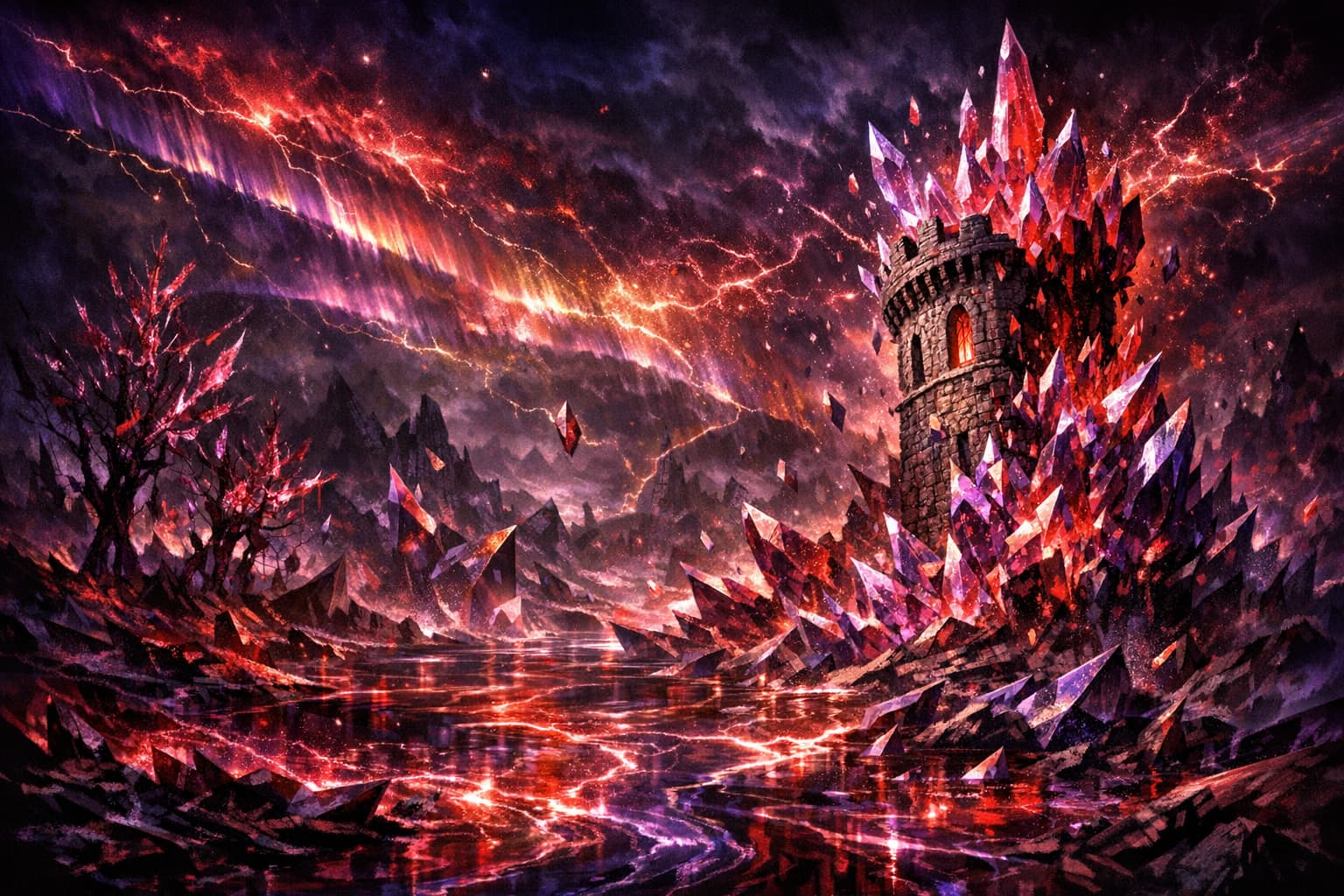


Sorcerer
Magic not learned but inherited — raw arcane power woven into blood, bone, and breath
What Is a Sorcerer?
The sorcerer exists to answer a question that wizards would rather you not ask: what if magic didn't require study? What if the power was just there, coiled in your marrow, humming behind your teeth, waiting for an emotion strong enough to set it loose? The wizard earns magic through decades of rigorous scholarship. The sorcerer was born with it, and that difference changes everything about how power relates to identity.
At its core, the sorcerer fantasy is about inheritance — gifts you didn't choose and can't refuse. Maybe a dragon slept with your great-great-grandmother. Maybe your bloodline brushed against the Far Realm and something stuck. Maybe the raw chaos of wild magic saturated the land where you were born, and you absorbed it like a sponge absorbs water. The origin matters less than the result: you are a living conduit for arcane energy, and the universe did not ask your permission before making you one.
This fantasy resonates because most people understand what it feels like to carry something they didn't ask for — a talent, a temperament, a family legacy. The sorcerer takes that feeling and turns the volume up to eleven. Your inheritance can level buildings. Your emotions can reshape reality. The question isn't whether you have power; it's whether you can control it before it controls you. That tension between gift and curse, between potential and catastrophe, is the engine that drives every great sorcerer story.
“The wizard opens a book and finds magic. The sorcerer opens their eyes in the morning and magic is already there, pacing like a caged animal.”
— On the nature of innate arcana
Literary & Mythological Origins
The idea of inborn magical power is older than civilization itself. Shamanic traditions across every continent describe individuals born with a connection to the spirit world — people who didn't choose their calling but were chosen by it. The Greek concept of "divine ichor" running through the veins of demigods, granting them powers beyond mortal reach, maps directly onto the sorcerer's bloodline fantasy. You are powerful because of what you are, not because of what you've learned.
In Arthurian legend, Merlin's power comes not from study but from his parentage — the son of a mortal woman and an incubus, his magic is a birthright. Morgan le Fay similarly draws power from Fae blood and innate talent, not from a university curriculum. These characters embody the sorcerer archetype centuries before D&D formalized it: magic as an expression of heritage rather than education.
Modern fantasy literature expanded the archetype considerably. Ursula K. Le Guin's Earthsea series explores how innate magical talent must still be trained, blurring the sorcerer-wizard line. Brandon Sanderson's Mistborn features Allomancers — people born with the genetic ability to burn metals for power — which is pure sorcerer territory. The X-Men, particularly Jean Grey and her barely-controllable Phoenix Force, translate the sorcerer fantasy into superhero language: overwhelming inborn power that threatens to consume the person wielding it.
Key Literary and Mythological Influences
| Source | Era | Contribution to the Archetype |
|---|---|---|
| Shamanic traditions | Prehistoric | The born-with-it mystic chosen by forces beyond mortal understanding |
| Greek demigods | c. 800 BCE | Divine bloodlines granting superhuman abilities; power as inheritance |
| Merlin (Arthurian) | c. 1136 CE | Half-human parentage as source of magic; power that must be guided, not taught |
| Earthsea (Le Guin) | 1968 | Innate magical talent still requiring discipline; the danger of uncontrolled power |
| Mistborn (Sanderson) | 2006 | Genetic magic systems; power limited by bloodline and resource management |
| Jean Grey / Phoenix | 1963/1976 | Inborn power that escalates beyond control; the cost of unlimited potential |
The sorcerer archetype predates the wizard in mythology by millennia. Study-based magic is the newcomer; blood-magic is the original.
Evolution Across Editions
The sorcerer is a relatively late arrival to D&D. For the game's first quarter-century, there was no mechanical distinction between a wizard who studied spellbooks and a character born with magic — the wizard (or magic-user) class covered both fantasies, poorly. The sorcerer debuted in D&D 3rd Edition (2000) as a distinct class, and the design goal was clear: give players a spontaneous caster who didn't need spellbooks, didn't prepare specific spells each morning, and could cast flexibly from a known list at the cost of knowing fewer spells overall.
Third edition's sorcerer was defined almost entirely by what it wasn't. It wasn't a wizard — no spellbook, no spell preparation, no need for Intelligence. It used Charisma as its casting stat, implying that sorcerous magic was powered by force of personality rather than intellectual rigor. The class worked, but it felt like a wizard variant rather than a fully realized archetype. Bloodline mechanics were minimal, and the class lacked a strong mechanical identity beyond "wizard but spontaneous."
Fifth edition (2014) fixed this by introducing Sorcery Points and Metamagic — the two mechanics that finally made the sorcerer feel like its own class rather than a wizard reskin. Sorcery Points created a flexible resource pool that sorcerers could spend to modify their spells in ways wizards simply couldn't. Metamagic options like Twinned Spell, Quickened Spell, and Subtle Spell gave the sorcerer a unique tactical vocabulary. The 2024 revision pushed further, granting innate spells tied to each subclass origin and expanding the Metamagic list, acknowledging that the sorcerer's identity lives in how they cast, not just what they cast.
D&D 3rd Edition
Sorcerer debuts as a standalone class. Spontaneous Charisma-based caster with no spellbook. Bloodline flavor but minimal mechanics to support it
D&D 3.5 Revised
Minor refinements. Familiar options expanded. Still largely defined as "wizard without a spellbook" rather than a truly distinct class
D&D 4th Edition
Sorcerer reimagined as a striker with Dragon Magic and Wild Magic builds. Spell source determined visual and mechanical effects. More distinct from wizard but divisive among fans
D&D 5th Edition
Sorcery Points and Metamagic introduced. Sorcerous Origins (Draconic Bloodline, Wild Magic) give strong subclass identity. Finally feels like its own class
Tasha's Cauldron of Everything
Aberrant Mind and Clockwork Soul added. These subclasses set a new standard by granting bonus known spells, addressing the sorcerer's limited spell list
D&D 2024 Revision
All subclasses gain origin spells. Sorcery Points expand. Metamagic list grows. The sorcerer finally has the spell volume and flexibility to stand fully alongside the wizard
Sorcery Points and Metamagic
Sorcery Points are the sorcerer's heartbeat. This flexible resource pool starts at your sorcerer level in points and recharges on a long rest. You can spend points to fuel Metamagic effects, convert points into additional spell slots, or burn spell slots to recover points. This resource conversion system means the sorcerer can, in theory, burn through their power in a single explosive encounter — or carefully ration it across an entire adventuring day. No other full caster in the game has this degree of resource fluidity.
Metamagic is what makes a sorcerer a sorcerer. Where a wizard casts Fireball, a sorcerer casts Fireball and then bends it. Twinned Spell lets you target two creatures with a single-target spell for the cost of the spell's level in Sorcery Points — imagine Haste on two allies simultaneously or Polymorph on two enemies at once. Quickened Spell lets you cast a full action spell as a bonus action, opening your action for a cantrip or other activity. Subtle Spell removes verbal and somatic components entirely, making your magic undetectable and immune to Counterspell. Each Metamagic option doesn't just modify a spell — it redefines what that spell can do.
The sorcerer's Achilles heel has always been their limited spell list. In the 2014 rules, a sorcerer knows only 15 spells at level 20, compared to a wizard who might have 40+ in their spellbook. This limitation was the intended trade-off for Metamagic flexibility, but in practice it often felt punishing. The 2024 revision addressed this by giving each subclass a set of origin spells that don't count against known spells, effectively expanding the sorcerer's repertoire by 10 additional spells. Tasha's-era subclasses like Aberrant Mind and Clockwork Soul pioneered this fix, and the improvement was dramatic enough that WotC applied it across the board.
- Spellcasting (Charisma, known spells)
- Sorcerous Origin (subclass at level 1)
- Font of Magic (Sorcery Points)
- Metamagic (2 options at level 3, up to 4)
- Sorcerous Restoration (short rest recovery at 20)
Knows 15 spells max at level 20. Sorcery Points equal sorcerer level. Metamagic is the core differentiator from wizard.
- Spellcasting (Charisma, known + origin spells)
- Sorcerous Origin (subclass at level 1, grants origin spells)
- Font of Magic (expanded Sorcery Points)
- Metamagic (expanded options list)
- Sorcery Incarnate (level 20 capstone)
- Innate Sorcery (bonus action self-buff)
All subclasses now grant origin spells that do not count against known spells. Innate Sorcery provides a concentration-free boost to spell save DC and advantage on sorcerer spell attack rolls.
Sorcery Points and spell slot conversion create a hidden math advantage. A sorcerer who burns all their 1st-level slots into Sorcery Points and then converts those points into a higher-level slot is performing resource alchemy that no other class can replicate. In Nova-round scenarios (one big fight per day), the sorcerer's burst potential can exceed the wizard's. Across a full adventuring day with six encounters, the wizard's broader spell list wins. Knowing your campaign's pacing is essential to optimizing a sorcerer.
The Archetype in Practice
Playing a sorcerer well means understanding that your power comes from within — and that distinction should bleed into everything about how your character interacts with the world. A wizard reads a scroll and thinks "I understand this formula." A sorcerer feels an emotional surge and the air ignites. Your spellcasting should feel visceral, instinctive, and personal. Describe the magic coming from your character's body: eyes glowing, veins luminous, the scent of ozone or sulfur or wildflowers that follows you when you cast.
Metamagic is where sorcerer gameplay truly shines at the table. The ability to twin a Haste onto two frontline fighters, subtle-cast a Suggestion in the middle of a tense negotiation, or quicken a Fireball to still have your action free transforms the sorcerer from a blaster into a tactician. The best sorcerer players don't just pick spells — they pick spells that Metamagic can amplify. A mediocre spell becomes extraordinary when Twinned, Quickened, or Empowered.
Resource management is the sorcerer's greatest challenge and greatest art. With fewer known spells than any other full caster, every slot matters. The temptation to convert everything into Sorcery Points for one massive turn is real, but so is the regret when you're out of resources by the third encounter. Learning when to conserve and when to nova is a skill that develops over a campaign, and the best sorcerer players make that tension part of their character's story — the constant negotiation between caution and the intoxicating pull of unlimited power.

Draconic Bloodline
The Draconic Bloodline sorcerer carries the legacy of dragons in their veins. Your ancestor's element defines your affinity — fire for red and gold, lightning for blue and bronze, cold for white and silver. At higher levels, draconic sorcerers sprout wings, gain damage resistance matching their ancestry, and add Charisma to elemental damage rolls. This is the sorcerer subclass for players who want to feel like a dragon trapped in a humanoid body, growing into their power over time. The aesthetic is magnificent: scales appearing on skin, pupils shifting to slits, and the growing certainty that you are not entirely mortal.

Wild Magic
Wild Magic sorcerers are walking chaos engines. Every time you cast a spell, the DM can ask you to roll on the Wild Magic Surge table — a d100 chart of random magical effects ranging from harmless (you turn blue for 24 hours) to catastrophic (you cast Fireball centered on yourself). Tides of Chaos lets you gain advantage on a roll in exchange for a guaranteed surge on your next spell. This is the subclass for players who love unpredictability, who want every spell to be a gamble, and who find comedy in catastrophe. The Wild Magic sorcerer makes the table laugh, gasp, and occasionally panic, often in the same turn.

Aberrant Mind
The Aberrant Mind sorcerer draws power from contact with the Far Realm, psionic entities, or alien intelligences that exist beyond the boundaries of normal reality. Mechanically, this subclass is widely considered the strongest sorcerer option in 5e. It grants ten bonus spells (solving the sorcerer's limited spell problem), lets you swap those spells for any divination or enchantment spell from the sorcerer, warlock, or wizard lists, and allows you to cast those bonus spells using Sorcery Points instead of spell slots — with no verbal, somatic, or material components. You become a subtle, resource-efficient psychic powerhouse. Thematically, the Aberrant Mind sorcerer is someone whose mind was opened to something vast and incomprehensible, and what came through that opening is both gift and horror.
Sorcerous Origins
The sorcerer's subclass system is unique in that you choose your Sorcerous Origin at level 1, not level 3 like most classes. This makes your origin central to your character concept from the first session. Each origin redefines where your magic comes from, and that origin should inform not just your mechanics but your roleplay, your appearance, and your relationship with the wider magical world.
The power gap between sorcerer subclasses is, unfortunately, significant. The original 2014 subclasses — Draconic Bloodline and Wild Magic — are solid but show their age compared to later designs. Tasha's-era subclasses like Aberrant Mind and Clockwork Soul set a new standard by granting bonus known spells, which the sorcerer desperately needed. The 2024 revision levels the playing field by giving all subclasses origin spells, but in 2014 rules, subclass selection has an outsized impact on class viability.
Baldur's Gate 3 features Wild Magic, Draconic Bloodline, and Storm Sorcery, each adapted for the digital format. The Wild Magic Surge table is simplified, and Tides of Chaos becomes a more reliable tactical tool. Storm Sorcery's fly-away-after-casting ability translates beautifully to the tactical grid, making it a more compelling choice in the video game than it often is at the tabletop.
Sorcerer Subclasses Across Editions and Supplements
| Subclass | Source | Core Fantasy |
|---|---|---|
| Draconic Bloodline | PHB 2014 / BG3 | Dragon ancestry grants elemental affinity, scales, and eventually wings |
| Wild Magic | PHB 2014 / BG3 | Chaotic surges of random magic; every spell is a gamble with reality |
| Divine Soul | Xanathar's | Celestial bloodline granting access to the entire Cleric spell list alongside sorcerer spells |
| Shadow Magic | Xanathar's | Shadowfell-touched power; darkness manipulation, shadow hound, and death resistance |
| Storm Sorcery | Xanathar's / BG3 | Tempest-born power; fly after casting, lightning and thunder affinity |
| Aberrant Mind | Tasha's | Psionic power from Far Realm contact; subtle casting, bonus spells, resource efficiency |
| Clockwork Soul | Tasha's | Power from Mechanus; order-based magic, damage mitigation, bonus utility spells |
| Lunar Sorcery | Dragonlance (SotDQ) | Moon-phase magic; switch spell lists with the lunar cycle for incredible versatility |
The sorcerer's subclass list reads like a catalog of fantasy power sources: dragons, chaos, gods, shadow, storms, alien minds, cosmic order, and the moon itself.
Sorcerer vs. Wizard: The Eternal Debate
It is the most common comparison question in D&D character building: should I play a sorcerer or a wizard? Both are arcane full casters with d6 hit dice and similar spell lists. Both fill the party's blaster/controller role. The difference is not power level — it is playstyle philosophy. Wizards are toolkits. Sorcerers are specialists. A wizard prepares the right spell for every situation from a massive spellbook. A sorcerer takes fewer spells but casts each one in ways a wizard literally cannot.
Metamagic is the mechanical heart of the distinction. Twinned Spell lets a sorcerer cast Haste on two allies simultaneously — something a wizard cannot replicate without a higher-level slot and a different spell. Subtle Spell removes verbal and somatic components, making the sorcerer immune to Counterspell and capable of casting in situations where a wizard would be detected. Quickened Spell turns a full action spell into a bonus action, allowing a sorcerer to Fireball and cantrip in the same turn. These modifications make each spell slot more impactful than a wizard's equivalent.
Where wizards win is versatility and endurance. A level 10 wizard has 24+ spells in their book and can prepare 15 per day. A level 10 sorcerer knows exactly 11 spells total, and changing them requires a level-up. In a dungeon crawl with varied challenges — fire-immune enemies, magical traps, social encounters, environmental hazards — the wizard has the right tool for each job. The sorcerer has fewer tools but uses each one with devastating precision. Over a full adventuring day with 6-8 encounters, the wizard's resource efficiency matters. In a nova round where everything rides on one combat, the sorcerer's burst potential is unmatched.
The honest answer to 'which is better' depends on your table. Short adventuring days with fewer, harder combats favor sorcerers — they can empty their resources in spectacular bursts. Long adventuring days with many encounters favor wizards — they have more spells prepared and Arcane Recovery for slot efficiency. Roleplay-heavy campaigns with lots of social encounters favor sorcerers (Subtle Spell is absurdly good for social manipulation) or wizards (ritual casting for free utility). Neither class is strictly better. They are better at different things, and choosing between them is one of the most satisfying decisions in D&D character creation.
Roleplaying & Personality
The sorcerer's defining roleplaying question is deceptively simple: how do you feel about power you didn't earn? Some sorcerers embrace their gifts with joy and confidence, treating inborn magic as proof of their specialness. Others resent it — every spell a reminder of an ancestor's bargain, a cosmic accident, or a trauma that rewrote their DNA. Some fear their own power, having learned through bitter experience that emotional spikes can shatter windows, ignite curtains, or worse. The sorcerer's personality grows from their answer to this question.
Charisma as the sorcerer's casting stat carries narrative weight. Sorcerous magic is powered by force of will, emotional intensity, and personal magnetism — not by intellectual comprehension. A sorcerer who is frightened casts differently than one who is angry, and both cast differently than one who is in love. Lean into this. Describe your magic changing color with your mood, growing louder when you're upset, becoming eerily precise when you're calm. The connection between emotion and power is the sorcerer's most fertile roleplaying ground.
The sorcerer's relationship with wizards is always interesting to explore. Wizards study for years to achieve what sorcerers do instinctively, which creates natural tension. A wizard might view a sorcerer as a dangerously untrained savant, a waste of talent, or an affront to the idea that magic requires discipline. A sorcerer might see wizards as people who need training wheels, as gatekeepers trying to control what should be free, or as admirable scholars who've mastered through effort what the sorcerer was handed by birth. Neither perspective is wrong, and the friction between them drives fantastic roleplay.
In your setting, are sorcerers born randomly or does sorcerous power run in families? If it runs in families, you've created a magical aristocracy. Noble houses breeding for specific bloodlines. Sorcerer children stolen by rivals. Marriages arranged for magical inheritance. The politics write themselves.
Bloodlines and Sorcerous Enclaves
How a society treats its sorcerers reveals everything about that society's relationship with uncontrolled power. In some settings, sorcerers are revered — living proof of divine favor, draconic lineage, or cosmic destiny. In others, they're feared and persecuted, their unearned power seen as a threat to the careful order that wizards, clerics, and governments have built. The Dragon Age franchise built its entire political framework around this question: what do you do with people born with dangerous magic they didn't ask for?
Sorcerer-specific organizations tend to form around shared origins. A cabal of Draconic Bloodline sorcerers might function like a noble house, tracing their ancestry to a specific dragon and competing with rival bloodlines for prestige. Wild Magic sorcerers might form loose mutual-aid networks, helping each other manage surges and sharing survival tips. Divine Soul sorcerers could be gathered into temple hierarchies, their celestial bloodline giving them a unique position within religious institutions — blessed but not ordained, powerful but not trained.
In settings where sorcerers are persecuted, underground networks and hidden societies become essential. Think of the mutant community in X-Men: sorcerers finding each other through shared experiences, building safe houses, developing their own culture separate from the magical establishment. A sorcerer's guild might look nothing like a wizard's academy — less library and more support group, trading practical advice about controlling surges over drinks rather than studying theory in silence.
Bloodline Houses & Cabals
Powerful sorcerer families who cultivate their bloodlines through selective marriage and careful training. Draconic houses compete for influence, each tracing their lineage to a different dragon. Shadow-touched families guard their connection to the Shadowfell as a proprietary advantage. The politics of inheritance — who manifests power and who doesn't — create succession crises, family rivalries, and desperate attempts to awaken latent bloodlines.
Surge Circles & Mutual Aid
Informal communities of sorcerers who help each other manage uncontrolled power. Wild Magic sorcerers share techniques for stabilizing surges. Aberrant Mind sorcerers practice psionic shielding together. These groups operate outside official magical institutions, meeting in tavern back rooms or wilderness retreats. Their knowledge is experiential rather than academic — less "read chapter seven" and more "here's what worked when my eyes started glowing and wouldn't stop."
Arcane Foci and Innate Catalysts
The sorcerer's relationship with equipment is fundamentally different from most classes because sorcerers don't actually need much of it. No armor proficiency, limited weapon options, and magic that flows from within rather than from external tools means the sorcerer's gear is more about focus and expression than function. An arcane focus — a crystal, an orb, a staff, or even a component pouch — is mechanically required for spellcasting, but a sorcerer's true weapon is themselves.
That said, the items a sorcerer carries tell their story. A Draconic Bloodline sorcerer might wear a scale from their draconic ancestor as an amulet. A Wild Magic sorcerer might carry a lodestone or a chaos-touched crystal that crackles with unpredictable energy. An Aberrant Mind sorcerer might have no visible focus at all — their magic is psionic, and the focus is their own alien-touched consciousness. The best sorcerer equipment choices are the ones that reinforce the origin narrative.
Magic items that enhance spellcasting are obviously valuable, but the sorcerer's real equipment priorities are defensive. With a d6 hit die and no armor, sorcerers are fragile. Items that boost AC (Bracers of Defense, Cloak of Protection), improve concentration saves (Amulet of Proof Against Detection and Location, Ring of Protection), or provide emergency survivability (Ring of Evasion, Brooch of Shielding) can make the difference between a sorcerer who reshapes battlefields and one who dies in the first round.
Iconic Sorcerer Equipment
| Item | Type | Why It Works |
|---|---|---|
| Bloodwell Vial | Arcane Focus | Sorcerer-specific item; restores 5 Sorcery Points on a short rest. The sorcerer's best friend. |
| Bracers of Defense | Wondrous Item | +2 AC with no armor; essential for a class with no armor proficiency |
| Metamagic Adept (feat) | Character Option | Two additional Sorcery Points and two extra Metamagic options expand your toolkit significantly |
| Staff of Power | Legendary Staff | +2 to spell attacks, AC, and saves, plus bonus spells and retributive strike |
| Ancestor scale or chaos shard | Flavor Focus | A physical reminder of your origin — dragon scale, wild-touched crystal, or alien artifact |
A sorcerer's most important equipment is already inside them. Everything else is insurance.
Multiclass Synergies
The sorcerer is one of the most popular multiclass dip targets in 5e, and the reason is two words: Metamagic and Charisma. Any Charisma-based class can dip into sorcerer for Metamagic without splitting their primary ability score. Conversely, sorcerers dipping into other Charisma classes gain new spell lists and features that Sorcery Points can then amplify. The result is some of the most powerful and creative multiclass combinations in the game.
The "Sorlock" — sorcerer combined with warlock — is perhaps the most infamous multiclass in 5e. The core combo works like this: warlock's Pact Magic slots recharge on a short rest, and you can convert those slots into Sorcery Points, which you then convert into sorcerer spell slots. This effectively gives you renewable Sorcery Points throughout the day. Add Eldritch Blast with Agonizing Blast for reliable damage, and Quickened Spell to fire it as a bonus action alongside another spell, and you have a character whose resource economy breaks the normal rules of attrition.
The sorcerer/paladin combination is another powerhouse. Paladin's Divine Smite consumes spell slots for burst damage, and sorcerer levels provide more spell slots to fuel those smites. Meanwhile, Quickened Booming Blade or Twinned Haste on yourself and an ally makes you a terrifying frontline presence. The Constitution save proficiency from sorcerer also helps maintain concentration while in melee. It requires careful ability score management (you need Strength, Charisma, and Constitution), but the payoff is a character who casts like a sorcerer and fights like a paladin.
Power Combinations
Sorcerer/Warlock (Sorlock): Short rest Pact Magic slots fuel Sorcery Points for nearly unlimited Metamagic. Eldritch Blast + Quickened Spell for devastating ranged damage. Hexblade dip adds medium armor and shields for survivability. Sorcerer/Paladin (Sorcadin): Extra spell slots for Divine Smite burst damage. Metamagic enhances self-buffs and battlefield control. Con save proficiency supports frontline concentration casting.
Flavorful Dips
Sorcerer/Bard: Two Charisma casters sharing a stat. Bard's Expertise and skill proficiencies cover the sorcerer's social gaps. Magical Secrets can grab spells the sorcerer list lacks. Sorcerer 1-3/Wizard X: Controversial but functional. Con save proficiency from sorcerer level 1, plus Metamagic if you go to 3. The wizard's broader spell list compensates for the sorcerer's limitations while Metamagic elevates key wizard spells. Divine Soul Sorcerer/Cleric: Access to both full spell lists creates the ultimate support caster.
Building Your Character
Charisma is everything. It's your spellcasting modifier, your spell save DC, your spell attack bonus, and likely your best social skill modifier. Max it first, always. Constitution is your second priority — it fuels your hit points (critical with a d6 hit die), your concentration saves (critical for maintaining powerful buff and control spells), and your general survival. Dexterity is third for AC, initiative, and the ever-common Dexterity saving throw.
Metamagic selection at level 3 defines your playstyle more than almost any other class choice in the game. Twinned Spell is the most universally powerful option — the ability to target two creatures with single-target spells like Haste, Polymorph, or Greater Invisibility is game-altering. Subtle Spell is the most versatile outside of combat, letting you cast Suggestion, Detect Thoughts, or Counterspell with no visible components. Quickened Spell enables burst rounds where you cast a leveled spell and a cantrip in the same turn. Choose based on your role: controller, blaster, or face.
Spell selection demands ruthless curation. With only 15 known spells at max level (more with origin spells in 2024 rules), every choice must earn its place. Take spells that scale well with higher-level slots (Fireball, Hold Person, Polymorph), spells that Metamagic can amplify dramatically (Haste for Twinning, Counterspell for Subtle casting), and at least one reliable cantrip for when you're conserving resources. Avoid niche spells that a wizard could prepare situationally — you can't afford to have a known spell that only matters once in a campaign.
Charisma 16, Constitution 14, Dexterity 14. Choose Draconic Bloodline for durability (bonus HP and AC 13 without armor) or Aberrant Mind for power and versatility. At level 3, take Twinned Spell and Subtle Spell as your Metamagic options. Prioritize Shield, Silvery Barbs, and one strong concentration spell (Web or Hold Person). Take the Charlatan or Sage background. You're a living weapon wrapped in charm — act like it.
Famous Sorcerers in Fiction
The sorcerer archetype — someone born with power they didn't choose and can't fully control — is one of fiction's most resonant character templates. It maps onto the superhero origin story, the fairy-tale curse, and the coming-of-age narrative simultaneously. What makes fictional sorcerers compelling isn't the magic itself but the relationship between the character and their power: is it a gift or a burden? A birthright or a sentence? The best sorcerer characters refuse to answer that question cleanly, living instead in the tension between potential and catastrophe.
In fantasy literature and games, the sorcerer archetype often serves as a foil to the studied wizard. Raistlin Majere in the Dragonlance saga is technically a wizard by class, but his story is pure sorcerer — a frail, ambitious young man whose hunger for power consumes everyone around him, including himself. Yennefer of Vengerberg in The Witcher embodies the sorcerer's bargain with painful literalness: born with innate magical talent and a twisted spine, she trades her fertility for beauty and power, and spends the rest of her life reckoning with that exchange. These characters resonate because they treat magic not as a tool but as an identity — something woven into who they are at the most fundamental level.
Modern media has embraced the sorcerer fantasy with particular enthusiasm. Elsa in Frozen is arguably the most widely recognized sorcerer origin story in contemporary culture — a young woman born with ice magic she can't control, whose emotional state determines whether her power creates beauty or destruction. Baldur's Gate 3 made Wild Magic sorcerers famous through viral surge moments, turning what was once a niche mechanical curiosity into shared cultural comedy. Jean Grey's Phoenix saga in X-Men translates the sorcerer's central dilemma into superhero language: what happens when the power inside you is bigger than you are?
Iconic Sorcerers Across Fiction
| Character | Source | Why They Matter |
|---|---|---|
| Raistlin Majere | Dragonlance Chronicles (1984) | The archmage driven by insatiable ambition whose power comes at the cost of his body and his relationships — the sorcerer as tragic overreacher |
| Yennefer of Vengerberg | The Witcher series (1986 / Netflix 2019) | Born with innate chaos magic and physical deformity, she trades one for beauty and spends her life navigating the cost — the sorcerer as someone marked from birth |
| Elsa | Frozen (2013) | Innate ice magic she was born with and must learn to control — the single most widely recognized sorcerer origin story in modern popular culture |
| Jean Grey / Phoenix | X-Men (1963 / 1976 Dark Phoenix Saga) | A mutant whose innate psychic power threatens to consume her entirely — the Phoenix Force as wild magic surge writ cosmically large |
| Wild Magic Sorcerers | Baldur's Gate 3 (2023) | The surge table turned Wild Magic sorcerers into viral comedy gold, making an entire generation associate the subclass with glorious, unpredictable chaos |
| Doctor Strange | Marvel Comics / MCU (1963 / 2016) | While he studies magic, his talent is innate and extraordinary — the Sorcerer Supreme who bends reality through will as much as knowledge |
| Willow Rosenberg | Buffy the Vampire Slayer (1997) | A natural witch whose power grows dangerously beyond her control — the dark phoenix sorcerer arc of someone whose gift becomes an addiction |
Across RPGs & Video Games
The sorcerer archetype — the innate caster whose power comes from blood, birthright, or cosmic accident rather than study — appears across virtually every RPG system, though the mechanical expression varies enormously. Some systems treat the distinction between innate and learned magic as the central organizing principle of their magic system. Others blur the line entirely, making all magic innate or all magic learned. How a game handles this question reveals its deepest assumptions about the nature of power and who deserves to wield it.
In tabletop RPGs, D&D 5e and Pathfinder 2e take meaningfully different approaches to the sorcerer. D&D defines the sorcerer through Metamagic and Sorcery Points — the class's identity lives in how you modify spells rather than which spells you know. Pathfinder 2e builds its sorcerer around Bloodlines that determine your entire spell tradition (arcane, divine, occult, or primal), making the sorcerer the most flexible caster in the system in terms of spell list access. Dragon Age takes the most radical approach: all mages are innate casters, and the entire political structure of Thedas exists to control people born with dangerous power they didn't ask for.
Video game sorcerers tend to emphasize the elemental and destructive aspects of innate magic. Diablo's Sorceress is the quintessential elemental blaster — channeling fire, ice, and lightning through sheer willpower with no books or scrolls in sight. World of Warcraft's Evoker class, exclusive to the Dracthyr race, is perhaps the closest video game analogue to the D&D sorcerer: a character whose magic is literally in their blood, inherited from draconic ancestors, and expressed through breath weapons and empowered spells. The Elder Scrolls takes yet another approach, making magic available to all races but giving certain bloodlines (Altmer, Bretons) innate advantages — a quiet acknowledgment that some people are simply born closer to magic than others.
The Sorcerer Archetype Across Game Systems
| Franchise | Class / Role | Key Mechanic | Key Distinction |
|---|---|---|---|
| D&D 5e | Sorcerer | Sorcerous Origins (Draconic, Wild Magic, Aberrant Mind, etc.), Metamagic (Twin, Quicken, Subtle, etc.), Sorcery Points, Font of Magic | Identity lives in Metamagic — the sorcerer is defined by how they cast, not what they cast |
| Pathfinder 2e | Sorcerer | Bloodlines (Aberrant, Angelic, Draconic, Fey, etc.) determine spell list and granted spells; spontaneous casting from any tradition | Bloodline choice grants access to any of the four spell traditions, making the sorcerer the most versatile caster by spell list access |
| Dragon Age | Mage | All mages are innate casters; Circle vs. Apostate framing; Specializations (Blood Mage, Spirit Healer, Arcane Warrior) | The sorcerer's "born with power" dilemma made institutional — the entire political system exists to answer what you do with people born dangerous |
| Diablo 2 / Diablo 4 | Sorcerer / Sorceress | Elemental specialist (Fire/Cold/Lightning); innate magical power channeled through willpower, not study | Pure elemental blaster fantasy — no books, no scrolls, just raw destructive will shaped into fire, ice, and lightning |
| Elder Scrolls | Innate magic users | All races can use magic, but Altmer, Dunmer, and Bretons have innate magicka advantages; birthsigns grant magical abilities | Magic as spectrum rather than binary — some are born closer to it, and that birthright advantage shapes entire cultures |
| World of Warcraft | Mage (Arcane) / Evoker | Evoker (Dracthyr race) channels innate draconic magic; Arcane Mage taps raw magical energy; Empowered spells scale with channel time | Evoker is the closest WoW analogue to the D&D sorcerer — racial magic in the blood, expressed through breath weapons and empowered casting |
The distinction between innate and studied magic is one of the oldest organizing principles in fantasy RPG design. How a system handles it reveals whether it believes power should be earned, inherited, or simply accepted.
The Sorcerer at the Table
The sorcerer's limited spell selection makes every choice a statement about who your character is and how they approach problems. Unlike wizards, who can prepare different spells each morning, sorcerers are committed to their known spells — and that commitment should inform how DMs build encounters. A sorcerer who chose fire spells needs fire-vulnerable targets occasionally. A sorcerer who invested in social enchantments needs social encounters where those spells shine. The sorcerer's lack of versatility is a design feature, not a flaw, but it requires DMs to build varied enough scenarios that every spell choice gets its moment.
Metamagic is where the sorcerer transforms from a wizard with fewer spells into something entirely unique. DMs should actively create situations where Metamagic options become the difference between success and failure. A tense negotiation where the noble has Detect Magic running? Subtle Spell bypasses it entirely, making the sorcerer the only caster at the table who can enchant without detection. A boss fight with two dangerous lieutenants? Twinned Banishment removes both simultaneously. Metamagic doesn't just modify spells — it redefines what's possible, and the game is better when the table sees that regularly.
For Wild Magic sorcerers specifically, the surge table is a collaborative storytelling tool, not a punishment mechanism. DMs should embrace surges as opportunities for memorable, unscripted moments rather than dreading them as disruptions. The surge that turns the sorcerer blue mid-negotiation, the one that summons a unicorn during a dungeon crawl, the one that casts Fireball centered on the caster during a tense stealth sequence — these become the stories your table tells for years. Lean into the chaos. The Wild Magic sorcerer's player chose unpredictability; honor that choice by making unpredictability feel exciting rather than punishing.
Use Wild Magic surge tables and environmental magical instability to create dynamic, unpredictable encounters that reward the sorcerer's improvisational strengths. Place encounters near ley line intersections where all magic is amplified — Metamagic costs one fewer Sorcery Point, but every spell triggers a Wild Magic check. Include anti-magic zones that suppress learned magic but not innate sorcery, giving the sorcerer a moment to shine while the wizard is powerless. Design social encounters where Subtle Spell is the only way to cast undetected, and combat encounters where Twinned or Quickened Spell can turn a losing round into a decisive one. The sorcerer's power is improvisational by nature — build encounters that reward thinking on the fly.
The Sorcerer in World-Building
Building a world that includes sorcerers means grappling with a fundamental question: what happens when some people are born with power and others aren't? This isn't just a magical question — it's a political, social, and ethical one. If sorcerous bloodlines exist, they create a natural aristocracy based on something even more immutable than wealth or birth. You can inherit a throne; you can't inherit a Fireball. Or can you? The sorcerer forces your setting to decide.
Consider the institutions that would arise around sorcerous power. If sorcerer bloodlines are known and valued, noble families would track magical lineage like horse breeders track thoroughbreds. Marriages would be arranged to combine powerful bloodlines. Children would be tested at birth for latent power. Sorcerers who manifest from non-magical families would be disruptions — proof that the old bloodlines don't have a monopoly, and therefore a threat to established power. The genetics of magic create politics that are at once fantastical and uncomfortably familiar.
Wild Magic sorcerers raise entirely different worldbuilding questions. If magical surges can happen spontaneously to people near ley lines, areas of wild magic, or sites of magical catastrophe, then sorcerers are environmental products — shaped by the land itself. This means your setting's magical geography matters enormously. Towns near wild magic zones might have entire populations of minor sorcerers. Cities might ban sorcerers from certain districts, not out of bigotry but because a surge in a crowded marketplace could kill people. The regulation of sorcerous power is as rich a worldbuilding topic as the power itself.
The deepest worldbuilding potential lies in the question of what sorcery costs. Wizard magic costs time and study. Cleric magic costs devotion and obedience. What does sorcerer magic cost? If the answer is nothing — it's free, inherited, and unlimited — then sorcerers are the most privileged magical class, and every other caster has reason to resent them. If the answer is control, sanity, or humanity — if the power slowly transforms you, isolates you, or consumes you — then sorcerers become tragic figures, burning bright and burning out. The cost you assign to sorcery defines how your world feels about innate power, and by extension, about talent, privilege, and fairness.
“The wizard chose power. The cleric was granted it. The sorcerer simply is it. And that — more than any spell or surge or bloodline — is what makes the world afraid.”
— On innate magic and the politics of birth
FAQ
Common Questions
A sorcerer is a full spellcaster whose magic comes from an innate source — a draconic bloodline, wild magic exposure, divine heritage, or other origin — rather than from study. The key mechanical differences from wizards are: sorcerers use Charisma instead of Intelligence, they know fewer spells but can cast them spontaneously without preparation, and they have access to Sorcery Points and Metamagic, which let them modify spells in ways wizards cannot. Wizards have breadth (more spells known); sorcerers have depth (more ways to cast each spell).
Sorcery Points are a resource pool equal to your sorcerer level that recharges on a long rest. You can spend them on Metamagic effects (like Twinned Spell, Quickened Spell, or Subtle Spell), convert them into additional spell slots, or convert unused spell slots back into Sorcery Points. Metamagic lets you modify spells as you cast them: Twinned targets a second creature, Quickened makes a spell a bonus action, Subtle removes verbal and somatic components, Empowered lets you reroll damage dice, and more. You choose your Metamagic options at level 3.
Aberrant Mind is widely considered the strongest for its bonus spells, spell list flexibility, and ability to cast psionic spells using Sorcery Points without components. Clockwork Soul is a close second for its defensive utility and similarly generous bonus spell list. Divine Soul is excellent for its access to the Cleric spell list. Draconic Bloodline is the best of the original subclasses, offering durability and elemental damage scaling. Wild Magic is the most fun but the most DM-dependent. In the 2024 revision, the gap between subclasses narrows significantly thanks to universal origin spells.
In the 2014 rules, many players felt the sorcerer was underpowered due to its severely limited spell list (15 spells at level 20 vs. the wizard's 40+). However, Metamagic gives sorcerers unique tactical options that wizards cannot replicate — a Twinned Haste or Subtle Counterspell is something no wizard can achieve. The 2024 revision significantly improved the sorcerer by adding origin spells to all subclasses, expanding the Metamagic list, and adding the Innate Sorcery feature. The classes are now more complementary than competitive: wizards excel at versatility and preparation, sorcerers excel at in-the-moment spell modification.
The Sorlock combines sorcerer and warlock levels to exploit a resource loop: warlock Pact Magic slots recharge on short rests and can be converted into Sorcery Points, which fund Metamagic or convert into sorcerer spell slots. Typically built as Sorcerer X / Warlock 2-3 (Hexblade), it gives you Eldritch Blast with Agonizing Blast for reliable damage, medium armor and shield proficiency for survivability, and a nearly inexhaustible Sorcery Point economy. It's popular because it's both mechanically powerful and narratively interesting — the pact and the bloodline as dual sources of power.
After you cast a sorcerer spell of 1st level or higher, the DM can have you roll a d20. On a 1, you roll on the Wild Magic Surge table (a d100 chart of random effects). The Tides of Chaos feature lets you gain advantage on one roll, but then the DM can trigger an automatic surge on your next spell instead of the d20 check. Strictly by the rules, Wild Magic Surge is DM-discretionary — if your DM never asks for the d20 roll, surges never happen. Talk to your DM before choosing Wild Magic to ensure they'll engage with the mechanic.
Focus on spells that scale well with higher-level slots, benefit from Metamagic, or provide essential utility. Top picks include: Shield (reaction defense), Silvery Barbs (powerful reaction debuff), Web or Hold Person (concentration control), Fireball (AoE damage), Counterspell (with Subtle Spell, it can't be countered back), Haste (Twinned on two allies is devastating), Polymorph (Twinned for two allies or two enemies), and Wall of Force (no save battlefield control). Avoid niche or situational spells — your limited known-spell list can't afford them.
Sorcerers raise fundamental worldbuilding questions about inherited power and social structure. In your setting, consider: Are sorcerers born randomly or do bloodlines matter? Are they revered, feared, or regulated? Do sorcerer families form a magical aristocracy? Is wild magic a natural phenomenon tied to geography? How do wizards and magical institutions view untrained innate casters? The answers shape political structures, family dynamics, and social conflict. Settings like Dragon Age (mages as feared outcasts), Mistborn (bloodline-based powers creating class hierarchy), and the X-Men (inborn power as minority allegory) all draw on the sorcerer archetype for their core tensions.