


Warlock
Power borrowed from beyond the veil — every spell a reminder that something vast and unknowable holds the other end of the leash
What Is a Warlock?
The warlock exists because someone looked at the cost of magic and decided to negotiate. Wizards spend decades in libraries. Sorcerers are born lucky. Clerics kneel and pray. The warlock walks up to something ancient and terrible, looks it in the eye, and asks: what will you give me, and what will it cost? The answer is always the same — power beyond mortal reckoning, in exchange for a debt that can never quite be repaid.
At its core, the warlock fantasy is about transaction. Not the reverent submission of the cleric or the studious mastery of the wizard, but a deal between two parties with fundamentally incompatible interests. Your patron wants something from you — your soul, your service, your eyes in the mortal world, your willingness to do things no angel would sanction. In return, you get Eldritch Blast and the ability to reshape reality on a budget. Whether that trade was wise depends entirely on how the story ends.
What makes the warlock compelling is the tension inherent in every interaction with their patron. A cleric who displeases their god might lose access to divine magic — uncomfortable, but theologically straightforward. A warlock who displeases their patron might lose their magic, gain a curse, find their dreams invaded, or discover that the fine print included clauses they never read. The warlock's power is fundamentally borrowed, and the lender has interests that extend far beyond the warlock's comfort or survival.
This fantasy resonates because modern life is built on similar bargains. Student loans. Corporate employment. Social media's exchange of privacy for connection. The warlock is the adventurer who took the shortcut, got the power early, and now has to deal with the consequences — and the nagging suspicion that the consequences haven't even started yet.
“The wizard earns power through study. The sorcerer inherits it through blood. The warlock signs for it, and the interest rate is calculated in dimensions the mortal mind cannot parse.”
— On the economics of arcane power
Roleplaying & Personality
The warlock is the only class in D&D where your power source is also a character with agency. A cleric's god might send visions or make demands, but that's a DM choice. A warlock's patron is baked into the class — it's in the name, in the mechanics, in the narrative DNA. This creates a unique roleplaying dynamic: you're not just playing your character, you're playing your character's most important relationship. And like all important relationships, it's complicated.
The range of warlock personalities is enormous because the pact itself can mean so many things. A warlock who made a desperate deal to save a dying loved one plays completely differently from one who sought power out of ambition, who stumbled into a pact by accident, who was tricked into it as a child, or who entered it as an equal negotiation with a patron who respects mortal agency. The circumstances of the pact define the warlock's emotional relationship with their own magic — do they use it with guilt, with glee, with resignation, or with defiance?
Consider the daily texture of being a warlock. When you cast a spell, what does it feel like? Does your patron's presence manifest — a whisper, a sensation of cold, a flicker of alien geometry at the edge of your vision? Do you dream of your patron, and are those dreams instructions, rewards, or warnings? When you use Eldritch Blast, are you channeling your patron's power or wielding your own power that your patron unlocked? The answers create character moments that no other class generates.
The warlock also occupies a unique social space in most settings. Unlike clerics, who serve recognized deities and enjoy institutional support, warlocks serve entities that polite society would rather not think about. A warlock might hide their source of power, openly embrace it, or struggle with the stigma. Playing a warlock means playing someone who carries a secret — or who has decided that the secret doesn't matter anymore.
How does your setting's legal system treat warlock pacts? Is dealing with a fiend a crime, a sin, or simply poor judgment? Are there warlock registration requirements, patron-disclosure laws, or inquisitions dedicated to finding and punishing those who traffic with otherworldly powers? The legal status of pact magic shapes how every warlock navigates society.
Patron Relationships and Roleplay Hooks
No other class comes with a built-in NPC relationship as central as the warlock's patron. The pact is not just a power source — it is a story engine that generates conflict, obligation, and narrative tension without the DM needing to invent reasons for the character to engage with the plot. The patron wants something. The warlock wants power. Those desires rarely align perfectly, and the friction between them is where the best warlock stories live.
The nature of the patron relationship varies enormously and should be established early in the campaign. Some patrons are active presences — whispering in dreams, sending emissaries, making demands. Others are distant and unknowable, their attention felt only as a vague sense of being watched or an occasional surge of unexpected power. The Hexblade patron might be a sentient weapon that communicates through emotions rather than words. The Great Old One might not even know the warlock exists, with the pact being more like a parasite feeding on cosmic radiation than a negotiated contract.
DMs should treat patron interactions as a collaborative storytelling tool rather than a way to control the warlock player. The best patron moments come from the patron's goals conflicting with the party's goals in ways that force interesting decisions rather than punitive ones. A Fiend patron who demands a soul the party just rescued creates drama. A patron who arbitrarily strips power because the player missed a session creates resentment. The distinction is whether the conflict generates story or just generates frustration.
For players, investing in patron roleplay pays compounding dividends. Write your patron a letter between sessions. Ask your DM what your patron thinks about major plot developments. Narrate your spellcasting as visibly flavored by your patron — an Archfey warlock's Eldritch Blast might look like thorned vines, while a Great Old One's might manifest as a beam of impossible geometry. The patron is not a tax on playing a warlock. It is the reason to play a warlock, and treating it as central to your character rather than peripheral transforms the class experience.
“Every warlock has two character arcs running simultaneously: their own, and their patron's. The best campaigns make those arcs collide.”
— Dungeon Master advice
Literary & Mythological Origins
The warlock's roots reach deeper than fantasy literature — they tap into humanity's oldest fear: that power can be obtained by dealing with forces that should not be dealt with. The Faustian bargain, named for the German legend of Dr. Johann Georg Faust (popularized by Marlowe in 1604 and Goethe in 1808), is the warlock's origin story in its purest form. A scholar sells his soul to the devil in exchange for knowledge and worldly pleasure. The story always ends badly, because the point of the Faust myth is that some prices are too high. The D&D warlock takes this premise and asks: but what if the story doesn't end?
The word "warlock" itself comes from the Old English "waerloga," meaning "oath-breaker" or "deceiver." In medieval Scotland, it specifically referred to a male practitioner of witchcraft — someone who had sworn a pact with the Devil. This etymology is revealing: the warlock was never the trusted village healer or the wise hermit. They were the one who had broken faith with the natural order, who had traded loyalty to God for loyalty to something else. The transgression was the defining characteristic.
Beyond European tradition, pact-making with supernatural entities appears across nearly every mythology. The crossroads deal in African American folklore (most famously associated with blues musician Robert Johnson), the jinn-binding traditions of pre-Islamic Arabian myth, the yokai bargains of Japanese folklore, and the faerie courts of Celtic legend all feature mortals acquiring supernatural power through negotiation with inhuman beings. Each tradition carries the same warning: the other party in the deal is always smarter, always older, and always playing a longer game.
Key Literary and Mythological Influences
| Source | Era | Contribution to the Archetype |
|---|---|---|
| Faust legend (Marlowe/Goethe) | 1604 / 1808 | The soul-selling bargain, knowledge as temptation, the devil as patron |
| Old English "waerloga" | c. 700 CE | The oath-breaker identity — power through transgression and broken faith |
| Robert Johnson crossroads myth | 1930s | The deal at the crossroads, talent as supernatural gift, the debt that comes due |
| H.P. Lovecraft's Mythos | 1920s–1930s | Alien patrons beyond comprehension, forbidden knowledge, the cost of cosmic truth |
| Elric of Melnibone (Moorcock) | 1961 | The pact-bound sorcerer-warrior, Stormbringer as patron-weapon, power with a will of its own |
| Ursula K. Le Guin's Earthsea | 1968 | The shadow-self summoned by reckless magic, power as a relationship with darkness |
Lovecraft's influence cannot be overstated — the Great Old One patron is essentially Cthulhu with a character sheet attached.
Evolution Across Editions
The warlock is one of D&D's newest core classes, and its mechanical evolution tells the story of designers trying to answer a deceptively hard question: how do you make a spellcaster that feels fundamentally different from every other spellcaster? The answer they eventually arrived at — Pact Magic, a short-rest-based spellcasting system entirely separate from the Vancian model used by every other class — is arguably the most innovative class mechanic in the game's history.
The warlock first appeared as an official class in D&D 3.5's Complete Arcane (2004). That version used "invocations" — at-will or limited-use abilities that functioned like spell-like abilities rather than true spells. You didn't have spell slots at all; instead, you could use Eldritch Blast (already the class's signature) as your primary attack and layer invocations on top of it. The 3.5 warlock was consistent and reliable — no spell slots to run out of, no daily resource management. It was also, by many accounts, somewhat repetitive: Eldritch Blast every turn, with different shapes and riders.
Fourth edition (2008) rebuilt the warlock around the "striker" role, emphasizing damage output and curse mechanics. The Warlock's Curse feature marked enemies for bonus damage, and pact choices (Fey, Infernal, Star) determined your at-will and encounter powers. 4e introduced the concept of different patrons as mechanical chassis — an idea that would become central to the 5e version. The edition also made warlocks Charisma-based, a change that stuck and transformed the class's social identity.
Fifth edition's 2014 version introduced Pact Magic as we know it: a tiny number of spell slots (starting at one, maxing at four) that recharge on a short rest, all cast at the highest available level. This system was polarizing. Some players loved the all-or-nothing feel — every spell is at maximum power, and you're always one short rest from being fully recharged. Others found the limited slots frustrating, especially in campaigns that didn't feature enough short rests. The 2024 revision addressed this by making Pact Magic slots recharge on a short or long rest and smoothing the progression curve.
Complete Arcane (3.5e)
Warlock debuts as an invocation-based class with at-will Eldritch Blast. No spell slots — consistent but repetitive
D&D 4th Edition
Warlock rebuilt as Charisma-based striker. Warlock's Curse mechanic introduced. Fey, Infernal, and Star pacts offer distinct playstyles
D&D 5th Edition PHB
Pact Magic introduced — few slots, short-rest recharge, always max level. Otherworldly Patron and Pact Boon systems define the class
Xanathar's Guide
The Hexblade patron transforms warlock optimization by enabling Charisma-based melee attacks
Tasha's Cauldron
Genie, Fathomless, and Undead patrons expand thematic range. Optional class features add flexibility
D&D 2024 Revision
Pact Magic slots recharge on short or long rest. Eldritch Invocations restructured. Pact Boons reworked as class features
Pact Magic and Eldritch Invocations
Pact Magic is the engine that makes the warlock unlike any other spellcaster in the game. You have very few spell slots — starting with one at level 1 and never exceeding four — but they recharge on a short rest, and every spell you cast uses your highest available slot level. A 9th-level warlock casting Hold Person isn't wasting a high-level slot; they're upcasting it automatically, potentially targeting multiple creatures. The system rewards short-rest-heavy adventuring days and punishes groups that push through without breaks.
Eldritch Blast is the warlock's true class feature disguised as a cantrip. It's a d10 force damage attack that scales with character level (two beams at 5th, three at 11th, four at 17th), and Eldritch Invocations can transform it into something extraordinary. Agonizing Blast adds your Charisma modifier to each beam's damage. Repelling Blast pushes targets 10 feet per hit. Grasp of Hadar pulls them toward you. Lance of Lethargy slows them. With the right invocations, Eldritch Blast becomes a control spell, a damage dealer, and a battlefield manipulation tool all at once — and it's free, every turn, forever.
Eldritch Invocations are the warlock's customization layer. You gain a selection of these passive or active abilities as you level, and they range from at-will spell effects (Mask of Many Faces for Disguise Self, Devil's Sight for magical darkvision) to Eldritch Blast modifications to powerful once-per-day abilities. Invocations let two warlocks of the same patron and pact feel completely different in play. One might be a social infiltrator with at-will disguises and charm magic; another might be a battlefield controller hurling enemies around with enhanced blasts.
Pact Boons define your physical relationship with your patron's gift. Pact of the Chain grants an enhanced familiar — an imp, pseudodragon, sprite, or quasit that can attack, scout, and deliver touch spells. Pact of the Blade conjures a magical weapon from nothing, enabling melee-focused warlock builds. Pact of the Tome provides a Book of Shadows with additional cantrips from any class list, expanding utility. Each boon opens invocations exclusive to it, creating deep specialization paths.
- Pact Magic (short-rest slots, always max level)
- Eldritch Blast (scaling cantrip)
- Eldritch Invocations (customizable features)
- Pact Boon (Chain, Blade, or Tome)
- Otherworldly Patron (subclass)
- Mystic Arcanum (6th–9th level spells, 1/day each)
Spell slots cap at 4 (two 5th-level slots at level 9). Mystic Arcanum provides one cast each of 6th, 7th, 8th, and 9th level spells per long rest.
- Pact Magic (short/long rest slots)
- Eldritch Blast (restructured invocations)
- Eldritch Invocations (reorganized tiers)
- Pact Boon (integrated as class feature)
- Otherworldly Patron (subclass, expanded options)
- Mystic Arcanum (retained, improved selection)
- Epic Boon at 19
The 2024 version smooths the slot progression and makes Pact Boons feel less like an invocation tax. Short or long rest recharge eliminates the adventuring-day dependency.
The warlock's short-rest economy creates a table-dynamics problem: in parties that rarely short rest, the warlock feels resource-starved compared to long-rest casters like wizards. In parties that short rest frequently, the warlock's slots-per-day can rival or exceed other casters. The 2024 revision addresses this by making slots recharge on short OR long rest, but the fundamental tension between warlock design and adventuring-day pacing remains a key consideration for DMs.
The Archetype in Practice
Playing a warlock well means embracing the tension between power and dependency. Every other caster's magic belongs to them — the wizard's spellbook, the sorcerer's bloodline, the cleric's faith. The warlock's magic belongs to someone else, and that someone else has opinions. The best warlock players lean into this dynamic, treating their patron not as a distant mechanic but as the most important NPC in their personal storyline.
The warlock's limited spell slots force creative problem-solving. You can't afford to burn a slot on every encounter, so you learn to rely on Eldritch Blast, invocations, and clever use of at-will abilities between the moments when you absolutely need a spell. This resource tension makes warlocks feel different from other casters at the table — you're not managing a deep pool of options, you're managing a few nuclear options and a reliable sidearm.
In social encounters, warlocks shine thanks to Charisma as their primary stat. Combined with invocations like Mask of Many Faces (at-will Disguise Self) and Beguiling Influence (proficiency in Deception and Persuasion), a warlock can be the party's face while maintaining an entirely separate identity as a combat caster. The duality fits the archetype perfectly — the warlock is always someone with a secret, someone who isn't quite what they appear to be.

The Fiend Patron
The Fiend is the original warlock fantasy made mechanical — you've made a deal with a devil or demon, and the infernal power flows freely. Dark One's Blessing grants temporary hit points every time you reduce a creature to zero, turning you into a frontline threat that feeds on carnage. Hurl Through Hell at 14th level banishes an enemy to the lower planes for a round, dealing massive psychic damage. The Fiend patron rewards aggressive play and makes the warlock surprisingly durable despite a d8 hit die.

The Hexblade Patron
The Hexblade fundamentally changed warlock optimization when it appeared in Xanathar's Guide. Hexblade's Curse marks a target for bonus damage and expanded critical range, while Hex Warrior lets you use Charisma for weapon attacks — eliminating the need for Strength or Dexterity in melee builds. Combined with Pact of the Blade, the Hexblade creates the "gish" (fighter-mage) that warlock players had been trying to build since 3.5e. It's so effective that it warps multiclass optimization around itself, with a one-level Hexblade dip being one of the most common builds in 5e.
The Great Old One Patron
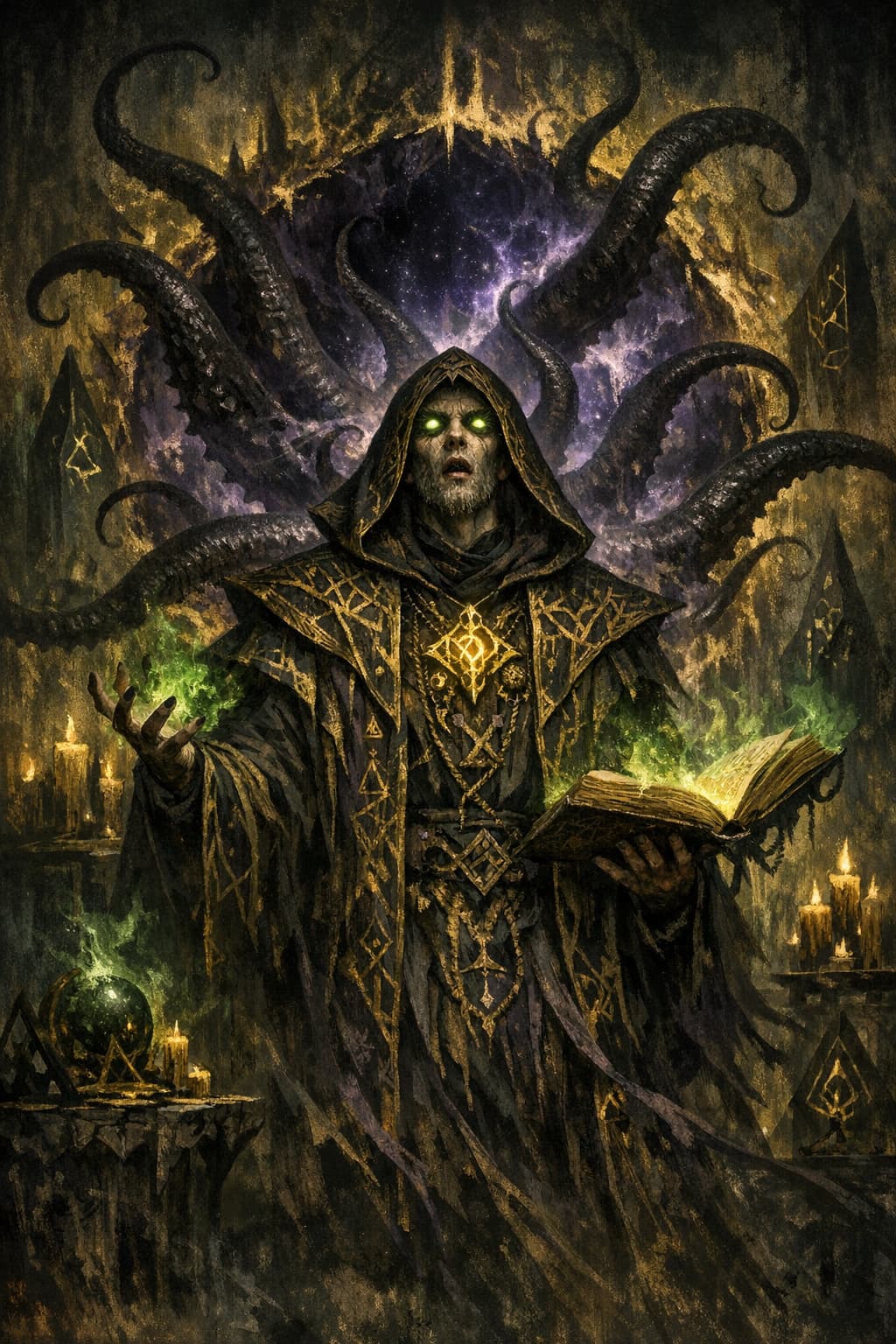
The Great Old One captures Lovecraftian horror in a character class. Your patron might not even know you exist — it's so vast, so alien, that your pact is less a negotiation and more an accident, like an ant gaining power by walking through a god's footprint. Awakened Mind grants telepathy. Thought Shield makes your mind unreadable. Create Thrall lets you charm humanoids into psychic servitude. The Great Old One warlock is the party's resident uncanny valley — human enough to travel with, strange enough to unsettle everyone who looks too closely.
Otherworldly Patrons
The warlock's subclass system — the Otherworldly Patron — defines not just your mechanical abilities but your entire narrative arc. Unlike a fighter choosing a martial archetype or a wizard specializing in a school of magic, the warlock's patron is a character in the story, an entity with desires, goals, and the leverage to enforce them. Choosing a patron is choosing a relationship, and every patron relationship tells a different kind of story.
Fifth edition launched with three patrons — the Archfey, the Fiend, and the Great Old One — and supplements have expanded the roster considerably. Each patron redefines what warlock magic looks like, sounds like, and costs. A Fiend warlock's magic crackles with hellfire and smells of brimstone. An Archfey warlock's spells shimmer with impossible colors and carry the scent of eternal summer. A Great Old One warlock's powers manifest as geometric impossibilities and whispers in dead languages.
The 2024 revision streamlined patron design while maintaining thematic variety. Several patrons received mechanical updates to address long-standing balance concerns (the Archfey's features were widely considered underpowered compared to the Fiend's), and the integration of Pact Boons as core class features rather than competing with invocations freed up design space for more patron-specific invocations.
Warlock Otherworldly Patrons Across Editions and Supplements
| Patron | Source | Core Fantasy |
|---|---|---|
| The Fiend | PHB 2014 / 2024 | Infernal bargain; temp HP on kills, fire and darkness magic, eventual banishment power |
| The Archfey | PHB 2014 / 2024 | Faerie court deal; charm, illusion, teleportation, fey presence and beguiling defenses |
| The Great Old One | PHB 2014 / 2024 | Cosmic horror; telepathy, psychic damage, mind-reading, alien incomprehensibility |
| The Hexblade | Xanathar's Guide | Sentient weapon pact; Charisma-based melee, curse mechanics, spectral armor and weapon |
| The Celestial | Xanathar's Guide | Upper-planes pact; healing light, radiant damage, fire and radiant spell list expansion |
| The Fathomless | Tasha's Cauldron | Deep sea entity; tentacle attacks, water breathing, cold and psychic damage, ocean themed |
| The Genie | Tasha's Cauldron | Elemental lord pact; vessel sanctuary, wish-adjacent capstone, element tied to genie type |
| The Undead | Van Richten's Guide | Undying lord; Form of Dread fear aura, necrotic transformation, spirit projection |
| The Undying | Sword Coast Guide | Lichdom-adjacent; death saves, undead control, disease immunity — widely considered weakest patron |
The Hexblade dominates 5e optimization discussions. The Genie quietly became one of the most versatile and satisfying patrons for actual play.
Cults, Cabals, and Pact-Seekers
Warlocks rarely form large, visible organizations — the nature of their power is too personal, too varied, and too stigmatized for anything resembling a guild or academy. But they do form networks: cabals of practitioners who serve the same patron, support groups for those regretting their bargains, and secret societies that leverage pact magic for political influence. The warlock's social world is built on whispered introductions, coded symbols, and the shared understanding that comes from having looked into the abyss and received a business card.
Patron-based organizations are the most common. A coven of Archfey warlocks might function like a faerie court embassy, mediating between the mortal world and the Feywild. A circle of Fiend pact warlocks might operate as a devil's intelligence network, each member pursuing their own goals while unknowingly advancing their patron's agenda. Great Old One warlocks might not organize at all — their patron doesn't care enough to facilitate introductions, and the warlocks themselves might not realize others share their experience until they recognize the same thousand-yard stare.
In urban settings, warlocks frequently gravitate toward positions that leverage their Charisma and their comfort with moral ambiguity: diplomats, spies, courtesans, criminal fixers, and information brokers. A warlock who can cast Disguise Self at will and read surface thoughts is devastatingly effective in political intrigue. In frontier settings, warlocks might serve as the community's uncomfortable last resort — the person you go to when the cleric's prayers aren't enough and you need someone willing to negotiate with something darker.
Patron Cabals
Secretive circles bound by shared service to a single entity. Members may compete for the patron's favor or cooperate under its direction. Fiend cabals often resemble cults with internal hierarchies. Archfey cabals operate on inscrutable faerie politics. Great Old One cabals tend toward academic circles studying forbidden cosmology — until the whispers get too loud.
The Unbound
Networks of warlocks who have severed or renegotiated their pacts. They retain their powers but no longer answer to a patron — or claim they don't. The Unbound trade knowledge about resisting patron influence, breaking contract clauses, and surviving the backlash. Some are genuinely free. Others have simply traded one patron for a more subtle one.
Pact Boons and Eldritch Foci
The warlock's equipment tells a story of pragmatism layered over the supernatural. With only light armor and simple weapon proficiency, the baseline warlock isn't built for physical combat — they're built for staying alive long enough to let Eldritch Blast do the work. A studded leather jacket, a light crossbow for emergencies, and an arcane focus that doubles as a symbol of your patron's influence. The warlock travels light because the heaviest thing they carry is the deal they've made.
Pact Boons transform the equipment equation entirely. Pact of the Blade conjures any melee weapon from thin air, meaning the warlock's weapon is always available, always magical, and always aesthetically aligned with their patron. A Fiend warlock might summon a sword wreathed in dark flame. An Archfey warlock's blade might be crystallized moonlight. The weapon is both tool and symbol — a constant physical reminder of the pact's reality.
Arcane foci for warlocks tend toward the dramatic and the unsettling. Where a wizard might use a crystal orb or a staff, warlock foci often carry narrative weight: a locket containing a devil's contract, a shard of meteorite that whispers in dead languages, a preserved eye that blinks when danger is near, or a grimoire bound in skin that probably isn't leather. The focus is the warlock's most personal possession — the object that bridges their mortal self and their otherworldly connection.
Iconic Warlock Equipment
| Item | Type | Why It Works |
|---|---|---|
| Rod of the Pact Keeper | Magic Rod | Bonus to spell attack and save DC; regain one spell slot per day — addresses the warlock's core resource tension |
| Eldritch Focus / Component Pouch | Arcane Focus | Required for spellcasting; warlock foci often carry patron-specific aesthetic and narrative weight |
| Studded Leather Armor | Light Armor | Best AC available without multiclassing; the warlock's sole armor option maxes out at 12 + Dex |
| Pact Weapon (Blade) | Conjured Weapon | Summoned from nothing, always magical, can be any melee weapon — flavored to match patron aesthetics |
| Book of Shadows (Tome) | Grimoire | Three cantrips from any class list; with the right invocation, also records rituals from any class |
| Patron Symbol / Talisman | Focus / Flavor | A physical anchor to the pact — contracts, sigils, relics, or gifts that remind the warlock who holds the other end |
Multiclass Synergies
The warlock is one of the most popular multiclass options in 5e, both as a base class and as a dip. The reason is Eldritch Blast plus Agonizing Blast — two levels of warlock give any Charisma-based character a reliable, scaling damage cantrip that rivals many characters' primary attacks. Add in short-rest spell slots that can be used for other class features (like a Paladin's Divine Smite) and you have one of the most efficient two-level investments in the game.
As a base class, the warlock benefits from multiclassing into classes that shore up its weaknesses: limited spell slots, low hit points, and narrow armor proficiency. A single level of Fighter or Paladin provides medium armor, shields, and martial weapons. A few levels of Sorcerer unlock Metamagic, allowing you to Quicken Eldritch Blast for two full sets of beams in one turn — the infamous "Sorlock" build that dominates optimization discussions.
The Hexblade patron warps multiclass calculations because it front-loads so much power into the first level. A Hexblade 1/Paladin X gets Charisma-based weapon attacks, a curse that adds proficiency bonus to damage, and warlock spell slots that recharge on short rest for extra smites. A Hexblade 1/Swords Bard X becomes a single-stat melee combatant with full spellcasting. The Hexblade dip is so universally strong that it has become a meme in optimization communities — "just take a level of Hexblade" being the answer to nearly every build question.
Strong Combinations
Warlock/Sorcerer ("Sorlock"): Convert warlock slots into sorcery points on short rests. Quicken Eldritch Blast for devastating burst damage. The premier sustained damage build in 5e. Hexblade/Paladin: Charisma attacks, short-rest smite slots, curse damage on top of Divine Smite crits. Single-stat SAD melee powerhouse. Warlock/Bard: Two Charisma casters with complementary spell lists. Pact slots fuel Bardic Inspiration recovery, and both classes dominate social encounters.
Popular Dips
Warlock 2 into any Charisma class: Eldritch Blast + Agonizing Blast gives Sorcerers, Bards, and Paladins a reliable ranged option that scales forever. Warlock 3 (Pact of the Tome): Adds ritual casting from any class list to your repertoire — enormous utility for a three-level investment. Any class/Hexblade 1: Medium armor, shields, Charisma weapons, and a curse. The most efficient single-level dip for Charisma-based characters in the game.
Building Your Character
The warlock's ability score priorities are refreshingly simple: Charisma first, and then it depends on your build. Charisma drives your spell attacks, save DCs, and — if you're a Hexblade — your weapon attacks. For a ranged Eldritch Blast warlock, Constitution second (for concentration saves and hit points) and Dexterity third (for AC and initiative). For a Pact of the Blade melee build without Hexblade, you'll need either Strength or Dexterity for weapon attacks, making the build more ability-score hungry.
Your two biggest decisions come at levels 1 and 3: your patron and your Pact Boon. Patron choice determines your subclass features, expanded spell list, and narrative arc. If you want to blast things, the Fiend gives you the best raw damage support. If you want versatility and the best capstone, the Genie is exceptional. If you want to be the party's face and social manipulator, the Archfey and Great Old One both excel. If you want to hit things with a weapon, the Hexblade is the mechanically optimal choice by a significant margin.
Pact Boon choice at level 3 defines your playstyle for the rest of the campaign. Chain gives you the best familiar in the game — an imp that can turn invisible, fly, and use the Help action to give you advantage on attacks. Blade turns you into a melee combatant with a magical weapon that can't be disarmed. Tome gives you the broadest utility, with three extra cantrips and (via the Book of Ancient Secrets invocation) ritual casting from any class list. There's no wrong choice, but there are mismatches — don't take Blade if you have 8 Strength and no Hexblade levels.
Invocation selection is where the warlock's true customization lives. At each level-up that grants a new invocation, you can also swap one existing invocation for another — the warlock is never locked in. Agonizing Blast is nearly mandatory for Eldritch Blast builds. Devil's Sight (seeing in magical darkness) combines devastatingly with the Darkness spell. Eldritch Smite (Blade only) adds force damage and knocks targets prone. Prioritize invocations that you'll use every session over flashy once-per-day options.
Charisma 16, Constitution 14, Dexterity 14. Choose the Fiend patron and pick Eldritch Blast as your cantrip. At level 2, take Agonizing Blast and Repelling Blast invocations. At level 3, choose Pact of the Tome for utility or Pact of the Chain for a scouting imp. Hex is your go-to concentration spell. You're done — point, blast, collect temporary hit points from the fallen.
Famous Warlocks in Fiction
The warlock archetype — power gained through dark bargains, forbidden pacts, and deals with entities that operate on a fundamentally different moral axis — has produced some of fiction's most compelling characters. What unites them isn't a spell list or a set of mechanics but a shared dramatic question: what happens when a person's power belongs to something else? The best warlock characters across novels, games, television, and film grapple with that question in ways that resonate far beyond the fantasy genre.
In tabletop-adjacent media, the warlock has become one of the most popular character archetypes precisely because the patron relationship generates conflict automatically. You don't need a DM to manufacture tension when your character's power source has its own agenda. Wyll in Baldur's Gate 3 can't separate his heroism from the devil who enabled it. Fjord in Critical Role spent an entire campaign arc wrestling with a patron who wanted to drown the world. The warlock writes its own drama.
Beyond explicitly labeled warlocks, the archetype appears wherever characters gain power through transactions with forces they can't fully control. Daenerys Targaryen's dragons are familiars granted by an ancient pact with fire and blood. John Constantine negotiates with demons the way a warlock negotiates with a patron — always one bad deal away from damnation. Willow Rosenberg's Season 6 arc in Buffy is a warlock cautionary tale: power drawn from dark sources without understanding the cost. The warlock is everywhere once you learn to see it.
Iconic Warlock-Archetype Characters Across Fiction
| Character | Source | Why They Matter |
|---|---|---|
| Wyll | Baldur's Gate 3 | The Blade of Frontiers, pacted with the devil Mizora. Embodies the warlock's central tension: genuine heroism powered by an infernal contract, with every good deed shadowed by the question of who really benefits. |
| Fjord | Critical Role (Campaign 2) | Travis Willingham's half-orc Hexblade warlock. His patron drama — from Uk'otoa's oceanic hunger to the eventual pact renegotiation — demonstrated how the patron relationship can drive an entire character arc across hundreds of hours of play. |
| Faust | German legend (Marlowe, Goethe) | The original pact-maker who sold his soul for knowledge and worldly power. Every warlock character descends from this bargain, and every patron relationship echoes the question Faust could never answer: was it worth it? |
| Elric of Melnibone | Michael Moorcock's Elric Saga | Wielder of Stormbringer, a soul-drinking sword that grants power at terrible cost. Elric is the warlock as tragic antihero — bound to a patron-weapon he despises but cannot abandon, because without it he is nothing. |
| Willow Rosenberg | Buffy the Vampire Slayer (Season 6) | A cautionary tale of drawing on dark power without understanding the price. Willow's descent into dark magic is the warlock's "too much too fast" arc — the moment when the power stops being a tool and starts being an addiction. |
| John Constantine | DC Comics / Hellblazer | Occultist who makes deals with demons and angels alike, always gambling that he can outwit entities who have been playing the game for millennia. Constantine is the warlock as con artist — surviving not through power but through leverage and bluff. |
| Daenerys Targaryen | Game of Thrones / A Song of Ice and Fire | Born with power tied to ancient pacts of fire and blood, her dragons functioning as familiars granted by legacy rather than negotiation. The warlock whose patron is inheritance itself — and whose power ultimately consumes her. |
Across RPGs & Video Games
The warlock archetype — power acquired through pacts, dark bargains, and relationships with entities beyond mortal comprehension — appears across virtually every major RPG and video game franchise, though it wears different names and mechanics in each. What remains constant is the core fantasy: you have power that comes from somewhere else, and that somewhere else has opinions about how you use it. The mechanical expression varies enormously, but the dramatic engine is always the same.
In tabletop RPGs, D&D 5e's warlock is the most mechanically distinctive version, with its short-rest Pact Magic and Eldritch Invocation system creating a caster that plays unlike any other. Pathfinder 2e approaches the pact fantasy through the Witch class, emphasizing the familiar and patron hexes rather than eldritch blasting. Neither system has fully solved the design challenge of making "borrowed power" feel mechanically different from "earned power," but both create characters whose magic carries narrative weight that other casters lack.
Video games tend to simplify the patron relationship into aesthetic flavor while focusing on the warlock's mechanical identity: damage over time, summoned minions, and dark-themed abilities. World of Warcraft's warlock is defined by curses, demons, and Soul Shards. Diablo's necromancer captures the "power from dark sources" theme through undead armies and life-draining magic. Dragon Age's blood mage — a mage who bargains with demons for forbidden power — is perhaps the closest video game analogue to the D&D warlock's moral complexity, because the game actually judges you for the choice.
The Warlock Archetype Across Franchises
| Franchise | Class / Role | Key Mechanic | Key Distinction |
|---|---|---|---|
| D&D 5e | Warlock | Pact Magic (short-rest slots), Eldritch Invocations, Pact Boons (Blade, Chain, Tome) | The only TTRPG caster with a fundamentally different spellcasting economy; patron as narrative co-star |
| Pathfinder 2e | Witch (+ Oracle) | Patron-granted hexes, familiar-focused casting; Oracle uses cursed power | No direct warlock equivalent, but the Witch captures the pact fantasy through familiar mechanics and patron lessons |
| World of Warcraft | Warlock | Affliction (DoTs/curses), Demonology (summoning), Destruction (fire/chaos); Soul Shards resource | Permanent demon pet and Soul Shard economy; the warlock as dark summoner rather than pact negotiator |
| Diablo | Necromancer | Summoning, dark pacts, life-and-death magic; corpse and essence mechanics | Closest to the warlock's "power from dark sources" theme; the bargain is with death itself rather than a specific entity |
| Dragon Age | Blood Mage | Forbidden magic powered by blood sacrifice; demon bargains for power and knowledge | The mage who bargains with demons mirrors the warlock pact directly; the game enforces narrative consequences for the choice |
| Elder Scrolls | Daedric Worshipper / Conjurer | Daedric pacts for artifacts and power; Conjuration school summons bound entities | The pact is transactional — Daedric Princes offer power in exchange for service, and the relationship is explicitly contractual |
The warlock's mechanical identity varies more across franchises than almost any other class archetype. What stays constant is the dramatic question: who really controls the power?
The Warlock at the Table
The patron relationship is the warlock's greatest storytelling asset, and DMs who treat it as a passive background detail are leaving the class's best material on the table. A patron should be an active presence in the campaign — not necessarily appearing every session, but making its existence felt through dreams, omens, demands, and consequences. The patron doesn't need to be adversarial, but it should want something, and what it wants should occasionally conflict with what the party needs. That friction is where the best warlock stories live.
For players, the warlock's limited spell slots are a feature, not a bug. Eldritch Blast is your reliable damage — consistent, scaling, and enhanced by invocations into something genuinely formidable. Your spell slots are for the moments that matter: the Counterspell that saves the party, the Banishment that removes the boss, the Hypnotic Pattern that turns an impossible fight into a manageable one. Learning when to blast and when to burn a slot is the skill ceiling that separates adequate warlocks from exceptional ones.
Communication between player and DM is essential for making the warlock work. Before the campaign starts, establish the patron's personality, communication style, and goals. Discuss how much screen time the patron should get and whether the patron's demands will create inter-party conflict. A player who wants their patron to be a background flavor element and a DM who wants it to be a central antagonist will create frustration on both sides. Align expectations early, and the warlock becomes the campaign's richest source of personal drama.
Use patron quests and demands to create personal story arcs that tie into the main campaign. A Fiend patron might require the warlock to retrieve a soul gem from a dungeon the party was already planning to explore — aligning patron goals with party goals creates drama without derailing the story. When the patron's interests diverge from the party's, give the warlock a meaningful choice rather than a mandate. The best warlock encounters force the player to weigh loyalty to their patron against loyalty to their companions, with genuine consequences for either decision.
The Warlock in World-Building
Incorporating warlocks into your setting means deciding how the universe handles consent, contracts, and the gap between mortal and immortal interests. A warlock exists because an otherworldly entity decided that a mortal was useful — or amusing, or pitiable, or simply in the wrong place at the wrong time. What does it mean for your world that these transactions are possible? Is pact magic common enough that there are lawyers who specialize in patron contracts? Or is it so rare that a warlock is treated as a singular aberration?
The patron relationship creates worldbuilding opportunities that no other class provides. Every warlock is a thread connecting the mortal world to something beyond it. A Fiend patron implies that the Nine Hells (or your setting's equivalent) actively recruits mortal agents. An Archfey patron means the Feywild has interests in mortal affairs. A Great Old One patron suggests that cosmic entities of incomprehensible scale exist at the edges of reality. Each warlock in your setting is evidence that these planes and entities are real, active, and interested.
Consider the institutional response to warlock pacts. Does your setting have an Inquisition that hunts pact-makers? A regulatory body that licenses them? A black market for patron introductions? The more developed the institutional response, the more the warlock feels like part of the world rather than an exception to it. A setting where warlock pacts are illegal but common creates noir-style stories. A setting where they're legal but regulated creates bureaucratic horror. A setting where they're unheard-of creates isolated terror.
The most compelling worldbuilding question the warlock raises is this: what do the patrons want? Not individually — most DMs have an answer for that — but collectively. Why are otherworldly entities investing power in mortal agents? Is there a war between patrons that plays out through warlock proxies? Is the mortal world a chessboard, and warlocks are the pieces? Or are patrons simply bored immortals entertaining themselves by empowering mortals and watching what happens? The answer shapes the cosmological stakes of your entire setting.
“Every warlock pact is a thread stitched between worlds. Pull on enough of them and the veil between mortal and immortal stops being a wall and starts being a curtain — thin, translucent, and easily torn.”
— On the cosmological implications of pact magic
FAQ
Common Questions
Pact Magic differs from other spellcasting in three key ways. First, warlocks have very few spell slots (1-4) but recover them all on a short rest instead of a long rest. Second, all warlock spell slots are always at your highest available level — you can't choose to cast at a lower level. Third, warlocks supplement their limited slots with Eldritch Invocations (passive abilities) and at-will cantrips, especially Eldritch Blast. This makes warlocks consistent damage dealers who spike with their slots rather than rationing a large pool across the day.
Eldritch Blast is a cantrip that deals d10 force damage and fires additional beams as you level (two at 5th, three at 11th, four at 17th level). On its own, it's a solid attack. Combined with Eldritch Invocations, it becomes extraordinary: Agonizing Blast adds Charisma to each beam's damage, Repelling Blast pushes targets 10 feet per hit, and other invocations add slowing, pulling, or bonus effects. Since warlocks have so few spell slots, Eldritch Blast serves as their primary action nearly every turn, and invocations ensure it scales to rival any class's sustained damage output.
A warlock is a spellcasting class that derives its magical power from a pact with an otherworldly entity known as a patron. Unlike wizards who study magic or sorcerers who inherit it, warlocks acquire power through a bargain — trading service, loyalty, or something more personal in exchange for arcane abilities. Warlocks use a unique Pact Magic system with few spell slots that recharge on short rests, rely heavily on the Eldritch Blast cantrip, and customize their abilities through Eldritch Invocations and Pact Boons.
The Hexblade is widely considered the most mechanically powerful patron due to Charisma-based weapon attacks and the Hexblade's Curse feature. The Fiend is the strongest blaster patron, granting temporary hit points on kills and excellent damage spells. The Genie (from Tasha's Cauldron) offers outstanding versatility with its vessel sanctuary and elemental damage riders. For roleplay-focused games, the Great Old One and Archfey provide the richest narrative hooks. The Celestial is the only patron that lets warlocks serve as backup healers.
Pact Boons are gained at level 3 and define your warlock's playstyle. Pact of the Chain gives you an enhanced familiar (imp, pseudodragon, sprite, or quasit) that can attack and scout. Pact of the Blade lets you conjure any melee weapon and is essential for melee warlock builds. Pact of the Tome grants three extra cantrips from any class and enables ritual casting via the Book of Ancient Secrets invocation. Choose Chain for scouting and support, Blade for melee combat (especially with Hexblade), or Tome for maximum utility and spell versatility.
A single level of Hexblade warlock provides medium armor proficiency, shield proficiency, Charisma-based weapon attacks, and the Hexblade's Curse (bonus damage and expanded crit range against one target). For any Charisma-based class — Paladin, Sorcerer, Bard — this is an extraordinarily efficient investment. Paladins get Charisma-based attacks and short-rest spell slots for extra smites. Sorcerers get armor and a reliable weapon option. Bards get combat viability without splitting ability scores. It's so universally strong that "just dip Hexblade" became a running joke in optimization communities.
Pact Magic spell slots cap at 5th level. For higher-level spells (6th through 9th), warlocks gain Mystic Arcanum — one spell of each level that can be cast once per long rest without using a spell slot. You choose one 6th-level spell at level 11, one 7th-level spell at level 13, one 8th-level spell at level 15, and one 9th-level spell at level 17. These cannot be swapped for other spells of the same level on a short rest and don't benefit from Pact Magic's short rest recharge. They function more like a sorcerer's or cleric's highest-level slots.
The patron relationship is the warlock's richest roleplaying opportunity. Work with your DM to establish how your patron communicates (dreams, whispers, omens, direct conversation), what it wants from you (souls, information, influence, entertainment), and how much control it exerts. Consider whether your warlock made the pact willingly, desperately, or unknowingly. Play the tension: your power isn't yours, and the entity that lent it to you has its own agenda. The best warlock roleplay comes from moments when your patron's goals conflict with your party's — or with your own conscience.