
Changelings
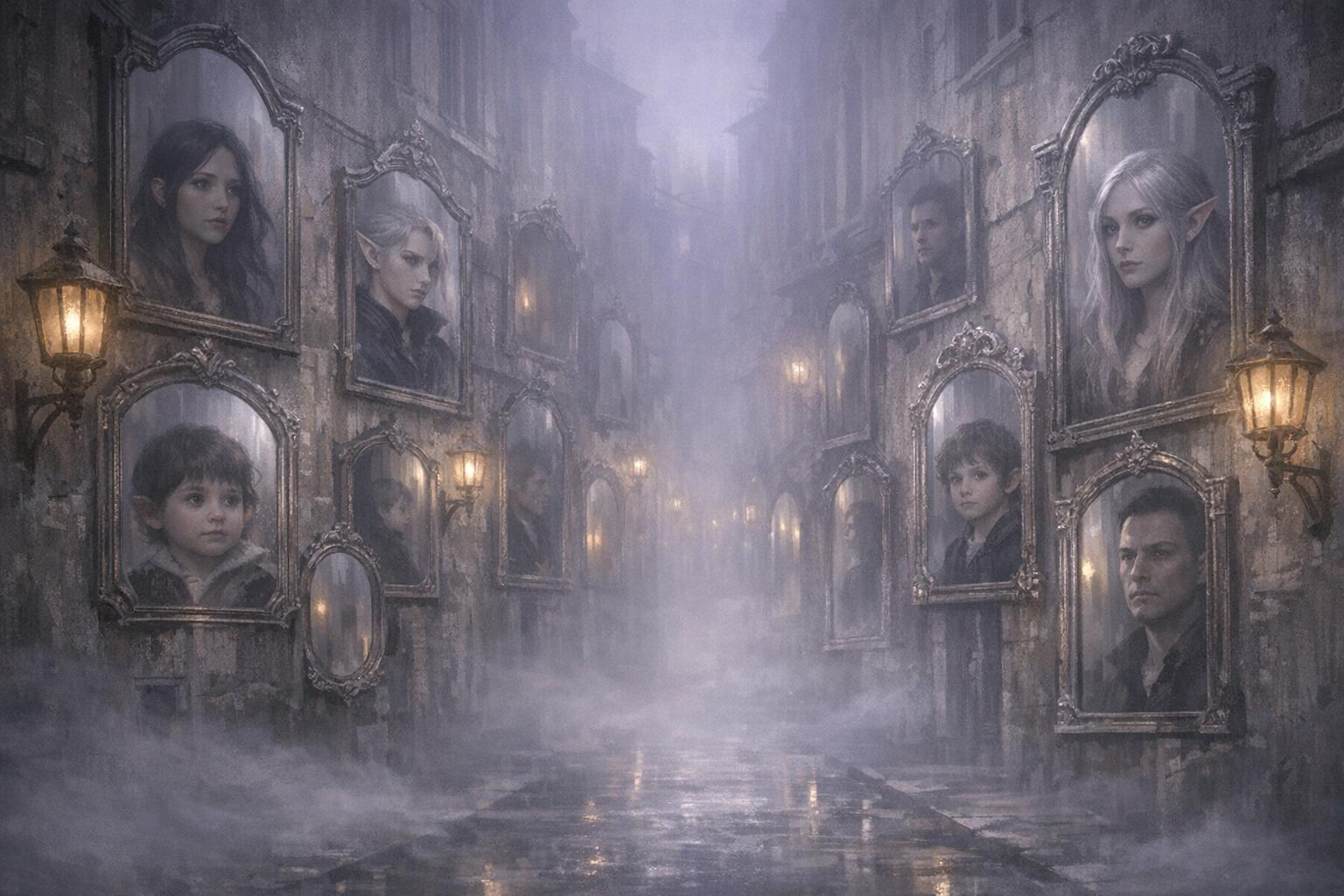
Shapeshifters who wear identity like clothing — every face a truth, every mask a confession, and underneath it all the question nobody can answer: is there a bottom to the stack?
Folklore Roots & the Stolen Child
The changeling myth predates fantasy gaming by centuries. In Irish, Scottish, Welsh, and Scandinavian folklore, a changeling was a fairy creature left in place of a stolen human child — a swap performed in the cradle while the parents slept. The child the fairies left behind looked wrong. It cried too much, ate too much, didn't grow the way it should. The folklore was an explanation for developmental differences, failure to thrive, and the uncanny feeling that something about your child had changed overnight.
The real-world consequences of the changeling myth were brutal. Children suspected of being changelings were subjected to ordeals — exposure to cold, placement on hot shovels, abandonment in the woods — designed to force the fairy to reveal itself or to compel the fairies to return the "real" child. These weren't fairy tales in the whimsical sense. They were frameworks that justified violence against vulnerable children, and understanding that context gives D&D's changeling species a darker undertone than most players realize.
D&D's changelings diverge from folklore in a critical way: they aren't replacements. They aren't stolen children or fairy duplicates. They're a species in their own right, with their own biology and culture. But the folklore resonance lingers. The fear that someone isn't who they appear to be, the suspicion that the familiar face masks something alien — changelings in D&D still trigger these anxieties, and the best campaigns use that discomfort intentionally rather than accidentally.
Changelings entered D&D through Eberron, Keith Baker's pulp-noir campaign setting, which debuted in the Eberron Campaign Setting sourcebook in 2004. Baker designed changelings as a species native to Eberron — not planar visitors, not cursed humans, but people who evolved (or were created) with the innate ability to reshape their physical form. The setting treated shapeshifting as biology, not magic, which had enormous implications for how changelings fit into the world.
In Eberron's lore, changelings are believed to descend from humans and doppelgangers, though the truth is murkier. The species emerged during the Age of Monsters as a distinct people, eventually migrating into human-dominated Khorvaire where their shapeshifting allowed them to integrate — or infiltrate, depending on who's telling the story. During the Last War, changeling spies were invaluable to every nation and trusted by none. The war ended but the suspicion didn't.
Baker's design philosophy for changelings centered on identity as performance. Every changeling maintains multiple personas — faces, names, personalities, entire lives — and no single persona is inherently more "real" than the others. This wasn't treated as deception but as a fundamentally different relationship with selfhood. Humans have one face and consider it authentic. Changelings have many faces and consider all of them authentic. Neither perspective is wrong; they're just different answers to the question of what identity means.
The Changeling Myth Across Cultures
| Tradition | Term | Mechanism | Purpose of the Myth |
|---|---|---|---|
| Irish | Changeling / Siofra | Fairy swaps infant in the cradle | Explained developmental differences; justified exposure ordeals |
| Scottish | Changeling / Sibhreach | Fairy substitution of a sickly fae | Rationalized childhood illness and infant mortality |
| Scandinavian | Bytting | Troll replaces human baby with its own | Community boundary-policing; fear of the outsider within |
| Welsh | Plentyn Newid | Tylwyth Teg steal beautiful children | Reinforced fairy faith; children "taken" to the Otherworld |
| German | Wechselbalg | Devil or elf leaves substitute child | Martin Luther endorsed the belief; connected to demonic theology |
The consistent element across every tradition: the changeling looks like one of us but isn't. D&D flips this — changelings look like anyone, but they are always themselves.
“A changeling doesn't wear masks to hide who they are. They wear masks because all faces are masks — yours included. The only difference is that a changeling gets to choose.”
— Keith Baker, on changeling identity
Publication History Across Editions
Unlike elves or dwarves, changelings have a precise birthday in D&D: June 2004, when the Eberron Campaign Setting hit shelves. They were setting-specific from day one, which gave them a coherent identity but limited their reach. For years, changelings existed only in Eberron supplements, invisible to players running Forgotten Realms or Greyhawk campaigns. The species spent a decade and a half as Eberron's best-kept secret.
The breakthrough came with Eberron: Rising from the Last War (2019), which brought Eberron's species into 5th Edition with full mechanical support. Changelings became accessible to the broader D&D community, and players discovered what Eberron fans already knew: a species built around identity and performance creates roleplay opportunities that no other species matches. The 2024 rules haven't yet included changelings in the core PHB, but their presence in the broader 5e ecosystem is secure.
The doppelganger — changelings' monstrous cousin — has existed in D&D since the original Monster Manual (1977). Doppelgangers are shapeshifters too, but they're telepathic predators who replace people for personal gain. The relationship between changelings and doppelgangers is like the relationship between dogs and wolves: shared ancestry, dramatically different social contracts. Changelings live among other species as participants. Doppelgangers infiltrate as parasites. The distinction matters because it's the difference between community and predation.
Doppelganger in the Monster Manual
The shapeshifting doppelganger debuts as a monster. Telepathic, predatory, and capable of assuming any humanoid form. The ancestral template for what changelings would become.
Eberron Campaign Setting (3.5e)
Changelings debut as a playable species unique to Eberron. Keith Baker establishes their biology, culture, and the concept of personas as authentic identities.
Eberron Player's Guide (4e)
Changelings adapted to 4th Edition mechanics. Changeling Trick power lets them gain combat advantage through deception — the first mechanical expression of social shapeshifting in combat.
Eberron: Rising from the Last War (5e)
Changelings arrive in 5th Edition with Shapechanger trait and flexible ability scores. The broader D&D community encounters them for the first time outside Eberron-specific play.
Tasha's Cauldron of Everything
Custom lineage rules let any character use changeling-adjacent mechanics. The flexible ASI model that changelings pioneered becomes the standard for all species.
Biology of Shapeshifting
Changeling shapeshifting is biological, not magical. This is the single most important fact about how they work, and most people get it wrong. A changeling's body is physically malleable — their flesh, bone, and cartilage can restructure in seconds. Detect magic doesn't reveal a shifted changeling. Antimagic fields don't revert them. Dispel magic does nothing. The face they're wearing is physically real. The body underneath is physically real. There's no illusion to pierce because there's no illusion. There's just a body that does something other bodies can't.
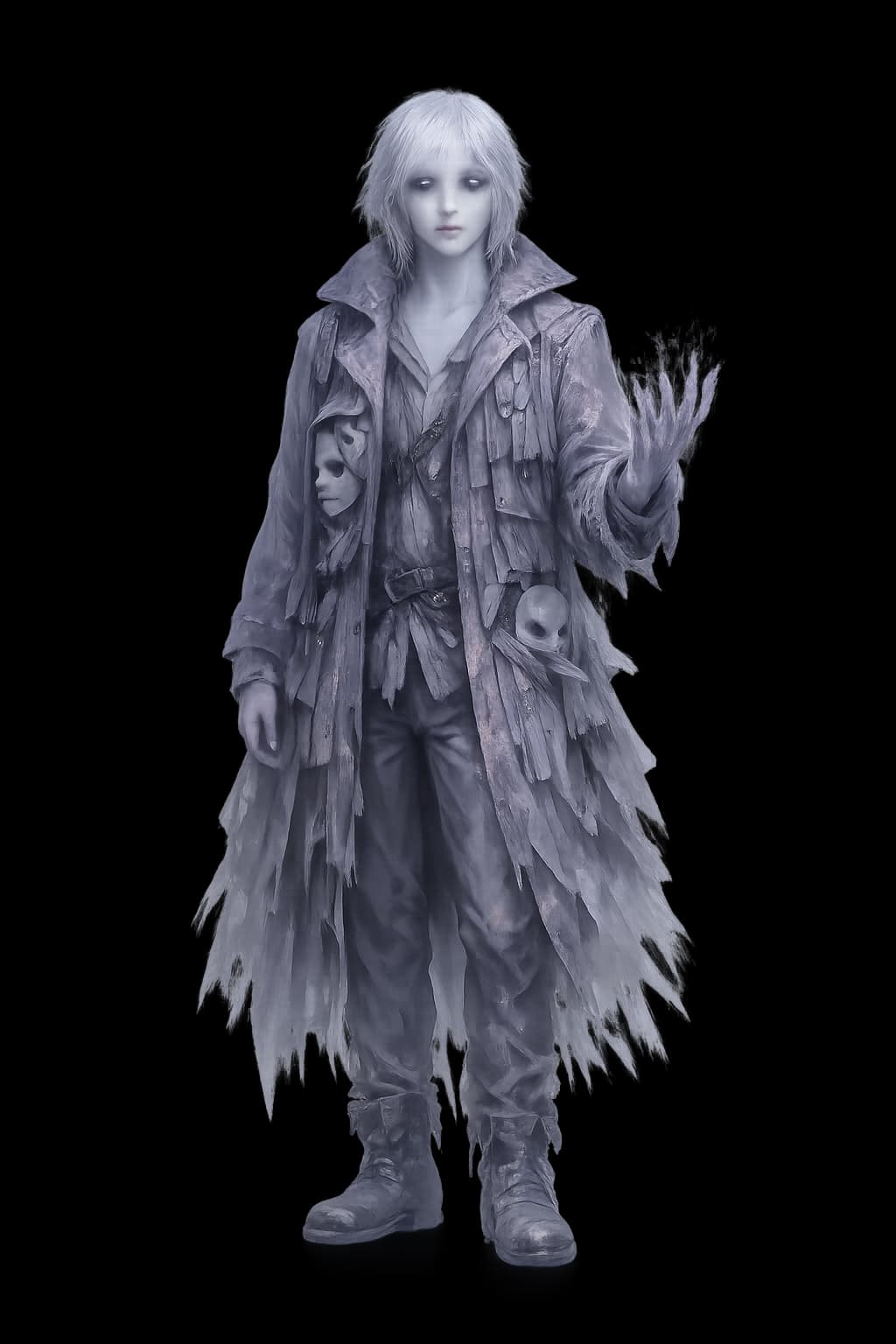
In their natural form — if "natural" even applies — changelings present as pale-skinned humanoids with white or light silver hair and colorless eyes. Their features are soft, almost unfinished-looking, as though the face is a sketch waiting for detail. Most changelings spend very little time in this form outside of safe spaces. It isn't that they're ashamed of it. It's that their natural form is conspicuous in a way that defeats the purpose of being a changeling. You might as well wear a sign that reads "shapeshifter."
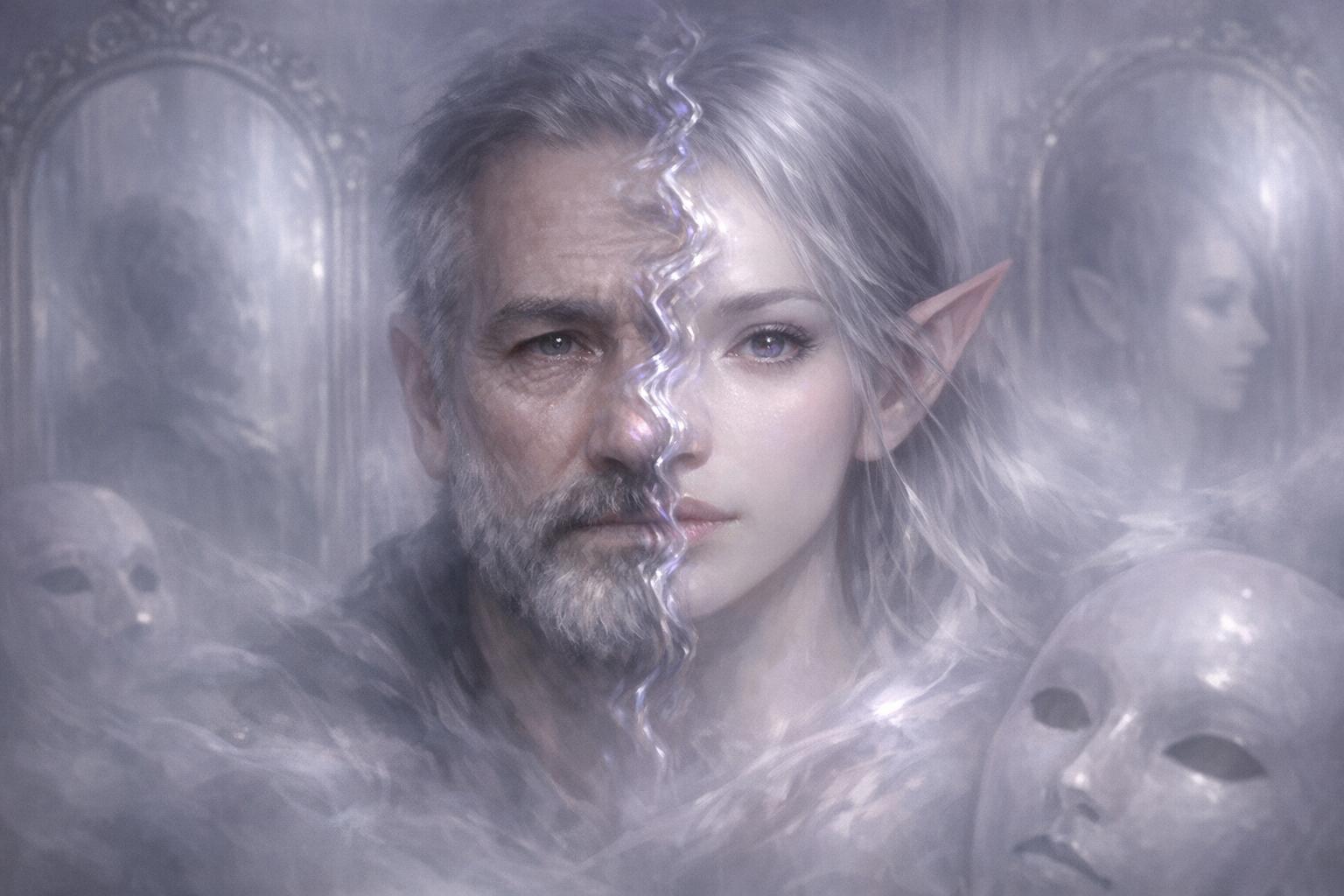
The shift itself takes about a second, involves no visible transformation effect (no shimmer, no morphing — just one face replacing another between blinks), and can alter height, weight, coloring, facial features, apparent age, and apparent sex. Changelings cannot replicate specific individuals without study, and they can't change their fundamental body plan — no extra limbs, no wings, no becoming a different creature type. They work within the humanoid template, but within that template, almost anything is possible.
The Shift
A changeling shifts the way you blink — quickly, reflexively, and with so little visible process that bystanders miss it if they aren't watching. One heartbeat you're looking at a dwarven merchant. The next heartbeat, same body, same clothes, but the face is an elven scholar. The transition is seamless because there is no transition. The body simply reconfigures.
Children learn to shift instinctively, often before they learn to speak. Changeling parents deal with infants who cycle through faces in their sleep — a phenomenon both endearing and deeply unsettling to non-changeling caregivers. Control comes with maturity. Most changeling adolescents have established their primary personas by their teens, though the personas themselves continue to evolve throughout life.
Personas as Architecture
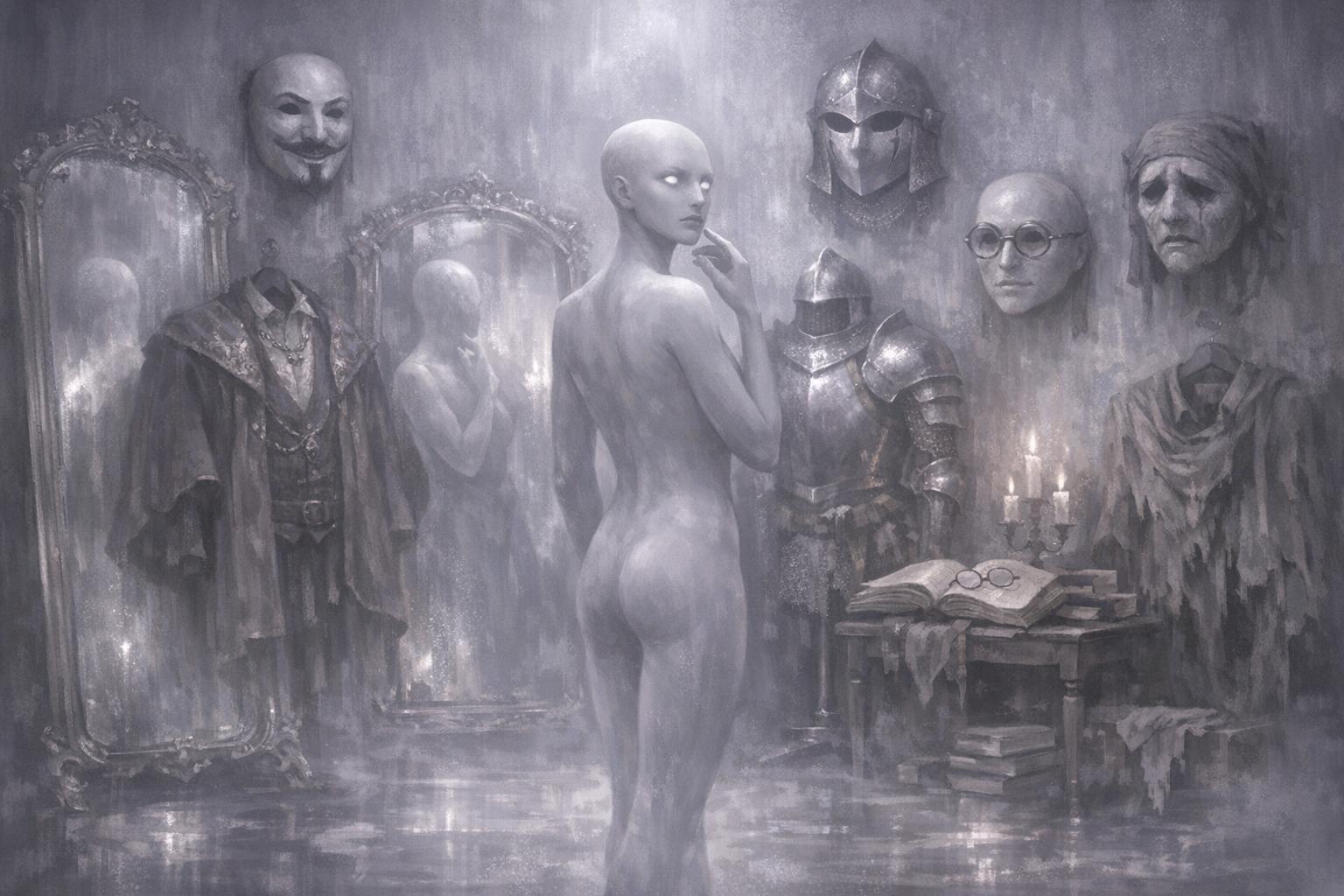
A persona isn't just a face. It's a complete identity — name, mannerisms, voice, posture, history, relationships. Experienced changelings maintain three to six personas simultaneously, each with its own social circle, reputation, and function. One persona handles business. Another maintains friendships. A third pursues a romantic relationship. A fourth might be the face they wear when they need to disappear.
Building a persona takes time. A quick shift can change your face in a crowd, but establishing a persona that withstands scrutiny requires weeks of observation, practice, and gradual social integration. Changelings refer to this process as "building a life," and they approach it with the care and craftsmanship that a woodworker brings to a chair. A well-built persona feels lived-in. A shoddy one collapses under pressure.
Empathic Intuition
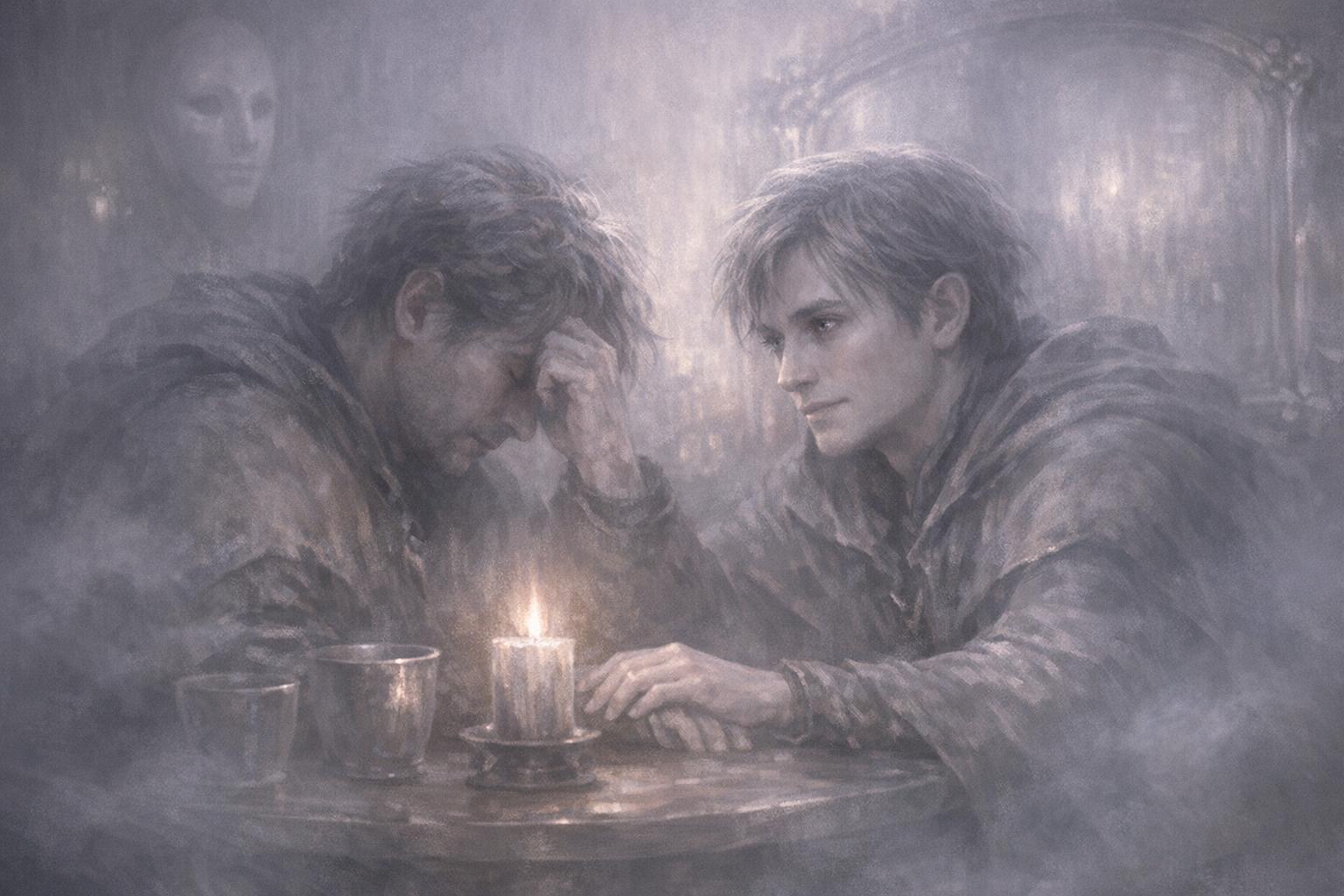
Changelings possess a heightened sensitivity to emotional cues that borders on — but technically isn't — telepathy. They read micro-expressions, body language, vocal tone, and physiological stress responses with an accuracy that feels supernatural. In Eberron's lore, this likely derives from their doppelganger ancestry, which included full telepathy. Changelings got the perceptive half without the projective half.
This empathic sense makes changelings devastating in social encounters. They know when someone is lying, when someone is afraid, when someone's friendliness is genuine versus performed. Combined with their shapeshifting, it means a changeling in conversation holds almost every card. They can become the person you want to see while knowing exactly what you're feeling. Whether they use that advantage kindly or cruelly is the character question that defines every changeling.
Psychology of a Fluid Self
The question that non-changelings always ask — "but who are you really?" — reveals a fundamental assumption that changelings don't share. Humans assume identity is singular and fixed. You have one true self, and everything else is performance. Changelings experience identity as plural and fluid. Every persona is a real expression of who they are. Asking "which one is the real you" is like asking "which of your moods is the real mood?" The question doesn't parse.
This isn't dissociative identity disorder or psychological fragmentation. Changeling psychology is integrated — they know all their personas are them. The cobbler persona, the spy persona, the friend persona — they share memories, values, and continuity of experience. What shifts is the expression, not the core. Think of it less like wearing masks and more like speaking multiple languages. You're the same person in French and in Elvish. You just express different things differently.
The psychological challenge for changelings isn't knowing who they are. It's navigating a world that demands they pick one answer and stick with it. Legal systems want one name. Relationships want one face. Communities want one neighbor. The changeling who maintains six personas isn't confused about their identity — they're frustrated by a social infrastructure built for beings who can only be one thing at a time.
Changeling children raised in changeling families tend to be psychologically healthy about their shifting nature. Those raised by non-changeling parents — adopted, orphaned, or hidden — often struggle with the gap between how they experience themselves and how the world insists they should. The child who shifts in their sleep and wakes to a panicking foster parent learns very quickly that what comes naturally to them terrifies everyone else.
“You ask which face is real as though you only have one. I have seen you at work, at home, with your mother, with your lover. Four faces. You just can't take yours off between visits.”
Daily Life & the Culture of Masks
A typical changeling day involves at least two persona transitions, often more. The morning begins in whatever form serves the first task — perhaps the half-elf artisan who opens a shop at dawn. Midday might require a shift to the human courier who carries messages across the city. Evening could bring the dwarf regular at a particular tavern, maintaining a social life that the artisan and courier don't share. Each transition is practiced, fluid, and utterly invisible to bystanders.
The logistical demands are considerable. Each persona needs separate living arrangements, or at least separate entry and exit routes from shared space. Wardrobes must be maintained for different body types. Social calendars can't overlap — the artisan can't be seen in the same place as the courier. Changelings develop extraordinary organizational skills by necessity, maintaining mental maps of who knows what, where each persona has been seen, and which identities can safely intersect.
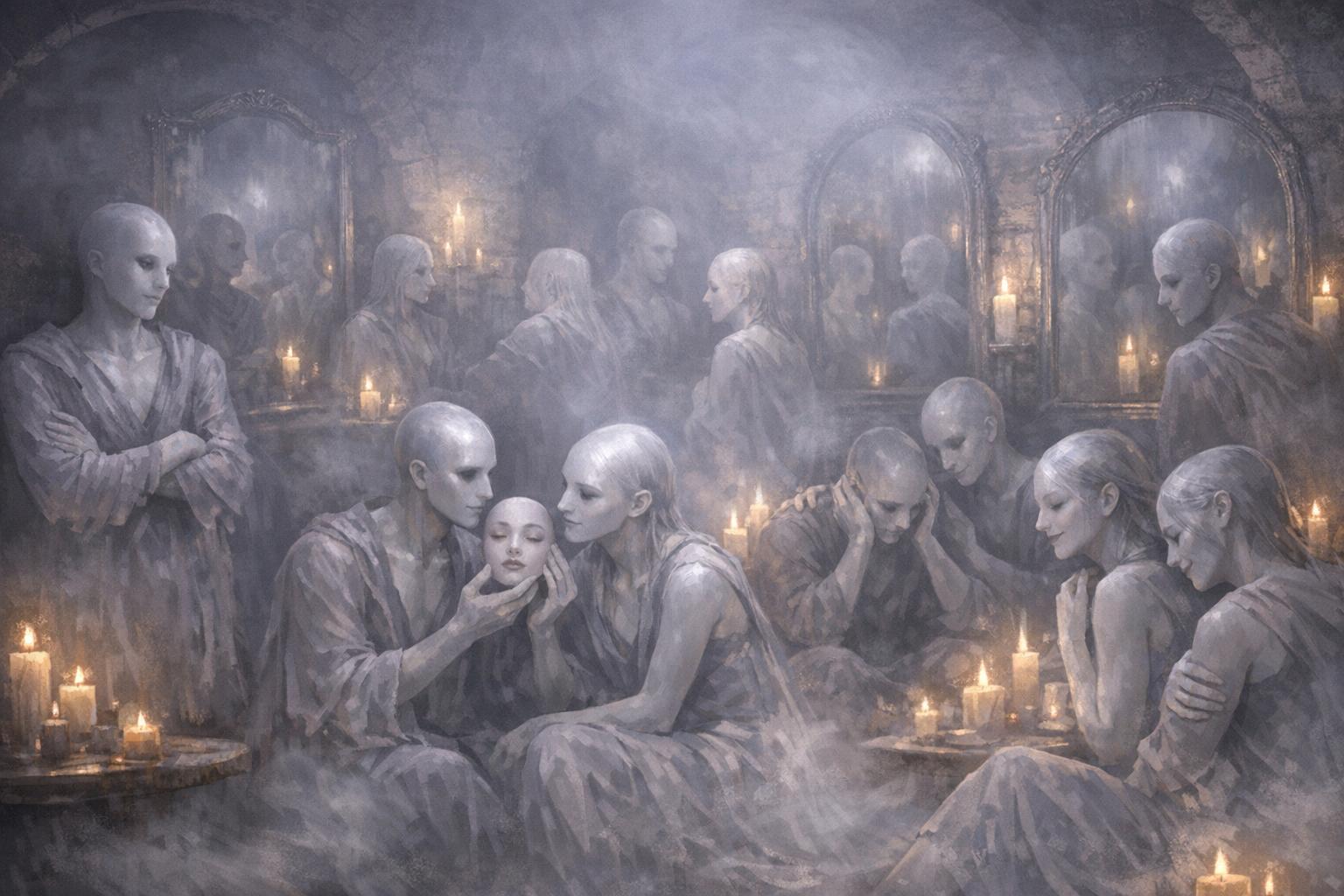
Meals are often the only honest moments in a changeling's day. In safe spaces — changeling gathering places, or alone in a locked room — they drop all personas and exist in their natural form. These moments aren't relief from deception. They're more like stretching after holding a position for too long. The personas are comfortable, but the body appreciates a moment without shape.
Changeling children complicate logistics exponentially. A child who hasn't learned full control might shift in public, revealing the family secret. Changeling parents teach control the way human parents teach manners — through repetition, gentle correction, and the occasional panicked grab when the toddler starts growing pointed ears in the middle of a market. Mixed families, where one parent is changeling and one isn't, face the additional challenge of explaining to a non-changeling partner why their infant keeps waking up with a different face.
Changeling culture — to the extent a dispersed, hidden species can be said to have unified culture — revolves around the concept of the Mask. Not a physical mask, but the philosophical framework that treats every persona as a legitimate expression of self. In Eberron's changeling communities, "wearing a mask" isn't deception. It's art. The quality of a persona is judged by the same criteria an actor uses: consistency, believability, emotional truth, and the ability to sustain the performance under pressure.
The three major changeling philosophical traditions in Eberron reflect different relationships with masking. The Passers integrate fully into other species' societies, maintaining a single non-changeling identity and hiding their true nature even from close friends. The Becomers embrace fluid identity, cycling through personas and treating each as equally valid. The Reality Seekers pursue the question of whether an authentic, unmasked self exists beneath the shifting — a philosophical quest that some changelings devote their entire lives to without resolution.
Passers & Becomers
Passers want stability. They pick a face, build a life around it, and maintain that life with the commitment of a deep-cover operative. Some Passers go decades without shifting, suppressing their nature so thoroughly that they half-forget they're changeling at all. The appeal is belonging — being a member of a community rather than a visitor in one. The cost is that the life they've built collapses if the mask slips.
Becomers represent the opposite extreme. They cycle through personas freely, treating identity as situational rather than permanent. A Becomer might live as a human merchant for three years, then become a halfling sailor for two, then an elven scholar for five. Each life is sincere while it lasts. None is meant to last forever. Becomers tend to be more psychologically resilient than Passers but less socially anchored.
Reality Seekers
Reality Seekers ask the hardest question: stripped of every persona, what remains? Is there a "true" changeling underneath the shifting, or is the shifting itself the truth? Some Reality Seekers spend years in their natural form, trying to discover who they are without a mask. Others study philosophy, meditation, or magic, seeking tools to examine the self beneath the surface.
The tradition has no consensus answer, which is the point. Some Reality Seekers conclude that the question is unanswerable and find peace in the uncertainty. Others decide that every persona is equally real and stop looking for a singular truth. A few have breakdowns when the search yields nothing. The journey matters more than the destination, and the journey itself is what makes Reality Seekers the most philosophically interesting tradition in changeling culture.
A changeling player character might maintain a "party persona" — the face the adventuring group knows — and several civilian personas for downtime. What happens when a downtime persona gets into trouble that the adventuring persona has to solve? What happens when a party member accidentally encounters the changeling in a different face? The logistics of maintaining multiple lives create drama without requiring combat or external threats.
Religion & the Traveler
In Eberron, the deity most associated with changelings is the Traveler — one of the Dark Six, the shadowy counterpart to the Sovereign Host. The Traveler's portfolio includes change, deception, innovation, and evolution. Unlike most D&D gods, the Traveler has no fixed form, no consistent depiction, and no organized church. Worshippers don't build temples. They leave offerings at crossroads and recognize the Traveler's influence in moments of unexpected transformation.
The theological fit is obvious. A species defined by transformation worships a god defined by transformation. But the relationship is more nuanced than simple affinity. The Traveler doesn't demand worship. The Traveler doesn't even confirm existence in the way other gods do through clerical magic and divine intervention. Faith in the Traveler is faith in the principle of change itself — faith that flux is not chaos but possibility, that the next face you wear might be the one that saves your life.
Not all changelings worship the Traveler, and not all Traveler worshippers are changelings. Some changelings gravitate toward Boldrei (community and home — the stability they struggle to maintain) or Olladra (luck and fortune — the randomness that governs their daily survival). A changeling cleric of the Silver Flame presents a fascinating contradiction: a shapeshifter devoted to a faith that values transparency and truth. The tension is the point.
Outside Eberron, changeling spirituality adapts to whatever pantheon the setting provides. Gods of trickery, secrets, and change attract changeling worshippers naturally. But some of the most interesting changeling characters worship gods of truth and justice — not despite their shapeshifting nature, but because they understand better than anyone how fragile truth is and how much effort it takes to maintain.
In settings without the Traveler, changeling religion becomes a worldbuilding opportunity. Does your pantheon include a god of identity, transformation, or masks? If not, how do changelings relate to existing gods? A changeling worshipping a god of truth is a paradox. A changeling worshipping a god of war has chosen a face that can't be faked. These contradictions generate character depth without requiring setting-specific lore.
Shapeshifting in Play & Magical Synergy
Changeling shapeshifting in 5e is deceptively powerful. The Shapechanger trait lets a changeling alter their appearance at will as an action, with no spell slot, no concentration, and no magical detection. Combined with proficiency in Deception and one other social skill, this creates a character who can become anyone, anywhere, at any time — and who the game's primary detection tools cannot catch.
The mechanical interaction with class features is where changelings become extraordinary. A changeling rogue with Expertise in Deception is nearly impossible to unmask through social means. A changeling bard can shift between personas during a performance, playing multiple characters in a one-person show. A changeling warlock with Mask of Many Faces has redundant disguise capabilities that free the invocation slot for other uses — or stack for even more convincing deception.
The challenge for DMs is that changeling shapeshifting short-circuits a lot of traditional adventure design. Infiltration missions become trivial. Social encounters tilt heavily in the changeling's favor. "Who can we trust?" scenarios gain a new dimension when the party includes someone who could be literally anyone. The solution isn't to nerf the ability but to design encounters that engage with it — situations where being able to become anyone isn't enough, where the challenge is knowing who to become.
Infiltration & Intelligence
A changeling who studies a guard's face for ten minutes can become that guard. Not an illusion of the guard — the guard, physically, down to the mole on their left cheek. This makes changelings the ultimate infiltrators, capable of bypassing security that would stymie entire adventuring parties. The limitation is knowledge, not ability. You can become the captain of the guard, but you still need to know the captain's passwords, habits, and relationships to survive the impersonation.
During the Last War, changeling intelligence operatives were deployed by every nation in Khorvaire. Breland's Royal Eyes, Aundair's Royal Spies, Karrnath's Order of the Emerald Claw — all recruited changelings for missions that no other agent could execute. The post-war intelligence community still relies on changeling assets, which creates a permanent tension: the nations that depend on changeling abilities are the same nations whose citizens fear those abilities most.
Social Combat & Emotional Leverage
In social encounters, a changeling's empathic intuition combines with their physical adaptability to create an overwhelming advantage. They can become the person you trust most while reading your emotional state in real time. A changeling negotiator shifts their appearance to mirror qualities the target responds to — authority, warmth, familiarity — while adjusting their pitch, posture, and pacing based on moment-to-moment emotional feedback. It's less like conversation and more like a concert where the changeling is playing the other person like an instrument.
The best class synergies exploit this. A changeling soulknife rogue gains telepathy that complements empathic intuition. A changeling eloquence bard can make themselves unsettlingly persuasive through Universal Speech combined with a face the target already wants to trust. A changeling aberrant mind sorcerer collapses the distinction between social manipulation and psionic influence entirely. In each case, the changeling's biological gifts amplify class features that are already designed for social dominance.
The Ethics of Shifting
Here is the question that defines changeling morality: is shapeshifting deception? The answer seems obvious to non-changelings. Of course it is. You're presenting a false face to the world. You're lying with your body. Every interaction built on a shifted form is built on a foundation of fraud. This perspective is intuitive, widely held, and — changelings would argue — completely wrong.
The changeling counter-argument runs like this: everyone performs identity. The merchant who smiles at customers they despise is performing. The soldier who hides fear behind bravado is performing. The noble who speaks one way at court and another way in private is performing. The only difference is that changelings perform with their bodies as well as their behavior. If no one calls the merchant a liar for smiling, why is the changeling a liar for shifting?
This philosophical tension has no clean resolution, which is what makes it valuable at the table. A changeling who assumes a dead person's identity to comfort their grieving family is doing something compassionate and something deeply violating at the same time. A changeling who poses as a noble to expose corruption is committing fraud in service of justice. A changeling who maintains a romantic relationship in a shifted form is being authentic in every way except the physical — and the question of whether physical appearance is part of authenticity depends entirely on who you ask.
The most sophisticated changeling characters don't resolve this tension. They live inside it. They know that their existence challenges every other species' assumptions about honesty, consent, and identity. Some carry guilt about this. Others resent being held to a standard that exists only because other species can't do what they can. A few have thought about it so long and so deeply that they've reached a kind of peace — not an answer, but an acceptance that the question is unanswerable and that living well means acting with intention rather than certainty.
For DMs, the ethics of shifting are a campaign tool. A society that criminalizes shapeshifting is making a statement about what it values (legibility, control, fixed identity). A society that accepts it is making a different statement (fluidity, privacy, self-determination). The changeling character moving between these societies experiences the full range of what it means to have an ability that some people call a gift and others call an offense.
“You say I'm dishonest because I change my face. But you change your voice when you speak to your boss, your posture when you speak to your mother, your entire personality when you speak to someone you desire. I am at least honest about my dishonesty.”
Fear, Trust & Changeling Mechanics
Changelings are feared. Not the dramatic, torch-wielding fear that drives mobs against tieflings. Something quieter, colder, more insidious. The fear that the person you're talking to might not be the person you think they are. The fear that your neighbor, your colleague, your spouse might be someone — something — else entirely. This is the fear of the impostor, and it runs deeper than fear of the monster because the monster, at least, is identifiable.
In Eberron, the Last War turned changeling fear into changeling paranoia. Every nation employed changeling spies. Every nation lost operatives to changeling double-agents. The peace that followed Cyre's destruction didn't erase the memory of what changelings could do when nations paid them to do it. Post-war Khorvaire is full of people who look at strangers and wonder. The changelings who served faithfully during the war — and many did — receive no credit because the nature of their service is invisible.
Relationships between changelings and other species tend to fall into three patterns. Trust-by-ignorance: the relationship works because the other person doesn't know they're dealing with a changeling. Trust-by-acceptance: the other person knows and has decided the changeling's nature doesn't invalidate the relationship. Trust-by-testing: the other person knows and constantly checks, verifies, and reassures themselves that this changeling, at least, is being honest. Only the second pattern is sustainable. The first collapses when the truth surfaces. The third exhausts both parties.
The tragedy of changeling social life is that the species best equipped to form connections — empathic, attentive, adaptable — is also the species least trusted to form genuine ones. A changeling who loves you will become exactly what you need, and you'll never be sure whether that's devotion or manipulation. The changeling isn't sure either, sometimes. When you can be anything, the line between "choosing to be what someone needs" and "performing what someone needs" blurs past recognition.
Changeling mechanics have always centered on the same core feature — shapeshifting — but the implementation has shifted with each edition's design philosophy. The trajectory is toward simplicity and power: early changeling mechanics were fiddly and limited, while modern versions are clean, flexible, and surprisingly potent. The species has benefited from the broader trend toward streamlined player options.
Changeling Relationships with Other Species
| Species | Typical Dynamic | Source of Tension |
|---|---|---|
| Humans | Integration and suspicion in equal measure | Changelings look most natural as humans; humans feel most threatened by the mimicry |
| Elves | Mutual wariness; long memories | Elves value permanence and tradition; changeling fluidity unsettles them deeply |
| Dwarves | Grudging respect for craft, deep distrust of shifting | Dwarven identity is clan and stone — fixed, immutable. Changelings are the antithesis |
| Halflings | Surprising kinship | Halfling adaptability and changeling fluidity share a philosophical root |
| Warforged | Philosophical fascination | Both species grapple with what identity means when the body is atypical |
| Doppelgangers | Complicated family resemblance | Shared ancestry, divergent morality. Changelings distance themselves aggressively |
Warforged-changeling conversations about identity are some of the best roleplay opportunities in Eberron: two species who have no fixed form asking each other what "self" means.
- Minor Change Shape (Su): alter self as at-will supernatural ability, humanoids only
- Natural linguist: Speak Language always a class skill
- +2 racial bonus on Bluff, Intimidate, and Sense Motive
- Shapechanger subtype
The 3.5e changeling treated shapeshifting as a supernatural ability, meaning it could be suppressed by antimagic. This was a significant limitation that later editions removed. The social skill bonuses established changelings as face-role specialists from day one.
- Changeling Disguise: alter appearance at will (minor action)
- Changeling Trick: gain combat advantage when target hits an ally adjacent to you
- Mental Defense: +1 to Will defense
- Shapechanger keyword
The 4e version was the first to give changelings a combat application for their shifting — Changeling Trick turned social mimicry into tactical advantage. Elegant design that justified the species in combat-heavy play.
- Shapechanger: alter appearance at will (action), non-magical
- Changeling Instincts: two skill proficiencies from Deception, Insight, Intimidation, Persuasion
- Languages: Common + two others
- Creature Type: Fey (changed from humanoid)
The critical change: shapeshifting became explicitly non-magical. Detect magic, dispel magic, and antimagic fields have no effect. This elevated changelings from "good at disguises" to "fundamentally undetectable through magical means," a massive power increase.
Shapeshifters Across Franchises
The shapeshifter who lives among us is one of speculative fiction's oldest anxieties, and every franchise that tackles it reveals something about what that franchise considers fundamental to identity. D&D's changelings are the tabletop version, but the concept appears everywhere — sometimes as horror, sometimes as superpower, sometimes as metaphor for assimilation, queerness, or the performance of self.
What distinguishes D&D's changelings from most fictional shapeshifters is the emphasis on community rather than isolation. Mystique is a lone operative. The Thing is a solitary predator. The Founders are conquerors. Changelings are neighbors. They live among you not to replace you but to participate in the world alongside you, in the only way their biology allows. The horror of the changeling is real, but so is the tragedy: a species that wants to belong to communities that would reject them if they knew the truth.
The Pathfinder naming collision deserves special mention because it confuses players constantly. In Pathfinder, a changeling is a hag-born humanoid — the offspring of a hag and a mortal, marked by their mother's supernatural nature but possessing no inherent shapeshifting ability. The two concepts share absolutely nothing except the name. If a player says "I want to play a changeling" at your table, your first question should be "the shapeshifter or the hag-child?" because the answer determines which game system they've been reading.
Shapeshifters in Speculative Fiction
| Franchise | Shapeshifter | Core Theme | Key Distinction from D&D Changelings |
|---|---|---|---|
| D&D | Changeling | Identity as performance; all masks are real | Community-oriented; shapeshifting as way of life, not weapon |
| Marvel Comics | Mystique (Raven Darkholme) | Outsider weaponizing her nature | Isolated operative; shifting serves personal and political agendas |
| Star Trek: DS9 | Founders / Changelings | Distrust of "solids"; liquid identity | Shapeshifting as species supremacy; the opposite of integration |
| The Thing (1982) | The Thing | Paranoia; the enemy is indistinguishable from allies | Predatory mimicry; no personhood, only consumption |
| Pathfinder | Changeling (hag-born) | Different concept: hag offspring, not shapeshifters | Same name, entirely different species — a common point of confusion |
| World of Darkness | Pooka / various | Trickster archetypes in fae courts | Embedded in fairy court politics rather than mortal society |
Pathfinder's "changelings" are hag-children with no inherent shapeshifting — a naming collision that confuses cross-system players constantly. The concepts share nothing but the word.
FAQ
Common Questions
Detect magic cannot, because changeling shapeshifting is biological, not magical — there's no magical aura to detect. Truesight is more complicated. In 5e, truesight lets you see through illusions and perceive the "true form" of a shapechanger. Since changelings have the Shapechanger trait, truesight should reveal their natural appearance. This is one of the very few reliable ways to identify a shifted changeling, and it requires a rare and powerful magical ability to do it. Most NPCs don't have access to truesight, which means most changelings operate with near-complete security.
The best approach is transparency with the table, even if the character is secretive. Discuss with your DM and party during Session Zero: does the party know you're a changeling? If not, when and how will the reveal happen? Secret changeling characters can create excellent dramatic moments, but they can also make other players feel deceived on a player level, not just a character level. The rule of thumb is that the reveal should feel like a narrative payoff, not a betrayal of table trust. Many experienced changeling players reveal their nature to the party early and let the drama come from how the world reacts, not from intra-party deception.
Both, depending on who you ask — and that ambiguity is intentional. Biologically, changelings have a default form: pale, featureless, androgynous. This is the form they revert to when unconscious or dead. Philosophically, many changelings reject the idea that this form is more "true" than any other. Keith Baker has described the default form as analogous to a blank canvas — it's the starting point, not the masterpiece. The canvas isn't more real than the painting. But the canvas is what remains when you strip everything else away. Whether that makes it the truth depends on whether you think identity lives in the body or in the choices you make with it.
Foreshadow. The worst version of a changeling NPC is the one who appears from nowhere to invalidate the players' assumptions. The best version is the one the players suspect before the reveal. Drop subtle inconsistencies — the innkeeper who forgot a regular's name, the guard whose mannerisms shifted between encounters, the ally who seems to know things their stated background wouldn't explain. When the reveal comes, players should feel clever for catching the signs, not cheated for missing them. The changeling NPC is a mystery to solve, not a trap to spring.