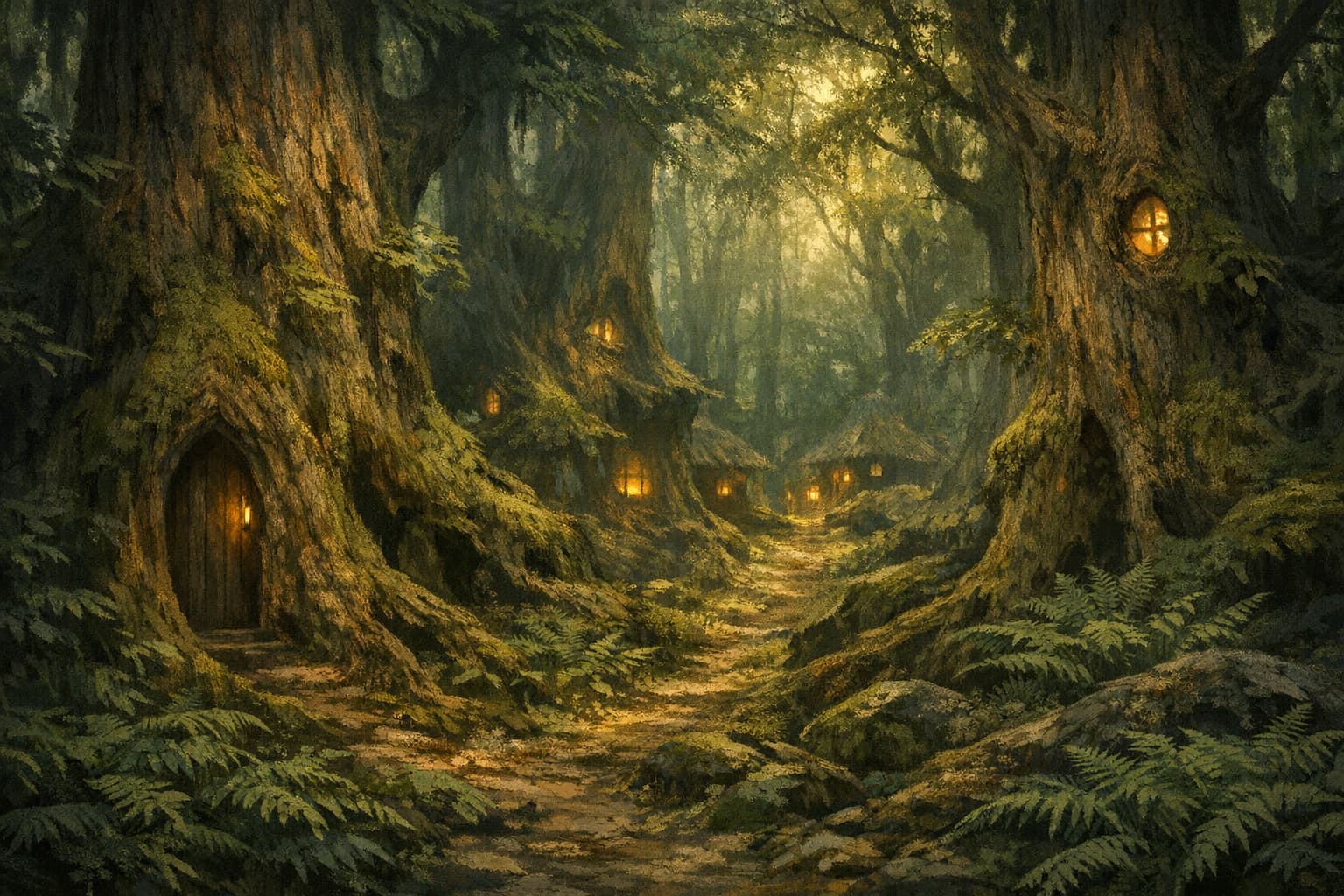


Firbolgs
Gentle giants who guard the deep woods in silence — unseen protectors who would rather vanish than fight, and whose kindness is as vast as their forests
The Fir Bolg of Irish Myth
The name "firbolg" comes directly from Irish mythology, where the Fir Bolg were one of the legendary peoples who inhabited Ireland before the arrival of the Tuatha De Danann. The name translates roughly to "men of bags" or "men of Bolg" — the etymology is contested, with some scholars linking it to the leather bags these people supposedly carried during forced labor in Greece, and others connecting it to the Belgian tribe the Belgae. What isn't contested is their role in the mythological cycle: the Fir Bolg were there first, they ruled well, and they lost.
The mythological Fir Bolg weren't giants. They were ordinary humans — or as ordinary as anyone gets in Irish myth — who divided Ireland into its five provinces and established the concept of just kingship. Their most famous king, Eochaid mac Eirc, was said to be the first king under whom neither rain nor dew fell crookedly, meaning the land itself recognized his fairness. When the Tuatha De Danann arrived with their superior magic, the Fir Bolg fought at the Battle of Mag Tuired and lost, but they were honored in defeat. The victors acknowledged their courage.
D&D took the name and almost nothing else. The mythological Fir Bolg were human-sized, politically sophisticated, and associated with sovereignty. D&D's firbolgs are reclusive forest giants who avoid civilization entirely. The only thread connecting them is a vague sense of being an older people displaced by newcomers — which, to be fair, is a powerful archetype that the game uses well, even if it bears no actual resemblance to the source material.
Firbolgs in 5e don't use personal names among themselves. This is one of their most distinctive cultural features and one of the most frequently misunderstood. A firbolg identifies itself by its actions, its relationship to its community, and its connection to the land. Introducing yourself with a personal name, to a firbolg, is like walking into a conversation and announcing your net worth — it centers the individual in a way that feels inappropriate.
When interacting with other species who insist on names, firbolgs adopt temporary ones the way a traveler might adopt local customs. These borrowed names are functional rather than personal. A firbolg might go by the name of the tree they slept under, the stream near their grove, or a simple descriptor like "the tall one who speaks to mushrooms." The name belongs to the context, not the firbolg. When the context changes, the name might change with it.
This naming convention has practical consequences at the table. A firbolg character needs a name that other players can actually use, which means most firbolg PCs have adopted a "small-folk name" as a concession to adventuring life. The best firbolg names carry a hint of their origins — natural features, seasons, qualities of light or weather — without being so literal that they sound like parody. Moss, Thorn, Cedar, Bramble, Dewfall. Names that sound like someone describing a place they love.
Fir Bolg in Irish Mythology vs. D&D Firbolgs
| Attribute | Irish Mythology | D&D (2e–3.5e) | D&D (5e Onward) |
|---|---|---|---|
| Size | Human-sized | Giant-kin (10+ feet) | Large humanoid (7–8 feet) |
| Society | Provincial kings, just rule | Isolated clans, giant hierarchies | Hidden forest communes |
| Disposition | Warriors and statesmen | Reclusive but formidable | Pacifist nature guardians |
| Appearance | Ordinary humans | Nordic giant features | Bovine/fey features, blue-gray skin |
| Magic | No particular magic | Some druidic ability | Innate druidic magic, invisibility, Disguise Self |
| Cultural Role | First just rulers of Ireland | Monster Manual entry | Fan-favorite gentle giant |
The transformation from Irish warrior-kings to cow-faced forest pacifists is one of the most dramatic reimaginings in D&D history. Whether that is creative evolution or cultural erasure depends on who you ask.
“To name yourself is to separate yourself from the forest. We are not separate. We are the grove speaking, the root thinking, the canopy deciding. Why would one branch need its own name?”
— Firbolg elder, explaining naming customs to a bewildered halfling merchant
From Giant-Kin to Gentle Giants
Firbolgs have one of the most dramatic redesign histories in D&D. They debuted in 2nd Edition as giant-kin — ten-foot-tall, fair-skinned warriors who resembled oversized Vikings. They lived in clan structures, fought with massive swords, and had more in common with hill giants than with druids. The 2e firbolg was a monster entry, not a player option, and the stat block reflected that: big, strong, and hostile if provoked.
3rd Edition kept this interpretation largely intact. Firbolgs remained giant-kin, associated with cold forests and mountains, and had a few druidic abilities layered over their fundamentally martial nature. They could detect magic and cast a handful of nature-themed spells, but the core identity was still "big warrior who lives in the woods" rather than anything more nuanced.
Then came 5th Edition's Volo's Guide to Monsters in 2016, and everything changed. The 5e firbolg was a complete reimagining: smaller (7 to 8 feet rather than 10+), gentler, deeply connected to nature, capable of turning invisible, and sporting distinctive bovine features — broad noses, pointed ears, and a general furriness that fan artists immediately amplified into full cow-faced gentle giants. The internet did the rest. Within months, firbolgs went from obscure monster entry to one of the most beloved player species in the game.
AD&D 2nd Edition — MC Compendium
Firbolgs debut as giant-kin. Ten feet tall, fair-skinned, clan-based warriors who resembled giant Vikings. Listed as monsters, not player options.
3rd Edition Monster Manual
Firbolgs retain their giant-kin status with minor druidic abilities added. Still fundamentally large warriors with a nature flavor.
Volo's Guide to Monsters (5e)
Complete reimagining. Firbolgs become 7–8 foot gentle giants with bovine features, innate invisibility, Disguise Self, and deep pacifism. Playable for the first time.
Critical Role & the Caduceus Effect
Taliesin Jaffe's Caduceus Clay on Critical Role becomes one of the most beloved D&D characters in streaming history. Firbolg popularity explodes among new players.
Tasha's Cauldron of Everything
Flexible ability scores remove the WIS/STR lock. Firbolgs can now pursue any class without fighting their stat block.
2024 PHB & Monsters of the Multiverse
Firbolg stats streamlined. The species is firmly established as a gentle, fey-adjacent giant rather than a warrior giant-kin.
Biology & Physicality
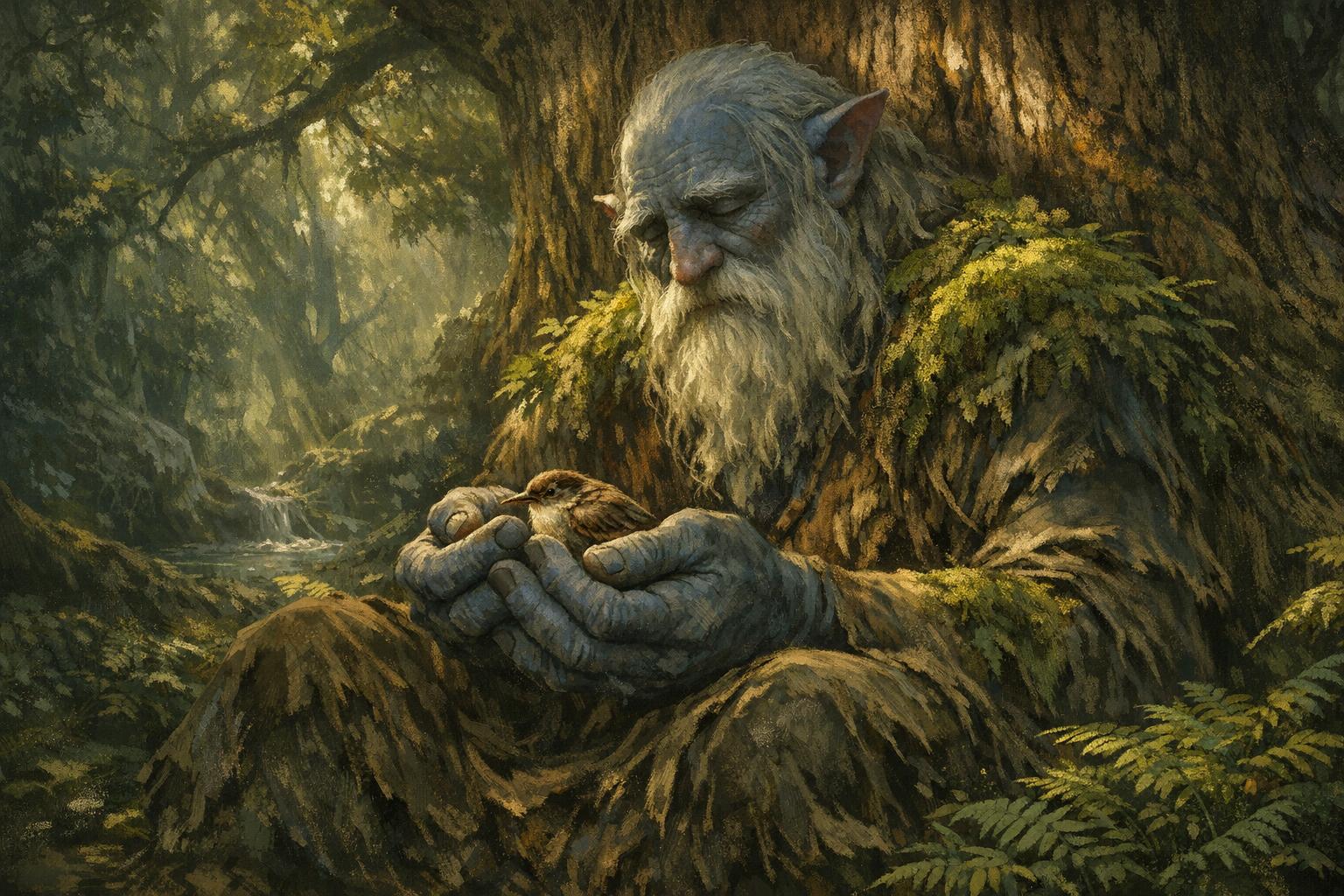
Firbolgs are large without being imposing, which is a difficult trick for a species that averages seven to eight feet tall. Their bulk is distributed softly — broad shoulders, thick limbs, a general heaviness that reads as gentle rather than threatening. Think of the difference between a bear standing on its hind legs and a bear sitting down and eating berries. Same animal, completely different energy. Firbolgs default to the berry-eating posture.
The 5e redesign gave firbolgs their most distinctive physical features: blue-gray or earth-toned skin, broad flat noses, pointed ears, and a general furriness — particularly around the face, ears, and forearms — that fan artists and community creators amplified into the now-iconic "cow person" interpretation. The official art is subtler than what the internet made of it, but the bovine reading caught on because it reinforced the gentle-giant archetype so perfectly. Cows are large, placid, herbivorous, and unthreatening. So are firbolgs.
Stature & Build
Seven to eight feet tall and proportionally broad, firbolgs carry their size with a deliberate gentleness. Their movements are slow and considered — not because they lack agility, but because they've learned that quick movements from someone their size alarm smaller folk. A firbolg reaching for something on a high shelf does so with the careful precision of someone who knows they could accidentally knock over everything on the table below it.
Skin, Fur & Coloring
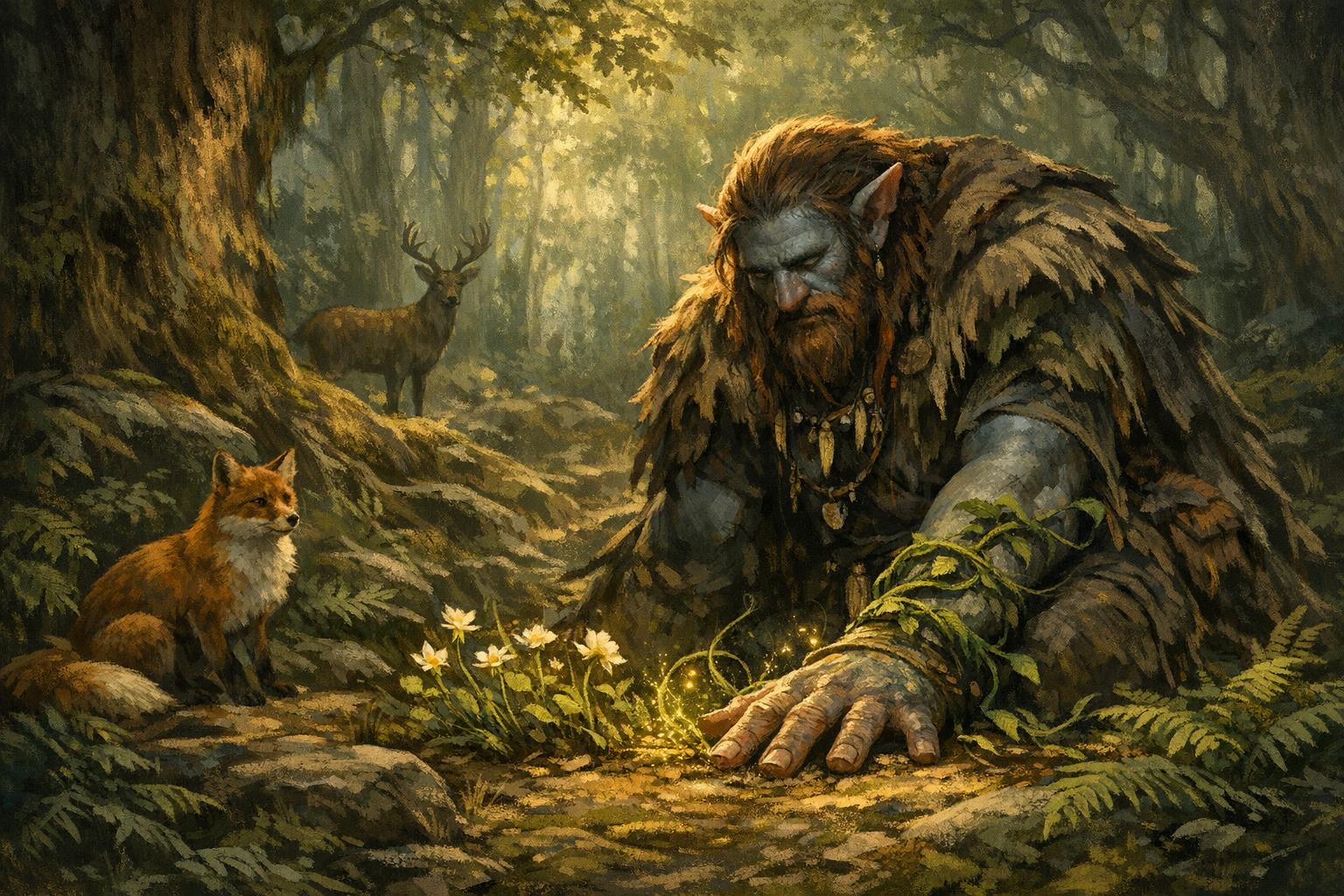
Firbolg skin ranges from cool blue-gray to warm earth brown, often with a slight mossy or bark-like texture on the forearms and shoulders. Fine fur covers much of their body, thicker around the face and ears, giving them their characteristic soft appearance. Their coloring shifts subtly with the seasons — slightly greener in spring, warmer brown in autumn — as if their bodies are synchronized with the forest around them.
Senses & Forest Attunement
Firbolgs perceive forests the way musicians perceive orchestras — not as a wall of sound but as distinct instruments playing distinct parts. They hear individual bird calls within a chorus, distinguish between the footfalls of different animal species at a hundred yards, and read wind patterns through canopy movement the way sailors read weather through clouds. This isn't magic, though it looks like it. It's a lifetime of attentive living in a single environment.
Psychology & the Way of the Grove
Firbolg psychology centers on a concept that doesn't translate neatly into Common: the idea that the individual is an expression of the community, which is an expression of the forest, which is an expression of the world. This isn't mysticism — it's lived experience. A firbolg who grew up tending the same grove their great-grandparents planted genuinely does not experience themselves as separate from that grove. Asking a firbolg to prioritize personal ambition over community need is like asking your left hand to act independently of your right.
This communal orientation is why firbolgs struggle with adventuring life. An adventuring party is built around individual achievement — you level up, you get magic items, you gain fame. Firbolg characters need a reason to have left a worldview where none of those things matter. The best firbolg backstories involve a community obligation that requires engagement with the outside world: a blight that can't be cured with forest magic, an encroachment that diplomacy might prevent, a prophecy that requires someone to walk among the small folk.
Firbolg pacifism is often overstated. They're not opposed to violence — they're opposed to unnecessary violence, which is a very different thing. A firbolg will absolutely fight to protect their grove, their community, or an innocent creature. They'll fight with the calm, focused intensity of someone performing an unpleasant but necessary task. What they won't do is start fights, pursue vengeance, or use violence to solve problems that patience could solve instead. The distinction between pacifism and restraint matters enormously for how a firbolg character plays at the table.
“We do not refuse to fight. We refuse to fight first. When the wolf threatens the fawn, the oak does not negotiate. It simply stands between them.”
— Firbolg grove-tender, on the difference between pacifism and restraint
Daily Life, Community & Governance
A day in a firbolg grove begins and ends with the forest. Morning work follows the needs of the season: spring means planting and tending new growth, summer means managing water and shade, autumn means harvesting and preserving, winter means protecting vulnerable trees and animals from the worst of the cold. There are no rigid schedules. The forest sets the pace, and firbolgs match it.
Meals are communal and largely foraged. Firbolgs are omnivores but lean heavily toward plants, fungi, nuts, and honey. Hunting happens when the forest has surplus game, and it's conducted with a ritualistic respect that would look familiar to anyone who's studied Indigenous land management practices. Nothing is wasted. A deer that feeds the grove also provides hide for clothing, bone for tools, and antler for carving. The animal is thanked, specifically and sincerely, and its remains are returned to the soil.
Firbolg craftsmanship favors organic materials worked with minimal alteration. Clothing is woven from plant fibers and dyed with natural pigments. Tools are shaped from wood, bone, and stone rather than metal. Shelters are grown as much as built — living trees trained over decades into canopy structures, root systems redirected to form foundations, moss encouraged to fill gaps. A firbolg home that's been maintained for a century is indistinguishable from the forest around it, which is exactly the goal.
Firbolg governance is consensus-based to a degree that would paralyze most other cultures. Major decisions — where to forage, when to split the grove, how to respond to outsiders — are discussed until everyone agrees or until the dissenters accept the majority position voluntarily. There's no voting, no majority rule, no chief who makes the call. If even one member of the grove has a serious objection, the discussion continues until that objection is resolved or the objector is persuaded.
This works because firbolg communities are small and because the shared framework of forest-stewardship provides a common value system that resolves most disputes before they escalate. When the question is "what does the forest need?" rather than "what do I want?," agreement comes more naturally. It would not work for a community of five hundred, which is why firbolg groves never reach that size.
The Elder Circle
Every grove has an informal council of its oldest members — not rulers, but advisors whose long experience gives their perspectives extra weight. Elders remember which foraging grounds were depleted forty years ago, which neighboring communities were friendly or hostile, which weather patterns preceded droughts. Their authority comes from memory and demonstrated wisdom, not from any title or position.
An elder who consistently gives poor counsel gradually loses influence. One who proves wise over decades gains it. The system self-corrects because the community is small enough for everyone to evaluate advice against results. There's no bureaucracy to hide behind.
The Outwalker Tradition
Some firbolgs are designated — or volunteer — to interact with the outside world on behalf of the grove. These outwalkers learn Common and other languages, study the customs of neighboring species, and serve as diplomats, traders, and intelligence-gatherers. They are the grove's interface with a world it would otherwise ignore entirely.
Outwalkers often become adventurers, which is the most mechanically convenient explanation for why a firbolg would join a party. They're already acclimated to non-firbolg society, already speak Common, and already have a mandate from their community to engage with the wider world. It's a backstory that makes sense without requiring trauma or exile.
The 2e firbolg lived in clan halls and fought with forged weapons — essentially giant Vikings in the woods. The 5e firbolg sleeps in a living tree and wouldn't touch a steel sword if you paid them. These aren't the same species in anything but name. If your campaign uses older lore, your firbolgs will be dramatically different from what most modern players expect. Decide early and communicate clearly which version you're running.
Religion & the Living Forest
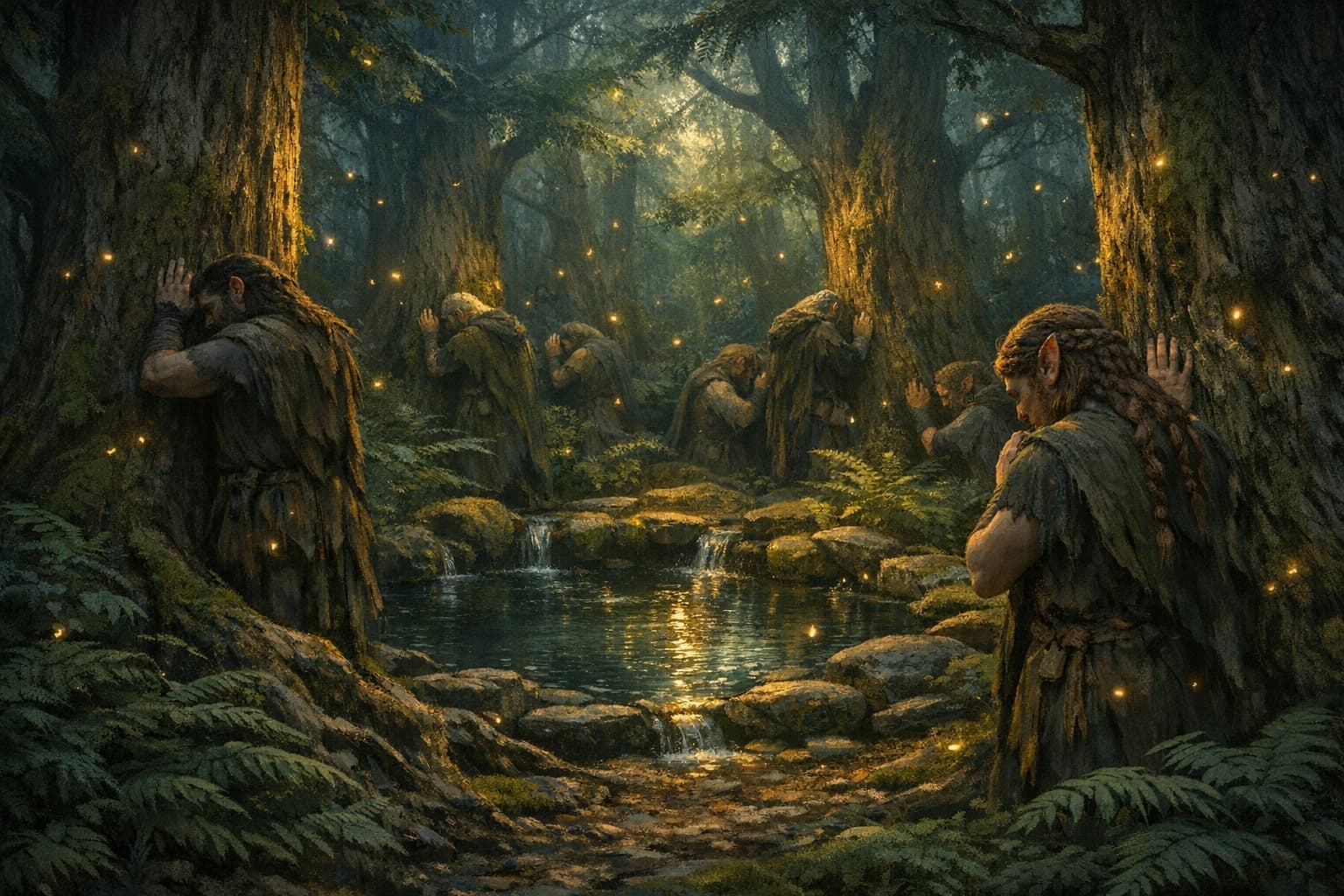
Firbolgs don't worship gods. This is one of their most unusual characteristics in a game where divine magic is mechanically tied to deity worship. Firbolgs worship the forest itself — not as a metaphor, not as a symbol of some greater deity, but as a living entity deserving of reverence. The trees, the soil, the water cycle, the web of predator and prey — this is the firbolg's divine being, and it speaks to them through growth, through weather, through the health or sickness of the land.
This creates an interesting theological position. A firbolg cleric or druid channels divine magic, but the source of that magic isn't a named deity sitting on a throne in the Outer Planes. It's the immanent divinity of the natural world. Some theologians in D&D settings would call this primal magic rather than divine magic. Firbolgs would call the distinction irrelevant. The forest answers when they pray. What else do you need to know?
Firbolg religious practice is woven into daily life rather than separated into formal worship. Tending a sick tree is prayer. Guiding a lost fawn back to its mother is devotion. Sitting in silence and listening to the forest breathe is meditation. There are no temples, no holy texts, no religious hierarchy. The closest thing to a firbolg priest is the grove-tender — the member of the community whose sensitivity to the forest's needs is strongest — and even they hold no formal authority.
Seasonal transitions are the closest firbolgs come to organized ceremony. The first frost, the spring thaw, the summer solstice, the autumn equinox — these are observed with communal meals, storytelling, and quiet gratitude. The ceremonies are gentle, unhurried, and would bore most adventurers to tears. Firbolgs consider this a feature, not a bug.
A firbolg cleric in your party doesn't need to worship a named deity if you don't want them to. The 2024 rules explicitly allow for clerics devoted to concepts, forces, or philosophies rather than specific gods. A firbolg whose divine magic comes from their connection to the living forest is mechanically identical to one who worships Silvanus — the spells work the same way. The difference is entirely narrative, and it's a richer narrative.
The Invisible Guardians
The most distinctive firbolg ability — and the one that defines their relationship with the wider world — is their innate capacity to turn invisible and to disguise themselves as other creatures. Firbolg Disguise Self lets them appear as any humanoid up to three feet shorter or taller. Their invisibility, while limited to a single turn in combat terms, is a lifestyle outside of combat. Firbolgs use it constantly, reflexively, the way a chameleon changes color — not as a tactical choice but as a default state of being.
This means that firbolgs have been watching the world without the world watching back for centuries. A firbolg grove near a human settlement has probably observed that settlement for its entire existence — watching generations of farmers, recording which families treat the forest well and which ones overharvest, noting patrol patterns and festival schedules and the names of children who wander too far into the trees. They know everything about their neighbors. Their neighbors don't know they exist.
The implications are profound and slightly unsettling. Every "haunted forest" in your campaign setting might actually be a firbolg grove. The unexplained phenomena — the logger whose axe keeps going missing, the hunter who always finds her prey already field-dressed, the child who got lost and was mysteriously returned to the village edge — might all be firbolg intervention, invisible and unacknowledged. Firbolgs don't want credit. They want the forest to be safe. If they can accomplish that without ever being seen, so much the better.
This guardianship creates a particular kind of loneliness. Firbolgs who spend years watching a human village develop genuine affection for its inhabitants — they name the farmers' cows, they root for the blacksmith's apprentice to succeed, they grieve when the old healer dies. But they never introduce themselves. The relationship is entirely one-directional, a thousand small kindnesses delivered by invisible hands. It's protective. It's beautiful. And it's a little bit heartbreaking.
Disguise Self
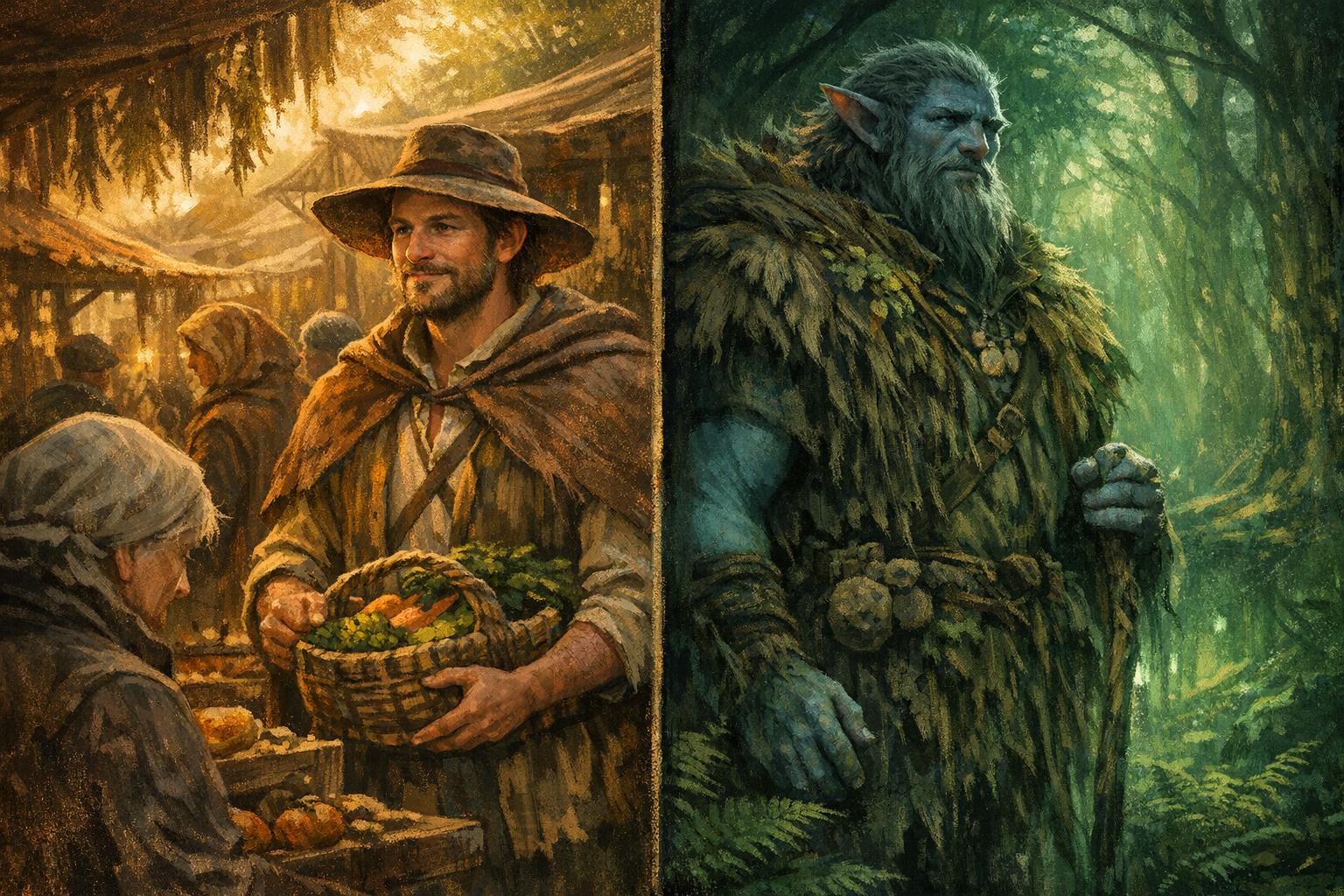
Firbolg Disguise Self is more versatile than the wizard spell of the same name. They can appear as any humanoid within three feet of their actual height, which means a seven-foot firbolg can pass as a tall human, a large half-orc, or even a short goliath. They use this primarily to visit towns for supplies or information, moving through marketplaces as unremarkable strangers. Some firbolgs maintain consistent disguise personas for decades — the quiet herbalist who visits the village market every month, the traveling merchant who always has unusual forest goods. Entire relationships built on an illusion that the other party never suspects.
Invisibility
Once per short rest, a firbolg can become invisible until the start of their next turn or until they attack, deal damage, or force a saving throw. In combat, this is a single-turn tactical advantage. Outside of combat, it's a way of life. Firbolgs chain short rests with periods of invisibility to move through populated areas without ever being detected. They patrol their forest borders invisible. They observe intruders invisible. They conduct their entire relationship with the outside world invisible. To a firbolg, being seen is an active choice, not a default state.
Speech of Beast & Leaf
Firbolgs can communicate with beasts and plants. Not in the Doctor Dolittle sense — they can't have a conversation with a squirrel about macroeconomics. But they can convey simple ideas to animals and understand what plants and animals are feeling. A firbolg can ask a tree which direction the river is and receive an impression — not words, but a pull, a sense of direction communicated through root systems and fungal networks. They can calm a frightened deer with a few quiet sounds. They can ask a bird to carry a simple message.
This ability fundamentally shapes firbolg culture. When you can ask the forest what it needs, the concept of land ownership becomes absurd. The forest isn't property. It's a neighbor, a partner, a patient. Firbolg land management is a conversation rather than a decree, and the results are forests that thrive in ways that perplex druids from other species. Trees grow in patterns that maximize light distribution. Animal populations self-regulate. Disease spreads more slowly. The forest looks wild, but it's curated — maintained by a partnership between firbolgs and the ecosystem itself.
At the table, Speech of Beast and Leaf gives firbolg characters a unique problem-solving toolkit. Can't find the villain's hideout? Ask the ravens. Need to cross a river? The willow tree knows where the shallows are. Looking for a missing person? The deer saw them three days ago heading east. None of these interactions replace skill checks — the DM sets the DC and determines what information is available — but they provide a narrative framework for abilities that would otherwise feel like generic nature magic.
Speech of Beast and Leaf is a 5e-onward ability. In 2e and 3e, firbolgs had no innate communication with animals or plants. If you're running a retrograde firbolg, their relationship with the forest is intuitive rather than conversational — they read the forest the way an experienced woodsman does, through observation and knowledge rather than magical communication. Both versions work. The 5e version is just more overtly supernatural.
Inter-species Relations
Firbolgs interact with other species primarily by avoiding them, which tells you most of what you need to know. They don't hate outsiders. They simply find most other cultures loud, destructive, and confusing. A firbolg's first encounter with a human city — the noise, the waste, the frantic pace, the complete indifference to the natural world — is genuinely overwhelming. It's not that firbolgs think they're better than city-dwellers. It's that the values gap is so wide that meaningful communication requires effort neither side usually makes.
Elves are the species firbolgs understand best, particularly wood elves whose relationship with forests overlaps significantly with firbolg values. Firbolg-elf alliances are quiet affairs — mutual non-interference pacts, shared intelligence about threats to the forest, occasionally coordinated responses to logging operations or monster incursions. These alliances sometimes last centuries without either side ever visiting the other's settlement. Friendship at a comfortable distance.
Druids of any species are welcomed more readily than most outsiders, because they arrive already understanding the firbolg worldview. A human druid who demonstrates genuine respect for the forest might be invited into a grove as a guest — the highest honor a firbolg community extends to non-firbolgs. Even then, the druid will notice that conversations stop when they enter certain clearings and that some parts of the grove remain hidden. Trust is earned in decades, not days.
The giant connection is complicated. 5e firbolgs are technically fey-adjacent rather than true giants, but older lore placed them firmly in the giant hierarchy. Firbolgs who encounter true giants — hill giants, stone giants, cloud giants — experience a recognition that's more cultural memory than lived experience. Something about the giants feels familiar, ancestral, even if the modern firbolg lifestyle is nothing like the Ordning. It's the feeling of meeting a distant cousin you've heard stories about but never met.
Firbolg Relations with Other Species
| Species | Relationship | Basis |
|---|---|---|
| Wood Elves | Quiet alliance | Shared forest stewardship values and mutual respect |
| Druids (any species) | Cautious welcome | Common understanding of natural balance |
| Humans | Avoidance | Incompatible land-use values; humans rarely notice firbolgs exist |
| Dwarves | Mutual indifference | Different biomes, different priorities; minimal contact |
| True Giants | Complicated kinship | Ancestral connection through giant lineage, divergent cultures |
| Fey Creatures | Comfortable familiarity | Shared connection to the natural world; frequent neighbors in deep forests |
The pattern is clear: firbolgs are most comfortable with species that share their values and least comfortable with species that extract from forests rather than tending them.
D&D Mechanics Across Editions
The mechanical history of firbolgs is a story of a species being reinvented from scratch. The 2e firbolg and the 5e firbolg share a name and a preference for forests. Everything else — size category, ability scores, signature features, cultural identity — was rebuilt from the ground up. Tracking the mechanical changes reveals exactly when and how the design team decided that "big warrior in the woods" was less interesting than "invisible gentle giant who talks to mushrooms."
The 5e version works mechanically because it gives firbolg characters tools that no other species provides in the same combination. Hidden Step (invisibility), Firbolg Magic (Disguise Self and Detect Magic), Speech of Beast and Leaf, and Powerful Build create a character who can disappear, infiltrate, communicate with nature, and carry heavy things. It's a toolkit for problem-solving rather than combat, which perfectly reflects the species' personality.
- Giant-kin type (10+ ft. tall)
- Can hurl boulders
- Detect magic at will
- Minor druid spells
- Not a playable species
The 2e firbolg was a monster, not a player option. Stats are approximate from the monster entry. They were large, strong, and martial — basically forest hill giants with better manners.
- Firbolg Magic (Disguise Self + Detect Magic, 1/short rest each)
- Hidden Step (invisibility until start of next turn, 1/short rest)
- Powerful Build
- Speech of Beast and Leaf
The complete reinvention. WIS/STR pushed firbolgs toward druid, cleric, and ranger. Hidden Step and Disguise Self gave them a unique infiltration toolkit. Powerful Build preserved a nod to their giant heritage.
- Firbolg Magic (Detect Magic + Disguise Self, uses = proficiency bonus/long rest)
- Hidden Step (uses = proficiency bonus/long rest)
- Powerful Build
- Speech of Beast and Leaf
Flexible ability scores untethered firbolgs from the WIS/STR box. Usage scaling by proficiency bonus replaced the short-rest model. Core identity preserved: invisible, disguised, nature-speaking, strong.
Across Franchises & Media
Firbolgs are one of D&D's most setting-specific creations. Unlike elves, dwarves, or orcs — which appear in virtually every fantasy franchise — firbolgs don't have clear analogues in other games or media. The closest equivalents are gentle-giant forest guardians that appear across folklore and fantasy, but none of them carry the specific combination of invisibility, shapeshifting, and communal pacifism that defines the D&D firbolg.
The firbolg's modern cultural presence owes more to actual-play streaming than to published material. Caduceus Clay from Critical Role, played by Taliesin Jaffe, is probably the single character most responsible for firbolg popularity. His gentle demeanor, deadpan wisdom, and quiet competence became the template that thousands of firbolg characters followed. Before Caduceus, firbolgs were a niche Volo's Guide option. After Caduceus, they were one of the most-created species on D&D Beyond.
Fan art played an equally significant role. The community's embrace of the cow-faced firbolg interpretation — rounder, softer, and more overtly bovine than official art suggests — created a visual identity that spread across social media and became, for many players, the "real" firbolg regardless of what the sourcebooks showed. It's one of the few cases where fan interpretation has genuinely overwritten official art direction. Wizards of the Coast has gradually adjusted their firbolg art to reflect community expectations, which is either a lovely example of collaborative worldbuilding or a studio bowing to market pressure, depending on your cynicism level.
Gentle Forest Giants Across Fiction
| Franchise / Source | Equivalent | Core Trait | Key Distinction from D&D Firbolg |
|---|---|---|---|
| Irish Mythology | Fir Bolg | First rulers of Ireland, warrior-kings | No giant features, no magic, completely different concept |
| Tolkien | Ents / Huorns | Ancient tree guardians, slow to act | Plant-based rather than humanoid; similar protective ethos |
| Studio Ghibli | Forest spirits (Princess Mononoke) | Invisible forest guardians | Closest tonal match; quiet protection of wild spaces |
| Critical Role | Caduceus Clay | Deadpan gentle giant, tea-obsessed cleric | Defined the modern firbolg archetype for an entire generation of players |
| Nordic folklore | Huldra / forest trolls | Hidden forest beings who punish despoilers | Similar hiding behavior; more punitive than firbolgs |
| Pathfinder | No direct equivalent | — | Pathfinder's giantkin don't include the gentle-pacifist archetype |
The D&D firbolg occupies a unique niche: a giant species whose defining trait is not being seen. Most other gentle-giant archetypes are visible protectors. Firbolgs are invisible ones.
FAQ
Common Questions
The most common and most satisfying answer is obligation. The grove needs something the forest can't provide — a cure for a magical blight, diplomatic intervention against encroaching loggers, intelligence about a threat that Speech of Beast and Leaf can't identify. The firbolg doesn't want to leave. They leave because the community needs them to, and communal need outweighs personal preference every time. This gives the character a built-in motivation (complete the mission, return home) and a built-in tension (the longer they're away, the more they change, and the harder returning becomes).
In practice, most firbolg PCs adopt a name for the convenience of their party. The name is typically drawn from nature — Moss, Thorn, Clay, Bramble, Fog — and the character treats it as a tool rather than an identity. Some players lean into the awkwardness: the firbolg who introduces themselves differently every time, or who asks the party to just call them whatever feels right. The key is that the firbolg doesn't identify with the name. It's a label they wear for others' comfort, like a visitor's badge.
Absolutely, and the 2024 flexible ability scores make any class mechanically viable. A firbolg wizard who left the grove to study magic their community couldn't teach them is compelling. A firbolg fighter serving as a grove's outwalker — their community's interface with the violent world — works perfectly. Even a firbolg warlock has narrative potential: what if the forest itself offered a pact, or what if a fey patron sought out a firbolg specifically because their innate nature magic made them a uniquely powerful vessel? The druid/cleric default is strong, but it's a starting point, not a cage.
They're almost completely different species. The 2e firbolg is a ten-foot giant-kin warrior — think Scandinavian berserker living in the deep woods. The 5e firbolg is a seven-foot gentle giant with bovine features, innate invisibility, and deep pacifism. Use whichever serves your campaign. If you want a dangerous, martial species with giant connections, the 2e version or a hybrid approach works well. If you want the gentle-guardian archetype that most modern players expect, use 5e. Just communicate your choice early so players know what they're building toward.