
Githzerai
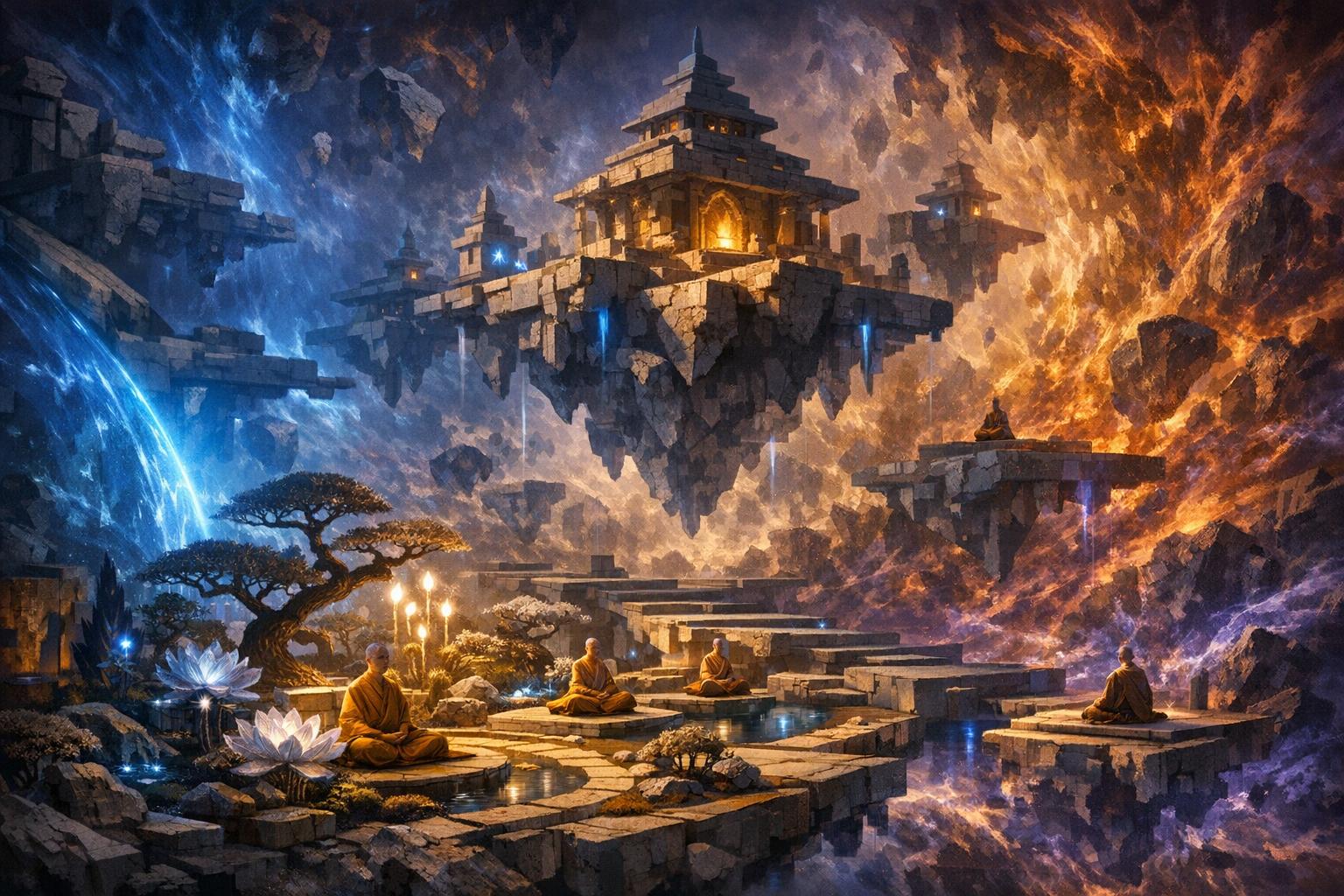
Monks of chaos who found stillness inside the storm and built monasteries in the plane where reality obeys only the disciplined mind
The Other Path After Liberation
Every githzerai carries the memory of slavery in their cultural DNA, even if no living individual remembers the mind flayer pens. The gith people — before the split, before the names meant anything — were thralls of the illithid empire, cattle bred for psychic susceptibility and physical labor across a dominion that spanned the planes. When the rebellion came, it was total. The figure known as Gith united every slave caste, every psionic bloodline, every broken mind that still had enough will left to fight. They won. What happened next broke the species in half.
Gith the Liberator wanted war eternal. She looked at the shattered illithid empire and saw not freedom but opportunity — a chance to build a military dominion that would ensure the gith were never enslaved again. Her vision was conquest. Her logic was simple: the strong rule, the weak serve, and if you stop fighting, you become prey. A significant portion of the freed gith agreed. They followed Gith into the Astral Plane and became the githyanki.
Zerthimon did not agree. The monk-philosopher who had fought beside Gith saw her transformation from liberator to tyrant as a repetition of the very cycle they had just escaped. Trading one master for another, trading illithid chains for githyanki chains — the shape of the oppression changed, but the structure remained. Zerthimon argued for a different path: inward mastery rather than outward dominion, discipline rather than conquest, the cultivation of the self rather than the subjugation of others.
The schism was violent. Gith and Zerthimon's followers clashed in what the githzerai call the Pronouncement of Two Skies, a civil war fought with psionic weapons in the ruins of the mind flayer empire. Zerthimon fell — or transcended, depending on which tradition you follow. His followers retreated into Limbo, the plane of pure chaos, and there they built something that shouldn't be possible: monasteries of perfect order in a realm where matter itself refuses to hold shape.
Githzerai names are acts of philosophical compression. Each name carries layered meaning — a surface sound for outsiders to use and a deeper resonance understood only by those who share the speaker's monastic tradition. The practice emerged from necessity: in the early years on Limbo, when every thought could reshape reality, names needed to be precise. An imprecise name, carelessly thought, could literally unmake the person it described.
Birth names among the githzerai tend to be short and hard-edged. Dak. Zerth. Kalla. Izera. These aren't decorative — they're anchors. A githzerai child learns their name before they learn to walk, and that name becomes the first fixed point in a mind that must eventually impose order on chaos itself. Monks who achieve significant breakthroughs in their discipline sometimes take new names, or add syllables to existing ones, marking the transformation in identity that accompanies the transformation in capability.
The naming system reflects a broader githzerai attitude toward language. Words are tools of mental architecture, not ornaments. Githzerai speech tends toward the precise and economical — not because they lack eloquence, but because they understand that every word shapes thought, and every thought shapes reality. A githzerai who uses ten words where three would suffice is displaying a lack of discipline, which is roughly equivalent to a dwarf showing up drunk to a forge. Technically possible. Culturally devastating.
The Gith Schism — Two Paths from One Liberation
| Aspect | Githyanki (Gith's Path) | Githzerai (Zerthimon's Path) |
|---|---|---|
| Philosophy | Freedom through dominance | Freedom through discipline |
| Home Plane | Astral Plane | Limbo |
| Power Source | Martial prowess + arcane magic | Psionic focus + monastic training |
| View of Illithids | Enemies to be exterminated | Cautionary reminder of what control costs |
| Government | Military hierarchy under a lich-queen | Monastic enclaves under enlightened masters |
| Core Fear | Vulnerability | Loss of self-mastery |
Same slavery, same liberation, same species. Two completely irreconcilable conclusions about what freedom means.
“A name spoken carelessly in Limbo is not merely rude. It is structurally dangerous. The githzerai learned to name things precisely because imprecision could collapse the monastery walls.”
— From the Zerth teaching cycles
Githzerai Through D&D Editions
The githzerai entered D&D not as playable characters but as part of the ecology of the planes. Charles Stross created the gith for the Fiend Folio in 1981, and from the start they were something unusual: a monster defined primarily by philosophy rather than appetite. Illithids eat brains. Githyanki conquer. But githzerai — what do they do? They think. They meditate. They impose order on chaos through force of will. That's a hard thing to stat up as a combat encounter.
The species found its true home in Planescape (1994), where the multiverse became a place characters could actually live rather than just visit. The githzerai monastery-fortress of Shra'kt'lor in Limbo became one of the setting's most evocative locations — a city that exists because its inhabitants collectively will it to exist, and would dissolve into roiling chaos the moment they stopped concentrating. Try running that as a dungeon crawl.
Fourth Edition folded githzerai into the Player's Handbook 3, giving them a formal mechanical identity as a psionic species with bonuses to Wisdom and Dexterity. This was the first time githzerai appeared as a core playable option rather than an exotic supplement choice. Fifth Edition pulled them back to supplemental status in Mordenkainen's Tome of Foes, while the 2024 rules haven't yet given them a formal update — leaving githzerai in a design limbo that their Limbo-dwelling characters would probably find philosophically appropriate.
Fiend Folio
Charles Stross introduces the gith — both githyanki and githzerai — as planar creatures. Githzerai are monk-psionics dwelling in Limbo. Minimal lore, maximum concept.
Planescape Campaign Setting
Githzerai become fully realized as a culture. The fortress-monastery of Shra'kt'lor is detailed. Dak'kon in Planescape: Torment (1999) becomes the defining githzerai character.
Psionics Handbook (3e)
Githzerai gain formal psionic class support. Their identity as psionic monks solidifies. Racial stats emphasize Dexterity and Wisdom.
Player's Handbook 3 (4e)
Githzerai become a core playable race for the first time. Iron Mind, Shifting Fortunes, and Danger Sense define their mechanical identity as disciplined reactors.
Mordenkainen's Tome of Foes (5e)
Githzerai return as a playable option with Wisdom bonuses, Mental Discipline, and Githzerai Psionics. Supplemental rather than core, but mechanically clean.
Current Status
No formal 2024 PHB entry yet. Githzerai exist in a design gap — beloved by fans, mechanically dated, waiting for an update that suits the new flexible-stats paradigm.
Limbo Monasteries & Shaped Reality
Limbo is the plane where matter has no default state. Rock becomes water becomes fire becomes nothing, moment to moment, driven by the thoughts of whatever sentient beings happen to be nearby. Most creatures experience Limbo as lethal nonsense — a blender of elements with no pattern and no mercy. The githzerai experience it as home, which tells you everything you need to know about the species.
Githzerai monasteries exist because their inhabitants force them to exist. Every wall, every floor, every breath of stable air is maintained by collective psionic concentration. Junior monks contribute to the structural fields as part of their daily practice. Senior monks maintain the deep architecture — the gravity, the atmosphere, the fundamental physics that allow biology to function. The most powerful zerths can stabilize regions of Limbo miles across, creating pockets of reality that persist even when they sleep.
This isn't metaphorical. A githzerai monastery is literally a group meditation made physical. If the inhabitants were killed or scattered, the monastery would dissolve into chaos within minutes. There are no githzerai ruins in Limbo. There are no abandoned githzerai cities. When a community fails, it doesn't leave wreckage — it leaves nothing. This creates a relationship with impermanence that shapes every aspect of githzerai psychology: everything you have exists only because you are actively maintaining it.

Shra'kt'lor — The Floating City
The largest githzerai settlement in Limbo, Shra'kt'lor functions as both capital city and supreme monastery. Tens of thousands of githzerai maintain its existence through layered psionic fields, each citizen contributing to the stability of the whole. The city's architecture shifts subtly depending on the collective mood of its inhabitants — a feature the githzerai consider a feature, not a bug. When the population is focused, the buildings are sharp-edged and geometric. During festivals (yes, they have festivals), the architecture softens and curves.
Visitors to Shra'kt'lor report a sensation like standing inside someone else's dream — everything is real, everything is solid, but there's an awareness that it could all change if the dreamer woke up. The githzerai find this observation boring. Of course reality could change. That's true everywhere. They're just honest about it.
A party arriving at a githzerai monastery could be asked to contribute to the stabilization fields. Non-psionic characters might need to focus intensely on believing the floor is solid — because in Limbo, if you doubt the floor, the floor doubts you back. This creates a wonderful inversion of the usual dungeon: the danger isn't what's in the building, it's whether the building continues to exist.
Zerthimon's Way
Zerthimon is not a god. The githzerai are quite insistent about this, and the distinction matters. Zerthimon was a mortal — a slave who fought, a philosopher who thought, a leader who chose a different path and died (or transcended) defending that choice. The githzerai do not worship Zerthimon. They study him. The difference between reverence and worship is the difference between reading a philosopher and praying to one, and githzerai will correct you on this point with the patient intensity of someone explaining basic arithmetic to an adult.
The teachings of Zerthimon survive in the Unbroken Circle of Zerthimon, a collection of philosophical texts that function as both scripture and training manual. Each "circle" in the collection presents a teaching through narrative — a story from the gith enslavement or liberation that illustrates a principle of mental discipline. The circles are studied sequentially, each building on the last, and a githzerai's progress through the circles marks their advancement in monastic training.
What makes Zerthimon's philosophy distinctive is its pragmatic mysticism. The teachings don't promise enlightenment as a reward for good behavior. They describe enlightenment as a set of cognitive skills that can be developed through practice. Controlling your emotions isn't virtuous — it's useful. Understanding the nature of reality isn't spiritual — it's practical, especially when reality is the substance you're building your house from. The githzerai spiritual tradition is, at its core, an engineering discipline applied to consciousness.
This has theological implications that other species find uncomfortable. If the mind is a tool to be maintained and upgraded, what is the soul? If discipline can achieve everything that prayer offers, what are gods for? The githzerai don't reject divine beings — they're aware the gods exist. They simply regard worship as an unnecessary dependency. Why ask a god to calm your mind when you can calm it yourself? The gods, for their part, seem to find the githzerai mildly irritating, like a species of students who keep finishing the exam before the teacher is done explaining the questions.
The Unbroken Circle of Zerthimon is one of the most fascinating artifacts in D&D lore. In Planescape: Torment, the player can actually study its circles alongside the githzerai companion Dak'kon, and each circle unlocks both philosophical understanding and mechanical power. It's one of the few examples in gaming where reading philosophy is presented as a form of leveling up, and it works because the philosophy is actually compelling.
Psychic Discipline & Reality Shaping
Githzerai psionics don't operate like arcane magic. There are no verbal components, no material components, no somatic gestures unless the practitioner chooses to include them for focus. Githzerai psionic abilities are pure thought made manifest — the mind reaching out and rearranging reality through concentrated will. This makes githzerai psionics nearly impossible to counter through conventional antimagic, which is one of several reasons that fighting a githzerai zerth is a profoundly bad idea.
The training progression follows a clear hierarchy. Initiates learn to still their minds — to think without thinking, to observe without reacting. Adepts learn to extend that stillness outward, shaping small volumes of chaos-stuff in Limbo into stable forms. Full zerths can maintain complex structures, enhance their physical capabilities through psionic augmentation, and project mental force with enough precision to disable an opponent without damaging the surrounding environment. Masters operate at a scale that blurs the line between psionics and reality alteration.
Combat applications are elegant and terrifying. A githzerai monk doesn't just punch harder — they punch with psionic force channeled through physical motion, turning their body into a delivery system for mental energy. The monk tradition among githzerai isn't borrowed from other cultures. It's native. Their unarmed combat was psionic combat before it was physical combat, and the physical techniques evolved as frameworks for directing mental power more efficiently.
Githzerai Psionic Progression
| Rank | Psionic Capability | Practical Application |
|---|---|---|
| Initiate | Mental stillness, basic emotional regulation | Contributing to monastery stabilization fields; surviving Limbo |
| Student | Minor telekinesis, empathic sensing | Shaping small objects, reading emotional states of others |
| Adept | Sustained reality shaping, psionic shielding | Maintaining personal quarters in Limbo, resisting mental attacks |
| Zerth | Combat psionics, large-scale stabilization | Full martial-psionic integration, anchoring community structures |
| Master | Regional reality anchoring, psionic projection | Stabilizing miles of Limbo, communicating across planes |
| Great Githzerai | Plane-scale influence, consciousness distribution | Anchoring entire cities, existing as partially distributed awareness |
The leap from Zerth to Master is where most githzerai plateau. The leap from Master to Great Githzerai has been made by fewer than a dozen individuals in recorded history.
Psionic Physiology
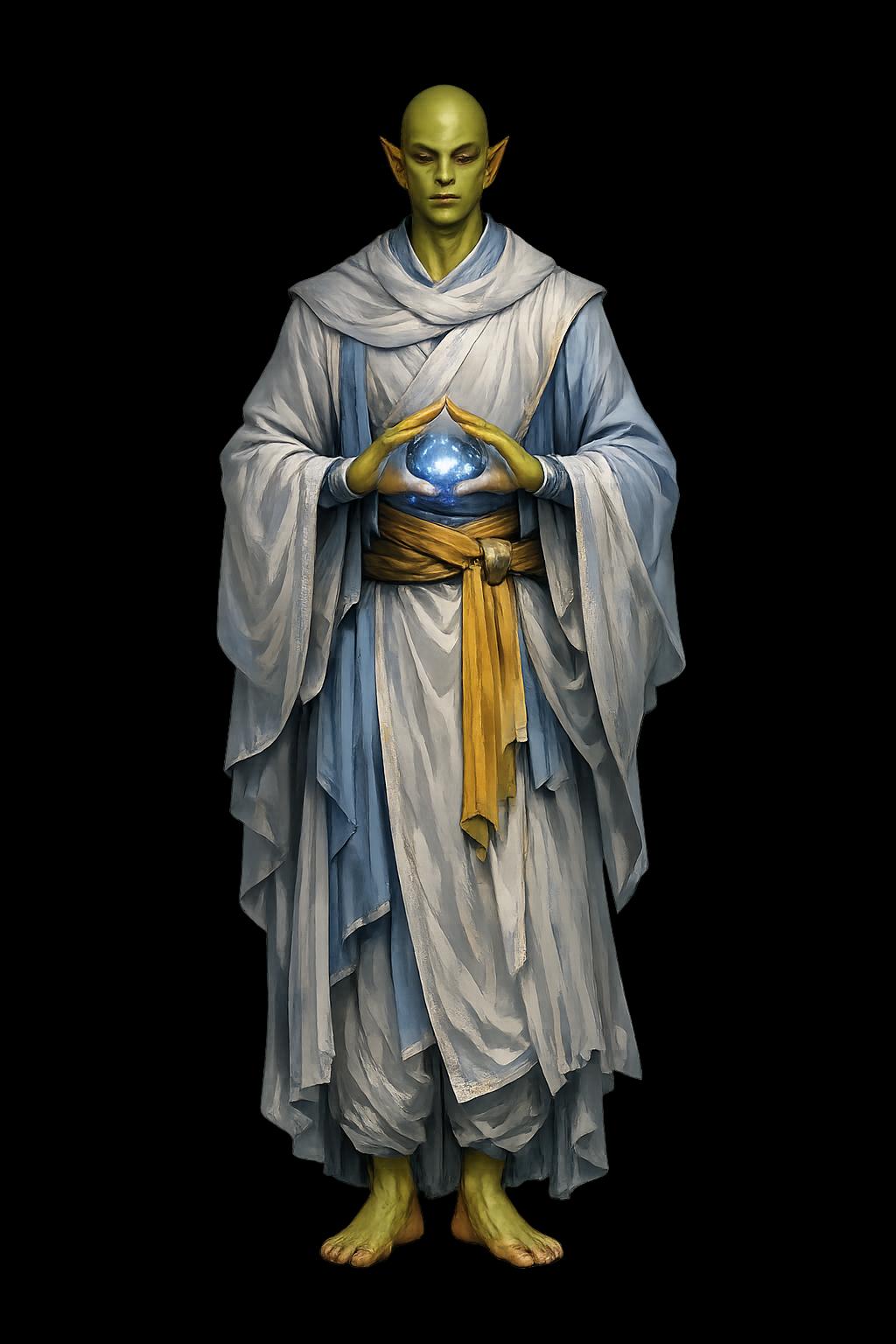
Githzerai bodies are the product of two evolutionary pressures: millennia of illithid breeding for psionic receptivity, and generations of living in a plane where your physical form is negotiable. The result is a species that looks deceptively fragile — tall, lean, angular features, skin tones ranging from pale yellow to deep green — but possesses a neurological architecture that makes them among the most psionically potent humanoids in the multiverse.
The illithid breeding programs left their mark in the githzerai nervous system, which contains psionic conduits that other humanoid species simply don't have. These aren't magical — they're biological, a network of specialized neural tissue that processes mental energy the way muscles process physical force. Every githzerai, trained or not, has some degree of psionic sensitivity. Untrained githzerai might unconsciously shape small objects in Limbo or sense strong emotions nearby. Trained zerths can shatter stone with a thought.
Living in Limbo added a second layer of adaptation. Githzerai bodies are subtly more mutable than those of other humanoids — not shapeshifting, but a kind of physical resilience that allows them to exist comfortably in environments that would stress other species. They tolerate pressure changes, temperature extremes, and atmospheric variations better than their physiology suggests. Their bodies learned to be flexible because their home demanded it.

Neural Psionic Network
The psionic conduits running through githzerai neural tissue are visible under the right conditions — faint silver-blue lines beneath the skin of the temples, wrists, and along the spine. During intense concentration, these conduits luminesce. A githzerai deep in meditation glows faintly, which in Limbo serves a practical purpose: it signals to other monks that a stabilization field is being maintained and shouldn't be interrupted. Disrupting a glowing githzerai is the Limbo equivalent of kicking out someone's load-bearing wall.

Physical Adaptability
Githzerai muscle and bone density adjusts over time in response to environmental demands — a passive psionic adaptation they share with no other known species. A githzerai who spends years in a high-gravity environment will gradually become denser and stronger without conscious effort. One who lives in low gravity will become lighter and more agile. This isn't fast enough to matter in combat, but it means githzerai communities in different regions of Limbo can look surprisingly different from one another despite sharing identical genetics.
The Discipline of Stillness
Stillness, for the githzerai, is not the absence of action. It is the presence of absolute intentionality. Every movement deliberate. Every thought examined before it shapes reality. Every emotion acknowledged and then directed rather than suppressed. The common outsider mistake is to see githzerai discipline as repression — a species that has buried its feelings under layers of monastic training. The reality is closer to the opposite: githzerai feel everything, and they have learned to feel it precisely.
This discipline emerged from survival necessity. In Limbo, an undisciplined mind is a hazard. An untrained githzerai experiencing sudden anger might unconsciously reshape their surroundings — cracking walls, disrupting gravity fields, destabilizing the atmosphere their neighbors are breathing. The monasteries developed the Discipline of Stillness not as a spiritual luxury but as a public safety measure. Learning to control your thoughts was learning not to accidentally kill everyone around you.
The result is a species-wide psychological profile that other cultures often misread. Githzerai aren't unemotional — they're precisely emotional. They don't lack passion — they channel it with surgical accuracy. A githzerai who appears calm during a crisis isn't suppressing fear. They've acknowledged the fear, categorized it as unhelpful, redirected the energy into problem-solving, and filed the emotional residue for later processing during evening meditation. The whole sequence takes about two seconds.
Outsiders find this unsettling. It looks like indifference. It looks like coldness. It is, in fact, the most intensive form of emotional engagement possible — a mind so thoroughly aware of its own states that nothing operates on autopilot. The githzerai monk who calmly discusses the destruction of their monastery is not numb. They are experiencing grief with full clarity and choosing not to let it dictate their actions. Whether that's admirable or disturbing depends on your own relationship with emotional control.
“Chaos is not the enemy. Chaos is the teacher. The enemy is the undisciplined mind that lets chaos think for it.”
— Zerth teaching maxim
Monastic Daily Practice
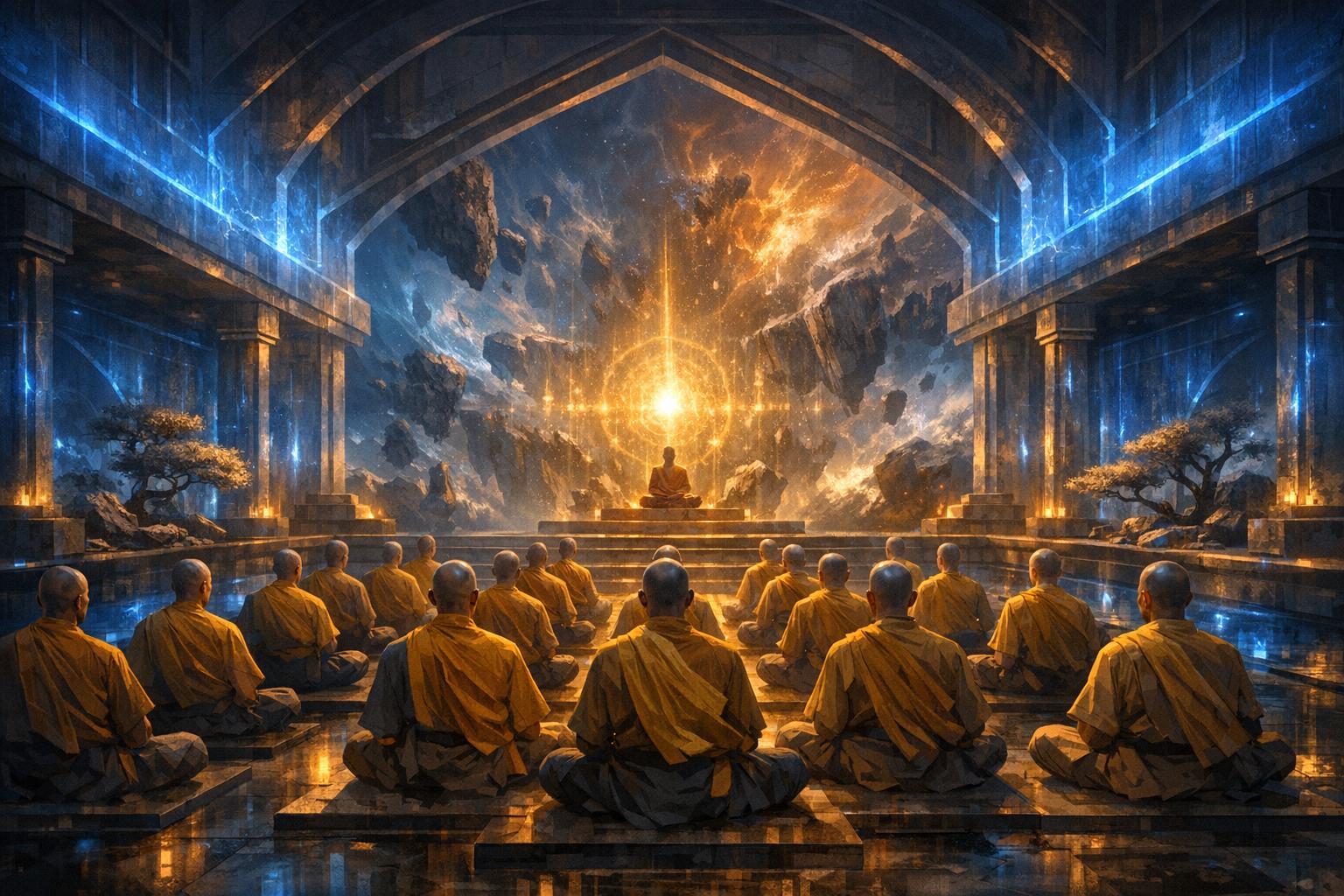
A day in a githzerai monastery begins before dawn — or what passes for dawn in Limbo, where the community's senior monks establish the light cycle as part of their reality-maintenance practice. The first hour belongs to stabilization meditation: every monk, from the most junior initiate to the oldest zerth, contributes to the psionic fields that keep the monastery physically coherent. This isn't optional. It's load-bearing consciousness.
Training occupies most of the remaining hours, but "training" encompasses far more than martial practice. Yes, githzerai monks drill combat forms — the flowing, precise movements that channel psionic energy through physical motion. But they also study philosophy, practice reality-shaping exercises (moving objects with thought, altering local temperature, maintaining complex mental structures for hours at a time), engage in structured debate, and perform community labor. A githzerai monk who can shatter stone with a punch but can't maintain a coherent argument about the nature of freedom has failed at half the curriculum.
Meals are communal and functional. Githzerai cuisine, such as it is, prioritizes nutrition and mindfulness over flavor — though visitors report that the food is better than its reputation suggests. The act of eating is itself a meditation: taste consciously, chew deliberately, appreciate the fact that food exists in Limbo only because someone willed it into existence. Githzerai don't say grace before meals. They acknowledge that the meal is a collective act of creation, which is arguably more impressive than thanking a deity for it.
Evening practice shifts toward introspection. Monks process the day's experiences, examine their emotional responses, and identify areas where discipline faltered. This isn't self-flagellation — it's maintenance. A mind that doesn't regularly audit itself accumulates distortions, and in Limbo, distortions become physical. The monk who ignores a growing resentment might wake up to find their quarters have developed sharp edges. Limbo is, in this sense, the most honest therapist in the multiverse: it shows you exactly what you're really thinking.
The githzerai expression "your walls are showing" means someone's emotional state is affecting the physical environment. It's used as gentle correction among friends and devastating criticism among rivals. In a culture where your surroundings reflect your mental state, interior decorating and therapy are the same discipline.
Governance by Enlightenment
Githzerai don't have kings, presidents, or elected officials. They have teachers. The distinction is not cosmetic. Authority in githzerai society flows from demonstrated mastery — of psionic discipline, philosophical understanding, and the practical ability to maintain stable reality in Limbo. You lead because you are the most capable, and you remain leader only as long as that capability is evident. There is no inherited rank. There is no political campaigning. There is practice, and there is proof.
The Great Githzerai, the closest thing the species has to a head of state, is the supreme monk-philosopher whose psionic abilities and wisdom are acknowledged as unmatched. Historically, this role has been occupied by figures of extraordinary power — individuals capable of stabilizing entire regions of Limbo single-handedly. The most famous Great Githzerai is Zaerith Menyar-Ag-Gith, often simply called Menyar-Ag, whose consciousness is said to anchor the largest githzerai settlements simultaneously.
Githzerai Governance — Meritocratic Stillness
Authority derives from demonstrated inner mastery. The monk who maintains the largest stabilization field, resolves the most complex philosophical disputes, and trains the most capable students naturally assumes leadership. Decisions are made through structured dialogue rather than voting — the goal is to reach the correct answer, not the popular one.
This system is remarkably stable because it self-corrects. A leader who loses their edge — whose discipline slips, whose psionic abilities wane — simply ceases to command the same respect. No coup is necessary. No revolution is required. The system doesn't need to be overthrown because it doesn't accumulate the kind of structural power that requires overthrowing.
The weakness is exclusivity. Githzerai meritocracy privileges a very specific type of merit. A brilliant strategist who lacks psionic talent will never lead. An empathetic counselor whose meditation practice is merely average won't rise. The system works, but it works by defining excellence narrowly enough that some kinds of contribution go permanently unrecognized.
Githyanki Governance — Hierarchical Aggression
Authority derives from the lich-queen Vlaakith, who has ruled the githyanki for over a thousand years through a combination of divine-tier power and systematic elimination of anyone who might challenge her. Githyanki warriors who approach her level of power are executed or consumed. Obedience is absolute. The chain of command is military and brooks no philosophical debate.
This system is remarkably unstable, held together only by Vlaakith's personal power and the external threat of the illithids. Remove either pillar and the githyanki hierarchy would collapse into factional warfare within a generation. The system requires a tyrant to function, which means it can never peacefully transition power.
The strength is decisiveness. When Vlaakith commands, the entire species acts as one. No debate, no consensus-building, no philosophical inquiry into whether the command is just. In military operations, this unity is devastating. In every other domain of civilization, it produces stagnation, paranoia, and cultural atrophy.
The Eternal Rift with Githyanki
The war between githyanki and githzerai has been ongoing for longer than most Material Plane civilizations have existed. It's not a border dispute or a resource conflict. It's a philosophical argument conducted with swords and psionics — a species-level disagreement about the meaning of freedom that neither side can resolve because both sides are, from their own perspective, completely correct.
Githyanki believe freedom means never being vulnerable again. Build an empire, maintain military supremacy, destroy potential threats before they materialize. It's the logic of a people who were once utterly powerless and have decided that power is the only reliable protection against a repetition of that powerlessness. There's nothing irrational about this position. It's the position most freed peoples in real-world history have adopted.
Githzerai believe freedom means never being controlled again — including by your own desires for power and dominance. Build inner discipline, resist the urge to become what enslaved you, and demonstrate that strength doesn't require subjugation. It's the logic of a people who watched their liberator become a tyrant and concluded that the cycle of oppression is internal before it's external. This position is also not irrational. It's just harder to maintain when someone is swinging a silver sword at your head.
The tragedy is that both sides are responding to the same trauma with equal validity and absolute incompatibility. Neither the githyanki nor the githzerai are wrong about what freedom requires. They're wrong about the idea that only one answer can exist. But telling that to either side is a reliable way to start a fight, which somewhat undermines the point.
Named githzerai characters in D&D lore are relatively rare compared to elves or dwarves, which reflects the species' late arrival and niche appeal rather than any lack of narrative potential. The githzerai who do appear in published materials tend to be extraordinarily well-drawn characters, precisely because the species' built-in philosophical depth gives writers more to work with than "angry warrior" or "wise elder."
The defining githzerai character in all of D&D is Dak'kon from Planescape: Torment. A zerth warrior carrying a blade made of his own crystallized doubt — the Karach blade, which changes form based on the wielder's mental state — Dak'kon embodies every tension in the githzerai identity. He follows Zerthimon's teachings but has lost faith. He carries discipline but is tormented by uncertainty. He serves the player character out of a debt that is itself a form of bondage, creating a recursive irony that the game's writers clearly relished.
Notable Githzerai in D&D Lore
| Figure | Source | Significance |
|---|---|---|
| Zerthimon | Core gith lore | Founder-philosopher who rejected Gith's path. Dead, transcended, or something in between. His teachings define the species. |
| Dak'kon | Planescape: Torment (1999) | Zerth warrior whose Karach blade reflects his mental state. The most fully realized githzerai character in any medium. A masterclass in writing philosophical struggle as character drama. |
| Zaerith Menyar-Ag-Gith | Mordenkainen's Tome of Foes | The current Great Githzerai. His consciousness anchors the largest githzerai settlements. More concept than character at this point — a distributed mind maintaining reality. |
| Belthinus | Various supplements | A githzerai monk who achieved mastery on the Material Plane rather than in Limbo, proving that the discipline works outside its native environment. |
| Sensei of the Shattered Mind | Monster lore / NPC templates | A zerth master who deliberately destabilized their own psyche to explore the boundaries between order and chaos. The githzerai equivalent of experimental art — respected, feared, and not invited to dinner. |
Dak'kon alone justifies the githzerai's place in D&D history. His story proves that a character defined by philosophical discipline can be as compelling as one defined by martial prowess.
The gith civil conflict is one of D&D's best-written conflicts because it has no correct side. A DM who presents githyanki as unambiguous villains and githzerai as unambiguous heroes has missed the point. The most interesting campaigns involving gith treat the conflict as a genuine philosophical disagreement where the players' sympathies should be torn. Let them spend time with both sides. Let both sides make good arguments. Then let the players decide — or not decide, which is also valid.
Mechanical Identity — Monks of the Mind
Githzerai mechanics across editions have consistently emphasized two things: mental resilience and psychic utility. Where githyanki get martial power and arcane magic, githzerai get saving throw advantages and psionic defense. This asymmetry perfectly mirrors the philosophical split: githyanki mechanics say "I attack," while githzerai mechanics say "I endure and redirect."
The Mental Discipline feature in 5e (advantage on saving throws against the charmed and frightened conditions) is one of those small mechanical touches that carries enormous narrative weight. The githzerai aren't just resistant to fear and charm — they've trained for generations to resist exactly these kinds of mental intrusion because their ancestors spent millennia under illithid mind control. Every saving throw advantage is a small act of species-wide defiance: you cannot control us again.
Class synergies lean heavily toward monk and psionic subclasses, which makes intuitive sense. A githzerai monk is the platonic ideal of the class — a contemplative warrior whose physical techniques are expressions of mental discipline. But githzerai also make excellent wizards (disciplined mind + Intelligence-adjacent training), clerics of knowledge or peace domains (philosophical tradition + Wisdom bonus), and surprisingly effective rogues (Dexterity bonus + the ability to remain calm under pressure is basically the rogue skill set described differently).
Optimal Class Combinations for Githzerai Characters
| Class | Synergy Rating | Why It Works |
|---|---|---|
| Monk | Excellent | Wisdom bonus feeds AC and abilities. Mental Discipline stacks with Stillness of Mind. The class was designed for this species. |
| Wizard (Divination/Abjuration) | Strong | Intelligence bonus, disciplined study tradition, shield spell stacks with wizard spell list for defensive depth. |
| Cleric (Knowledge/Peace) | Strong | Wisdom bonus is core. Githzerai philosophical tradition maps cleanly onto Knowledge domain. Peace domain mirrors Zerthimon's rejection of conquest. |
| Rogue (Inquisitive/Soulknife) | Good | Mental Discipline protects against common rogue-targeting effects. Soulknife is thematically perfect — psionic blades from disciplined focus. |
| Fighter (Psi Warrior) | Good | Psi Warrior subclass was practically written for githzerai. Telekinetic abilities channeled through martial training. |
| Ranger (Gloom Stalker) | Decent | Wisdom synergy, but the nature-oriented flavor requires narrative adjustment. Best for githzerai who left Limbo to study Material Plane environments. |
The monk synergy is obvious. The less obvious combinations often produce more interesting characters — a githzerai bard who uses performance as a psionic discipline, or a githzerai artificer who treats device-building as reality shaping with extra steps.
- Mental Discipline (advantage vs. charmed/frightened)
- Githzerai Psionics: mage hand (cantrip), shield (3rd), detect thoughts (5th)
- Innate spellcasting uses Wisdom
- Languages: Common, Gith
Clean and thematic. The shield spell as innate psionics is a perfect mechanical translation of "disciplined mind deflects attacks." Detect thoughts reflects the psionic sensitivity bred into them by illithids. Wisdom as the casting stat reinforces the contemplative identity.
Githzerai in Planescape & Beyond
The githzerai are, at their core, a Planescape species. They were born in a setting about philosophy made physical, about belief shaping reality, about the multiverse as a place where ideas have architectural consequences. Strip away the planes and the githzerai lose most of what makes them distinctive. A githzerai in a standard Forgotten Realms campaign is a displaced monk with a weird backstory. A githzerai in Planescape is someone whose entire existence is a philosophical argument with the structure of reality.
That said, githzerai have appeared productively outside their native planar context. Spelljammer campaigns put githzerai aboard ships sailing the void between crystal spheres, where their ability to maintain stable environments in hostile space makes them valued (if unsociable) crew members. Githzerai in Eberron have been placed as residents of Dal Quor or Xoriat, planes that map imperfectly but interestingly onto Limbo's chaos. The species travels, in other words, but it travels best when the destination is strange.
Baldur's Gate 3 brought githzerai back into mainstream D&D consciousness, though primarily through the githyanki lens. The game's gith content focuses on Lae'zel and githyanki culture, with githzerai appearing as foils and occasional allies. This is, paradoxically, a faithful representation of the githzerai in broader D&D: they're always the other gith, the ones who chose differently, the footnote to the githyanki's more photogenic warmongering. The fact that the footnote contains the more interesting philosophy is part of the joke the githzerai would never make, because unnecessary humor is a sign of undisciplined thought.
The githzerai's future in D&D likely depends on whether the game continues to invest in planar content. In a multiverse where Limbo matters, githzerai matter. In a game focused primarily on Material Plane adventures with occasional planar excursions, they'll remain niche — beloved by a small, passionate fan base and unfamiliar to the broader playerbase. The githzerai, characteristically, are fine with either outcome. Popularity is an external validation, and external validations are precisely what the Discipline of Stillness trains you to disregard.
Running a campaign arc in a githzerai monastery is a chance to do something most D&D games never attempt: make the environment responsive to the players' mental states. Track party stress, fear, anger, and confidence. When the barbarian rages, the walls ripple. When the cleric prays, the light steadies. When the rogue lies, the floor becomes uncertain. Limbo as a setting isn't just a backdrop — it's a mirror, and mirrors make for the most unsettling dungeons.
FAQ
Common Questions
They're two halves of the same species who fought a civil war over a philosophical question: what does freedom mean after slavery? Githyanki chose military dominance — build an empire, never be vulnerable again. Githzerai chose inner discipline — master yourself, never be controlled again. For your group, the distinction matters because it creates one of D&D's richest faction conflicts. Neither side is wrong. Both sides are dangerous. And any adventure involving one gith faction inevitably involves the other, because they define themselves in opposition.
Their entire culture is monastic discipline applied to reality manipulation. Githzerai train from childhood to still their minds, control their emotions, and channel mental energy through physical motion — which is literally what the monk class does. The Wisdom bonus reinforces this mechanically. But the fit goes deeper than stats: a githzerai monk isn't borrowing a class fantasy from another culture. They invented it. The monk class, for a githzerai, isn't an adventuring profession. It's their baseline education.
Zerthimon's teachings — compiled in the Unbroken Circle of Zerthimon — function as philosophy, training manual, and cultural constitution simultaneously. They define what it means to be githzerai as distinct from githyanki: freedom through self-mastery rather than external power. A githzerai who rejects Zerthimon's teachings hasn't just left a religion. They've rejected the foundational premise of their civilization. It's closer to a human rejecting the concept of language than to someone leaving a church.
Psi Warrior fighter channels their psionic heritage through martial training without requiring the monk's ascetic framework — a githzerai who chose a more direct path. Soulknife rogue creates a character whose stealth and precision are psionic expressions of disciplined awareness. Knowledge cleric maps beautifully onto the zerth scholarly tradition. And a githzerai wizard (especially Abjuration or Divination) represents someone who supplemented their innate psionic training with formal arcane study — belt and suspenders for a mind that refuses to be caught unprepared.
Most D&D meditation is a spiritual or restorative practice — elves trance to process memories, monks meditate to center their ki. Githzerai meditation is structural engineering. When a githzerai meditates in Limbo, they are literally holding reality together: maintaining walls, atmosphere, gravity, and the physical laws their community depends on. Even outside Limbo, githzerai meditation retains this architectural quality. They aren't emptying their minds — they're auditing and reinforcing their mental architecture, checking for emotional distortions, patching cognitive weaknesses, and stress-testing their psionic discipline against simulated threats. A githzerai who skips morning meditation isn't neglecting self-care. They're leaving a load-bearing pillar unattended.