
Gnomes
Relentless tinkerers and illusion-weavers whose curiosity rewrites the rules that bigger folk assume are permanent
Mythological Foundations
Gnomes have one of the stranger etymological lineages in fantasy. They started as earth spirits in Renaissance alchemy, became garden ornaments in Victorian England, and ended up as gear-obsessed tinkers in tabletop games. That trajectory — from elemental guardian to lawn decoration to player character — tells you something about how culture digests the uncanny by making it small and cute.
Paracelsus coined the term in 1566 to describe elemental beings of earth, creatures that moved through rock the way fish swim through water. His gnomes weren't whimsical. They were geological forces with intelligence, custodians of underground treasure who could collapse a mine on anyone who took without asking. The diminutive stature came later, conflated with Germanic Erdmännlein and Scandinavian tomte traditions where small size signaled a different relationship with the physical world rather than weakness.
D&D inherited the post-Victorian version — small, clever, slightly eccentric — and bolted on a mechanical aptitude that owed more to clockpunk aesthetics than any mythological source. The result is a species that carries traces of three unrelated traditions and somehow holds together through sheer personality.
Gnome Origins Across Mythological Traditions
| Tradition | Name / Concept | Key Trait | Legacy in D&D |
|---|---|---|---|
| Paracelsus (1566) | Gnomus | Earth elemental, moves through stone | Gnomish affinity for burrowing and stonework |
| Germanic folklore | Erdmännlein | Underground smith, treasure guardian | Rock gnome crafting traditions |
| Scandinavian folklore | Tomte / Nisse | Household spirit, protector of farms | Forest gnome animal friendship, rural charm |
| Victorian England | Garden gnome | Decorative, whimsical, harmless | The "comic relief" reputation D&D keeps trying to outgrow |
| Warhammer / Warcraft | Gnomish engineer | Reckless inventor, explosion-prone | Tinker gnome archetype, Artificer class synergy |
Paracelsus classified gnomes alongside sylphs (air), undines (water), and salamanders (fire) as one of the four elemental beings. Only gnomes made it into D&D as a core species.
Etymology & Name Origins
The word "gnome" probably derives from the Greek genomos, meaning "earth-dweller," though Paracelsus may have invented it outright. Some scholars connect it to gnosis — knowledge — which would make gnomes "the knowing ones." Both etymologies fit. Gnomes in every tradition are defined by what they understand: the structure of stone, the behavior of mechanisms, the hidden logic behind appearances.
D&D gnomish naming conventions lean into consonant clusters and bright vowels — Bimpnottin, Dimble, Ellywick, Zook. The names feel like the sound of small mechanisms clicking into place, which is probably intentional. Gnomish characters in official material tend to have names that are longer than seems necessary for someone three feet tall, often with a familiar nickname and a formal name reserved for important occasions.
This naming pattern reflects something real about gnomish culture: they accumulate. Names, projects, curiosities, grudges, friendships. A gnome's full name might encode three generations of family history, a hometown reference, and a personal achievement. Trimming it down for outsiders isn't simplification — it's an act of trust, choosing which part of yourself to share.
“If gnome derives from gnosis, then the species name is a thesis statement: these are people defined by the compulsion to know, regardless of whether knowing is safe, practical, or advisable.”
— On the etymology of the small and dangerously curious
History in D&D Settings
Gnomes entered D&D in the 1974 original as a monster, not a player race — small, grumpy, and largely interchangeable with dwarves. They didn't become playable until AD&D 1st Edition in 1978, where they occupied an awkward mechanical niche between halflings and dwarves. The perception that gnomes are D&D's forgotten middle child starts here and has never entirely gone away.
Each major setting gave gnomes a distinct identity crisis. In Greyhawk, they were hill-folk and gemcutters. In Dragonlance, Krynn's tinker gnomes became a punchline — their inventions always malfunctioned, played strictly for comedy. The Forgotten Realms split them into rock gnomes (tinkerers), forest gnomes (reclusive illusionists), and deep gnomes (Underdark survivors). Eberron's Zilargo gave gnomes political teeth for the first time: a society of information brokers where smiling cooperation masked ruthless intelligence networks.
The 2014 Player's Handbook finally treated gnomes as a first-class species rather than a dwarven footnote. Forest gnome and rock gnome subraces got distinct mechanical identities. But the damage was done — decades of inconsistent treatment left gnomes without the clear cultural throughline that elves, dwarves, and halflings enjoy. Every gnome character has to do extra work explaining what gnomes are in this specific world.
Original D&D
Gnomes appear as monsters in the original box set, described as smaller relatives of dwarves with no distinct cultural identity.
AD&D 1st Edition
Gnomes become a playable race in the PHB. Illusionist class affinity established, giving gnomes their first unique mechanical hook.
Dragonlance Tinker Gnomes
Krynn introduces tinker gnomes whose inventions always fail catastrophically. Entertaining but reinforces gnomes as comic relief for a generation.
Forgotten Realms Split
The Complete Book of Gnomes and Halflings codifies rock, forest, and deep gnome subtypes, giving the species its first real cultural taxonomy.
Eberron's Zilargo
Keith Baker creates the gnomish nation of Zilargo — intelligence operatives disguised as friendly neighbors. Gnomes finally get to be dangerous.
5th Edition PHB
Gnomes receive full species treatment with distinct subraces. Gnome Cunning (advantage on INT/WIS/CHA saves vs. magic) becomes a defining mechanical feature.
Key Settlements & Homelands
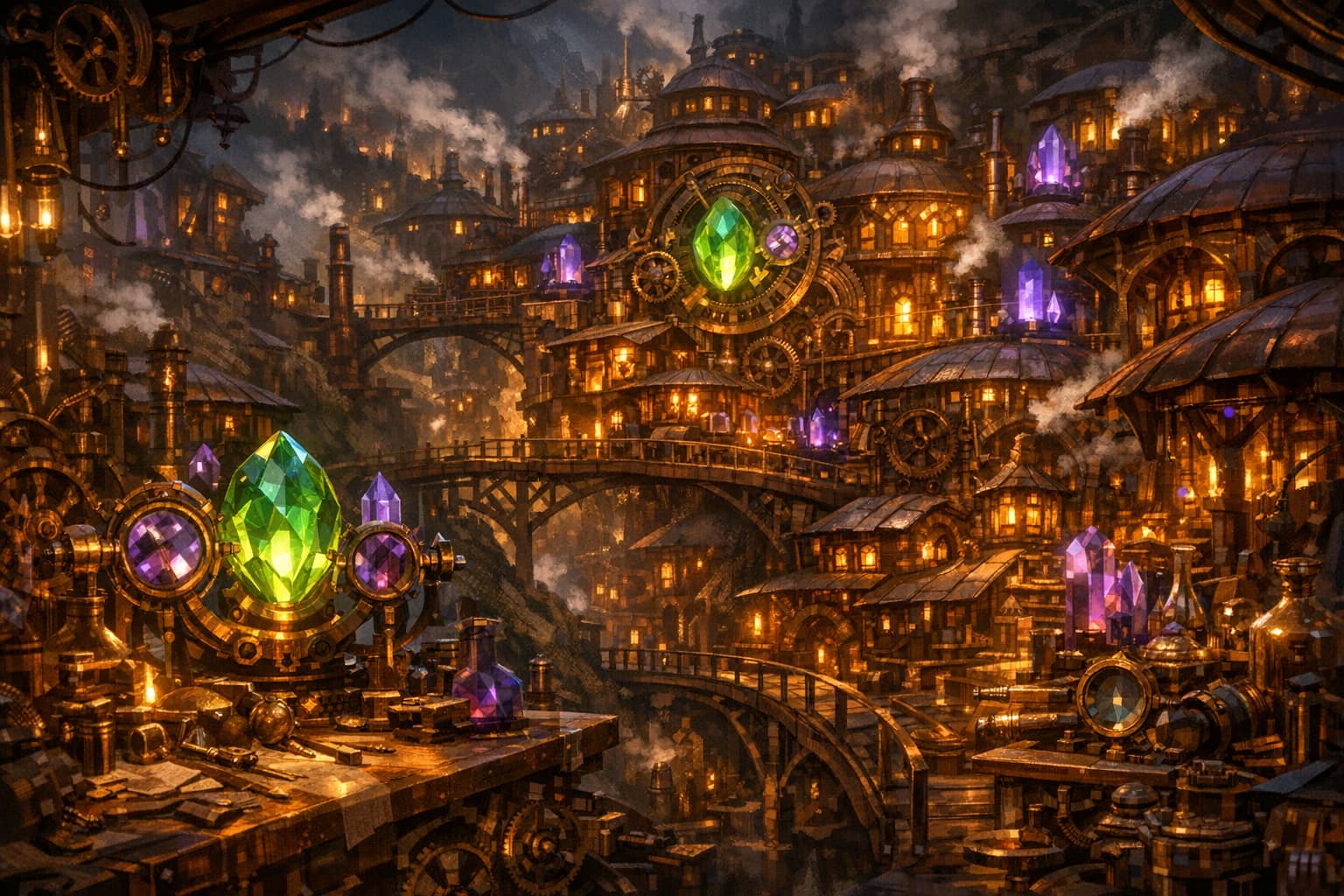
Gnomish settlements share a common trait across settings: they're easy to underestimate. Where dwarven cities announce themselves with massive gates and elven cities dazzle with impossible architecture, gnomish communities tend to look modest until you realize the hill you're standing on is hollow, heated, and contains a working sewer system more advanced than anything the nearest human city has managed.
This reflects gnomish priorities. A dwarven king wants his hall to impress visitors. An elven lord wants beauty that endures. A gnomish community wants things that work. The aesthetic ambition goes inward — into the mechanisms, the efficiency, the clever solution to a problem you didn't know existed.
Major Gnomish Homelands Across Settings
| Setting | Location | Character | Notable Feature |
|---|---|---|---|
| Forgotten Realms | Lantan | Island of inventors, smokepowder engineers | Destroyed and rebuilt; the gnomish relationship with catastrophe in miniature |
| Eberron | Zilargo | Seemingly idyllic nation of information brokers | The Trust — a secret police force that keeps order through surveillance and quiet elimination |
| Dragonlance | Mount Nevermind | Volcanic tinker-gnome city of perpetual invention | Life Quests: every gnome devotes their existence to perfecting one invention (usually unsuccessfully) |
| Greyhawk | Kron Hills | Hill communities of gemcutters and prospectors | Allied with Verbobonc; gnomes as reliable neighbors rather than spectacle |
| Planescape | Bytopia | Twin-layered plane of honest labor and pastoral calm | Gnomish afterlife realm; Garl Glittergold's divine domain |
| Spelljammer | Various | Gnomish spelljamming ships and space stations | Gnomes in space, where tinker traditions meet wildspace exploration |
Zilargo remains the most mechanically interesting gnomish society in D&D. A campaign set there reads more like a spy thriller than a dungeon crawl.
Biology & Physicality
Gnomes are small. This seems obvious until you think about what it means in a world where danger scales by hit die. Three feet tall and forty pounds puts gnomes at a serious physical disadvantage against basically everything that wants to eat them. Their survival strategy isn't strength or endurance — it's being clever enough that strength becomes irrelevant.
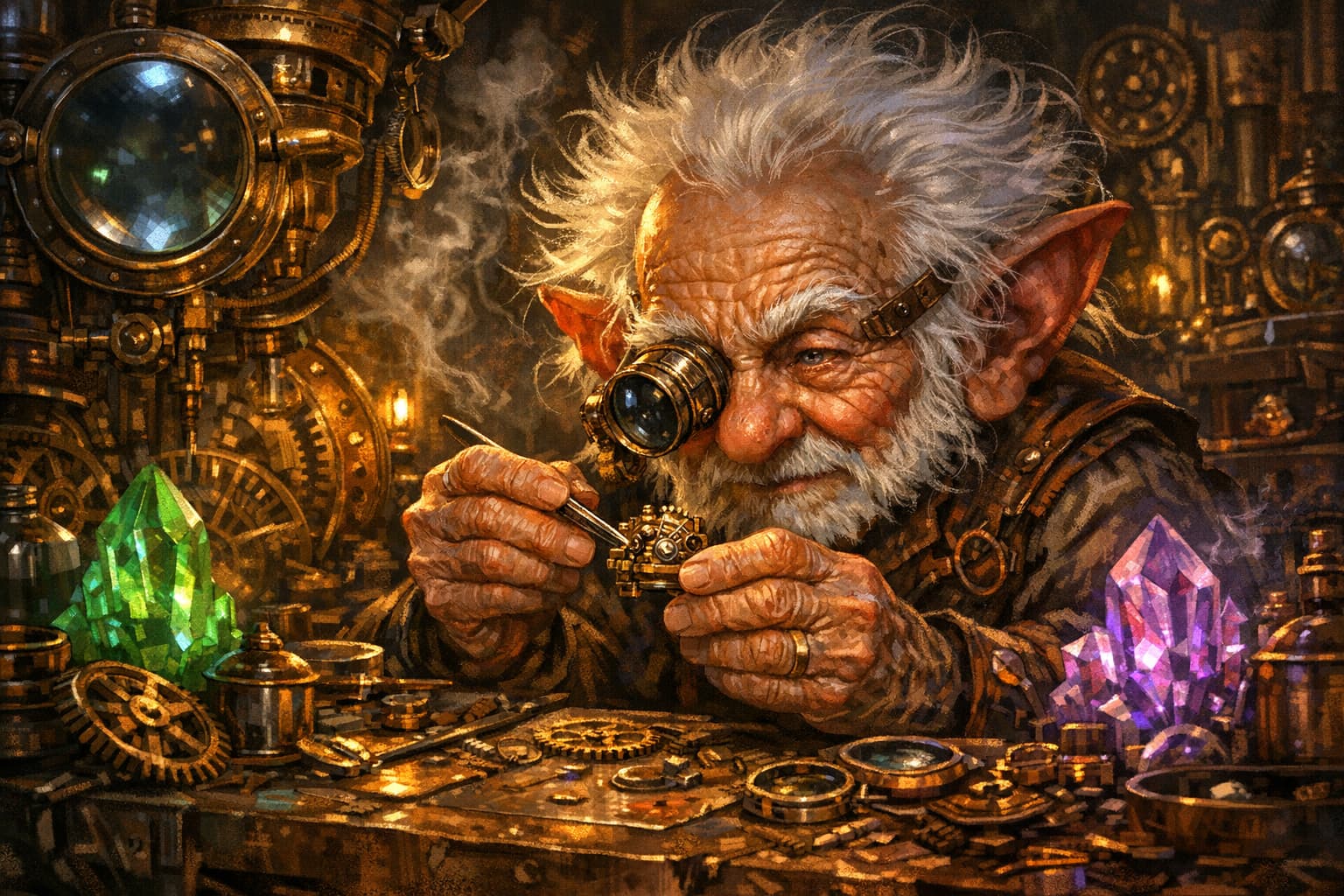
This selective pressure produced a species optimized for perception and lateral thinking over raw power. Gnomish senses are sharper than their size suggests. Their hand-eye coordination is extraordinary — necessary for the fine mechanical and magical work that defines gnomish culture. And their metabolisms burn hot, fueling brains that never quite stop working on the last interesting problem they encountered.
Size & Build
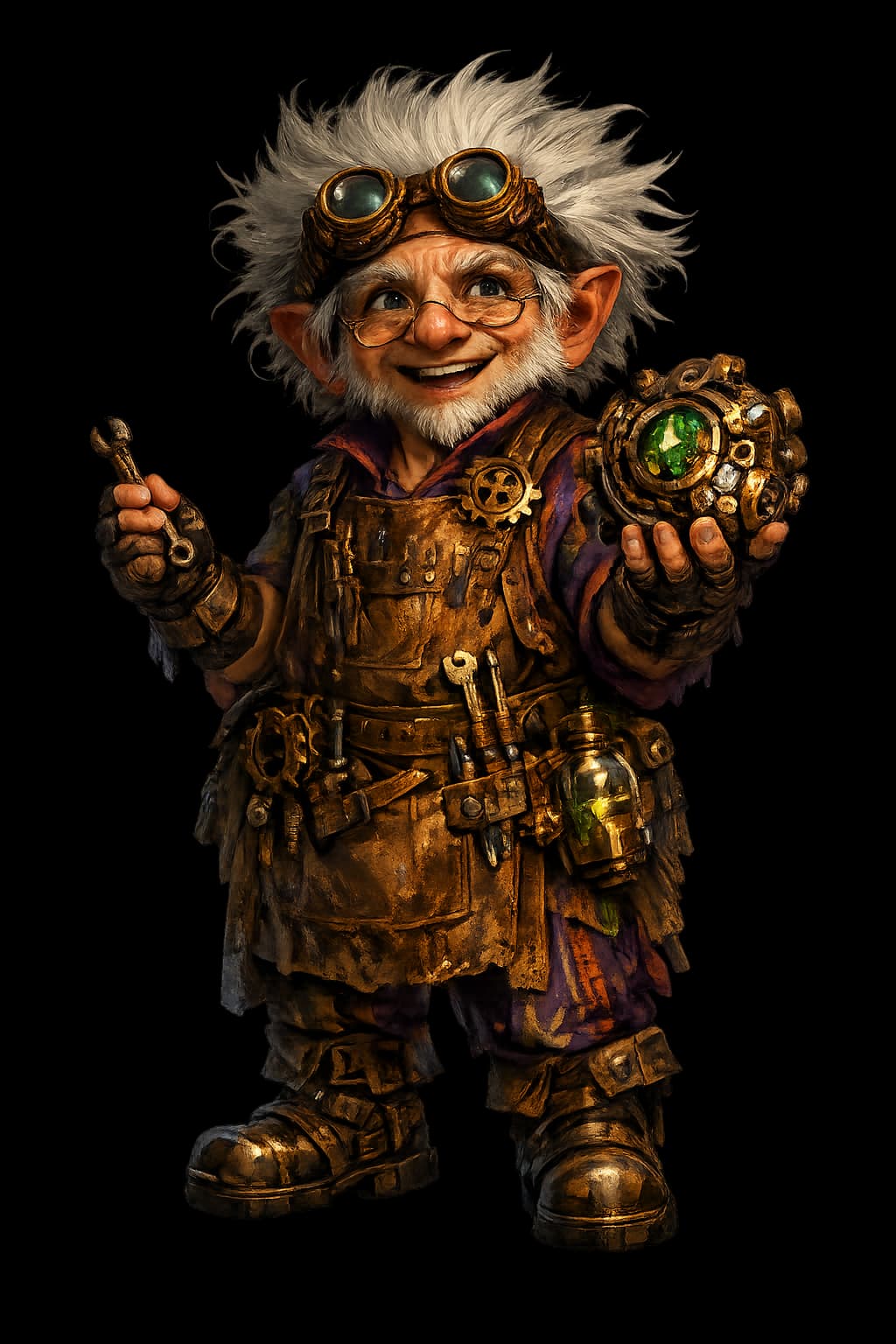
Adult gnomes stand between 3 and 3.5 feet tall, typically weighing 35-45 pounds. Their proportions differ subtly from halflings — gnomes have larger heads relative to body size, reflecting (or at least correlating with) their cognitive emphasis. Their frames are wiry rather than stocky, built for dexterity and speed over endurance. A gnome can fit into spaces that would stop a halfling, and their low center of gravity makes them surprisingly hard to knock down.
Lifespan & Aging
Gnomes live 350 to 500 years, placing them between humans and elves on the longevity scale. This lifespan is long enough to master multiple disciplines but short enough to maintain urgency. Unlike elves, who can afford to spend centuries on a single pursuit, gnomes feel the clock — they have enough time to become expert in several fields but not enough to become complacent about any of them. This temporal sweet spot may explain gnomish restlessness: they live long enough to see patterns but not long enough to stop being surprised by them.
Darkvision & Gnome Cunning
Gnomish darkvision out to 60 feet reflects their ancestral burrowing habits — a Paracelsian echo that survived into game mechanics. More distinctive is Gnome Cunning, the 5e trait granting advantage on Intelligence, Wisdom, and Charisma saving throws against magic. Mechanically this makes gnomes among the most magic-resistant species in the game. Narratively it suggests a species whose minds are unusually difficult to fool, override, or reshape — consistent with creatures who see through illusions because they specialize in creating them.
Psychology & Worldview
The gnomish mind doesn't idle. This is the single most important thing to understand about the species. Gnomes experience boredom as something close to physical pain. An understimulated gnome doesn't zone out — they start disassembling things to see how they work, whether those things belong to them or not.
This isn't ADHD played for laughs, though bad portrayals reduce it to that. It's a fundamentally different cognitive architecture. Gnomes process the world through active investigation. They understand things by taking them apart, literal or metaphorical. A gnome merchant doesn't just sell goods — they understand supply chains, material science, and customer psychology because they couldn't stop themselves from investigating those systems once they noticed them.
The flip side is that gnomes can hyperfocus with terrifying intensity. A gnome working on a problem that interests them will forget to eat, sleep, and acknowledge the existence of other people for days. This alternation between scattered curiosity and laser focus makes gnomes unpredictable companions. They're either paying attention to everything or paying attention to exactly one thing, and the transition between states happens without warning.
“A gnome doesn't ask 'why?' out of philosophy. They ask it the way a reflex hammer tests a knee — compulsively, involuntarily, and with results that sometimes surprise everyone involved, including the gnome.”
— On the nature of gnomish curiosity
Daily Life & Innovation
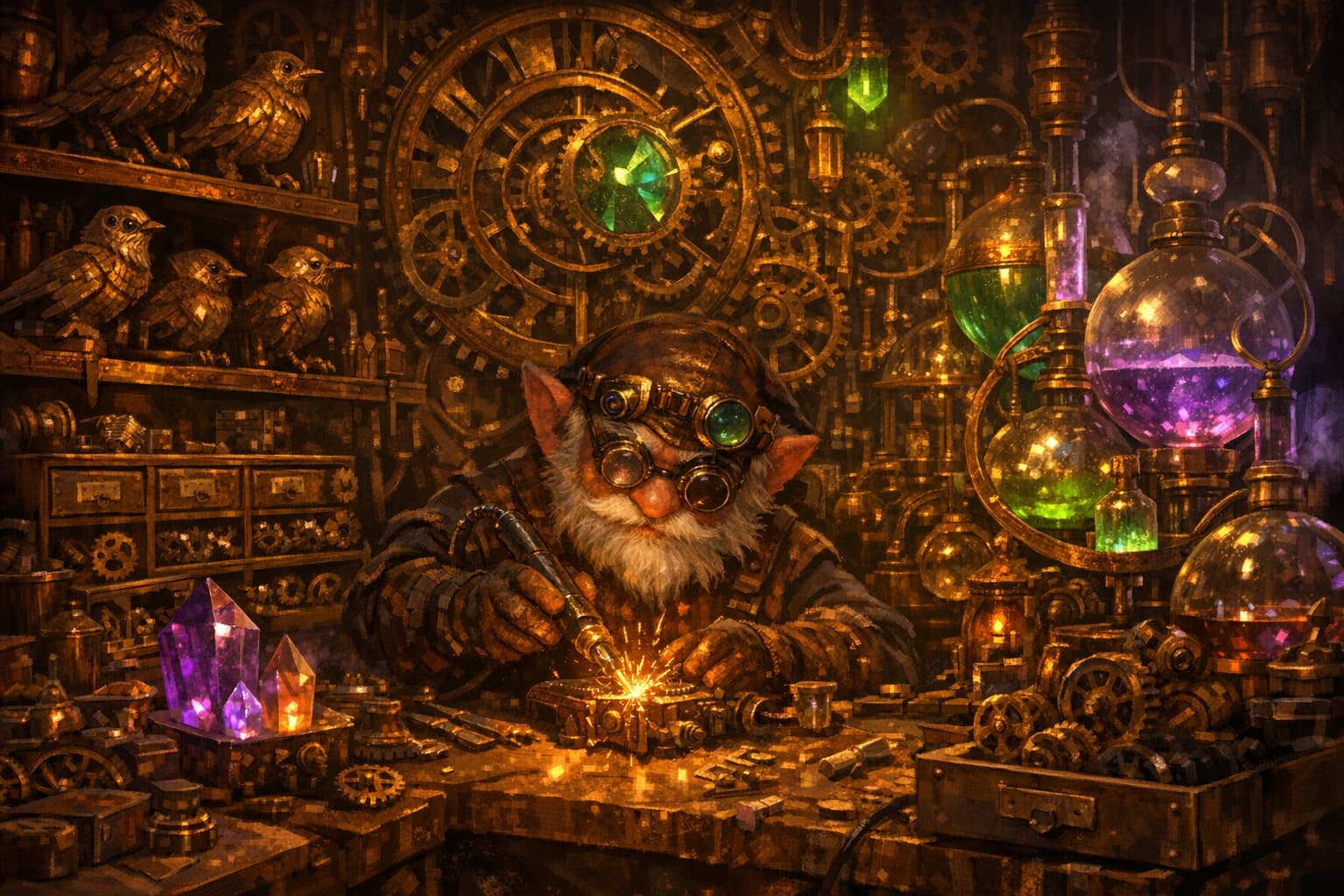
A gnomish household is a workshop that happens to contain beds. Tools share shelf space with dinner plates. Half-finished projects occupy every horizontal surface. Guests learn to check chairs for prototypes before sitting down. This isn't messy living — it's an environment optimized for a mind that might need to test an idea at three in the morning.
Gnomish innovation follows a pattern that frustrates larger species: iterate wildly, fail spectacularly, learn from the explosion, try again. Where dwarven engineering is methodical and elven enchantment is patient, gnomish invention is aggressive. Build fast, test immediately, document what went wrong. The Dragonlance tinker gnome is a caricature of this process, but the underlying truth — that gnomish progress is purchased with acceptable amounts of chaos — holds across settings.
Not every gnome is an inventor, but every gnome is an optimizer. The gnomish baker doesn't just bake bread — they redesign the oven, experiment with grain ratios, and develop a rising schedule calibrated to local humidity. The gnomish guard doesn't just patrol — they map traffic patterns, identify sightline vulnerabilities, and propose architectural modifications to improve security. The compulsion to improve systems applies to every field, not just mechanical tinkering.
When building gnomish NPCs, give each one a current project and an opinion about how something nearby could work better. The project doesn't have to be mechanical — a gnomish poet is revising their epic for the fourteenth time, a gnomish cook is perfecting a sauce that's been "almost right" for six years. The constant is iteration, not engineering.
Culture & Governance
Gnomish governance varies dramatically between subtypes, but two broad models dominate: the consensus-driven councils of rock gnome communities and the informal elder networks of forest gnome settlements. Both resist the hierarchical structures favored by dwarves and humans, partly from temperament and partly because gnomes don't respond well to being told what to do by someone who hasn't earned their respect through demonstrated competence.
Rock Gnome Societies
Rock gnome communities organize around guilds, workshops, and shared infrastructure projects. Leadership gravitates toward gnomes who can coordinate complex endeavors without stifling individual creativity — a management challenge that rock gnomes elevate to an art form. Town councils debate in sessions that look chaotic but follow procedural rules so intricate that outsiders need a guidebook.
Disputes are settled through competitive demonstration rather than argument. If two gnomes disagree about the best way to build a bridge, both build scale models and the community evaluates the results. This empirical approach to governance works well for technical questions and poorly for emotional ones, which rock gnome societies tend to handle through elaborate social rituals designed to let everyone save face.
Forest Gnome Societies
Forest gnome communities are smaller, more hidden, and governed by tradition rather than procedure. Elders advise rather than command. Decisions emerge from quiet conversation rather than public debate. The emphasis on concealment — forest gnomes can cast minor illusion innately — produces societies that value discretion, observation, and the ability to disappear when trouble arrives.
Where rock gnomes build outward, forest gnomes build inward. Their settlements integrate so thoroughly with the natural environment that most travelers walk through them without noticing. This isn't primitive — it's a sophisticated design philosophy that prioritizes harmony with surroundings over visible achievement. A forest gnome village might have plumbing, insulation, and food preservation techniques rivaling any human town, all invisible from ten feet away.
Religion & Garl Glittergold
Garl Glittergold is the head of the gnomish pantheon, and his portfolio tells you everything about gnomish values: trickery, gemcutting, humor, and protection. Not war and honor like Moradin. Not beauty and magic like Corellon. Cleverness and craft and the willingness to laugh at yourself. The gnomish supreme deity is, fundamentally, a prankster who makes beautiful things.
This shapes gnomish religion into something closer to a comedy club than a cathedral. Gnomish temples are workshops where creation is worship. Rituals involve puzzles, riddles, and elaborate practical jokes with theological significance. The faithful honor Garl not through solemn prayer but through acts of cleverness, generosity, and the kind of humor that reveals truth rather than conceals it.
The rest of the gnomish pantheon — Baervan Wildwanderer, Baravar Cloakshadow, Flandal Steelskin, Gaerdal Ironhand, Nebelun, Segojan Earthcaller — covers the full range of gnomish interests from wilderness to illusion to forge work to warfare. Notably, even the gnomish war god (Gaerdal Ironhand) is primarily a defender rather than a conqueror. The pantheon lacks an aggressive deity because gnomish culture doesn't glorify aggression. Defense, yes. Cleverness in conflict, absolutely. But conquest for its own sake doesn't appear in gnomish theology.
Garl Glittergold once collapsed the cavern lair of Kurtulmak, the kobold god, as a prank. This single mythological event is the canonical source of the kobold-gnome enmity across D&D settings. It also reveals something important: gnomish humor has an edge. The "harmless prankster" god committed an act that a kobold would reasonably call an atrocity. How your gnome characters process this tension says a lot about their relationship with their own culture.
Illusion Magic & Tinker Traditions
Gnomish magic gravitates toward illusion not because gnomes are dishonest but because illusion is the school of magic most concerned with perception — and gnomes are obsessed with how things appear versus how they actually work. An illusion spell is, at its core, an experiment in epistemology: what do you think you're seeing, and how wrong are you?
The gnomish affinity for illusion magic creates a species that treats reality as a first draft. Every gnome who can cast minor illusion has practiced making things look like other things, which means they've spent meaningful time thinking about what makes appearances convincing. This bleeds into gnomish art, architecture, and social interaction. Gnomes are difficult to deceive not because they're paranoid but because they understand deception from the inside.
Tinker traditions represent the mechanical counterpart to illusionist magic. Where an illusionist manipulates perception, a tinker manipulates physical reality — but both share the gnomish conviction that the world as given is merely a starting point. The best gnomish artificers blend the two traditions, creating devices that are partially mechanical and partially magical, neither approach sufficient on its own.
The Illusionist Legacy
AD&D explicitly linked gnomes to the Illusionist class, making them the only non-human species that could reach the highest illusionist levels. This mechanical privilege established illusion as definitionally gnomish. Even after later editions removed class restrictions, the cultural association persisted. A gnomish wizard who specializes in evocation is making a statement about their relationship to tradition, whether they intend to or not.
Clockwork & Contraptions
Rock gnome Tinker lets you build a clockwork toy, firestarter, or music box — small objects that demonstrate principles without achieving much. This is intentional design. The gnomish tinkering tradition isn't about building powerful weapons; it's about understanding mechanisms. The toy that walks across a table encodes the same engineering principles as a construct that walks across a battlefield. Gnomes start small because starting small is how you learn what actually works before scaling up to something that could kill you if it fails.
Inter-species Relationships
Gnomes get along with almost everyone, which sounds boring until you realize it's a survival strategy. A three-foot-tall species with no meaningful military power maintains its independence by being useful, pleasant, and connected to everyone. Gnomish friendliness isn't naive — it's diplomatic infrastructure.
Dwarves respect gnomish craftsmanship while finding gnomish methods chaotic. The dwarf who plans a project for six months before touching materials and the gnome who starts building before the idea is fully formed represent fundamentally different engineering philosophies. They collaborate well because their strengths don't overlap: dwarves provide structural integrity, gnomes provide innovation.
Halflings and gnomes share the experience of being small in a big world, but their responses differ. Halflings adapt to existing communities; gnomes reshape communities to fit their needs. A halfling neighborhood in a human city blends in. A gnomish neighborhood is the one with unusual plumbing, modified streetlights, and that building that hums.
Elves find gnomes exhausting. The gnomish energy level, the constant tinkering, the inability to leave any system unimproved — it grates on a species that values patience and contemplation. But elves also recognize that gnomish curiosity, properly directed, produces results that centuries of careful elvish study might miss. The gnome who stumbles onto a breakthrough by accident while trying to solve an unrelated problem is a recurring theme in cross-species magical collaboration.
The gnome-kobold enmity is D&D's most asymmetric species conflict. Gnomes view kobolds as a nuisance. Kobolds view gnomes as an existential threat whose god literally destroyed their god's home. Building a campaign around this perspective gap — where the "comedy relief" conflict is actually a legitimate grievance seen from the other side — produces surprisingly rich storytelling.
Literature & Notable Figures
Gnomish characters in official D&D material tend toward two modes: comic relief or surprising competence, and the best ones manage both simultaneously. The gnome who seems ridiculous until you realize their absurd invention actually works is a character archetype that D&D has refined across decades of published adventures.
Beyond D&D, gnomes appear across fantasy literature in roles that consistently emphasize intelligence over power. Terry Pratchett's Discworld gnomes are six-inch-tall survivalists. C.S. Lewis used Earthmen (gnome-like beings) in The Silver Chair as enslaved underground workers, echoing Paracelsus. Warcraft's gnomes are refugee engineers whose capital city was irradiated by their own defense system — a dark joke about gnomish overreach that became genuine tragedy.
Notable Gnomish Figures & Characters
| Name | Setting / Source | Role | Significance |
|---|---|---|---|
| Fizban / Zifnab | Dragonlance / Death Gate | Eccentric wizard persona | Not actually a gnome, but the archetype of "seemingly silly, secretly powerful" that gnomish characters channel |
| Gnomish Inventors of Mount Nevermind | Dragonlance | Collective protagonists | Codified the tinker gnome as a comedic archetype; Life Quests became the defining gnomish narrative device |
| Jan Jansen | Baldur's Gate II | Turnip-obsessed illusionist/thief | One of the most beloved CRPG companions; proved gnomish characters could be funny and emotionally resonant |
| Scanlan Shorthalt | Critical Role | Gnome bard (Campaign 1) | Demonstrated that gnomish humor could carry dramatic weight in actual play; Sam Riegel's performance redefined gnome expectations |
| Chromie | World of Warcraft | Bronze dragon in gnome form | A dragon who chose to appear as a gnome — an in-universe endorsement of gnomish approachability |
| Nebelun the Meddler | D&D Pantheon | Gnomish god of invention | The divine patron of tinkering; said to have created the first clockwork devices in the multiverse |
D&D Mechanics Across Editions
Gnomish mechanical identity has shifted more than any other core species across D&D editions. Dwarves have always been tough. Elves have always been dexterous. Gnomes have been illusionists, tinkers, magic-resistant, and — in 4th Edition — fey teleporters. The mechanical instability mirrors the species' cultural instability: nobody quite agrees on what gnomes are for.
What has remained consistent is the sense that gnomes interact with magic differently than other species. Whether through illusionist class affinity, innate spellcasting, or Gnome Cunning's saving throw advantage, every edition has given gnomes a distinctive relationship with the arcane. They're not the strongest casters (that's elves) or the most resistant to magic (that's dwarves in most editions). They're the most slippery — magic slides off gnomish minds in ways that frustrate casters and delight gnomes.
Gnome Mechanical Evolution
| Feature | AD&D 1e | 3.5e | 5e (2014) | 2024 |
|---|---|---|---|---|
| Ability Scores | -1 STR, +1 INT | -2 STR, +2 CON | +2 INT, +1 subrace | Flexible |
| Signature Mechanic | Illusionist multi-class | Spell-like abilities (1/day) | Gnome Cunning | Gnome Cunning |
| Vision | Infravision 60 ft. | Low-light vision | Darkvision 60 ft. | Darkvision 60 ft. |
| Anti-Kobold Feature | +1 attack vs. kobolds | +1 attack vs. kobolds, goblins | Removed | Removed |
| Subrace Model | None explicit | Rock, Forest, Deep (Svirfneblin) | Rock, Forest | Rock, Forest (streamlined) |
| Design Role | Illusionist chassis | Small race with SLAs | Magic-resistant generalist | Magic-resistant generalist |
The removal of the anti-kobold attack bonus in 5e was a quiet but significant shift — D&D moved away from encoding species enmities in combat math.
- Infravision 60 ft.
- +1 attack bonus vs. kobolds and goblins
- Defensive bonus vs. gnolls, bugbears, ogres, trolls, giants
- Mining detection abilities (slope, depth, unsafe walls)
- Multi-class as Fighter/Illusionist or Fighter/Thief
The 1e gnome was mechanically a dwarf variant with illusionist access instead of cleric. The anti-kobold bonus was the first mechanical expression of the gnome-kobold enmity.
- Darkvision 60 ft.
- Gnome Cunning (advantage on INT/WIS/CHA saves vs. magic)
- Rock Gnome: Artificer's Lore, Tinker (clockwork devices)
- Forest Gnome: Natural Illusionist (minor illusion), Speak with Small Beasts
Gnome Cunning is arguably the strongest defensive racial trait in 5e. It applies to the three mental saves, which are the most common targeting saves for the most dangerous spells (hold person, banishment, dominate).
- Darkvision 60 ft.
- Gnome Cunning (unchanged)
- Gnome Lineage choice: Rock or Forest (streamlined)
The 2024 PHB keeps Gnome Cunning as the species' signature trait while removing fixed ability scores. Gnomes remain the premier choice for characters who expect to face enemy spellcasters.
Across Franchises
The gnome archetype — small, clever, technologically inclined, underestimated — appears in most major fantasy franchises but with wildly different tonal registers. Comparing implementations reveals how designers answer the same question: what role does a species of brilliant small people fill in a world dominated by larger, stronger beings?
The answer usually falls on a spectrum between comedy and competence, and where a franchise places its gnomes says a lot about how seriously it takes ingenuity as a form of power. D&D's gnomes have oscillated along this spectrum for fifty years. Other franchises have committed more firmly to one end or the other.
Gnome Archetype Across Franchises
| Franchise | Name / Equivalent | Tone | Key Distinction |
|---|---|---|---|
| D&D (generic) | Gnome | Varies by setting (comedy to espionage) | The original; defined by what each setting needs gnomes to be |
| World of Warcraft | Gnome | Comedic resilience | Lost their capital to radiation; rebuilt. Tone is "laugh to keep from crying" |
| Warhammer Fantasy | No direct equivalent | — | Dwarven Engineers Guild absorbs the tinker role; gnomes written out entirely |
| Pathfinder | Gnome | Fey-touched, emotionally volatile | Gnomes fade and die without novel experiences (the Bleaching). Curiosity is literal survival |
| Elder Scrolls | Dwemer (loosely) | Extinct, unknowable | Vanished; their ruins are dangerous. Tonal opposite of comedic gnome — technology as hubris |
| Discworld | Gnome (Nac Mac Feegle adjacent) | Satirical survivalism | Six inches tall, built like a brick. Pratchett inverts every "small = cute" assumption |
| Magic: The Gathering | Various artifact creatures' creators | Incidental worldbuilding | No species called gnome, but the archetype appears in Izzet researchers and Kaladesh inventors |
Pathfinder's Bleaching mechanic is the most elegant solution to the "why are gnomes curious?" question — it makes curiosity a biological imperative rather than a personality trait.
FAQ
Common Questions
Give your gnome specific expertise and opinions rather than general wackiness. A gnome who cares deeply about acoustic engineering and gets frustrated when people treat sound design as trivial is more interesting than a gnome who's randomly eccentric. Humor should emerge from the character's genuine perspective clashing with the world, not from performing silliness. Let the comedy happen naturally — gnomish curiosity in dangerous situations is inherently funny without you trying to make it funny.
Artificer is the obvious thematic fit, and Gnome Cunning shores up the class's weak mental saves. Wizard benefits from the Intelligence bonus and the same defensive trait. But the sleeper pick is any class that normally suffers against spellcasters — gnome fighters, barbarians, and rogues all benefit enormously from Gnome Cunning in campaigns with frequent magical opposition. A gnome barbarian who shrugs off charm effects while raging is mechanically distinctive and narratively unexpected.
Rock gnomes engage with the world by building and modifying — they see problems as engineering challenges. Forest gnomes engage by observing and adapting — they see problems as puzzles to solve without disrupting the surrounding system. A rock gnome encountering a locked door reaches for tools. A forest gnome notices the door's hinges are rusted and suggests waiting for the wind to do the work. Same intelligence, different relationship with intervention.
Rarely through direct confrontation. Gnomish defense doctrine emphasizes making conflict more trouble than it's worth — concealed settlements, trapped approaches, alliances with neighbors who have armies. Zilargo in Eberron is the purest expression: a gnomish nation that survives between larger powers by knowing everyone's secrets. When gnomes do fight, they prefer traps, illusions, and environmental manipulation over standing battles. Three feet tall and forty pounds means you don't get to pick fair fights.