
Goblins
Small, cunning, and endlessly underestimated — thriving in the cracks of a world that never made room for them
Folklore & Mythological Roots
Goblins predate fantasy gaming by centuries. The word first appears in medieval French as "gobelin," possibly derived from the Greek "kobalos" — a mischievous, shape-shifting spirit that plagued travelers and farmers. German folklore gives us the kobold, a household or mine spirit that could be helpful or malicious depending on how you treated it. English tradition merged these strands into something simpler: a small, ugly, mean-spirited creature that lurked in dark places and caused trouble for decent folk.
What's consistent across every tradition is the goblin's relationship to civilization. Goblins don't exist in the wilderness the way wolves or bears do. They exist at the edges of human spaces — in abandoned mines, under bridges, in the walls of old houses. They're parasitic in the ecological sense: they need civilization nearby in order to steal from it, scavenge from it, or simply annoy it. This parasitic relationship is the oldest and most persistent goblin trait, predating any stat block by a thousand years.
The fairy-tale goblin also carries a specific class anxiety. In European folklore, goblins steal from the rich and hoard what they take. They ruin craft goods, sour milk, and sabotage tools. They represent the fear that something small and invisible is degrading the value of your labor. This isn't the existential dread of a dragon or a demon — it's the mundane dread of rot, theft, and entropy. Goblins are the fantasy of everything going wrong in small, accumulating ways.
Christina Rossetti's 1862 poem "Goblin Market" pushed the archetype further into sinister territory — goblin merchants selling enchanted fruit that creates addiction and wastes the body. Here the goblin becomes a tempter, a dealer in destructive pleasure. This strand feeds into the D&D goblin's mercantile cunning, the sense that a goblin will always try to sell you something you shouldn't buy.
Mythological Roots of the Goblin Archetype
| Source | Concept | Legacy in Fantasy |
|---|---|---|
| French "gobelin" (12th c.) | Mischievous household spirit | Small trickster archetype; name itself |
| Greek kobalos | Shape-shifting prankster spirit | Cunning, deception, and disguise traditions |
| German kobold | Mine spirit — helpful or vengeful | Association with underground lairs and mines |
| English brownie/boggart | Domestic spirit turned malicious | Goblins as corrupted helpers; lair-dwelling pests |
| Rossetti's "Goblin Market" (1862) | Tempter-merchants with addictive wares | Goblin mercantile cunning; dangerous bargains |
| Tolkien (1937) | Underground slave-armies of the Misty Mountains | Goblins as industrial vermin in vast tunnel networks |
The goblin has always been small, clever, and unwelcome. Fantasy gaming formalized what folklore had been saying for centuries.
Etymology & the Name Problem
"Goblin" comes to English through Old French "gobelin," attested in the 12th century, but the trail goes cold after that. The most popular etymology traces it to the Greek "kobalos" via Medieval Latin "gobelinus," a demon name recorded in chronicles from Normandy. Others connect it to the German "Kobold" through a shared Proto-Germanic root. Nobody's certain, which is fitting — a creature defined by sneaking through cracks in civilization should have an origin that's hard to pin down.
The D&D relationship between goblins and orcs is etymologically tangled because Tolkien tangled it first. In The Hobbit, the creatures under the Misty Mountains are called goblins. In The Lord of the Rings, functionally identical creatures are called orcs. Tolkien eventually settled on orcs as the "real" name and goblins as a hobbit colloquialism, but the damage was done. D&D separated them into distinct species — goblins small and sneaky, orcs large and aggressive — creating a taxonomy from what was originally a translation problem.
The goblinoid family in D&D — goblins, hobgoblins, and bugbears — adds another layer. "Hobgoblin" originally meant a friendlier spirit ("hob" being a familiar name like "Robin"), while "bugbear" comes from the Welsh "bwg" meaning ghost or scarecrow. D&D inverted both: hobgoblins became the disciplined military version, bugbears became the brutal ambush predator. The names carried connotations the game systematically reversed, which is either creative or confusing depending on your perspective.
“A creature whose name nobody can trace, whose taxonomy nobody can agree on, and whose relationship to every neighboring species is a matter of scholarly debate. The goblin is the footnote that ate the page.”
— On goblin etymology
Warrens, Lairs & Tribal Territory
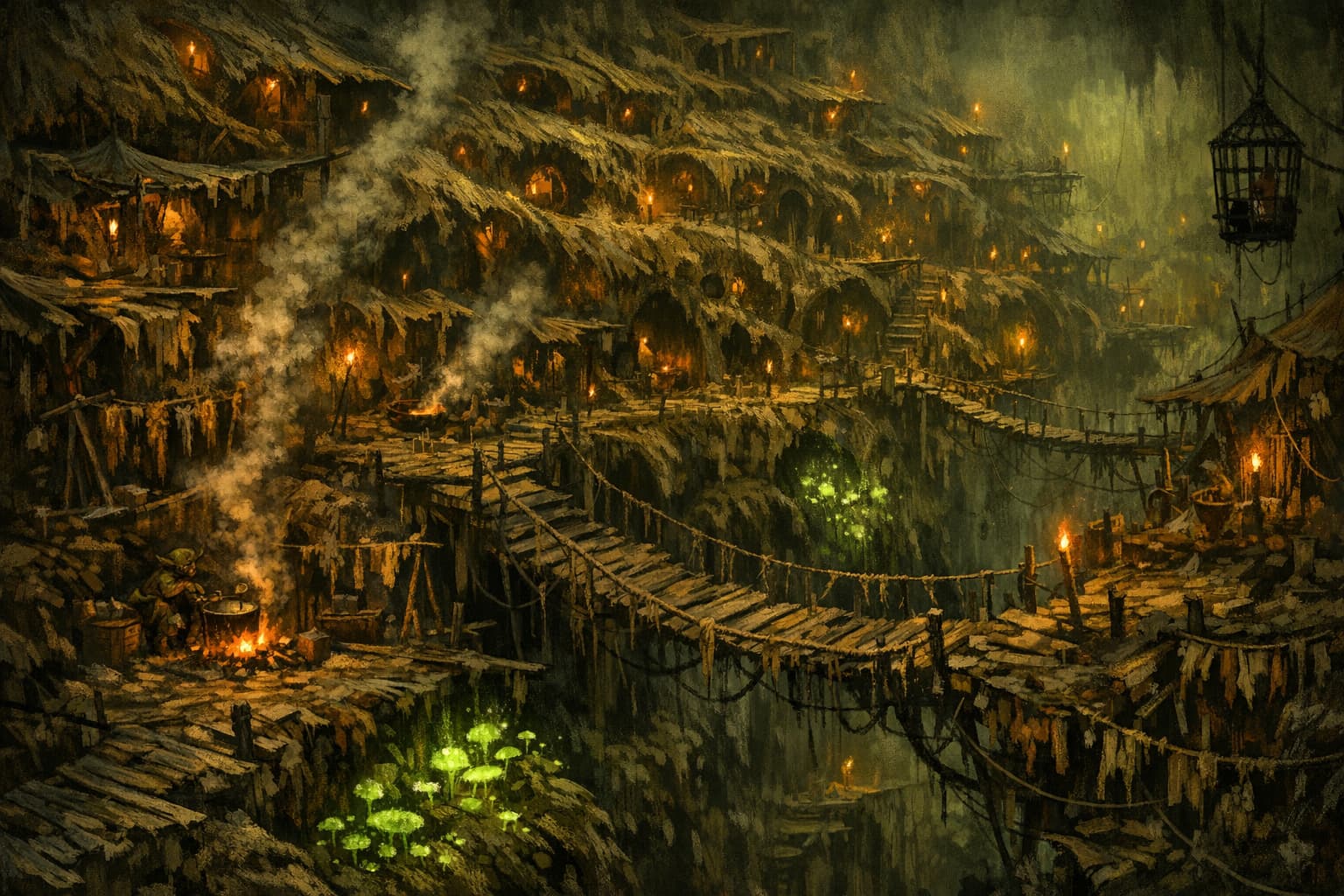
Goblin settlements are engineering marvels that nobody respects. A mature warren — the goblin term for a permanent settlement — is a network of tunnels, chambers, trap corridors, and escape routes carved into hillsides, built under ruins, or excavated from abandoned mines. The tunnels are sized for goblins, which means anything Medium-sized or larger fights at disadvantage in every meaningful way. This isn't accidental. This is the architectural equivalent of a species-wide defense strategy.
The typical warren houses between forty and two hundred goblins across an extended tribal group. Rooms serve multiple functions — sleeping quarters double as storage, cooking areas adjoin fungus gardens, and every major chamber has at least two exits. Goblin architecture prizes redundancy over comfort. A warren that loses one entrance simply routes traffic through another. A warren that loses a whole wing seals the tunnels and keeps functioning.
Above-ground goblin camps are different: temporary, disposable, and designed to be abandoned quickly. A raiding camp might last a week before the tribe moves on. A seasonal camp near a trade road might be used for months during caravan season. These camps leave almost no trace — goblins take everything useful when they leave and burn what they can't carry. The difference between a goblin camp and an empty clearing is subtle enough that experienced rangers look for the signs: stripped bark at goblin height, small fire pits filled with fish bones, and shallow latrines exactly fifty paces from the sleeping area.
When designing goblin warrens, think in three dimensions. Goblins dig vertically as well as horizontally — trapdoors in floors, ceiling chutes for dropping rocks or boiling water, crawl tunnels that connect distant rooms through the walls. A map that looks simple on the horizontal plane should be a nightmare in cross-section. Give your goblins murder holes, flooding mechanisms, and at least one escape tunnel that exits a quarter mile away.
History Across D&D Editions
Goblins have appeared in every edition of D&D, but their role has shifted from generic low-level fodder to a species with genuine worldbuilding depth. The trajectory is slower than the orc's journey from monster to protagonist — goblins are still primarily antagonists in most published adventures — but the trend is clear. Each edition gives them a little more personality, a little more culture, and a little more reason to exist beyond being the thing first-level characters kill.
The mechanical history is a story about the game learning to make low-CR encounters interesting. Early goblins were bags of hit points. Modern goblins have Nimble Escape, pack tactics, and environmental advantages that make a group of them genuinely dangerous to unprepared parties. The design evolution says: even the weakest enemies should fight smart.
Original D&D
Goblins appear as Chaotic monsters with -1 morale in daylight. Functionally identical to kobolds at the bottom of the dungeon food chain. No culture, no tactics, no personality.
AD&D 1e Monster Manual
First real goblin write-up: tribal society, hatred of dwarves, wolf-riding raiders. Goblins get their own king (the "Boss") and a military hierarchy. Still 1-1 HD fodder, but fodder with an org chart.
B2: Keep on the Borderlands
The Caves of Chaos establish the goblin lair as a staple D&D experience. Multiple goblin factions with internal rivalries. The template for decades of goblin dungeon design.
AD&D 2e — The Complete Book of Humanoids
Goblins become playable for the first time. Cultural details expand: crafting, trapping, scavenging economies. The "sniveling coward" characterization solidifies but is treated as tactical rather than moral.
3.5e — Goblin PCs Formalized
Small size, +4 DEX, -2 STR, -2 CHA. The "sneaky little guy" archetype gets hard numbers. Goblins are the go-to for players who want to play rogues with a sense of humor.
5e — Nimble Escape Changes Everything
Nimble Escape (Disengage or Hide as a bonus action) makes goblins tactically interesting at every level. A goblin encounter becomes a puzzle, not just a speed bump. Volo's Guide (2016) adds full PC stats and Nilbog lore.
Pathfinder 2e Separates the Lineage
Paizo makes goblins a core ancestry in PF2e, fully severing them from the "disposable pest" tradition. Goblins are weird, curious, and playable without apology. The most radical goblin rehabilitation in tabletop history.
2024 D&D PHB
Goblins appear in the 2024 Monster Manual with updated stat blocks but are not a core PC species in the PHB. The Fury of the Small and Nimble Escape features continue to define the species mechanically.
Biology & Physiology
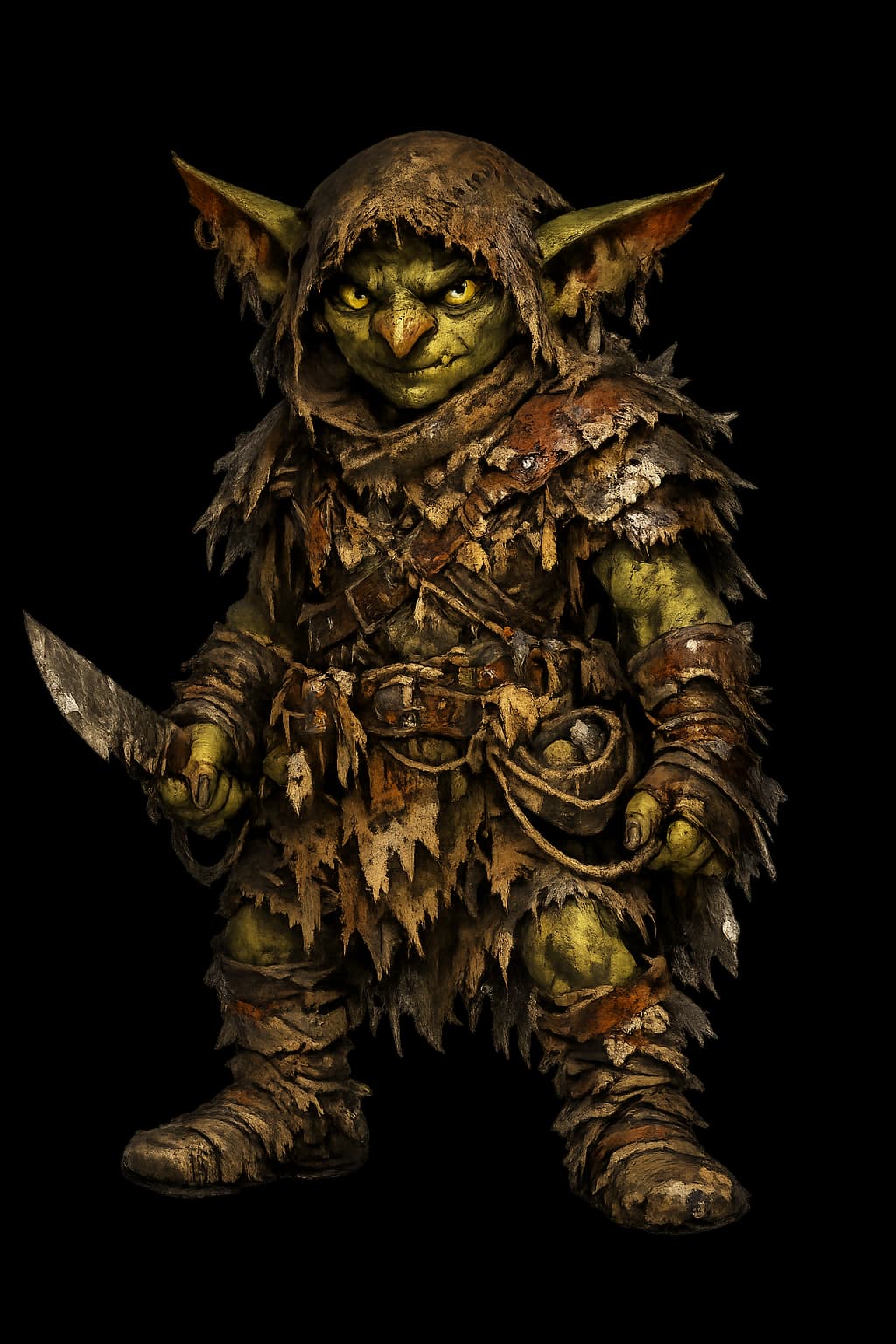
Goblins are Small creatures, typically standing between three and three-and-a-half feet tall and weighing forty to eighty pounds. Their frames are wiry rather than frail — pound for pound, goblin muscle is denser than human muscle, optimized for bursts of speed and climbing rather than sustained labor. Their oversized heads house brains that are proportionally larger than a human's relative to body mass, which makes the recurring "goblins are stupid" characterization in older sourcebooks biologically awkward.
The defining physical features — large ears, flat noses, wide mouths with sharp teeth, and yellow-to-orange eyes — are all sensory adaptations for underground life. Those ears hear frequencies humans can't. Those noses detect airflow changes in tunnel systems. Those eyes see in darkness out to sixty feet. Goblins didn't evolve for open battlefields. They evolved for cramped, lightless spaces where hearing a threat before it hears you is the difference between survival and a footnote.
Darkvision & Sensory Package
Goblin darkvision extends to 60 feet in total darkness, but unlike dwarven darkvision, it's motion-optimized. Goblins detect movement in low light faster than almost any other humanoid species — a survival trait honed by generations of living alongside underground predators. Their peripheral vision is exceptional, covering nearly 270 degrees, which makes sneaking up on a goblin sentry considerably harder than most adventurers expect.
Nimbleness & Agility
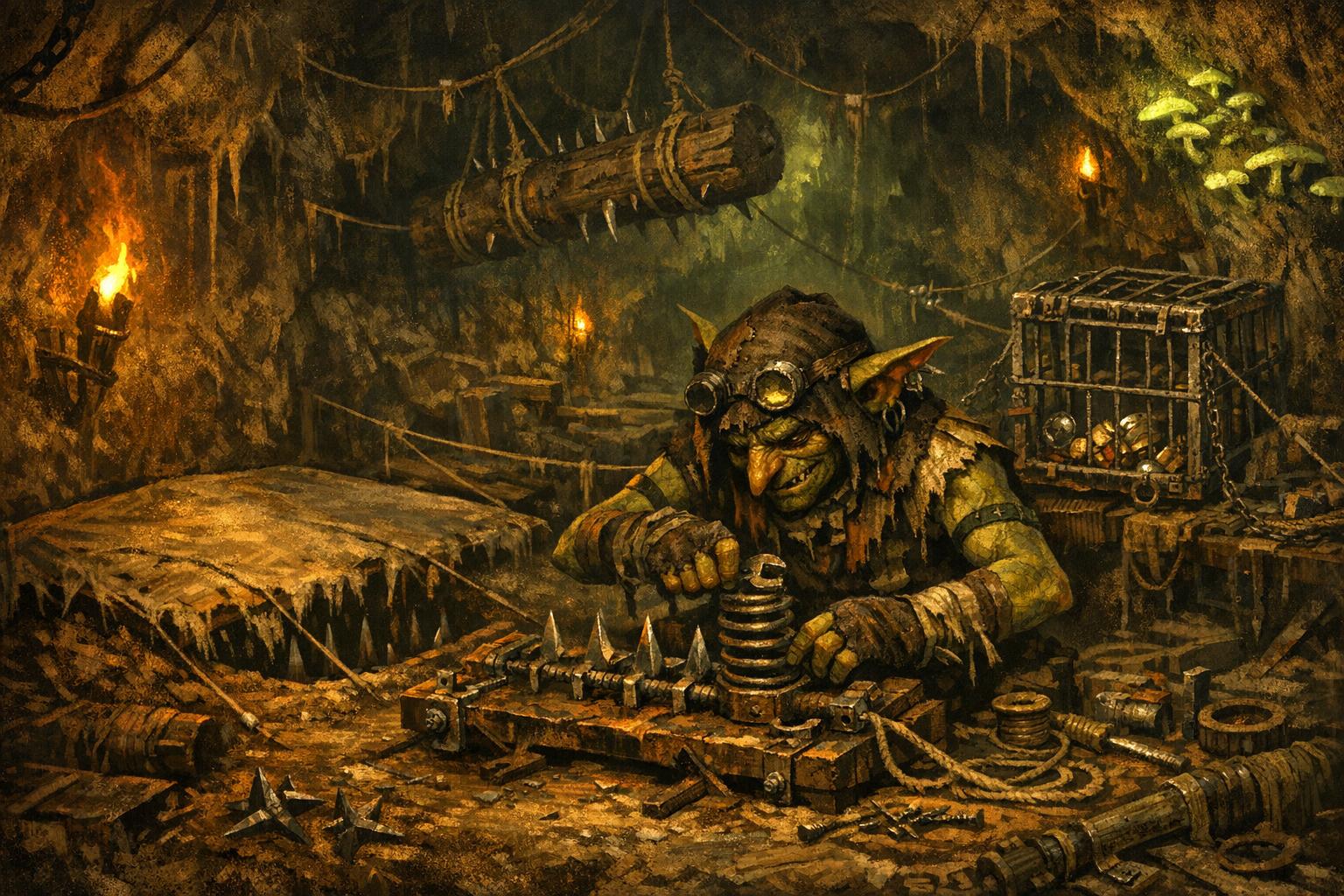
The goblin skeletal structure is built for flexibility. Double-jointed wrists, highly mobile shoulder sockets, and ankle joints that allow near-vertical climbing on rough surfaces. A goblin can squeeze through any opening its skull fits through — roughly nine inches in diameter for an adult. This isn't a party trick. It's how goblins escape collapsed tunnels, evade larger predators, and infiltrate structures that should be secure. Nimble Escape isn't just a game feature; it's a species survival strategy codified as a mechanic.
Diet & Metabolism
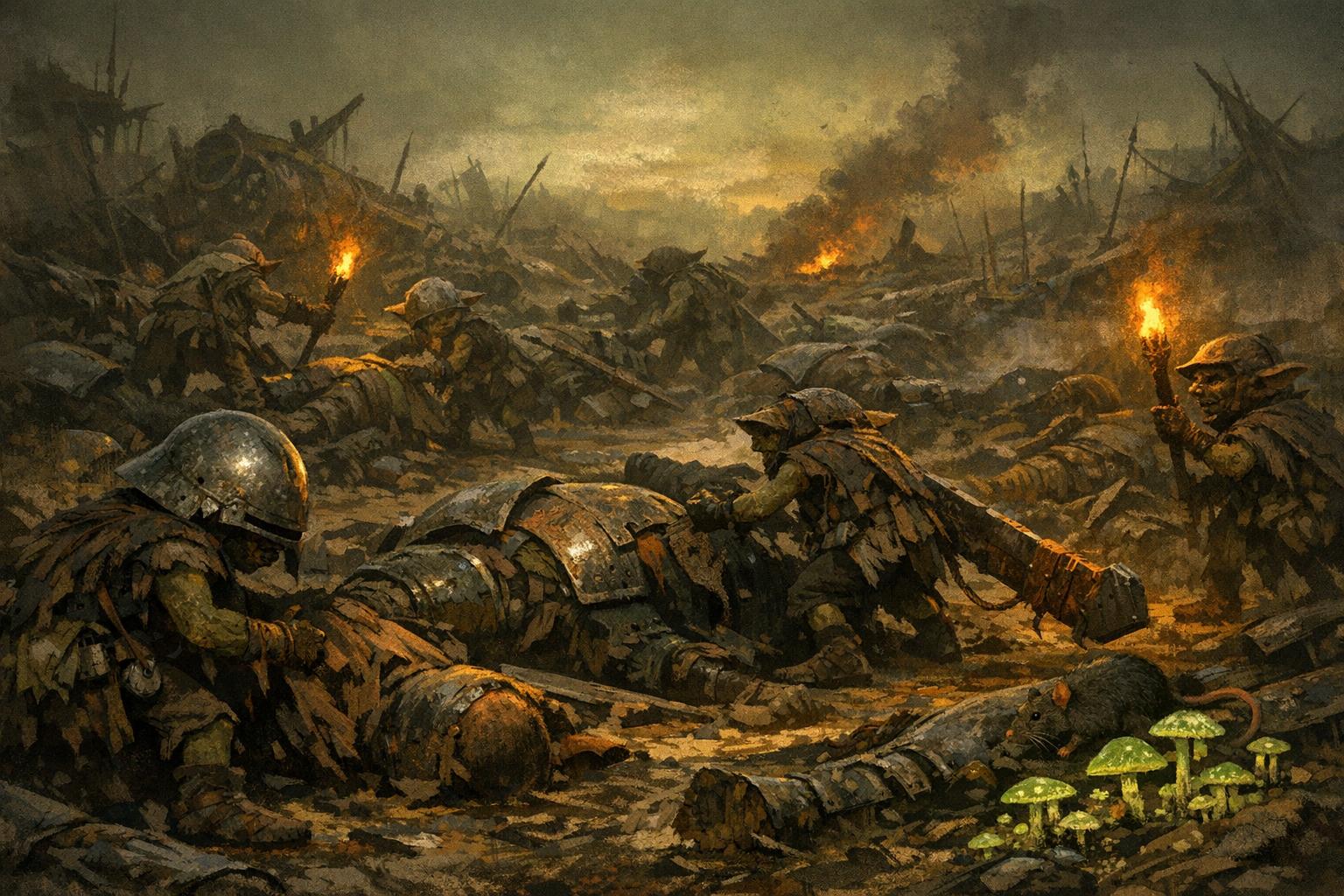
Goblins are true omnivores with digestive systems that would make a goat envious. They can extract nutrition from rotting meat, raw fungi, insects, bark, leather, and substances most species wouldn't classify as food. This isn't a sign of primitiveness — it's an extreme survival adaptation. A species that can eat anything doesn't starve when preferred food sources disappear. Goblin metabolism runs hot and fast: they eat frequently, burn energy quickly, and maintain a body temperature slightly higher than humans, which contributes to their jittery, hyperactive behavior.
Reproduction & Lifespan
Goblins breed rapidly — litters of three to five are common, and a goblin reaches physical maturity by age eight. This fast reproduction cycle is the species' primary survival strategy: they replace losses faster than almost any other humanoid. A goblin tribe devastated by an adventuring party or a territorial predator can recover its numbers within a few years. The tradeoff is lifespan. Most goblins live forty to sixty years if nothing kills them first, though 'nothing kills them first' is not the way to bet.
Cowardice as Survival Strategy
Every sourcebook since 1977 has described goblins as cowardly. This is true in the same way that calling a fox cowardly for running from a wolf is true — technically accurate and completely missing the point. Goblins don't flee because they lack courage. They flee because they're three feet tall, they live in a world full of things that can kill them in one hit, and standing their ground against a creature three times their size is not bravery. It's bad math.
Goblin "cowardice" is actually a sophisticated risk-assessment system. A goblin warrior evaluates threats constantly: how many of us, how many of them, what's the terrain, where are the exits, do we have traps set, is running an option. If the numbers favor the goblins, they attack with shocking ferocity. If the numbers don't, they retreat, regroup, and reengage on better terms. This isn't fear. It's tactical awareness operating at an instinctive level.
The species' survival proves the strategy works. Goblins are the most numerous humanoid species in most D&D settings. They've outlasted empires, survived dragon attacks, endured genocide campaigns by every "civilized" species on the continent, and kept breeding, scavenging, and adapting. The orcs' strategy is to be tough enough to survive anything. The elves' strategy is to be powerful enough to prevent threats. The goblin strategy is simpler: be too many to kill and too fast to catch. It's worked for millennia.
“The brave goblin is the dead goblin. The coward goblin has grandchildren. We know which one the tribe remembers.”
— Goblin proverb
Tribal Hierarchy & Daily Life
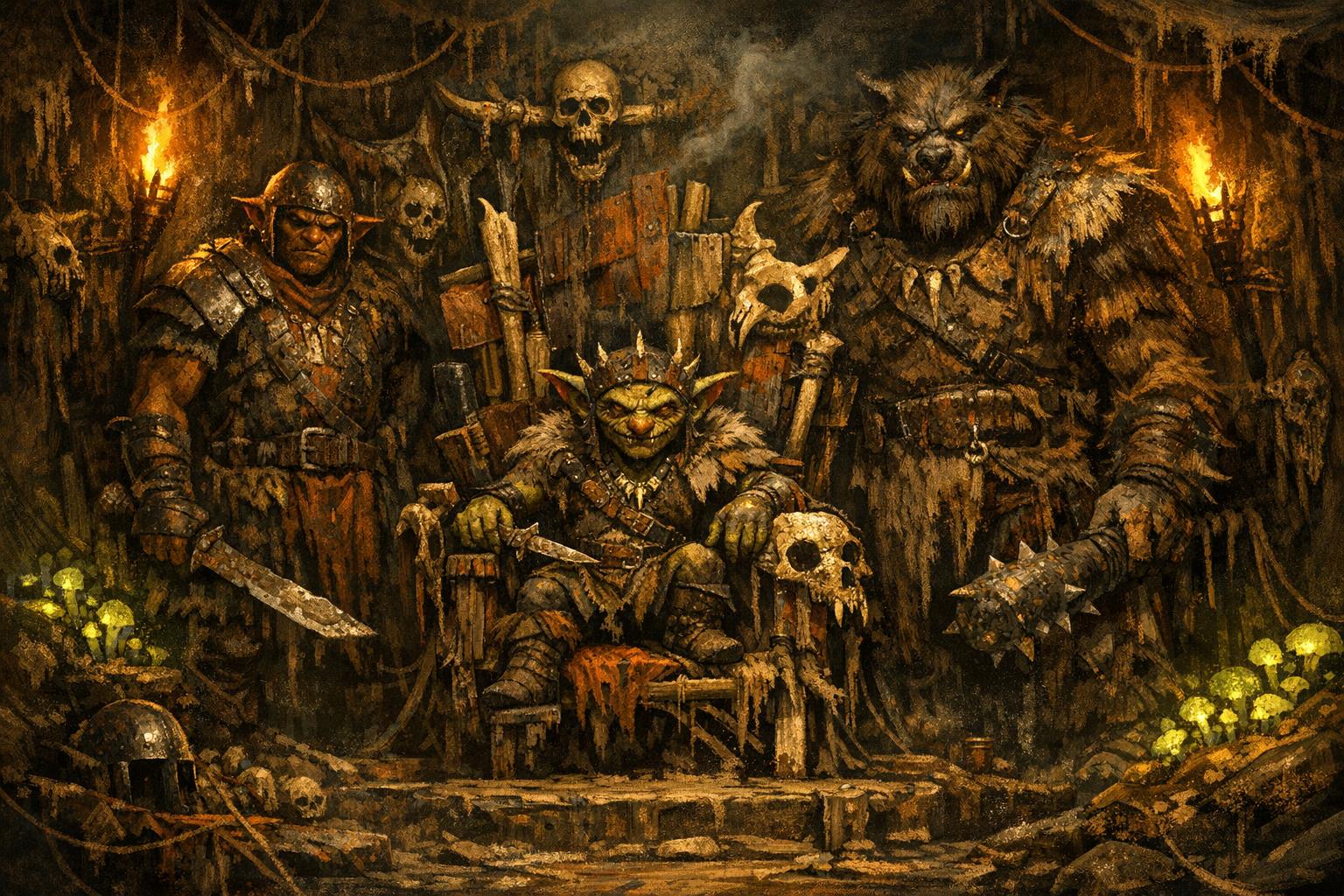
Goblin tribal structure is a pyramid of bullying that runs from the biggest goblin at the top to the smallest at the bottom, but that description hides real complexity. The chief leads through a combination of physical dominance, cunning, and the ability to keep the tribe fed. A chief who can't provide gets overthrown — goblin loyalty is transactional, which means goblin leadership is perpetually accountable in a way that hereditary monarchies aren't.
Below the chief sits a loose council of specialists: the best trapmaker, the head scavenger, the war leader (often a different goblin from the chief), the shaman, and whoever controls the food supply. These goblins hold power because they provide essential services, and they can collectively check a chief who overreaches. It's not democracy, but it's not pure tyranny either — it's a patronage network where influence flows from competence.
Daily life in a goblin warren revolves around three activities: eating, crafting, and scouting. Foraging parties leave the warren at dawn and dusk — goblins prefer dim light for surface work. Crafters repair traps, maintain weapons, and build the jury-rigged contraptions that goblin engineering is notorious for. Scouts monitor the territory for threats and opportunities: a caravan to raid, a predator to avoid, an abandoned campsite to strip for materials. Children learn by following adults, and goblin childhood is short — you're working by age six or you're taking someone else's rations.
A goblin tribe's relationship with its neighbors tells you everything about the local power structure. A tribe that raids farms is desperate or aggressive. A tribe that trades scavenged goods is pragmatic. A tribe that pays "protection taxes" to a local lord in exchange for being left alone has made a calculation about the value of peace. The most interesting goblin communities are the ones that have figured out that coexistence, however uneasy, beats the constant attrition of warfare.
The Goblinoid Family: Bugbears & Hobgoblins
Goblins don't exist in isolation — they're the smallest member of the goblinoid triad, and understanding goblins means understanding their relationship with hobgoblins and bugbears. The three species share a divine creator (Maglubiyet), a biological kinship that's more than cosmetic, and a social dynamic that is, frankly, abusive.
Hobgoblins are the disciplined middle sibling. Taller than goblins, organized into rigid military hierarchies, and utterly convinced of their own superiority, hobgoblins treat goblins as expendable labor and cannon fodder. A hobgoblin legion uses goblin skirmishers as a screening force — the goblins absorb the first wave of enemy attacks while the hobgoblin infantry forms up behind them. The goblins know exactly what their role is. They do it because the alternative is worse: a goblin tribe without hobgoblin protection is vulnerable to everything.
Bugbears are the antisocial older sibling. Larger, stronger, and lazier than either goblins or hobgoblins, bugbears serve as enforcers, ambush predators, and the threat that keeps goblins in line within the tribe. A bugbear assigned to a goblin warband functions as a one-creature terror weapon — the goblins are more afraid of the bugbear behind them than the adventurers ahead of them, which is exactly the point.
Under Hobgoblin Rule
Goblin tribes absorbed into hobgoblin legions lose their autonomy but gain security. The hobgoblin military machine feeds its troops, protects its territory, and maintains order. Goblins serve as scouts, trappers, skirmishers, and servants — the least desirable roles, always. But they eat regularly, which is more than many independent tribes can guarantee.
The cost is cultural erasure. Hobgoblins impose their language, their gods (Maglubiyet above all), and their social structure on subject goblins. Independent goblin traditions — their oral histories, their craft styles, their particular brand of chaotic spirituality — get flattened into hobgoblin conformity. Goblin rebellions within hobgoblin legions are common, brutal, and usually unsuccessful.
Independent Tribes
Free goblin tribes are messier, more creative, and more vulnerable. Without hobgoblin discipline they develop their own governance, their own crafting traditions, and their own religious practices — which tend to be wilder, more animistic, and less focused on Maglubiyet. Independent goblins trade, innovate, and adapt to local conditions in ways that regimented goblins can't.
The vulnerability is real though. An independent goblin tribe has to handle its own defense, its own food production, and its own diplomacy with neighbors who may not take them seriously. Many independent tribes survive by being too annoying to bother exterminating but too useful to ignore — providing scavenging services, trap-clearing in ruins, or cheap labor that nobody else wants to do.
Religion & Maglubiyet the Mighty
Maglubiyet, the Mighty One, is the god of goblinoids — all three species owe him divine allegiance, and he collects on it with the enthusiasm of a landlord on rent day. In goblin theology, Maglubiyet conquered the original goblin gods and enslaved their people as a divine right. This isn't worship born from love or gratitude. It's worship born from subjugation, which makes goblin religion fundamentally different from the devotion of most D&D species.
Goblins pray to Maglubiyet because the alternative is worse. The Mighty One rewards goblinoid victories in war and punishes failure with spiritual torment in the afterlife. Goblin souls that don't serve Maglubiyet go to Acheron, where they fight in his armies for eternity. Goblin souls that do serve Maglubiyet also go to Acheron, where they fight in his armies for eternity but in slightly better positions. The theological incentive structure is, to put it mildly, bleak.
Independent goblin tribes often maintain older spiritual practices alongside or underneath Maglubiyet worship. Animistic traditions — reverence for cave spirits, fire spirits, and the spirits of particularly clever ancestors — persist in tribes far from hobgoblin influence. Some goblins worship the Nilbog, a trickster spirit of chaos and reversal that may or may not be an aspect of the god Maglubiyet accidentally created when he conquered the original goblin pantheon. The Nilbog possesses goblins and forces them to do everything backward — a spirit of rebellion encoded in the species' own mythology.
The Nilbog tradition is one of the most interesting pieces of goblin lore because it's essentially a religious resistance movement. A Nilbog-possessed goblin can't be controlled by hobgoblins, can't be ordered by chiefs, and inverts the power structure of the tribe. If Maglubiyet represents forced obedience, the Nilbog represents forced disobedience. A campaign built around a Nilbog cult trying to free goblin souls from Maglubiyet's afterlife army writes itself.
Traps, Alchemy & Scavenger Magic
Goblin magic isn't pretty. It's not elegant elven enchantment or precise dwarven rune-work. It's functional, improvisational, and built from whatever materials are available. Goblin shamans brew potions from cave fungus and stolen reagents. Goblin trapmakers imbue their contraptions with minor enchantments that wouldn't impress a wizard's apprentice but reliably take the kneecap off an armored knight. The aesthetic is junkyard sorcery — crude, effective, and entirely underestimated.
Trap-making is the goblin art form. Where humans have painting and elves have music, goblins have the spring-loaded blade, the concealed pit, the tripwire-triggered rockslide, and the increasingly improbable Rube Goldberg death machine. A master goblin trapmaker is an engineer, an artist, and a psychologist — they need to understand how their victim thinks in order to predict where they'll step, what they'll touch, and what they'll ignore. The best traps exploit assumptions. Adventurers check the floor for pressure plates but not the ceiling for drop-nets. They watch for tripwires but not for the grease coating the next six feet of floor.
Goblin alchemy occupies the space between magic and chemistry that polite society pretends doesn't exist. Smoke bombs, fire pots, stink grenades, adhesive compounds, and various toxic concoctions — all brewed in small batches from foraged ingredients and stolen supplies. The results are inconsistent. A goblin fire pot might explode on impact or it might fizzle. This unreliability is a feature, not a bug: it means even the goblins don't know exactly what's going to happen, which makes them that much harder to predict.
Warren Trap Networks
A mature goblin warren is less a home and more a kill-zone with bedrooms. Every corridor has at least one trap. High-traffic areas have multiple layers — a pit trap that drops you into a lower tunnel where a swinging log awaits, followed by a choke point where archers fire through murder holes. The goblins navigate this maze through memorized safe paths that change weekly. Invading a goblin warren without a guide is an exercise in suffering.
Scavenger Enchantment
Goblin shamans practice a form of magic that other traditions don't even have a name for: the art of extracting residual magical energy from broken, discarded, or depleted magic items. A wand with no charges left still contains trace enchantment. A shattered sword of flame still remembers fire. Goblin scavenger magic recycles these remnants into minor but useful effects — a blade that glows faintly warm, a shield that hums when orcs are near, a helm that makes the wearer slightly harder to notice. Nothing powerful. Everything useful.
Fire & Demolition
Goblins have an institutional relationship with fire that borders on religious. Fire clears tunnels, cooks food, forges crude weapons, and — when applied to the right target — solves most problems that goblins can't solve with numbers alone. Goblin demolitions experts specialize in controlled burns, directed collapses, and incendiary devices. "Controlled" is relative. The accepted margin of error in goblin demolitions is significantly higher than in dwarven engineering. The accepted casualty rate is also higher, but goblins have more goblins.
Swarm Tactics & Mob Psychology
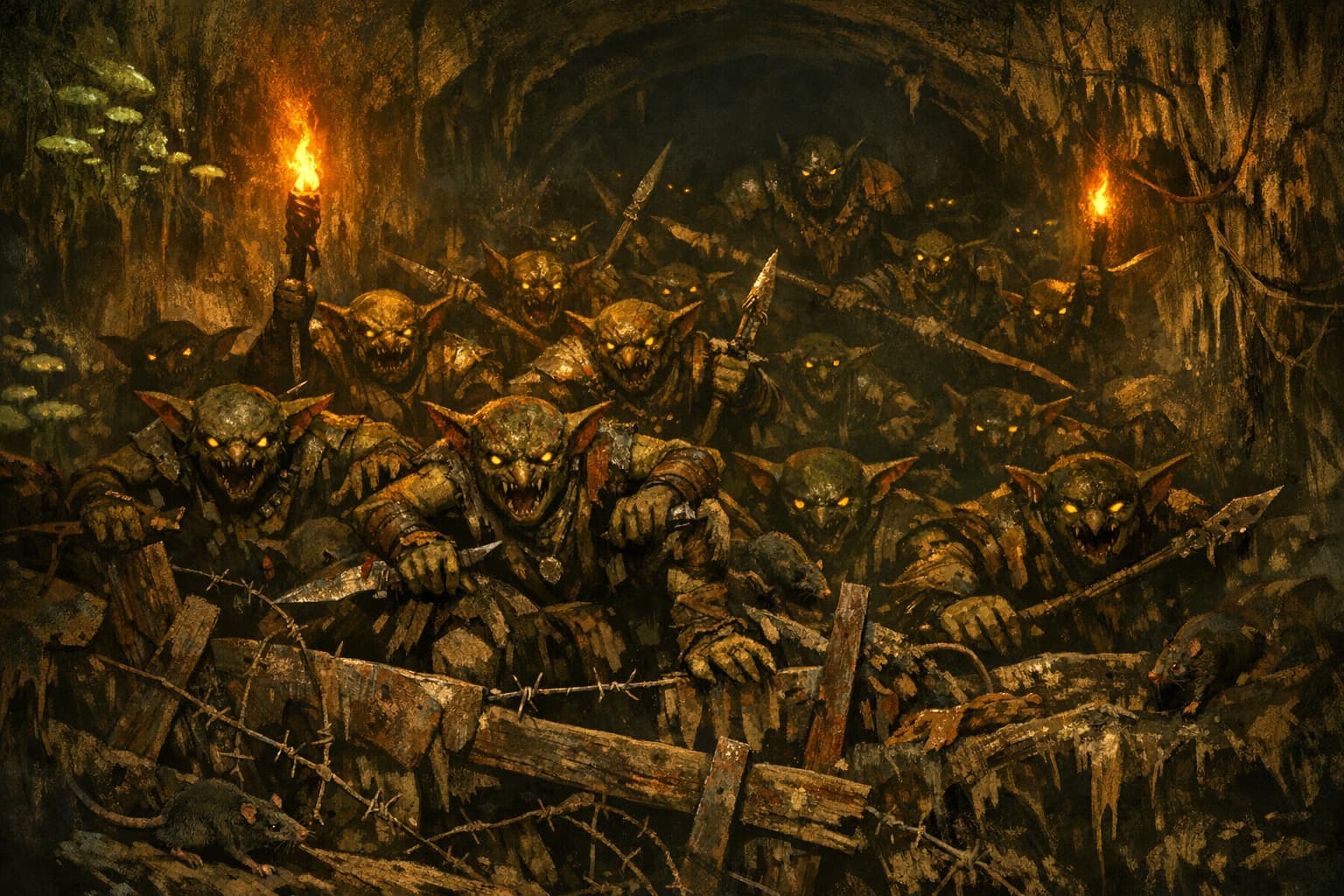
The single most important thing to understand about goblin combat is that there is no such thing as a goblin fight. There are goblin swarm events. A lone goblin is a nuisance. Two goblins are a problem. Twenty goblins are a catastrophe. Goblin military doctrine — if you can call it doctrine — is built entirely around the principle that quantity has a quality all its own.
Goblin swarm tactics work because they exploit a fundamental limitation of the action economy in D&D and in real combat alike. A fighter with a greatsword can kill one goblin per attack. If ten goblins rush that fighter simultaneously, at least eight of them are getting through. The fighter might kill three before the rest swarm over them. Each individual goblin in the swarm expects to die, but the swarm expects to win. This is not mindless charging — it's applied mathematics with a species-level risk tolerance that other cultures find incomprehensible.
The mob psychology of a goblin swarm is distinct from simple courage in numbers. Individual goblins in a swarm enter a state of collective aggression that overrides their normal caution. The shrieks, the momentum, the press of bodies behind them — it creates a feedback loop where retreat becomes physically impossible before it becomes psychologically impossible. The goblins in the front rank can't turn around because the goblins in the second rank are pushing them forward. Fear becomes irrelevant when the swarm itself is in motion.
Smart goblin leaders — and there are more of them than adventurers like to admit — refine the swarm into something more sophisticated. Feint groups draw defenders to one point while the main swarm hits another. Reserve groups wait in hidden positions until the enemy commits, then emerge to cut off retreat. Harassment teams with ranged weapons and fire pots soften targets before the swarm connects. The result is less "horde of screaming idiots" and more "distributed military operation with a very high tolerance for losses."
The real danger of goblin swarm tactics isn't the initial assault — it's the follow-through. Goblins who sense victory become exponentially more aggressive. A swarm that breaks through a defensive line doesn't stop to loot or celebrate. It keeps going, exploiting every gap, overwhelming every isolated defender, and turning a tactical breach into a complete rout. Adventuring parties that fight goblin swarms often discover that killing the first wave was the easy part. Surviving the second, third, and fourth waves while exhausted and out of spell slots is where things get ugly.
Goblin Swarm Tactics by Engagement Type
| Scenario | Tactic | Objective | Accepted Loss Rate |
|---|---|---|---|
| Open field ambush | Converge from multiple hidden positions simultaneously | Overwhelm before targets can organize | 40-60% |
| Warren defense | Funnel invaders through trapped corridors into kill zones | Attrit attackers room by room | 20-30% |
| Caravan raid | Block front and rear, swarm the middle, grab goods, flee | Acquire resources, not territory | 10-20% |
| Siege assault | Expendable ladder teams draw fire while sappers dig beneath walls | Create breaches for hobgoblin infantry | 70-80% |
| Retreat and regroup | Scatter in all directions, reassemble at predetermined rally point | Preserve core fighters for next engagement | Variable — survival is the metric |
The loss rates are not errors. Goblin tactical planning accounts for massive casualties as a baseline assumption. The species reproduces fast enough to absorb losses that would destroy a human army.
Inter-species Relationships & Notable Goblins
Goblins relate to other species the way a stray cat relates to a neighborhood: with a mixture of opportunism, wariness, and grudging familiarity. Every species in D&D has an opinion about goblins, and the opinion is rarely flattering, but goblins have survived alongside every one of them by being adaptable enough to fill whatever ecological niche is available.
The dwarf-goblin enmity is the oldest and most personal. Goblins and dwarves compete for the same underground territory, and neither species has ever been inclined to share. Dwarven records document goblin raids on mines and settlements going back to the founding of the oldest holds. Goblin oral traditions remember dwarven extermination campaigns with equal bitterness. The hatred is structural — two species fighting over the same ecological niche for thousands of years — and it won't be resolved by any number of individual friendships.
Human-goblin relationships are more varied because humans are more varied. Frontier communities treat goblins as pests to be exterminated. Urban centers occasionally tolerate goblin scavengers in their sewers and middens because the goblins provide a free waste-disposal service. Some human merchants trade with goblin tribes, exchanging manufactured goods for raw materials that goblins extract from places humans can't easily reach. The relationship is never equal, but it's more complex than simple hostility.
The elven view of goblins is mostly indifference tinged with contempt. Elves don't compete with goblins for resources, and goblin lifespans are too short for any individual goblin to register as a persistent threat. An elf might kill a goblin raider the way a human might swat a fly — with minimal emotional engagement. This indifference is, from the goblin perspective, almost worse than hatred. At least dwarves take goblins seriously.
Named goblin characters in D&D are rare, which says more about the game's storytelling habits than about the species. Goblins appear in more published adventures than any other monster species — from the Caves of Chaos in 1981 to the opening encounters of Lost Mine of Phandelver — but they're almost always anonymous. The nameless goblin horde is such a fixture of tabletop gaming that the species has become synonymous with "disposable encounter." The goblins who break through that anonymity are the exceptions that reveal what the species can be when given the space.
Outside D&D, goblins have enjoyed a literary and cinematic career that includes everything from Victorian fairy tales to modern manga. The Labyrinth (1986) gave us goblins as agents of chaos under a glam-rock king. The Harry Potter series made goblins bankers — a characterization with its own uncomfortable implications. Pathfinder's reimagining of goblins as chaotic, fire-obsessed, dog-hating weirdos became so popular that it influenced D&D's own treatment of the species. The goblin's cultural range is wider than any other "minor" fantasy species.
Notable Goblins in D&D and Fantasy
| Figure | Source | Significance |
|---|---|---|
| Nezznar (The Black Spider) | Lost Mine of Phandelver | Not a goblin himself (drow), but his goblin minions Klarg and the Cragmaw tribe are the first enemies most 5e players ever fought. Defined a generation's relationship with goblins. |
| Klarg the Bugbear's goblin retinue | Lost Mine of Phandelver | The Cragmaw hideout is the single most-played goblin encounter in D&D history. A template for every goblin lair since. |
| Nilbog (concept) | Volo's Guide to Monsters | The trickster-possessed goblin that inverts power structures. Less a character than a mythological archetype — the fool that cannot be controlled. |
| Great Gark | Eberron: Rising from the Last War | Goblin leader in Darguun, the goblinoid nation. Represents what goblins can achieve when they run their own civilization without hobgoblin oversight. |
| Jareth's Goblin Army | Labyrinth (1986 film) | Not D&D, but enormously influential. Established the "chaotic, musical, weirdly sympathetic" goblin aesthetic that Pathfinder later codified. |
| Manga/Anime "Goblin Slayer" goblins | Goblin Slayer (2016+) | Reframed goblins as genuinely dangerous through sheer malice and numbers. A corrective to decades of goblins-as-comic-relief. |
The pattern is telling: goblins are culturally ubiquitous but individually anonymous. The species has shaped more first sessions than any other monster, yet almost no individual goblin is remembered by name.
The most interesting goblin NPC relationships are the asymmetric ones. A goblin who idolizes a particular adventurer and follows them around trying to be helpful. A goblin merchant who has figured out that humans will pay absurd prices for "authentic dungeon artifacts" (which the goblin manufactures in a shed). A goblin diplomat who speaks six languages badly and negotiates trade deals by being so persistently annoying that the other party agrees just to make them leave.
D&D Mechanics Across Editions
The mechanical history of goblins tracks the game's evolving answer to a design question: how do you make the weakest humanoid enemy interesting to fight? Early editions answered "you don't" — goblins existed to die in large numbers while players leveled up. Modern editions answer it with features like Nimble Escape that make even a single goblin a tactical puzzle. The difference between fighting ten 1974 goblins and fighting ten 2024 goblins is the difference between mowing a lawn and defusing a bomb.
For players, the goblin PC has gone from a joke option to a legitimate mechanical choice. The shift from fixed ability scores (-2 STR, -2 CHA) to flexible scores removed the mechanical penalty for playing against type. A goblin paladin, a goblin wizard, a goblin barbarian — all are mechanically viable in current rules. Whether your table treats them as serious characters or comic relief depends on your table, not the stat block.
Goblin Mechanical Evolution
| Feature | 3.5e | 5e Volo's (PC) | 5e Monster | 2024 |
|---|---|---|---|---|
| Primary Stat | +4 DEX | +2 DEX, +1 CON | 14 DEX | 14 DEX |
| Signature Mechanic | Stealth bonuses | Nimble Escape | Nimble Escape | Nimble Escape |
| Darkvision | 60 ft. | 60 ft. | 60 ft. | 60 ft. |
| Design Philosophy | Sneaky but fragile | Tactical and elusive | Dangerous in groups | Refined tactical pest |
| CR / Level Adjustment | LA +0 | PC species | CR 1/4 | CR 1/4 |
Nimble Escape has been the goblin's core identity since 2014. No other low-CR creature has a feature this elegant or this influential on encounter design.
- Small size (+1 AC, +1 attack, +4 Hide)
- Darkvision 60 ft.
- Move Silently +4 racial bonus
- Ride +4 racial bonus
- Favored Class: Rogue
The +4 DEX made goblins natural rogues, but the -2 STR and Small size punished melee. The Ride bonus acknowledged the wolf-riding tradition. No mention of traps or cunning — the mechanics said "sneaky" and left it at that.
- Small size
- Darkvision 60 ft.
- Fury of the Small (extra damage 1/rest)
- Nimble Escape (Disengage or Hide as bonus action)
Nimble Escape is the defining goblin mechanic and one of the best-designed racial features in 5e. It makes every goblin encounter tactical and makes goblin PCs slippery nightmare combatants. Fury of the Small adds a satisfying spike of damage against larger foes.
- Nimble Escape (unchanged)
- Scimitar or shortbow attacks
- CR 1/4 (50 XP)
- Pack tactics (variant goblin boss)
The 2024 goblin stat block refines rather than reinvents. Nimble Escape remains the core feature. The variant boss with pack tactics makes goblin leaders tactically distinct. Goblins remain the gold standard for low-CR encounter design.
FAQ
Common Questions
Nimble Escape means goblins can Disengage or Hide as a bonus action every turn. In practice, this means goblins should almost never stand still and trade blows — they hit, move behind cover, and hide. Design goblin encounters around terrain: lots of half-cover, narrow tunnels they can flee through, elevated positions they can drop from. A goblin fight in an open field is boring. A goblin fight in a warren full of cover, traps, and murder holes is one of the best encounters in the game.
Absolutely, and the mechanics support it. A goblin warlock who made a pact to save their tribe. A goblin ranger who serves as a guide through underdark passages no one else can navigate. A goblin artificer whose jury-rigged inventions actually work. The comedy comes naturally from the size differential and the cultural clash — you don't need to force it. Play the character straight and the humor emerges from the situations, not from treating the species as a joke.
Kobolds are defined by their relationship to dragons — they worship them, serve them, and model their societies on draconic hierarchies. Goblins are defined by their relationship to scarcity — they scavenge, adapt, and survive through cunning and numbers rather than devotion to a powerful patron. Kobolds build traps to protect a lair. Goblins build traps because traps are what they do. Kobolds have a vertical power structure (dragon at top). Goblins have a horizontal one (the tribe as collective unit). In practice, kobolds are loyal fanatics and goblins are pragmatic survivors.
Because they're perfectly designed for it. Low CR, interesting tactics via Nimble Escape, plausible as raiders or scouts near any settlement, and culturally familiar to players who've never rolled a d20 before. A goblin ambush teaches new players about initiative, cover, bonus actions, and the action economy without requiring any lore knowledge. They're also scalable — the same goblin stat block works for a Level 1 cave encounter and a Level 5 warren assault. Just add more goblins.