
Goliaths
Born above the treeline where fairness is survival and every task is a contest worth winning
Races of Stone — Where Goliaths Began
Goliaths entered D&D through the 3.5e supplement Races of Stone (2004), sharing a book with dwarves and gnomes. That placement was deliberate. Dwarves carve their homes under mountains. Gnomes build in hills and burrows. Goliaths live on the mountain itself — the exposed ridgelines and alpine meadows where nothing grows above knee height and the air is too thin for comfort. They occupy the ecological niche nobody else wanted.
The design intent was a species shaped entirely by altitude. Not cave-dwellers, not valley folk, but people who live at elevations where weather kills the unprepared. That constraint produced everything distinctive about goliaths: the competitive culture (because at altitude, complacency is fatal), the emphasis on fairness (because a cheater in a small tribe destroys the group), and the massive frame (because surface-area-to-volume ratio matters when the wind chill drops to lethal).
What makes the Races of Stone origin interesting is how complete it was from day one. Most D&D species accumulate lore across multiple editions and supplements. Goliaths arrived nearly fully formed — competitive, fair-minded, nomadic, giant-kin — and the core concept has barely changed in twenty years. The original design was that solid.
Goliath Design Origins in D&D Publishing
| Source | Year | Contribution |
|---|---|---|
| Races of Stone (3.5e) | 2004 | Complete species introduction: culture, biology, religion, competitive scoring system |
| Volo's Guide to Monsters | 2016 | Official 5e stats; condensed lore; placed goliaths in the Forgotten Realms mountain ranges |
| Mordenkainen's Tome of Foes | 2018 | Expanded giant-kin lore; connected goliaths more firmly to the ordning (giant hierarchy) |
| Bigby Presents: Glory of the Giants | 2023 | Deepest giant-kin treatment; new feat options; goliath ancestry explored in detail |
| 2024 PHB | 2024 | Core species for the first time; flexible ability scores; multiple giant-ancestry options |
Twenty years from niche supplement species to core PHB. Goliaths climbed the roster the way they climb mountains — steadily, without complaint.
Etymology & the Weight of the Name
The name "goliath" carries obvious biblical baggage. The Philistine champion from 1 Samuel 17, a giant warrior brought down by a shepherd boy — it is possibly the most famous underdog story in Western civilization. Naming a species after him is a statement: these are the big ones, the imposing ones, the ones you look up at.
But the biblical Goliath was a villain, and D&D goliaths are not. The name creates an expectation the species deliberately subverts. Goliaths are large and physically dominant, yes. They are also deeply communal, obsessively fair, and culturally allergic to bullying. A goliath who used their size to intimidate someone smaller would face immediate social censure from their tribe. The name says "giant threat." The culture says "fair competition or nothing."
Goliath naming conventions within D&D reflect their three-name system: a birth name, a nickname earned through deeds (and frequently changed), and a clan name. The nickname is the one that matters socially. "Bearkiller" or "Dawncaller" or "Flintknapper" — these tell you what someone has done lately, not who their parents were. Identity is performance. You are what you accomplish, and when you stop accomplishing, the name changes.
“A goliath with a stale nickname is a goliath who has stopped trying. The tribe notices.”
— On goliath naming customs
D&D History & the Climb to Core
Goliaths took the scenic route to becoming a core D&D species. They spent nearly two decades as a supplement option — beloved by players who discovered them, but never quite mainstream enough for the Player's Handbook. Their promotion to core species in the 2024 PHB represents a shift in what D&D considers essential to the fantasy experience.
The trajectory tells you something about how the hobby's taste evolved. In 2004, the core fantasy species were the Tolkien standards: human, elf, dwarf, halfling, gnome, half-elf, half-orc. By 2024, the core roster includes tieflings, dragonborn, orcs, aasimar, and goliaths. The definition of "standard fantasy" expanded to include species that represent physical extremes, elemental connections, and non-European mythological roots.
Races of Stone (3.5e)
Goliaths debut as a fully realized species. Competitive culture, mountain ecology, three-name system, and the concept of fair play as survival mechanism are all present from the start.
4th Edition
Goliaths appear in the PHB 2 as a playable species. Their racial power, Stone's Endurance, becomes their mechanical signature. Giant-kin connection formalized.
D&D Next Playtest
Goliaths included in early playtests for what becomes 5th Edition, signaling WotC's intent to keep them in the mix despite not making the initial 5e PHB.
Volo's Guide to Monsters
Official 5e goliath stats published. +2 STR, +1 CON, Stone's Endurance, Mountain Born, Powerful Build. Clean, effective design that makes them immediately popular.
Icewind Dale: Rime of the Frostmaiden
Goliath communities featured prominently in the Spine of the World setting. First major adventure to integrate goliath culture into the story rather than treating them as background flavor.
2024 Player's Handbook
Goliaths become a core PHB species. Giant ancestry options (cloud, fire, frost, hill, stone, storm) replace fixed ability bonuses. Twenty years from supplement to standard.
Above the Treeline — Settlements & Homelands
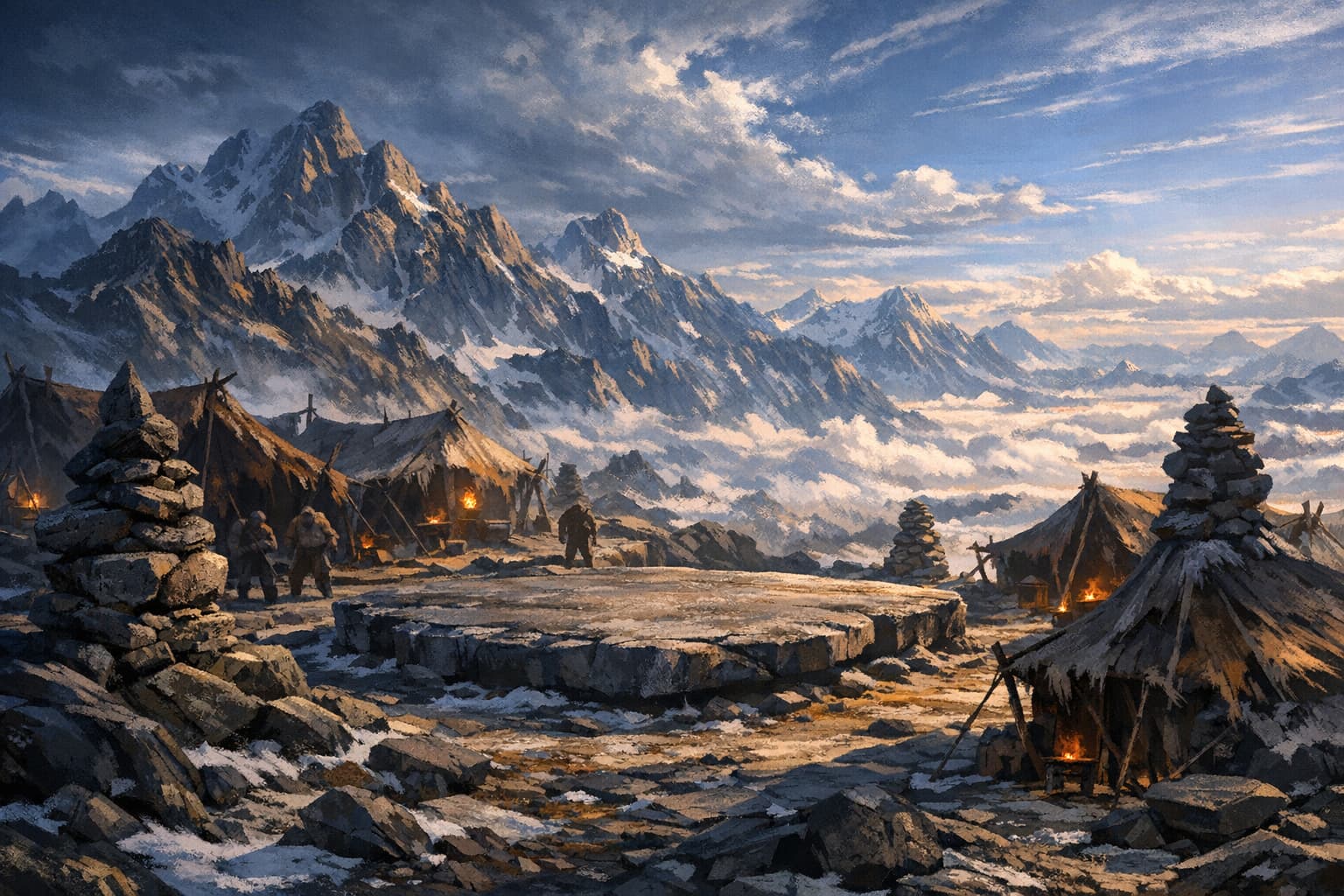
Goliaths don't build cities. They don't build much of anything permanent, because permanence is a liability above the treeline. A settlement that can't be packed up and moved when the weather turns or the game herds shift is a settlement that will eventually kill everyone in it. Goliath camps are functional, temporary, and deliberately light on the land.
This nomadic pattern isn't primitive — it's optimized. Goliath tribes follow seasonal circuits between summer alpine meadows and winter sheltered valleys, timing their movements to match animal migrations, snowmelt patterns, and the fruiting of high-altitude plants. The knowledge required to run these circuits successfully is enormous, held by the tribe's skywatcher and passed down through oral tradition. Losing a skywatcher is a genuine crisis.
The Spine of the World in the Forgotten Realms is the most canonical goliath homeland, but any sufficiently imposing mountain range works. The Barrier Peaks, the Crystalmist Mountains, the Hellfurnaces in Greyhawk — anywhere the elevation is high enough to discourage permanent settlement by other species but not so high that nothing survives.
If you're playing a goliath who has left the mountains, think about what altitude sickness feels like in reverse. Your character is used to thin air, vast sightlines, and constant wind. Lowland forests feel claustrophobic. Cities smell overwhelming. The flat horizon is disorienting. These sensory details make the fish-out-of-water experience feel physical rather than just cultural.
Built for the Peak — Biology & Physicality
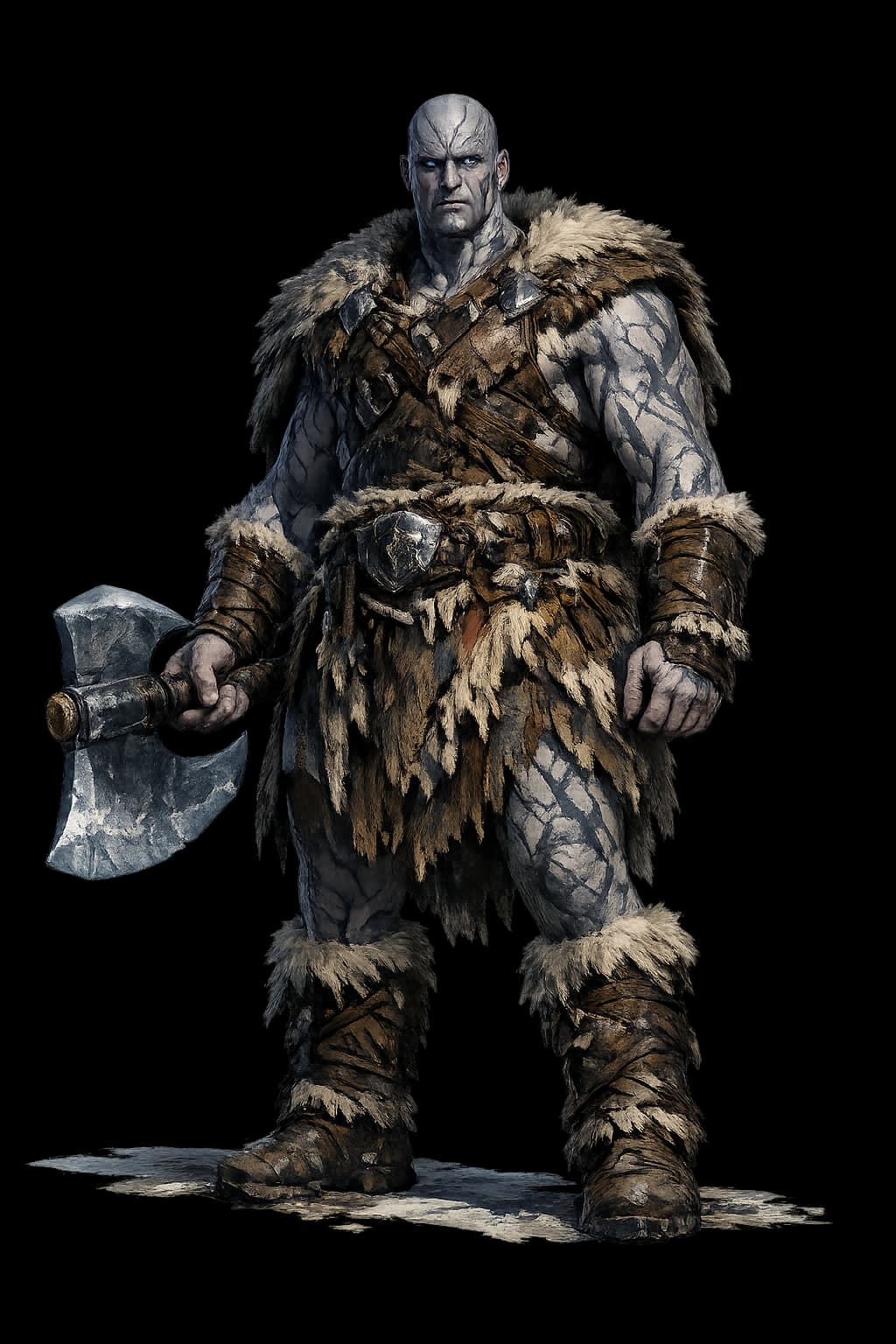
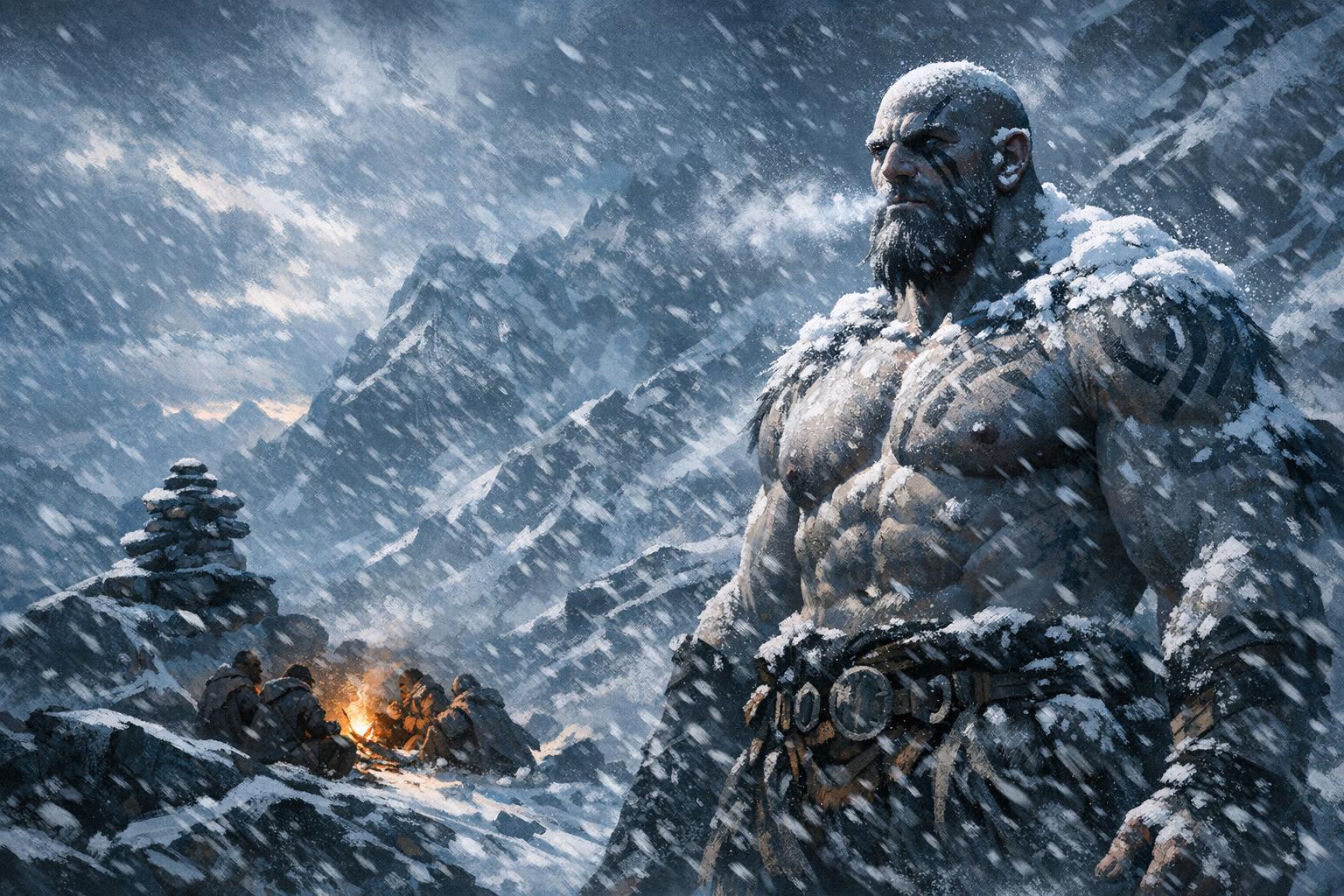
Goliaths stand seven to eight feet tall and weigh between 280 and 340 pounds. Those numbers alone set them apart from most humanoid species, but the numbers don't capture what makes goliath biology distinctive. It's not just size. It's how the size is distributed — dense bone, heavy muscle, proportionally short limbs for heat retention, broad hands and feet for stability on uneven terrain. Everything about a goliath's body says "this organism was built for mountains."
Cold resistance is their most practically significant biological trait. Goliaths operate comfortably in temperatures that would incapacitate unprotected humans within hours. Their metabolism runs hot, their subcutaneous fat layer is substantial, and their circulatory system prioritizes core temperature maintenance over extremity comfort. A goliath can sleep in conditions that would freeze a human solid, and they find lowland summers genuinely unpleasant.
Strength Beyond Scale
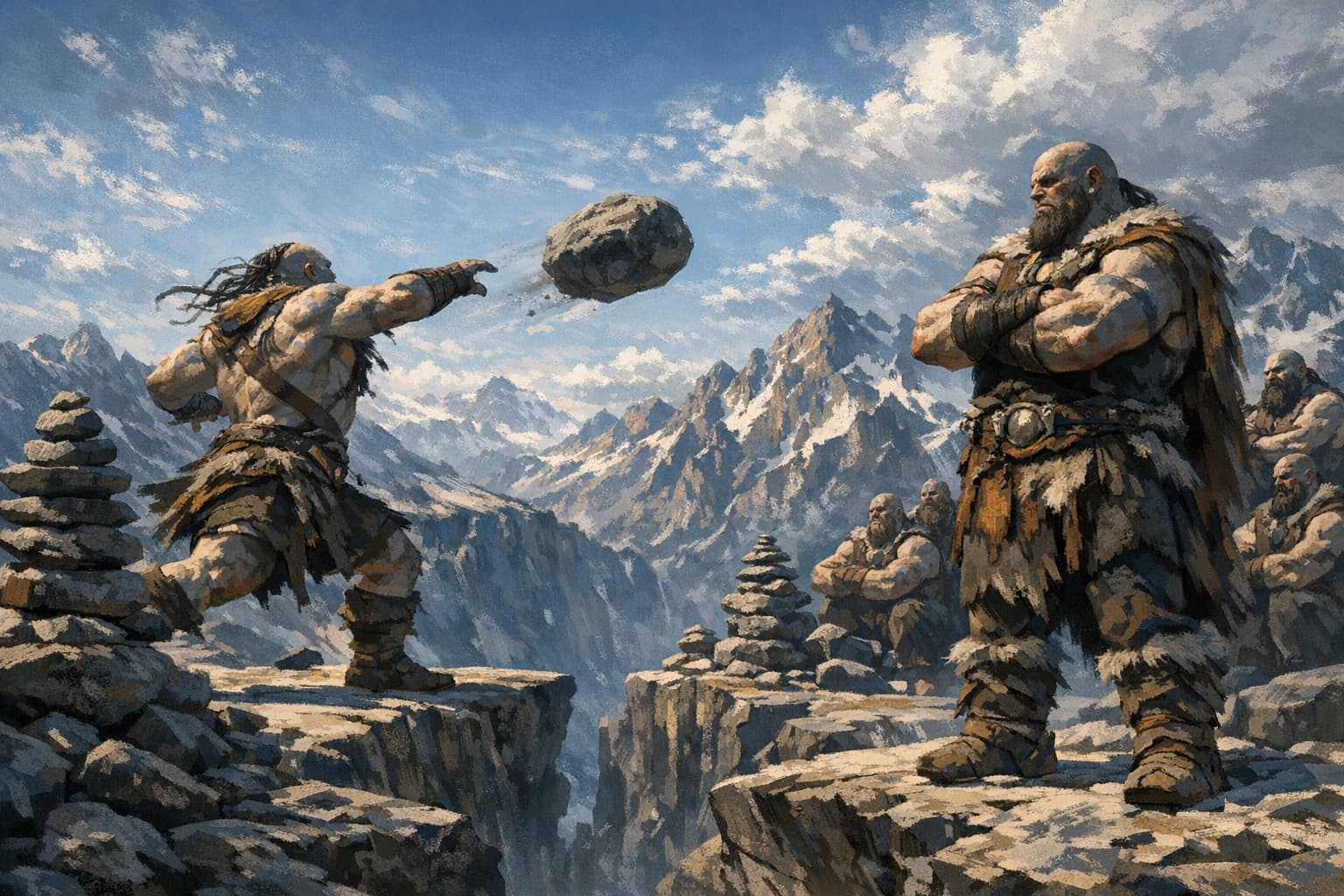
Powerful Build isn't just a racial trait — it's a description of how goliath musculature works. A goliath counts as one size larger for carrying capacity and push/drag/lift thresholds. In practical terms, a goliath can haul loads that would require two humans and a cart. Their grip strength is proportionally extreme. Goliath climbers navigate sheer rock faces that other species need ropes and pitons for, using finger-crack holds that a human hand couldn't maintain for ten seconds.
Lithoderms — The Stone Markings
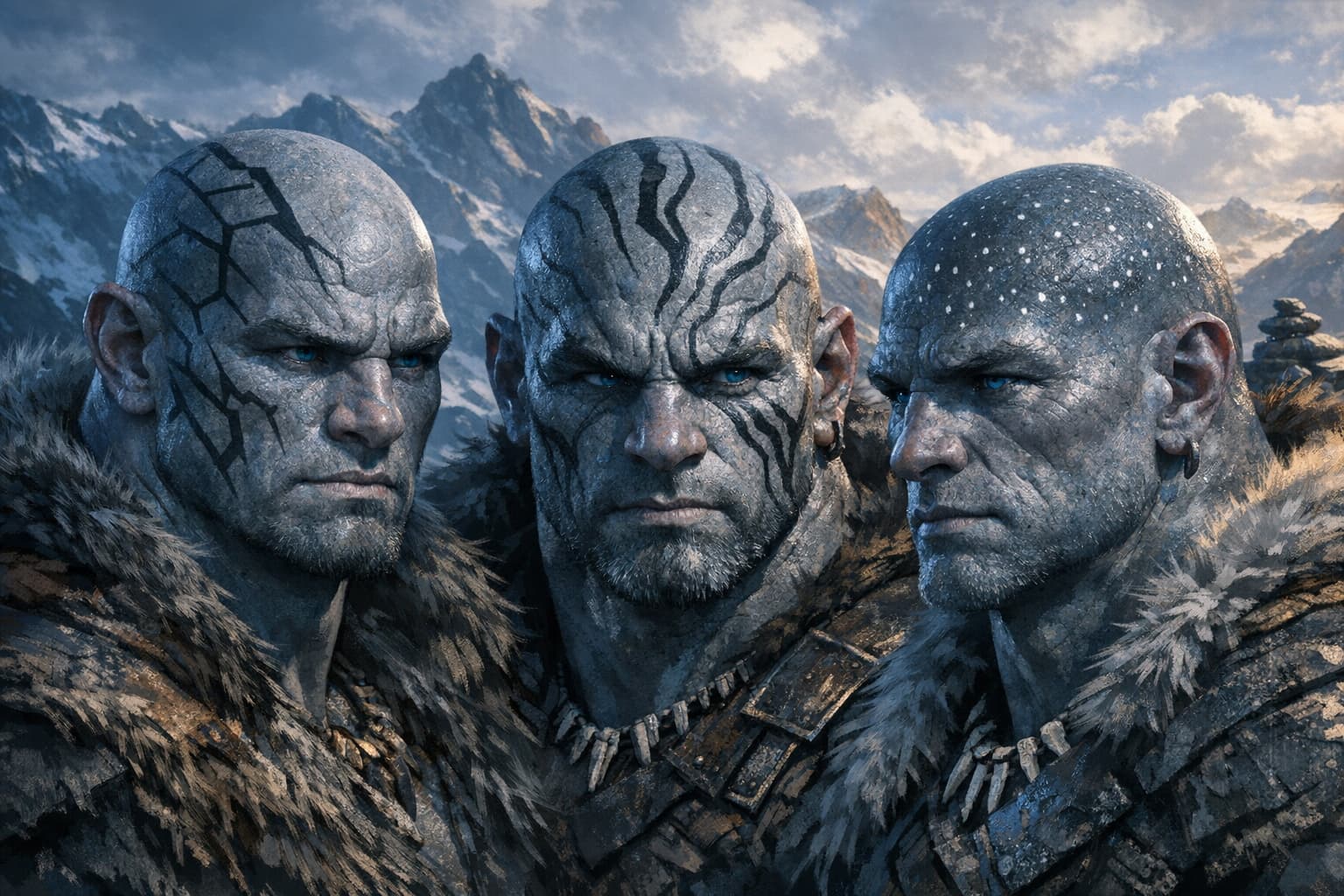
The most visually striking goliath feature is their lithoderms: dark, symmetrical markings that appear across their skin in patterns unique to each individual. These aren't tattoos or scars. They're biological — patches of hardened, stone-like tissue that develop during adolescence and continue to darken throughout life. Goliaths believe lithoderm patterns are meaningful, though interpretations vary by tribe. Some read them as prophecy. Others treat them as markers of destiny. All agree that no two patterns are identical.
Stone's Endurance
The signature goliath ability lets them shrug off damage that would stagger other species. When a goliath takes a hit, they can roll a d12 + Constitution modifier and reduce the damage by that amount. Biologically, this represents a combination of dense bone, thick hide, and a pain-response system calibrated for a life where injuries are constant and complaining about them is socially unacceptable. Goliaths don't endure pain because they're tough. They endure it because their body literally processes it differently.
Psychology — Competition & the Obsession with Fairness
Goliath psychology is built on two pillars that other species often find contradictory: relentless competition and absolute fairness. Every task is a contest. Who carries the heaviest load today? Who spots the mountain goat first? Who starts the fire fastest? But every contest must be fair. Advantages of birth, equipment, or circumstance are expected to be acknowledged and compensated for. A goliath who wins because they had a head start hasn't really won.
This isn't sportsmanship for its own sake. It's survival logic. In a small tribe living at the edge of habitability, everyone needs to pull their weight. Competition identifies who is best at each task so the tribe can allocate roles efficiently. But unfair competition — competition rigged by favoritism or deception — produces incorrect results. The wrong person gets the wrong job, and on a mountainside, wrong jobs get people killed.
Lowland cultures frequently misread goliath competitiveness as aggression. It is not. A goliath who challenges you to a carrying contest isn't threatening you. They're offering you the highest compliment they know: treating you as a worthy opponent. Refusing the contest is more insulting than losing it. And losing, in goliath culture, carries no shame. The only shameful outcome is refusing to compete, or competing dishonestly.
“You don't prove anything by beating someone who never had a chance. You prove it by matching the best and finding out which of you is better today. Tomorrow the answer might change.”
— Goliath competitive philosophy
The Score — Competition as Culture
Every goliath tribe keeps score. Not metaphorically — literally. Goliaths track individual accomplishments and failures with a granularity that borders on obsessive. Heaviest load carried in a day. Fastest ascent of a particular peak. Most game brought back from a hunt. The tallies are maintained by the tribe's skywatcher and recited publicly, so everyone knows exactly where they stand relative to everyone else.
The scoring system transforms mundane tasks into micro-competitions. Fetching water becomes a race. Pitching tents becomes a speed trial. Cooking becomes a taste contest judged by whoever didn't cook. Nothing is exempt. For a goliath, a day without a contest is a day wasted — not because they crave glory, but because competition is how they measure whether they're improving. Stagnation is the real enemy, not losing.
This cultural scorekeeping creates a social dynamic that visitors find exhausting and goliaths find exhilarating. Every interaction is calibrated against performance. A goliath who held the record for fastest fire-starting for three seasons will introduce themselves differently than one who just set a new personal best yesterday. The score is identity. It tells the tribe — and the individual — whether they're contributing enough to justify the resources they consume.
The flip side is equally important: a goliath who consistently dominates is expected to handicap themselves. If you always win the carrying contest, you start with a heavier load next time. If you're the best hunter, you take the harder route. Excellence isn't rewarded with comfort. It's rewarded with harder challenges. The tribe needs its best members operating at the edge of their ability, not coasting on past achievement.
Goliath scorekeeping collides with other cultures in predictable and story-rich ways. A goliath adventurer who insists on tracking party contributions — who killed the most enemies, who took the most damage, who solved the puzzle — can generate friction or camaraderie depending on how the table plays it. The goliath isn't being rude. They're applying the only framework they have for understanding group dynamics. Helping them learn that not everything needs a winner is a solid character arc.
Tribal Roles — Skywatcher, Chieftain, Tent-Mother
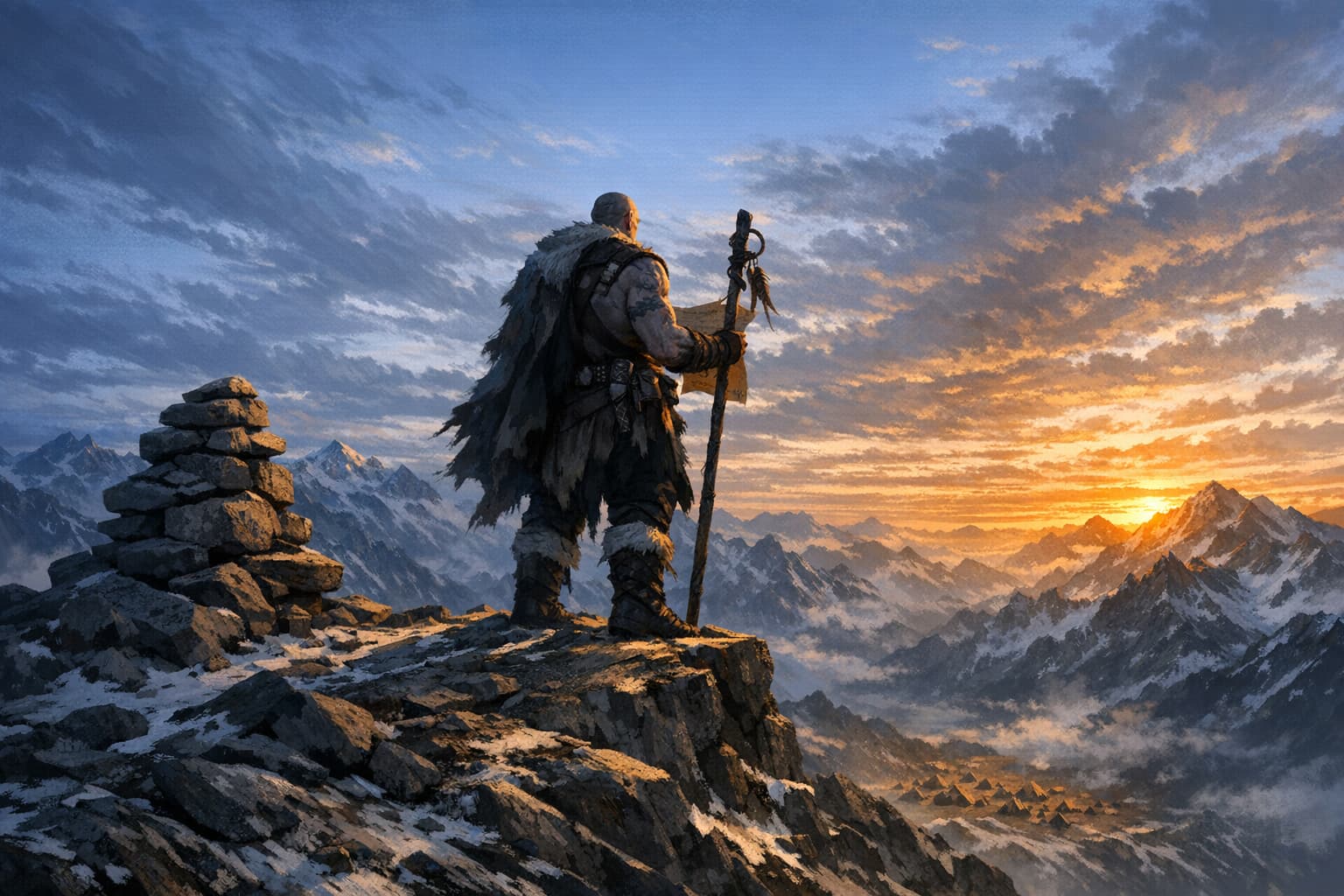
Goliath tribes function through three key leadership roles that balance against each other. The chieftain handles military and hunting decisions. The skywatcher reads weather, tracks the score, interprets lithoderm patterns, and decides when the tribe migrates. The tent-mother (or tent-father, depending on the tribe) manages internal social dynamics — resolving disputes, overseeing child-rearing, and deciding resource allocation within the camp.
No single role dominates. A chieftain who overrules the skywatcher on migration timing risks leading the tribe into a lethal storm. A skywatcher who ignores the chieftain's assessment of a threat risks an unprepared tribe. A tent-mother who can't mediate disputes risks the internal cohesion that keeps a small group functional under extreme conditions. The three-role system is a check-and-balance structure born from pragmatism, not political theory.
Below the leadership triad, goliath tribes organize by demonstrated competence. The best climber scouts. The best tracker hunts. The best crafter maintains equipment. Roles shift as abilities change — an aging goliath who can no longer lead hunts transitions to teaching, crafting, or weather-reading without any loss of status. Usefulness is respected regardless of the form it takes. A tribe that wasted experienced members because their knees gave out wouldn't last a single winter.
The Skywatcher
Part meteorologist, part historian, part priest. The skywatcher reads weather patterns, maintains the tribe's oral history and competitive tallies, interprets the significance of lithoderm markings on newborns, and decides the timing and direction of seasonal migrations. This role requires an encyclopedic memory and decades of observational experience.
A tribe that loses its skywatcher without a trained successor is in genuine danger. The migration knowledge alone — which passes require which water levels, where the avalanche risk peaks in which season, which meadows support grazing at what time of year — takes a lifetime to accumulate and can't be replaced quickly.
The Chieftain
The chieftain leads through demonstrated competence, not inherited authority. A chieftain who fails the tribe — leads a bad hunt, misjudges a threat, shows cowardice — can be challenged and replaced. The process is typically a direct physical competition, though some tribes allow contests of broader scope: tactical problems, endurance trials, or wilderness survival challenges.
What distinguishes goliath chieftains from leaders in other cultures is the expectation of personal excellence. A goliath chieftain doesn't command from the rear. They carry the heaviest pack, take the most dangerous position, and eat last. Leadership is obligation, not privilege.
Kavaki the Ram-Lord & Skoraeus Stonebones
Goliath religion centers on Kavaki, the Ram-Lord — a deity who embodies the mountain goat's combination of agility, stubbornness, and willingness to headbutt anything that gets in the way. Kavaki isn't a war god. He's a survival god. His commandments aren't about conquest. They're about perseverance: climb higher, endure longer, protect the herd. The Ram-Lord doesn't promise paradise. He promises that the mountain will test you, and that passing the test is its own reward.
Skoraeus Stonebones occupies a different theological niche. As the stone giant deity of art, craftsmanship, and the deep earth, Skoraeus represents the contemplative side of giant-kin spirituality. Goliaths who worship Skoraeus tend toward introspection, stone-carving, and reading the patterns of the earth rather than the patterns of the sky. Where Kavaki's followers compete, Skoraeus's followers create.
The broader giant pantheon — Annam the All-Father, Stronmaus the storm giant god, Surtur of the fire giants — also features in goliath theology, particularly among tribes that maintain strong connections to their giant ancestry. But Kavaki remains primary for most goliaths because his concerns match theirs: survival, competition, and the mountain itself as both home and adversary.
A goliath cleric of Kavaki isn't a typical battlefield healer. They're the person who keeps the tribe alive when the blizzard hits — treating frostbite, rationing food, maintaining morale. Healing in this tradition is practical, unsentimental, and delivered with the expectation that the patient will get back on their feet and pull their weight. "Rest when you're dead" isn't callous. It's theological.
Giant-Kin & the Ordning
Goliaths exist in an awkward position within the giant hierarchy — the ordning. They're clearly related to giants. Their size, their stone markings, their Mountain Born trait, and their cultural emphasis on physical competition all point to giant ancestry. But true giants don't consider goliaths part of the ordning. To a frost giant, a goliath is a small creature with delusions of grandeur. To a goliath, a frost giant is a distant and terrifying cousin who happens to be thirty feet tall.
The giant-kin connection became mechanically explicit in the 2024 PHB, which gives goliaths a choice of giant ancestry — cloud, fire, frost, hill, stone, or storm — each with a distinct supernatural ability. This design choice formally answers the question of where goliaths come from: they're the humanoid descendants of giant bloodlines, carrying a trace of elemental giant nature in a mortal-sized frame.
The ordning itself — the hierarchical ranking system that organizes giant society from storm giants at the top to hill giants at the bottom — has no official place for goliaths. Some goliath tribes find this liberating. They're outside the system, free to define their own hierarchy based on merit rather than species. Others find it painful, a reminder that even their own kin don't consider them real giants. Both reactions produce interesting characters.
Frost Giant Heritage
Goliaths with frost giant ancestry embody endurance pushed to its extreme. They resist cold damage innately, function in blizzard conditions that would blind other species, and develop the pale blue-grey skin tones and ice-white lithoderms associated with their frost giant forebears. Culturally, frost-kin goliaths tend toward the most austere and competitive tribal structures.
Stone Giant Heritage
Stone giant ancestry produces the most visibly lithic goliaths — their markings are darker, their skin has a genuinely rocky texture, and some develop small calcified ridges along the brow and shoulders. Stone-kin goliaths are drawn to craft and artistry more than pure competition. Their tribal traditions emphasize stone-carving, architecture, and the kind of patient observation that stone giants prize.
Among Other Peoples — Goliaths in the Lowlands
Goliaths who leave the mountains encounter a world that doesn't operate by their rules, and the adjustment goes both directions. Lowland cultures find goliaths simultaneously impressive and baffling. Here's someone who could crush you with one hand, and they're upset because you won the arm-wrestling contest by bracing your elbow on the table and they consider that an unfair advantage.
Dwarves tend to get along with goliaths better than most, sharing an appreciation for stone, endurance, and straightforward communication. The relationship isn't without friction — dwarves accumulate wealth and goliaths consider hoarding a mild character flaw — but the mutual respect for craftsmanship and physical capability forms a solid foundation.
Halflings and gnomes fascinate goliaths. A species that thrives while being small contradicts the goliath assumption that size correlates with capability. Goliaths who spend time around halflings often develop genuine admiration for how much the small folk accomplish with such limited physical resources. It recalibrates their understanding of what "strength" means.
The relationship with true giants is more complex. Giants generally dismiss goliaths as runts, which stings more than goliaths typically admit. A goliath who encounters a storm giant for the first time confronts a being that represents everything their culture aspires to — power, presence, elemental command — and is told they don't belong. That rejection shapes goliath identity as much as the mountains do.
A goliath in an adventuring party will instinctively establish pecking orders through competition. If the rogue keeps sneaking the last healing potion or the wizard keeps solving problems before anyone else can try, the goliath notices and it bothers them. Not because they want to win everything — because they want everyone to have a fair shot. This produces fascinating intra-party dynamics when the goliath starts handicapping themselves or proposing "fairer" ways to distribute loot.
Notable Goliaths in Lore & Fiction
Named goliath characters in published D&D material are scarce compared to elves or dwarves, a consequence of their relatively recent introduction and their lore being tied to remote mountain regions that adventures don't visit frequently. The figures who do appear tend to be either exemplars of goliath culture taken to extremes or goliaths who have left the mountains and found themselves changed by the lowlands.
The most significant goliath representation in modern D&D comes from actual-play streams and podcasts, where player characters have done more to establish goliath personality in the public imagination than any published novel. Grog Strongjaw from Critical Role — technically a half-giant, but played with goliath cultural sensibility — introduced millions of viewers to the competitive, straightforward, deeply loyal goliath archetype.
Notable Goliaths in D&D Lore & Media
| Figure | Source | Significance |
|---|---|---|
| Keothi (various NPCs) | Races of Stone / Volo's Guide | Template goliath names used in sourcebook examples; established the three-name convention |
| Goliath tribes of Icewind Dale | Rime of the Frostmaiden (2020) | First major adventure module to feature goliath communities as integral to the story |
| Grog Strongjaw | Critical Role Campaign 1 | Half-giant barbarian played with goliath cultural coding; popularized the competitive-but-loyal archetype for a massive audience |
| Various storm herald goliaths | Bigby Presents: Glory of the Giants (2023) | Expanded goliath ancestral connections to specific giant types; deepened the species lore significantly |
The relative absence of iconic goliath NPCs is an opportunity for your table. The archetype is established but not yet claimed by a Drizzt or Bruenor figure.
D&D Mechanics Across Editions
Goliath mechanics have been remarkably consistent across editions, which is unusual. Most species undergo significant redesigns as the game evolves. Goliaths got Stone's Endurance in 3.5e and still have a version of it in 2024. The core mechanical identity — damage mitigation, powerful build, cold resistance, mountain adaptation — has been refined but never reinvented.
The 2024 revision is the biggest change, replacing the fixed Stone's Endurance with a choice of giant ancestry abilities. This is a meaningful shift: it transforms goliaths from a single mechanical profile into six variants, each with a distinct supernatural ability. A cloud giant goliath plays differently from a fire giant goliath, which plays differently from a storm giant goliath. The species finally has the mechanical diversity that elves and dwarves have had for decades.
Goliath Mechanical Evolution
| Feature | 3.5e | 5e (Volo's) | 2024 |
|---|---|---|---|
| Ability Scores | +4 STR, +2 CON, -2 DEX | +2 STR, +1 CON | Flexible |
| Signature Mechanic | Stone's Endurance (1/day) | Stone's Endurance (1/rest) | Giant Ancestry (6 options) |
| Size Feature | Powerful Build | Powerful Build | Powerful Build + Large Form |
| Cold Resistance | Acclimated only | Full cold resistance | Varies by ancestry |
| Design Philosophy | Mountain specialist | Durable athlete | Giant descendant with ancestry choice |
The through-line is durability. Every edition says the same thing about goliaths: they take hits that would drop other species and keep climbing.
- Powerful Build (count as Large for carrying/grappling)
- Mountain Movement (no penalty on steep slopes)
- Stone's Endurance (1/day, reduce damage by 1d12 + CON mod)
- Acclimated (altitude sickness immunity)
The original design nailed the concept. +4 STR and the suite of mountain-survival abilities made goliaths feel immediately distinct. The -2 DEX was the only concession, and it made sense for a species built like a boulder.
- Natural Athlete (Athletics proficiency)
- Stone's Endurance (1/rest, reduce damage by 1d12 + CON mod)
- Powerful Build (count as one size larger for carry/push/drag)
- Mountain Born (cold resistance, acclimated to high altitude)
Clean, effective, and immediately popular. Stone's Endurance once per short rest made goliaths one of the most durable species in 5e. No penalties, no complications, just solid mountain reliability.
- Powerful Build
- Giant Ancestry (choose: cloud, fire, frost, hill, stone, or storm)
- Large Form (grow to Large size, bonus damage, limited uses)
- Each ancestry grants a unique supernatural ability
The giant ancestry system is the most significant mechanical evolution. Cloud goliaths can teleport. Fire goliaths deal extra fire damage. Storm goliaths generate tempest auras. Goliaths finally have the subrace variety that dwarves and elves have enjoyed for editions.
Across Franchises — Giants in Mortal Form
The "small giant" archetype — a humanoid species descended from or connected to true giants — exists across fantasy but rarely gets the treatment D&D gives goliaths. Most franchises either make giants too large to be playable or scale them down into something functionally human-sized. Goliaths occupy a specific niche: large enough to feel imposing, small enough to fit through doors.
The closest analogues in other franchises tend to emphasize different aspects of the giant connection. Some focus on brute strength. Others emphasize elemental heritage. D&D's goliaths are distinctive because they emphasize culture over power — the competitive meritocracy, the fairness obsession, the mountain adaptation. You could strip a goliath of every supernatural ability and they'd still be interesting because of how they think, not what they can do.
Giant-Kin and Large Humanoids Across Franchises
| Franchise | Species | Core Theme | Key Distinction |
|---|---|---|---|
| D&D | Goliaths | Mountain competition, fairness, giant ancestry | Culture-first design; the scorekeeping and meritocracy make them unique |
| Pathfinder 2e | Giants (various ancestries) | Elemental giants as playable ancestries | Direct giant play rather than giant-descended humanoids |
| Elder Scrolls | Giants (Skyrim) | Pastoral nomads with mammoths | Non-verbal, non-social; a missed opportunity for culture |
| God of War | Jotnar | Cosmic beings of fate and prophecy | Giants as narrative forces rather than playable species |
| Warhammer | Ogres / Ogors | Brute appetite, mercenary culture | Size without the fairness ethic; competition through consumption rather than merit |
| Attack on Titan | Titan Shifters | Humans who become giants | Transformation horror rather than species identity; the giant form is a weapon, not a heritage |
D&D goliaths remain the most fully realized "giant-descended humanoid" in fantasy gaming. The competition-and-fairness cultural package has no direct equivalent elsewhere.
FAQ
Common Questions
Goliaths stand between 7 and 8 feet tall and weigh 280 to 340 pounds, making them the largest standard-sized playable species in D&D. They're taller than dragonborn (average 6'2"–6'8") and significantly larger than any other core PHB species. The 2024 rules add the Large Form ability, which lets goliaths temporarily grow to Large size — a mechanical reflection of their giant heritage activating under stress.
Absolutely, and it's one of the more interesting character concepts available. A goliath who finds the constant scorekeeping exhausting, or who left the mountains because the relentless competition felt hollow, has a built-in character tension that drives story. Maybe they're searching for a way of life where worth isn't measured in daily tallies. Maybe they still catch themselves keeping score involuntarily and hate that they can't stop. The cultural programming doesn't erase easily, and that friction is great material.
It depends on your playstyle. Frost is the closest to traditional goliath identity — cold resistance and damage reduction echo the classic Stone's Endurance. Stone emphasizes durability and fits the contemplative goliath archetype. Fire works for aggressive martial builds. Cloud provides magical mobility (a teleporting goliath is unexpected and effective). Storm is the most overtly supernatural option. Hill is straightforward and effective for any melee build. Pick the ancestry that matches the story you want to tell, not just the optimal combat choice.
Goliaths bring a competitive-but-fair energy to party dynamics that can be played for comedy, drama, or both. They naturally track contributions ("I carried three people across that chasm and the wizard carried zero"), propose contests for decisions ("We disagree on which door to open, so we arm-wrestle for it"), and insist on fairness in loot distribution with an intensity that other characters may find either refreshing or maddening. The key to playing this well is remembering that goliath competition isn't about ego — it's about everyone being their best. A goliath who sees a teammate struggling will offer help, not mockery.