
Half-Orcs
Straddling two worlds and belonging fully to neither — forging identity in the space between human ambition and orcish tenacity
The Half-Breed Archetype in Myth
The concept of a person caught between two peoples is ancient, and it has almost never been comfortable. Greek myths gave us figures like Theseus — half divine, half mortal, belonging fully to neither court. Medieval romances produced Melusine, a woman whose fairy heritage surfaced in monstrous form every Saturday. The pattern is consistent: mixed heritage as narrative engine, identity as battleground, the body itself as proof that you don't fit anywhere cleanly.
Half-orcs inherit this archetype at its most loaded. Where a half-elf gets to straddle two cultures that are both broadly admired — humans and elves, ambition and grace — the half-orc sits between humanity and a species that most fantasy settings have coded as violent, primitive, and evil. The in-between space isn't romantic. It's a minefield. Every half-orc character is, whether the player intends it or not, making a statement about what it means to carry heritage that the world around you considers monstrous.
This is the elephant in the room with half-orcs, and it's worth naming directly: the species concept draws on real-world histories of racial mixing, colonialism, and the dehumanization of certain peoples. Early D&D didn't handle this thoughtfully. The original half-orc was often framed as the product of violence, carrying "savage" blood that needed to be overcome through human virtue. Modern D&D has worked to move past this framing, but the bones of it remain visible in the skeleton of the concept. You can't engage with half-orcs honestly without acknowledging what the archetype was built on.
What makes the archetype worth reclaiming is the universality of the emotional core. Strip away the specific racial coding, and you find a character defined by in-betweenness — someone who doesn't match neatly into the categories their world provides. That experience resonates with anyone who has ever felt like they belong to two groups and neither one fully claims them. Immigrants, biracial individuals, people who grew up between cultures, anyone who code-switches daily — half-orcs, at their best, are about that experience given fantasy armor and tusks.
A half-orc's name is often the first declaration of allegiance. Raised among humans, they carry human names — Marcus, Elena, Theron — and every time someone learns what they are, the name becomes a small act of defiance. That's a human name. You don't look human. The dissonance is the point. Raised among orcs, they carry orcish names — Gash, Keth, Shump — and if they venture into human territory, the name arrives before they do, setting expectations they may or may not want to meet.
Many half-orcs carry two names: one for each world they move through. The human name for the market and the tavern, the orcish name for the wilderness and the warband. This isn't deception. It's navigation. Different contexts demand different presentations of self, and a half-orc who has survived to adulthood has learned which name opens which doors. The private question — which name feels like mine? — is one of the most revealing things you can ask a half-orc character.
Some half-orcs reject both naming traditions and choose their own. An epithet earned through deeds: Wallbreaker, Bloodpeace, Bridgeburner. A name that belongs to neither culture because the person has decided to stop performing belonging and start performing self. These chosen names tend to be the most aggressive — not because the half-orc is aggressive, but because claiming your own identity in a world that wants to categorize you requires a certain combativeness.
The Half-Breed Archetype Across Mythology & Literature
| Source | Figure | Heritage | Half-Orc Parallel |
|---|---|---|---|
| Greek mythology | Minotaur | Human mother, divine bull father | Monstrous appearance as identity prison; judged before speaking |
| Arthurian legend | Mordred | Born of incest/deception, used as weapon | Origin in violence; the child blamed for circumstances of conception |
| Norse mythology | Fenrir's children | Wolf-god offspring among the Aesir | Treated as threat because of parentage, not personal action |
| Tolkien | Half-elves (Elrond, Arwen) | Mortal and immortal blood | The choice between two peoples — but with a more charitable framing |
| Real-world history | Metis, mestizo, hapa | Colonial-era mixed heritage | The direct uncomfortable parallel that D&D initially drew from and has slowly tried to complicate |
The half-orc sits at the harshest end of this spectrum. Where half-elves get tragedy and beauty, half-orcs get suspicion and violence. That asymmetry is itself worth interrogating at the table.
“Which name feels like mine? The human one that makes people comfortable, or the orcish one that makes them flinch? The answer changes depending on who is asking, and that flexibility is its own kind of armor.”
Half-Orcs Through D&D History
Half-orcs have been in D&D almost from the beginning, and their treatment across editions reads like a barometer of the hobby's evolving relationship with race and monstrosity. They appeared in the 1978 Players Handbook for Advanced D&D, making them one of the original playable species — though "playable" is generous. The 1e half-orc had a Charisma maximum of 12, was limited to four classes, and was described in terms that made clear this was a species you tolerated rather than celebrated.
Second Edition removed half-orcs entirely. The Complete Book of Humanoids (1993) brought them back as an option, but their absence from the core rules spoke volumes: TSR had decided that the half-orc concept was more trouble than it was worth. The reasons were partly mechanical (the species was underpowered), partly commercial (fewer players picked them), and partly the growing awareness that "half-breed of a savage race" wasn't a concept that aged well.
Third Edition rehabilitated half-orcs as a core PHB species, giving them +2 Strength, -2 Intelligence, -2 Charisma, and the ability to rage as a racial feature. The stat penalties are telling: the game was still comfortable saying that orc blood made you dumber and less likable. But 3e also gave half-orcs real mechanical value (the Strength bonus was enormous for martial characters) and better narrative framing. They were survivors, not just brutes.
Fifth Edition (2014) continued the rehabilitation: +2 Strength, +1 Constitution, Relentless Endurance, and Savage Attacks. No mental stat penalties. The removal of Intelligence and Charisma penalties was a deliberate design choice — WotC was moving away from the idea that species determined mental capacity. By 2024, the entire "half" species concept was reconsidered. The 2024 PHB doesn't include half-orcs as a separate species at all, rolling their mechanical identity into the broader orc species entry.
AD&D 1st Edition Players Handbook
Half-orcs debut as a playable species with severe limitations: Charisma capped at 12, restricted to fighter, cleric, thief, and assassin. Described as products of violence, tolerated but never trusted.
2nd Edition AD&D
Half-orcs removed from the core game. The species vanishes from the PHB for the only time in D&D history, reflecting discomfort with the concept and low player demand.
3rd Edition D&D
Half-orcs return to the PHB with +2 STR, -2 INT, -2 CHA. The stat penalties reinforce stereotypes, but the mechanical value of the Strength bonus makes them popular for barbarians and fighters.
4th Edition
Half-orcs get a significant narrative overhaul. +2 STR, +2 DEX (or CON), no mental penalties. Presented as a fierce and resilient people rather than a tragic byproduct.
5th Edition PHB
Half-orcs receive +2 STR, +1 CON, Relentless Endurance, Savage Attacks, and Menacing proficiency. No negative ability modifiers. The best mechanical and narrative treatment to date.
2024 Player's Handbook
Half-orcs are not listed as a separate species. Orc becomes the core species, and mixed heritage is handled through the game's new ancestry rules. The "half" concept is retired.
Borderland Homes & Contested Spaces
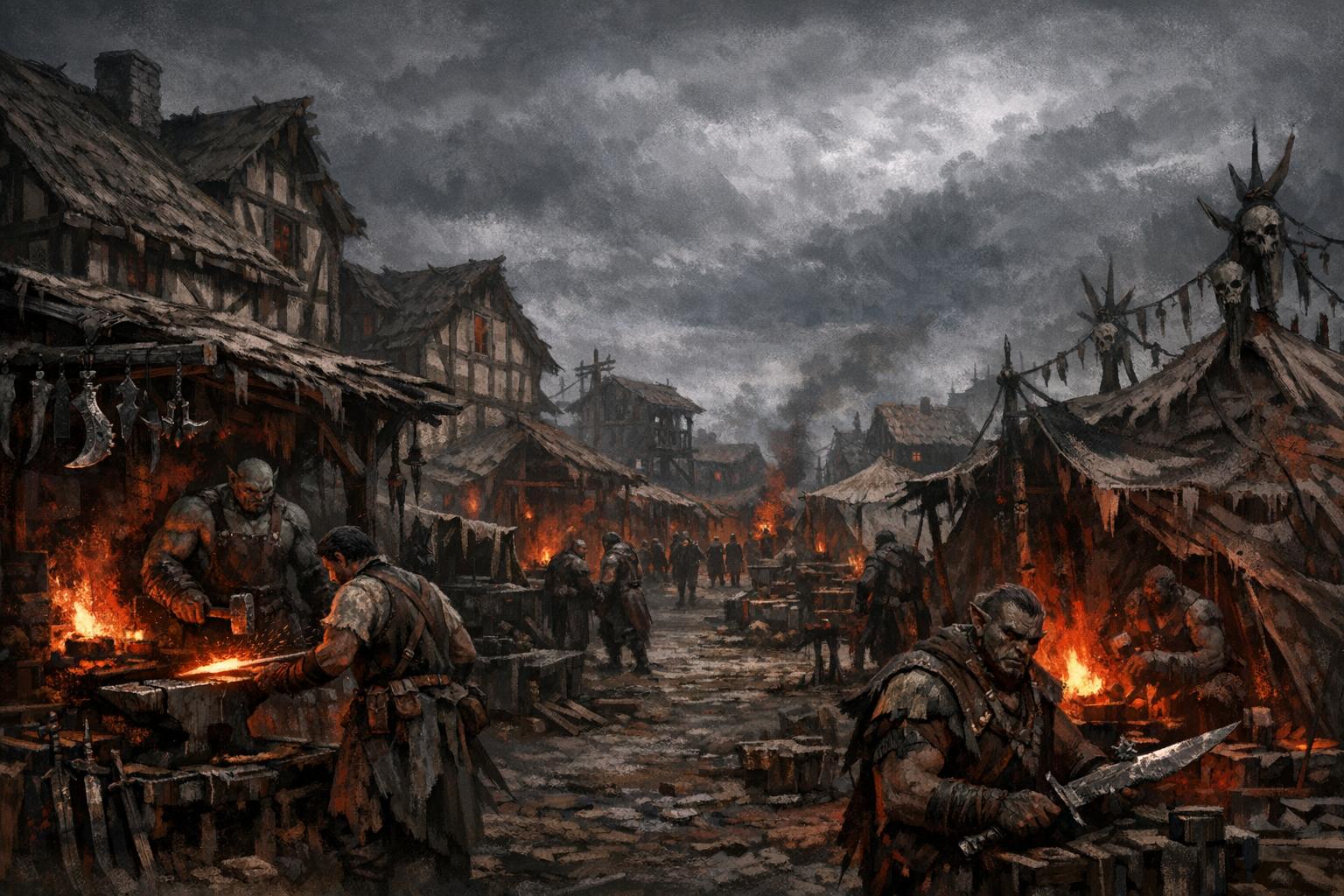
Half-orcs congregate where cultures bleed into each other. Frontier towns where human settlers and orc warbands share an uneasy border. Port cities where anyone with coin is welcome regardless of tusks. Mining communities where the work is too hard and the pay too low for anyone with better options. These liminal spaces are half-orc habitats — not because half-orcs choose margins, but because margins are the only places that don't demand they pick a side.
In the Forgotten Realms, the city of Palischuk stands as the most prominent half-orc settlement: a city in Vaasa rebuilt by half-orcs who transformed it from a ruin into a functioning community. Palischuk is significant because it represents half-orcs defining a space on their own terms rather than fitting into someone else's. Most half-orc characters, though, don't come from Palischuk. They come from the unnamed borderlands, the places between.
The geography of half-orc life shapes their worldview in practical ways. Growing up where two cultures meet means learning to read rooms quickly — is this a human tavern or an orc tavern, and how much of myself do I show in each? It means understanding trade, negotiation, and threat assessment before you understand philosophy. Half-orcs from borderlands tend to be pragmatists, not because orc blood makes them pragmatic, but because the border makes dreamers into corpses.
Where your half-orc grew up matters more than their blood. A half-orc raised in Waterdeep's North Ward has more in common with a human noble than with a half-orc from the Spine of the World. A half-orc raised in a Gruumsh-worshipping warband has more in common with a full orc than with any city-dweller. Heritage is biology. Home is identity. Build the character from the ground up, not the blood down.
Hybrid Physiology
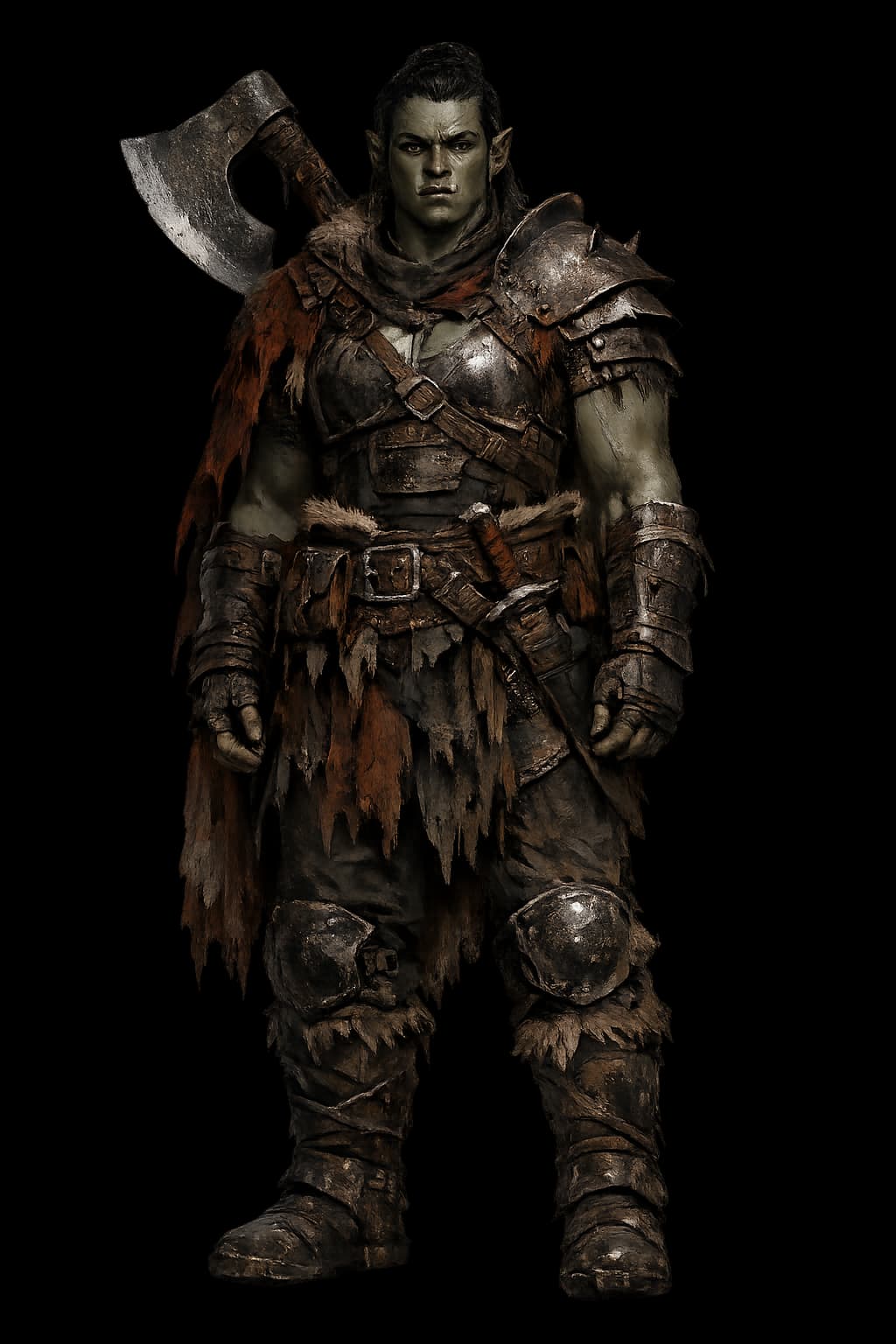
Half-orcs are built like apologies for existing. That's the ungenerous reading, anyway — that the broad shoulders, the prominent jaw, the grey-green skin, and the lower tusks are marks of monstrosity that human features can only partially conceal. The generous reading is more interesting: half-orc physiology represents a genuine hybrid, combining human adaptability with orcish resilience in ways that produce something neither parent species achieves alone.
Physically, half-orcs tend toward the large end of the human spectrum: six to seven feet tall, heavily muscled, with dense bone structure that makes them heavier than they look. The orcish traits — the skin coloration, the pronounced brow, the tusks — vary enormously between individuals. Some half-orcs could pass as large, rough-featured humans in dim light. Others couldn't pass in a blizzard. The degree of visible orcish heritage becomes a social sorting mechanism that half-orcs learn to navigate early.
The tusks deserve special attention because they carry outsized cultural weight. Lower canines that protrude past the lip are the most immediately visible marker of orcish blood, and they affect everything from speech patterns to eating habits to how strangers react in the first three seconds of meeting. Half-orcs develop complex relationships with their tusks. Some file them down to pass more easily. Others sharpen them as a declaration. The tusks become a physical metaphor for the larger identity question: how much of the orc do you show the world?
Relentless Endurance
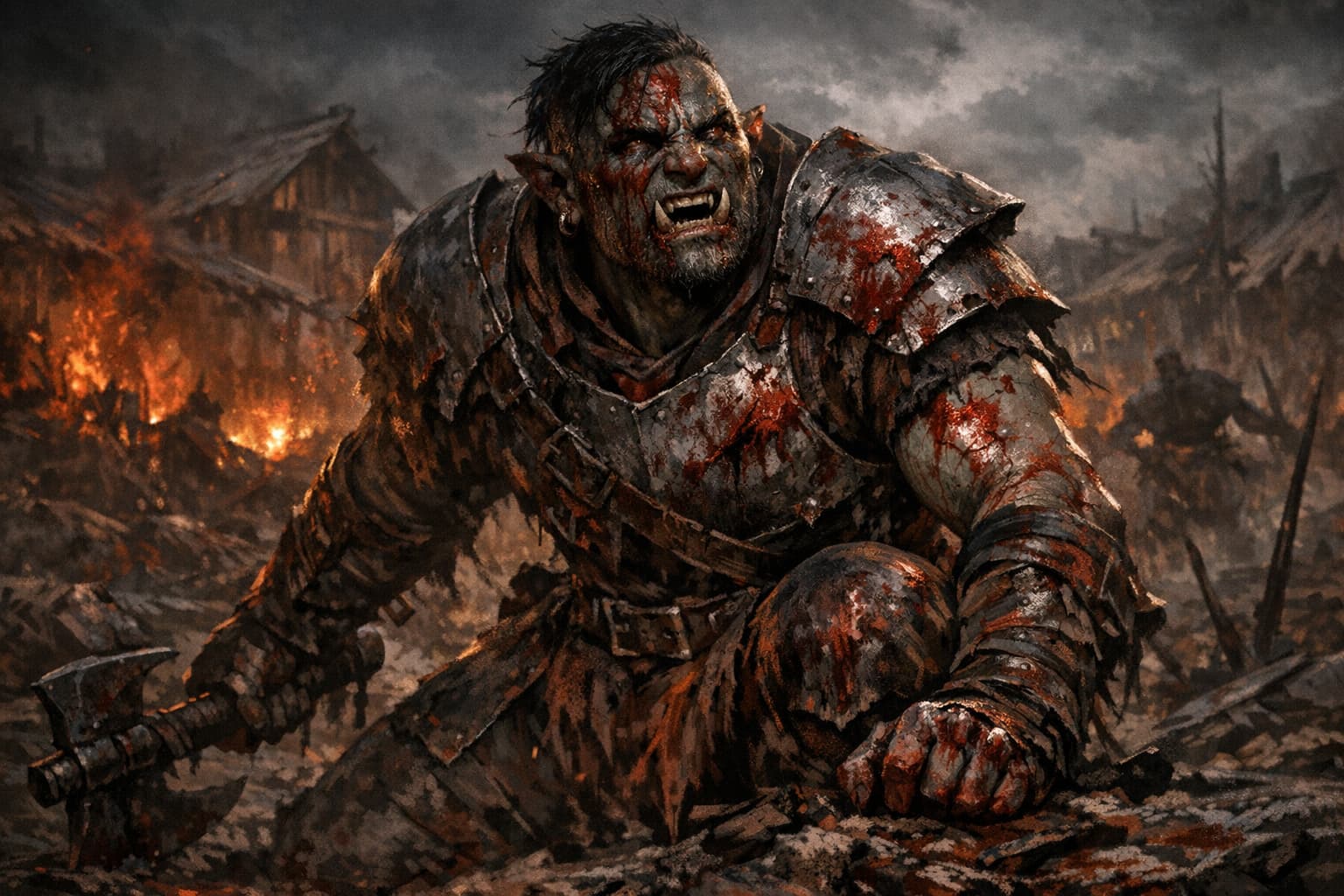
The signature half-orc trait in 5e: when reduced to 0 hit points but not killed outright, the half-orc drops to 1 hit point instead. Once per long rest. Mechanically, it's a safety net. Narratively, it's a statement about what half-orc bodies are built to do — survive. Not thrive, not dominate, survive. The body refuses to quit even when the math says it should.
Relentless Endurance resonates because it mirrors the half-orc experience metaphorically. You get knocked down. The world hits you. You should be done. And something in you — call it stubbornness, call it orcish grit, call it the fury of someone who has been underestimated their entire life — drags you back to your feet. It's the most thematically perfect racial trait in D&D, and it's not even close.
Savage Attacks
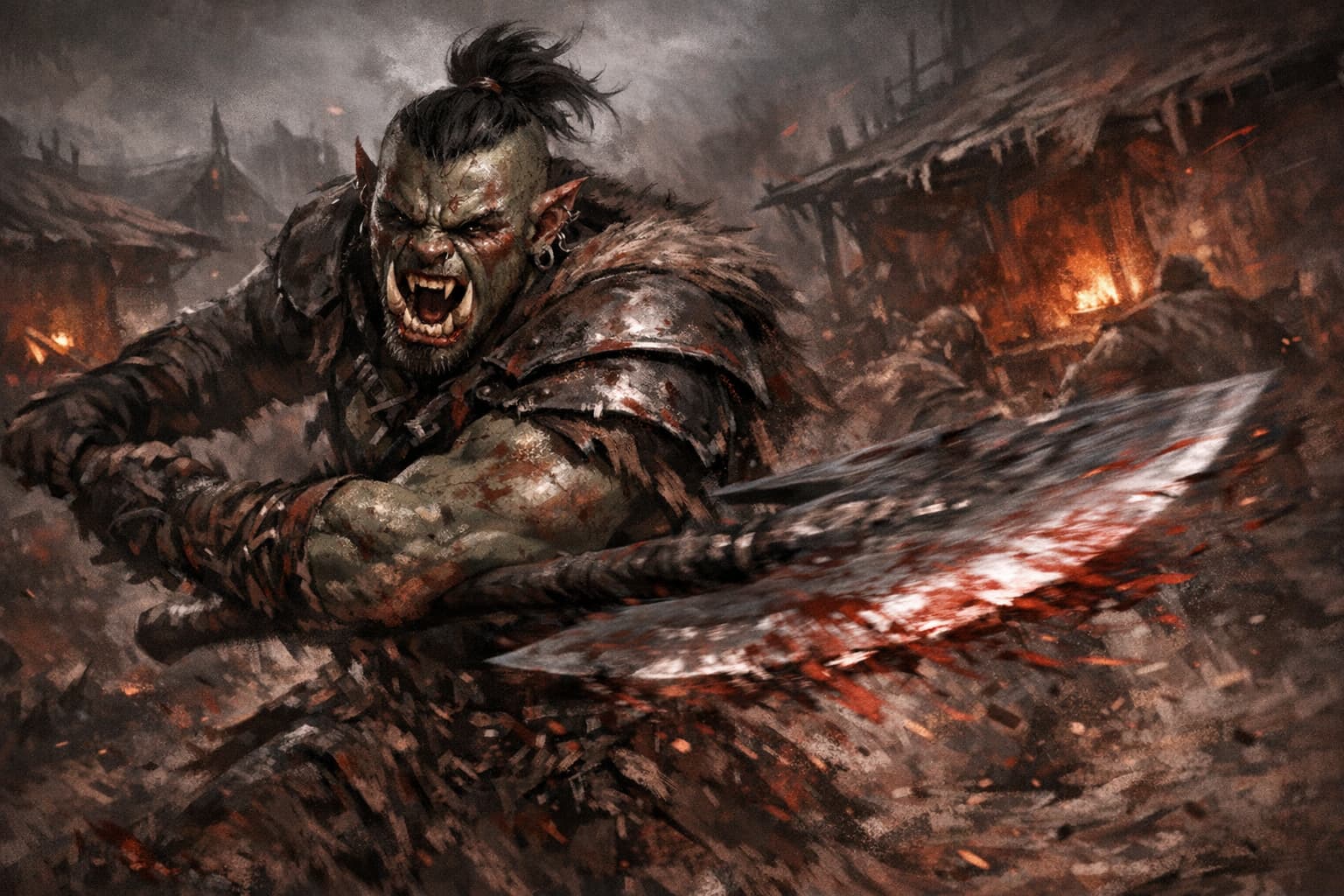
When a half-orc scores a critical hit with a melee weapon, they roll one additional damage die. The name is unfortunate — "Savage Attacks" leans into exactly the kind of language modern D&D is trying to move away from — but the mechanic itself captures something real about half-orc combat style. It's not finesse. It's not calculated. It's the moment when restraint fails and the full weight of orcish physicality comes through, and the result is devastating.
For players, Savage Attacks creates memorable combat moments. That critical hit where the half-orc barbarian's greataxe deals 3d12 instead of 2d12 feels different from a regular crit. It feels earned by the character's nature rather than just dice luck. The extra die is a mechanical reminder that this character carries something in their blood that comes out when the stakes are highest.
Between Two Worldviews
Human culture, broadly, values planning, accumulation, and social navigation. Orcish culture, as D&D has traditionally framed it, values strength, directness, and the immediate moment. A half-orc raised with access to both traditions absorbs a contradictory set of instructions about how to live. Save for winter. Take what you need now. Build alliances. Trust only strength. Be polite. Be fierce. The internal contradictions are the character.
This cultural duality produces half-orcs who are often better judges of character than members of either parent species. They've spent their lives reading people — is this human smiling because they're friendly or because they're nervous? Is this orc posturing because they want a fight or because they're scared? The half-orc who grew up navigating between two sets of social rules develops an instinct for what people actually mean versus what they perform. It's a survival skill that translates beautifully to adventuring.
The mental toll of perpetual code-switching shouldn't be underestimated. A half-orc who spends the morning being human-polite in the marketplace and the afternoon being orc-direct in the fighting pit is performing two separate identities, and the gap between them generates a specific kind of exhaustion. The moments when a half-orc drops both performances — when they're too tired or too comfortable to maintain the act — reveal who they actually are underneath the adaptations.
Some half-orcs resolve the tension by picking a side. They go full human: filed tusks, tailored clothes, careful speech, a lifetime of proving they're not what they look like. Or they go full orc: embrace the strength, lean into the intimidation, stop apologizing for the tusks. Both choices are understandable. Both involve amputating part of the self. The most interesting half-orc characters are the ones who refuse to choose and instead build something that is neither human nor orcish but entirely their own.
Your half-orc grew up translating between their human mother's merchant guild and their orc father's raiding band — not just language, but values, priorities, body language. Now they've left both worlds behind to adventure, and they discover they can read every culture they encounter with startling clarity. The skill that was born from pain has become a genuine gift. But when someone asks where they're from, the answer still sticks in their throat.
Life on the Margins
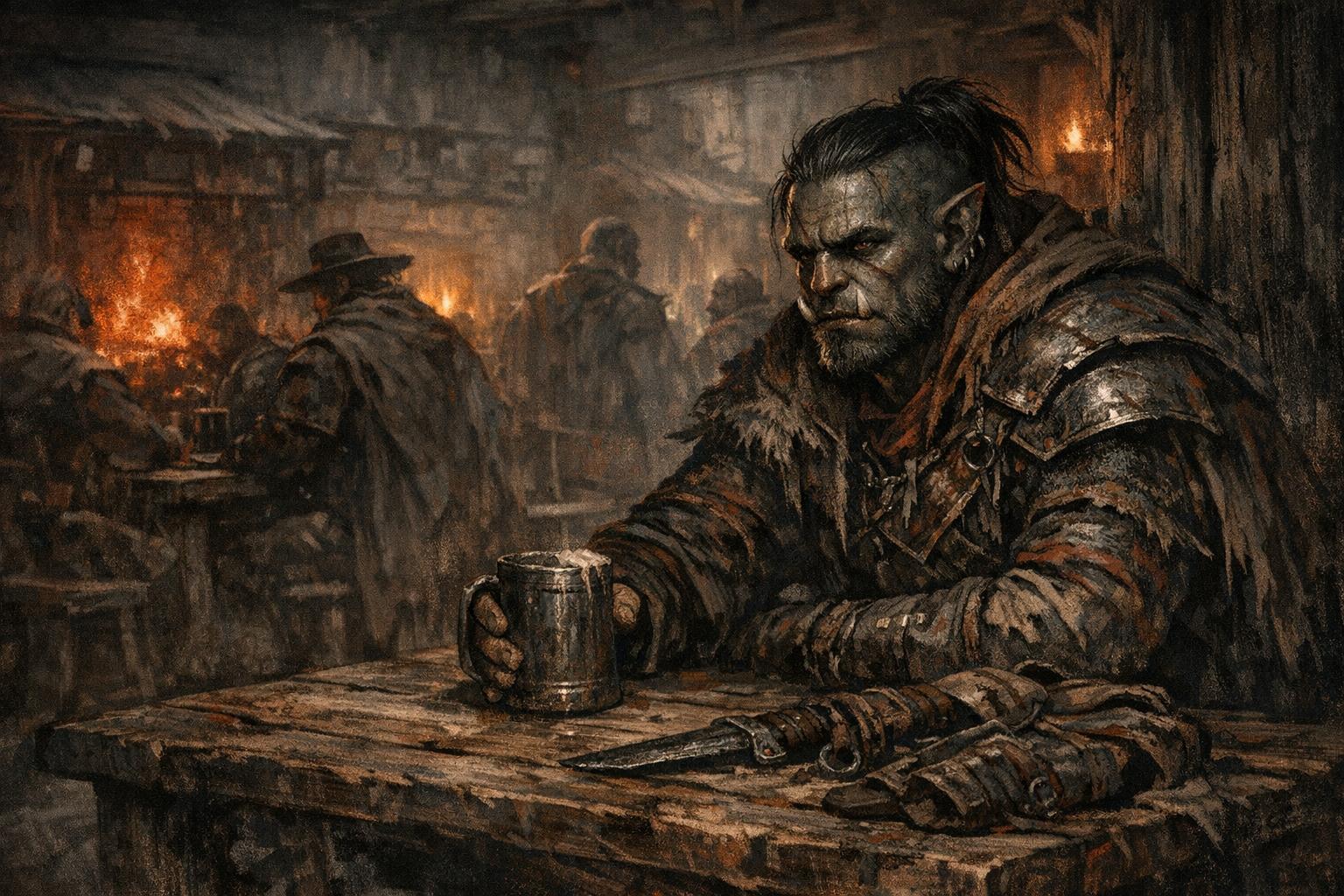
Daily life for most half-orcs involves a constant, low-frequency hum of negotiation with the world's expectations. It begins with the body. Walking into a room as a half-orc means absorbing the flinch — the microsecond where a stranger registers the tusks, the skin, the size, and decides whether you're a threat before you've opened your mouth. Most half-orcs learn to compensate: speak softly, smile with closed lips, keep hands visible, approach slowly. The behavioral adjustments are so deeply internalized that many half-orcs don't realize they're doing them until they meet someone who doesn't require them.
Employment tracks along predictable lines. Soldier, bouncer, laborer, mercenary, caravan guard — work where intimidating appearance is an asset or at least not a liability. Half-orcs who pursue scholarly, artistic, or political careers face the additional burden of constantly proving they belong. The half-orc wizard isn't just studying magic; they're studying magic while every new colleague's eyebrows rise a fraction of an inch upon meeting them. The cumulative weight of a thousand raised eyebrows is its own form of exhaustion.
Communities that accept half-orcs tend to do so conditionally. You're welcome as long as you're useful, as long as you're controlled, as long as you don't get too angry. The conditional nature of the acceptance is the cruelest part — it means the half-orc is never fully at rest, because belonging can be revoked if the mask slips. One lost temper, one raised voice, one moment where the orcish physicality manifests without permission, and the community's tolerance can evaporate. "I always knew you were dangerous" doesn't require evidence. It just requires a moment that confirms the bias.
Half-orc friendships, when they form, tend to be intense and loyal. A person who has spent their life being tolerated knows the difference between tolerance and genuine acceptance, and they hold onto genuine acceptance with both hands. The half-orc who has found someone — a friend, a partner, a community — that sees them fully, without flinching or qualifying, will walk through fire for that person. Not because of orcish ferocity. Because of the rarity and preciousness of being seen.
Codes of Belonging
Half-orcs don't have a shared culture in the way that elves or dwarves do. There's no ancestral homeland, no ancient tradition, no half-orc language or cuisine or architectural style. What they have instead is a scattered, informal network of shared survival strategies — an unwritten code that half-orcs teach each other in the spaces between other people's cultures.
The code varies by region but shares common principles. Know your exits. Read the room before you enter it. Don't bare your tusks unless you mean it. Keep your temper on a shorter leash than anyone else, because your anger will be interpreted through the lens of what you are. Stand up for other half-orcs when you can, because nobody else will. And — the hardest rule — decide early whether you're going to spend your life making humans comfortable or making yourself comfortable, because you probably can't do both.
Among Humans
Half-orcs in human communities develop a performance of humanity that becomes second nature. Softer voice. Slower movements. Hands that gesture small instead of wide. Laughter that's careful not to show too many teeth. This isn't submission — it's strategy. A half-orc who makes humans comfortable gets access to resources, relationships, and opportunities that a threatening half-orc doesn't. The performance is exhausting, but the alternative is exclusion.
The human communities that work best for half-orcs are the ones too busy or too diverse to care about heritage. Frontier towns, port cities, mercenary companies, adventuring guilds. Places where what you can do matters more than what you look like. A half-orc who finds one of these communities often stays for life, because the relief of putting down the performance — of being evaluated on merit rather than appearance — is intoxicating.
Among Orcs
Half-orcs in orcish communities face a different but equally taxing set of expectations. Among orcs, the human half is the liability. Too soft, too small (relatively), too inclined toward talking when hitting would be faster. A half-orc in an orcish warband has to be twice as fierce to earn half the respect, because the assumption is that human blood dilutes orcish strength.
Ironically, the half-orcs who thrive among orcs are often the ones who leverage their human heritage as an advantage rather than hiding it. The half-orc who can negotiate with human traders, read human maps, understand human fortification patterns — they become invaluable to warbands that interact with human territory. The trick is framing the human skills as orcish assets: not 'I'm smart because I'm half-human' but 'I know how the enemy thinks because I grew up among them.'
Faith Between Pantheons
Gruumsh One-Eye looms over half-orc spirituality like a father who won't stop calling. The chief god of the orc pantheon represents everything human culture fears about orcs — conquest, destruction, the fury of a being who was cheated of his place in the world and will never stop fighting to reclaim it. For a half-orc, Gruumsh is a theological problem. He's the deity most associated with your orcish heritage, and his doctrine has historically claimed that orcs (and by extension, half-orcs) exist to conquer the world that was denied to them. Accepting Gruumsh means accepting a narrative of grievance and violence. Rejecting him means rejecting part of your spiritual inheritance.
Many half-orcs find their way to human deities instead, and the choice of god reveals the character. Tempus, the god of war, attracts half-orcs who want to channel their martial nature through a framework that values honor alongside strength. Ilmater, the god of suffering, draws half-orcs who have transformed their pain into compassion. Tymora, goddess of luck, appeals to half-orcs who have decided that if the world was going to deal them a difficult hand, they might as well gamble on themselves.
The most theologically interesting half-orc characters are the ones who worship Gruumsh and disagree with him. They honor the orcish divine tradition — they acknowledge the rage, the grievance, the refusal to be diminished — while rejecting the conclusion that the only response is destruction. A half-orc cleric of Gruumsh who argues that the One-Eye's fury can be channeled into building rather than breaking is doing real theological work, and the tension between orthodoxy and reinterpretation fuels a character arc that never runs dry.
Some half-orcs abandon organized religion entirely, finding that no existing pantheon has room for what they are. They develop private spiritual practices — ancestor veneration, nature worship, simple meditation — that don't require them to fit into a theological box designed for someone else. This spiritual independence mirrors the broader half-orc experience: when no institution was built with you in mind, you build your own.
If your half-orc character worships a human deity, consider what the temple community thinks about them. Does the local priesthood of Lathander welcome a half-orc worshipper, or do they shift uncomfortably when the tusked congregant takes a pew? Religious communities are microcosms of broader society, and a half-orc's experience in a temple can illuminate the difference between institutional values (all are welcome) and the lived reality in the pews.
Battle Magic & Primal Instinct
Half-orcs and magic have a complicated relationship in D&D's mechanical history. For most of the game's life, ability score penalties to Intelligence and Charisma mechanically discouraged half-orc wizards, sorcerers, and bards. The message was clear if unintentional: orc blood and arcane talent don't mix. The removal of those penalties in 5e opened doors that had been subtly locked for decades, and the half-orc spellcaster went from suboptimal to fully viable.
That said, the half-orc magical tradition that D&D has developed most thoroughly is primal rather than arcane. Barbarian rage is coded as instinctive, physical, rooted in the body rather than the mind — and half-orc barbarians have been one of the most popular race/class combinations since 3rd Edition. The synergy isn't just mechanical (though Savage Attacks plus a greataxe crit is spectacular). It's thematic. Rage is the half-orc experience distilled: the moment when the careful control drops, when the performance of civility collapses, and the raw force of what you are comes through.
But reducing half-orc magic to "rage and hit things" does the species a disservice. A half-orc druid who channels primal magic through orcish traditions of nature worship — storm-calling, beast-speaking, earth-shaping — connects to a magical tradition that predates human arcane academies. A half-orc warlock whose patron is interested precisely because of their hybrid nature — a being of two worlds makes an excellent agent in liminal spaces — turns the species' identity crisis into a source of power. The best half-orc spellcasters don't overcome their heritage to do magic. They do magic because of their heritage.
The rage itself deserves closer examination as a magical phenomenon. In-world, barbarian rage isn't just anger. It's a channeled state that enhances physical capability, reduces pain response, and for some subclasses manifests as literal supernatural power — storm auras, spectral totems, ancestral spirits. For a half-orc, rage occupies an uncomfortable space between gift and stigma. It's the most powerful thing about them. It's also the thing that confirms every stereotype. Using rage in front of people who already fear you is a tactical decision with social consequences.
Half-Orc Class Synergies & Themes
| Class | Mechanical Synergy | Thematic Resonance | Narrative Tension |
|---|---|---|---|
| Barbarian | Savage Attacks + Brutal Critical; Relentless Endurance as safety net | Rage as authentic expression of hybrid fury | Confirming the stereotype vs. channeling the rage intentionally |
| Fighter | STR bonus + CON bonus; Savage Attacks with Action Surge | Discipline imposed on raw physical power | Proving worth through martial excellence; the soldier who is never off duty |
| Paladin | STR for smites; Relentless Endurance for oath survival | Choosing devotion despite a world that expects savagery | The oath as identity anchor; what happens when rage threatens the code? |
| Warlock | CHA-based but thematic gold; Relentless Endurance matters | Patron attracted to liminal identity; power from in-betweenness | Is the pact a liberation or another form of servitude? |
| Druid | WIS focus; Wild Shape as literal identity fluidity | Connection to primal orcish nature traditions | Finding peace in a form that isn't judged; Wild Shape as escape from appearance |
| Bard | CHA-focused; Savage Attacks with melee bard builds | Half-orc as storyteller, chronicler of borderland experience | The performer whose audience can't see past the tusks |
The removal of mental stat penalties in 5e made every class genuinely viable. The best half-orc characters pick the class that tells the most interesting story, not the one that maximizes the Strength bonus.
Walking Between Peoples
The half-orc's defining narrative is liminality — existing in the threshold between two worlds. This isn't the half-elf version of liminality, which tends toward wistful beauty and the romantic tragedy of outliving your human friends while being too mortal for elven society. Half-orc liminality is rougher, more immediate, more dangerous. The threshold between human and orc is a contested border, and the half-orc standing on it is exposed to fire from both sides.
In adventuring parties, this liminality becomes an asset. The half-orc is the character who can talk to the orc warband and the human lord. Who understands what the barbarian tribe is actually saying beneath the posturing. Who reads the room in the dockside tavern with the precision of someone who has been reading rooms for survival since childhood. The in-between perspective that causes pain in civilian life becomes a genuine superpower in the chaotic context of adventuring.
What makes half-orc stories compelling at the table is the way they force engagement with identity questions that most fantasy species handle more abstractly. An elf grappling with mortality is philosophical. A half-orc grappling with belonging is personal and immediate. Do they sit with the humans or the orcs at the tavern? Do they tell the party about their orcish heritage upfront or let it emerge? When the party encounters orc enemies, how do they feel about fighting creatures who share their blood? These aren't abstract dilemmas. They come up in play, session after session, and they produce character development that purely fantastic species rarely generate.
The best half-orc arcs move from survival to self-definition. The character begins reactive — adapting to others' expectations, managing perceptions, performing whichever identity the moment demands. Over the course of a campaign, they stop reacting and start defining. They decide what their heritage means on their own terms. They stop asking where they belong and start building a place that belongs to them. It's a satisfying arc because it mirrors a real human journey, and it works in D&D because the fantasy context provides enough distance to examine it without the weight of real-world specificity.
“They stop asking where they belong and start building a place that belongs to them. That's the half-orc arc at its best — not finding acceptance, but outgrowing the need for it.”
— On the half-orc character journey
Notable Half-Orcs in Lore
Published D&D material has produced a handful of memorable half-orc characters, though the species has never received the literary attention lavished on elves and dwarves. The most famous half-orcs tend to come from novels and video games rather than sourcebooks, reflecting a broader truth: half-orcs are characters who need stories to be understood. A stat block can't convey what it means to be half-orc the way a narrative can.
Obould Many-Arrows, the orc king from R.A. Salvatore's novels, isn't a half-orc but profoundly shaped how half-orcs are understood in the Forgotten Realms. His arc — from brutal warlord to something approaching a statesman — demonstrated that orcish heritage was compatible with strategic thinking and even diplomacy. Every half-orc character who argues that their orcish blood doesn't make them stupid is standing on the ground Obould broke.
In video games, Baldur's Gate 3 brought half-orc companions and origin characters to a massive audience, making the species' identity tensions visible in a medium that reached millions of players who might never read a D&D sourcebook. The game's treatment of half-orc characters — their relationships, their self-awareness, their humor about their own position — represents perhaps the most nuanced mass-market portrayal the species has received.
Notable Half-Orcs & Orc Figures in D&D Media
| Character | Source | Significance |
|---|---|---|
| Obould Many-Arrows | R.A. Salvatore novels (Forgotten Realms) | Orc king who pursued diplomacy alongside conquest; redefined what orcish ambition could look like |
| Tordek & Krusk (iconic PCs) | D&D 3e/3.5e Player's Handbook | Krusk was the iconic half-orc barbarian in 3e art; established the visual template for a generation |
| Coran (half-orc NPCs) | Various D&D adventure modules | Scattered but recurring presence; half-orc NPCs as quest-givers, merchants, and allies challenged the "always hostile" framing |
| Karlach | Baldur's Gate 3 (2023) | Tiefling barbarian, but her narrative arc — judged by heritage, choosing her own path — mirrors the definitive half-orc story |
| The Dark Urge | Baldur's Gate 3 (2023) | Origin that can be played as half-orc; the game's most popular exploration of unwanted heritage and agency |
Half-orcs are underserved in official lore. The species' best stories are being told at home tables, not in published novels — which is arguably how it should be.
Mechanical Evolution
The half-orc's mechanical history in D&D is a case study in how game design reflects and shapes cultural attitudes. In 1e, the mechanical limitations were the lore: half-orcs were limited because the game believed — or at least assumed — that orcish heritage was a liability. By 5e, the mechanics told a different story: half-orcs are resilient, powerful, and defined by their refusal to stay down. The shift from penalty-based design to asset-based design mirrors a broader change in how D&D thinks about species that were once labeled monstrous.
The 2024 PHB's decision to fold half-orcs into the orc species entry is the most significant mechanical change in the species' history, and it's philosophically loaded. On one hand, it removes the "half" framing that always carried uncomfortable implications — that half-orcs were defined by being half-something rather than being fully themselves. On the other hand, it erases a species category that many players had meaningful connections to. A half-orc character who has spent twenty years of real-world campaigns defining themselves as "half-orc" is now told that category doesn't exist anymore.
The mechanical identity that half-orcs leave behind is small but iconic. Relentless Endurance (drop to 1 HP instead of 0, once per long rest) and Savage Attacks (extra damage die on melee crits) are the two traits that defined the species mechanically. Neither was overwhelmingly powerful. Both were perfectly thematic. Relentless Endurance said "I don't quit." Savage Attacks said "When I connect, you know it." Together, they painted a mechanical portrait of a species that was hard to kill and hit like a truck — not because they were brutish, but because they had something to prove.
- Infravision 60 ft.
- Class restrictions: Fighter, Cleric, Thief, Assassin only
- Multi-class limited to Fighter/Cleric, Fighter/Thief, Cleric/Thief, or Fighter/Assassin
- Can speak Orcish in addition to Common
The 1e half-orc was mechanically punished for existing. The Charisma cap of 12 meant they could never be truly persuasive, and class restrictions locked them out of magic-using roles. The message was clear: tolerated, but limited.
- Darkvision 60 ft.
- Orc Blood (counts as orc for effects targeting orcs)
- No class restrictions
The mental stat penalties remained — the game still said orc blood made you dumber and less likable. But the removal of class restrictions was a genuine step forward. A half-orc wizard was now mechanically possible, just mechanically discouraged.
- Darkvision 60 ft.
- Menacing (Intimidation proficiency)
- Relentless Endurance (drop to 1 HP instead of 0, 1/long rest)
- Savage Attacks (extra damage die on melee crits)
The definitive mechanical treatment. No negative ability modifiers. Two iconic features that reward aggressive play while providing survivability. The Intimidation proficiency was a small nod to appearance-based social dynamics without imposing a penalty.
- Darkvision 120 ft.
- Adrenaline Rush (Dash as bonus action, temp HP, PB/long rest)
- Relentless Endurance (from 5e, modified)
- Size: Medium
Half-orcs are not a separate entry. The orc species covers full orcs and mixed heritage alike. Adrenaline Rush replaces Savage Attacks, shifting the identity from "hits harder" to "keeps going." The 120 ft. darkvision is a notable upgrade.
Half-Orcs in Other Franchises
Orcs are everywhere in fantasy, but the specific concept of the half-orc — the hybrid caught between human and orc societies — is rarer than you'd expect. Most franchises treat orcs as either fully alien (Warhammer, Warcraft) or fully redeemed (Elder Scrolls Orsimer), leaving little narrative space for the in-between identity that makes D&D's half-orcs distinctive. The half-orc as a species defined by liminality rather than combat ability is, surprisingly, almost unique to D&D.
Tolkien, who invented modern fantasy orcs, explicitly addressed orc-human mixing in his letters and found it deeply disturbing. The Uruk-hai of Saruman are sometimes described as orc-human crossbreeds, and their existence is presented as an abomination — a corruption of both species. Tolkien's discomfort with the concept is worth noting because it shaped how every subsequent fantasy franchise approached the idea. If the foundational text treats half-orcs as monstrous, every later version has to actively push against that framing.
Pathfinder, D&D's closest mechanical sibling, has handled half-orcs similarly to D&D's trajectory: from a distinct species to a heritage option within the broader orc ancestry. The Elder Scrolls series offers an interesting counterpoint — the Orsimer (orcs) are a fully fleshed-out civilization with their own code of honor, religion, and crafting tradition, which means the concept of a "half-orc" is less loaded because the orc half of the equation isn't coded as savage. When both parent cultures are respected, being mixed isn't a crisis.
Video games have generally been kinder to half-orcs than tabletop lore, possibly because the medium requires playable species to be appealing rather than just tolerated. Baldur's Gate, Neverwinter Nights, and Pathfinder: Wrath of the Righteous all offer half-orc player characters with nuanced storylines. The visual medium also helps — seeing a half-orc rendered with care and detail (rather than as a generic brute in a sourcebook illustration) humanizes the species in ways that text descriptions struggle to achieve.
Orc & Half-Orc Representations Across Franchises
| Franchise | Species | Cultural Status | Key Difference from D&D Half-Orcs |
|---|---|---|---|
| D&D | Half-Orc | Liminal — between human and orc society | The original; defined by in-betweenness and identity tension |
| Pathfinder | Half-Orc (heritage) | Similar to D&D; now a heritage of orc ancestry | Mechanically parallel; Pathfinder 2e moved to heritage system first |
| Tolkien | Uruk-hai / half-orcs | Abomination — Saruman's corruption | No individual identity; the concept itself is framed as evil |
| Elder Scrolls | Orsimer (Orcs) | Full civilization with Code of Malacath | No "half" needed — orcs are a complete, respected culture |
| Warcraft | Orcs (+ human allies) | Noble warrior culture post-redemption | No half-orc species; orcs don't need human heritage to be sympathetic |
| Warhammer | Greenskins / Orruks | Fungal reproduction — no interbreeding | Biologically incompatible; the half-orc concept is impossible |
D&D's half-orc remains the most complex treatment of the concept because it insists on the discomfort. Other franchises either avoid the hybrid or remove the tension. D&D sits in it.
FAQ
Common Questions
Early D&D framed half-orcs as products of orcish raids on human settlements — a thinly veiled allusion to sexual violence that the game treated as backstory flavor. This is the darkest part of the species' history, and modern D&D has moved away from it. The 2024 rules treat orc-human relationships the same as any other interspecies pairing. But the old lore lingers in older sourcebooks and in the cultural memory of the hobby. If you're playing or DMing a half-orc, it's worth having an explicit conversation with your table about how your campaign handles half-orc origins. Consensus and comfort matter more than lore accuracy. Many tables simply state that half-orcs are born from willing partnerships, border communities, or cultural exchange, and that works perfectly. You don't need trauma to make a half-orc character interesting.
The "noble savage" trap frames the half-orc as impressive because they've overcome their orcish nature through human virtue — which implies orcish nature is something to be overcome. Avoid this by treating both halves of the heritage as genuinely valuable, not as a liability offset by humanity. Your half-orc's orcish traits — resilience, directness, physical confidence — aren't flaws being compensated for. They're assets that exist alongside human traits. The character isn't noble despite being part orc. They're a complete person whose orcishness contributes to, rather than detracts from, who they are. Also, let your half-orc be messy. Noble savages are idealized. Real characters have bad days, petty grudges, and stupid opinions. A half-orc who snores, hates mushrooms, and holds an irrational grudge against halflings is more interesting than one who exists solely to demonstrate that orcs can be good.
Mechanically, yes — the 2024 orc species entry covers the design space that half-orcs occupied. Relentless Endurance is still there, Adrenaline Rush replaces Savage Attacks, and the flexible ability scores mean you can build any character concept. Narratively, no. The "half" experience — belonging fully to neither world, navigating dual identity, the specific social position of being visibly mixed — isn't captured by playing a full orc. If that liminal experience is central to your character concept, you can still call your character a half-orc within the game fiction while using the orc stat block. The rules describe mechanics. The story is yours. Many tables are doing exactly this: using 2024 orc stats while maintaining the half-orc identity in roleplay, backstory, and social interactions.
Barbarian is iconic but can be one-note if you're not careful — lean into the tension between rage and restraint rather than just smashing things. Paladin creates incredible narrative friction: a character who swears an oath of devotion while carrying heritage the world considers dangerous. Bard is underrated and wonderful — a half-orc who processes the borderland experience through art and storytelling subverts every expectation. For backgrounds, Outlander captures the frontier upbringing, but Soldier (proving yourself through service), Acolyte (finding identity through faith), and Sage (the half-orc who pursued knowledge despite every raised eyebrow) all produce richer stories than the default. The strongest combinations create tension between what the character is and what they chose to become: a half-orc Noble who inherited a human title, a half-orc Hermit who left both societies entirely, a half-orc Criminal who decided that if the world was going to treat them as dangerous, they might as well profit from it.