
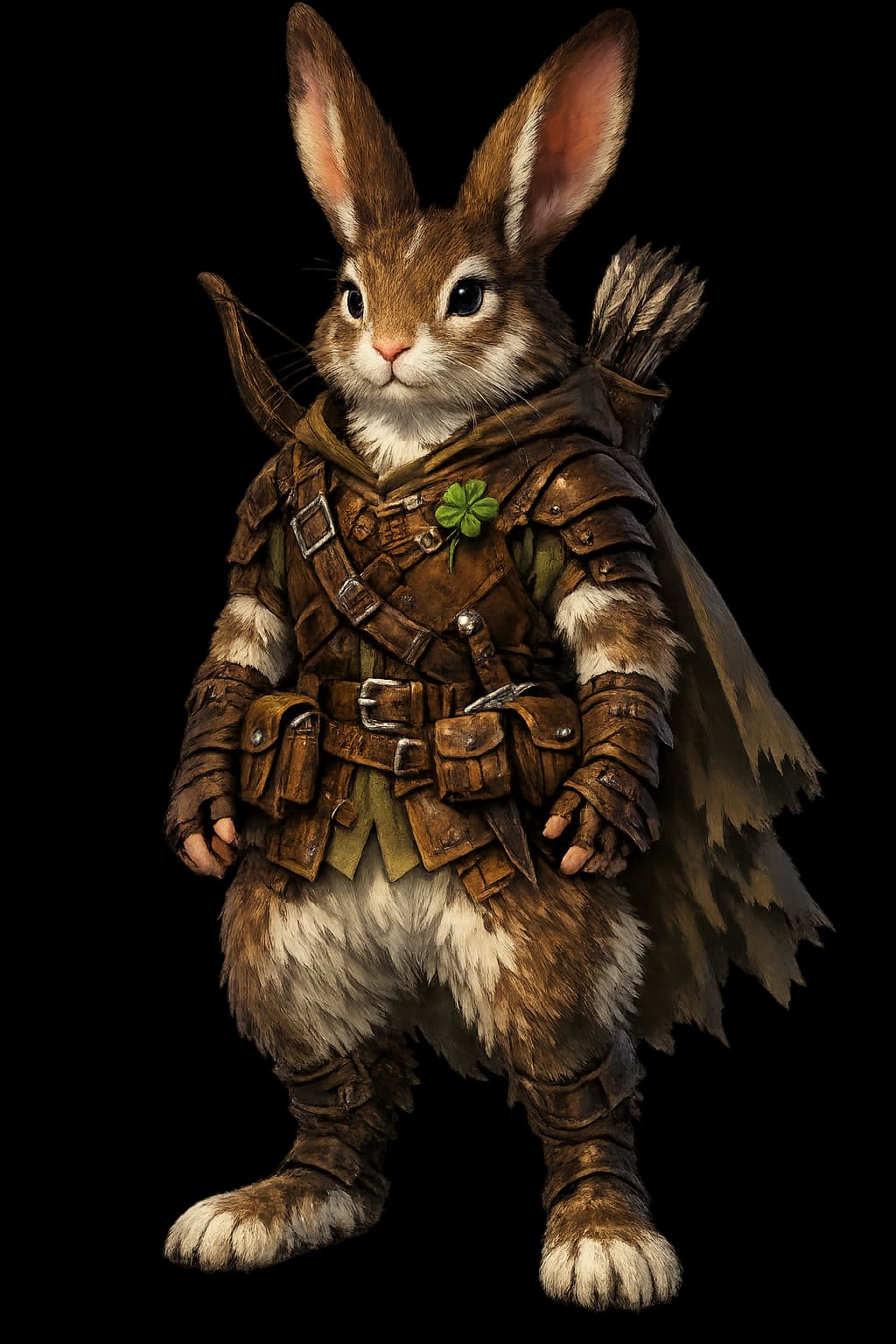

Harengon
Rabbit-folk who leapt from the Feywild carrying luck, speed, and an instinct for exactly when to run
The Rabbit in World Mythology
Rabbits and hares occupy a peculiar space in world mythology: they are simultaneously symbols of cowardice and cleverness, fertility and doom, luck and the moon. In West African and African American folklore, Br'er Rabbit outsmarts every predator in the forest through sheer audacity and a willingness to lie. In Chinese and Japanese lunar mythology, the Moon Rabbit pounds medicine — or mochi, depending on the tradition — connecting the hare to cycles, immortality, and quiet labor performed where nobody can see. The Aztec Centzon Totochtin were four hundred divine rabbits who governed drunkenness and celebration, which is a remarkably specific portfolio for a prey animal.
The European hare is weirder still. March hares were considered mad because they boxed and leaped in open fields during mating season — behavior so erratic it entered English idiom via Lewis Carroll. The Easter Bunny descends from Eostremonath, an Anglo-Saxon fertility festival, which is how a rabbit ended up delivering eggs despite being a mammal. In medieval bestiaries, the hare was associated with melancholy and vigilance, an animal that never fully sleeps because it knows something is always hunting it.
What unites every rabbit myth is the tension between vulnerability and survival. Rabbits are not apex predators. They don't breathe fire or command armies. They endure because they're fast, they breed prolifically, and they have an almost supernatural awareness of danger. The harengon inherits all of this. They're not the fantasy species that conquers through power. They're the species that's still here because they always knew when to run and when to come back.
D&D's designers tapped this mythological vein deliberately. The harengon's Rabbit Hop ability, their Lucky Footwork feature, their bonus to initiative — these aren't arbitrary mechanical choices. They're codifications of the rabbit archetype: move first, trust your instincts, and never bet against a creature that's survived by not being where the teeth land.
The Rabbit Across World Mythology
| Tradition | Figure | Core Association |
|---|---|---|
| West African / American | Br'er Rabbit | Trickster who defeats strength with cunning and deceit |
| Chinese / Japanese | Moon Rabbit (Yutu / Tsuki no Usagi) | Lunar cycles, medicine, selfless sacrifice |
| Aztec | Centzon Totochtin | Four hundred rabbit gods of revelry and excess |
| Anglo-Saxon / European | Easter Hare / March Hare | Fertility, madness, seasonal renewal |
| Medieval bestiary | The vigilant hare | Sleepless watchfulness, melancholy, prey-alertness |
| Carroll / English idiom | The Mad March Hare | Eccentricity, unpredictability, chaotic wisdom |
The harengon draws from all of these threads — trickster, survivor, creature of luck and lunar strangeness.
Harengon Naming Traditions
Harengon names split along a fault line that reveals something fundamental about the species. Feywild-born harengon carry names that sound like wind through tall grass — sibilant, rhythmic, often incorporating natural sounds that Sylvan handles elegantly and Common mangles. Cloverfoot, Threadleap, Burrowshine. These names are descriptive, earned through action rather than assigned at birth. A harengon born in the Feywild might cycle through three or four names before settling on one that sticks, each discarded name marking a phase of life that's over.
Material Plane harengon trend differently. Generations removed from the Feywild, they adopt the naming conventions of whatever culture raised them — human, halfling, gnomish — with small alterations. A harengon raised in a halfling community might be called Milo Thistlejump, the surname a nod to heritage even as the given name blends in. Those raised in human cities often carry names that feel slightly off in a way nobody can articulate: Hasenpfeffer shortened to "Hasen," or Lepara softened into "Lepi." The names want to belong without quite managing it.
Then there are the warrens. Harengon who live in all-harengon communities on the Material Plane develop a third naming tradition: den-names. A den-name combines the family's burrow with a personal trait. Deephollow Quick-ear. Briargate Long-stride. Mossbank Softpaw. Den-names tell you where someone is from and what they're known for in a single breath, which is useful for a species that historically needed to identify friends fast and strangers faster.
The absence of surnames in Feywild tradition and the adoption of them on the Material Plane maps neatly onto the harengon experience of displacement. Names are how harengon track their relationship to place. A harengon with no surname is either Feywild-connected or deliberately rootless. A harengon with a compound surname is anchored to a specific community. A harengon using a non-harengon name has decided, consciously or not, that blending in matters more than standing out.
Ask your harengon player how many names they've had. A character who has shed names has a history of reinvention. A character who has kept the same name since the Feywild is clinging to something. A character who took a human name has a story about why — and it's probably not a happy one.
A New Species for a New Era
The harengon debuted in The Wild Beyond the Witchlight (September 2021), making them one of the newest official species in D&D's fifty-year history. This timing matters. They arrived during a period when Wizards of the Coast was actively rethinking how species work in the game — removing inherent alignment, replacing biological ability score bonuses with flexible ones, and reconsidering the implications of calling fantasy peoples "races" at all.
As a result, harengon were designed from the ground up under a philosophy that didn't exist when elves or dwarves were created. There's no harengon alignment tendency in the rules. There's no stat block that implies all harengon are dexterous or that none of them are strong. The species is defined entirely by culture, narrative, and a small set of features — Rabbit Hop, Lucky Footwork, Hare-Trigger — that describe what harengon can do without prescribing what they are.
This makes harengon a bellwether for where D&D species design is heading. They prove that a species can be distinctive and mechanically interesting without relying on biological determinism. You know what a harengon is because of how they feel in play — twitchy, lucky, quick to react — not because the rules tell you they have +2 Dexterity and tend toward chaotic alignments. The features create a play experience. The lore fills in the rest. Nothing forces a harengon into a box.
Critics argue that this approach makes harengon feel generic — that without strong mechanical identity, they're just "pick a stat, add rabbit ears." There's some truth to this. Older species like dwarves carry decades of cultural weight that makes them feel specific even when mechanically flexible. Harengon don't have that weight yet. They're building it in real time, one campaign at a time, which is either exciting or frustrating depending on how much you value established lore versus emergent storytelling.
“Harengon are the first species designed for a D&D that doesn't want to tell you who your character is. Whether that's liberation or a vacuum depends on what you bring to the table.”
— On post-Tasha's species design
Feywild Meadows & Mortal Warrens
Harengon originate in the Feywild, which explains a lot about them if you understand what the Feywild actually is. It's not a forest paradise. It's a plane where emotion shapes reality, where seasons change based on the mood of archfey, and where a meadow that was safe yesterday might swallow you today because the local fey lord got bored. Growing up in this environment doesn't make you whimsical. It makes you hyper-alert, adaptable, and slightly fatalistic in a cheerful sort of way.
In the Feywild, harengon live in extended family groups called lopes — a term borrowed from the collective noun for hares. A lope might number between twenty and eighty individuals, occupying a territory defined not by borders but by relationships with the local fey courts. A lope that pleases the Summer Court might enjoy endless meadows and warm breezes. A lope that offends the Queen of Air and Darkness might find its burrows filling with ice overnight. Harengon diplomacy with archfey is less negotiation and more weather forecasting: reading the signs, adjusting behavior, and knowing when to relocate entirely.
The migration to the Material Plane happened in waves, not as a single event. Some harengon were exiled — driven from the Feywild by fey politics or failed bargains. Others left voluntarily, drawn by the Material Plane's stability. A world where the ground stays where you put it and seasons follow a predictable cycle is enormously appealing to a species accustomed to capricious geography. Still others arrived by accident, slipping through fey crossings during moments of planar thinness and finding themselves unable or unwilling to return.
Material Plane warrens reflect this mixed origin. Some are meticulously organized, run by harengon who craved the predictability the Feywild lacked. Others are chaotic, built by harengon who brought Feywild instincts to a world that doesn't reward them the same way. The most interesting warrens are hybrids: structured enough to function in the Material Plane, wild enough to feel like home. A warren might have a perfectly maintained root cellar and a meeting hall where the ceiling changes color based on the collective mood of the occupants — a residual fey enchantment that nobody has figured out how to stop.
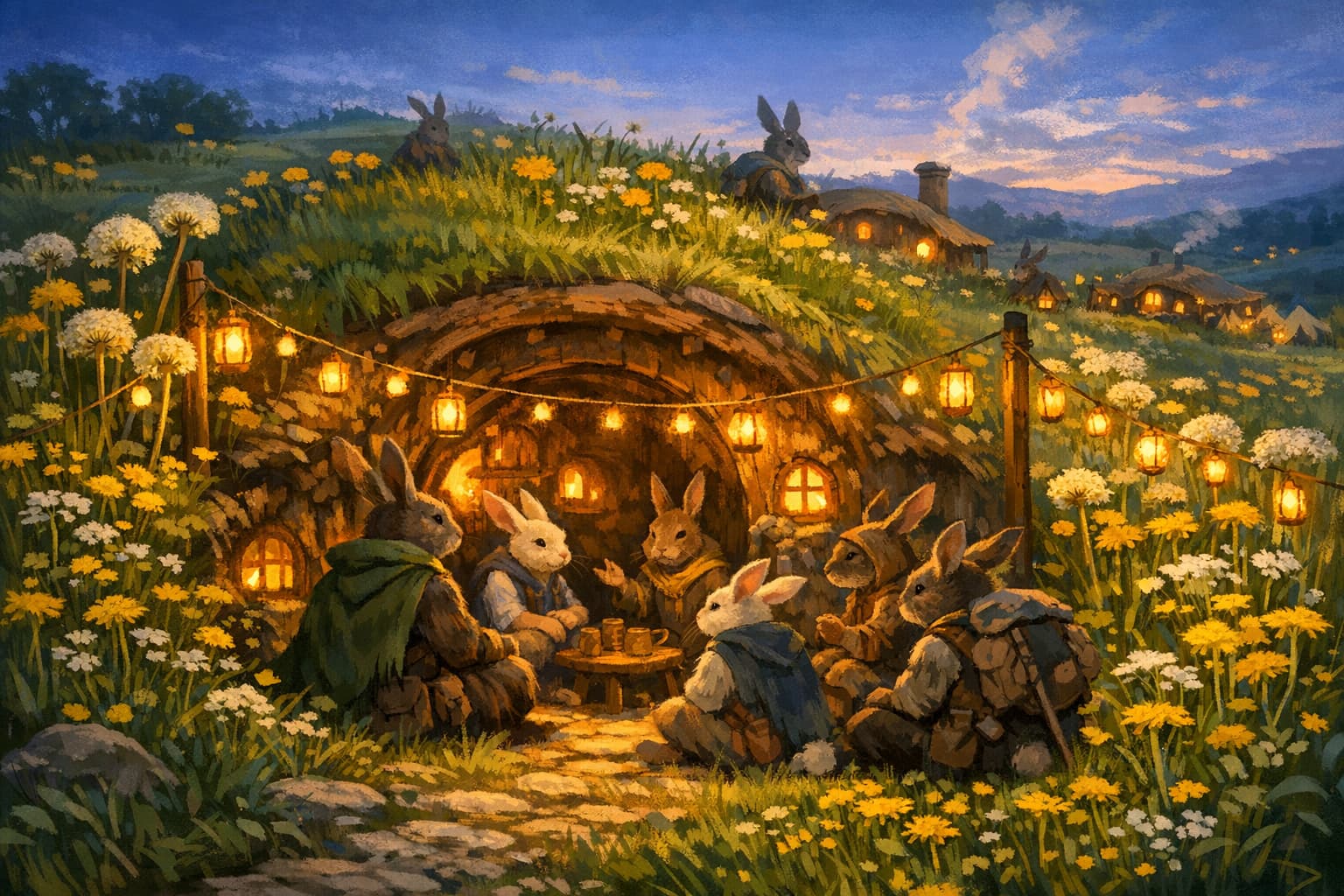
The Lope: Feywild Family Structure
A harengon lope is not a family in the human sense. It's closer to a mobile village organized around shared survival rather than bloodline. Lopes include parents, siblings, and children, but also adopted members, strays, and the occasional non-harengon who proved useful or entertaining enough to keep around. Leadership within a lope is informal and rotational — whoever has the best instincts for the current crisis leads until the crisis passes. Permanent leaders are viewed with suspicion, because in the Feywild, anyone who wants power for its own sake is probably working an angle.
Lagomorph Anatomy
Harengon stand between three and six feet tall, which is an enormous range and reflects the species' origins in a plane where biology responds to environment more dramatically than on the Material Plane. Feywild-born harengon tend toward the extremes — pocket-sized individuals barely three feet tall living alongside towering six-foot specimens — while Material Plane generations have normalized toward a human-adjacent four-to-five-foot range. The fur ranges from snow white through brown, grey, tawny gold, and mottled patterns that would be excellent camouflage in meadow grass, which was presumably the point.
The legs are the engineering marvel. Harengon lower limbs are structured like a hare's rather than a human's: digitigrade, with elongated foot bones that function as a second lever arm. This produces the explosive vertical leap that defines harengon movement. A harengon in good health can clear a fifteen-foot vertical jump from a standing start, which is mechanically represented by Rabbit Hop but in practice means that harengon architecture includes a lot of vertical space that other species find baffling. Why build a door when you can build a ledge?
The ears deserve their own paragraph because they're not decorative. Harengon ears are mobile, independently directional, and capable of detecting sound frequencies well above and below human range. Each ear can rotate nearly 270 degrees, creating a passive sonar system that gives harengon their signature alertness. The Hare-Trigger feature — adding proficiency bonus to initiative — isn't a game abstraction. It's what happens when a species can literally hear a bowstring being drawn from forty yards away. Harengon don't have good reflexes. They have early warning systems built into their skulls.
The nose twitches are involuntary and constant, processing scent information at a rate that exceeds most humanoid species. Harengon can identify individuals by smell, detect emotional states through pheromone shifts, and determine the freshness of a trail with a single sniff. In the Feywild, where illusions are common and appearances lie, scent was the reliable sense. Material Plane harengon retain this ability even in environments where it's less critical, leading to the common observation that harengon always seem to know something they shouldn't.
Harengon Physiological Traits
| Trait | Function | Game Relevance |
|---|---|---|
| Digitigrade legs | Explosive vertical and horizontal leaping | Rabbit Hop — bonus action jump without provoking opportunity attacks |
| Independent rotating ears | 270-degree sound detection across wide frequency range | Hare-Trigger — proficiency bonus added to initiative rolls |
| Oversized hind feet | Vibration detection through ground contact | Perception advantages on solid ground; warren early-warning system |
| Dense fur coat | Temperature regulation and Feywild-adapted camouflage | Advantage on Stealth in natural environments (DM discretion) |
| Rapid nose twitch | Continuous scent processing; emotion and trail detection | Social perception; tracking instinct; resistance to some illusions |
Every signature harengon feature maps to a real-world lagomorph adaptation, scaled up and sharpened by Feywild evolution.
Instinct & Intuition
The word most commonly applied to harengon psychology is "jumpy," which manages to be both literally accurate and deeply reductive. Yes, harengon startle easily. Yes, they have a baseline alertness that other species find exhausting to be around. But calling a harengon jumpy is like calling a hawk observant — technically true, but it misses the architecture behind the behavior.
Harengon process threat assessment continuously and largely unconsciously. Their nervous system is wired for what psychologists would call hypervigilance, except in harengon it's not a disorder — it's the default operating mode. Every room is evaluated for exits. Every stranger is assessed for threat level. Every sudden noise triggers a cascade of physical responses — ears rotating, muscles tensing, weight shifting to the balls of the feet — that prepares the harengon to move before the conscious mind has even identified the danger.
This has consequences for personality that go beyond "nervous rabbit person." Harengon who grow up in safe environments — stable Material Plane communities, protected warrens — often develop a studied calm that reads as confidence but is actually the hypervigilance turned inward. They've learned that the alarm system fires constantly and that most alarms are false, so they cultivate stillness as a deliberate practice. The calmest harengon in the room is often the most alert; they've simply learned not to show it.
The Lucky Footwork feature captures something the lore doesn't always spell out: harengon have an uncanny ability to avoid harm through micro-adjustments that look like luck. A harengon who dodges an arrow didn't get lucky — they heard the bowstring, felt the air displacement, and shifted two inches without thinking about it. The game codes this as a reaction that adds to a saving throw, but the in-world experience is a species that seems supernaturally fortunate because their threat response is faster than observation can follow.
In the Feywild, this hypervigilance isn't paranoia — it's baseline survival. The Feywild rewards those who notice the trap before it springs, who feel the mood of a fey lord shift before the decree comes down. Harengon who move to the Material Plane often struggle to calibrate their instincts downward. The world is safer here, but the alarm system doesn't know that.
Burrow Life & Seasonal Rhythms
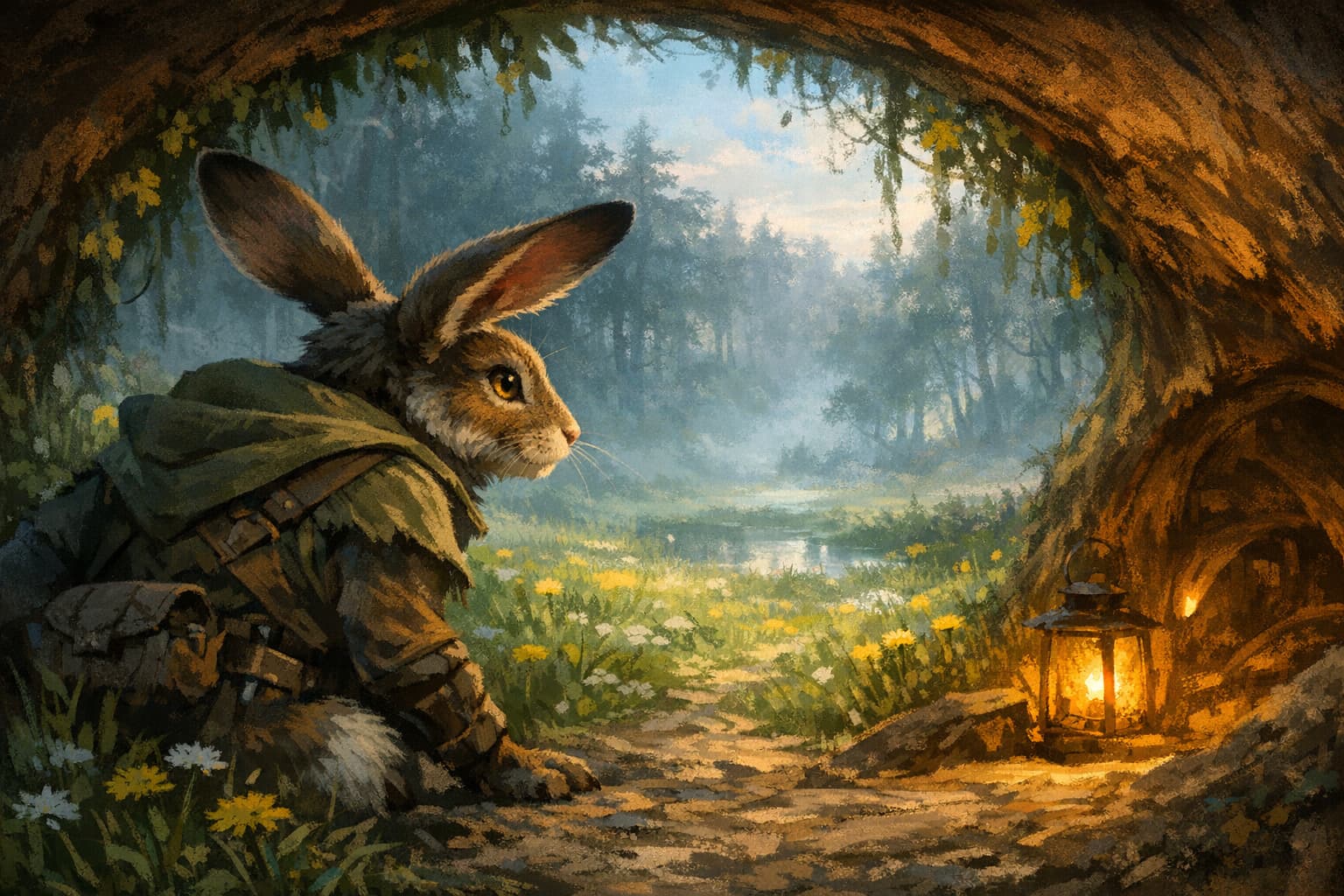
Harengon warrens on the Material Plane are deceptively complex. The surface entrance — usually a modest hole in a hillside or beneath a large tree — gives way to a network of chambers, tunnels, and communal spaces that can extend thirty feet underground and cover an area the size of a small village. Unlike goblin warrens, which are designed for defense, harengon warrens are designed for comfort and social connection. Rooms are round, ceilings are arched, and every major chamber has a central hearth or fey-light that serves as a gathering point.
The seasonal calendar governs harengon social life with a regularity that surprises outsiders who expect Feywild-descended folk to be chaotic. Four festivals mark the year: Greenleap in spring, when yearlings make their first long jumps and new community members are formally welcomed; Longday at midsummer, a festival of contests, games, and deeply competitive cooking; Rustledown in autumn, focused on storytelling, remembrance, and preserving food; and Stillburrow in deep winter, a period of reduced activity, quiet crafting, and what harengon call "thinking slow" — deliberate meditation that counters their natural hypervigilance.
Daily warren life revolves around two meals and an event. Mornings start with a communal breakfast where the day's plans are discussed — not assigned, discussed. Harengon don't take well to orders. The evening meal is larger, more social, and almost always accompanied by storytelling or music. Between meals, harengon work on whatever needs doing: tending gardens, maintaining tunnels, crafting, trading, or the activity most central to warren culture — running. Harengon run for exercise, for meditation, for social bonding, and because sitting still too long makes their legs itch in a way that is not metaphorical.
Children are raised communally within the warren, with biological parents holding a special role but not an exclusive one. Any adult in the warren can feed, teach, or discipline any child, which produces harengon who are comfortable with diffuse authority and suspicious of concentrated power. A harengon raised in a warren has been parented by a dozen adults and considers all of them family, which can make their concept of loyalty confusing to species with nuclear family structures.
Feywild Lopes vs. Material Warrens
Feywild lopes are mobile, temporary, and responsive to the shifting landscape. Burrows are dug for a season and abandoned when the terrain changes — which it does, frequently. Possessions are minimal. Emotional bonds are intense but portable. A lope that relocates three times in a year considers that stability.
The culture prizes adaptability above all else. A harengon who can't adjust to a new meadow, a new court's rules, or a new threat isn't being stubborn — they're being dangerous. Flexibility isn't a virtue in the Feywild. It's oxygen.
Settled Warren Culture
Material Plane warrens are permanent, expanding over generations into multi-level complexes with dedicated rooms for specific functions. Possessions accumulate. Traditions solidify. A warren that's existed for three generations has architecture, recipes, and songs that would be unthinkable in the Feywild.
The tradeoff is rigidity. Warren harengon sometimes lose the reflexive adaptability that kept their Feywild ancestors alive. When crisis comes — a flood, a hostile neighbor, a plague — warrens that forgot how to relocate are in genuine danger. The best warrens remember their roots. The worst ones have basements.
Warren Democracy
Harengon governance is aggressively democratic in a way that baffles species accustomed to hierarchy. There are no harengon kings, no hereditary leaders, no permanent councils. Decisions are made by the Stamp — a meeting where every adult harengon in the warren thumps their foot on the ground to signal agreement. A proposal that generates a thunderous stamp passes. A proposal met with silence dies. A proposal that produces mixed thumping gets discussed until the stamp resolves one way or the other.
The Stamp works because harengon warrens are small enough for direct democracy and because the species has a deep cultural aversion to concentrated authority. This aversion traces directly to the Feywild, where powerful individuals — archfey, hag covens, fomorian kings — exercise arbitrary control over those beneath them. Harengon watched this system operate for generations and decided they wanted no part of it. The Stamp is not an idealistic experiment. It's a trauma response codified into governance.
Leadership within a warren is situational and temporary. The best tracker leads during a hunt. The best builder leads during construction. The eldest leads during remembrance festivals. The fastest leads during an evacuation. No single harengon leads in all situations, and any harengon who tries to accumulate permanent authority will find their proposals suddenly met with deafening silence at the next Stamp. The system has a built-in immune response to would-be autocrats.
The limitation is obvious: the Stamp doesn't scale. A warren of sixty can make decisions this way. A city of six thousand cannot. Harengon who live in larger communities — mixed-species cities, trading towns — often struggle with the hierarchical structures they encounter. They're not opposed to following orders in principle. They're opposed to following orders from someone who didn't earn the role through demonstrated competence in the specific task at hand. A harengon will happily follow a skilled captain into battle but bristle at being told to clean the barracks by that same captain, because fighting and cleaning are different competencies.
The Stamp is a worldbuilding tool that creates instant roleplay hooks. A harengon PC who grew up in a warren will reflexively seek consensus before acting, which can slow a party down or enrich it depending on the table. A harengon who left the warren might have done so because they couldn't tolerate the constant negotiation. Either way, the Stamp shapes how they approach group decisions — and adventuring parties are nothing if not groups making decisions under pressure.
Warren Democracy & Seasonal Elections
Harengon warrens practice a form of governance that other species struggle to take seriously until they see it work. Leaders are elected seasonally — not annually, not for life, but every three months, because harengon political theory holds that no leader should serve long enough to become comfortable. Spring elections favor optimists and builders. Summer elections favor defenders and provisioners. Autumn elections favor harvesters and diplomats. Winter elections favor the cautious and the warm.
The seasonal rotation means that harengon communities cycle through leadership styles the way they cycle through weather. A warren that spent spring expanding aggressively under a bold leader might spend summer consolidating under a cautious one, then autumn trading surplus under a charismatic negotiator, then winter hunkering down under a pragmatic survivalist. The system produces communities that adapt to changing conditions faster than any permanent leadership structure could manage.
Campaigning is vigorous, brief, and conducted primarily through competitive displays of the relevant seasonal skill. A candidate for spring leader demonstrates their building projects. A winter candidate shows their food stores. Speeches happen but matter less than demonstrated competence. Harengon voters are deeply skeptical of rhetoric — they've heard too many convincing speakers who turned out to be better at talking than leading. Show them what you've built, stored, defended, or negotiated, and they'll decide whether to follow you for the next ninety days.
Seasonal leadership creates natural adventure hooks. The party arrives at a harengon warren just before an election, and the current leader — an ally — is about to lose power to a candidate with very different priorities. Helping the current leader win means completing a task that proves their competence before the vote. Failing means dealing with a new leader who may not honor the old one's agreements.
Fey Spirits & Luck Worship
Harengon religion — to the extent that word even applies — orbits around two concepts: luck and the land. They don't worship gods in the traditional sense. Feywild-born harengon acknowledge the power of archfey the way you acknowledge the weather: you respect it, you plan around it, but you don't pray to a thunderstorm. Material Plane harengon have developed a more structured spirituality, but it still resists the temple-and-priesthood model that most species find natural.
The closest thing to a harengon faith is the veneration of what they call the Fortunate Spirits — a loose pantheon of luck-entities that might be minor fey, might be ancestral harengon who achieved something remarkable, or might be personified forces of chance. The Fortunate Spirits include figures like Three-Stride (patron of escapes), Cloverfoot (patron of found things), and Old Longears (patron of good counsel given too late). These aren't gods with domains and clerics. They're narrative figures that harengon invoke in specific situations: "Three-Stride, don't let me stumble" before a dangerous leap, or "Cloverfoot's found it" when discovering something valuable by accident.
Luck itself occupies a theological position in harengon culture that goes beyond superstition. Harengon treat luck as a real, tangible force — not divine will, not random chance, but a kind of energy that flows through the world and accumulates around certain actions, objects, and people. A four-leaf clover isn't lucky because of some arbitrary association. It's lucky because the extra leaf indicates a concentration of the same force that makes a harengon's feet find solid ground in a mudslide. Lucky Footwork isn't just a game mechanic; it's a species interacting with a force they believe is as real as gravity.
This belief system produces a distinctive relationship with risk. Harengon are not reckless — their survival instincts are too sharp for that — but they do distinguish between "foolish risk" and "lucky risk." A foolish risk ignores danger. A lucky risk acknowledges danger and moves through it because the flow of fortune feels right. Outsiders cannot tell the difference and frequently consider harengon decision-making irrational. Harengon consider outsiders deaf to information they can't help but hear.
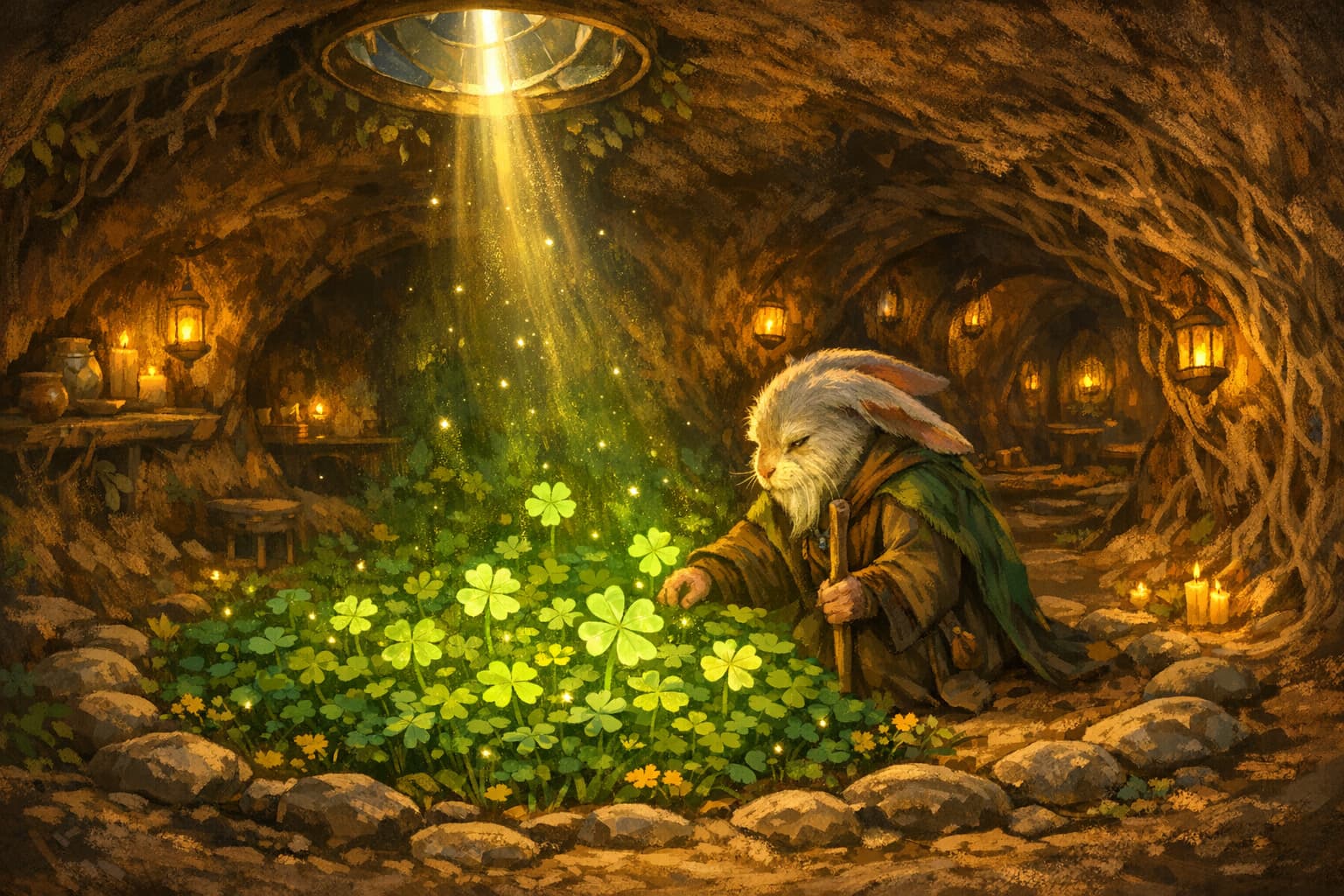
The Clover Shrines
Every harengon warren maintains at least one clover shrine — a small, carefully tended patch of clover grown in an underground chamber using fey-light or directed sunlight via mirror tunnels. The shrine isn't prayed at. It's consulted. Harengon visit the clover patch to sit quietly, assess their luck, and make decisions about major life events. The number of four-leaf clovers present at any given time is read as an indicator of the warren's collective fortune. A patch full of four-leaf clovers means the community is in a period of high luck and should take risks. A patch with none means it's time to hunker down and wait. Agronomists would point out that four-leaf clovers are a genetic mutation and their frequency has nothing to do with fortune. Harengon would point out that agronomists have terrible luck.
Leap Magic & Lucky Charms
Harengon magic — when it manifests — tends toward the kinetic and the probabilistic. Harengon sorcerers are disproportionately Wild Magic users, which makes sense for a species that perceives luck as a tangible force: Wild Magic surges aren't random failures to a harengon, they're the luck-force expressing itself in unexpected ways. Harengon wizards, rarer but not unheard of, gravitate toward divination and abjuration — schools that align with the species' instinct to perceive danger and avoid it.
The most distinctive harengon magical tradition is leap magic, a Feywild-derived practice that channels arcane energy through movement rather than words or gestures. A leap mage doesn't cast fireball by speaking an incantation. They cast it by jumping — the height, angle, and timing of the leap shapes the spell. This looks absurd to human wizards trained in Vancian traditions and produces devastatingly effective results in the hands of a practitioner who has been jumping since before they could walk. Leap magic isn't codified in any official D&D sourcebook, but it's the kind of cultural flavor that a DM can use to make harengon spellcasters feel fundamentally different from human ones.
Lucky charms are ubiquitous in harengon culture, and the term is used without irony. Harengon carry, wear, and sometimes eat objects believed to concentrate or redirect luck. A polished river stone from a stream that never dried up. A feather from a bird that escaped a hawk. A dried four-leaf clover pressed into a leather bracelet. The objects themselves vary, but the practice is universal: every harengon has at least one charm, and losing it is considered a genuine crisis — not because of superstition, but because the loss itself is read as evidence that luck is flowing away from you.
Harengon clerics and druids — though the terms don't quite fit — operate as charm-crafters and luck-readers rather than traditional priests. They maintain the clover shrines, craft charms for community members, and interpret patterns of fortune and misfortune within the warren. Their magic is real in the D&D sense, drawing power from fey patrons, nature spirits, or the raw luck-force that harengon culture insists is objective. Whether it actually is objective or whether harengon magic simply works because they believe it does is a question the game wisely declines to answer.
Common Harengon Lucky Charms
| Charm | Material | Associated Fortune |
|---|---|---|
| Leapstone | River-polished quartz from an unfailing stream | Safe travel and sure footing |
| Hawk-feather twist | Feather from a bird that escaped a predator | Evasion and narrow escapes |
| Pressed clover | Four-leaf clover in leather or resin | General good fortune and wise decisions |
| Moonthread | Spider silk gathered during a full moon | Clarity of thought and dream protection |
| Burrow-root | Root from a tree that shelters a warren entrance | Homecoming and family connection |
| Jinxbone | Bone from an animal that died of old age | Long life and resistance to disease |
Charm-crafting is a respected harengon profession. A good charm-crafter can read what kind of luck a person needs and shape a charm to draw it.
Harengon Among Other Peoples
Harengon get along with most species and are trusted by almost none of them. This isn't because harengon are dishonest — they're actually scrupulously fair in their dealings, a trait inherited from Feywild commerce where broken bargains have tangible consequences. The trust deficit comes from the fact that harengon are visibly, constantly processing information that other species can't perceive, and people don't trust what they can't follow. A harengon who suddenly leaves a conversation to walk to the other side of the room isn't being rude. They heard something. But the other person just sees someone who walked away mid-sentence.
Halflings are the natural allies. Both species are small, community-oriented, and philosophically committed to the proposition that comfort matters more than glory. Halfling villages with harengon neighborhoods are common in settings where both species are present, and the cultural exchange produces interesting hybrids: halfling luck traditions absorbing harengon charm-craft, harengon cuisine adopting halfling cooking techniques, and a shared love of second breakfast that transcends species boundaries. The main friction point is architecture — halflings build horizontally while harengon build vertically, so mixed neighborhoods tend to sprawl in all three dimensions.
Gnomes appreciate harengon curiosity and energy. The two species share an enthusiasm for the world that manifests differently — gnomes want to understand things, harengon want to experience things — but the common wavelength is real. Gnomish tinkers and harengon charm-crafters often collaborate, producing items that blur the line between technology and magic in ways that make wizards uncomfortable.
Humans find harengon charming but exhausting. The constant motion, the sudden stillness, the ears tracking sounds that humans can't hear — it's unsettling in a way that humans process as either endearing or creepy depending on their temperament. Urban harengon learn to moderate their behavior around humans, damping down the ear-swivels and controlling the nose-twitches, which is essentially masking and carries the psychological costs that masking always carries.
“Living with harengon is like living with someone who can see a color you can't. They're reacting to real information. You just can't verify it. At some point you either trust them or you don't.”
— Halfling innkeeper in a mixed community
Folk Heroes & Trickster Tales
Harengon oral tradition centers on trickster stories, which is unsurprising for a species descended from the same mythological lineage as Br'er Rabbit. But harengon trickster tales have a distinctive flavor that separates them from the broader tradition. In most trickster stories, the trickster wins through cleverness alone. In harengon stories, the trickster wins through a combination of cleverness and knowing when to run. The moral is never "be smarter than your enemy." The moral is "be smart enough to know when being smart isn't enough."
The most popular harengon folk hero is Quickfoot Bramble, a figure who appears in stories across every harengon community on the Material Plane despite no evidence of a real historical individual. Quickfoot's stories follow a pattern: she encounters a powerful being (a dragon, an archfey, a king), is placed in an impossible situation, and escapes not by defeating the threat but by redefining the problem. In one story, she escapes a dragon's lair not by fighting or sneaking but by convincing the dragon that she was never actually inside the lair — that the dragon was dreaming her. The dragon, unable to disprove this, falls asleep to check, and Quickfoot leaves with the treasure.
These stories serve a pedagogical function. Young harengon learn from Quickfoot tales that survival is more important than victory, that reframing a problem is better than solving it on its terms, and that the best escape route is one your pursuer doesn't realize exists. The tales also teach a more subtle lesson: that power is often less stable than it looks. Dragons dream. Kings doubt. Archfey get bored. The structures that seem immovable are held in place by attention, and attention is the most unreliable force in the universe.
The storytelling tradition itself is competitive. At Rustledown festivals, harengon compete to tell the best new Quickfoot story. The rules are simple: the story must feature Quickfoot, must involve escape rather than confrontation, and must be original. Recycling old plots is considered worse than telling a bad story, because a bad story at least represents an attempt at creation. The best new Quickfoot tale earns the teller a season of prestige and the obligation to teach their technique to anyone who asks.
Quickfoot Bramble stories make excellent in-game content. Have a harengon NPC tell one before a major encounter to foreshadow a non-combat solution. Or have a harengon PC's backstory include a favorite Quickfoot tale that reflects their approach to problem-solving. The story-within-a-story structure lets you deliver worldbuilding through character voice rather than exposition.
Wild Beyond the Witchlight & Mechanics
The Wild Beyond the Witchlight (2021) did something unusual for a D&D adventure: it introduced new species options and designed an entire module that could be completed without combat. Harengon debuted in this context, which shapes how the species reads. They're not the product of a Monster Manual entry adapted for player use. They were born in a story about wonder, loss, and the Feywild's capacity for both beauty and cruelty. This origin gives harengon a narrative DNA that's different from species introduced as monsters first and people second.
Mechanically, harengon are defined by three features that create a cohesive play identity. Hare-Trigger adds your proficiency bonus to initiative, making harengon consistently among the first to act in combat. Lucky Footwork lets you add a d4 to a failed Dexterity saving throw, converting near-misses into dodges. Rabbit Hop lets you jump as a bonus action without provoking opportunity attacks, with a distance equal to five times your proficiency bonus. Together, these features produce a character who acts first, dodges what they can't avoid, and repositions freely — exactly the survival toolkit you'd expect from a prey species that refused to be prey.
The features interact with class selection in interesting ways. A harengon rogue gets Hare-Trigger stacked on top of already-high Dexterity for initiative, plus Rabbit Hop as an alternative to Cunning Action Disengage — freeing up the bonus action for other uses. A harengon ranger benefits from the repositioning that Rabbit Hop provides in the middle of combat, leaping to better terrain without spending their action. A harengon monk becomes genuinely terrifying: already fast, already hard to pin down, now also jumping fifteen feet as a bonus action and acting before almost everyone else.
The 2024 Player's Handbook adjusted these features slightly but maintained the core identity. The species remains one of the most mechanically distinctive options in the game, not because the numbers are high but because the features encourage a specific playstyle. Harengon players move differently than other characters. They think about positioning, about escape routes, about when to engage and when to hop away. The mechanics don't just give you abilities. They teach you to play like a harengon.
The Wild Beyond the Witchlight
Harengon debut as a playable species alongside the fairy. First D&D species introduced in an adventure module rather than a rules supplement. Three signature features: Hare-Trigger, Lucky Footwork, Rabbit Hop.
Monsters of the Multiverse
Harengon reprinted with updated formatting to match the revised species template. No significant mechanical changes, but the inclusion signals harengon as a permanent part of the species roster rather than an adventure-specific option.
2024 Player's Handbook
Harengon features refined under the new rules framework. Lucky Footwork and Rabbit Hop adjusted for balance within the updated proficiency bonus scaling. The species is now fully integrated into core D&D.
Rabbit-Folk in Fantasy Media
Harengon don't exist in a vacuum. They arrive in a fantasy landscape already populated by rabbit-folk, from Watership Down's complex warren politics to Redwall's hare warriors to the Viera of Final Fantasy — elegant, isolationist rabbit-people who predate harengon by over a decade. Understanding where harengon sit in this tradition helps define what makes them distinctive and what they borrow, consciously or not.
Richard Adams' Watership Down (1972) is the foundational text for taking rabbit society seriously. Adams built a complete rabbit culture with its own language (Lapine), mythology (El-ahrairah the trickster prince), and social structure (the Owsla warrior caste). The parallels to harengon worldbuilding are unmistakable: the lope structure echoes the warren, the Quickfoot Bramble tales echo El-ahrairah, and the harengon instinct for democratic governance echoes Watership Down's critique of authoritarian warrens like Efrafa. Whether the D&D designers were conscious of the debt is irrelevant. The mythological current flows through Adams' work into every subsequent rabbit-folk creation.
The Viera from Final Fantasy (first appearing in Final Fantasy Tactics Advance, 2003) take a different approach: rabbit-folk as ethereal, long-lived forest guardians with strict isolationist policies. Viera are elegant where harengon are scrappy, ancient where harengon are new, and culturally rigid where harengon are adaptive. The contrast is useful because it highlights what makes harengon distinctive in the rabbit-folk space: they're not noble forest isolationists. They're Feywild refugees building new lives in a world that doesn't quite know what to do with them.
In tabletop gaming specifically, Palladium's TMNT and Other Strangeness (1985) let players play anthropomorphic rabbits decades before harengon existed, and various OSR games have included lagomorph species as player options. The broader "furry" community has been creating rabbit-folk characters in fiction and art for even longer. Harengon enter a well-established tradition, but they bring something the tradition often lacks: a mechanical identity that reinforces the narrative one. Being a harengon feels different in play, not just in description. The hop, the luck, the initiative bonus — these aren't cosmetic. They change how you interact with the game, which is what separates a well-designed species from a reskinned human.
Literary Rabbit-Folk
Watership Down gives us warren politics, mythological depth, and the rabbit as a political animal. Redwall's hares are military aristocrats — boisterous, brave, and always hungry. Beatrix Potter's Peter Rabbit is the proto-trickster, raiding Mr. McGregor's garden with cheerful disregard for consequences. The Velveteen Rabbit explores what it means to become real, which resonates uncomfortably with a Feywild species adjusting to the Material Plane.
Each of these traditions contributes something to how players imagine harengon characters. The warren-builder, the warrior, the trickster, the displaced — these are all valid harengon archetypes because the literary tradition supports all of them.
Gaming Rabbit-Folk
The Viera established rabbit-folk as a viable fantasy species in video games. Overgrowth (2017) explored rabbit-folk as martial artists in a brutal world. Armello (2015) featured a rabbit clan defined by speed and cunning. In tabletop, Humblewood's mapach and corvum overshadow its rabbit options, but the design space exists.
Harengon benefit from arriving after all of these. They can draw on established rabbit-folk tropes while adding the specifically D&D elements — the Feywild origin, the luck mechanics, the trickster-survivor identity — that make them feel like they belong in a world of dragons and dungeons rather than being imported from a different genre.
FAQ
Common Questions
Ground the character in the survival instincts that define the species. Harengon aren't cute — they're prey animals who evolved to not be prey anymore. Play the hypervigilance: your character scans every room for exits, assesses every stranger for threat, and has opinions about terrain that other party members find obsessive. Lean into the Feywild displacement angle — your character comes from a world where the ground could change under your feet, and the Material Plane's stability is still novel. Use the Lucky Footwork mechanic as a character trait: your harengon doesn't get lucky, they notice dangers a half-second before anyone else does. The humor comes naturally from a character who takes their own survival very seriously in a party full of people who don't understand why the rabbit person won't sit with their back to the door.
Rabbit Hop's real power is that it doesn't provoke opportunity attacks, which means it's a free reposition in the middle of combat. This changes your tactical calculus entirely. Instead of choosing between attacking and moving safely, you attack and then hop to a better position. Stack this with class features: a rogue can Sneak Attack, Rabbit Hop to cover, and still have Cunning Action available. A ranger can hop to high ground for advantage on ranged attacks. A monk can Flurry of Blows and then hop out of melee range. The distance scales with proficiency bonus, which means it gets better as you level — at tier 3 and 4, you're hopping 25-30 feet as a bonus action. Position is everything in 5e combat, and harengon are the species that treats position as a free resource.
Harengon were built after Tasha's Cauldron of Everything removed fixed ability score bonuses from species, which means they're one of the first species designed without the assumption that biology determines capability. Their features — Hare-Trigger, Lucky Footwork, Rabbit Hop — create a play experience without boxing characters into specific classes or builds. There's no +2 Dexterity pushing you toward rogue or ranger. A harengon barbarian works. A harengon wizard works. The species identity comes from how you play, not from what you play. This also means harengon don't carry the alignment baggage that older species do. There's no 'harengon tend toward chaotic' in the rules. The species is a blank slate with specific tools, and what you build on it is entirely your business. It's the design philosophy the 2024 PHB would adopt for all species, tested first on rabbit-folk.