
Humans
Sixty years to leave a mark on a world built for immortals — and somehow, they keep reshaping it anyway
Mythological Foundations of Humanity
Humans are the wallpaper of fantasy. They're so ubiquitous that most settings don't bother explaining where they came from — they're just there, the default population against which every other species is measured. Elves are "like humans but immortal." Dwarves are "like humans but shorter and tougher." Orcs are "like humans but angrier." The baseline assumption is always human, which means humans themselves get almost no mythological attention. This is a design failure disguised as common sense.
In D&D's cosmology, human origins vary wildly by setting and are almost never as compelling as those of other species. Elves were dreamed into being by Corellon Larethian. Dwarves were forged by Moradin. Orcs were granted fury by Gruumsh after he was denied a homeland. Humans? The usual answer is a shrug and something about being created by multiple deities, or evolving naturally, or simply appearing when the world needed something to fill the space between the interesting species. The Forgotten Realms assigns human creation to multiple gods without any single origin myth that carries emotional weight.
This absence is actually revealing. In most real-world mythologies, humans are the point of creation — the audience the gods were performing for, the caretakers of the earth, the species that matters most. In D&D, humans are an afterthought in the divine narrative, which perfectly mirrors how they're treated in most campaign settings: essential to the world's functioning but not particularly special in the telling of it. The irony is that this narrative neglect is itself the most human thing about them. Humans in fantasy do what humans in reality do: they show up, they adapt, they build, and they rarely wait for permission.
The closest thing to a compelling human origin myth in D&D comes from Eberron, where humans migrated from the continent of Sarlona to Khorvaire and built the Five Nations essentially from scratch. No divine mandate, no prophesied homeland — just a species that saw empty territory and decided it was theirs. That's the human creation myth: "We arrived. We stayed. Try to move us."
Human Origin Myths Across D&D Settings
| Setting | Origin | Divine Patron(s) | Narrative Weight |
|---|---|---|---|
| Forgotten Realms | Created by multiple deities, no single origin | No dedicated creator deity | Minimal — humans just exist |
| Greyhawk | Ancient migrations from the western continent | Varied human pantheon | Historical rather than mythological |
| Eberron | Migrated from Sarlona, built Five Nations | Sovereign Host (cultural, not creators) | Strong — human ambition drives the setting |
| Dragonlance | Created by the gods alongside other species | Neutral gods (balance between good/evil) | Moderate — humans are the swing vote |
| Dark Sun | Survivors of ecological catastrophe | None (gods are absent) | High — survival defines humanity here |
Notice how human origin stories get more interesting as settings get darker. Humans need adversity to become narratively compelling — comfort makes them invisible.
Language & Naming Traditions
Common is the most unremarkable language in D&D, which is exactly what makes it the most important. While Elvish has its lyrical reputation, Dwarvish its runic gravitas, and Draconic its arcane authority, Common is the language of trade, diplomacy, and getting things done. It's the language you default to when two species meet and need to communicate without killing each other first. And it's a human invention — or at least a human imposition.
The dominance of Common as a lingua franca tells you everything about human cultural strategy. Humans didn't create the most beautiful language or the most magically resonant one. They created the most useful one — flexible, easy to learn, borrowing vocabulary from every language it encountered. Common is a pidgin that became a standard, which is the most human linguistic achievement imaginable. Elves kept their language pure for millennia. Humans built a language that absorbed everyone else's words and became indispensable.
Human naming conventions in D&D are deliberately vague, which frustrates players looking for guidance and perfectly captures the species' diversity. There's no single human naming tradition because there's no single human culture. The Forgotten Realms alone has Chondathan names, Calishite names, Illuskan names, Mulan names, Rashemi names, and Turami names — each drawn from different real-world linguistic traditions. This variety is the point. Where an elf name tells you which court they're from and a dwarf name tells you which clan they belong to, a human name tells you which of a hundred possible cultures shaped their family. The information density is lower, but the range is wider.
This naming diversity creates a practical worldbuilding problem. When everything is a valid human name, nothing feels distinctly human. DMs who want human cultures to feel as textured as elven or dwarven ones need to establish naming conventions for specific human nations and stick to them. The Calishite merchant should sound different from the Illuskan barbarian, not because one is more "human" than the other, but because human cultures are supposed to be as varied as every other species' cultures combined.
“Common isn't a language anyone loves. It's a language everyone needs. That distinction is the entire human brand in a single linguistic observation.”
— On the dominance of Common
Humans Across D&D Editions
Humans have been in every edition of D&D because they are D&D's structural load-bearing wall. Remove elves and you lose some flavor. Remove dwarves and you lose some charm. Remove humans and the entire framework collapses, because every other species is defined relative to the human baseline. The game has never known what to do with this importance — humans are mechanically essential and narratively boring in almost every edition, which is a problem that took fifty years to partially solve.
The mechanical history of humans reveals an ongoing identity crisis. What do you give the species that has no distinguishing biological features? Early editions answered: nothing special, but no penalties either. Middle editions answered: bonus feats, because versatility is the human thing. Fifth edition answered: a bonus to every ability score, which is either the most elegant or the laziest solution depending on your perspective. The 2024 revision kept the flexible ability scores and added Heroic Inspiration, finally giving humans a mechanical identity beyond "good at everything, great at nothing."
What's striking about the edition-by-edition history is how late D&D arrived at treating human versatility as a positive trait rather than the absence of negative ones. For the first twenty-five years of the game, humans were defined by what they didn't have — level limits, class restrictions, racial penalties. The implicit message was: humans are boring, but at least they're not handicapped. It took third edition's bonus feat to reframe the conversation from "humans lack limitations" to "humans gain flexibility." That single design decision changed how an entire generation of players thought about the species.
Original D&D
Humans are the only species that can play every class with no level limits. In a game where elves cap at level 8 Fighter, this is enormous — humans dominate high-level play by default. The mechanic says: humans lack talent but have no ceiling.
AD&D 1st Edition
Humans remain the "unrestricted" species while every demihuman has class and level limits. The design intent is that humans should be the most common player choice. It works, but for coercive reasons rather than compelling ones.
AD&D 2nd Edition
Same framework — humans have no limits, demihumans are restricted. Dual-classing (a human-only option) becomes the mechanical justification for choosing human over the more flavorful alternatives.
D&D 3rd Edition
Level limits are gone. Humans get a bonus feat at 1st level and extra skill points. For the first time, humans have a positive mechanical identity rather than just the absence of restrictions. The bonus feat becomes iconic.
D&D 4th Edition
Humans get +2 to one ability score (player's choice), a bonus at-will power, and a bonus feat. The flexible ability score becomes the template for all future human design. 4e humans feel genuinely versatile rather than generically adequate.
D&D 5th Edition
Base human: +1 to all six ability scores. Variant human: +1 to two scores, a skill, and a feat. The variant immediately dominates optimization discussions. Humans are finally the most popular player choice for reasons that have nothing to do with restrictions on everyone else.
2024 Player's Handbook
Humans keep flexible ability scores, gain Heroic Inspiration at the start of each day, Resourceful (Inspiration on nat 20), and Skillful (one Origin feat). The "lucky generalist" identity crystallizes into a coherent mechanical vision.
Kingdoms & Major Settlements
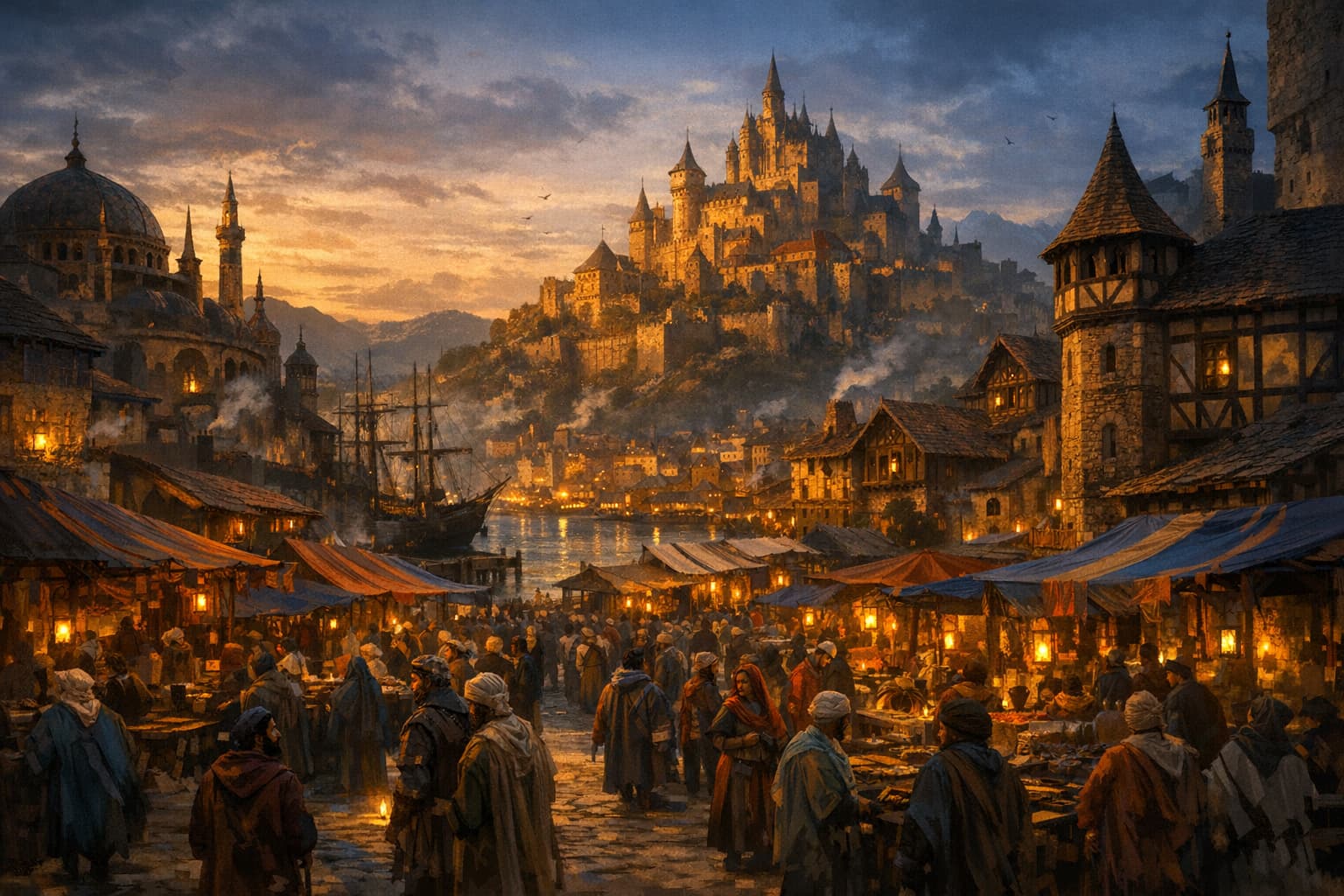
Human kingdoms are the default power structure of nearly every D&D setting, which is simultaneously the species' greatest achievement and the reason they're narratively invisible. When every major city, every trade route, and every political alliance is human-dominated, human civilization stops being a feature of the setting and becomes the setting's wallpaper. Waterdeep, Baldur's Gate, Sharn, Palanthas — these are human cities so thoroughly established that players rarely think about what it means that humans built them.
The Forgotten Realms is the most extreme example. The Sword Coast is essentially a human civilization with pockets of other species. Waterdeep is run by human lords. Baldur's Gate is run by human dukes. Neverwinter is run by a human Lord Protector. The few non-human power centers — Mithral Hall for dwarves, Evermeet for elves — are explicitly framed as exceptions to the human norm. This creates a weird paradox where humans are supposedly one species among many but functionally the landlords of the entire setting.
Eberron handles this better by making human dominance a plot point rather than an assumption. The Five Nations are human kingdoms that spent a century destroying each other in the Last War, which makes human civilization feel like something with consequences rather than something that simply exists. The Mournland — an entire nation transformed into a magical wasteland — is a monument to what human ambition costs when it goes wrong. In Eberron, human kingdoms are powerful, fragile, and interesting. In the Realms, they're just there.
The lesson for DMs building homebrew settings is straightforward: human kingdoms need friction to be interesting. A human city that thrives without tension is scenery. A human city that thrives despite internal corruption, external pressure, ancient debts to non-human powers, and a succession crisis brewing in the royal court is a campaign setting. The best human settlements in published D&D material — Baldur's Gate with its criminal underbelly, Sharn with its vertical class stratification, Tyr with its post-revolutionary chaos — all share one trait: they're cities where the success is visibly temporary and the failure modes are compelling.
Major Human Power Centers Across D&D Settings
| Kingdom/City | Setting | Government | Defining Trait |
|---|---|---|---|
| Waterdeep | Forgotten Realms | Masked Lords (oligarchy) | Wealth and secrecy — the city runs on both |
| Baldur's Gate | Forgotten Realms | Council of Four / Parliament of Peers | Commerce, corruption, and pragmatic amorality |
| Sharn, City of Towers | Eberron | Lord Mayor + Council | Vertical urbanism, manifest zones enabling impossible architecture |
| Solamnia | Dragonlance | Knightly orders + feudal lords | Honor culture colliding with political reality |
| Tyr (City-State) | Dark Sun | Recently overthrown sorcerer-king | Post-tyranny reconstruction — humans rebuilding after humans destroyed |
| The Free City of Greyhawk | Greyhawk | Oligarchy of merchants and nobles | Political intrigue as the primary form of conflict |
Human cities span every governmental form because humans can never agree on how to organize themselves. This is a feature, not a bug.
Adaptable Physiology
Humans are, by any objective biological measure, the least impressive species in D&D. No darkvision. No natural armor. No innate magic. No resistance to anything. No claws, fangs, wings, tails, or breath weapons. An elf can see in the dark, resist charm effects, and skip sleep. A dwarf shrugs off poison and sees through stone-darkness. A human gets... a slightly better chance at learning a new skill. On paper, the species is a blank sheet surrounded by elaborately decorated competitors.
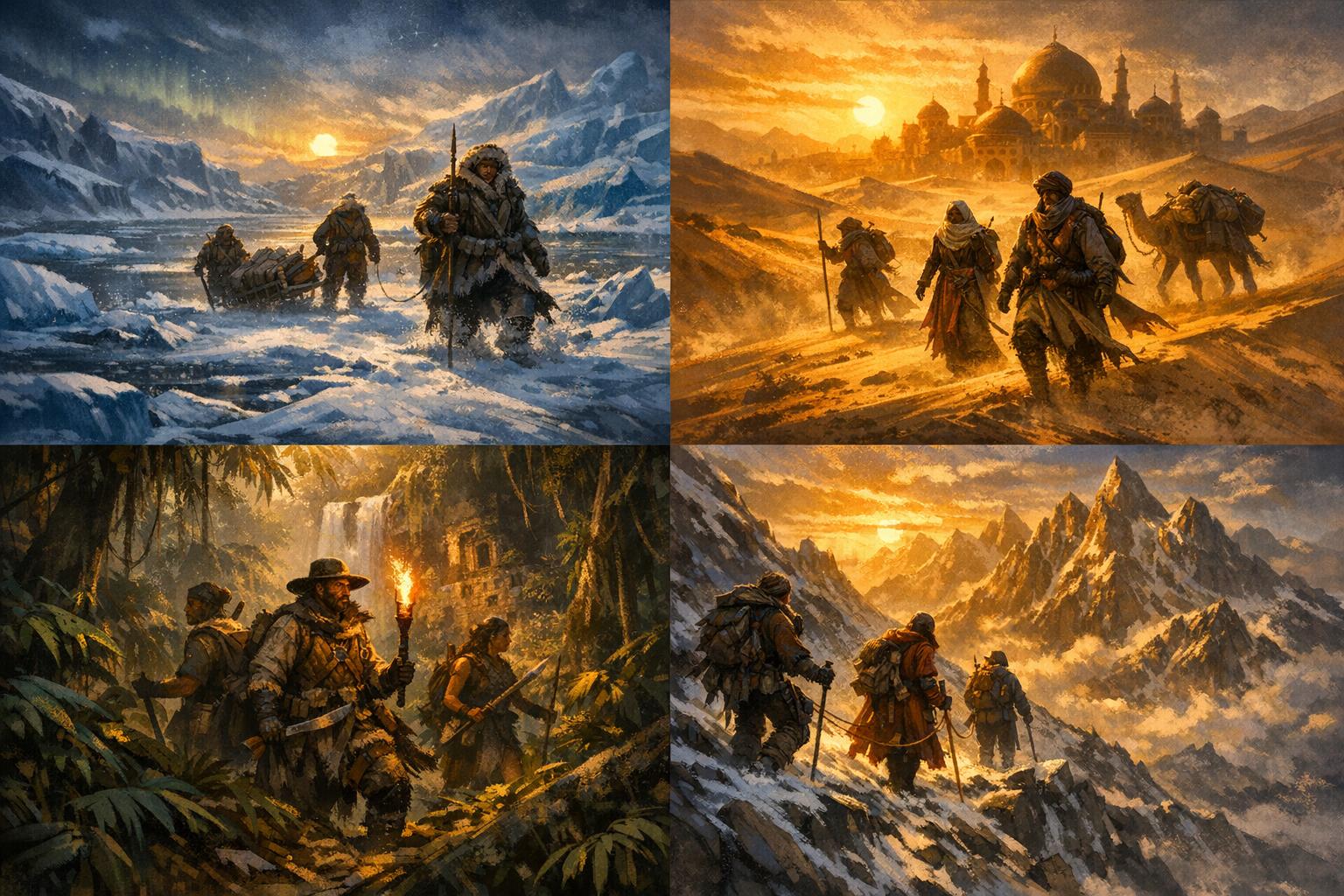
And yet humans dominate every setting. This is the species' central paradox: the least biologically specialized people in the world consistently outcompete the specialized ones. The answer isn't that humans are secretly superior — it's that specialization is a trap. An elf optimized for forests struggles in deserts. A dwarf optimized for underground life has disadvantages on the surface. Humans aren't optimized for anything, which means they're adequate everywhere. In a world of specialists, the generalist who can function in any environment and learn any skill has a structural advantage that no single biological gift can match.
The real human adaptation is speed — not movement speed, but generational speed. Humans reproduce faster, mature faster, and iterate on ideas faster than any of the long-lived species. An elven master smith might spend two hundred years perfecting a technique. A human smith's apprentice copies that technique in five years, teaches three students who each improve on it, and within a generation the human version is better than the original. Humans don't innovate because they're smarter. They innovate because they can't afford to wait.
This biological urgency — the pressure of a sixty-to-eighty-year lifespan in a world where your neighbors live for centuries — is the single most important thing about humans in D&D. Every human character carries an invisible clock that elves and dwarves don't. When a human adventurer takes a dangerous quest, the stakes are proportionally higher because there's no time to recover from a wasted decade. Humans are ambitious because mortality demands it.
Consider the implications for inter-species competition in concrete terms. An elven bladesinger trains for fifty years before seeing combat. A human fighter trains for five years and compensates with battlefield innovation, tactical doctrine, and sheer numbers. The individual elf is better. The human military system produces ten competent replacements in the time it takes to train one elf. This ratio — individual inferiority offset by systemic advantage — explains human dominance more completely than any other factor. Humans win not by being better but by being faster, more numerous, and more willing to accept losses that would devastate a slower-breeding species.
The Generalist Edge
Where other species have one or two exceptional capabilities, humans have no floor. They can learn any class, adapt to any climate, and integrate into any culture. This absence of biological constraints is itself a biological trait — the most powerful one in a world that keeps throwing new problems at you. The elf archer who's been training for a century is better than any human archer alive. But the human archer who retrained as a wizard when magic became more relevant adapted faster than the elf ever will.

Reproductive Speed & Cultural Momentum
A human generation is twenty to twenty-five years. An elven generation is over a hundred. This means human cultures evolve four to five times faster than elven ones. Languages shift. Fashions change. Technologies advance. Political systems rise and fall. An elf who leaves human lands for a century returns to find an entirely different civilization in the same location. This cultural velocity is disorienting for long-lived species and it's the primary reason humans dominate despite lacking any single superior trait.
The Human Mindset
The defining psychological trait of humans in D&D isn't intelligence, courage, or ambition — it's impatience. Not the petulant kind. The existential kind. When you have sixty years and the elf next to you has seven hundred, every decision carries different weight. The elf can afford to deliberate for a decade. The human needs an answer by Thursday. This urgency shapes everything about how humans think, plan, build, and destroy.
Human psychology in D&D is canonically described as "versatile" and "adaptable," which are polite words for "unstable." Humans change their minds. They abandon traditions that stop working. They adopt foreign customs that seem useful. They betray allies when incentives shift and form alliances with former enemies when circumstances demand it. Every other species in D&D has a cultural core that resists change — elven grace, dwarven stubbornness, halfling cheer, orcish endurance. Humans have no cultural core. They have cultural velocity.
This makes humans the most dangerous species in D&D from a geopolitical perspective. You can predict what an elven nation will do because elven values are stable over millennia. You can predict dwarven behavior because dwarven honor codes don't bend. You cannot predict what a human kingdom will do in fifty years because it might not exist in fifty years, and if it does exist, it might have completely different values, alliances, and ambitions than it does today. Human unpredictability isn't a bug — it's the feature that keeps every other species on edge.
At the individual level, this translates into the widest moral spectrum of any D&D species. Humans produce saints and tyrants in roughly equal measure. The same generation that builds a hospital burns a library. The same kingdom that signs a peace treaty funds a secret invasion. Other species tend toward moral consistency — not because they're better, but because their cultures have had more time to enforce behavioral norms. Humans haven't finished deciding what they believe yet, and they probably never will.
“An elf plans in centuries. A dwarf plans in generations. A human plans in decades, executes in years, and pivots in months. The other species call this reckless. The humans call it Tuesday.”
— On human temporal psychology
Governance & Political Systems
Humans have tried every form of government that exists and several that shouldn't. Monarchies, republics, theocracies, magocracies, merchant oligarchies, military dictatorships, elected councils, hereditary councils, and at least one setting where a city is governed by whoever can hold a particular magic sword longest. This governmental diversity is unique among D&D species — elves default to monarchy or council of elders, dwarves default to clan-based hereditary rule, and most other species have a single traditional structure. Humans can't even agree on how to agree.
The political instability of human kingdoms is a direct consequence of short lifespans. A dwarven king might rule for two centuries, providing continuity that makes long-term planning possible. A human king rules for decades at most, and succession crises are the rule rather than the exception. The Wars of the Roses, transposed into D&D settings a hundred times over, are the default state of human politics. Every stable human kingdom is a temporary achievement maintained by institutional momentum, and every collapse is a reminder that human systems require constant maintenance.
This volatility makes human kingdoms the most common source of campaign-driving political conflict. A stable elven court doesn't generate adventures — it generates stasis. A dwarven succession follows predictable clan rules. But a human kingdom where the king just died, the three heirs hate each other, the treasury is empty from the last war, and a neighboring power smells weakness? That's a campaign. Human political fragility is a narrative feature that DMs rely on constantly, even when they don't think of it in species terms. Every succession crisis, every civil war, every corrupt noble plot in D&D is leveraging the structural instability that short human lifespans create.
Short-Lived Strengths
Rapid leadership turnover means failed policies get abandoned quickly. A bad king dies or gets deposed within decades, not centuries. New rulers bring new ideas, new alliances, and new approaches to old problems. Human kingdoms evolve faster than any other political structure in D&D because they're constantly cycling through leadership.
Democratic and meritocratic experiments emerge naturally from human societies because no single ruler lasts long enough to make hereditary rule feel inevitable. When grandpa's king dies and your king is a completely different person with different priorities, the idea that leadership should be earned rather than inherited becomes easy to articulate.
Short-Lived Vulnerabilities
Institutional memory is fragile. Treaties signed by one generation are forgotten or repudiated by the next. Long-term infrastructure projects struggle to maintain funding across multiple administrations. The dwarven bridge that's lasted a thousand years was built by a clan that committed to maintaining it for a thousand years. The human bridge collapses in a century because nobody remembered whose job it was to inspect it.
External powers exploit succession crises routinely. A dragon who's been manipulating a human kingdom for three centuries has seen a dozen kings come and go and has leverage on all of their descendants. The kingdom thinks it's independent. The dragon knows better. Human political fragility is a resource that patient, long-lived adversaries harvest systematically.
Religion & The Pantheon Problem
Every other species in D&D has a relatively tidy religious situation. Elves worship the Seldarine. Dwarves worship the Morndinsamman. Orcs follow Gruumsh and his circle. Halflings have Yondalla and her family. These pantheons are small, coherent, and deeply tied to species identity. Then there are humans, who worship everything. Every god, every philosophy, every cult, every weird local spirit that lives in a particular river. The human approach to religion is the same as the human approach to everything else: try all of it, keep what works, fight wars over the disagreements.
The Forgotten Realms human pantheon is enormous — dozens of deities covering every conceivable domain, many of them borrowed or adapted from other species' religions. Humans worship Mystra, a human goddess of magic, but also Corellon if they like the elven approach to arcana. They worship Tempus for war, Tyr for justice, Shar for darkness, Selune for the moon, and Cyric for being terrible. The sheer number of human deities reflects the species' inability to reach consensus on anything, including the fundamental nature of the divine.
This religious diversity is strategically valuable. A species with one god can be targeted through that god — kill the priesthood and you've severed the divine connection. A species with fifty gods is religiously unkillable. Destroy one temple and another faith rises. Discredit one priesthood and three alternatives are already competing for the vacancy. Human religious resilience comes not from the strength of any single faith but from the redundancy of having so many.
The darker side of human religious diversity is sectarian violence. Species with unified pantheons don't have religious wars — there's nothing to fight about. Humans have religious wars constantly, because when you have dozens of competing truth claims, some of them are going to collide. The Time of Troubles in the Forgotten Realms, where gods walked the earth in mortal form, hit humans hardest not because human gods were more vulnerable but because humans had more gods to disrupt and more sectarian fault lines to exploit.
Human clerics and paladins reflect this religious sprawl mechanically. A dwarven cleric almost certainly serves Moradin or one of the Morndinsamman. An elven cleric draws from the Seldarine. A human cleric could serve literally any deity in the setting, from the most benevolent to the most malevolent, and the choice carries no species-based stigma. Humans worship war gods and peace gods, death gods and life gods, gods of law and gods of chaos, frequently within the same city. This theological promiscuity means human religious institutions are simultaneously the most creative and the most volatile in any D&D setting — capable of producing both the selfless hospitalier order and the doomsday cult in the same generation.
Consider a human kingdom where religious tolerance is maintained not by philosophical commitment to pluralism but by practical exhaustion. After centuries of sectarian wars, the kingdom's constitution simply says: "All gods are legal. No god is official. Anyone who starts a religious war gets executed by a joint tribunal of all faiths." The peace holds because everyone remembers how bad the wars were. But memories fade, and the last survivor who actually fought in the wars just died of old age...
Human Magical Traditions
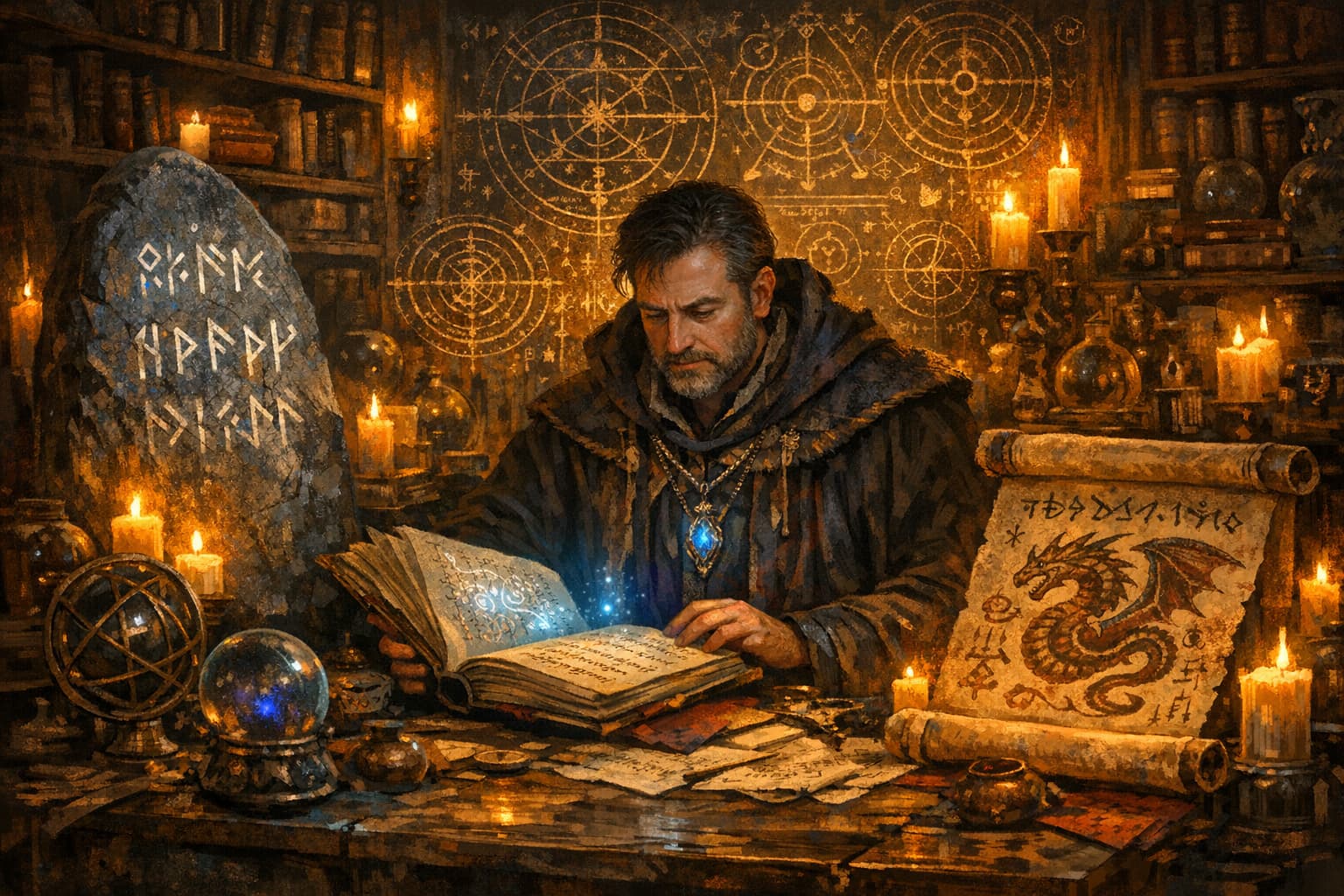
Elves have an innate connection to the Weave. Dwarves encode magic into runes carved over centuries. Gnomes blend magic with invention. Humans have none of these advantages and all of these techniques. Human magical traditions are defined by borrowing, systematizing, and institutionalizing — taking magical practices developed by longer-lived species and making them teachable, reproducible, and scalable. The wizard's spellbook is a human invention in most settings, and it perfectly captures the human approach: you can't feel the magic instinctively, so you write it down, study it, and teach it in schools.
The great magical academies of D&D settings are overwhelmingly human institutions. The War Wizards of Cormyr. The Red Wizards of Thay. The Arcane Brotherhood of Luskan. The Twelve of Khorvaire. These aren't just schools — they're military-academic-industrial complexes that produce magic at scale. An elven mage might be individually more gifted than any human wizard. But fifty competently trained human war wizards, organized into batteries and following standardized doctrine, will win the battle every time. Humans don't do magic better. They do it more efficiently and in greater numbers.
Human magical traditions also produce more dark magic than any other species, for the same reason humans produce more of everything: volume and impatience. When you have sixty years and the spell you need takes a century to develop safely, cutting corners becomes tempting. Lichdom, pacts with fiends, blood magic, soul harvesting — the necromantic and forbidden traditions of D&D are disproportionately human because humans are disproportionately desperate. An elf who wants immortality can simply wait for reincarnation. A human who wants immortality has to cheat death, and cheating death usually involves terrible costs.
The warlock class is, in many ways, the most human class in D&D — not because other species can't take pacts, but because the warlock's fundamental bargain (power now in exchange for consequences later) is the most human transaction imaginable. A being with seven hundred years ahead of them can afford to study for decades. A being with forty years left makes deals. The warlock patron relationship mirrors every Faustian bargain in human literature because humans invented the Faustian bargain. When your time is limited, trading future freedom for present power isn't foolish — it's arithmetic.
Institutional Wizardry
The defining human contribution to arcane magic isn't any single spell or technique — it's the concept of the magical academy. Schools like the Blackstaff Tower in Waterdeep or Arcanix in Aundair take a practice that other species treat as an individual calling and systematize it into a curriculum. Students learn standardized spell notation, shared theoretical frameworks, and institutional best practices. The result is magical literacy as a mass phenomenon rather than an elite pursuit. An elven high mage is a wonder. A hundred competent human evokers are an army.
The Dark Side of Haste
Human impatience in magical research has produced more forbidden knowledge than any other single factor. The Red Wizards of Thay didn't become the most feared magical organization on Faerun by being careful — they became it by being willing to experiment with things other cultures had the good sense to leave alone. Lichdom, the ultimate expression of human mortality-anxiety applied to magic, was pioneered by human wizards who decided that death was a problem to be engineered around rather than accepted. The results are spectacular and horrifying in roughly equal measure.
Diplomacy & Inter-species Relations
Humans are D&D's universal neighbor. They share borders with everyone, trade with everyone, fight with everyone, and intermarry with enough other species to have produced half-elves, half-orcs, and various other hybrid populations that polite society doesn't always discuss. No other species has this range of inter-species contact, which makes humans the connective tissue of most D&D settings — the species through which all other species interact.
This diplomatic ubiquity isn't purely positive. Humans are also D&D's most prolific colonizers. In the Forgotten Realms, the expansion of human kingdoms has pushed elves into increasingly small enclaves, driven halfling communities into marginal land, and turned orc territories into perpetual conflict zones. The human diplomatic posture is often: "We'd like to live in peace with you, also we're building a city where your forest used to be." This expansionism is rarely framed as villainy in the source material, which is itself a commentary on which species gets to be the protagonist.
The inter-species relationships that humans maintain are fascinatingly asymmetric when lifespans are considered. A human diplomat who negotiates a fifty-year peace treaty with an elven nation has committed a significant portion of their species' active political memory. The elves, for whom fifty years is a brief experiment, may view the same treaty as a temporary concession. Human-dwarf relations are slightly better because dwarven timescales, while longer than human ones, are at least in the same order of magnitude. Human-elf relations are perpetually strained by the fundamental incompatibility of how each species experiences time.
The most interesting human diplomatic innovation across D&D settings is the multi-species city. Waterdeep, Sharn, Sigil — these are human-founded or human-dominated spaces that function precisely because they make room for everyone. Humans invented cosmopolitanism, not out of tolerance but out of mercantile self-interest. A city that welcomes all species attracts all species' money, skills, and knowledge. Human inclusivity, when it exists, is strategic as often as it's principled.
Half-elves and half-orcs deserve mention here because they're a uniquely human phenomenon. No other D&D species produces viable hybrid offspring with as many other species as humans do. This biological compatibility is treated as a lore footnote, but it's actually one of the most significant facts about humans in D&D. Humans don't just trade with other species, ally with them, and fight alongside them — they merge with them, genetically. The existence of half-elves and half-orcs as recognized populations means that human communities are, over enough generations, absorbing the bloodlines of every species they contact. Whether this constitutes cultural openness or biological imperialism depends on who you ask and which side of the family tree they're standing on.
When running human NPCs in diplomatic scenarios, lean into the lifespan asymmetry. The human ambassador who's spent their entire thirty-year career working toward peace with the elves is genuinely passionate. The elven counterpart who's handled six human ambassadors views this one the way you'd view a particularly enthusiastic intern. Neither is wrong. The tension between these perspectives drives excellent roleplay without anyone needing to be a villain.
Legendary Humans in Fantasy
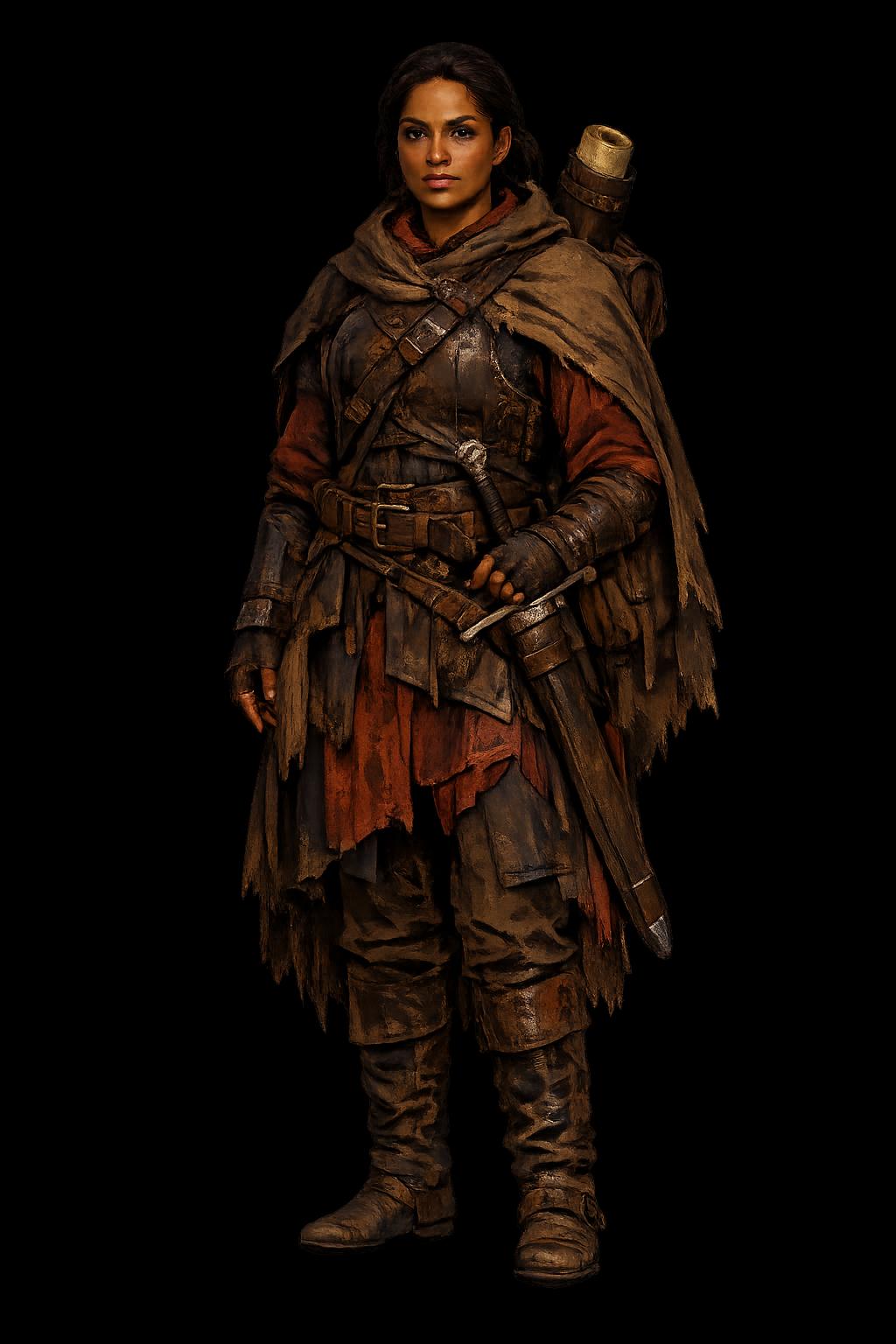
The greatest human characters in D&D aren't great because they're human — they're great because being human forced them to be exceptional. Elminster Aumar has survived for over a thousand years, but only because he's relied on divine patronage, magical augmentation, and sheer ruthless cunning to extend a lifespan that should have ended centuries ago. His longevity is an achievement, not a birthright, and that distinction defines what makes human legends different from elven or dwarven ones.
Human heroes in D&D lore tend to fall into two categories: the ones who transcended human limitations through extraordinary means, and the ones who accomplished extraordinary things within them. The first category includes liches, chosen of gods, and archmages who've essentially stopped being human in any biological sense. The second category — the mortal heroes who did impossible things in a single human lifetime — are more interesting and more rare in the lore, probably because game designers find immortal characters easier to write about than mortal ones.
The underrepresentation of "normal" human heroes in D&D fiction is a design oversight with mechanical consequences. When every legendary figure is either immortal or divinely empowered, it tells players that human characters need to become something other than human to matter at high levels. The best human character stories push back against this — the fighter who defeats the ancient dragon at level 17 not because of magical augmentation but because of tactical brilliance, accumulated experience, and the human refusal to accept that something is impossible just because it's always been done a certain way.
There's also a pattern worth noting in how human villains differ from those of other species. Elven villains tend toward corruption of beauty or arrogance of longevity. Dwarven villains tend toward greed or obsessive grudges. Human villains are terrifying specifically because they could be anything. Strahd is a vampire because he couldn't accept aging. Vecna became a lich because he wanted to know everything. Szass Tam built a necrocracy because he thought the living were inefficient. Human villainy isn't constrained to a single thematic lane — it sprawls across every possible motivation, which is why human antagonists are the most common and the most varied in D&D fiction. The same adaptability that makes human heroes inspiring makes human villains unpredictable.
Legendary Human Figures in D&D Lore
| Figure | Setting | Achievement | What Makes Them Human |
|---|---|---|---|
| Elminster Aumar | Forgotten Realms | Chosen of Mystra, centuries-old archmage | His power comes from patronage and persistence, not birthright |
| Lord Soth | Dragonlance | Death knight — greatest fallen paladin | His fall was driven by human pride, jealousy, and moral cowardice |
| Strahd von Zarovich | Ravenloft | Vampire lord of Barovia | Became a monster specifically because he couldn't accept human mortality |
| Vecna | Greyhawk / Multiverse | Ascended from mortal wizard to god | The ultimate expression of human refusal to accept limitations |
| Jarlaxle Baenyne | Forgotten Realms | Drow, but operates in human style | Not human, but his pragmatism and adaptability are coded human |
| Tasha (Iggwilv) | Greyhawk / Multiverse | Witch queen, planar traveler, author | Human ambition channeled into becoming the multiverse's most dangerous scholar |
Notice how many legendary humans became legendary by refusing to remain human. The species' greatest figures are defined by their attempts to escape its limitations.
Mechanical Identity Across Editions
The mechanical problem with humans has always been the same: how do you make the species that has no special abilities feel special? Every edition has proposed a different answer, and the progression reveals what each era of D&D thought versatility meant. In Original D&D, versatility meant no restrictions. In 3rd edition, it meant a bonus feat. In 5th edition, it meant a bonus to everything. In the 2024 rules, it means Inspiration — luck, resourcefulness, and the tendency to pull something useful out of nowhere at the critical moment.
The Variant Human from 5th edition deserves special attention because it solved the human identity crisis so thoroughly that it warped the game's meta. A feat at level 1 is enormously powerful in a system where feats compete with ability score increases. Polearm Master at level 1. Sentinel at level 1. Lucky at level 1. The Variant Human didn't just make humans competitive — it made them optimal for any build that wanted early access to a specific mechanical strategy. For the first time in D&D history, humans were the powergamer's choice.
The 2024 revision takes a different approach. Rather than front-loading raw mechanical advantage, it gives humans Heroic Inspiration — a renewable resource that represents the human knack for rising to the occasion. You start each day with Inspiration, and you earn more on natural 20s. Mechanically, this translates into a species that gets more second chances than anyone else. Which is, if you think about it, the most human mechanic possible. Humans don't succeed because they're better. They succeed because they keep trying after everyone else has decided the situation is hopeless.
- Bonus feat at 1st level
- 4 extra skill points at 1st level
- 1 extra skill point per level
- Favored Class: Any
The first positive mechanical identity for humans. The bonus feat was transformative — it made humans the species of choice for any build that needed a specific feat early. No bonuses, no penalties, just raw flexibility.
- +1 to all ability scores
- One extra language
- Medium size, 30 ft. speed
Elegant and boring. +1 to everything means humans are slightly good at everything and excellent at nothing. Almost no one plays standard human when the variant exists.
- +1 to two ability scores of choice
- One skill proficiency
- One feat
The most influential human design in D&D history. A feat at level 1 enabled builds that other species couldn't match until level 4. Variant Human dominated optimization for a decade.
- Heroic Inspiration (gain Inspiration at start of each long rest)
- Resourceful (gain Inspiration on natural 20)
- Skillful (gain one Origin feat)
- Versatile (gain one skill proficiency)
The most coherent human design yet. Inspiration as a renewable resource captures the human identity — not stronger, not smarter, but luckier and more persistent. The species that always has one more trick.
Humans Beyond D&D
Humans in fantasy settings outside D&D face the same fundamental challenge: how do you make the species that the audience already is feel interesting to play or read about? Most franchises solve this the same way D&D does — by making humans the political default and defining every other species relative to them. But a few settings have found more creative approaches, and they're worth studying for what they reveal about how to make humans narratively compelling.
Tolkien's approach was to make humans the species that matters most to the future of Middle-earth. Elves are leaving. Dwarves are declining. Hobbits are retreating into irrelevance. The Age of Men is coming, and it's framed as both a triumph and a loss — the world will belong to the least magical, least wise, least beautiful species, and something irreplaceable will vanish when the older peoples depart. This elegiac framing makes humans interesting through tragedy rather than achievement.
The Elder Scrolls takes a different route: humans are divided into multiple species (Nords, Bretons, Imperials, Redguards) with distinct cultures, abilities, and histories. This solves the "humans are generic" problem by not treating them as a single group. A Nord and a Breton are as different as an elf and a dwarf in other settings. Warhammer similarly divides humans by nation and gives each a distinct military culture and aesthetic. The lesson is clear: the way to make humans interesting is to stop treating them as one thing.
The most radical approach to humans in fantasy comes from settings where they're not the dominant species at all. Dark Sun, where humans are one of several species surviving in a post-apocalyptic wasteland, makes human adaptability feel genuinely heroic rather than generically convenient. Planescape, where humans are one minor species among thousands in an infinite multiverse, makes human ambition look simultaneously adorable and terrifying. The best human stories in fantasy are the ones where being human is a challenge to overcome, not a default to ignore.
Video games have generally done a better job than tabletop RPGs at making humans feel like a deliberate species choice rather than a default. Baldur's Gate 3 gives human characters specific dialogue options that reflect human cultural perspectives — shorter time horizons, different attitudes toward risk, a pragmatism that contrasts with companion characters from longer-lived species. Dragon Age uses human nobility as a specific origin story with political consequences rather than a blank slate. Mass Effect makes humanity the ambitious newcomer to galactic civilization, which is essentially the D&D human archetype translated into science fiction. The throughline in every successful human portrayal is the same: make the species' mortality and adaptability into active story elements rather than invisible defaults.
Humans Across Fantasy Franchises
| Franchise | Human Identity | Core Theme | Design Lesson |
|---|---|---|---|
| D&D | Adaptable generalists, political default | Versatility and ambition | Flexibility is a species trait, not the absence of one |
| Tolkien | Inheritors of a diminishing world | Mortality as gift and curse | Framing human mortality as meaningful rather than limiting |
| Warcraft | Alliance founders, politically fractured | Unity through shared threat | Humans work best when they have something bigger to oppose |
| Elder Scrolls | Multiple human species with distinct identities | Cultural diversity within humanity | Split humans into subgroups to avoid genericness |
| Warhammer Fantasy | The Empire — besieged by everything | Survival through faith, steel, and gunpowder | Humans are interesting when they're outmatched |
| Dark Sun | Survivors in a ruined world | Adaptability under extreme pressure | Strip away human dominance and the species becomes compelling |
The pattern is consistent: humans become interesting in direct proportion to how much the setting challenges them. Comfortable humans are boring. Desperate humans are heroes.
FAQ
Common Questions
It's partly audience identification — most players and readers are human, so human characters require the least imaginative leap. But it's also structural. D&D and most fantasy settings use humans as the baseline against which everything else is measured. Elves are "humans plus longevity and grace." Dwarves are "humans plus toughness and tradition." This makes humans the zero point on every axis, which means they're always present but rarely distinctive. The better question is whether this needs to be the case. Settings like Dark Sun and Planescape demonstrate that humans become far more interesting when they're displaced from the default position and forced to compete on equal footing with species that are genuinely different rather than merely "human plus extras."
Lean into specificity. An elf character gets built-in flavor from longevity, trance, and cultural weight. A human character has to generate that flavor from personal history, cultural background, and individual motivation. Pick a specific human culture from your setting — not just "human" but Calishite, Karrnathi, Solamnic. Give them opinions shaped by that culture. Then give them reasons to deviate from those opinions. The most interesting human characters aren't the ones who are generically adaptable — they're the ones who have a specific worldview shaped by a specific background and are being challenged by the specific circumstances of the campaign. Mechanically, the 2024 human's Heroic Inspiration encourages a playstyle where you attempt bold actions knowing you have a safety net. Play into that — your human character should be the one who says "I have an idea" when everyone else is out of options.
Absolutely not, and breaking from this default is one of the easiest ways to make your setting feel distinctive. Human political dominance is a convention, not a requirement. Consider a setting where elves never retreated and their empire still controls the best territory. Or where dwarven industrial output makes them the economic superpower and human kingdoms are dependent trading partners. Or where a recent magical catastrophe devastated human populations and other species are filling the power vacuum. The most interesting political dynamics come from challenging the assumption that humans run everything. That said, if you do keep human dominance, make it cost something. Human kingdoms that rule by default are boring. Human kingdoms that rule because they outmaneuvered, outbred, and occasionally outfought everyone else — and are resented for it — have built-in conflict that drives campaigns.
In the 2024 rules, the honest answer is: all of them, equally. Flexible ability scores and the Heroic Inspiration feature have no class dependency. That said, certain classes benefit more from what humans bring narratively. Fighter and Rogue reward the human theme of skill and persistence over innate power. Wizard fits the human tradition of systematizing magic through study rather than talent. Warlock pairs beautifully with the human mortality theme — a character trading their soul for power they couldn't achieve in a single lifetime. For optimization specifically, any class that benefits from Inspiration rerolls (which is all of them, but especially classes that make critical saving throws) gets value from the 2024 human kit. The real answer, though, is that humans are the species where class choice is most purely a character expression rather than a mechanical optimization. Pick the class that tells the story you want to tell.
Humans dominate through adaptability, ambition, and reproductive speed rather than magical talent or physical superiority. In most settings, humans breed faster than elves, adapt to more environments than dwarves, and pursue more diverse goals than any single non-human species. The mechanical reflection — flexible ability scores and a bonus feat or skill — captures this: humans aren't the best at anything specific, but they can be good enough at anything to compete. The real advantage is narrative. Humans fill every niche because they try every niche, and quantity has a quality all its own.
By leaning into what makes humans distinctive: choice. Every other species has a built-in narrative — dragonborn carry draconic heritage, tieflings bear infernal marks, elves wrestle with immortality. A human character chose to be an adventurer without any cosmic push, ancestral calling, or biological imperative. That choice is the hook. Why does a person with no special destiny, no divine heritage, and no racial enemy pick up a sword and walk into a dungeon? The answer to that question is more interesting than any species trait because it's entirely personal.
The darkvision question is really about whether humans should have meaningful limitations. In a game where most species see in the dark, a human without darkvision has to carry torches, use light spells, and plan around darkness — which creates gameplay friction that some tables find tedious and others find immersive. The 2024 rules kept humans without darkvision, which is a deliberate design choice: humans are supposed to feel baseline, and baseline means working within constraints that other species bypass. If your table finds it frustrating, a torch costs one copper piece.