
Kenku
Cursed crow-folk who lost their wings and their voices, and learned to build both from borrowed pieces
The Curse That Clipped Their Wings
Every kenku knows the story, though none of them can tell it in their own words. Once, the kenku served a powerful master — a being whose identity shifts depending on who's doing the telling. A demon lord, a forgotten god, an archfey of the shadowfell. The specifics matter less than the structure: the kenku were trusted servants who betrayed that trust, and their punishment reshaped the species entirely.
The curse stripped three things. Flight, the ability that defined their existence as avian beings. Creative voice, the capacity to generate original speech and song. And according to some tellings, the spark of true invention — the ability to create something genuinely new rather than reproduce what already exists. Three losses, each devastating alone, together forming a prison that the kenku carry in their biology.
What makes the curse compelling isn't the punishment itself but what the kenku do with it. A species defined by loss could easily become a species defined by despair. Instead, the kenku became improvisers, adapters, scavengers of sound and meaning. They can't create from nothing, so they create from everything. The curse intended to diminish them. In practice, it made them the most resourceful species in the fantasy canon.
The variations in the curse story are themselves revealing. In some tellings, the kenku stole something from the master — a word of power, a secret of creation, a treasure of immense value. In others, they simply planned to leave, and the master cursed them for daring to want freedom. The first version makes the kenku culpable. The second makes them victims. Most kenku hold both versions in mind simultaneously, which produces a species-wide ambivalence about authority, loyalty, and the price of ambition that colors every kenku interaction with power structures.
The Three Losses of the Kenku Curse
| Loss | What Was Taken | How Kenku Adapted |
|---|---|---|
| Flight | The ability to fly despite having wings | Kenku became climbers, leapers, and rooftop runners — mastering the vertical world without leaving it |
| Creative voice | Original speech and song | Mimicry became language; kenku communicate through collected sounds, quotes, and environmental noise |
| True invention | The spark of original creation | Kenku became master copyists, forgers, and adapters — perfecting reproduction as its own art form |
The curse was designed to break them. The kenku turned every restriction into a technique.
Crow-Folk Across Mythology
Corvid mythology runs deep in nearly every culture on earth. Crows and ravens appear as tricksters, messengers, creators, and omens of death — often all at once. The Norse god Odin sent two ravens, Huginn and Muninn (thought and memory), to fly the world and report back. In Japanese Shinto tradition, the yatagarasu is a three-legged crow that guides heroes through dark places. Native American traditions feature Raven as both creator and fool, a being who shapes the world through cleverness and accident in equal measure.
D&D's kenku inherit the trickster-corvid archetype but add something the myths rarely explore: what happens when the trickster loses its greatest tool? Crows in mythology are defined by cleverness and voice — they speak, they mimic, they carry messages between worlds. Kenku have the cleverness but the voice is borrowed, every word a fragment of someone else's speech. It's the trickster stripped of its signature move, forced to find new ones.
The Japanese tengu provides the closest mythological cousin. Originally depicted as bird-headed spirits who haunted mountains and forests, tengu evolved in folklore from malicious tricksters to skilled martial artists and teachers. Kenku follow a similar trajectory in D&D: first introduced as simple bird-monsters, gradually developed into a complex species with culture, psychology, and narrative depth. The tengu comparison isn't accidental — early D&D designers drew explicitly from Japanese folklore when creating the kenku.
If you want to ground your kenku character in real mythology, pick one corvid tradition as a touchstone. A kenku inspired by Odin's ravens might be an information broker, obsessively collecting knowledge. One inspired by the Native American Raven trickster might be a chaotic improviser who stumbles into solutions. One inspired by tengu might be a reluctant warrior with a teacher's instinct. The mythology gives you a template; the curse gives you the twist.
“Every culture that watched crows decided they were up to something. The kenku are what happens when that suspicion turns out to be justified — and then the something gets taken away.”
From Monster Manual to Player Option
Kenku first appeared in the 3rd Edition Monster Manual III (2004) as a minor monster — bird-folk who lurked in cities and served as low-level antagonists for urban campaigns. They were thieves, forgers, and spies, defined more by occupation than culture. The mimicry was present but treated as a combat trick rather than a fundamental aspect of identity. Early kenku were corvid kobolds: simple, disposable, and forgettable.
The transformation came in 5th Edition's Monster Manual (2014) and was cemented when Volo's Guide to Monsters (2016) made kenku a playable species. The curse narrative gave them depth, mimicry became a defining roleplay challenge, and the yearning for flight added an emotional core that the original monster entry completely lacked. Suddenly kenku weren't just bird-thieves. They were a tragic, creative, deeply strange species that demanded a particular kind of player commitment.
The 2024 Player's Handbook revised kenku further, adjusting their mimicry mechanics and expanding their cultural options. But the essential concept — cursed crow-folk who communicate through stolen sounds — remained intact because it's one of D&D's most original species designs. Kenku don't map to Tolkien. They don't map to mythology in a straightforward way. They're genuinely novel, which is rare in a game built on borrowed archetypes.
The community response to kenku has been disproportionate to their mechanical power. They're not optimized. They don't have flight or fire resistance or powerful innate spellcasting. What they have is a concept so distinctive that players who connect with it become intensely loyal to the species. Kenku main characters in actual play shows and streaming campaigns have produced some of the most memorable moments in the hobby — not because of what they could do, but because of how the mimicry constraint forced creativity from both player and table.
The 2024 revision's decision to let kenku speak normally was met with genuine grief from a segment of the player base. For many, the speech restriction wasn't a limitation — it was the entire point. Playing a kenku was choosing to communicate differently, to think about language as something assembled rather than generated. Removing the restriction made kenku more accessible but arguably less interesting, trading the species' most distinctive feature for broader appeal. The debate mirrors a larger conversation in game design about whether constraints create or limit player creativity.
3rd Edition Monster Manual III
Kenku debut as a minor urban monster. Bird-folk thieves with mimicry abilities, played as disposable antagonists with no cultural depth.
5th Edition Monster Manual
Kenku receive the curse narrative, transforming them from simple monsters into a species defined by loss, adaptation, and creative limitation.
Volo's Guide to Monsters
Kenku become a playable species. The mimicry mechanic becomes a roleplay feature, and the yearning for flight becomes a character motivation.
2024 Player's Handbook
Revised kenku with updated mimicry rules and expanded cultural context. The core concept survives because it was always strong.
Rookeries & Rooftop Settlements
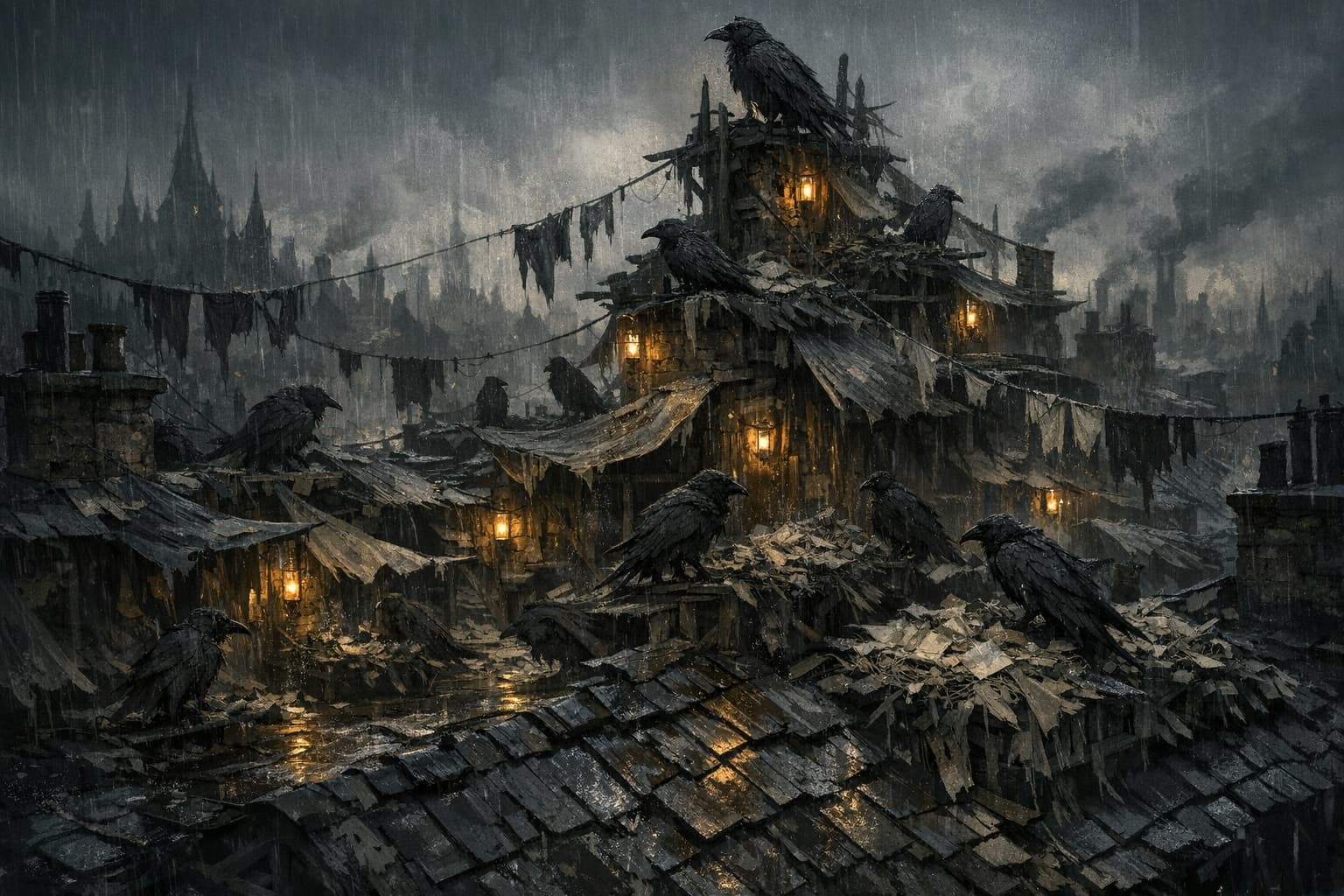
Kenku don't build cities. They inhabit them — specifically, the parts that other species have abandoned, overlooked, or can't be bothered to maintain. Rooftops, condemned buildings, sewer junctions, forgotten attics above busy shops. A kenku rookery is a settlement that exists in the negative space of someone else's architecture, parasitic and invisible by design.
The typical rookery occupies vertical space within a larger urban area. Kenku cluster in the upper floors of tenement buildings, connected by rooftop paths and rope bridges that only matter if you can't fly. They favor high ground instinctively — a vestigial preference from the days when they could take to the air — and a kenku forced to live at street level is a kenku in distress. Height means safety, sight lines, and the bittersweet reminder of what was lost.
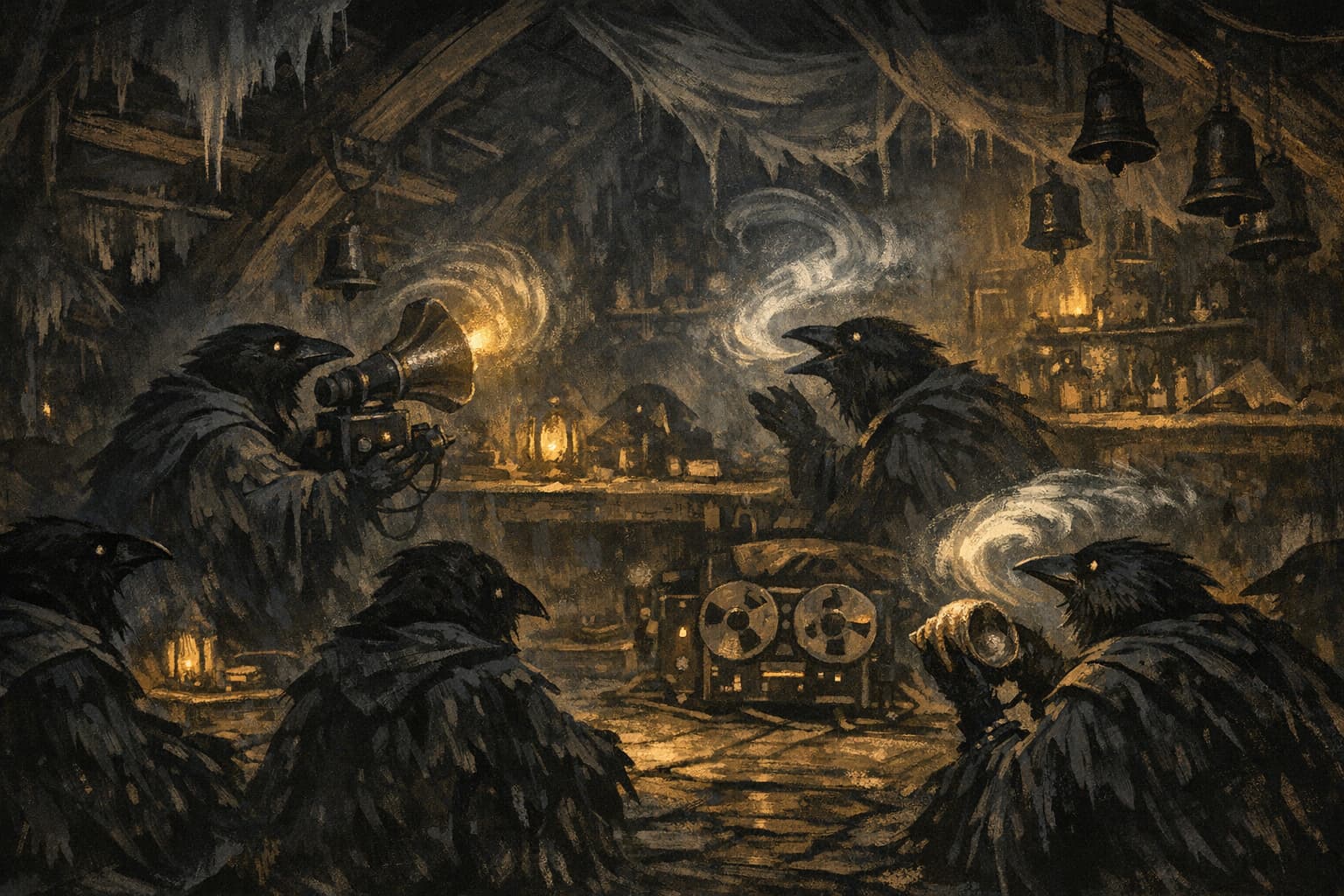
The interior of a rookery looks chaotic to outsiders but follows a strict acoustic logic. Living spaces are arranged so that sound carries efficiently from the communal gathering areas to every nest. Walls are thin or absent — privacy in a kenku community is negotiated through behavioral norms rather than architecture. The most valuable spaces aren't the largest or the highest but the quietest: rooms where a kenku can practice new sounds without contaminating the communal soundscape, and where delicate sound-work can be performed without interference.
Rookery politics are informal and reputation-based. There are no kenku kings or councils. Instead, influence flows to whoever can provide the most useful sounds. A kenku who has memorized the voice of the city watch captain, the password to the merchant guild vault, and the mating call of the alderman's prize songbird holds more power than any warrior. Information is currency, sound is information, and the best collectors of sound lead by default.
Rookeries are transient by nature. When a city's power structure shifts — new watch captains, changed patrol routes, disrupted criminal networks — the kenku evaluate whether the acoustic landscape still supports their community. If it doesn't, the rookery dissolves and its members scatter to other cities, other rooftops, other opportunities. Kenku don't mourn abandoned rookeries. They carry the sounds with them, and the sounds are the rookery. The buildings were always borrowed.
When building a kenku rookery, think vertically and parasitically. The rookery doesn't compete with the city around it — it feeds on the city's acoustic landscape. Map a kenku settlement as an overlay on an existing urban map: which rooftops connect, which walls are thin enough to hear through, where the best sounds collect. A kenku rookery is an audio surveillance network disguised as a slum.
Anatomy of the Flightless Crow
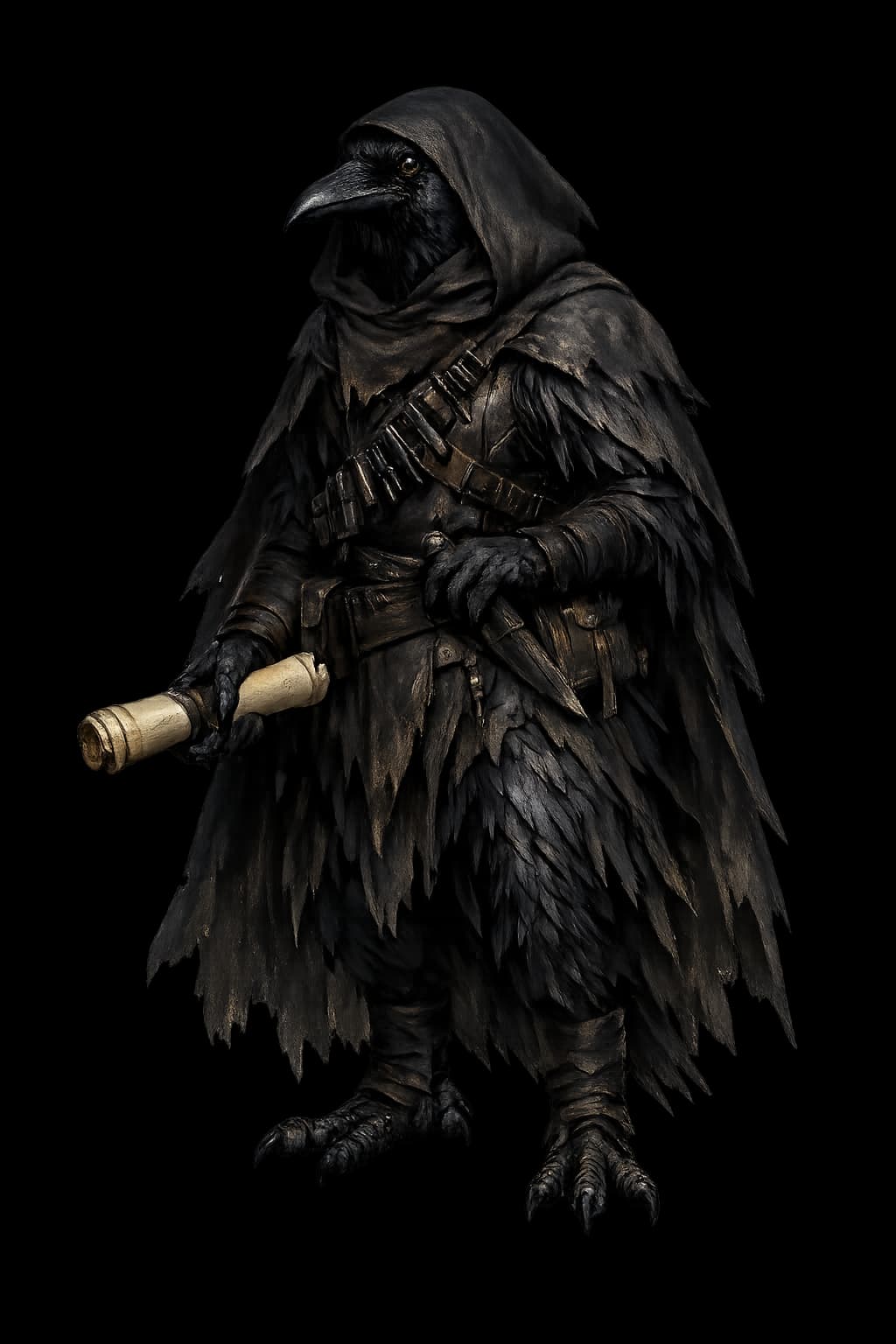
Kenku are avian humanoids standing between four and five feet tall, covered in dark feathers that range from glossy black to deep gray-brown. Their heads are unmistakably corvid: sharp beaks, round dark eyes with an intelligence that unnerves people who associate birds with simple creatures, and a mobility of expression that communicates more than most people expect from a face without lips.
The wings are the cruelest part of the anatomy. Kenku still have them — vestigial, shortened, tucked against the back beneath cloaks and coats. They can't generate lift. They can't sustain glide. But they twitch during dreams and spread involuntarily in moments of excitement or fear, a body remembering an ability the curse deleted. Watching a kenku's wings flare during a sudden noise is watching phantom limb syndrome play out across an entire species.
Their hands are remarkable: three-fingered with an opposable thumb, tipped in hard keratin that functions somewhere between fingernail and talon. These hands are built for precision. Kenku can forge documents, pick locks, and perform sleight of hand with a dexterity that other species find uncanny. The same digits that can't grip a thermal can thread a needle in dim light without hesitation.
Kenku age at roughly the same rate as humans, reaching maturity around twelve and rarely living past sixty. Their metabolism runs hot — an avian trait that survived the curse — and they eat frequently, favoring grain, insects, fruit, and the occasional scavenged meat. A kenku's diet in a city tends to mirror whatever the city wastes: market scraps, bakery leavings, the protein-rich insects that infest granaries. They're not picky. Corvids never are.
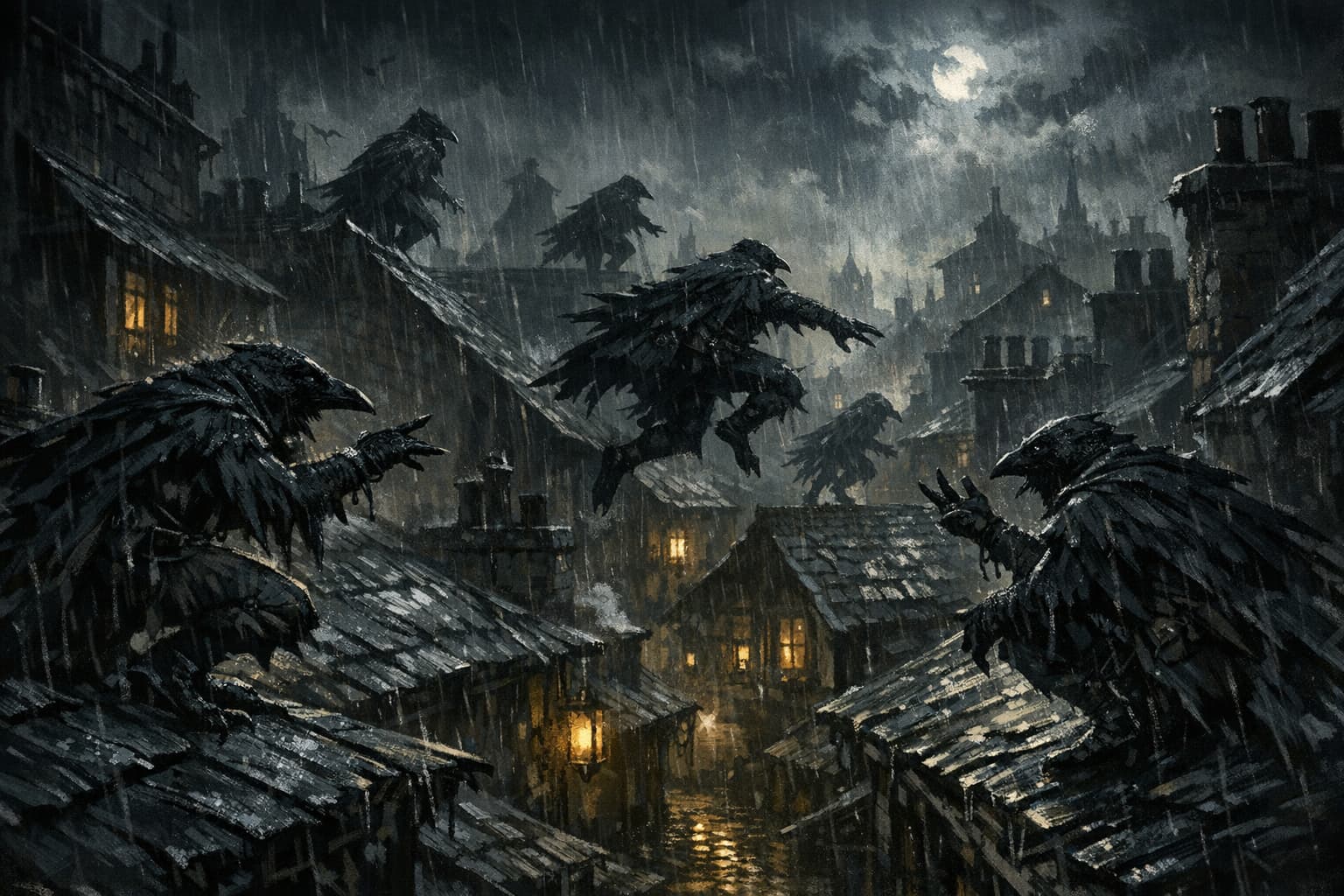
Physically, kenku are deceptively strong for their size. Their hollow bones make them lighter than comparable humanoids, which combined with powerful leg muscles allows bursts of speed and remarkable jumping ability. A kenku can't fly, but they can leap vertically to heights that startled observers sometimes mistake for flight. This jumping ability, combined with their climbing instincts and light weight, makes them superbly mobile in the three-dimensional urban environments they call home. A kenku fleeing across rooftops is nearly impossible to catch on foot.
Mimicry & the Syrinx
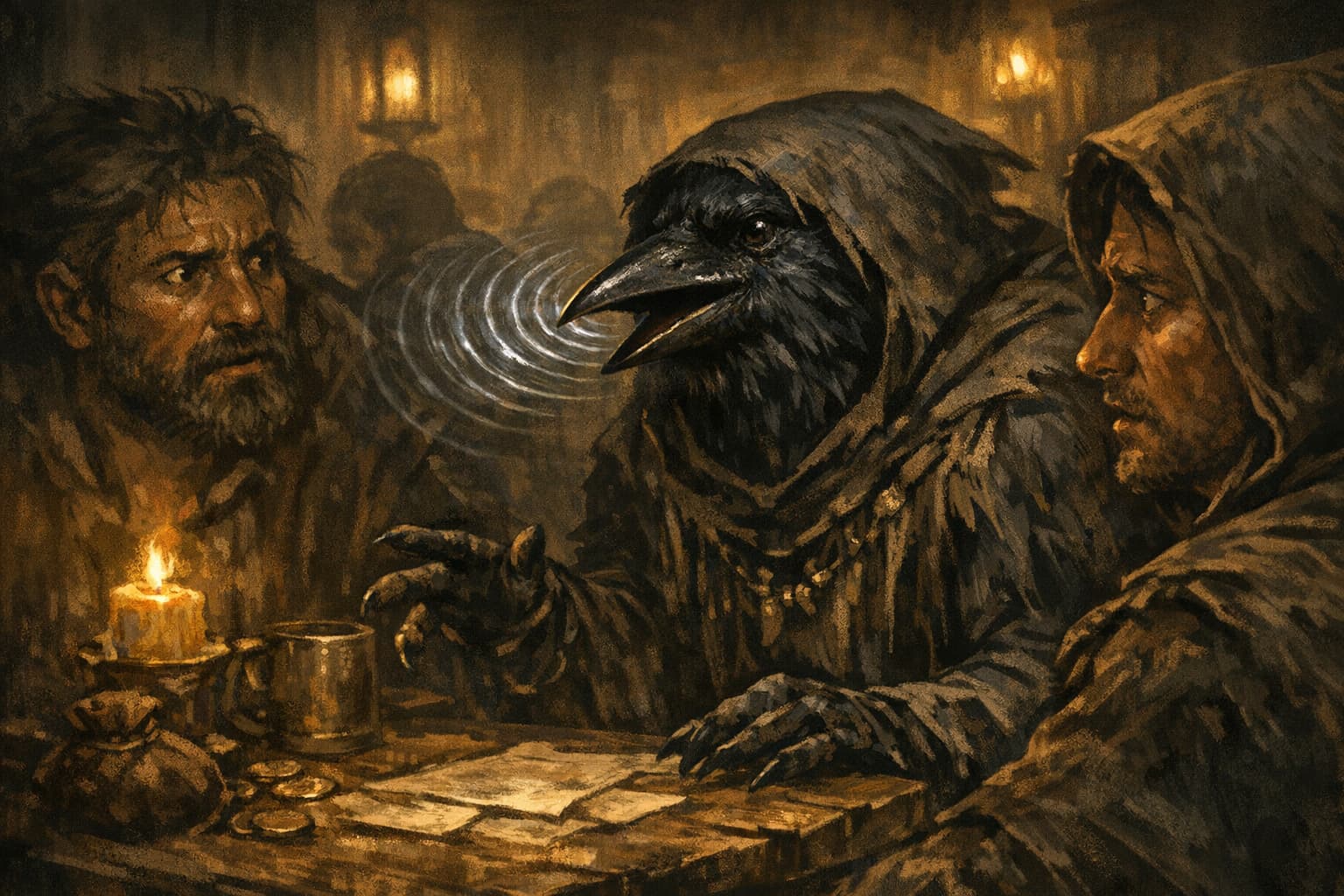
The kenku vocal apparatus is more complex than any other humanoid's. Their syrinx — the avian equivalent of a larynx — can reproduce virtually any sound it has heard with perfect fidelity. A slamming door, a crying child, a specific person's laugh, the exact pitch and cadence of a magistrate's sentencing voice. The reproduction isn't approximate. It's identical, indistinguishable from the original even under magical analysis.
What the syrinx cannot do is generate original speech. A kenku can replay the word 'fire' in thirty different voices but cannot say the word in their own voice, because they don't have one. This limitation shapes every social interaction, every relationship, every moment of kenku existence. Communication is constant collage, assembling meaning from a library of borrowed sounds.
Vestigial Wings & the Phantom Sky
Kenku wings are too small for flight but too present to ignore. They fold against the back, covered by clothing in most social situations, but they move. They react to wind. They spread during falls in a useless reflex that slows nothing. Kenku who live near cliffs or tall buildings report a persistent urge to jump — not suicidal, but instinctive, the body insisting it knows how to fly despite centuries of evidence to the contrary.
This phantom-flight instinct drives much of kenku behavior. They climb compulsively. They prefer high ground. They sleep in elevated positions when possible. And they watch birds with an intensity that ranges from wistful to agonized, depending on the individual kenku and the day. The wings are a monument to what was taken, carried everywhere, impossible to put down.
Feathers, Plumage & Expression
Kenku feathers are diagnostic. Healthy kenku have glossy, well-maintained plumage with an iridescent sheen in good light — greens, purples, and blues playing across the black. Stressed, sick, or grieving kenku lose that sheen; their feathers become dull, brittle, and may fall out in patches. You can read a kenku's emotional state from across the room if you know what to look for.
Preening is both hygiene and social bonding. Kenku groom each other in a practice called 'feather-tending' that serves the same social function as conversation in verbal species. The kenku who tends your feathers is the kenku who trusts you. Refusing feather-tending is a serious insult. Offering it to a non-kenku is a declaration of deep friendship that most non-kenku completely fail to understand.
Psychology of the Echo
Imagine knowing exactly what you want to say and being physically incapable of saying it in your own words. Every thought must be translated through someone else's voice, someone else's phrasing, fragments stitched together from overheard conversations and memorized speeches. This is baseline kenku psychology: a mind as sharp as any other humanoid's, trapped behind a voice that belongs to everyone except its owner.
This doesn't make kenku stupid. It makes them phenomenal listeners. A kenku in a crowded tavern isn't socializing — they're archiving. Every conversation, every laugh, every whispered secret gets catalogued for potential use. The better your library of sounds, the more precisely you can communicate, which means kenku are motivated to go everywhere, hear everything, and forget nothing. Their memory for sound is essentially eidetic.
The yearning for flight adds a second psychological layer. Kenku experience a species-wide low-grade grief that never fully resolves. They dream of flying — literally, their dreams contain flight — and wake to a body that can't deliver. Some kenku channel this grief into ambition, climbing higher and higher in both the physical and social senses. Others fall into a fatalism that reads as depression to outside observers. Most oscillate between the two, driven by a loss they never personally experienced but carry in their bones.
Despite all this, kenku are not a miserable species. They find joy in clever mimicry, in the perfect reproduction of a complex sound, in the satisfaction of a well-executed heist. Their humor is sophisticated — kenku jokes are layered audio constructions that lose everything in translation. A kenku making another kenku laugh is performing a feat of acoustic comedy that would take a bard ten minutes to explain to a human audience.
Kenku social bonds form quickly and run deep. A kenku who has shared sounds with you — really shared, offering rare or personal recordings from their private library — has made an investment of trust that they don't extend lightly. Betraying a kenku's sound-trust is one of the few offenses that rookeries punish collectively. The offender finds that no kenku in the city will share sounds with them, a social death sentence for a species that builds identity from acoustic fragments.
Young kenku develop their acoustic identities during adolescence, a period that other species might compare to the human experience of finding your voice — except for kenku, the metaphor is literal. Juvenile kenku collect sounds compulsively, hoarding far more than they'll ever use, experimenting with different combinations to find the ones that feel like them. The process is messy, loud, and annoying to adult kenku, who remember doing exactly the same thing. A rookery full of adolescent kenku sounds like an orchestra tuning up permanently.
Kenku parenting emphasizes listening above all other skills. Hatchlings are brought to the busiest parts of the rookery and the noisiest parts of the city, immersed in sound from birth. A kenku child who grows up in a sonically rich environment develops a larger and more nuanced vocabulary than one raised in quiet isolation. The best kenku parents are the ones who take their children everywhere, exposing them to the widest possible range of sounds before their acoustic preferences solidify. An orphaned kenku raised outside a rookery — by humans, say — develops a vocabulary limited to whatever sounds that environment provided, and other kenku can identify them immediately by the gaps in their acoustic library.
“A kenku's silence isn't empty. It's full of every sound they've ever heard, waiting to be assembled into something that almost — almost — says what they actually mean.”
The Art of Found Sound
The common assumption is that kenku can't create art because the curse stole their creative spark. This is wrong. What the curse stole was the ability to create from nothing. It did not — could not — kill the desire to create. Kenku art exists in the space between those two facts, and it is unlike anything any other species produces.
Kenku music is the clearest example. A kenku composer doesn't write melodies — they arrange found sounds into sequences that produce emotional responses. The creak of a specific door hinge, followed by the laugh of a child, followed by the sound of rain on copper, followed by a heartbeat. These compositions are performed from memory with perfect fidelity to the original sounds, but the arrangement is the art. The individual sounds belong to the world. The order belongs to the kenku.
This extends to visual art and craft. A kenku painter can reproduce any painting they've seen, stroke for stroke. But kenku galleries — and they exist, hidden in rookeries — display these reproductions in curated sequences that create meaning the originals never intended. A portrait of a smiling noble hung next to a reproduction of a wanted poster for the same noble tells a story neither piece tells alone. The kenku artist is a curator, an editor, a remixer.
The philosophical implications are profound and kenku scholars debate them endlessly, in borrowed words. Is arrangement creation? If you build something new from existing pieces, is the new thing original? Kenku culture answers yes, emphatically, and the art they produce supports the argument. A kenku sound-sculpture made from forty-seven precisely sequenced environmental recordings is not a copy of anything. It's something that never existed before, assembled from things that did.
Found-sound performance is the highest kenku art form. A master performer can hold a rookery audience in absolute silence for an hour, building emotional narratives from nothing but sequenced environmental sounds. The audience weeps, laughs, feels terror and relief, all without a single word of original speech. These performances are never recorded because they can't be — each one exists only in the moment and in the memories of those present. Kenku art is ephemeral by necessity and devastating by design.
Non-kenku who witness these performances often describe the experience as disorienting and deeply moving. A human bard who attended a kenku sound-sculpture performance in Waterdeep's Dock Ward described hearing the entire life cycle of a rainstorm — from the first distant thunder to the last drip from a gutter — interspersed with fragments of a child's laughter and the sound of footsteps walking away. She wept without understanding why. The kenku artist had communicated something that language could never capture, using nothing but the raw sounds of the world arranged in a sequence that bypassed intellect and spoke directly to emotion.
Sound Collectors
Some kenku specialize in gathering rare and beautiful sounds. They travel far from their rookeries, visiting waterfalls, volcanic vents, ancient forests, and battlefields — anywhere the acoustic landscape offers something the rookery's library lacks. A sound collector who returns with the echo of a dragon's roar or the exact frequency of a crystal cave's resonance earns status that no amount of gold can buy.
Collectors develop an aesthetic sensibility about sound that non-kenku find difficult to grasp. They describe sounds the way a sommelier describes wine: texture, body, finish, emotional weight. Two door-slams are not interchangeable. The slam of a prison door carries different meaning than the slam of a tavern door, and a skilled collector knows the difference matters.
Echo Weavers
Echo weavers are the kenku equivalent of composers or poets. They take the raw materials gathered by collectors and arrange them into performances, messages, and cultural artifacts. A talented echo weaver can tell a complete story using nothing but environmental sounds and borrowed phrases, layered and timed with a precision that approaches mathematics.
The best echo weavers are celebrities within their rookeries, their performances anticipated for weeks. They develop signature styles — some favor minimalism, building entire emotional arcs from three or four sounds. Others are maximalists, layering dozens of simultaneous recordings into overwhelming sonic tapestries. The art form has schools, traditions, and rivalries as fierce as anything in the bardic colleges.
Daily Life in the Shadow Economy
Kenku daily life revolves around the acquisition and trade of useful sounds and marketable skills. A typical kenku day begins before dawn — corvid circadian rhythms favor early rising — with a period of communal sound-sharing. New sounds collected the previous day are performed for the rookery, assessed for value, and integrated into the collective vocabulary. This isn't casual conversation. It's a morning news broadcast performed entirely in stolen voices.
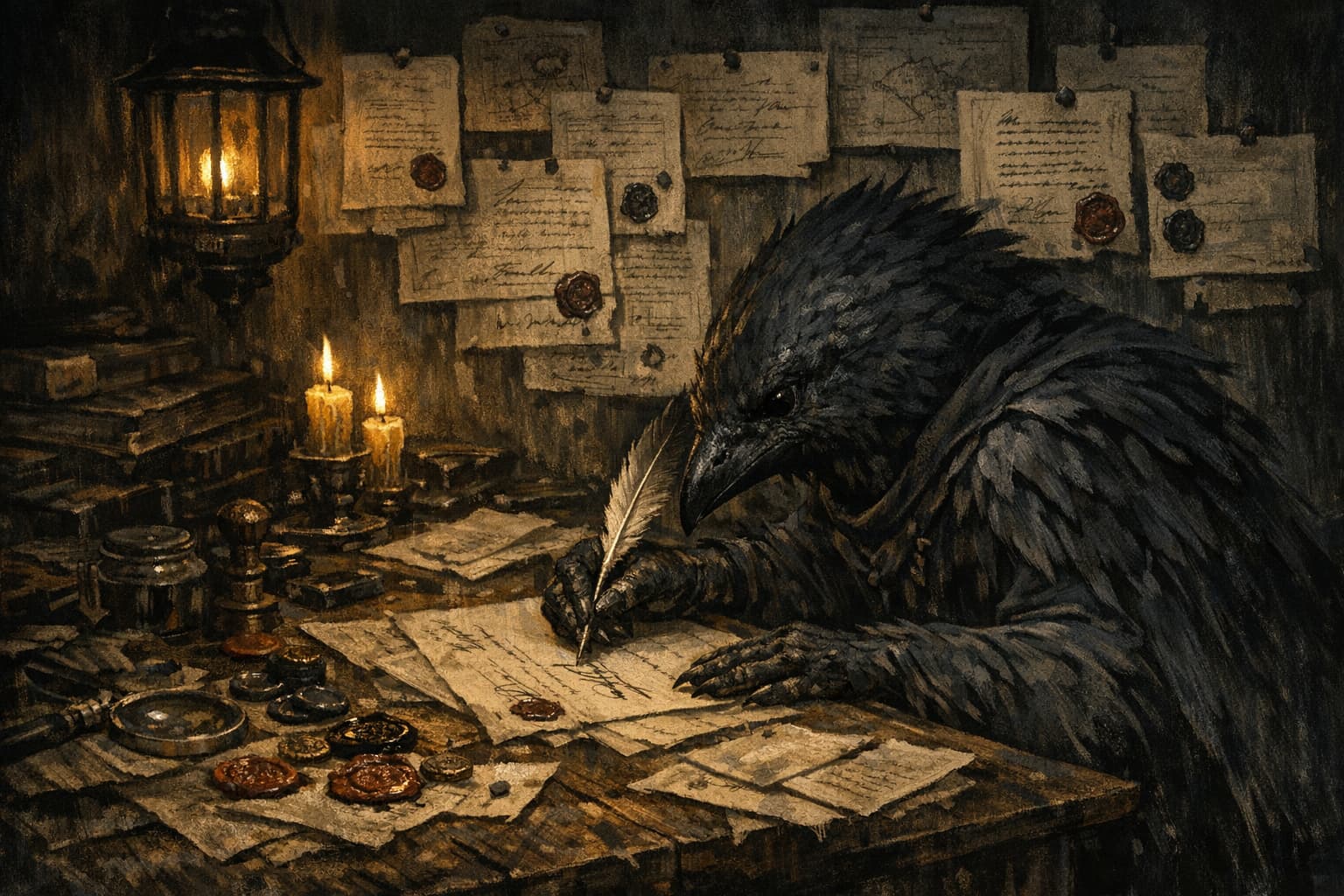
Most kenku work within the shadow economy of whatever city hosts their rookery. Forgery is the signature trade: kenku can reproduce any document they've studied with mechanical precision, matching handwriting, ink weight, and even the subtle impressions of the original writer's hand pressure. A kenku forger doesn't approximate a signature — they replicate it so perfectly that the original signer can't tell the difference. In cities with established kenku populations, banks and bureaucracies have developed special verification methods — magical wards, unique paper stocks, enchanted inks — specifically because standard authentication is useless against kenku precision.
Beyond forgery, kenku fill niches that reward their specific abilities. They work as spies (perfect voice mimicry makes eavesdropping productive), scouts (small, quiet, comfortable on rooftops), messengers (can deliver messages in the sender's exact voice), and occasionally as legitimate artisans (their copying ability extends to any craft they can observe). The line between criminal enterprise and honest work is blurry in kenku communities because the same skill set serves both.
Kenku artisan guilds exist in larger cities, though they're rarely recognized by official trade organizations. A kenku calligrapher can reproduce any script in any hand. A kenku jeweler can replicate a piece from memory after a single examination. These skills command premium prices from clients who need discretion — nobles replacing lost heirlooms, merchants duplicating competitor designs, scholars reproducing damaged manuscripts. The work is legal. The clients' reasons for commissioning it frequently are not.
Playing a kenku in daily roleplay means deciding how your character communicates moment to moment. Build a vocabulary of sounds your kenku has collected: voices of party members, environmental noises, phrases from NPCs you've met. Keep a mental or written list. The constraint isn't a burden — it's the most creative roleplay challenge in D&D, and the players who commit to it produce some of the most memorable characters at any table.
The Unnamed Master & Kenku Faith
Kenku religion centers on a figure they cannot name, because the name was part of what was taken. The master who cursed them — god, demon lord, archfey, or something else entirely — exists in kenku theology as an absence around which faith orbits. They worship the shape of the hole, the outline of the being defined by everything they remember losing.
This produces a theology unlike any other species'. Kenku prayers are assembled from overheard prayers to other gods, repurposed and rearranged to point at something the worshipper can feel but not describe. A kenku cleric invoking their nameless patron sounds like a collage of a dozen different faiths, which is exactly what it is — and exactly what it needs to be. The divine response, when it comes, arrives as sounds: doors opening, chains breaking, the rush of wind beneath wings that haven't existed for centuries.
Some kenku worship gods of other species, particularly those associated with trickery, travel, or redemption. A kenku follower of a trickster deity finds theological validation for the mimicry that defines their existence. A kenku drawn to a travel god channels the wanderlust that the loss of flight transformed but didn't extinguish. These adopted faiths work, but they always carry an undertone of something missing — the kenku worshipper performing rituals in borrowed words, directing devotion toward gods who didn't make them and can't unmake the curse.
Some kenku theologians argue that the curse was not a punishment but a test, and that the species will regain flight and voice when they've proven they can create meaning without them. Others believe the master is dead and the curse persists as an echo of a power that no longer exists. A smaller faction holds that the master was never real — that kenku created the myth to explain biological limitations that have natural causes. These theological disputes play out in performances rather than written texts, competing sound-compositions that argue through arrangement rather than argument.
Kenku death rituals center on sound preservation. When a kenku dies, members of the rookery gather to perform the deceased's characteristic sounds — their favorite collected phrases, the sounds they were known for, the audio signature that identified them. This performance serves as both eulogy and archive. A well-remembered kenku's sounds persist in the rookery's collective vocabulary for generations. A kenku truly dies only when the last person who remembers their sounds stops performing them.
The unnamed master is deliberately vague in official D&D lore, which makes it a perfect campaign hook. The master could be a dead god whose portfolio is up for grabs, a demon lord who wants to renegotiate the curse, an archfey running an experiment, or a collective hallucination. Each answer changes what the kenku are and what lifting the curse would mean. Let the mystery drive the campaign rather than resolving it too early.
Kenku & the Arcane
Kenku approach magic the same way they approach everything else: through reproduction and adaptation. A kenku wizard doesn't invent spells — they meticulously copy spell formulae from observed castings, stolen spellbooks, and overheard incantations. The process works. Kenku wizards are perfectly functional. But they're aware, in a way that human wizards never are, that every spell in their book originated in someone else's mind. This awareness produces either humility or resentment, depending on the wizard.
This creates interesting dynamics with verbal spell components. Kenku cast spells using memorized incantations in the voices of the wizards they learned from. A kenku sorcerer's fireball might sound like the archmage of Waterdeep because that's whose casting they originally copied. Some kenku develop enormous catalogs of different voices for the same spell, choosing which version to use based on the situation or their mood. It's not mechanically different, but it's a roleplay goldmine.
Kenku sorcerers present a philosophical puzzle. Sorcerous magic comes from within — from bloodline, from innate power, from something fundamental to the caster's being. If kenku can't create original sounds, can they generate original magic? In practice, yes. Kenku sorcerers exist and their magic works. But the magic manifests in copied forms — a kenku sorcerer's fire bolt looks identical to one they witnessed another caster produce. Whether the magic itself is original even though its expression is copied is a question that keeps kenku metaphysicians arguing across rookeries.
The relationship between kenku mimicry and bardic magic is particularly rich. Bardic spellcasting relies on music and speech — two things kenku can only produce through reproduction. A kenku bard performs entirely in other people's songs, other people's speeches, assembling a performance from fragments that somehow produces genuine magical effects. The philosophical question of whether copied art can produce authentic magic has occupied kenku scholars for generations. The practical answer is that it clearly can, because kenku bards exist and their spells work.
Kenku warlocks present a different angle entirely. The pact relationship — service in exchange for power — echoes the original arrangement with the unnamed master that produced the curse. A kenku who enters a warlock pact is knowingly repeating the pattern that doomed the species, which is either profound courage or reckless arrogance depending on who you ask. Some kenku warlocks seek patrons specifically hoping to find the original master and renegotiate the terms. Others choose patrons who oppose whatever the master was, treating the pact as an act of defiance rather than repetition.
Wild magic is particularly feared in kenku communities. A wild magic surge in a rookery — a sonic boom, an unexpected thunderclap, an eruption of chaotic sound — can permanently contaminate the acoustic library of every kenku in earshot. Imagine a lifetime of carefully curated sounds suddenly interrupted by an alien noise that you can never unhear and can't stop reproducing. Kenku wild magic sorcerers tend to be exiled from rookeries early, not out of cruelty but out of acoustic self-preservation.
Inter-species Relationships
Kenku exist in the margins of other species' societies, which shapes every inter-species relationship they have. Most urban kenku interact with humans more than any other species, and the dynamic is defined by mutual wariness. Humans find kenku unsettling — the mimicry, the silence, the alien body language of a species that communicates through feather-position and stolen sounds. Kenku find humans useful but loud, wasteful with sound, throwing away phrases and tones that kenku would treasure.
Trust between kenku and non-kenku develops slowly because the communication barrier is real. A human who befriends a kenku must learn to read meaning from context, tone-of-mimicry, and body language rather than from words that mean what they say. The kenku who trusts a non-kenku enough to share their private sound-library — the sounds they use only among close companions — has offered something more intimate than most species understand. It's the equivalent of reading someone your diary, except the diary is made of the most meaningful sounds you've ever heard.
The relationship with aarakocra is the most complicated in the kenku social world. Aarakocra fly. Kenku used to fly. Watching an aarakocra soar produces reactions in kenku that range from awe to grief to a jealousy so sharp it registers as physical pain. Some kenku seek out aarakocra communities hoping to learn something about their lost heritage. Others avoid flying species entirely because the reminder is too painful. Aarakocra, for their part, tend to regard kenku with a mixture of pity and discomfort — like meeting a version of yourself that had something essential removed.
Kenku and halflings share practical ground. Both species are small, underestimated, and effective in spaces that larger species overlook. Halfling-kenku partnerships in the urban underworld are legendary: the halfling talks, the kenku listens, and between them they know everything that happens in a city's shadow economy. Gnomes find kenku fascinating for their mechanical precision in copying, and more than one gnomish workshop has employed kenku artisans specifically for their ability to reproduce complex technical drawings from a single viewing.
Elves tend to view kenku with an uncomfortable mixture of academic interest and condescension. The elven concept of art centers on original creation — new songs, new poems, new magic shaped from personal vision. Kenku art, built entirely from existing materials, strikes many elves as clever but ultimately hollow. Kenku, predictably, find this attitude insufferable. The argument about whether arrangement constitutes creation has been running between elven scholars and kenku echo weavers for centuries, conducted entirely in borrowed elven philosophical terms that the kenku reproduce with pointed accuracy.
Dwarves, practical as ever, judge kenku by the quality of their work rather than the method of its production. A kenku-forged blade that performs identically to the original is a good blade, regardless of how it was designed. This pragmatic acceptance makes dwarven cities some of the more comfortable places for kenku to live, though the relationship is strictly transactional. Dwarves hire kenku for their skills. They don't invite them to clan halls. The arrangement suits both parties: kenku get steady work and access to dwarven acoustic environments — the ring of hammer on anvil, the rumble of mine carts, the echo of deep halls — and dwarves get artisans whose reproduction skills border on the supernatural.
Kenku Relations with Other Species
| Species | Dynamic | Typical Interaction |
|---|---|---|
| Humans | Mutual wariness, economic interdependence | Kenku work in human cities but rarely integrate socially; humans hire kenku skills but distrust kenku motives |
| Aarakocra | Grief, jealousy, and painful kinship | The only species kenku cannot view neutrally; every aarakocra is a reminder of what was lost |
| Halflings | Practical partnership | Complementary skills in urban environments; halflings provide the voice, kenku provide the ears |
| Gnomes | Intellectual curiosity | Gnomes admire kenku precision; kenku appreciate gnome inventiveness as something they can study and reproduce |
| Tieflings | Solidarity of outcasts | Both species know what it means to be defined by a curse that predates them; quiet mutual respect |
Kenku alliances are always practical. Sentiment is a luxury for species that can say what they feel.
Notable Kenku & Cultural Figures
Kenku history is oral — or more precisely, acoustic. There are no kenku libraries because kenku don't write original texts. Instead, notable figures are preserved as sound-portraits: curated collections of their characteristic sounds, performed by students and admirers across generations. A famous kenku lives on as a performance, which is more fitting than any biography.
The concept of kenku 'fame' differs from other species' understanding of the word. A famous human is known by name. A famous kenku is known by their signature sounds — the specific combination of mimicked voices, environmental recordings, and acoustic trademarks that constituted their identity. When kenku gather to honor a legendary figure, they don't tell stories. They perform that figure's sound-portrait, essentially resurrecting them acoustically. The audience doesn't hear about the famous kenku. For the duration of the performance, they hear them.
The challenge of documenting kenku figures in a written format like this is that their names are sounds, not words. What appears below are the translated or approximated names used by non-kenku historians, each one a rough label for a personality that was actually identified by a specific combination of mimicked sounds — a door creak, a hawk's cry, the particular way a forge hammer rings on a cold morning.
Kenku names themselves deserve attention. A kenku's name is a sound or sequence of sounds they've chosen to identify themselves — a slamming door, a specific bird call, the clink of coins, a snippet of a song. These names are impossible to write and difficult for non-kenku to reproduce, which means kenku operating in mixed-species environments often acquire nicknames based on translations of their sound-names. The kenku whose name is the sound of rain on a tin roof becomes 'Drip' or 'Tinroof' in Common, and every translation loses something essential.
Notable Kenku Figures
| Name (Translated) | Era | Significance |
|---|---|---|
| Creaking-Hinge | Pre-curse mythology | The kenku who supposedly initiated the betrayal of the master; some traditions revere Creaking-Hinge as a liberator, others as the architect of damnation |
| Whisper-of-Locks | 3e era lore | Legendary forger whose reproductions of royal documents were so perfect they caused a succession crisis in a kingdom that never discovered the originals were replaced |
| Thunder-Before-Rain | 5e era lore | Kenku cleric who claimed to have heard the unnamed master speak, sparking a theological movement that split three major rookeries |
| Seven-Voices | Baldur's Gate 3 era | Echo weaver whose found-sound performances drew non-kenku audiences for the first time, briefly bridging the communication gap between species |
Kenku fame is measured in how many rookeries perform your sound-portrait. A kenku forgotten is a kenku whose sounds no one bothers to reproduce.
Kenku Mechanics Across Editions
Kenku mechanics tell the story of a species moving from monster to player option, with the mimicry mechanic as the constant thread. The mechanical challenge has always been the same: how do you represent a species that can perfectly copy sounds but can't generate original speech? Each edition answered differently, and none got it entirely right, which is arguably the point — the kenku communication constraint is more interesting as a roleplay negotiation than as a rigid mechanical rule.
The evolution from 3.5e to 2024 follows a clear arc: increasing player accessibility at the cost of what made kenku mechanically distinctive. The original kenku was a monster with stats. The Volo's kenku was a roleplay challenge with mechanics. The 2024 kenku is a flexible character option with vestigial flavor. Each version has defenders, and each version reflects a different philosophy about whether species mechanics should constrain or enable player expression.
Kenku Mechanical Evolution
| Feature | 3.5e | 5e (Volo's) | 2024 |
|---|---|---|---|
| Key Ability | DEX +2, STR -2 | DEX +2, WIS +1 | Flexible |
| Size | Small | Medium | Small or Medium |
| Mimicry | Monster trait, loosely defined | Core identity, limits speech | Bonus feature, speech unrestricted |
| Skill Bonuses | Hide, Move Silently | Two from a rogue-adjacent list | Two skills of your choice |
| Signature Feature | Great Ally (flanking) | Expert Forgery | Kenku Recall |
| Design Role | Rogue-focused monster | Roleplay-first species | Flexible character option |
Each edition's kenku reflects a different answer to the question: is the mimicry restriction a feature or a bug? The design team clearly changed their mind between 2016 and 2024.
- Small size
- Mimicry (replicate sounds and voices)
- +2 bonus to Hide and Move Silently
- Great Ally: +1 to attack when flanking (instead of normal flanking bonus)
- Natural weapon: bite (1d3)
- Favored Class: Rogue
The original kenku was a monster first, player option second. Small size and rogue synergy pushed them into a specific niche. Mimicry was a paragraph of text, not a structured mechanic — DMs improvised how it worked at their tables.
- Expert Forgery: duplicate any handwriting or craftwork
- Kenku Training: proficiency in two skills (Acrobatics, Deception, Stealth, or Sleight of Hand)
- Mimicry: replicate sounds and voices (opposed by Insight check)
- Languages: understands Common and Auran but speaks only through mimicry
The 5e kenku was a roleplay-first design. The mimicry limitation was controversial — some tables loved it, others found it unworkable. The best implementations treated mimicry as creative constraint rather than communication barrier.
- Kenku Recall: proficiency in two skills of your choice
- Mimicry: replicate sounds (opposed by Insight check)
- Can speak normally (mimicry constraint relaxed)
- Size: Small or Medium
The 2024 revision controversially relaxed the speech restriction. Kenku can now speak normally, with mimicry as a bonus feature rather than a communication framework. Purists argue this removed what made kenku unique. Pragmatists note that the original restriction was often ignored anyway.
Tengu, Corvians & Crow-Folk Elsewhere
Bird-folk appear across fantasy media, but the specific kenku combination — corvid features, mimicry-based communication, lost flight, criminal underworld associations — is largely D&D's invention. The closest parallel is the tengu, which D&D's kenku were explicitly inspired by, but even tengu operate differently in their native Japanese context than kenku do in D&D's western-fantasy framework. Understanding these differences reveals what makes the kenku concept specifically effective rather than generically birdlike.
What distinguishes kenku from every other crow-folk in fiction is the constraint. Most bird-folk species in other franchises can fly and speak normally. The kenku curse makes them fundamentally different from their cross-franchise cousins by defining them through absence rather than presence. A kenku isn't a crow-person who can do crow things. A kenku is a crow-person who can't do the two most important crow things, and that loss is the species.
The World of Warcraft arakkoa deserve special mention. The arakkoa were split into two castes: the Adherents, who retained their ability to fly, and the Outcasts, who were cursed with broken wings and banished to the surface. The Outcasts mirror the kenku almost exactly — flightless bird-folk living in the margins of a society that pities and exploits them. Whether Blizzard's designers were consciously drawing from D&D's kenku or arrived at the same concept independently, the parallel highlights how compelling the 'fallen bird' archetype is. Take flight away from a species built for it, and the story writes itself.
Crow-Folk Across Franchises
| Franchise | Species | Key Trait | Distinction from Kenku |
|---|---|---|---|
| D&D | Kenku | Cursed mimics, flightless, sound-based communication | The original; defined by loss and adaptation |
| Pathfinder | Tengu | Sword-trained bird-folk, full speech, no curse | Martial focus replaces the mimicry concept; no existential loss |
| Japanese folklore | Tengu | Mountain spirits, martial arts masters, tricksters | Supernatural beings rather than a mortal species; power instead of limitation |
| Dark Souls | Corvians | Hollowed crow-people in a dying world | Share the aesthetic but lack the mimicry and curse narrative; horror rather than tragedy |
| Sekiro | Tengu of Ashina | Masked warrior with corvid associations | A title and aesthetic, not a species; human underneath |
| World of Warcraft | Arakkoa | Cursed bird-folk split into winged and wingless castes | Closest parallel — the wingless arakkoa mirror kenku loss directly |
The WoW arakkoa comparison is striking: a bird species split into those who retained flight and those who lost it, with the flightless caste forming a resentful underclass. Whether this was inspired by D&D kenku or convergent design is debated.
FAQ
Common Questions
Build a sound library during play. Every time you hear an NPC speak, a notable sound occurs, or another player says something distinctive, mentally note it as something your kenku now has access to. In practice, describe what your kenku is communicating and mention whose voice or what sound they're using: "My kenku says 'danger ahead' in the guard captain's voice from earlier, then makes the sound of a sword being drawn." You don't need to act out every sound — narrating the collage is enough. The goal is flavor, not a puzzle.
Absolutely. Verbal spell components require specific sounds, not original speech, and kenku can reproduce any sound perfectly. A kenku wizard who has heard a spell cast once can replicate the verbal component exactly. Some DMs rule that kenku must have heard a spell's verbal component before casting it, which adds an interesting collection mechanic. Others treat it as automatic. Either way, kenku spellcasters are fully functional — and a kenku bard performing entirely in sampled sounds is one of the most creative character concepts in the game.
Accessibility and table experience. The original mimicry-only restriction was polarizing: dedicated roleplayers loved it, but many tables found it frustrating when it slowed communication or excluded the kenku player from conversations. The 2024 revision makes mimicry a feature rather than a limitation, preserving the flavor without the friction. If you prefer the original restriction, nothing stops you from playing it that way — the 2024 rules are a floor, not a ceiling.
Rogue is the classic and still excellent — kenku skill proficiencies, Dexterity bonuses, and thematic alignment with stealth and deception make it the path of least resistance. But don't overlook bard (found-sound performance as spellcasting), ranger (urban bounty hunter or rooftop scout), or artificer (kenku copying ability applied to magical item creation). Monk also works thematically — a kenku who learned martial arts by perfectly mimicking the movements of a master they observed. The mimicry concept extends beyond sound to any form of reproduction.
The curse prevents original creation in the strictest sense — a kenku cannot compose a melody they've never heard or write a sentence in words they haven't encountered. But kenku art is real, sophisticated, and deeply moving. They create collages of sound, combining fragments of overheard music into compositions that are simultaneously derivative and entirely new. They forge paintings by perfectly reproducing techniques they've observed, then combining elements from different sources into arrangements no one else has imagined. The philosophical question of whether reassembly constitutes creation is one that kenku communities debate endlessly — in borrowed words, naturally.