
Kobolds
Cunning tunnel-dwellers who worship dragons, engineer deadly traps, and survive everything the world throws at them through sheer collective spite
Germanic Folklore Origins
The kobold that haunts a German silver mine has almost nothing in common with the three-foot reptilian that sets tripwire crossbows in D&D. Yet the name survived the journey intact, which means the concept kept something essential even as it shed everything else. Understanding what carried over — and what didn't — tells you more about the species than any stat block.
In Germanic folklore, kobolds were household and mine spirits. The house kobold (Kobold as Hausgeist) was a small, invisible helper that performed domestic tasks in exchange for food left out at night. Mistreat one and the helpfulness inverted — spoiled milk, missing tools, fires that wouldn't light. Mine kobolds were more dangerous. They haunted silver and cobalt deposits, and miners blamed them for cave-ins, toxic fumes, and worthless ore that looked promising. The element cobalt takes its name from Kobold — miners thought the spirits had cursed the blue-gray metal to spite them.
D&D stripped the domestic kobold entirely and kept the mine spirit, then fused it with reptilian biology and draconic worship. The result is a species that retains the original's association with underground spaces, trickery, and disproportionate impact from small beings, while looking and acting nothing like its namesake. It's one of the stranger etymological journeys in fantasy.
Kobold Origins Across Folklore & Fantasy
| Tradition | Kobold Type | Key Trait | D&D Echo |
|---|---|---|---|
| Germanic household folklore | Hausgeist (house spirit) | Invisible helper that turns vengeful if disrespected | Kobold loyalty mechanics — devoted when led well, dangerous when wronged |
| Germanic mining folklore | Berggeist (mine spirit) | Causes cave-ins, poisons ore, haunts tunnels | Underground warrens, mining expertise, trap-building |
| Etymology (cobalt) | Named for Kobold | Miners cursed "useless" blue ore as kobold trickery | Kobolds as nuisance creatures that are more dangerous than they appear |
| Early D&D (1974-1977) | Dog-like humanoid | Small, tribal, low-level cannon fodder | The expendable enemy archetype that later editions rehabilitated |
| Modern D&D (3e onward) | Reptilian draconic servant | Trap-builders, dragon worshippers, pack tactics | Current species identity — clever, devoted, underestimated |
The shift from canine to reptilian happened between 1st and 3rd Edition, driven partly by the desire to connect kobolds to the draconic hierarchy rather than the goblinoid one.
Etymology & Naming Conventions
"Kobold" entered English through German mining terminology, where it described spirits that sabotaged underground operations. The word itself may derive from the Greek kobalos — a rogue or trickster — filtered through medieval Latin. Whether the Greek connection is real or a folk etymology, it fits. Kobolds across every tradition are defined by cleverness that larger beings underestimate until the ceiling collapses.
D&D kobold names tend toward sharp consonants and clipped syllables — Meepo, Spurt, Yip, Dak, Pun-Pun. They sound hurried, percussive, like instructions shouted across a noisy tunnel. This isn't accidental. Kobold warrens are loud environments — mining, construction, alarms, dragon-chanting — and names that carry through echoing stone corridors have survival value. A name you can mishear is a name that gets you killed when someone shouts a warning.
Kobold naming also reflects hierarchy. Personal names are short and functional. Titles accumulate with achievement — the kobold who successfully traps a purple worm becomes something like Yip Who-Dropped-the-Ceiling-on-the-Wyrm. The title tells the community what this individual accomplished, which matters in a species where individual identity is secondary to collective survival.
“A kobold name is a bark, a snap, a sound that reaches the far end of the tunnel before the cave-in does. Anything longer is a luxury their world does not afford.”
— On kobold linguistics
Warren Architecture & Settlements
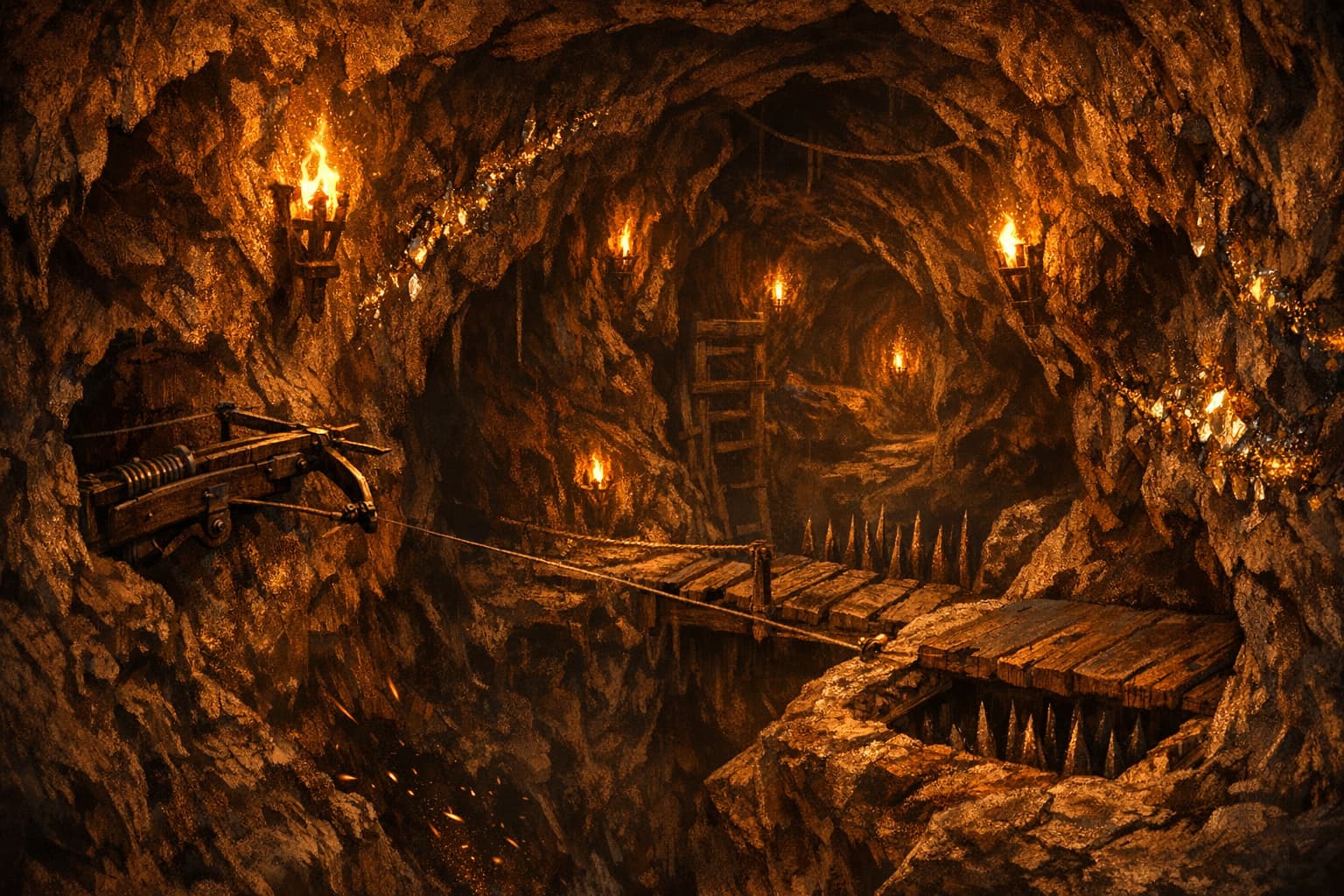
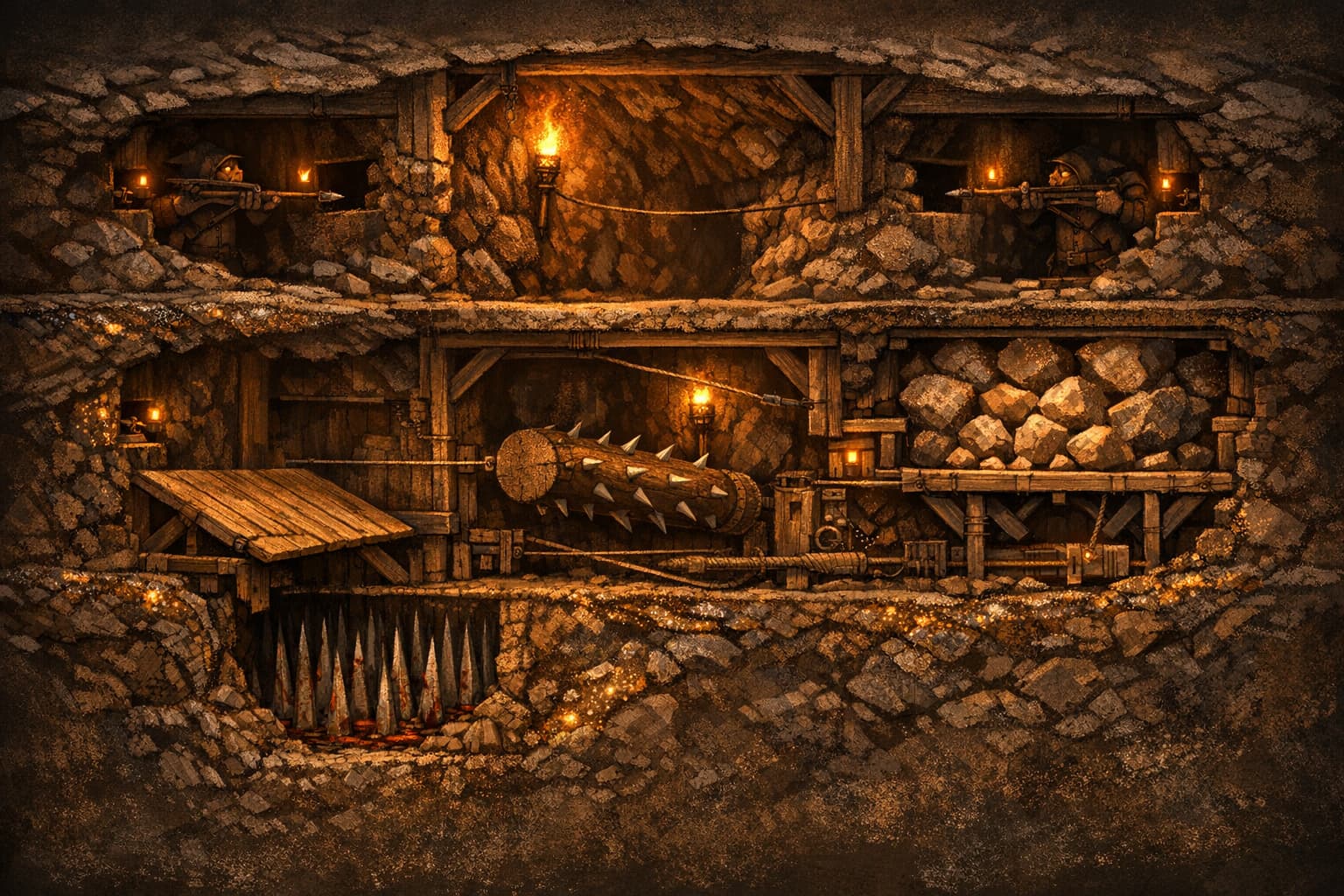
A kobold warren is not a cave. It's a machine. Every tunnel, chamber, choke point, and dead end serves a purpose — ventilation, drainage, defense, resource extraction, or some combination of all four. Kobolds don't just dig holes; they engineer underground complexes with the systematic attention to function that dwarves give to aesthetics. The difference is that dwarves build to impress visitors. Kobolds build to kill them.
Warren construction follows predictable principles once you understand the logic. Entry tunnels are narrow — sized for kobolds, uncomfortable for anything bigger. Main corridors have irregular widths that prevent formation fighting. Storage chambers sit behind concealed passages. Nurseries occupy the deepest, most defensible positions. And everything — every corridor, every junction, every decorative carving — is a potential trap trigger.
The most sophisticated warrens incorporate multiple layers of defense in depth. An invading force might clear the entrance traps only to find the corridor floods. Surviving the flood, they reach a chamber where the ceiling drops. Past that, crossbow slits cover a killing ground. Kobolds don't fight fair because they can't. They compensate by making their home ground so lethal that fairness becomes irrelevant.
Temperature management in warrens is more sophisticated than outsiders expect. Kobolds, being cold-blooded, need warmth — but underground temperatures are relatively stable. Warrens near volcanic activity or hot springs get natural heating. Those in cold regions use communal fire chambers with ventilation shafts that double as smoke-screen mechanisms during attacks. The engineering required to heat an underground complex without suffocating its inhabitants demonstrates a practical intelligence that the "stupid monster" reputation entirely fails to account for.
When mapping a kobold warren, don't just place traps randomly. Think about it from the kobolds' perspective: where would they funnel intruders? What escape routes do the kobolds use? Where are the murder holes and flooding mechanisms? A warren designed with actual defensive logic is more challenging and more satisfying than one with arbitrary trap placements. Give your kobolds the credit of being intelligent defenders.
From Dog-Faced to Dragon-Blooded
Kobolds have undergone the most dramatic visual and thematic redesign of any creature in D&D history. In 1st Edition, they were described as dog-like humanoids with scaly skin — an awkward hybrid that couldn't decide what animal it was borrowing from. Illustrations showed them as vaguely canine, often with pointy ears and fur-covered skin. They were the weakest monsters in the game, placed at the bottom of encounter tables as something for 1st-level characters to fight without dying.
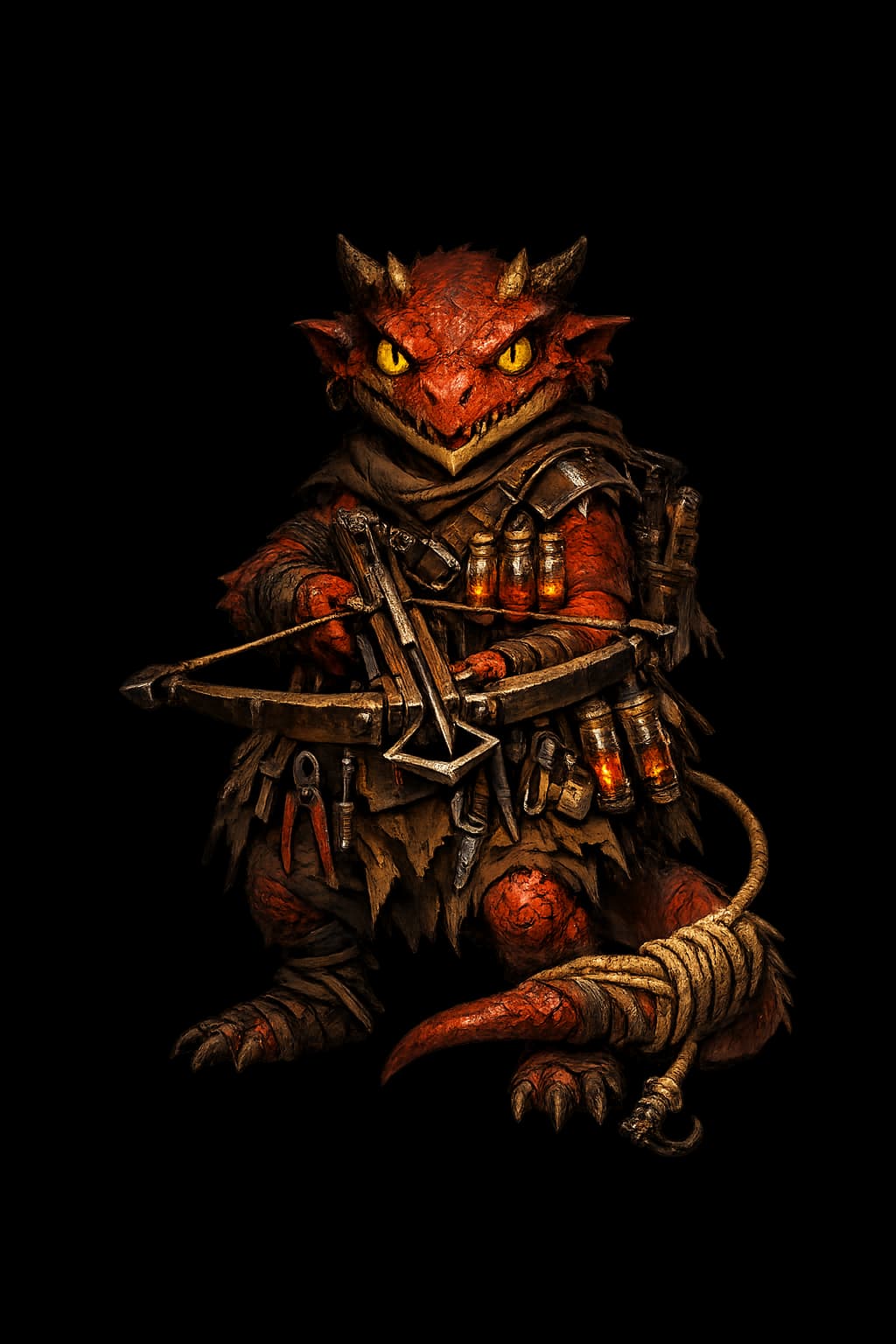
The shift to reptilian biology began in 2nd Edition and completed in 3rd, where kobolds became small, scaled, horned creatures that claimed draconic ancestry. This wasn't purely aesthetic. By linking kobolds to dragons, designers gave the weakest creature in D&D a connection to the most powerful. The irony was the point — kobolds worship beings that could destroy them by sneezing, and this devotion shapes every aspect of their culture.
4th Edition experimented with kobolds as shifty, mobile combatants. The "Shifty" ability let kobolds shift as a minor action, creating encounters where the little creatures constantly repositioned, ducking behind cover and swarming from unexpected angles. This wasn't the most lore-rich version of kobolds, but it made them mechanically distinctive and genuinely fun to run as a DM. The emphasis on mobility rather than strength perfectly captured how a small species fights.
5th Edition leaned into the draconic connection further. Volo's Guide to Monsters (2016) gave kobolds pack tactics, sunlight sensitivity, and a detailed cultural write-up that treated them as a real society rather than dungeon filler. The 2024 Player's Handbook made kobolds a playable species for the first time in a core rulebook, completing a fifty-year journey from weakest monster to full protagonist.
Original D&D
Kobolds debut as the weakest monster in the game — 1-4 hit points, 1d4 damage. Dog-like appearance. Their purpose is to die in large numbers to low-level adventurers.
AD&D 1e Monster Manual
Described as small, dog-faced humanoids with scaly skin. Egg-laying. Live in dark places. Still cannon fodder, but with tribal structure and trap-building mentioned for the first time.
Tucker's Kobolds
Roger E. Moore publishes an editorial in Dragon Magazine #127 about a DM named Tucker whose kobolds terrorized high-level parties. Redefines how the community thinks about kobold encounters.
3rd Edition Redesign
Kobolds become fully reptilian with draconic heritage. The visual shift from dog-like to lizard-like is complete. Draconic sorcerer bloodlines established.
Volo's Guide to Monsters
Kobolds receive their most detailed cultural treatment: warrens, trap engineering, dragon worship, pack tactics, and sunlight sensitivity. Treated as a real society for the first time.
2024 PHB Core Species
Kobolds become a core playable species. Draconic Cry replaces sunlight sensitivity. The journey from weakest monster to protagonist species is complete.
Biology & Physiology
Kobolds are small, cold-blooded, egg-laying reptilians that stand between two and three feet tall and weigh twenty-five to thirty-five pounds. Everything about their biology optimizes for survival in underground environments with limited resources. They need less food than any comparably sized humanoid. They see in total darkness. They can squeeze through gaps that would stop a halfling. And they mature fast — a kobold reaches functional adulthood in six to eight years, ensuring rapid population recovery after catastrophic losses.
Their scales range from rusty brown to dark red to black, with occasional metallic or chromatic coloration that kobolds interpret as signs of strong draconic heritage. Horns — small, often asymmetric — grow throughout life and are shaped by diet, health, and (kobolds claim) spiritual favor. A kobold with impressive horns is assumed to carry more draconic essence, which translates to social status in the warren.
Kobold lifespans are short by fantasy species standards — roughly 120 to 140 years if they survive that long, which most don't. The combination of dangerous occupations, limited medical care, and a world that actively hunts them means most kobolds die well before biological old age. This compressed timeline creates urgency. A kobold who reaches fifty is already an elder. One who reaches a hundred is a repository of institutional memory that the warren literally cannot afford to lose. Old kobolds are protected, consulted, and occasionally carried to safety on the backs of younger warren-mates during evacuations.
Darkvision & Sunlight Sensitivity
Kobold darkvision extends 60 feet — standard for underground species. More distinctive is the historical sunlight sensitivity that defined the species mechanically for decades. In editions before 2024, kobolds suffered disadvantage on attacks and Perception checks in direct sunlight. This wasn't a minor inconvenience — it made kobolds functionally nocturnal and shaped their entire tactical doctrine around fighting underground or at night. The 2024 rules removed this penalty, but its cultural fingerprint remains. Even without the mechanical drawback, kobold societies are built for darkness.
Egg-Laying & Rapid Maturation
Kobolds lay eggs in communal clutches, typically four to eight eggs per clutch, with a short gestation period. Eggs are tended collectively — the warren's nursery is a shared responsibility, not a single parent's burden. This communal child-rearing produces adults whose primary loyalty is to the group rather than to individual parents. A kobold doesn't ask "who is my mother?" They ask "which warren hatched me?" The distinction shapes everything about kobold psychology.
Size as Strategy
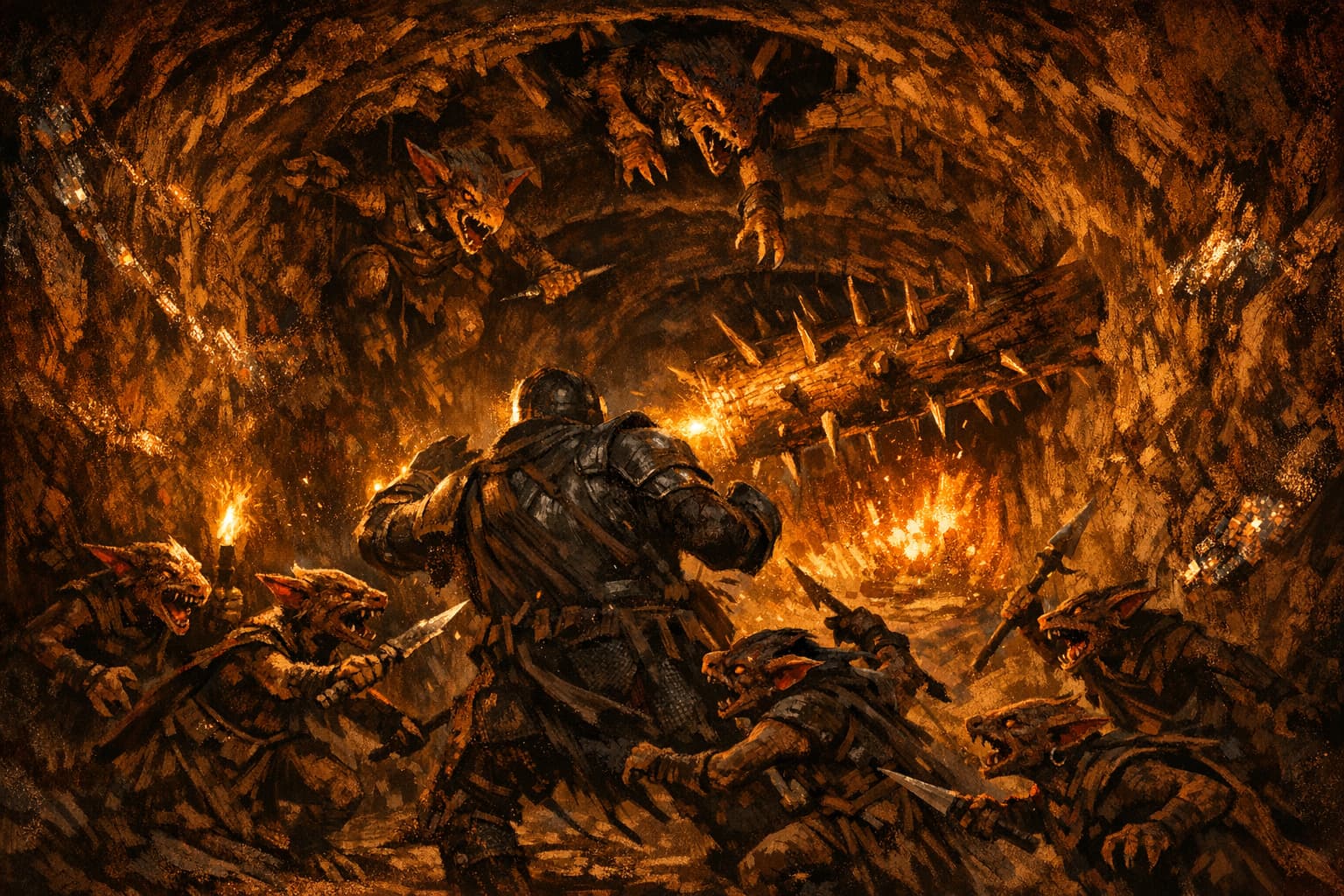
Being two feet tall in a world of six-foot adventurers is not a disadvantage if you plan for it. Kobold tunnel networks are sized so that Medium creatures must crouch, crawl, or squeeze — negating reach advantages, preventing shield use, and turning plate-armored fighters into slow, vulnerable targets. The kobold's small size is a feature of their defensive architecture, not a flaw in their biology. Every adventurer who has tried to chase a kobold through a two-foot-high tunnel while being pelted with caltrops understands this.
Psychology & Pack Mentality
Kobold psychology is collective first, individual second. This isn't hive-mind — individual kobolds have distinct personalities, preferences, and opinions. But a kobold's sense of self is embedded in group identity to a degree that most other species find difficult to comprehend. A kobold alone is anxious, diminished, incomplete. A kobold in a group of twenty is confident, creative, and far more dangerous than the arithmetic would suggest.
This is the mechanical truth behind Pack Tactics. The advantage on attack rolls when an ally is adjacent isn't just a combat bonus — it's a psychological reality expressed as a die roll. Kobolds fight better together because they think better together. Isolation is the cruelest punishment a kobold warren can inflict, worse than physical harm, because it removes the context that makes a kobold feel like a kobold.
The flip side of this collectivism is a willingness to sacrifice that other species find disturbing. A kobold will die to protect the warren without the dramatic heroism that humans attach to self-sacrifice. It's not brave — it's obvious. The warren matters more than any individual because individuals only exist in the context of the warren. This makes kobolds simultaneously admirable and alien. Their courage is absolute and their reasoning is fundamentally different from species that privilege individual survival.
“One kobold is a nuisance. Ten kobolds are a problem. A hundred kobolds, in tunnels they built, with traps they designed, defending a dragon they worship? That's a TPK waiting to happen.”
— Adventurer wisdom, widely attributed
Daily Life in the Warren
Warren life runs on a rotation system that never stops. Kobolds don't observe day-night cycles underground, so labor shifts, guard rotations, and communal meals follow an internal schedule maintained by designated timekeepers. Mining crews alternate with construction teams. Trap-setters work in shifts with trap-maintenance crews. Hunters and foragers operate on cycles timed to minimize surface exposure. The warren is a machine, and every kobold is a component.
Food in a kobold warren is communal, practical, and not remotely appetizing to outsiders. Subterranean fungi, cave insects, blind fish from underground streams, rats, bats, and whatever surface foragers bring back during nighttime raids. Kobolds eat efficiently rather than well. Meals are social events — one of the few times work pauses — but the food itself is fuel, not culture. A kobold who complains about the menu is a kobold with too much time on their hands. That said, long-established warrens do develop culinary preferences. Mushroom fermentation produces a sour drink that kobolds consume enthusiastically and outsiders describe as "aggressive."
Crafting occupies whatever time mining and defense don't claim. Kobolds make traps, obviously, but also tools, crude pottery, leather goods from cave-dwelling creatures, and surprisingly detailed religious carvings. The trap-making gets the attention, but kobold material culture is broader than their reputation suggests. A warren that has been stable for a generation accumulates craft traditions that rival any surface village.
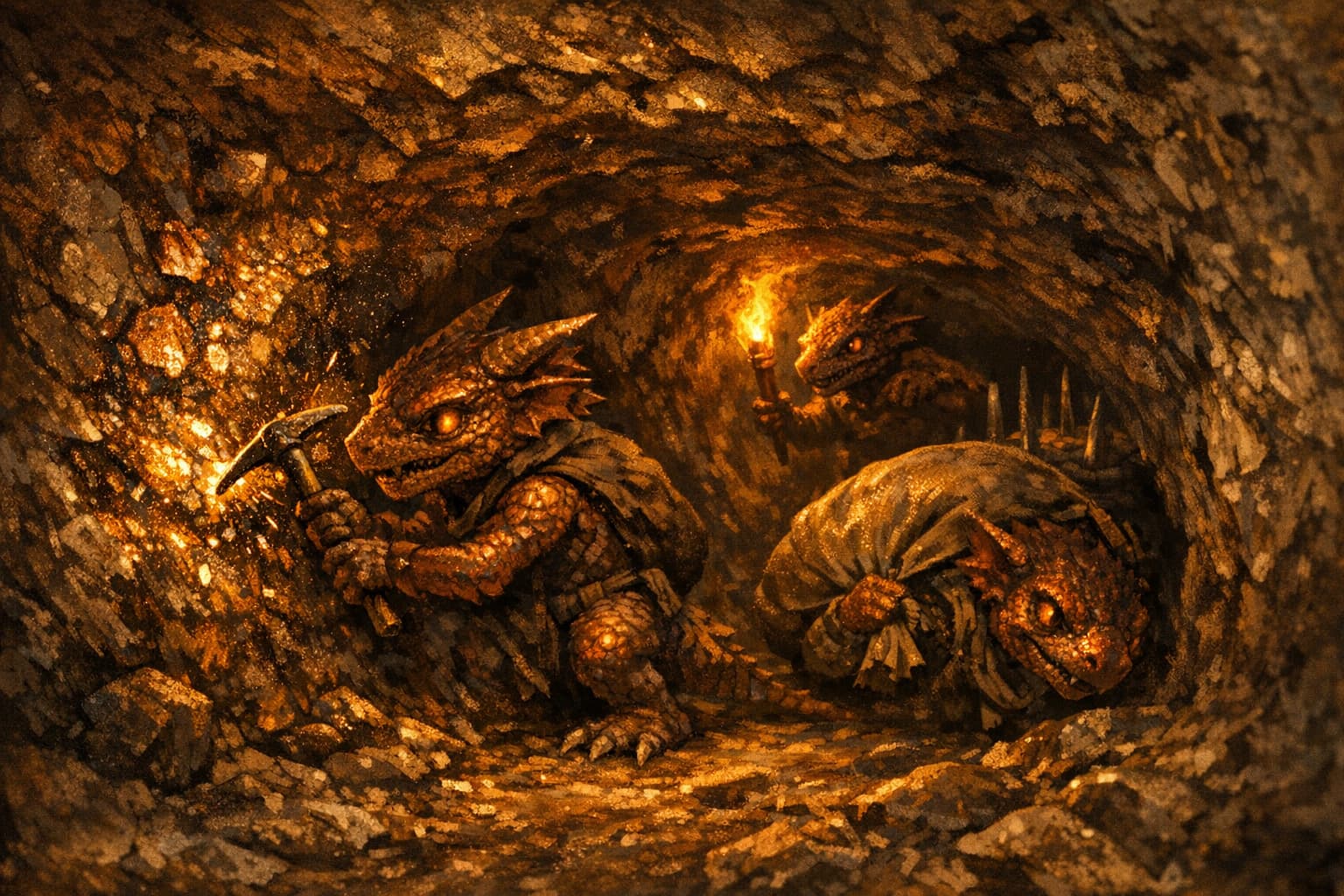
Mining is central to warren economy. Kobolds are gifted miners — their small size lets them follow narrow veins that dwarves would have to expand at enormous labor cost. A kobold mining crew can extract ore from deposits that larger species would write off as unprofitable. This mining expertise is one of the main reasons kobolds survive in a world that outclasses them physically: they produce value. A settlement that exterminates its local kobold warren may discover that the kobolds were the only ones working the marginal silver deposits that fed the regional economy.
Entertainment in a kobold warren trends toward the competitive and practical. Wrestling matches double as combat training. Trap-building contests produce innovations that improve warren defenses. Storytelling sessions around communal fires retell tribal history, draconic myths, and — most popularly — accounts of gnome defeats, embellished with each retelling until the original incident is unrecognizable. Humor exists but runs dark. Kobold jokes tend to involve someone getting crushed, poisoned, or tricked, which tells you something about what kobolds find funny and why other species find kobold humor unsettling.
Different settings treat kobold intelligence very differently. Forgotten Realms kobolds are cunning but unsophisticated. Eberron kobolds, particularly those in Droaam and the Shadow Marches, develop complex engineering and political alliances. Kobold Press's Midgard setting elevates kobolds to a major civilization with their own cities, ghetto-warrens in human capitals, and a tradition of mechanical invention. When building kobold NPCs, decide first which tradition you're drawing from — it changes everything.
Draconic Devotion & Warren Hierarchy
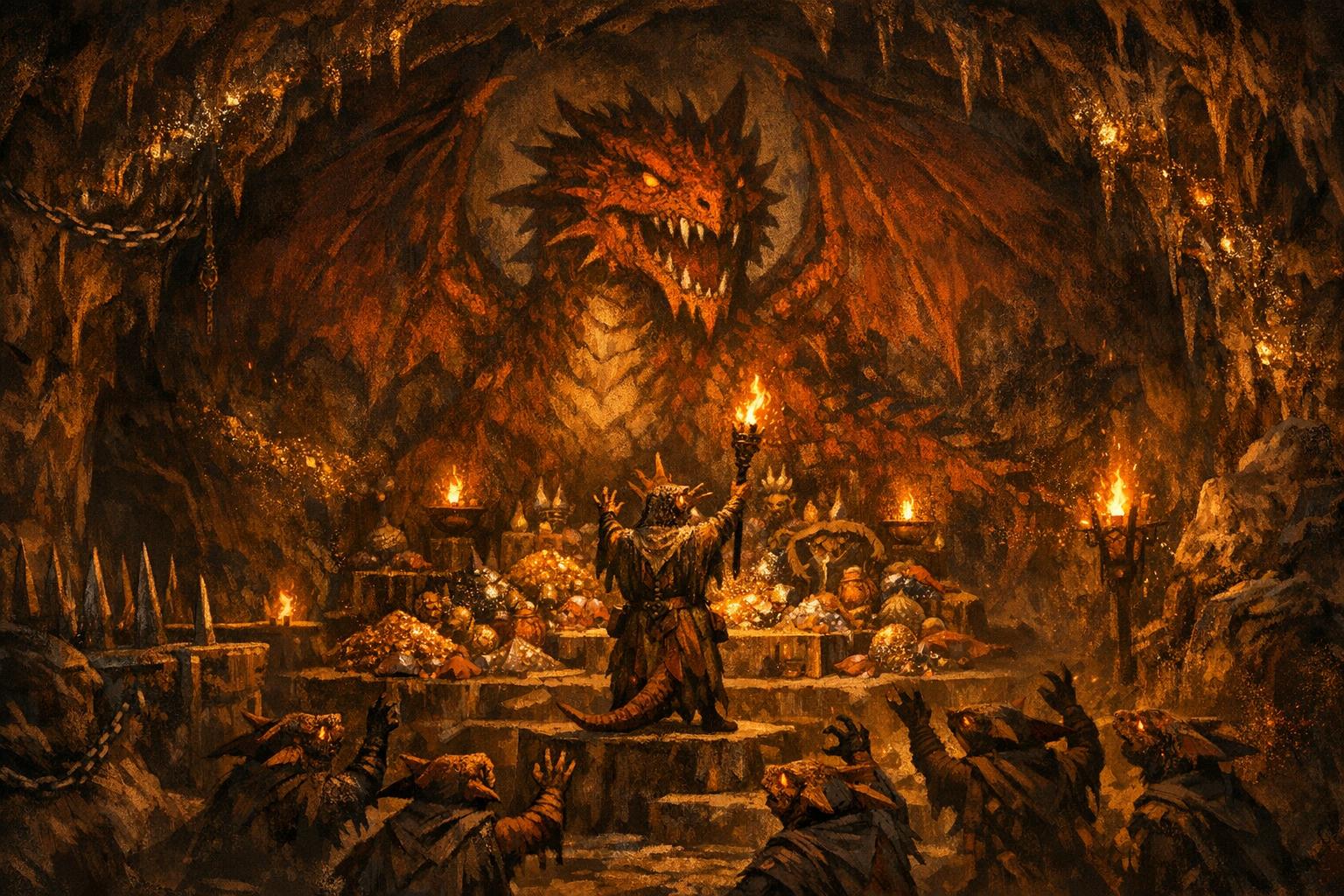
Kobold society orbits dragons the way planets orbit stars. A warren with a dragon patron — even a young, weak one — is a warren with purpose, direction, and a reason to believe they matter in a world that mostly treats them as vermin. The dragon doesn't have to be benevolent. It doesn't even have to be present. The belief that a dragon favors the warren is sufficient to organize an entire society.
This devotion is often dismissed as pathetic, which misses the point. Kobolds have correctly identified that individual kobolds are weak. They've correctly identified that dragons are the most powerful creatures in the material world. Attaching themselves to dragons is a rational survival strategy dressed in religious fervor. The kobold who serves a red dragon and gets eaten for dropping a goblet hasn't been foolish — they've been unlucky within a system that, on average, keeps more kobolds alive than the alternative.
Warren Hierarchy
Warren leadership follows a loose hierarchy: the dragon (if present) commands absolutely. Beneath the dragon sits the chief — typically the oldest or most cunning kobold, not necessarily the strongest. Shamans and sorcerers with draconic bloodlines hold spiritual authority. Trap-masters command engineering crews. Egg-wardens protect the nurseries. Every other kobold occupies a functional role — miner, hunter, guard, crafter — with status determined by contribution to the warren rather than birth.
Succession is rarely contested violently. Kobolds can't afford the population loss of internal power struggles. When a chief dies or becomes incapable, the shaman typically selects the next leader from among proven warren veterans. If the dragon has opinions, the dragon's opinion is final.
Draconic Bloodlines
Kobolds who manifest sorcerous abilities are treated as living proof of the warren's draconic heritage. Scale coloration matching a chromatic or metallic dragon, the ability to produce even a spark of elemental energy, or physical features like wing stubs elevate a kobold to near-priestly status. These individuals become sorcerers, advisors, and — in warrens without a dragon — substitute objects of veneration.
The kobold claim to draconic ancestry is debated in-setting. Dragons generally find the idea laughable or irrelevant. Scholars offer competing theories: divine creation by Tiamat, alchemical experiments gone wrong, or convergent evolution in draconic environments. Kobolds don't care about the academic debate. They know what they know. The dragon's blood runs in them, and no amount of scholarly skepticism changes how that feels.
Dragonborn-kobold relations are particularly fraught. Both species claim draconic heritage, but dragonborn are large, powerful, and respected while kobolds are small, fragile, and dismissed. Some dragonborn view kobolds as embarrassing cousins. Some kobolds view dragonborn as proof that draconic blood can elevate a species — and therefore as evidence that their own draconic claims are legitimate. The power differential makes mutual recognition awkward in either direction.
Kurtulmak — The Trapped God
Kurtulmak is the kobold deity, and his origin story is one of the most revealing myths in the D&D pantheon. He was the first kobold, the greatest kobold, the architect of the most perfect warren ever constructed. Then Garl Glittergold, the gnome god, collapsed the tunnels on him as a prank. Kurtulmak has been trapped, digging, raging in the dark ever since.
This myth accomplishes several things simultaneously. It explains the kobold-gnome enmity as a divine grudge that every kobold inherits. It frames kobold existence as fundamentally tragic — their god is buried alive, and they can hear him scratching at the walls. And it provides a theological justification for kobold tunnel-building: every warren is, symbolically, an attempt to dig Kurtulmak free. The species' defining activity is recast as an act of devotion.
Kobold religious practice reflects this trapped-god theology in ways that surface religions rarely match. There are no grand temples — Kurtulmak is underground, so worship happens underground. Shrines are carved into tunnel walls, often at junctions or dead ends, featuring crude but earnest depictions of the god digging. Offerings are practical: the first good ore from a new vein, a trap mechanism that worked perfectly, a gnome skull if one is available. The aesthetics are functional because the god they worship is a god of function — mining, trapping, surviving.
Kurtulmak's portfolio — traps, mining, war — maps directly onto kobold survival skills. He's not a god of abstract virtues. He's a god of the specific things kobolds need to not die. This pragmatism extends to kobold worship practices. Prayers are short, functional, and usually accompany work rather than interrupting it. A miner whispers to Kurtulmak while swinging a pickaxe. A trap-maker dedicates a particularly clever mechanism. Worship and labor are the same activity.
The theological rivalry between Kurtulmak and Garl Glittergold is one of D&D's richest divine conflicts because the moral framing depends entirely on perspective. To gnomes, Garl played a prank — mischievous, maybe excessive, but fundamentally in character for a trickster god. To kobolds, Garl committed an act of cosmic cruelty against their creator, and every gnome carries the guilt of their god's crime. Neither side is entirely wrong.
Not all kobolds worship Kurtulmak. Dragonborn-aligned kobolds may venerate Tiamat directly. Kobolds in Eberron follow the Sovereign Host or the Dark Six. Pathfinder's kobolds have their own deity in Apsu (dragon god) or regional spirits. When running kobolds, choose whether Kurtulmak-worship is universal, dominant, or just one tradition among several — the answer shapes how monolithic or diverse your kobold cultures feel.
Tucker's Kobolds — Trap Engineering
In 1987, Roger E. Moore published a short editorial in Dragon Magazine #127 that changed how an entire generation thought about kobolds. "Tucker's Kobolds" described a DM named Tucker whose kobolds — ordinary, low-hit-point, no-magic kobolds — consistently terrorized parties of 12th-level and higher characters. Not through buffed stats or magical assistance. Through traps, terrain, and tactics.
Tucker's kobolds used murder holes, flaming oil, collapsing corridors, and coordinated ambushes from positions that high-level adventurers couldn't easily reach. They attacked supply lines, targeted spellcasters through arrow slits, retreated through tunnels too small for pursuers, and reoccupied positions the party thought they'd cleared. The editorial wasn't about kobold lore — it was about DM philosophy. But it accidentally created the defining image of kobolds as tactical geniuses who compensate for physical weakness with environmental mastery.
The trap engineering that Tucker's Kobolds popularized has become central to the species' identity. A well-designed kobold encounter isn't a combat — it's a puzzle. The kobolds aren't trying to out-fight the party. They're trying to make the environment fight for them. Pit traps with spikes. Corridors that flood with alchemist's fire. Ceilings rigged to drop. Alarm systems made of tin cans and string. Every piece of the warren is a potential weapon, and the kobolds know where every trigger is.
This approach transforms kobolds from forgettable low-level enemies into memorable threats at any tier. A 15th-level fighter can kill a hundred kobolds in straight combat. That same fighter, crawling through a two-foot-high tunnel toward the sound of clicking mechanisms, is in genuine danger. Tucker's Kobolds proved that intelligence and preparation are more dangerous than hit points and damage dice, and kobolds have owned that lesson ever since.
The legacy extends beyond D&D. "Tucker's Kobolds" has become shorthand in game design for any scenario where weak enemies become dangerous through intelligent use of terrain and preparation. Video game designers cite it when discussing enemy AI. Military tacticians have drawn parallels to guerrilla warfare and asymmetric conflict doctrine. A two-page editorial about a tabletop game from 1987 became one of the most influential pieces of game design writing ever published, and it's fundamentally a love letter to the smallest monster in the book.
Classic Kobold Trap Types & Tactical Applications
| Trap Category | Example | Tactical Purpose | Counter-Play Challenge |
|---|---|---|---|
| Area denial | Flooding tunnels, alchemist fire channels | Force invaders into kill zones | Requires water breathing or fire resistance — resources spent before the real fight |
| Structural collapse | Rigged ceilings, undermined floors | Eliminate heavy-armor targets, block retreat | Perception checks in dim light while under fire |
| Harassment | Murder holes, arrow slits, caltrops | Attrit HP and spell slots over time | Clearing each position costs time and resources while the clock ticks |
| Psychological | Alarm bells, decoy tunnels, false retreats | Create paranoia, slow advance to a crawl | Even detecting the trick costs the party attention and momentum |
| Environmental | Smoke, darkness, narrow passages | Negate size and equipment advantages | Forces adaptation — remove armor, abandon formation, split the party |
The genius of Tucker's Kobolds was proving that a DM who thinks like a kobold is more dangerous than a DM who gives kobolds better stats.
Inter-species Relationships & Notable Kobolds
The kobold-gnome enmity is D&D's most lopsided species rivalry. Gnomes treat it as a theological footnote and occasional nuisance. Kobolds treat it as an existential blood feud mandated by divine trauma. This asymmetry makes it more interesting than the orc-elf or dwarf-goblin conflicts because the intensity is so unevenly distributed. A gnome player character might not even mention kobolds unprompted. A kobold player character has opinions about gnomes that could fill a manifesto.
With dragons, the relationship is simultaneously servile and aspirational. Kobolds serve dragons willingly, eagerly, fanatically — but they also believe themselves to be distant draconic kin. The service isn't purely subservient. It's devotional, the way a lesser priest serves a higher power while believing they share the same divine spark. This creates a relationship that's simultaneously hierarchical and intimate, which makes for complicated storytelling when the dragon is cruel.
Kobolds interact with goblins and other underground species as competitors for the same ecological niche. Goblin-kobold conflicts tend to be territorial, resource-driven, and bitter without the mythological weight of the gnome rivalry. Goblins are louder, more chaotic, and less architecturally sophisticated, which kobolds find contemptible. Goblins, in turn, find kobold discipline oppressive and their dragon-worship pretentious. The conflicts are petty, frequent, and deeply felt on both sides.
With larger species — humans, orcs, dwarves — kobolds default to avoidance. Direct confrontation with bigger, stronger beings is a losing strategy, so kobold communities near surface settlements tend to stay hidden, raid cautiously, and negotiate from concealment when forced to interact at all. Dwarven-kobold interactions are particularly tense because both species are underground miners competing for the same deposits. Dwarves regard kobolds as pests that collapse good tunnels. Kobolds regard dwarves as arrogant claim-jumpers who refuse to acknowledge kobold mining rights. The grudge lacks the theological dimension of the gnome enmity but makes up for it in day-to-day bitterness.
For a species historically treated as the game's punching bag, kobolds have produced a surprisingly devoted following. The "kobold fan" is a recognizable type in the D&D community — someone who champions the underdog, appreciates tactical creativity, and finds the species' combination of pathetic circumstances and lethal ingenuity irresistible. Kobolds inspire affection precisely because they shouldn't be threatening and are.
Several individual kobolds have achieved lasting fame in the community, which is remarkable for a species whose identity is fundamentally collective. Each famous kobold tends to embody a different aspect of what makes the species compelling — the loyalty, the cleverness, the sheer refusal to accept their position at the bottom of the food chain.
The kobold's cultural footprint extends beyond official D&D materials. Kobold Press, one of the largest third-party D&D publishers, took their company name from the species — a declaration of intent that identified with the scrappy, underestimated, punching-above-their-weight creature rather than the dragons, demons, or heroes that dominate fantasy branding. The choice says everything about how the D&D community actually feels about kobolds: they're not just monsters. They're an attitude.
Allies of Convenience
Kobolds will work with almost anyone who offers a tangible benefit and doesn't try to eat them. Orc warbands sometimes employ kobold scouts and sappers, valuing their trap expertise while treating them as expendable. Hobgoblin legions integrate kobold engineers into their military structure more formally — hobgoblin discipline and kobold ingenuity produce siege capabilities neither species achieves alone. Even human settlements occasionally reach uneasy truces with nearby warrens, trading surface goods for mined ore.
Enemies by Default
Adventurers are the kobold's primary predator. Not wolves, not owlbears — adventuring parties that clear warrens for experience points and treasure. This creates a darkly ironic dynamic: the species most famous for clever defense evolved that cleverness specifically because it's the species most frequently attacked by protagonists. Kobold trap engineering is, functionally, an evolutionary response to player characters. Every innovation in kobold defense is a response to some previous party that kicked down the door and started swinging.
Notable Kobolds in D&D Lore & Community
| Name | Source | Significance |
|---|---|---|
| Meepo | The Sunless Citadel (2000/2017) | The kobold who lost his dragon. Meepo became an icon of kobold pathos — desperately loyal, completely outmatched, and somehow endearing. Players who killed him felt bad about it afterward, which was the point. |
| Spurt | Critical Role (Campaign 2) | A kobold NPC who lived for eleven real-time minutes before dying heroically. Sam Riegel's brief portrayal crystallized the kobold experience: brief, intense, absurd, and oddly moving. |
| Pun-Pun | D&D 3.5e optimization forums | A theoretical kobold build that achieved functionally infinite stats through rules exploits. Pun-Pun became a meme about the gap between kobold lore (weakest species) and kobold mechanics (breakable with sufficient creativity). |
| Deekin Scalesinger | Neverwinter Nights: SoU/HotU | A kobold bard companion who wrote terrible poetry and stole scenes from the player character. One of the first kobold NPCs treated as a full character rather than a target. |
| Kurtulmak (as NPC) | Various campaign settings | The kobold god himself, occasionally encountered in his collapsed domain. Stat blocks exist for DMs brave enough to let players try to free him. |
Meepo's popularity led to kobolds appearing more frequently as sympathetic NPCs in published adventures. A single pathetic dragon-keeper changed the species' narrative trajectory.
The most interesting kobold-gnome encounters don't start with combat. They start with the realization that both sides are present and the escalation that follows. A gnome NPC who dismisses the kobold-gnome feud as "ancient history" while standing next to a kobold PC who considers the gnome's existence a personal affront generates roleplay tension that no combat encounter can match.
Kobold Mechanics Across Editions
Kobold mechanical design tells a fifty-year story about what D&D thinks weakness means. In early editions, kobolds were weak because they were meant to be killed easily. In middle editions, they were weak but given tools — Pack Tactics, trap proficiency, tunnel-building rules — that made weakness contextual. In the 2024 rules, they're not weak at all. Draconic Cry, flexible ability scores, and core species status mean kobolds can stand next to any other player species without mechanical apology.
The evolution of Pack Tactics is particularly telling. Introduced as a monster trait, it perfectly captured the kobold philosophy: alone they're nothing, together they're dangerous. When it carried over to playable kobolds alongside sunlight sensitivity, it created a species defined by a tension between power-in-numbers and vulnerability-in-light. The 2024 removal of sunlight sensitivity and the addition of Draconic Cry shifts the identity from "scrappy survivor" to "draconic inheritor," which is a different fantasy entirely.
This mechanical evolution mirrors a broader design question: should kobolds be defined by their limitations or their strengths? The best answer is probably both. A kobold whose mechanics emphasize teamwork, cleverness, and draconic heritage — without pretending they're physically equivalent to a goliath — captures the species fantasy that players actually want. You're small, you're fragile, you're brilliant, and you have a dragon's fire in your veins. That's a character concept worth playing.
- Infravision 60 ft.
- -1 to hit in daylight
- Attack in large groups (40-400)
- Set traps and ambushes
The original kobold — half a hit die, sunlight penalty, and dangerous only in swarms. Described as dog-like. Their defining trait was numerical superiority.
- Darkvision 60 ft.
- Pack Tactics (advantage when ally within 5 ft. of target)
- Sunlight Sensitivity (disadvantage on attacks and Perception in sunlight)
- Grovel, Cower, and Beg (distract enemies to grant allies advantage)
The Volo's kobold was a masterclass in trade-off design. Pack Tactics was one of the strongest racial features in the game, balanced by crippling sunlight sensitivity. Players who built around the strengths while mitigating the weakness were rewarded with extraordinary combat effectiveness.
- Darkvision 60 ft.
- Draconic Cry (bonus action shout grants advantage to allies attacking enemies within 10 ft. of you)
- Kobold Legacy (choice: Draconic Sorcery cantrip, Defiance skill, or Draconic Craft tool)
Core species with no penalties. Draconic Cry replaces Pack Tactics with a similar but more versatile effect. Sunlight sensitivity is gone entirely. The 2024 kobold is a legitimate protagonist species rather than an underdog defined by disadvantage.
Across Franchises
The kobold concept fractures more dramatically across franchises than almost any other fantasy creature, partly because the folkloric source material is so broad. D&D's reptilian trap-builders, Pathfinder's draconic inventors, World of Warcraft's candle-worshipping engineers, and the original Germanic mine spirits share a name and not much else. Each version answers the same question differently: what does it mean to be the smallest, weakest intelligent species in a world that wants to eat you?
The answer is usually some form of compensatory intelligence, which is why kobolds — despite their low status in most settings — are among the most mechanically and narratively interesting species in fantasy. A species defined entirely by how it overcomes disadvantage is inherently more dynamic than a species defined by the advantages it was born with.
What's consistent across every franchise is the emotional register: kobolds are simultaneously pathetic and admirable, laughable and lethal, disposable and indispensable. That contradictory identity is why players love them. You root for the kobold because the kobold has no business surviving, and it survives anyway, through sheer collective stubbornness and a willingness to drop the ceiling on anyone who underestimates them.
Kobold Archetype Across Franchises
| Franchise | Kobold Identity | Core Theme | Key Distinction |
|---|---|---|---|
| D&D | Reptilian dragon-worshippers, trap-builders | Collective survival through environmental mastery | Pack Tactics and warren architecture define the species mechanically and narratively |
| Pathfinder | Draconic inventors with tribal pride | Clever adaptation and draconic ancestry claims | More heroic portrayal; kobolds as scrappy innovators rather than disposable minions |
| World of Warcraft | Candle-obsessed underground miners | Comic survival in a hostile world | Played entirely for comedy; "You no take candle!" is their cultural thesis |
| Kobold Press (Midgard) | Urban and underground civilizations | Political complexity and craft guilds | Most sophisticated kobold society in any setting; full cities, trade networks, political intrigue |
| Germanic folklore | Mine and house spirits | Nature spirits of underground and domestic spaces | The original — invisible, helpful or vengeful, associated with cobalt and cave-ins |
D&D and Pathfinder kobolds have diverged significantly. Pathfinder's version leans into inventor-hero energy, while D&D's retains more of the "dangerous vermin" tension that makes the species compelling to play against type.
“Every franchise that includes kobolds eventually has to answer the same question: is it possible to be the weakest thing in the world and still matter? The answer is always yes, and the method is always intelligence applied with desperate creativity.”
— On the kobold archetype in fantasy
FAQ
Common Questions
Kobolds are compelling precisely because of their weakness. Playing a kobold means engaging with the world as an underdog — every victory is earned, every survival is an achievement, and the creativity required to overcome physical disadvantage produces more interesting gameplay than a species that starts with every advantage. There's also the Tucker's Kobolds legacy: the community respects a species that can threaten high-level parties through intelligence alone. Players who choose kobolds are making a statement about what they value — cleverness over power, teamwork over individual glory, and the satisfaction of winning a fight the stat block says you should lose.
Think like a defender, not a monster. Kobolds know their warren intimately — every trap trigger, escape tunnel, and choke point. They won't stand in a room waiting to be killed. They'll attack from murder holes, retreat through passages too small for the party, reset traps behind the adventurers, and target the squishiest party member through arrow slits. Use waves, not a single encounter. Let the party clear a room, then have kobolds reoccupy it from a hidden passage. Make the warren itself the enemy, not the individual kobolds. And give the kobolds a goal beyond "fight to the death" — they're protecting eggs, guarding a dragon, or buying time for an evacuation.
Absolutely, and dragonless warrens are often more interesting than those with a patron. A kobold community without a dragon has to find its own purpose — which might be surviving, building, expanding, or searching for a dragon to serve. The search itself can drive an entire campaign arc. Alternatively, a dragonless warren might develop heretical theology, worshipping Kurtulmak directly, venerating a long-dead dragon's bones, or even rejecting draconic hierarchy entirely. The absence of a dragon creates a power vacuum that generates narrative possibilities a satisfied, dragon-ruled warren doesn't.
This is one of D&D's best built-in character dynamics. The key is that the enmity is asymmetric — the kobold cares far more about it than the gnome. A kobold PC might seethe with theological rage while the gnome PC has no idea why. Play this gap for drama and comedy: the kobold who grudgingly admits the gnome's trap-disarming skills are useful, the gnome who keeps accidentally insulting kobold religion by mentioning Garl Glittergold. The best version isn't permanent hostility — it's two characters whose cultures say they should hate each other discovering that the person next to them in the dungeon is actually pretty good at keeping them alive.