
Lizardfolk
Cold-blooded pragmatists who survived the age of dinosaurs and see no reason sentiment should interfere with survival
Reptilian Roots in Myth & Legend
Reptilian humanoids haunt the margins of nearly every mythological tradition. The Nagas of Hindu and Buddhist mythology, the feathered serpent Quetzalcoatl of Mesoamerica, the dragon kings of Chinese folklore, the serpent people of Aboriginal Australian dreamtime — wherever warm-blooded civilizations emerged, they imagined cold-blooded counterparts watching from the water, older and less comprehensible.
What separates lizardfolk from other reptilian fantasy species is their lack of grandeur. They are not dragons. They are not serpent gods. They are practical, territorial, and profoundly uninterested in the mythic narratives that mammals construct. If dragons represent the terrible majesty of the reptilian world, lizardfolk represent its daily reality: patient, efficient, and indifferent to anything that does not contribute to survival.
The real-world inspiration is less mythology than biology. Crocodilians, monitor lizards, and marine iguanas demonstrate the traits lizardfolk embody: ambush predation, environmental patience, and a metabolic relationship with the world that mammals find deeply alien. A crocodile does not hate its prey. It does not love its territory. It simply occupies the ecological niche its body was built for. Lizardfolk bring that sensibility to a humanoid frame, and the result unnerves every warm-blooded species they encounter.
Reptilian Humanoids in World Mythology
| Tradition | Figure | Nature | Lizardfolk Parallel |
|---|---|---|---|
| Hindu / Buddhist | Nagas | Serpentine water-guardians with vast wisdom | Territorial aquatic species with ancient knowledge |
| Mesoamerican | Cipactli | Primordial crocodilian earth-monster | Swamp-dwelling predator older than mammalian civilization |
| West African | Ninki Nanka | River-dwelling reptilian spirit | Feared marsh predator misunderstood by outsiders |
| Aboriginal Australian | Rainbow Serpent | Creator-being tied to water and landscape | Deep connection between reptilian species and waterways |
| Sumerian | Mushussu | Composite serpent-beast of the gods | Reptilian nature as divine or primordial rather than evil |
Unlike dragons and nagas, lizardfolk occupy the non-mythic register of reptilian fantasy — practical survivors rather than cosmic forces.
Cold-Blooded Biology
Lizardfolk biology diverges from mammalian norms in ways that affect every aspect of their behavior, culture, and relationship with other species. They are ectothermic — cold-blooded — which means their metabolism, energy levels, and even their cognitive processing speed fluctuate with ambient temperature. A lizardfolk in warm sunlight is alert, fast, and dangerous. The same lizardfolk in freezing conditions becomes sluggish, dull, and vulnerable.
Natural Armor
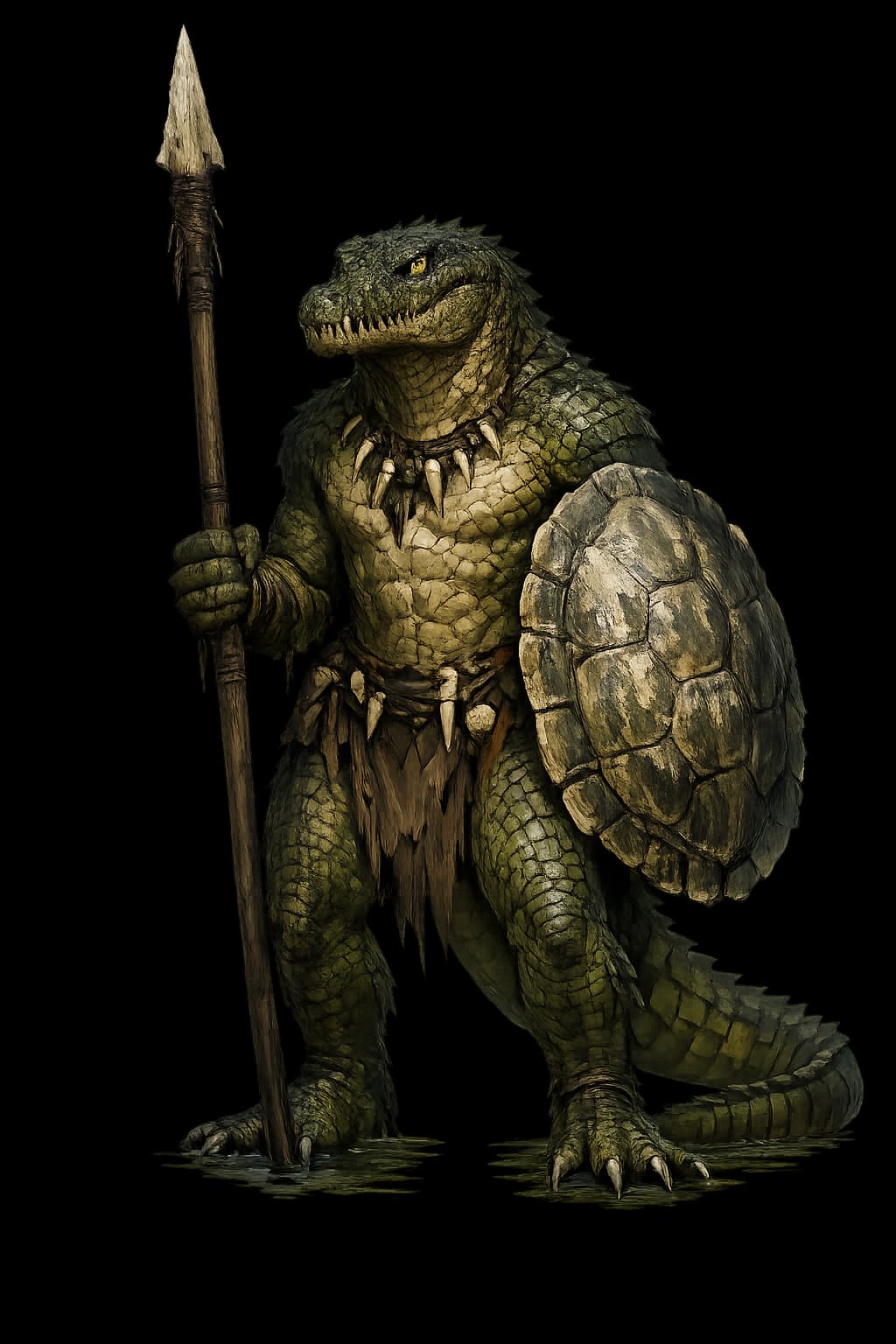
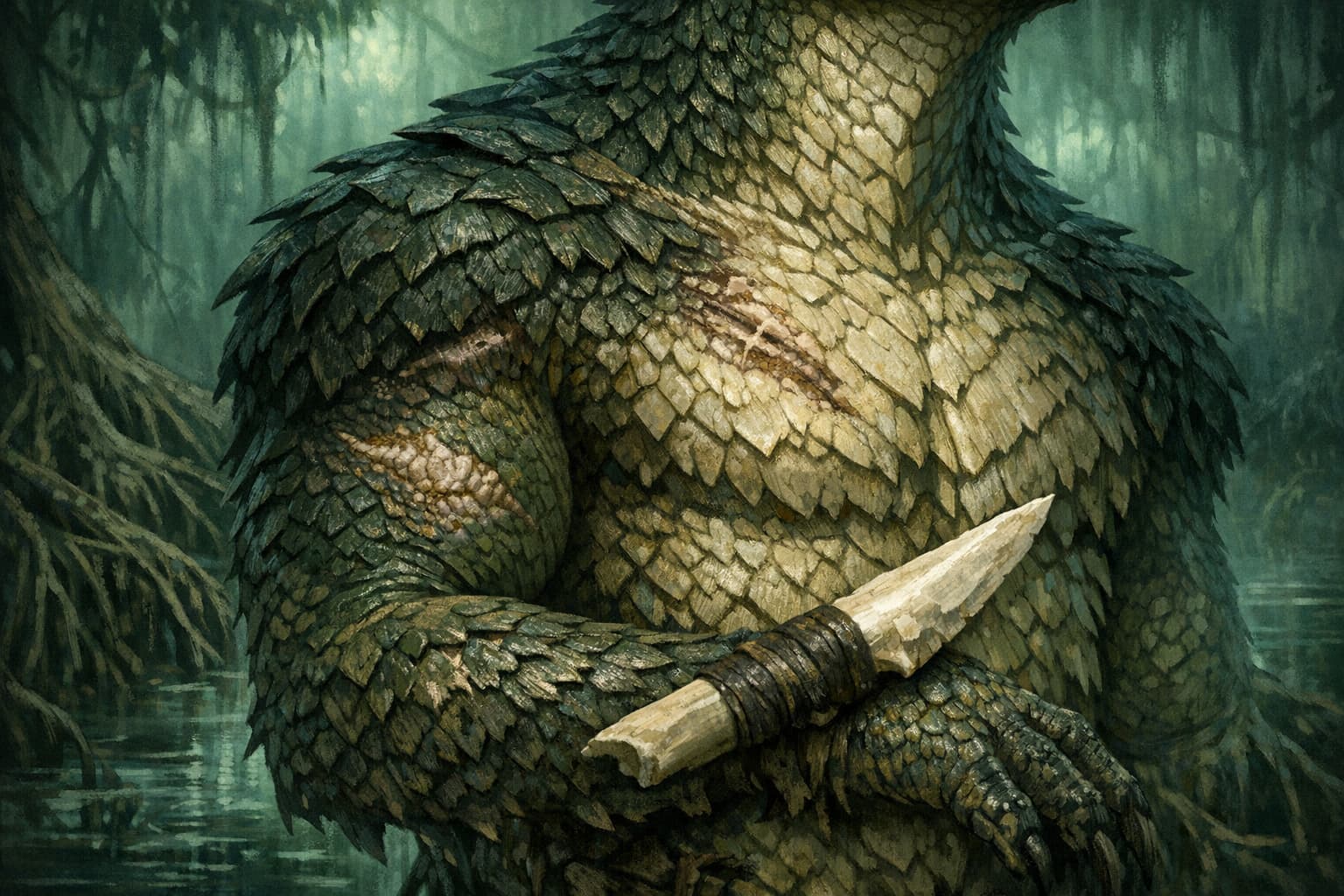
Lizardfolk scales provide protection equivalent to light armor without the weight, noise, or cost. The scales are not decorative. They are dense, overlapping keratinous plates that deflect glancing blows and reduce the severity of cuts. This natural armor is the reason most lizardfolk see manufactured armor as redundant — why carry extra weight when your skin already does the job?
The scales molt periodically, with old layers shedding in patches over the course of several weeks. Molting lizardfolk are irritable and physically uncomfortable, which mammalian companions sometimes mistake for aggression. Understanding the molt cycle prevents unnecessary conflict.
Bite & Jaw Strength
The lizardfolk jaw is a weapon. Powerful enough to crush bone, equipped with conical teeth designed for gripping rather than chewing, and backed by neck muscles that allow a sustained death-grip. In combat, the bite is not a last resort — it is a natural part of a lizardfolk fighting style that integrates weapons, claws, and teeth into a single fluid approach.
Socially, the bite carries different weight than a weapon strike. Using a weapon is combat. Using your jaw is personal. Lizardfolk who bite in a dispute are making a statement about dominance that transcends the immediate conflict.

Aquatic Adaptation
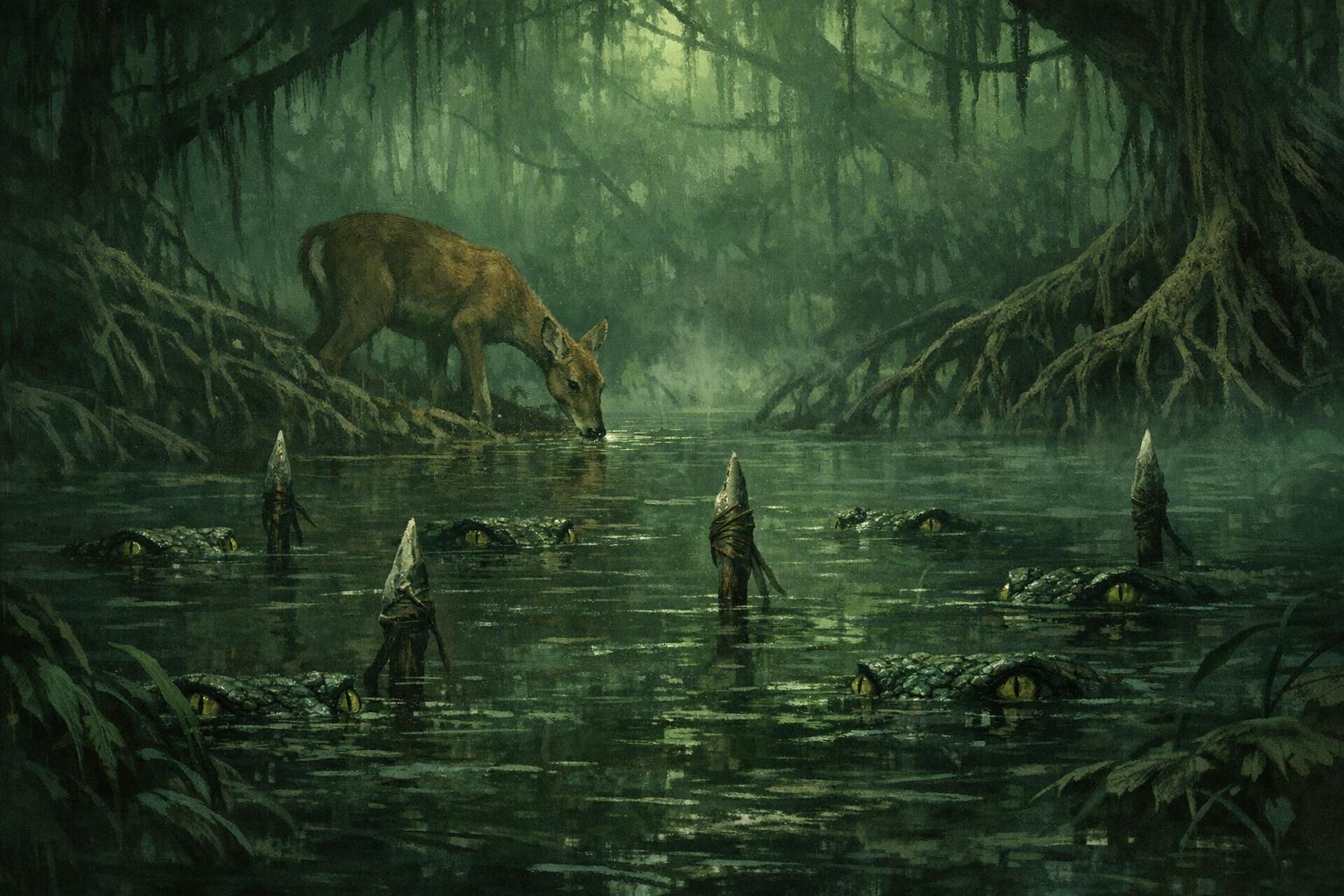
Lizardfolk swim speed (30 feet in 5e) understates their aquatic capability. They can hold their breath for extended periods — fifteen minutes or more — and their eyes function clearly underwater. They sleep partially submerged when conditions allow, with nostrils above water and the rest of the body hidden. For lizardfolk, water is not an obstacle. It is home advantage.
This aquatic capability shapes every tactical encounter. A lizardfolk who can disappear into three feet of murky water and reappear behind you has a fundamentally different relationship with battlefield terrain than any terrestrial species.
Alien Pragmatism
This is the section that matters most for playing a lizardfolk, and it is the hardest for mammalian players to internalize. Lizardfolk do not lack emotions. They experience satisfaction, discomfort, interest, and alarm. What they lack is the mammalian framework that layers sentiment, nostalgia, guilt, and attachment onto those base emotional states. A lizardfolk feels hunger and then eats. A human feels hunger and then agonizes over whether eating the last ration is selfish.
The most commonly cited example is their relationship with death. When a lizardfolk companion dies, the surviving lizardfolk do not mourn. They assess. Is the body useful? Can the meat feed the tribe? Can the bones become tools? Can the hide become shields? A dead companion is a resource, and letting resources rot is the only true offense against survival. This is not cruelty. It is not disrespect. It is a worldview in which waste — not death — is the fundamental wrong.
Mammalian adventurers find this horrifying, which is itself confusing to the lizardfolk. You buried your dead companion in the ground where the meat feeds nothing but worms, the bones become nothing but dust, and the hide rots into uselessness. You did this and called it "honor." The lizardfolk turned their companion into food that kept the tribe alive for three days and a shield that protected a hunter for two seasons. Which response actually values the dead?
This alien pragmatism extends to every domain mammals consider emotional. Art exists only if it serves a function — decorating a shield to intimidate enemies is craft, but painting a sunset because it is beautiful is incomprehensible. Romantic attachment is unnecessary when mating is seasonal and driven by fitness assessment rather than bonding. Promises matter only insofar as breaking them has practical consequences. A lizardfolk does not understand loyalty as an abstract virtue. They understand mutual advantage, and they honor it for exactly as long as it remains mutual.
The struggle to understand mammalian psychology is the richest vein of lizardfolk roleplaying. A lizardfolk who has traveled with warm-blooded companions for months may begin to mimic emotional responses without understanding them. They learn that saying "I am sorry for your loss" prevents mammals from becoming upset, even though the statement communicates nothing useful. They learn that giving gifts creates social bonds, even though the gift-object has no survival value. They are, in essence, learning a foreign emotional language by rote, and the gaps in their fluency produce moments that are alternately hilarious and devastating.
A lizardfolk adventurer who keeps a "journal of mammalian behaviors" — cataloguing emotional responses they have observed but do not understand — is one of the best character concepts the species enables. Each entry is an attempt to decode warm-blooded psychology: "The dwarf became angry when I suggested we eat the dead horse. He had not ridden the horse in three days. The horse was not useful. The dwarf was not hungry. I do not understand the anger."
“You weep for the dead and let the meat spoil. I do not weep and the tribe eats. Tell me again which of us dishonors the fallen.”
— Lizardfolk response to a human funeral rite
Daily Life & Tribal Rhythms
Lizardfolk daily routines are dictated by temperature and light to a degree that no mammalian species experiences. Dawn brings basking — the tribe gathers on sun-warmed rocks or exposed mud to raise their body temperature to operational levels. This is not leisure. It is as necessary as breakfast, and a lizardfolk deprived of morning basking is measurably slower, less alert, and more irritable for the entire day.
Once warm, the tribe disperses into its functional roles. Hunters move to the territory perimeter and beyond. Crafters work bone, wood, hide, and stone into tools and weapons. Egg-tenders monitor the communal clutch. Sentries patrol waterways and approach routes. There is no idle time in a lizardfolk settlement — every individual has a function, and the function is performed until conditions change.
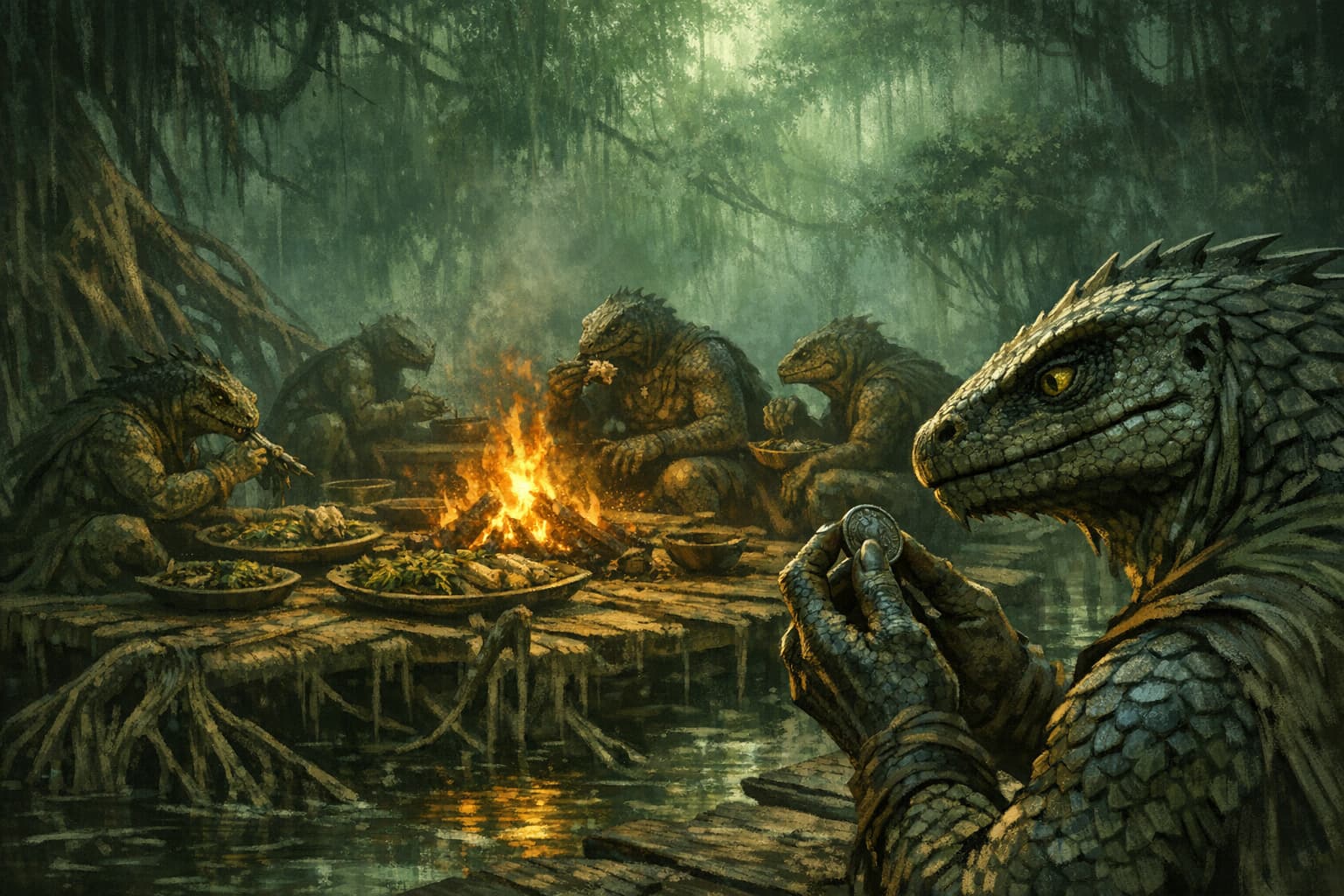
Communal decision-making happens during the evening cooling period, when the tribe gathers to share food and information. The eldest and most experienced lizardfolk speak, not because age confers authority in any formal sense, but because survival to old age in a swamp full of predators is itself proof of competence. Decisions are practical: where to hunt tomorrow, whether the territory can sustain the current population, whether an approaching threat requires relocation or defense.
Culture: Purpose Over Beauty
Lizardfolk do not have a concept of art for its own sake, and this absence reveals more about what "art" means than any aesthetic theory could. When a lizardfolk carves a pattern into a shield, the pattern serves a purpose: it identifies the carrier's tribe, intimidates enemies, or commemorates a successful hunt that teaches useful information about prey behavior. If the pattern is also beautiful by mammalian standards, that is incidental. The lizardfolk did not intend beauty. They intended function.
This does not mean lizardfolk material culture is crude. Their bone-carving is intricate. Their weaving of reeds into waterproof shelters demonstrates sophisticated engineering. Their weapons are balanced, sharp, and ergonomically suited to their grip. The craftsmanship is excellent — it simply is not motivated by aesthetics. A perfectly crafted javelin is not beautiful to a lizardfolk. It is correct.
What Lizardfolk Create
Bone weapons and tools: javelins, daggers, fishhooks, needles, and scraping implements fashioned from the bones of prey animals and — yes — deceased tribe members. The material is strong, renewable, and carries no cultural taboo.
Hide shields and armor: treated animal skins stretched over wooden frames. Lizardfolk leatherwork is waterproof by necessity and surprisingly durable. Shields decorated with tribal markings serve identification and intimidation functions.
Reed and wood structures: huts, platforms, fish traps, and storage containers woven from marsh materials. These structures are temporary by design — a tribe that may relocate seasonally does not invest in permanent architecture.
What Lizardfolk Do Not Create
Music for entertainment: lizardfolk produce rhythmic vocalizations during mating season and territorial displays, but these serve biological functions. The concept of "a song you sing because it sounds pleasant" does not translate.
Visual art without function: no paintings, sculptures, or decorative objects. When lizardfolk encounter mammalian art galleries, the typical response is confusion. "You made this object. It does nothing. Why?"
Written literature: oral tradition exists in the form of survival knowledge passed between generations, but storytelling as entertainment is a mammalian import. Lizardfolk who adopt it from companions treat it as a social bonding tool rather than an art form.
Etymology & Naming Conventions
The name "lizardfolk" is bluntly descriptive in a way that tells you everything about how other species perceive them. Not "the Scaled People" or "Children of the Marsh" — just lizardfolk. Folk who are lizards. The name was coined by outsiders and accepted by lizardfolk themselves with characteristic indifference. Names are tools. This one communicates species identity. It functions. Why would they care what it sounds like?
Lizardfolk personal names tend toward sibilant consonants and short syllables: Arashk, Sseth, Kessht, Othokent. These names are adapted for a mouth built around a different jaw structure and a forked tongue. Mammalian adventurers frequently mispronounce them, and lizardfolk rarely correct the error. The mispronunciation communicates identity well enough. Precision in pronunciation is a mammalian concern.
In their own communities, lizardfolk often use descriptive identifiers rather than fixed names. "The one who catches the silver fish" or "the one who lost three fingers to the crocodile" serve as identifiers that update as circumstances change. A fixed name that follows you from birth to death is a mammalian invention that lizardfolk adopted for the practical purpose of interacting with species that insist on them.
“You gave me a name because you needed one for me. I use it because correcting you would take longer than accepting it.”
— Lizardfolk response to a census-taker, attributed
History in D&D Editions
Lizardfolk have been in D&D since the first Monster Manual in 1977, making them one of the oldest species in the game. For most of that history, they were treated as monsters — territorial swamp creatures that attacked adventurers who wandered into their marshes. The shift from monster to potential player character happened slowly and is still incomplete.
What changed was not lizardfolk themselves but how the game thought about non-mammalian intelligence. Early D&D assumed that anything with an alien psychology was either evil or too strange to roleplay. Modern D&D recognizes that "thinks differently than humans" is not a barrier to playability — it is, in fact, the entire point of playing a non-human species.
The 5e publication of Volo's Guide to Monsters (2016) marked the turning point. For the first time, lizardfolk received a detailed psychological profile that treated their alien pragmatism as a feature rather than a limitation. The text explicitly described how lizardfolk process emotions differently, view death without sentiment, and struggle to understand mammalian concepts like art for its own sake. Players responded enthusiastically. It turns out that playing a character who genuinely does not understand why you are crying is compelling roleplaying material.
1e Monster Manual
Lizardfolk (listed as "Lizard Men") appear as swamp-dwelling humanoid monsters. Territorial, tribal, and treated as a combat encounter rather than a culture.
Expert Set (B/X)
Lizardfolk appear in wilderness encounter tables as swamp threats. No cultural detail beyond "they attack in groups and use clubs and javelins."
Serpent Kingdoms (3.5e)
First detailed treatment of lizardfolk society, religion, and regional variants. Introduced the concept of lizardfolk as an ancient species predating mammalian civilizations.
Volo's Guide to Monsters (5e)
Lizardfolk become a playable species with a detailed psychological profile emphasizing alien pragmatism, emotional flatness, and survival-first thinking.
2024 Rules Revision
Lizardfolk receive updated mechanics with flexible ability scores, maintaining their natural armor, bite, and swim speed as core species features.
Swamp Settlements & Territorial Range
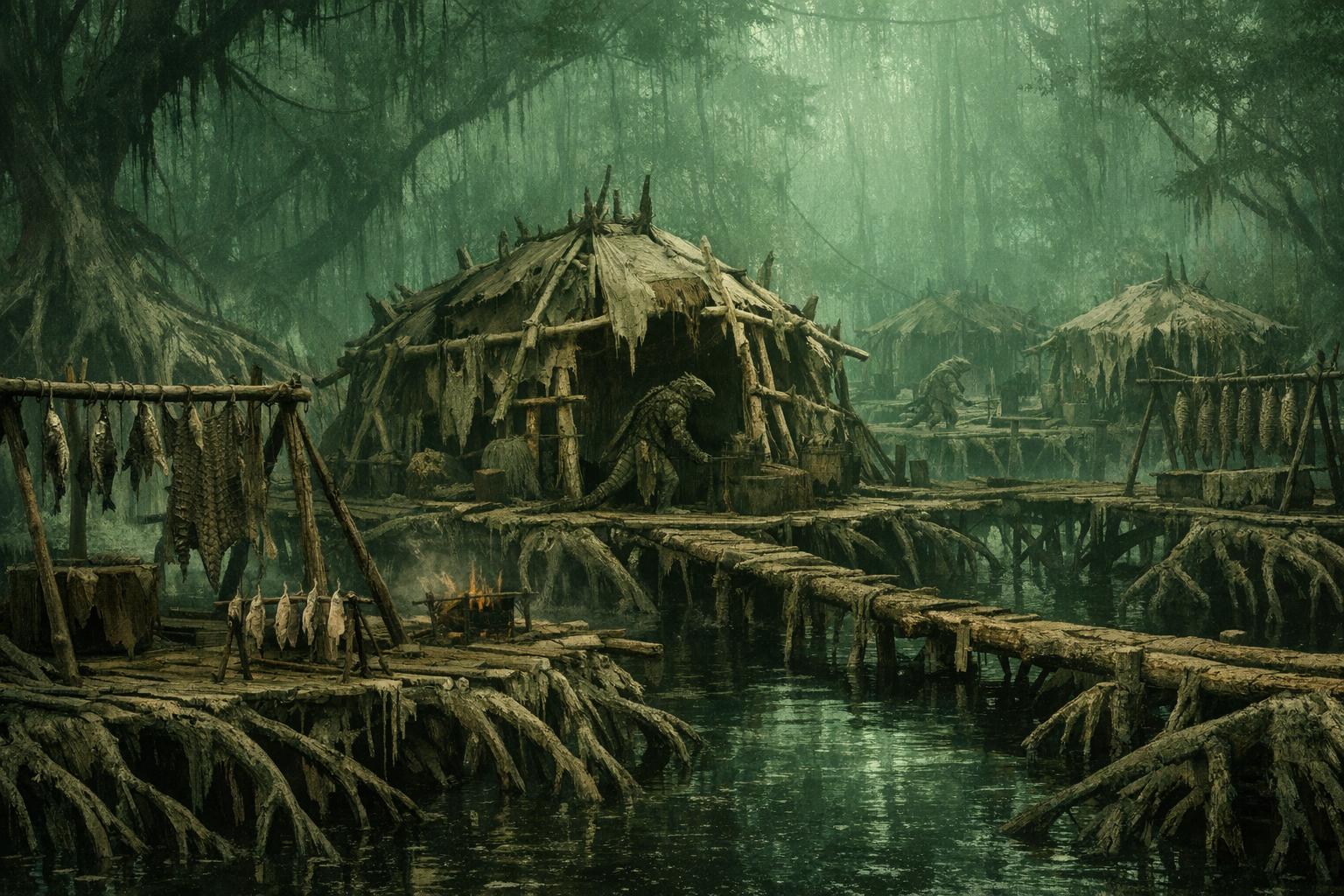
Lizardfolk settlements are not cities, villages, or camps in any mammalian sense. They are territories — stretches of swamp, marsh, river delta, or coastal wetland that a tribe claims, patrols, and harvests. The "settlement" is the ecosystem itself. Structures exist within it, but the structures serve the territory, not the other way around.
A typical lizardfolk territory encompasses several square miles of wetland with a central gathering area built on the most defensible ground available — usually a raised hummock or a platform constructed from logs and packed mud. Huts are functional rather than decorative: waterproof shelters for egg clutches, storage for preserved food, and communal spaces where the tribe gathers for decisions and resource distribution.
Lizardfolk do not build walls. They do not need to. The swamp itself is the defense. Invaders who enter lizardfolk territory face unstable ground, hidden waterways, biting insects, predatory wildlife, and an enemy that knows every submerged log, every quicksand patch, and every underwater passage. More armies have been destroyed by lizardfolk marshes than by lizardfolk weapons.
When mapping a lizardfolk settlement, think in terms of territory rather than buildings. Mark hunting grounds, egg-laying sites, fish-trapping weirs, underwater caches, and patrol routes. The "village" is the least interesting part of a lizardfolk home — the ten-mile radius of wetland surrounding it is where the gameplay lives.
Semuanya & the Theology of Survival
Semuanya is the lizardfolk deity, and understanding Semuanya is the fastest route to understanding the species. Semuanya is not a god of war, justice, wisdom, or love. Semuanya is the god of survival and propagation. That is the entire portfolio. Survive. Reproduce. Ensure the species continues. Everything else is irrelevant.
This makes Semuanya the most honest deity in the D&D pantheon. Other gods dress up survival instincts in philosophy — Gruumsh wraps survival in conquest, Moradin wraps it in craft, Corellon wraps it in beauty. Semuanya does not bother with the packaging. The mandate is naked: live, breed, persist. Semuanya does not demand worship, temples, crusades, or moral codes. Semuanya demands that lizardfolk exist tomorrow.
The practical result is a religious tradition that barely resembles religion by mammalian standards. There are no prayers, no scriptures, no commandments beyond the biological imperative. Lizardfolk shamans serve as interpreters of natural signs — weather patterns, prey migration, predator movements — rather than as intermediaries with a deity who has opinions about morality. Semuanya does not have opinions about morality. Semuanya has opinions about survival.
Some lizardfolk tribes have adopted or been influenced by the worship of Sess'innek, a demon lord who offers power in exchange for cruelty and domination. This represents a genuine theological corruption within lizardfolk culture — the replacement of Semuanya's neutral survival mandate with an active evil. Tribes that follow Sess'innek become aggressive raiders rather than territorial defenders, and other lizardfolk regard them as broken, not wicked. They have lost the pragmatism that defines the species.
Semuanya's indifference makes lizardfolk religious encounters play very differently from standard D&D deity interactions. A lizardfolk shaman asked "What does your god want?" will answer honestly: "Survival. That is all." There is no crusade to join, no moral code to debate, no divine quest to fulfill. For players accustomed to gods with agendas, this radical simplicity is disorienting — and excellent campaign material.
Natural Abilities & Primal Magic
Lizardfolk magical traditions — to the extent they exist — are rooted in the natural world rather than the arcane or divine. Their shamans practice what other species would classify as druidic magic: manipulation of weather, plants, animals, and natural forces. The distinction is that lizardfolk shamans do not frame this as magic. They frame it as a deeper form of the environmental awareness that all lizardfolk possess.
A lizardfolk who can predict a storm by reading water currents and air pressure is using natural observation. A lizardfolk shaman who can call that storm is doing the same thing with greater intensity. The line between natural skill and magical ability is, in the lizardfolk worldview, a distinction without meaning. You interact with the marsh. The marsh interacts with you. Sometimes the interaction involves moving water with your mind. This is not supernatural. This is the swamp working as intended.
Cunning Artisan
The Cunning Artisan trait from Volo's Guide captures something essential about lizardfolk: they waste nothing. During a short rest, a lizardfolk can fashion a simple weapon or shield from the remains of a slain creature. Bones become clubs or javelins. Hides become shields. Teeth become dagger-edges. This is not a combat ability — it is a survival philosophy expressed as mechanics.
At the table, Cunning Artisan changes how a lizardfolk interacts with the aftermath of combat. While the rest of the party loots gold and magic items, the lizardfolk harvests materials. The dragon's bones, the troll's hide, the giant spider's fangs — all of these have value that a lizardfolk recognizes and a human walks past.
Predatory Instinct
Lizardfolk perception is geared toward detecting movement, tracking scent trails through humid air, and sensing vibrations through water and saturated ground. This is not darkvision in the traditional sense — it is a predatory sensory suite that makes them exceptionally dangerous in their home environment and merely competent outside it.
A lizardfolk in a swamp can detect approaching creatures by the vibrations their footsteps send through waterlogged soil. In a dry dungeon corridor, that advantage disappears. Understanding this environmental dependency is crucial for DMs designing encounters that feature lizardfolk — they should feel like apex predators in wetlands and like ordinary fighters everywhere else.
Why Mammals Find Lizardfolk Unsettling
The lizardfolk relationship with other species is defined by a fundamental communication gap. Lizardfolk lack the facial muscles that mammals use for emotional expression. They do not smile, frown, wince, or make eye contact in the way warm-blooded species interpret as social engagement. To a human, a lizardfolk face is a mask — unreadable, unchanging, and instinctively threatening because the mammalian brain reads expressionlessness as concealment of intent.
This creates a one-directional problem. Lizardfolk can read mammalian emotions reasonably well because mammalian emotions are loud — expressed through facial movement, body posture, vocal tone, and scent that even a lizardfolk nose can detect. Mammals cannot read lizardfolk emotions at all because lizardfolk express internal states through subtle body language — tail position, throat coloring, scale-angle shifts — that no mammal has learned to interpret.
The result is that every interaction between lizardfolk and mammals operates at a disadvantage for the mammals. The lizardfolk knows how the human feels. The human does not know how the lizardfolk feels. This power imbalance, combined with the lizardfolk's pragmatic disregard for social niceties, produces encounters that mammals describe as "creepy" and lizardfolk describe as "normal."
Specific species relationships vary but follow predictable patterns. Elves find lizardfolk aesthetically repulsive and philosophically incomprehensible — a species without art is, to an elf, barely a species at all. Dwarves respect the craftsmanship but distrust the alien psychology. Halflings, surprisingly, adapt best to lizardfolk neighbors, perhaps because both species prioritize community survival and practical skill over abstract principles.
Lizardfolk suffer from a representation deficit in D&D fiction. They have no Drizzt, no Bruenor, no iconic character who humanized the species for a mainstream audience. This is partly because lizardfolk resist humanization by design — the alien pragmatism that makes them interesting to play makes them difficult to center in fiction aimed at mammalian readers.
The most significant lizardfolk appearances in D&D-adjacent media tend to be as antagonists or supporting characters whose alienness provides contrast to the protagonist's mammalian values. This is a missed opportunity. A novel told from a lizardfolk perspective — in which mammalian behavior is the strange, irrational norm that the protagonist must navigate — would be a genuine contribution to the genre.
Notable Lizardfolk in D&D & Related Media
| Figure | Source | Role | Significance |
|---|---|---|---|
| Redeye | Baldur's Gate 3 (cut content / mods) | Companion concept | Demonstrated player demand for lizardfolk party members |
| Shadowscale / Hist-bound | Elder Scrolls (Argonians) | Player species across multiple games | The most fully realized reptilian humanoid in gaming — the standard lizardfolk are measured against |
| Lizardfolk shamans | Tomb of Annihilation (2017) | Allies in Chult | Rare instance of lizardfolk presented as potential allies rather than default enemies |
| Dragonlance lizardfolk | Dragonlance setting | Bakali — ancient lizard species | Established lizardfolk as predating the "civilized" species of the setting by millennia |
The Elder Scrolls' Argonians have done more to popularize the reptilian humanoid archetype than forty years of D&D lizardfolk content.
A lizardfolk who has spent years among mammals and learned to perform emotional expressions — smiling when others smile, frowning when others frown — without understanding what the expressions mean. The performance is slightly wrong every time: the smile too wide, held too long, applied in inappropriate contexts. Other characters find this more disturbing than the original expressionlessness.
Mechanics Across D&D Editions
Lizardfolk mechanics have always revolved around the same three pillars: natural armor, a bite attack, and a swim speed. What has changed across editions is how much design space was allocated to their alien psychology and survival-focused toolkit versus simply treating them as "swamp fighter with scales."
The Volo's Guide implementation in 5e was the first time lizardfolk mechanics genuinely tried to capture the species' alien worldview. Hungry Jaws and Cunning Artisan are not just combat features — they communicate a species that views the world in terms of resources and survival. The mechanical message is clear: this is not a human in a lizard suit. This is something that thinks differently.
Lizardfolk Mechanical Evolution
| Feature | 3.5e | 5e (Volo's) | 2024 |
|---|---|---|---|
| Species Status | Monster with stats | Playable (Volo's) | Core playable |
| Natural Armor | +5 bonus | 13 + DEX | 13 + DEX |
| Bite Attack | 1d4 (natural weapon) | 1d6 + STR | 1d6 + STR |
| Swim Speed | 15 ft. | 30 ft. | 30 ft. |
| Unique Mechanic | Hold Breath | Cunning Artisan | Hungry Jaws scaling |
| Design Philosophy | Swamp monster | Alien survivor | Alien survivor (refined) |
Natural Armor has been the lizardfolk's quiet mechanical superpower across every edition — free AC that stacks with class features like Unarmored Defense.
- Natural Armor +5
- Natural weapons (claw/claw/bite)
- Hold Breath (4x CON modifier rounds)
- Swim speed 15 ft.
- +1 Level Adjustment
The level adjustment made lizardfolk unplayable in practice. A 1st-level lizardfolk character was treated as 2nd level for XP purposes, ensuring they fell permanently behind.
- Natural Armor (13 + DEX modifier)
- Bite (1d6 + STR melee weapon attack)
- Hungry Jaws (bonus action bite, gain temp HP)
- Cunning Artisan (craft from creature remains)
- Hold Breath (up to 15 minutes)
- Swim speed 30 ft.
- Hunter's Lore (two skill proficiencies)
The best mechanical implementation to date. Natural Armor alone makes lizardfolk competitive — a lizardfolk monk or barbarian ignoring armor entirely is thematically perfect and mechanically strong.
- Natural Armor (13 + DEX modifier)
- Bite (1d6 + STR melee weapon attack)
- Hungry Jaws (bonus action, temp HP equal to proficiency bonus)
- Hold Breath (up to 15 minutes)
- Swim speed 30 ft.
- Nature's Intuition (two skill proficiencies)
Flexible ability scores open lizardfolk to any class. The mechanical identity remains intact: natural armor, bite, swim speed, and resource-harvesting instincts.
Across Franchises: The Argonian Standard
Any discussion of lizardfolk in broader fantasy must reckon with the Argonians of the Elder Scrolls series. Bethesda's reptilian humanoids are, for most gamers, the definitive version of the archetype. Argonians have been playable since Arena (1994), and their development across six mainline games has produced a depth of lore, culture, and individual characterization that D&D lizardfolk have never matched.
The comparison is instructive. Argonians have the Hist — sentient trees that link the species through a psychic mycelium network and provide racial memory, purpose, and identity. D&D lizardfolk have Semuanya, who provides nothing beyond "survive." Argonians have Shadowscales (assassin-monks born under the sign of the Shadow), Hist-sap rituals, and a culture rich enough to sustain multiple novels. D&D lizardfolk have "they live in swamps and eat things."
The gap is not about quality — it is about investment. Bethesda treated Argonians as a full civilization with thousands of years of history. D&D has historically treated lizardfolk as a monster entry that occasionally gets promoted to player option. The potential is there. The development is not.
Reptilian Humanoids Across Franchises
| Franchise | Species | Defining Trait | Key Distinction |
|---|---|---|---|
| D&D | Lizardfolk | Alien pragmatism, survival theology | Most emphasis on non-mammalian psychology |
| Elder Scrolls | Argonians | Hist-connection, amphibious stealth | Deepest lore; the gold standard for reptilian humanoids in gaming |
| Warhammer | Lizardmen / Seraphon | Servants of the Old Ones, cosmic order | Lizardfolk as lawful enforcers rather than neutral survivors |
| Divinity: Original Sin 2 | Lizards (The Red Prince) | Aristocratic reptilian empire | Lizardfolk as civilization-builders with a caste system |
| Pathfinder 2e | Iruxi | Community-focused, territorial | Closest to D&D lizardfolk but with more cultural development |
| Guild Wars 2 | Largos / Krait | Aquatic predators, isolationist | Full aquatic rather than semi-aquatic; more alien, less playable |
The Elder Scrolls Argonians demonstrate what D&D lizardfolk could become with sustained creative investment — a species whose alienness enriches rather than limits storytelling.
FAQ
Common Questions
The key is that lizardfolk are not emotionless — they are differently emotional. They experience satisfaction when a hunt succeeds, discomfort when resources are scarce, and genuine interest in things they find useful. What they lack is the mammalian habit of layering sentiment onto practical situations. Play your lizardfolk as engaged and curious rather than blank. They should have strong opinions about efficiency, resource use, and survival strategy. The alienness comes not from absence of personality but from a personality organized around completely different priorities than everyone else at the table.
Yes, and this character arc is one of the best things about playing the species. A lizardfolk who starts the campaign baffled by crying and ends it holding a dying friend's hand — not because they understand grief, but because they have learned that this gesture reduces mammalian suffering and reducing suffering in allies is practical — is a character arc that hits harder than most emotional journeys in the game. The lizardfolk never truly "gets it." They just get better at responding usefully.
Lizardfolk are not emotionless — they are emotionally alien. They experience states like satisfaction after a successful hunt, agitation when territory is threatened, and contentment when basking in warmth. What they lack is the mammalian scaffolding that turns those raw states into nostalgia, guilt, romantic love, or existential dread. Think of them as functional reptiles rather than broken mammals. A lizardfolk does not fail to grieve — grieving is simply not part of their cognitive architecture. They register the loss of a companion as a change in resource availability and tribal capability, not as an emotional wound. This is not a deficit any more than a human's inability to sense magnetic north is a deficit. It is a different operating system, optimized for different priorities.
In traditional D&D lore, yes. A dead companion is a resource. Letting meat rot when the tribe could eat is wasteful, and waste is the closest thing to a sin in lizardfolk culture. At the table, discuss this with your group during Session Zero. Some tables find it compelling and darkly funny. Others find it genuinely upsetting. A good compromise: your lizardfolk suggests it once early in the campaign, gets the horrified reaction, catalogs "mammals do not eat their dead" in their mental file of incomprehensible warm-blooded behaviors, and never brings it up again — but visibly struggles with the waste every time.
To a lizardfolk, the question is backwards — the real question is why would you not? A dead body is protein, bone, and hide. Letting it decompose in the ground feeds worms and fungi, neither of which contribute to tribal survival. Consuming the dead ensures that the nutrients a tribe member accumulated over a lifetime return directly to the tribe. Bones become tools. Hide becomes shields. Meat sustains hunters for days. In the lizardfolk waste-not philosophy, burial and cremation are the bizarre practices — elaborate rituals that destroy perfectly usable resources to satisfy an emotional need lizardfolk do not possess. The disconnect with mammalian reverence for remains is not cruelty or disrespect. It is a fundamentally different answer to the question "what do we owe the dead?" Mammals say dignity. Lizardfolk say utility. Neither is wrong within its own framework, but the gap between those answers is vast enough to end friendships.
Ranger and druid are the most thematically natural fits — a lizardfolk ranger in their home swamp is an apex predator with class features that amplify already-terrifying survival instincts. Mechanically, any class that benefits from Natural Armor shines: monk and barbarian both have Unarmored Defense that competes with Natural Armor, letting you take whichever is higher. Cleric of the Nature domain captures the shaman role. Rogue works surprisingly well — a lizardfolk assassin who emerges from murky water, strikes, and disappears is the stuff of nightmares for any target.