
Loxodons
Patient giants who remember everything, forgive slowly, and build communities that outlast empires — the closest D&D gets to a species designed around collective endurance rather than individual ambition
Elephants in Myth & Religion
Elephants occupy a unique position in human mythology: they are the only real-world animal consistently credited with wisdom, grief, and moral reasoning by cultures that actually lived alongside them. Hindu tradition gives us Ganesha — the elephant-headed god of beginnings, wisdom, and the removal of obstacles — who remains one of the most widely worshipped deities on Earth. Thai culture reveres the white elephant as a symbol of royal power and spiritual purity. African traditions across dozens of distinct cultures associate elephants with memory, ancestral knowledge, and the weight of communal responsibility. No other animal carries this much symbolic freight.
What makes the elephant archetype so potent for fantasy species design is the combination of size and gentleness. A creature that could destroy anything in its path but chooses not to. An animal whose social bonds are so strong that herds will stand vigil over their dead for days. A being whose memory is not metaphorical — elephants genuinely recognize individuals they haven't seen in decades, return to the bones of deceased family members, and pass learned knowledge across generations. The elephant doesn't need mythological embellishment to be extraordinary. The reality is already there.
D&D's loxodons draw from this well without pretending to be subtle about it. They are elephant-people. The trunk is there, the memory is there, the communal structure is there, the patience is there. What the game adds is a philosophical framework — Selesnya collectivism, stone-skin durability, a lifespan measured in centuries — that takes the real-world elephant and asks: what if this creature could build temples and argue theology? The answer turns out to be one of the most interesting species in the game's roster.
Elephants in World Mythology and Religion
| Tradition | Figure or Symbol | Core Association | Loxodon Parallel |
|---|---|---|---|
| Hindu | Ganesha | Wisdom, new beginnings, obstacle removal | Loxodon patience and role as community problem-solvers |
| Thai / Southeast Asian | White Elephant (Chang Samkhan) | Royal power, spiritual purity, prosperity | Loxodon natural authority and reverence for tradition |
| African (multiple) | Elephant as ancestor-keeper | Memory, mourning, generational knowledge | Perfect recall, vigils for the dead, oral histories |
| Buddhist | Queen Maya's dream of a white elephant | Divine conception, spiritual promise | Loxodons as inherently spiritual beings drawn to faith |
| Roman | Pliny's "pious elephants" | Worship of celestial bodies, moral behavior | Selesnya devotion and loxodon sense of cosmic order |
The loxodon is one of the few D&D species where the real-world source animal is arguably more remarkable than the fantasy version.
Loxodon Naming — Memory in Sound
Loxodon names are built for memory. Not the memory of the person being named — loxodons remember everything regardless — but the memory of the community. A loxodon's name is meant to be spoken aloud in gatherings, recited in histories, and chanted during ceremonies that might continue for hours. The names are long, rhythmic, and phonetically deliberate, with syllable patterns that resist confusion even when hundreds of names are recited in sequence. Bayul, Dobrun, Domlov, Falharg, Kandir, Lestari, Mandavi, Nikali, Oriji, Tamuj, Vazeri. The sounds roll and anchor.
The Guildmasters' Guide to Ravnica provides the only official loxodon naming conventions, and they draw heavily from South Asian and Eastern European linguistic roots — a fitting blend given Ravnica's cosmopolitan design. Male and female names share structural similarities: two to three syllables, strong consonant-vowel alternation, and a preference for endings that resolve cleanly. There are no surnames in the traditional sense. Instead, a loxodon's full designation includes their name, their community or guild affiliation, and sometimes a descriptive epithet earned through decades of service.
What makes loxodon naming interesting at the table is its relationship to memory and identity. A loxodon who remembers every name they've ever heard treats names with a gravity that shorter-lived species can't match. Forgetting someone's name isn't a social faux pas — it's an impossibility. Mispronouncing one is a genuine slight. And giving someone a new name, an epithet earned through action, is one of the highest honors a loxodon community can bestow. Your name isn't a label. It's a verdict.
“We do not forget names. We do not forget faces. We do not forget kindnesses, and we do not forget insults. This is not a threat. It is simply what we are. Plan your behavior accordingly.”
— Loxodon trade representative addressing a merchant guild
From Ravnica to the Multiverse
Loxodons entered D&D through the Guildmasters' Guide to Ravnica (2018), making them one of the newest species in the game's catalog and one of the most setting-specific. Ravnica is a Magic: The Gathering world — a plane-spanning city where ten guilds compete for political dominance and every species belongs to (or is defined by resistance to) guild culture. Loxodons arrived pre-assigned to the Selesnya Conclave, the guild of nature, harmony, and collective consciousness. This wasn't a suggestion. It was the default. The first official loxodon was a Selesnya loxodon.
This origin creates both opportunities and constraints. The Ravnica connection gives loxodons a built-in culture, philosophy, and political context that many D&D species lack. You don't have to invent loxodon society from scratch — it's there in the Selesnya framework, complete with temples, hierarchies, rituals, and conflicts. But it also means that separating loxodons from Ravnica requires active work. A loxodon in the Forgotten Realms, in Eberron, in a homebrew world — these all require answers to questions that the Ravnica version doesn't ask: where do they come from? What do they worship? How do they organize?
The 2024 rules and Monsters of the Multiverse have begun the process of untethering loxodons from Ravnica, presenting them as a species that can appear in any setting. This is the standard trajectory for MtG-crossover species: arrive with a specific setting identity, then gradually become setting-agnostic. Whether this enriches loxodons or dilutes them depends on what individual DMs do with the freedom. The best adaptations keep the core — memory, patience, community, stone-skin endurance — while replacing Selesnya specifics with local equivalents.
Guildmasters' Guide to Ravnica
Loxodons debut as a playable species tied to the Selesnya Conclave. They receive +2 CON, +1 WIS, Natural Armor, trunk mechanics, and the Selesnya background as default.
Tasha's Cauldron of Everything
Flexible ability score rules allow loxodons to escape the CON/WIS lock. Any class becomes mechanically viable without fighting the stat block.
Monsters of the Multiverse
Loxodons receive a revised stat block with flexible ASIs and streamlined Natural Armor. The Ravnica tie loosens as the species is presented as multiverse-compatible.
2024 Core Rules Era
Loxodons exist in the broader D&D ecosystem as a recognized species option. Community adoption grows as players discover the appeal of patient, community-minded characters.
The Great Plazas & Selesnya Groves
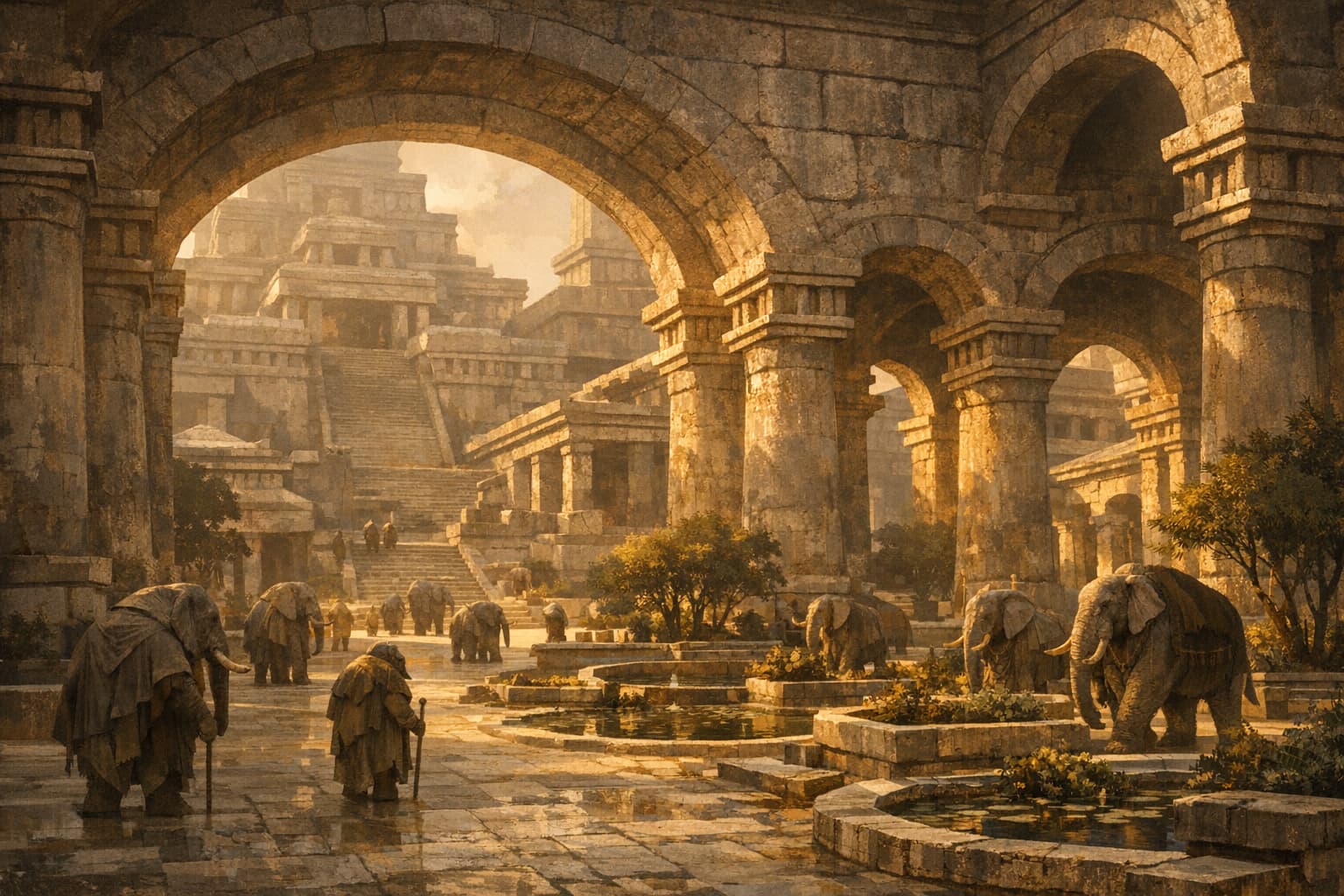
On Ravnica, loxodons live in the spaces where stone meets living wood. The Selesnya Conclave builds its communities around Vitu-Ghazi, the City-Tree — an enormous living tree that serves as the guild's spiritual and political center. Surrounding it are the groves and plazas where loxodons gather, meditate, work, and conduct the slow, deliberate business of communal governance. These spaces are designed for beings who think in decades: wide stone plazas with benches carved for loxodon proportions, gardens that have been tended continuously for centuries, and halls where the acoustics are tuned for voices that carry the deep resonance of a creature four times human mass.
The architecture tells you everything about loxodon values. Open plazas rather than private chambers — because community life is public life. Stone foundations with living-wood superstructures — because the best things grow slowly from strong roots. No locks on any door — because trust within the community is absolute, or it is nothing. The spaces are beautiful in the way that a well-maintained bridge is beautiful: functionally excellent, built to last, and completely uninterested in impressing anyone.
Outside Ravnica, loxodon communities adapt these principles to whatever landscape they inhabit. In a Forgotten Realms adaptation, loxodons might build their plazas in river valleys — open stone courts surrounded by cultivated groves, positioned where trade routes and waterways intersect. In Eberron, they might integrate with the communal structures of the Eldeen Reaches or build something entirely new in Xen'drik's ruins. The constant is the preference for open spaces, durable materials, and architecture that assumes the building will outlive everyone who designed it.
A loxodon plaza has existed for three hundred years at a crossroads that has since become a major trade city. The city grew around the plaza, not the other way around. The loxodons remember when the first human merchants arrived — they remember their names, their children's names, the exact date of every transaction. Now the city council wants to demolish the plaza for a new market district. The loxodons won't fight. But they won't leave. And they remember every promise the city ever made to them.
Elephantine Physiology
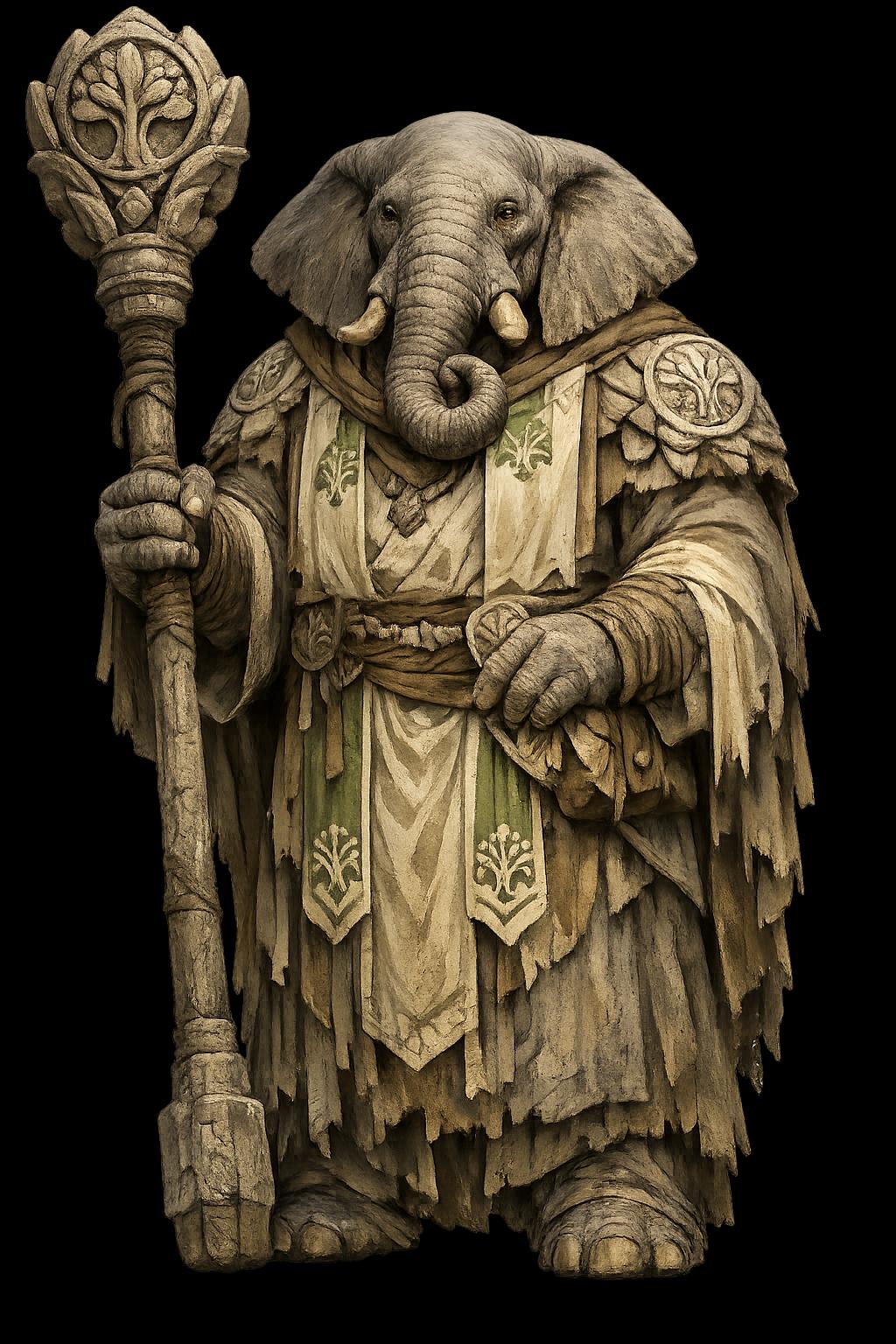
Loxodons are large in the way that a cathedral column is large: vertically imposing, structurally dense, and designed to bear weight for a very long time. They stand seven to eight feet tall and weigh between 300 and 400 pounds, with thick limbs, broad flat feet, and a body plan that prioritizes stability over speed. Their skin is thick and gray, ranging from pale ash to deep charcoal, and it has a rough, hide-like texture that provides natural protection equivalent to wearing armor. This isn't metaphorical. A loxodon's skin is literally tougher than leather armor.
The trunk is the feature that defines loxodon biology and separates them from every other large species in D&D. It's a muscular, prehensile appendage roughly five feet long, capable of fine manipulation (picking up a coin), moderate lifting (carrying a weapon or shield), and powerful gripping (restraining a struggling creature). The trunk can smell with extraordinary precision — loxodons identify individuals, detect emotions, and assess food quality primarily through scent. It can also produce the deep, resonant calls that loxodons use for long-distance communication, audible up to several miles in open terrain.
Loxodon ears are large, thin-skinned, and richly vascularized — they serve as radiators, dissipating body heat in warm environments. This means loxodons are more comfortable in warm climates than cold ones, though their thick skin provides adequate insulation in temperate regions. Their eyes are small relative to their head size and positioned laterally, giving them a wide field of vision but relatively poor depth perception at distance. They compensate with hearing and scent, both of which are extraordinary.
The tusks vary. Some loxodons have prominent tusks that extend several inches beyond the mouth. Others have smaller tusks or none at all. In loxodon communities, tusks carry no particular cultural significance — they're anatomy, not status symbols. Outsiders sometimes read tusks as threatening, which loxodons find mildly irritating in the way that a tall person finds "how's the weather up there" mildly irritating. It was never funny, and it doesn't get funnier with repetition.
The Trunk — Third Hand, First Sense
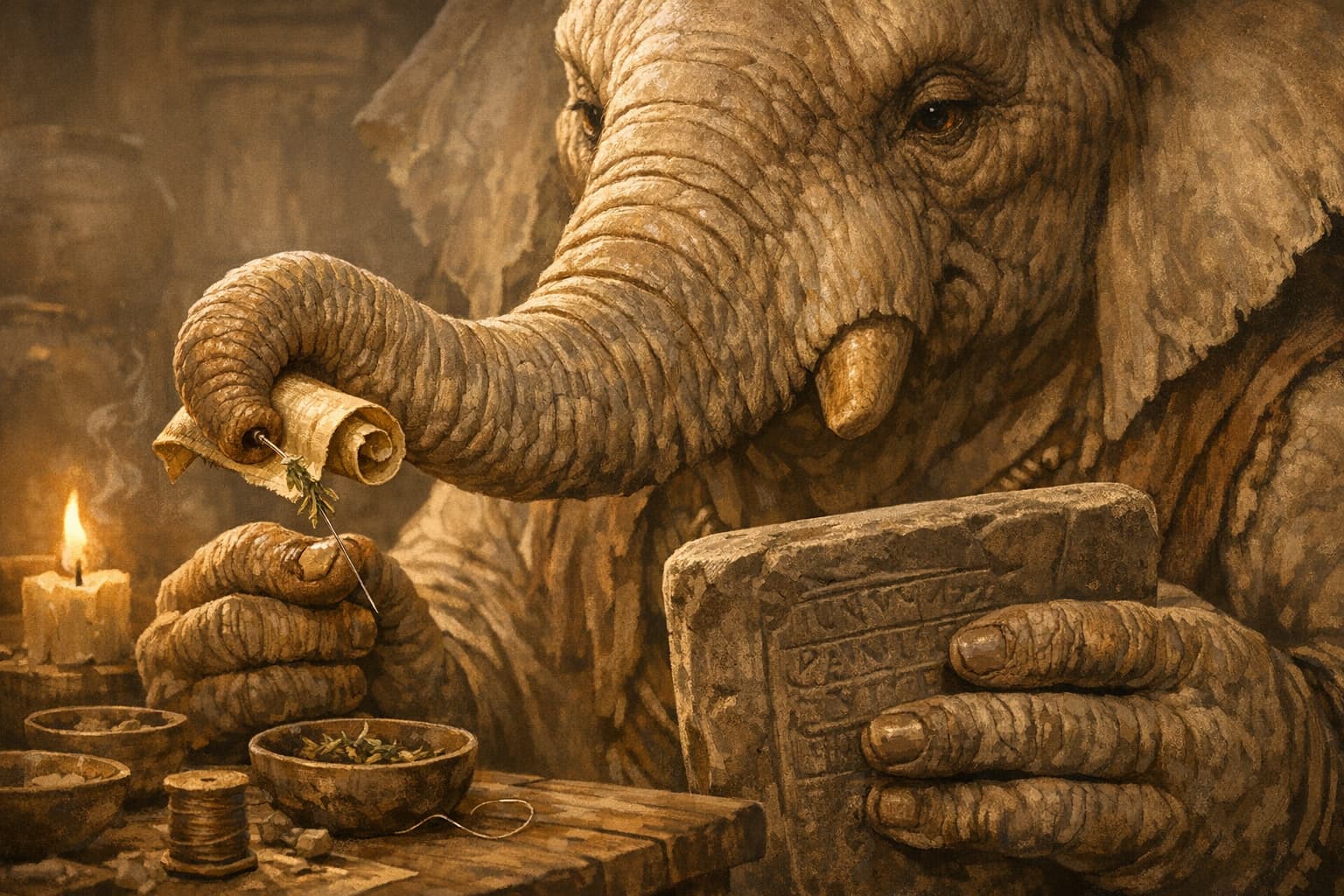
The loxodon trunk deserves its own section because it changes everything about how the species interacts with the world. Mechanically, the trunk can grasp objects, use tools, and perform somatic spell components — but it cannot wield weapons or shields with the same effectiveness as a hand. This creates a character who always has a free appendage for environmental interaction: opening doors while both hands hold weapons, carrying a torch while wielding a sword and shield, or retrieving items from a pack without dropping anything.
The sensory dimension is equally important. A loxodon can smell fear — not metaphorically, but literally, through the chemical signatures of stress hormones. They can identify someone they've met once from scent alone, track a creature through a crowded marketplace, and detect poisons in food or drink with a casual sniff. In social situations, the trunk provides information that no Insight check can replicate: this person is nervous, that one is lying, the third is genuinely delighted to see you. A loxodon diplomat has an unfair advantage, and everyone at the table knows it.
Natural Armor — Stone-Skin Resilience
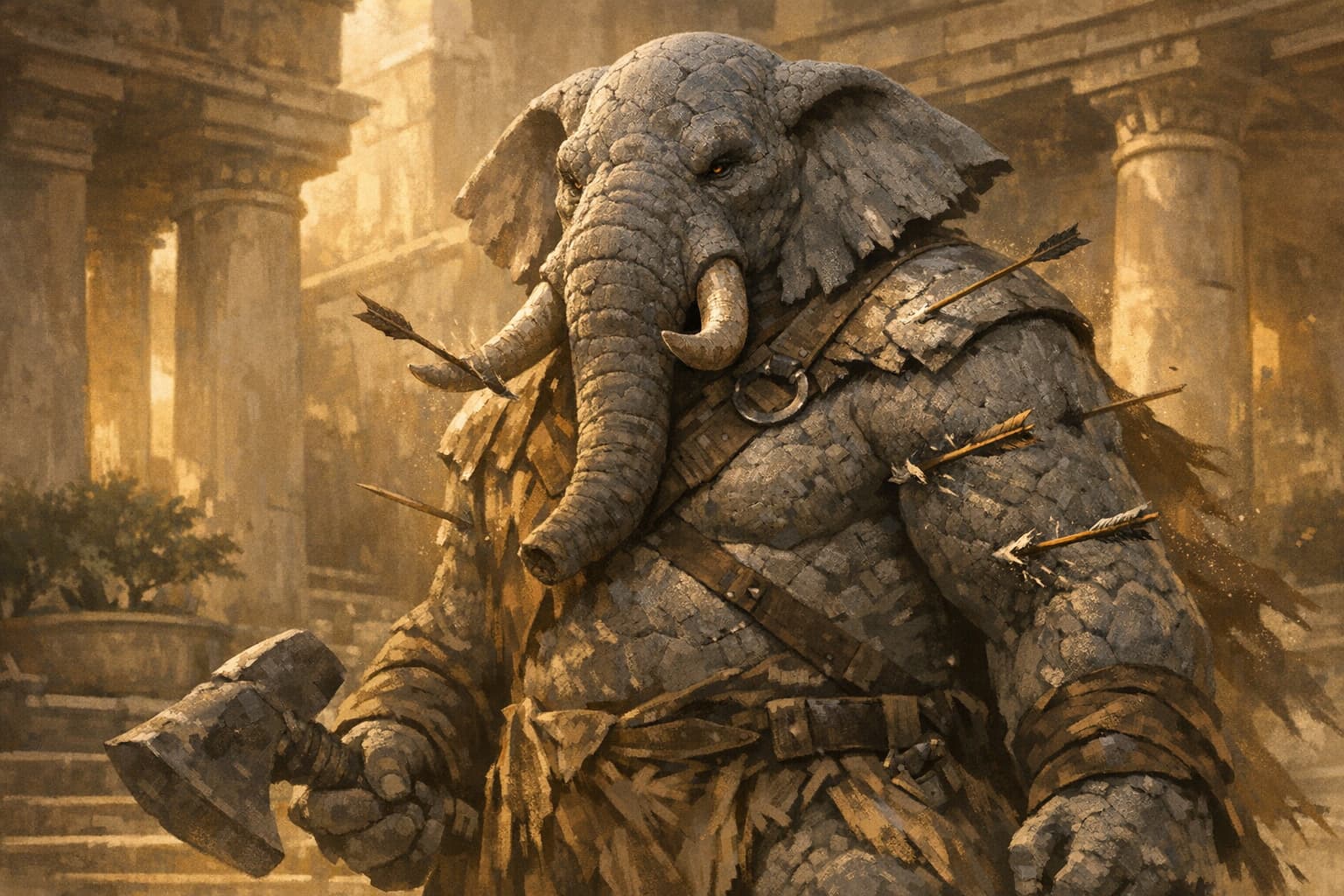
Loxodon skin is thick, tough, and layered in a way that provides genuine protection against physical damage. Their Natural Armor sets their base AC to 12 + Constitution modifier when not wearing armor — which means a loxodon with 16 Constitution starts with AC 15, no equipment required. For a monk or barbarian, this is excellent. For a cleric in heavy armor, it's a backup plan. For any loxodon, it means you are never truly unarmored. You walked out of the womb wearing protection that most adventurers have to buy.
The skin also heals with a density that other species find remarkable. Cuts close quickly. Bruises fade within hours rather than days. Scarring is minimal, which means a loxodon who has survived a century of hard living still looks relatively unblemished. This durability extends to environmental hazards: loxodon skin resists sunburn, windburn, insect bites, and minor abrasions with casual efficiency. The downside is sensitivity — thick skin means reduced tactile feedback from the body (though not the trunk, which remains exquisitely sensitive).
The Long View
Loxodons live for several centuries — the exact upper limit is unclear, but individuals of 300 to 450 years are documented on Ravnica. This lifespan changes everything about how they process time, risk, and consequence. A decision that a human makes in an afternoon, a loxodon might consider for a month. Not because they're slow-witted — their intelligence is at least human-average and often higher — but because they've learned, through centuries of observation, that hasty decisions have long consequences and that those consequences usually arrive after the person who made the decision has stopped caring.
This temporal patience is compounded by perfect memory. Loxodons don't just live a long time — they remember all of it. Every face, every conversation, every promise made and broken, every sunset and every betrayal. A 300-year-old loxodon carries three centuries of unedited experience in their head, which means they've seen every kind of scheme, every variety of deception, and every species of fool. They are, in practical terms, impossible to surprise. The downside is equally significant: they also remember every grief, every loss, every friend who aged and died while the loxodon stayed the same. The long view is a blessing for decision-making and a curse for emotional health.
At the table, playing a loxodon's time-sense well means leaning into the contrast with shorter-lived party members. The human rogue wants to act now. The loxodon suggests they wait a season and see how the situation develops. The halfling bard panics about an approaching deadline. The loxodon points out that deadlines only matter if you accept the framing of the person who set them. This isn't passive-aggression or obstructionism — it's a fundamentally different relationship with urgency, and the tension it creates with impatient party members is one of the best sources of in-character friction the game offers.
The memory dimension is where loxodons become genuinely uncanny. A loxodon NPC who remembers the party rogue's grandmother — because they bought bread from her stall sixty years ago and she shortchanged them by two copper — isn't being eccentric. They're being normal, for a loxodon. The party doesn't know whether to be charmed or unnerved. The answer is usually both.
When a loxodon says "I remember," they mean it in a way that no other species can match. They remember the exact words of a conversation from a century ago. They remember the weather on the day they met someone. They remember the expression on a liar's face and can describe it to a sketch artist with photographic accuracy. This has implications for investigation, diplomacy, and revenge that DMs should think through carefully. A loxodon who says "I will not forget this" is making a statement of biological fact, not a dramatic threat.
Community & Sacred Routine
Loxodon daily life is organized around routines that border on ritual. Morning meditation, communal meals, work assignments distributed by consensus, evening gathering for storytelling and music, and a closing ceremony that varies by community but always involves the same elements: gratitude for the day's work, acknowledgment of the community's needs, and a brief period of collective silence. These routines aren't enforced by authority — they're maintained by habit, shaped over centuries into patterns so deeply ingrained that disrupting them feels physically wrong.
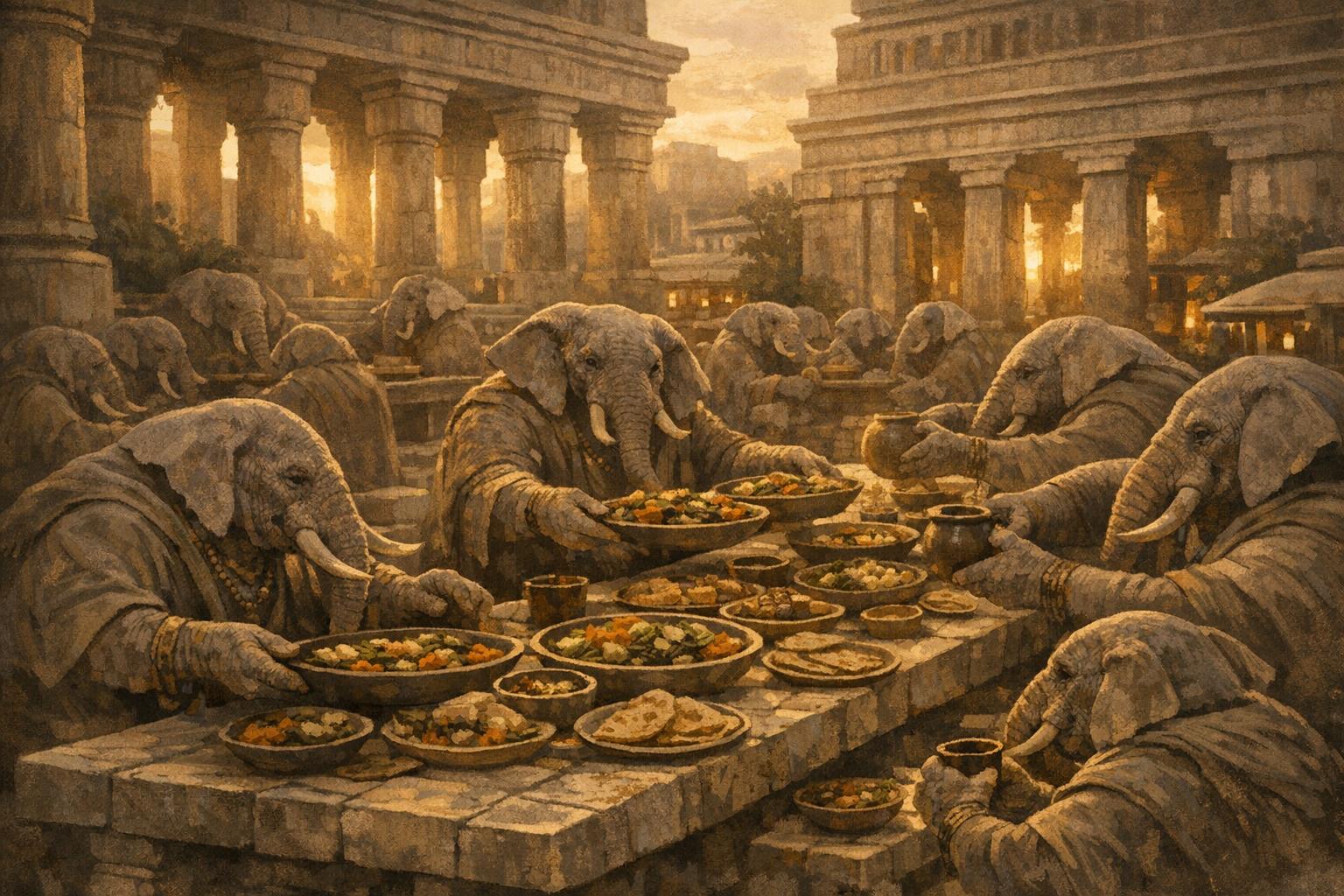
The communal meals deserve particular attention because they reveal more about loxodon values than any amount of philosophical exposition. Loxodons eat together. Always. Not as a rule that someone imposed, but as an expression of the fundamental loxodon conviction that sustenance is shared or it is shameful. A loxodon who eats alone is either grieving, meditating, or angry — and in each case, the community will send someone to check on them within the hour. Food is abundant, vegetarian-leaning but not exclusively so, and prepared in quantities that assume guests. A loxodon kitchen always cooks for more than are present, because someone might arrive.
Music is central to loxodon community life in a way that surprises outsiders. The deep resonance of loxodon voices makes them natural bass singers and chanters, and their long memories allow them to maintain musical traditions that stretch back centuries without ever being written down. Loxodon choral music — performed by a dozen voices with a combined range that starts below human hearing — is one of Ravnica's genuine cultural treasures, and outsiders who hear it for the first time often describe it as physically overwhelming. The vibrations move through the body, not just the ears.
Consensus Governance
Loxodons govern by consensus, and they have the patience to make it work. Where other species would devolve into deadlock after three hours of debate, loxodons will continue discussing for three weeks — calmly, methodically, with each participant's position recorded in the collective memory with perfect fidelity. There's no need for minutes. Everyone remembers exactly what everyone said. This makes it functionally impossible to misrepresent your previous position, walk back a commitment, or pretend a discussion didn't happen. Loxodon politics is politics without the possibility of plausible deniability.
The process frustrates outsiders but produces remarkably stable outcomes. A decision reached by loxodon consensus has the buy-in of every member of the community, which means implementation is nearly frictionless. Nobody sabotages a plan they genuinely agreed to. Nobody undermines a policy they helped shape. The front-loaded cost of extensive deliberation pays dividends in unified execution — a lesson that faster-moving species could learn but generally don't, because they can't stop themselves from acting before the discussion is finished.
Ravnica: Selesnya Hierarchy
On Ravnica, loxodon consensus governance operates within the larger framework of the Selesnya Conclave, which adds a layer of spiritual hierarchy. The Trostani — the guild's three-headed dryad leadership — sets broad direction, while individual communities handle local decisions through consensus. Loxodons serve as intermediaries: their patience and memory make them ideal mediators between the guild's top-down spiritual vision and the bottom-up practical needs of local congregations.
This creates a tension that many loxodon characters carry. The consensus process says everyone's voice matters equally. The guild hierarchy says some voices carry divine authority. A loxodon who believes in both principles simultaneously is navigating a contradiction that has no clean resolution — and that tension is excellent character material.
Adapted Settings: Independent Communities
Outside Ravnica, loxodon governance becomes purer consensus without the guild overlay. A loxodon community in the Forgotten Realms or a homebrew setting might operate as a council of equals where the eldest members are respected but hold no formal authority. Decisions are made in open assembly, debated for as long as necessary, and implemented collectively.
The challenge for DMs is making this governance interesting rather than procedural. The drama isn't in the vote — there is no vote. The drama is in the persuasion: the elder who holds an unpopular position because they remember the last time the community tried the popular approach and it failed catastrophically. The young loxodon who challenges tradition with new information. The outsider who is invited to address the assembly and must convince beings who have been thinking about this problem longer than the outsider has been alive.
Trunk Sign Language
Loxodon trunks are communication organs as much as they are manipulative appendages. A complex system of trunk positions, gestures, and subtle movements forms a silent language that loxodons use alongside spoken speech — and sometimes instead of it. Trunk-sign conveys emotional nuance that words cannot: a slight curl at the tip signals affection, a rigid horizontal extension communicates warning, and a slow weaving motion indicates deep contemplation. Non-loxodons who spend years among them learn to read the obvious signs but rarely master the subtleties.
The language has practical applications that other species envy. Loxodon scouts communicate silently across distances using trunk positions visible against the sky. Loxodon diplomats convey private messages to colleagues during public negotiations — a raised trunk-tip meaning 'I agree with this offer,' a tucked trunk meaning 'they are lying.' An entire parallel conversation happens in trunk-sign while the spoken conversation follows its own course.
Young loxodons learn trunk-sign before they learn to speak, the way human infants gesture before they form words. A loxodon creche is a forest of small trunks waving, curling, and reaching — babies communicating needs, emotions, and observations in a language so intuitive that it requires no formal instruction. The spoken word comes later and never fully replaces what the trunk says first.
If you're playing a loxodon, describe your trunk movements during conversation. 'My trunk curls slightly as I consider the offer' conveys more character than any dialogue could. Other players and the DM will start reading your trunk language as emotional shorthand, which adds a layer of nonverbal communication unique to your character.
Selesnya & the World-Soul
On Ravnica, loxodon spirituality is inseparable from the Selesnya Conclave's theology of the World-Soul — Mat'Selesnya, the collective consciousness that connects all living things in the guild's domain. This isn't an abstract belief for loxodons. They experience it. During deep meditation, a loxodon can feel the presence of other members of the Conclave as a warmth at the edge of perception, a sense of belonging that transcends physical proximity. Whether this is genuine psychic communion or a powerful form of communal self-hypnosis is a question that loxodon theologians have debated for centuries without resolution, and most of them consider the distinction irrelevant.
Loxodon devotion to the World-Soul manifests as a profound commitment to harmony — not the absence of conflict, but the resolution of conflict into something productive. A loxodon Selesnya cleric doesn't preach peace. They preach integration: the incorporation of different perspectives into a whole that is stronger than any individual part. This sounds idealistic, and it is. It also works, within the specific context of a community bound by shared values and centuries of practice. Whether it could scale to a city of millions is the question that Ravnica's other nine guilds answer with varying degrees of skepticism.
The spiritual practices themselves are meditative and communal. Group chanting that lasts for hours. Tending sacred groves where the boundary between cultivated garden and wild forest is deliberately blurred. Laying hands on the root systems of ancient trees and listening — really listening — for the pulse of something larger than any individual life. Outsiders who participate in these practices sometimes report feeling something genuine, which either validates the theology or demonstrates the power of group psychology. Loxodons don't much care which explanation you prefer, as long as you approach the practice with sincerity.
For loxodons outside Ravnica, the World-Soul concept translates into a more general animism. The world itself is alive, conscious in some distributed way, and worthy of reverence. This puts loxodons in natural alignment with druids, nature clerics, and any character whose spirituality centers on the interconnectedness of living things. It also creates productive friction with characters whose worldview is more individualistic. The loxodon who says "we are all connected" and the rogue who says "I work alone" are going to have a conversation that neither of them expects to find illuminating — and both of them will.
The Selesnya World-Soul gives loxodons something most D&D species lack: a default religious framework that isn't tied to a specific named deity. A loxodon cleric can channel divine magic through devotion to the collective consciousness of life itself, which avoids the setting-specific complications of deity worship while still providing a clear, compelling source for divine power. For DMs who want to use loxodons outside Ravnica, the World-Soul translates easily into any animist or pantheist theology.
Stoneskin Magic & Natural Armor
Loxodon magical tradition — to the extent that a species-wide tradition exists — gravitates toward magic that protects, sustains, and endures. Loxodon spellcasters are disproportionately represented in abjuration and restoration schools, and their innate Natural Armor reflects a deeper biological relationship with defensive magic that scholars on Ravnica have studied without fully explaining. The leading theory is that loxodon skin contains trace mineral deposits that interact with ambient magical energy to produce a low-level protective field. The loxodons themselves describe it more simply: we are the stone that shelters the community. Our bodies know this before our minds do.
The Loxodon Serenity trait — advantage on saving throws against being charmed or frightened — is the other magical dimension of loxodon biology, and it's arguably more significant than the Natural Armor. A loxodon's emotional stability isn't just cultural conditioning. It's partially magical resistance. Fear effects that would send a human warrior fleeing barely register as unease. Charm effects that would compromise a halfling's judgment bounce off the loxodon's calm like rain off stone. This makes loxodons extraordinary front-line characters in encounters heavy with enchantment or fear, and it makes them deeply unsettling opponents for enemies who rely on psychological manipulation.
Loxodon magical practice in communal settings tends toward rituals rather than individual casting. A circle of loxodon clerics performing a healing ritual channels more power through collective focus than the same number of clerics working individually — or at least that's the Selesnya claim, and the results are difficult to argue with. The communal dimension extends to meditation practices that loxodons use to prepare spells: sitting in circles, sharing focus, each caster's preparation strengthened by proximity to others doing the same work. It's the magical equivalent of studying in a library rather than alone in your room. The community makes everything stronger.
Loxodon Racial Traits Across Editions
| Trait | GGR (2018) | Monsters of the Multiverse (2022) | Mechanical Impact |
|---|---|---|---|
| Ability Scores | +2 CON, +1 WIS | Flexible (+2/+1 or +1/+1/+1) | Opens loxodons to every class, not just cleric/druid |
| Natural Armor | AC = 12 + CON mod | AC = 12 + CON mod (unchanged) | Competes with light armor; excellent for monks and barbarians |
| Trunk | Lift/carry small objects, no weapon use | Lift/carry small objects, no weapon use | Extra utility limb; somatic components with hands full |
| Loxodon Serenity | Advantage vs. charmed and frightened | Advantage vs. charmed and frightened | Major defensive benefit against enchantment-heavy encounters |
| Keen Smell | Advantage on Perception/Investigation/Survival using smell | Advantage on Perception/Investigation/Survival using smell | Powerful exploration utility; difficult to ambush a loxodon |
| Size | Medium | Medium | Despite the elephantine appearance, loxodons fit in standard spaces |
The core traits have remained remarkably stable. Loxodons got the flexible ASI treatment but their signature abilities — Natural Armor, Serenity, trunk, Keen Smell — survived intact.
Loxodons Among Smaller Folk
A loxodon in a human city is a study in gentle collision. The doorframes are too short. The chairs are too small. The food portions are insulting. The pace of conversation is bewildering — humans change the subject three times in the span it takes a loxodon to formulate a response to the first topic. And everywhere, the noise. Loxodons hear more than humans do, across a wider frequency range, and a busy marketplace produces a sensory assault that most loxodons find genuinely unpleasant. They endure it because the alternative — never interacting with the wider world — is worse. But they don't enjoy it.
The social dynamics are equally challenging. Other species read loxodon patience as slowness, loxodon deliberation as indecisiveness, and loxodon silence as emptiness. A loxodon who pauses for thirty seconds before answering a question isn't struggling to think of a response. They're formulating the best possible response, drawing on centuries of experience, and declining to speak until they've considered every relevant factor. The human who fills that silence with another question, assuming the loxodon didn't understand the first one, is committing a cultural faux pas that the loxodon will remember for the next two hundred years.
What loxodons bring to multi-species environments is irreplaceable: institutional memory, emotional stability, and a perspective so long-term that it functions as a form of wisdom. A loxodon advisor to a human king has watched three previous dynasties rise and fall. A loxodon merchant remembers market conditions across decades and can predict economic cycles that human economists discover only through historical analysis. A loxodon diplomat recalls the exact terms of treaties signed before anyone else in the room was born. These capabilities make loxodons extraordinarily valuable in any role that benefits from experience, and they know it — which produces a quiet confidence that shorter-lived species sometimes mistake for arrogance.
The loneliness is the part that doesn't appear in the stat block. A loxodon who lives among humans watches their friends age and die every few decades. The shopkeeper who always saved the best fruit for them. The city guard who learned to duck through the low archway first so the loxodon could follow without stooping. The child who grew up, grew old, and was buried in the same cemetery the loxodon has been walking past for a century. Perfect memory means perfect grief. Every loss is preserved in full fidelity, forever. Loxodons don't talk about this much. It's the tax they pay for the long view, and they pay it without complaint — but it accumulates.
“I have attended the funerals of four generations of your family. I remember all of their faces. I remember all of their kindnesses. Do not tell me that patience is easy. Patience is what remains after everything you loved has gone ahead of you.”
— Loxodon elder to a young human who called them "detached"
Notable Loxodons in D&D
Loxodons don't have a deep bench of famous named characters in D&D — the species is too new and too setting-specific for the kind of legacy that elves and dwarves carry. What they have instead is a presence in Magic: The Gathering that predates and informs the D&D version. Loxodon characters on MTG cards — Loxodon Hierarch, Loxodon Smiter, Loxodon Gatekeeper — established the visual and thematic template that D&D later adopted: heavily armored or unarmored, associated with white/green mana (healing, nature, community), and almost always depicted in service to something larger than themselves.
In published D&D adventures set on Ravnica, loxodons appear as Selesnya functionaries, temple guardians, and community leaders. They're rarely villains — the species' cultural inclination toward harmony and service makes loxodon antagonists unusual enough to be interesting. A loxodon who has turned against their community, who has decided that the consensus process has failed and that unilateral action is necessary, is a terrifying opponent not because of their physical power (though that's considerable) but because the decision was not made lightly. A loxodon who has abandoned patience has thought about it for decades. They're committed.
The community-created loxodon characters are where the species really comes alive. Actual-play shows, homebrew campaigns, and online D&D communities have produced loxodon paladins, loxodon bards, loxodon artificers, and even loxodon warlocks — each one subverting or extending the default template in interesting ways. The loxodon bard who uses their deep voice and trunk-produced infrasound to create music that other species feel in their bones. The loxodon artificer who builds devices designed to last centuries because that's the only kind of craftsmanship that makes sense to them. These characters demonstrate that the species has creative range far beyond the Selesnya cleric default.
Notable Loxodon Archetypes in D&D and MTG
| Archetype | Source | Role | What It Tells Us |
|---|---|---|---|
| Loxodon Hierarch | MTG: Ravnica block | Selesnya leader and healer | Established the loxodon-as-spiritual-leader template |
| Loxodon Smiter | MTG: Return to Ravnica | Uncounterable warrior | Demonstrated that loxodon patience includes patient violence |
| Selesnya Temple Guardian | GGR adventures | NPC protector of sacred spaces | The default loxodon role: immovable, devoted, calm |
| Community-created loxodon bards | Actual-play / homebrew | Infrasound musicians, oral historians | The species' creative range extends far beyond the cleric/druid default |
| Loxodon artificers | Homebrew / online communities | Builders of things meant to last | Loxodon craftsmanship philosophy: if it won't survive a century, why build it? |
The species is young enough that player-created characters are defining the archetypes as much as published material. Loxodon identity is still being written.
Ravnica Mechanics & Beyond
Building a loxodon character requires understanding what the stat block is optimized for and where the interesting deviations live. The core package — Natural Armor, Loxodon Serenity, Keen Smell, trunk utility — creates a character who is durable, psychologically stable, perceptive, and has a permanent extra appendage for environmental interaction. This is a generalist foundation that doesn't push hard toward any single class but rewards builds that value Constitution and don't depend on Dexterity for AC.
Natural Armor is the mechanical centerpiece. AC 12 + CON modifier means that a loxodon with 16 Constitution starts at AC 15 without wearing a single piece of armor. This competes with light armor for most characters, beats it for monks (who can choose the higher of Natural Armor or Unarmored Defense), and provides an excellent fallback for any character who might lose their equipment. The monk interaction deserves emphasis: a loxodon monk with high Constitution and Wisdom has two separate AC calculations to choose from, and Natural Armor ensures they're never below a solid floor.
Loxodon Serenity — advantage on saves against charmed and frightened — is the sleeper ability that experienced players build around. At low levels, it's nice to have. At high levels, where charm and fear effects are common and devastating, it's a defining advantage. A loxodon paladin with Aura of Protection and Loxodon Serenity is nearly immune to enchantment and fear effects, which means they can stand in front of a dragon's Frightful Presence without flinching. That's not just mechanically strong. It's narratively perfect for a species built around unshakable calm.
The trunk rounds out the package as a quality-of-life feature that consistently surprises players with its utility. Grappling an enemy with your hands while your trunk drinks a healing potion. Carrying a lantern in your trunk while fighting with sword and shield. Using your trunk to retrieve a spell component from your pack without spending an action. None of these are game-breaking, but they accumulate into a character who feels resourceful and versatile in ways that the stat block doesn't immediately advertise.
RAW, the trunk can "grasp things" but cannot wield weapons or shields. This is deliberately limiting — a third weapon-wielding limb would break action economy assumptions. But the things it can do are substantial: hold a torch, carry a rope, grip a ledge, manipulate a lock while your hands are occupied, deliver touch-range spells (ask your DM), and perform the somatic components of spells while both hands hold weapons. The trunk doesn't expand your combat options. It expands everything else.
Grief Rituals & Memory Halls
Loxodons do not forget their dead. This is not a metaphor — loxodon memory is precise enough to hold a departed community member's voice, gait, habits, and personality in vivid detail for decades after their passing. The grief this produces is proportionally immense. A loxodon who loses a close companion carries the loss as a living presence, not a fading photograph. The dead do not dim in memory. They remain exactly as vivid as they were in life, and the absence beside that vivid memory is a wound that never fully heals.
Memory Halls exist to give this grief a structure. Every loxodon community maintains a space — sometimes a physical building, sometimes a grove, sometimes simply a designated clearing — where the community gathers to remember the dead aloud. Speakers describe the departed in exhaustive, loving detail: their laugh, their opinions on breakfast, their way of solving problems, the specific sound their footsteps made on stone. The goal is not to summarize a life but to recreate it in shared memory, building a collective portrait so complete that the dead person seems to stand among the living for the duration of the telling.
For adventuring loxodons, grief rituals present a unique challenge. They have no Memory Hall. They may be the only person alive who carries a particular dead companion's complete memory. This creates an obligation that weighs on loxodon characters in ways other party members may not understand — the loxodon isn't just sad about a loss. They're carrying the entire record of someone's existence, and if they die, that record dies with them. It's grief compounded by responsibility.
“We do not mourn the dead. We maintain them. Every laugh remembered is a laugh preserved. Every story retold is a life extended. The dead are not gone while we hold them clearly.”
— Loxodon grief speaker
Ravnica Guild Politics
On Ravnica, loxodons are most closely associated with the Selesnya Conclave — the guild of nature, community, and collective harmony. The fit is natural: loxodon values of community consensus, patient deliberation, and the subordination of individual ambition to collective good align perfectly with Selesnya's philosophy. Loxodon hierarchs serve as some of the Conclave's most respected leaders, their calm authority and perfect memory making them ideal stewards of an organization that prizes continuity above innovation.
But Ravnica's guild system also reveals the tensions within loxodon nature. Not every loxodon fits comfortably in Selesnya's gentle embrace. Loxodons in the Orzhov Syndicate use their memory and patience for contract enforcement — no loxodon debt collector ever forgets a payment schedule. Loxodons in the Azorius Senate serve as archivists and legal scholars whose recall of precedent is literally perfect. Even the Gruul Clans have loxodon members whose communal instincts manifest as fierce tribal loyalty rather than peaceful consensus.
The guild system forces loxodons to confront something their culture usually avoids: the possibility that community values can serve destructive purposes when the community itself is destructive. A Selesnya loxodon and an Orzhov loxodon both value loyalty, memory, and collective action. They disagree about what those values should build. This intra-species tension is some of the best character material Ravnica offers.
Outside Ravnica, loxodons lack the guild framework that defines their political identity. In the Forgotten Realms or a homebrew world, loxodon communities need their own political structures. The Ravnica guild template suggests that loxodons gravitate toward organizations that value collective decision-making, but the specific form — religious order, merchant guild, druidic circle, military unit — depends entirely on the setting.
Elephant-Folk in Fantasy
Elephant-folk are rarer in fantasy than you'd expect given how culturally significant elephants are in the real world. D&D's loxodons are the most prominent example in tabletop gaming, and their competition in the broader fantasy landscape is thin. Pathfinder doesn't have a direct equivalent. World of Warcraft doesn't have one. Most fantasy video games that feature elephants feature them as mounts or monsters, not as people. The loxodon fills a niche that was surprisingly empty.
The closest analogues come from outside Western fantasy traditions. The Ganesha-inspired figures in various anime and manga — elephant-headed beings of wisdom and gentle power — share the loxodon's thematic DNA. The Elcor from Mass Effect, while not elephant-folk exactly, occupy the same design space: large, slow-speaking, emotionally understated beings whose communities prioritize patience and consensus. The Elcor's famous verbal emotional tags ("with genuine enthusiasm: this is acceptable") could have been written for loxodons, whose emotional expression is similarly opaque to outsiders.
What makes the loxodon distinctive in this sparse field is the combination of memory and community. Other large, patient species in fantasy tend to be solitary or nomadic. Ents are scattered and individualistic. Giants in most settings are territorial loners or small-clan dwellers. Loxodons are the opposite: deeply communal, profoundly social, and sustained by relationships that span centuries. They're what happens when you give an elephant's social structure a humanoid body and a 400-year lifespan. The result is a species whose greatest power isn't strength or magic but the accumulated weight of shared memory. Every loxodon carries the community inside them. Every community carries every loxodon who ever lived.
For DMs considering loxodons for their homebrew settings, the species slots in wherever you need a culture built around patience, memory, and collective decision-making. They work as temple guardians, as keepers of historical records, as mediators between short-lived species who keep forgetting the terms of their own treaties. They work as merchant princes whose trade networks span generations, as architects who design buildings intended to stand for millennia, as diplomats who never forget a slight but always offer the chance to make amends. The loxodon niche is "the adults in the room," and every setting has need of that.
Elephant and Pachyderm Folk Across Fantasy Media
| Franchise | Equivalent | Core Trait | Key Distinction from Loxodons |
|---|---|---|---|
| D&D (Ravnica) | Loxodons | Communal memory, Selesnya devotion, stone-skin | The original; deeply tied to guild politics and collective consciousness |
| Mass Effect | Elcor | Emotionally opaque, methodical, verbal emotion tags | Alien species, not fantasy; similar patience and communication challenges |
| Hindu mythology | Ganesha and associated figures | Wisdom, obstacle removal, new beginnings | Divine rather than mortal; loxodons are the mortal-scaled version |
| Discworld | Great A'Tuin's elephant bearers | Cosmic support, patience beyond mortal scale | Mythological function rather than species; pure symbolism |
| One Piece | Zunesha | Ancient elephant bearing an island, cursed to walk eternally | Scale and tragedy; echoes loxodon themes of memory and endurance |
| Various JRPG/anime | Elephant-folk NPCs (scattered) | Usually merchants or sages | Minor roles; loxodons are the first elephant-folk built as player protagonists |
The loxodon is quietly one of the most original species in D&D's modern roster. Everyone has elves. Almost nobody has playable elephant-people.
FAQ
Common Questions
Absolutely, and the process is simpler than most DMs expect. The core loxodon identity — patient, communal, long-memoried, durable — is not Ravnica-dependent. Strip out the Selesnya guild affiliation and replace it with any local equivalent: a temple order, a druidic circle, a merchant consortium, a monastic tradition. The World-Soul concept translates into any form of animism or collective spirituality. The consensus governance works anywhere there are small communities of long-lived beings. What you're adapting isn't the loxodon — the species is already universal. You're adapting the setting context around them. Give them a river valley, a reason to remember, and a community to protect, and loxodons will feel at home in any world.
The trunk functions as a third limb that can grasp, carry, and manipulate small objects but cannot wield weapons or shields effectively. In practice, this means your loxodon can hold a torch while fighting with sword and shield, retrieve items from a pack without dropping what they're holding, open doors during combat without using an action to sheathe a weapon, perform somatic spell components with hands otherwise occupied, and grapple a creature while maintaining a two-handed weapon grip. The trunk also provides Keen Smell — advantage on Perception, Investigation, and Survival checks that rely on scent — which makes loxodons exceptionally difficult to ambush or deceive. The limb isn't a combat multiplier. It's a versatility multiplier, and it matters more than new players expect.
Loxodon Natural Armor sets your base AC to 12 + your Constitution modifier when you aren't wearing armor. This is an alternative AC calculation, not a bonus — you choose the highest available option. If you're wearing medium or heavy armor that gives a higher AC, use the armor's calculation. If your Natural Armor is higher, use that. For monks: you choose between Unarmored Defense (10 + DEX + WIS) and Natural Armor (12 + CON) — whichever is higher. For barbarians: same choice between Unarmored Defense (10 + DEX + CON) and Natural Armor (12 + CON). Shields add +2 to whichever calculation you're using. The practical result is that loxodons always have a solid AC floor, even naked, even stripped of all equipment. A loxodon captured and thrown in a dungeon cell still has at least AC 13-15 depending on Constitution. They're never truly defenseless.
Cleric is the most thematically resonant — the loxodon as spiritual anchor, healer, and community voice maps perfectly onto the species identity. Life, Peace, and Nature domains are the obvious fits, but a loxodon Twilight cleric (watching over the community through the long night) or Order cleric (maintaining consensus through structure) also works beautifully. Paladin pairs loxodon durability with frontline divine power, and the Oath of Devotion or Oath of the Ancients aligns with their communal values. Monk is a mechanical sleeper — Natural Armor gives an excellent AC floor, Serenity provides charm/fear resistance, and the patient-warrior archetype fits loxodon temperament perfectly. Druid is strong both mechanically and thematically, especially Circle of the Land or Circle of Stars. For unconventional picks: loxodon bard (the infrasound musician and oral historian), loxodon artificer (building things meant to last centuries), or loxodon wizard (specifically the Divination school, because a creature that remembers everything and can see the future is a terrifying intelligence asset).
Profoundly and sometimes painfully. A loxodon who befriends a human will remember that friendship in perfect detail for decades after the human dies. They'll remember the exact sound of their friend's laugh, the specific way they held a cup, the precise words of their last conversation. This makes loxodons cautious about forming attachments with short-lived species — not because they don't care, but because they care with a permanence that shorter-lived species can't reciprocate. The grief of outliving friends who fade in their own species' memory while remaining vivid in yours is a uniquely loxodon burden.
Loxodons aren't pacifists — they're patient. There's an enormous difference. A loxodon who has exhausted every diplomatic option and determined that violence is genuinely necessary brings the same thoroughness to combat that they bring to everything else. Their physical advantages are significant: Powerful Build, natural armor from thick skin, trunk grappling capability, and a constitution that makes them exceptional tanks. A loxodon paladin or cleric who fights because their community needs defending is one of the most formidable frontline presences in the game.
Memory disputes are among the most serious conflicts in loxodon society. Because loxodon memory is so precise, disagreements about what happened carry existential weight — if two elders remember the same event differently, one of them must be wrong, and being wrong about a memory threatens the foundation of loxodon cultural identity. These disputes are resolved through a process called memory-walking: both parties recount their version in exhaustive detail before the community, and witnesses who share the memory contribute their own recollections. The process can take days and is treated with the gravity of a trial, because in loxodon culture, the integrity of collective memory is the integrity of the community itself.