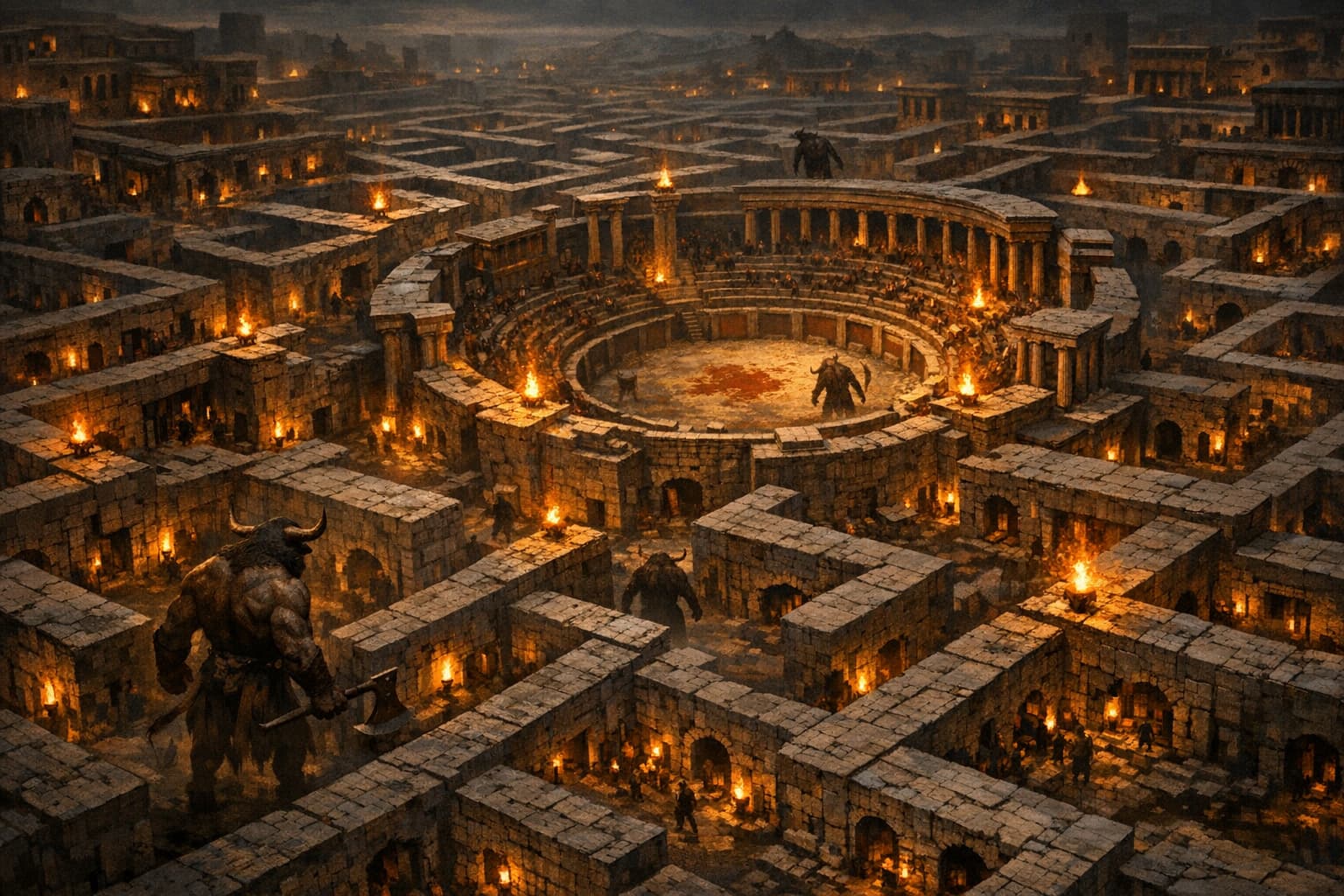


Minotaurs
Horned navigators of the deep labyrinth — half the world sees a monster, the other half never sees them coming
From Crete to the Campaign Table
The minotaur starts with a punishment. Poseidon sends a magnificent white bull to King Minos of Crete as a sign of divine favor, expecting it to be sacrificed. Minos keeps the bull. Poseidon retaliates by making Minos's wife Pasiphae fall in love with the animal. The result is Asterion — the Minotaur — a creature that is simultaneously a prince of Crete and a thing so monstrous that an entire architectural wonder must be built to contain it. The labyrinth isn't a dungeon. It's a solution to a problem nobody wanted to name out loud.
What makes the Greek myth compelling for fantasy is its refusal to let anyone be innocent. Minos sinned through greed. Pasiphae was cursed without consent. Asterion committed no crime except existing. Theseus, the hero who kills him, does so with borrowed tools — Ariadne's thread — and then abandons the woman who saved him. Every character in the myth is compromised. The minotaur is arguably the most sympathetic figure in the entire story, which is why fantasy keeps coming back to him.
D&D inherited the monster but initially discarded the tragedy. The 1st Edition Monster Manual (1977) presents the minotaur as a large, cunning beast haunting mazes — no culture, no interiority, just a thing to fight at the center of a dungeon. It took decades for the game to rediscover what the Greeks already knew: the minotaur is interesting because of what the maze means, not because of the stat block waiting inside it.
The Minotaur Across Mythological Traditions
| Source | Figure | Role | Legacy in Fantasy |
|---|---|---|---|
| Greek (Crete) | Asterion / The Minotaur | Cursed prince imprisoned in the labyrinth | The archetype — maze-dweller, feared and pitied |
| Mesopotamian | Gugalanna (Bull of Heaven) | Divine weapon loosed against Gilgamesh | Bovine creature as instrument of the gods |
| Hindu | Nandi (bull of Shiva) | Sacred guardian and divine mount | The bull as protector, not monster |
| Egyptian | Apis Bull | Living incarnation of Ptah | Bovine-humanoid reverence, horns as holy symbol |
| Celtic | Tarasque / Bull cults | Horned beast-gods of strength and fertility | Horned beings as wild, uncivilized power |
Only the Greek tradition frames the bull-creature as tragic. Every other tradition treats bovine strength as sacred. D&D draws mostly from Greece but is richer when it borrows from the rest.
Etymology & the Weight of a Name
"Minotaur" is Greek: "Minos" plus "tauros" (bull). The Bull of Minos. It's a possessive construction — the creature is defined by who owns it, not by who it is. Asterion, the minotaur's actual name in some sources, means "starry one" or "ruler of the stars." The gap between those two names tells you everything about how the myth works. One name is a cage. The other is an identity.
D&D minotaur naming conventions vary wildly by setting. In Dragonlance, minotaurs take names from their imperial culture — harsh consonant clusters reflecting a martial society. On Ravnica, minotaur names echo the Boros Legion's structure, blending personal names with rank designations. In Theros, names draw directly from Greek roots, connecting minotaurs to the mythological tradition that spawned them.
The best minotaur names at the table carry the same tension as Asterion versus Minotaur. A minotaur named by their own people sounds different from a minotaur named by the species that fears them. If a player names their minotaur character using a name imposed by outsiders, that's a character statement. If they insist on the name their clan gave them, that's a different statement entirely.
“They called him the Bull of Minos. His mother named him Asterion — ruler of the stars. Which name you use says more about you than it does about him.”
— On minotaur naming traditions
From Monster Manual to Player Option
Minotaurs have been in D&D since the first Monster Manual, but their trajectory from mindless maze-lurker to playable species is one of the most dramatic species arcs in the game's history. It tracks a broader shift in how D&D thinks about monsters — from obstacles to be killed to peoples to be understood.
The turning point was Dragonlance. Tracy Hickman and Margaret Weis gave Krynn an entire minotaur civilization: an imperial society with a senate, a navy, and a manifest-destiny ideology that made them antagonists not because they were monstrous but because their politics were genuinely threatening. The Dragonlance minotaurs weren't beasts in a maze. They were Rome with horns.
1e Monster Manual
Minotaurs appear as Large monstrous humanoids inhabiting mazes and underground lairs. No culture, no society — just a monster with a gore attack and a talent for never getting lost.
Dragonlance Campaign Setting
Minotaurs of Krynn are introduced as a full civilization: imperial, naval, honor-bound. They have a homeland (Mithas and Kothas), a government (the Supreme Circle), and ambitions of continental conquest.
Ravenloft & Monstrous Compendium
Minotaurs gain expanded lore as cursed beings in gothic horror settings. The labyrinth becomes psychological — a prison of the mind as much as stone.
3.5e — Dragonlance Sourcebooks
Krynn minotaurs get full playable stats with racial levels. The imperial culture is detailed with gladiatorial arenas, naval traditions, and a theology centered on Sargas (Sargonnas).
Guildmasters' Guide to Ravnica
Minotaurs become an official playable species for the first time in a 5e hardcover. Ravnican minotaurs are Boros Legion soldiers — disciplined, lawful, and nothing like the maze-skulking beasts of 1977.
Mythic Odysseys of Theros
Theros minotaurs draw directly from Greek mythology. They range from savage raiders to philosophical warriors, and the labyrinth connection is reframed as spiritual rather than literal.
2024 PHB — Species Revision
Minotaurs remain a published player option with updated mechanics. Hammering Horns and the gore attack are preserved as signature traits. The monster-to-person arc reaches its current form.
Homelands & Strongholds
Minotaur geography is setting-dependent in ways that most species aren't. An elf is an elf whether you're in Greyhawk or the Forgotten Realms — the specifics change, but the broad strokes hold. Minotaurs reinvent themselves completely with each setting. On Krynn they're island imperialists. On Ravnica they're urban soldiers. On Theros they're coastal raiders and mountain hermits. The species doesn't have a single homeland archetype; it has several, each with its own implications for who minotaurs are.
The one constant across settings is that minotaurs build vertically. Their architecture favors high ceilings, reinforced doorframes, and open central spaces — practical necessities for beings with horns that can span four feet tip to tip. A minotaur dwelling designed by non-minotaurs is immediately recognizable as a compromise. One designed by minotaurs for minotaurs has a scale and spatial logic that other species find imposing.
Minotaur Territories Across D&D Settings
| Territory | Setting | Society Type | Significance |
|---|---|---|---|
| Mithas & Kothas | Dragonlance (Krynn) | Imperial island-nation | The most developed minotaur civilization; senate, navy, gladiatorial tradition |
| Boros Garrison Districts | Ravnica | Urban military quarters | Minotaurs as soldiers and officers in a guild-based mega-city |
| Skophos (Labyrinth city) | Theros | Isolationist mountain stronghold | Built into a living labyrinth; reflects the mythological archetype most directly |
| Underdark Labyrinths | Forgotten Realms | Tribal, monster-adjacent | The classic "beast in the maze" version — least culturally developed |
| Talruum Territories | Dominaria (MTG crossover) | Mountain tribal confederation | Warrior clans with shamanic traditions and a deep suspicion of lowlanders |
The Forgotten Realms version is the least interesting precisely because it never moved beyond the 1977 monster entry. Every other setting asked "what if minotaurs had a culture?" and got better answers.
Horns, Hooves & the Body Built to Charge
A minotaur's body is an argument for momentum. Everything about their physical design — the dense musculature of the shoulders, the forward-weighted skull, the broad hooves that grip stone and earth — serves a single tactical purpose: close distance, make contact, and make contact count. The charge isn't a fighting technique minotaurs learned. It's what their bodies were built to do.
The bovine head on a humanoid frame creates biomechanical realities that most players don't think about. The neck musculature required to support a skull with horns spanning three to four feet is extraordinary. Minotaurs can't really look straight up without difficulty. They sleep on their sides or standing. Helmets are custom work or don't exist. Every piece of armor has to accommodate the horns, the broader skull, and a neck thicker than most humans' thighs.
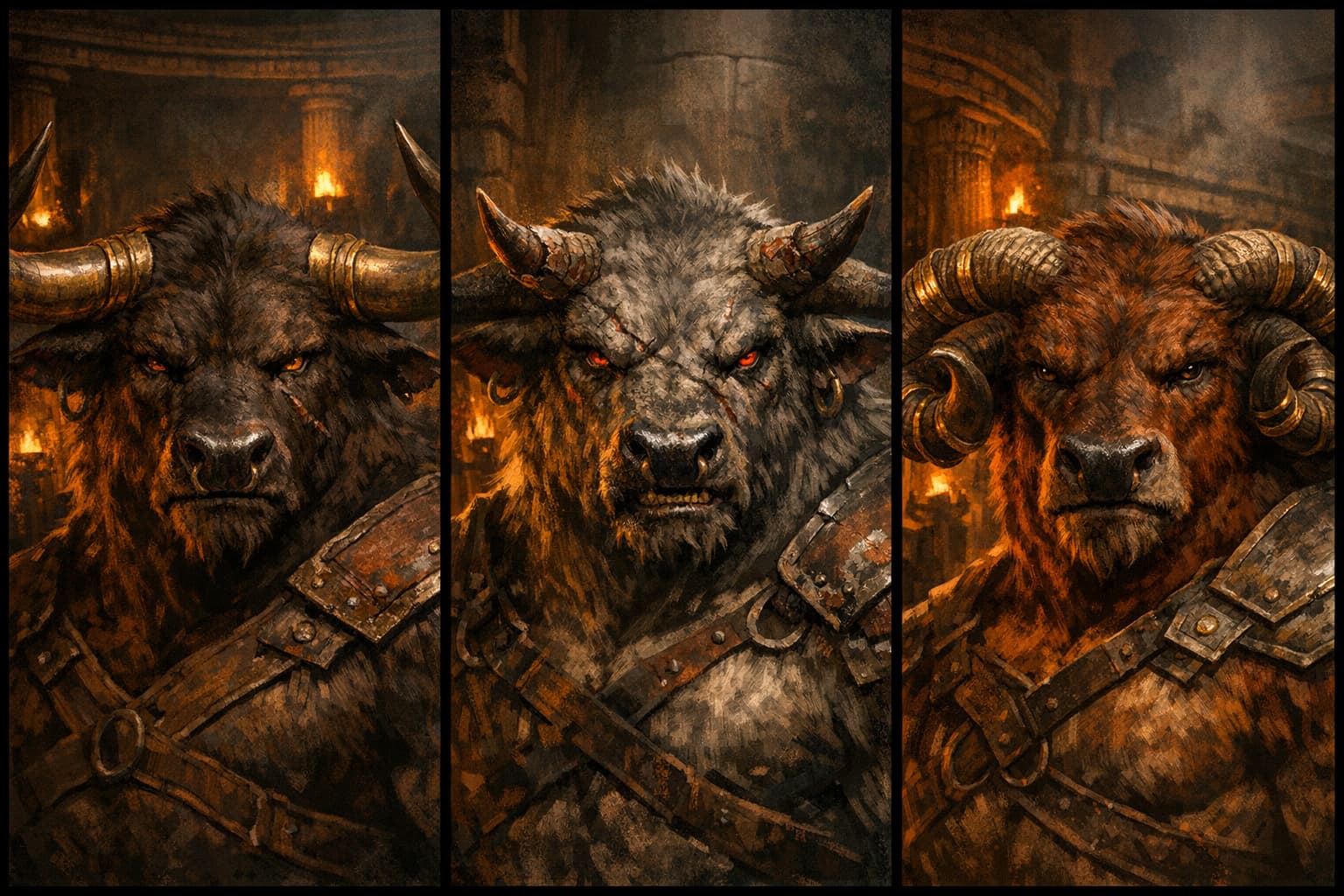
Horns & Gore Attack
The horns are weapon, social signal, and species identifier all at once. Horn shape, curvature, and growth patterns vary by lineage — some minotaurs carry wide-swept horns meant for hooking, others have forward-pointing spears designed for the direct charge. Horn care is a cultural practice. Polishing, oiling, capping with metal, carving decorative grooves — the way a minotaur maintains their horns communicates clan affiliation, personal history, and combat philosophy.
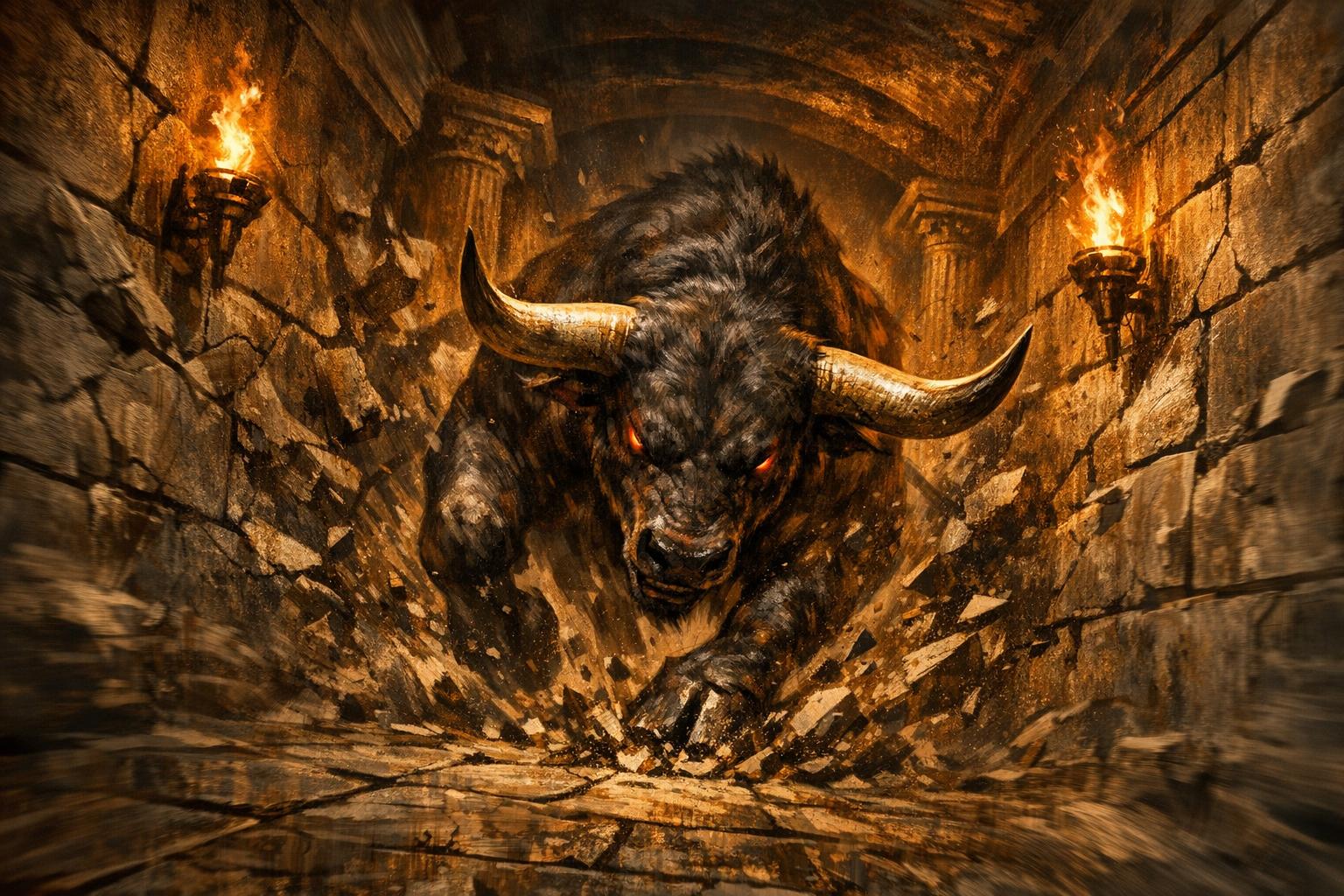
The Charge & Hammering Horns
Hammering Horns, the signature minotaur ability, isn't just a shove. It's the mechanical expression of a body designed for impact. When a minotaur hits you with their horns after a charge, the physics are terrifying — several hundred pounds of muscle and bone moving at sprinting speed, concentrated on two hardened points. The push effect reflects the reality that nothing short of a wall is going to stop that momentum. Defenders who brace against a minotaur charge don't deflect it. They redirect the damage to themselves.

Labyrinthine Recall
Minotaurs can perfectly recall any path they've traveled. This isn't a trained skill — it's a cognitive feature as fundamental as a human's ability to recognize faces. Minotaur brains process spatial information with a fidelity that other species can't replicate. They don't get lost. Ever. Not in dungeons, not in cities, not in featureless plains. They always know where they are in relation to where they've been, and they can retrace any route they've walked even years later.
Territorial Honor & the Navigating Mind
Minotaur psychology is built on two pillars that other species often mistake for one: territoriality and honor. They're related but distinct. Territoriality is the instinct to claim, defend, and know a defined space — to make a place yours through presence and memory. Honor is the social framework that determines how that instinct gets expressed. A minotaur without honor is dangerous. A minotaur without territory is lost in a way that goes beyond geography.
The navigational intuition that prevents minotaurs from getting physically lost extends into their social cognition. Minotaurs think in paths and connections. They remember who wronged whom three generations back, track obligation networks with the same precision they track corridors, and navigate political situations by mapping them spatially. A minotaur diplomat doesn't think in terms of arguments and counterarguments — they think in terms of routes to an outcome, dead ends, and hidden passages.
This means minotaurs are frequently underestimated intellectually. A species that thinks in spatial metaphors rather than verbal abstractions gets coded as simple by cultures that prize rhetoric. But the minotaur general who can't write a persuasive essay might be the best tactical mind on the field — because the battlefield is a maze, and no one navigates a maze like a minotaur.
“We do not get lost. Not in stone corridors, not in blood feuds, not in the tangle of promises and debts that other peoples call politics. The path is always there. You simply have to know how to see it.”
— Minotaur pathfinder proverb
The Labyrinth as Metaphor
Every other species in D&D has a place. Elves have forests. Dwarves have mountains. Halflings have shires. Minotaurs have the labyrinth — but the labyrinth isn't a place. It's a concept. And the way minotaurs relate to that concept is the single most interesting thing about the species.
In Greek myth, the labyrinth is a prison. Daedalus builds it to contain a monster that shames a king. The maze exists because the thing inside it is too horrible to look at and too important to kill. Theseus's entry is an intrusion, Ariadne's thread is cheating, and the Minotaur's death is the point of the story. The maze is the antagonist's home, and destroying the antagonist means you get to leave.
Minotaur cultures in D&D invert this. For the minotaurs of Theros, the labyrinth is sacred — a place of testing, meditation, and spiritual discovery. You enter the maze not to kill what's inside but to find what's inside yourself. The walls aren't traps. They're teachers. Each dead end is a lesson in patience. Each wrong turn is an opportunity to practice the only skill that matters: the willingness to keep going when you don't know where you are.
The Krynn minotaurs take a different approach. Their labyrinths are proving grounds — physical and political. The gladiatorial arenas of Mithas are labyrinths of combat. The halls of their senate are labyrinths of rhetoric. The concept extends everywhere: life itself is a maze, and only the strong, the clever, and the determined reach the center. This is not metaphor to them. It is architecture.
For a minotaur player character, the labyrinth question is foundational. Is the maze your prison, your temple, or your home? A minotaur who sees the labyrinth as confinement is running from something. A minotaur who sees it as sacred is seeking something. A minotaur who sees it as simply where they belong has already found it. The answer shapes every decision the character makes.
A party enters an ancient minotaur labyrinth expecting a dungeon crawl. The minotaur party member recognizes the carvings on the walls — this isn't a dungeon. It's a cathedral. The rest of the party wants to loot it. The minotaur wants to pray in it. Neither side is wrong. That's the conflict.
Daily Life & Cultural Divergence
Here is where the minotaur species fractures into something more interesting than a single archetype. A minotaur on Krynn wakes before dawn for mandatory physical training, eats a communal meal in a regimented mess hall, and spends the day in military drills, gladiatorial practice, or naval operations. Their life is structured by an empire that considers discipline the highest virtue and weakness a crime punishable by exile or death.
A minotaur on Ravnica wakes in a Boros garrison, straps on legion armor, and patrols a city of ten million beings representing dozens of species. Their life is structured by guild law, civic duty, and the strange experience of being a minority species in a cosmopolitan mega-city where your horns are an advantage in a bar fight and a liability on a crowded street.
A minotaur on Theros wakes in a mountain cave or a coastal camp, tends a herd or sharpens a weapon, and measures the day by the movements of the sun across the labyrinth-valley below. Their life is structured by the old ways — raiding, prophecy, the whispered commands of gods who still walk the earth.
The point is that "minotaur culture" is a phrase that means nothing without a setting qualifier. These are not variations on a theme. They are fundamentally different societies that happen to share a body plan. Playing a minotaur without choosing which tradition you come from is like playing a human without deciding which continent they're from.
Before session zero, decide which minotaur tradition your character comes from — even if your DM's setting doesn't map perfectly to a published one. An imperial minotaur who values hierarchy and strength will approach every social encounter differently than a guild-soldier minotaur who values law and procedure. The horns are the same. Everything else changes.
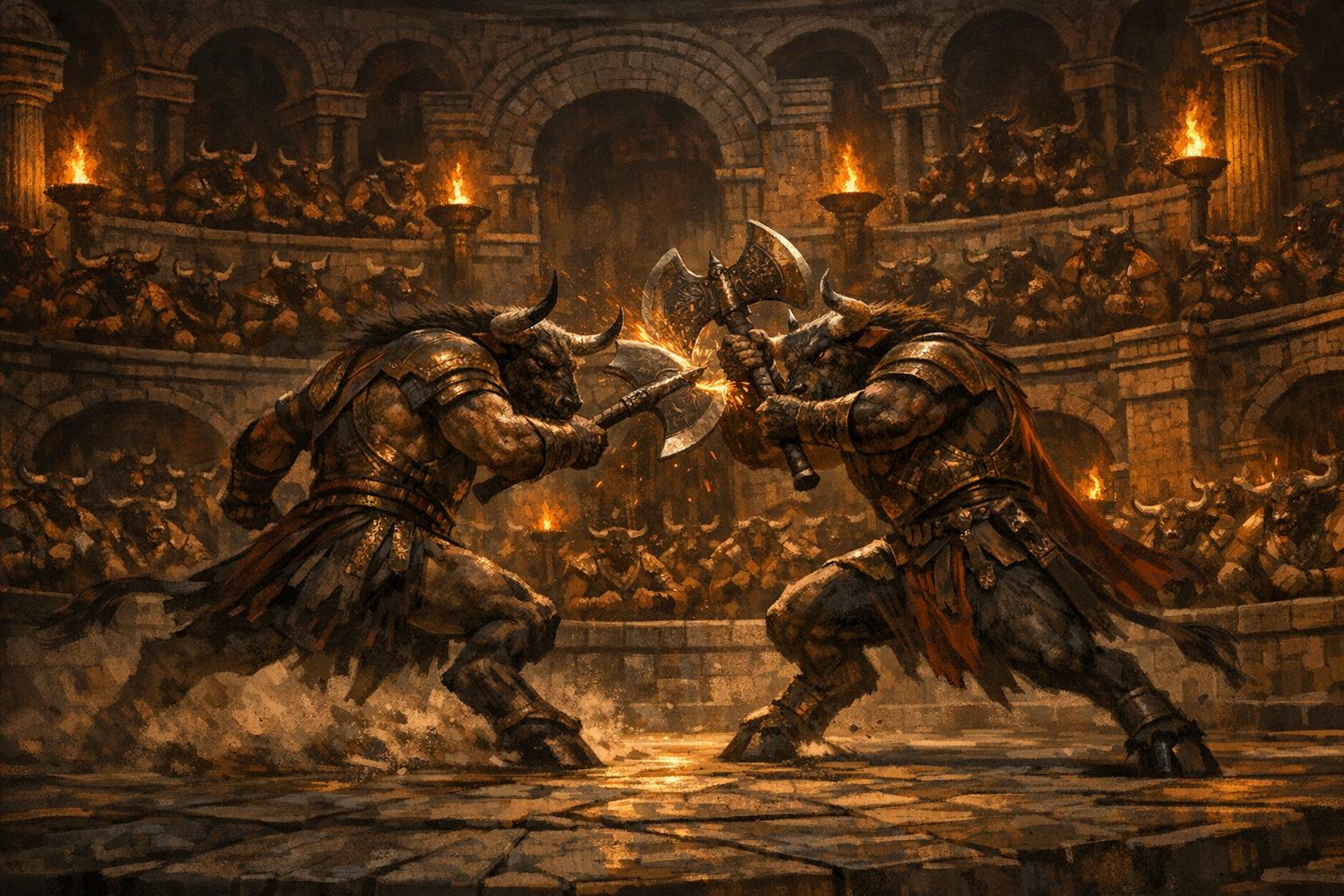
The Sargas–Baphomet Divide
Minotaur religion splits along a fault line that defines the species more than any biological trait: Sargas versus Baphomet. These two divine figures represent completely incompatible answers to the question of what minotaurs are for, and which one a minotaur community follows determines everything about their society.
Sargas — known as Sargonnas in some sources — is the god of vengeance, honor, and fire. On Krynn, he is the patron deity of the minotaur empire: a god who demands strength, rewards conquest, and frames minotaur dominance as a divine mandate. Sargas-worshipping minotaurs are imperialists with theological justification. They conquer because their god says they deserve to rule. This is not mindless aggression — it's ideology, backed by genuine divine power, which is much harder to argue with.
Baphomet is something else entirely. The Demon Prince of Beasts, lord of the Endless Maze in the Abyss, Baphomet represents the minotaur stripped of civilization — pure predatory cunning in a labyrinthine domain. Baphomet-worshipping minotaurs are the ones you find in dungeons, the ones who've abandoned society for the hunt. They are the version of the minotaur that most closely resembles the Greek myth: a monster in a maze, dangerous precisely because the maze is their territory.
The tension between these two traditions creates the species' most productive internal conflict. A Sargas minotaur and a Baphomet minotaur agree on almost nothing except that minotaurs are superior. They disagree fundamentally about what superiority means, how it should be expressed, and whether civilization is a strength or a cage.
Sargas (Order & Empire)
Sargas demands that minotaurs build. Empires, navies, institutions of law — the proof of minotaur superiority is the ability to create lasting structures of power. Worship is formal: temple ceremonies, ritual combat honoring the god, oaths of service to the state. The priesthood doubles as a political class.
The weakness of Sargas theology is its rigidity. Minotaurs who don't fit the imperial mold — artists, philosophers, pacifists — are marginalized or exiled. A god of strength has no patience for what he perceives as weakness, and his followers inherit that intolerance.
Baphomet (Savagery & the Maze)
Baphomet asks nothing except that minotaurs hunt. His worship is primal: blood offerings in labyrinthine shrines, frenzy-inducing rituals, the pursuit of prey through ever-more-complex mazes. There is no priesthood in the traditional sense — only the strongest and most cunning, who serve as conduits for the Demon Prince's will.
The weakness of Baphomet worship is its endpoint. A society that values only predation cannot sustain itself. Baphomet cults burn bright and collapse fast, leaving behind depopulated labyrinths and the bones of those who couldn't keep up. It's a theology of the short term.
Combat Arts & the Arena
Minotaur combat tradition is inseparable from minotaur culture because, in most settings, the arena is where culture happens. The gladiatorial tradition on Krynn isn't entertainment — it's jurisprudence, theology, and social mobility compressed into a single institution. Disputes are settled by combat. Promotions are earned by combat. Even theological arguments are sometimes resolved by putting two champions in a ring and seeing whose god hits harder.
The fighting styles reflect the body's capabilities. Minotaur martial arts emphasize the charge, the grapple, and the gore — techniques that exploit their weight, their horns, and their lower center of gravity. A minotaur trained in a formalized fighting tradition is devastating not because they're bigger (though they are) but because their techniques are designed for a body that other species' martial traditions don't account for. You train to fight humans, elves, dwarves. You do not train to fight something that leads with the top of its head at sprinting speed.
Weapons among minotaurs tend toward the heavy and the hafted. Greataxes, mauls, and halberds are common because minotaur arm and shoulder strength make weapons impractical for other species perfectly manageable for them. The double-bladed axe — the labrys, from which the word "labyrinth" may derive — carries particular cultural significance. It's not a coincidence. The maze and the axe share an etymology and a people.
The Labrys & Its Legacy
The double-headed axe appears in Minoan art centuries before the minotaur myth was written down. Scholars debate whether "labyrinth" derives from "labrys" — the house of the double axe. For minotaurs in D&D, this connection is literal: the weapon and the maze are the same symbol, representing a culture where the path forward is always cut, never found. A minotaur bearing a labrys is carrying a statement of cultural identity as much as a weapon.
Arena Combat Styles
Krynn's minotaur arenas have produced formalized fighting styles as sophisticated as any human martial tradition. The Hornrush is a charging grapple that transitions from gore attack to throw. The Ironwall is a defensive posture using a tower shield, designed to frustrate aggressive opponents into overextending. The Bloodpath is a sustained assault style that combines weapon strikes with horn attacks in alternation, never allowing the opponent to predict which weapon comes next.
How Other Species See the Horns & Notable Figures
Minotaurs provoke a visceral reaction in other species that few D&D peoples can match. A tiefling might make you uncomfortable. A dragonborn might impress or intimidate you. A minotaur makes you recalculate the geometry of the room — where the exits are, how much space is between you, whether the ceiling is high enough for those horns. The physical presence is inescapable.
On Ravnica, minotaurs have achieved the closest thing to genuine integration. As members of the Boros Legion, they serve alongside humans, goblins, and angels as soldiers and officers. The guild structure provides a social framework that transcends species — you're Boros first, minotaur second. This works because Ravnica's guild system values competence over appearance, and a minotaur who can hold a line is a minotaur who belongs.
The Dragonlance dynamic is the opposite. Krynn's minotaurs view other species as inferior — not with casual prejudice but with theological conviction. Their god says they are meant to rule. Their history of slavery and liberation reinforces the narrative that other species are either obstacles or subjects. Diplomatic relations with Krynn minotaurs are not negotiations between equals. They're negotiations between an empire and peoples the empire hasn't conquered yet.
Dwarves and minotaurs share an interesting mutual respect in settings where both exist as developed cultures. Both species value craft, endurance, and the willingness to build in stone. Both are stubborn to the point of self-destruction. Both hold grudges across generations. A dwarf and a minotaur may be enemies, but they're enemies who understand each other.
Named minotaur characters in D&D are concentrated in Dragonlance, where the species has the deepest cultural development. Outside of Krynn, minotaurs remain underrepresented in published fiction — a consequence of decades spent as monsters rather than people. The figures who do exist tend to be warriors and leaders, reflecting the martial emphasis of the settings that bothered to develop minotaur characters at all.
The cross-franchise picture is more interesting. Minotaurs appear across fantasy media with surprising consistency — always large, always horned, always connected to mazes or to combat, but with enough variation to show what different creators find compelling about the archetype.
Notable Minotaurs Across D&D and Fantasy
| Figure | Source | Significance |
|---|---|---|
| Kaz the Minotaur | Dragonlance (Richard Knaak) | The first minotaur protagonist in D&D fiction. A Krynn minotaur who rejects his empire's cruelty without rejecting minotaur identity. Defined the "honorable rebel" archetype. |
| Emperor Chot Es-Kalin | Dragonlance sourcebooks | Ruler of the minotaur empire at its height. Represents the Sargas-driven imperial ideology at its most dangerous and most effective. |
| Asterion | Greek myth / Theros | The original. His tragedy — imprisoned for existing, killed for someone else's glory — underpins every sympathetic minotaur written since. |
| Greckle (Iron Bull) | Dragon Age (cross-reference) | Not D&D, but the best-written minotaur-adjacent character in modern RPGs. A Qunari mercenary whose humor masks genuine philosophical conflict. |
| Baphomet | D&D Demon Lords | The Horned King of the Endless Maze. Not a minotaur exactly, but the divine figure who shapes how "evil" minotaurs are conceptualized across editions. |
Kaz remains the gold standard for minotaur protagonists in D&D fiction. His arc proves that rejecting your culture's worst impulses doesn't require rejecting your culture.
If you're playing a minotaur in a party of smaller species, lean into the spatial awareness. Your character notices doorways that are too narrow, ceilings that are too low, chairs that won't hold them. These aren't complaints — they're details that make the character feel physically real. A minotaur who has to duck through every doorway in a human city lives in a different world than their halfling companion, even when they're standing in the same room.
Mechanics Across Editions
The mechanical history of playable minotaurs is shorter than most species because they spent most of D&D's existence as monsters. When they did become playable, the design challenge was clear: how do you translate a Large creature with a gore attack and maze-navigation into balanced player mechanics without losing what makes a minotaur a minotaur?
The answer, across editions, has been to preserve the horns and the navigation while downsizing the body. Playable minotaurs are Medium, not Large — a concession to game balance that irritates some players but keeps the species from breaking every grid-based encounter. The gore attack persists as a natural weapon. Labyrinthine Recall persists as a ribbon ability. Hammering Horns, the ability to shove a creature after hitting with your horns, gives minotaurs a unique tactical identity that no other species replicates.
Minotaur Mechanical Evolution
| Feature | 3.5e (Krynn) | 5e (Ravnica/Theros) | 2024 |
|---|---|---|---|
| Size | Large | Medium | Medium |
| Horn Damage | 1d6 | 1d6 | 1d10 |
| Signature Ability | Natural Cunning | Hammering Horns + Goring Rush | Hammering Horns |
| Navigation | Never lost in mazes | Perfect path recall | Advantage on checks |
| Design Identity | Powerful brute | Charge-and-control specialist | Versatile horned warrior |
The shift from Large to Medium was controversial but necessary. Large player characters break encounter design in ways that penalize the entire table.
- Gore attack (1d6 + STR)
- Scent ability
- Natural Cunning (never lost in mazes)
- Large size (with all its advantages and complications)
Large size made Dragonlance minotaurs powerful but awkward in dungeon environments. The mental penalties echoed the "brute" stereotype the setting's own lore contradicted.
- Horns (1d6 unarmed strike)
- Goring Rush (bonus attack after Dash)
- Hammering Horns (push after melee hit)
- Labyrinthine Recall (perfect path memory)
Medium size. The combination of Goring Rush and Hammering Horns gave minotaurs a unique charge-and-control playstyle no other species could replicate. Labyrinthine Recall is the best ribbon ability in 5e.
- Horns (1d10 natural weapon)
- Hammering Horns (push on horn hit)
- Labyrinthine Recall (advantage on checks to avoid being lost)
- Medium size, flexible ability scores
The horn damage increase to 1d10 finally made the gore attack viable as a primary weapon option. Flexible ability scores opened minotaurs to every class without penalty.
Minotaurs Across Franchises
The minotaur is one of the most portable fantasy creatures because the source material is so specific — bull head, humanoid body, lives in a maze — that every franchise starts from the same recognizable template. What changes is the emphasis. Some franchises keep the monster. Some find the person inside the monster. The best do both.
The consistent thread across all versions is the maze. Whether it's literal stone corridors or the metaphorical labyrinths of politics, honor, and identity, the minotaur is always associated with paths that aren't straight. This is the species' deepest narrative function: minotaurs exist to make you think about the difference between being lost and being exactly where you're supposed to be.
Minotaurs Across Fantasy Franchises
| Franchise | Minotaur Identity | Core Theme | Key Distinction |
|---|---|---|---|
| D&D | Setting-dependent: monster, soldier, or imperialist | The maze as home, prison, or proving ground | Most mechanically detailed; widest range of interpretations |
| Greek Mythology | Asterion — tragic prisoner | Inherited shame, imprisonment without crime | The original; every fantasy minotaur is a response to this version |
| Magic: The Gathering | Tribal warriors (Dominaria) / guild soldiers (Ravnica) | Strength channeled through belonging | Direct D&D crossover via Ravnica; most integrated version |
| God of War | Divine constructs and labyrinth guardians | The maze as divine punishment mechanism | Returns to the Greek horror-monster roots |
| World of Darkness | Minotaur-kin (Gurahl adjacent) | Shape-shifting beast-spirits | Rarest interpretation — minotaurs as spiritual rather than physical |
| Assassin's Creed Odyssey | The Minotaur as Isu-created hybrid | Ancient technology misread as myth | Science-fiction reframe of the mythological creature |
The Greek original remains the most powerful version because it asks the hardest question: whose fault is the monster?
FAQ
Common Questions
Dramatically. Dragonlance minotaurs are an imperial civilization with a navy, a senate, and a manifest-destiny theology. Ravnica minotaurs are disciplined guild soldiers serving in a cosmopolitan mega-city. Theros minotaurs range from savage raiders to philosophical labyrinth-seekers. Forgotten Realms minotaurs are the least developed — mostly dungeon monsters with minimal culture. Choosing your setting of origin is the most important character decision a minotaur player makes.
Absolutely, especially with the 2024 rules removing fixed ability score bonuses. A minotaur cleric channeling divine power through ritual combat is thematically rich. A minotaur druid whose connection to the natural world expresses through bovine and beast forms makes perfect sense. Even wizard works if you lean into the spatial-reasoning angle — a minotaur who understands magic as architecture, building spells the way their ancestors built labyrinths.
Treat the labyrinth as metaphor rather than architecture. A minotaur's navigational instinct applies to any complex system — city streets, political alliances, investigation trails. Labyrinthine Recall means your character remembers every route they've taken through a city, every conversational path in a negotiation, every sequence of clues in a mystery. The maze doesn't have to be stone walls. It just has to be a problem with a path through it.
Complicated. Baphomet is a demon prince who claims dominion over all minotaurs, but most playable minotaur cultures reject him entirely. Krynn minotaurs worship Sargas, not Baphomet. Ravnica minotaurs follow guild law, not demonic cults. Baphomet-worshipping minotaurs exist, but they're the antagonist version — feral, labyrinth-dwelling, and closer to the 1977 monster entry than to any playable species. A player character minotaur might have strong feelings about Baphomet (revulsion, fear, or a complicated theological grudge), but worshipping him is typically villain territory.