
Orcs
Survivors first, warriors second — forged by hostility into something the comfortable world never had to become
Mythological Foundations
Orcs didn't spring fully formed from Tolkien's imagination, though he gets most of the credit. The word "orc" appears in Beowulf as "orcneas" — a compound usually translated as "evil spirits" or "walking corpses" — lumped alongside elves and giants as the monstrous progeny of Cain. Tolkien, the Beowulf scholar, knew this. He borrowed the word and built something new: a corrupted species, manufactured from captured elves by a dark god who couldn't create life from scratch and had to ruin someone else's work instead.
That origin story — corruption rather than creation — set the template for decades of fantasy. Orcs weren't born evil; they were made evil, which is a much more interesting and much more uncomfortable idea. It raises questions Tolkien himself struggled with: can a species be irredeemable? If orcs were corrupted against their will, do they bear moral responsibility for what they became? Tolkien never resolved this satisfactorily, and fantasy has been wrestling with his ambiguity ever since.
The Norse berserker tradition also feeds the archetype. Warriors who fought in trances, reportedly immune to pain, who terrified disciplined armies because they refused to behave rationally in combat. The berserker represented what civilization feared most: violence that couldn't be reasoned with, negotiated with, or predicted. Orcs inherit this anxiety. They're the thing on the other side of the wall that doesn't care about your walls.
Mythological Roots of the Orc Archetype
| Source | Concept | Legacy in Fantasy |
|---|---|---|
| Beowulf (c. 700 CE) | Orcneas — monstrous kin of Cain | The word itself; orcs as cursed outcasts |
| Norse Berserkers | Frenzied warriors beyond reason | Orc rage mechanics, fearlessness in combat |
| Tolkien (1937–1955) | Corrupted elves, industrial foot soldiers | Orcs as manufactured evil, tied to a dark master |
| Warhammer (1983+) | Greenskin fungal reproduction, comic brutality | Orcs as anarchic force of nature, separate from moral framing |
Each tradition contributed a layer. Strip any one away and the modern orc loses a dimension.
Etymology & Name Origins
The word "orc" carries more baggage than most fantasy terminology. In Old English, "orcneas" sat alongside "eotenas" (giants) and "ylfe" (elves) in Beowulf's catalogue of Cain's monstrous descendants. The precise meaning is debated — some scholars connect it to the Latin "Orcus," the Roman god of the underworld and punisher of oath-breakers, while others treat it as a purely Germanic word for demon or corpse.
Tolkien used "orc" rather than "goblin" deliberately, though he wavered between the two throughout his career. In The Hobbit, they're goblins. In The Lord of the Rings, they're orcs. The shift reflects a growing seriousness — goblins carried fairy-tale connotations that undermined the existential threat Tolkien wanted. "Orc" sounded harder, more Anglo-Saxon, more like something that belonged in a saga rather than a bedtime story.
D&D inherited the confusion. Orcs and goblins are separate species in every edition, but the line between them is vibes rather than biology. Orcs are bigger, meaner, and taken more seriously. Goblins are smaller, sneakier, and more likely to be comic relief. The distinction has more to do with narrative function than with any coherent taxonomy — orcs threaten civilizations while goblins threaten caravans.
“The word stretches from a Beowulf poet cataloguing the monsters in the dark, through a Roman death-god, to a Oxford professor who needed something that sounded like it could end the world. Every meaning is still in there.”
— On the etymology of "orc"
History in D&D Settings
Orcs have been in D&D since the beginning — literally page one of the monster lists. But what "orc" means in D&D has shifted more dramatically than almost any other species over the game's fifty-year history. They started as disposable enemies, became playable antiheroes, and are now the subject of one of the hobby's most contentious design debates.
The trajectory matters because it mirrors how the hobby thinks about evil, race, and whether sentient beings can be written off wholesale. Orcs are the canary in D&D's moral coal mine: how the game treats orcs tells you what the game thinks about the nature of evil itself.
Original D&D
Orcs appear as Chaotic monsters in the first monster lists. No culture, no society — just hit points, damage, and a tendency to serve evil overlords. Pig-faced in early illustrations.
AD&D 1e Monster Manual
Orcs get their first real write-up: tribal society, territorial aggression, half-orc offspring. The pig-face becomes canonical in David Sutherland's illustrations. Gruumsh One-Eye established as their deity.
Half-Orcs Become Playable
The 1e Player's Handbook includes half-orcs as a playable race. Not orcs themselves — you had to be half-human to be worthy of player status. The implication was clear.
AD&D 2e Removes Half-Orcs
The 2e PHB drops half-orcs entirely, citing discomfort with the "implications" of half-orc origins. The species becomes purely monstrous again.
Obould Many-Arrows
R.A. Salvatore introduces an orc king who builds a legitimate nation through diplomacy alongside conquest. The first major D&D orc character treated as a complex political actor.
3.5e Expands Orc Options
Full orcs become playable alongside half-orcs. The racial ability penalties are brutal (-2 INT, -2 WIS, -2 CHA) but the door is open.
5e Half-Orc in the PHB
Half-orcs return as a core player option with no ability score penalties. Savage Attacks and Relentless Endurance make them mechanically excellent. Full orcs appear in Volo's Guide (2016).
Tasha's & the Alignment Debate
Tasha's Cauldron removes default alignments and ability penalties from all species. WotC officially states that no species is inherently evil. The "always Chaotic Evil orc" is formally dead.
2024 PHB: Orc as Core Species
Orcs become a core player species for the first time in D&D history. No half-orc distinction needed — just orcs, playable from page one. Fifty years from monster to protagonist.
Key Settlements & Homelands
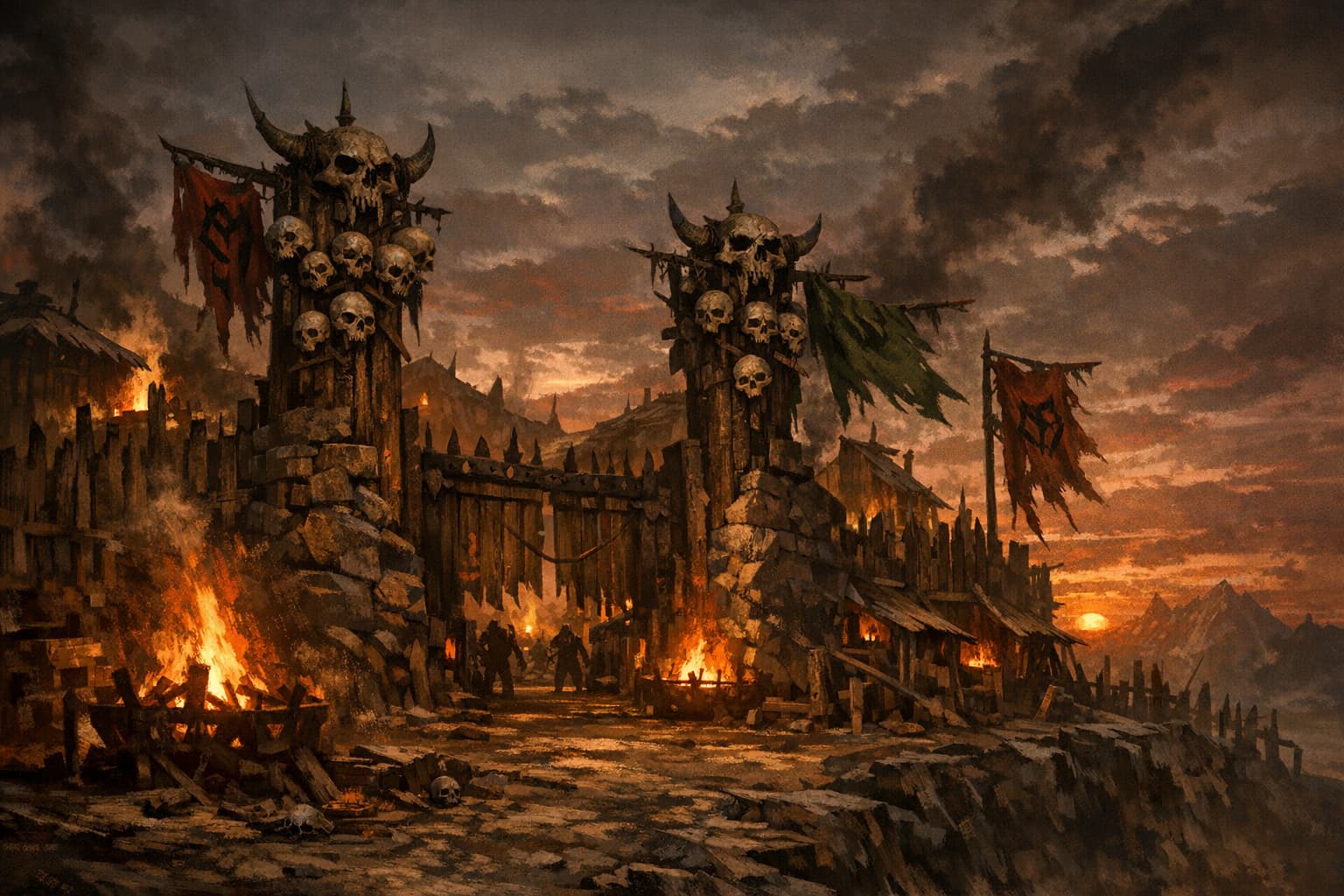
Orc settlements in D&D lore tend to fall into two categories: the stronghold and the ruin. Strongholds are active communities — fortified, aggressive, and organized around military capability. Ruins are the aftermath of expansion that couldn't sustain itself, or the remnants of orc nations that other powers dismantled. Both tell you something about how the game world views orcs: builders whose work is treated as temporary.
The Kingdom of Many-Arrows is the most significant exception. Founded by Obould Many-Arrows in the Spine of the World, it represents the first orc nation recognized by neighboring human and dwarven powers as legitimate. Its existence is controversial in-setting and out — many Forgotten Realms fans resisted the idea that orcs could build something that lasted. The kingdom's repeated destruction and reformation in various novels reflects this ambivalence.
Notable Orc Territories in D&D Settings
| Territory | Setting | Status | Significance |
|---|---|---|---|
| Kingdom of Many-Arrows | Forgotten Realms | Founded, destroyed, refounded | First orc nation recognized by neighboring powers |
| Nishrek (Gruumsh's Realm) | Outer Planes | Eternal | Acheron layer where orc spirits battle forever |
| Thar | Forgotten Realms | Contested | Blasted plateau of warring orc and ogre tribes |
| Uruk Lurk | Greyhawk | Active | Major stronghold in the Pomarj peninsula |
| The Severed Hand | Icewind Dale | Ruined | Former elven fortress conquered and lost again |
| Broken Skull tribe lands | Various | Mobile | Nomadic warbands following seasonal migration |
Notice the pattern: orc territory is always "contested," "ruined," or "mobile." The game world rarely lets orcs simply have a homeland.
Biology & Physicality
Orcs are built for endurance under conditions that would kill most other species. Dense musculature, rapid healing, tolerance for extreme temperatures and poor nutrition — these aren't combat adaptations. They're survival adaptations. Orcs evolved (or were created) for environments where resources are scarce and threats are constant.
This matters for how you play them. An orc doesn't fight because they enjoy it, necessarily. They fight because they come from a lineage where fighting was the only reliable way to eat. The aggression that other species find alarming is what kept orcs alive in places where the polite species wouldn't last a week.
Musculature & Frame
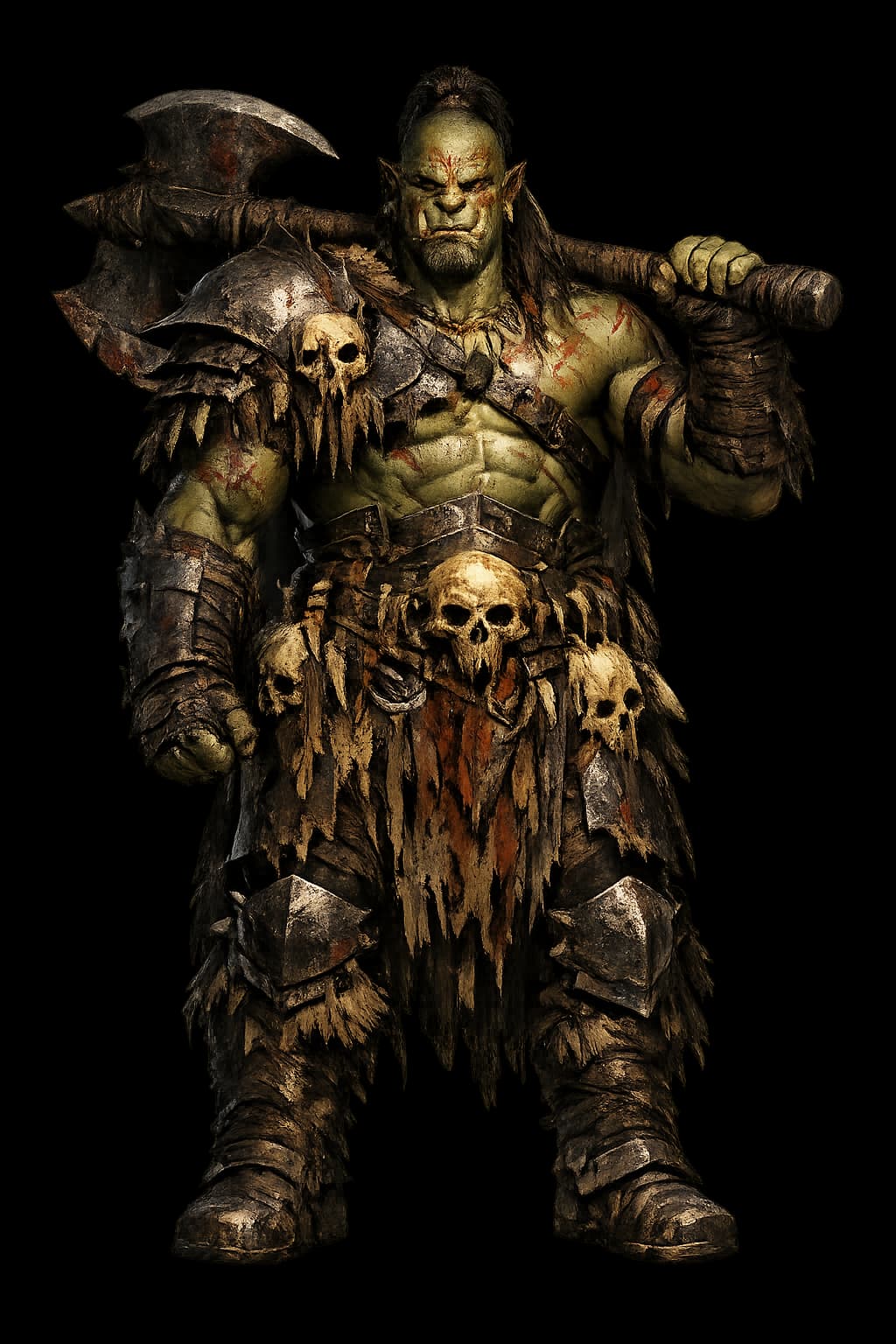
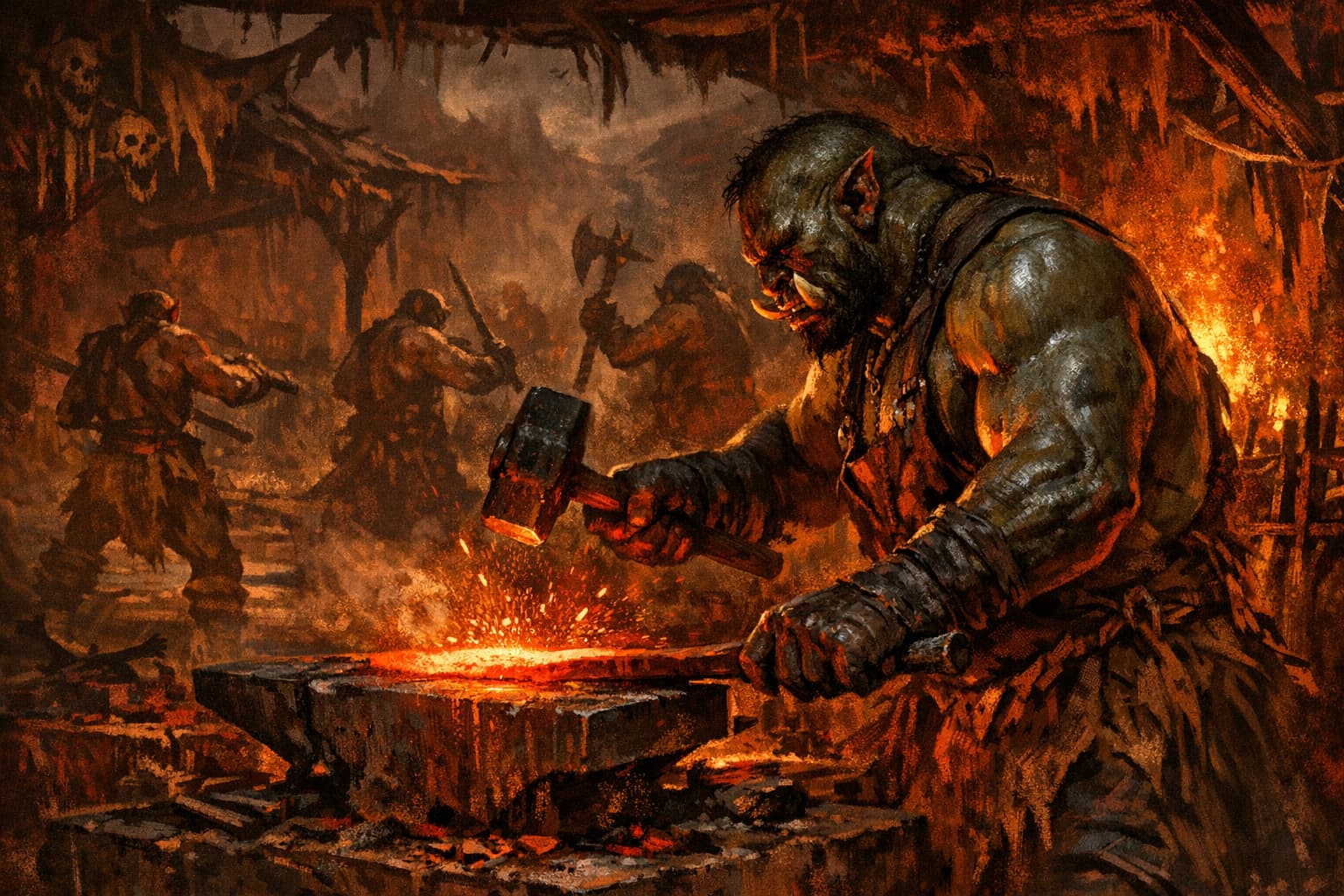
Orc muscle density exceeds that of humans by a significant margin, with a skeletal structure to match. Broader shoulders, thicker bones, joints designed to absorb impacts that would shatter human frames. This isn't bulk for show — it's functional architecture for a life where physical labor and physical combat are daily realities.
Tusks & Dentition
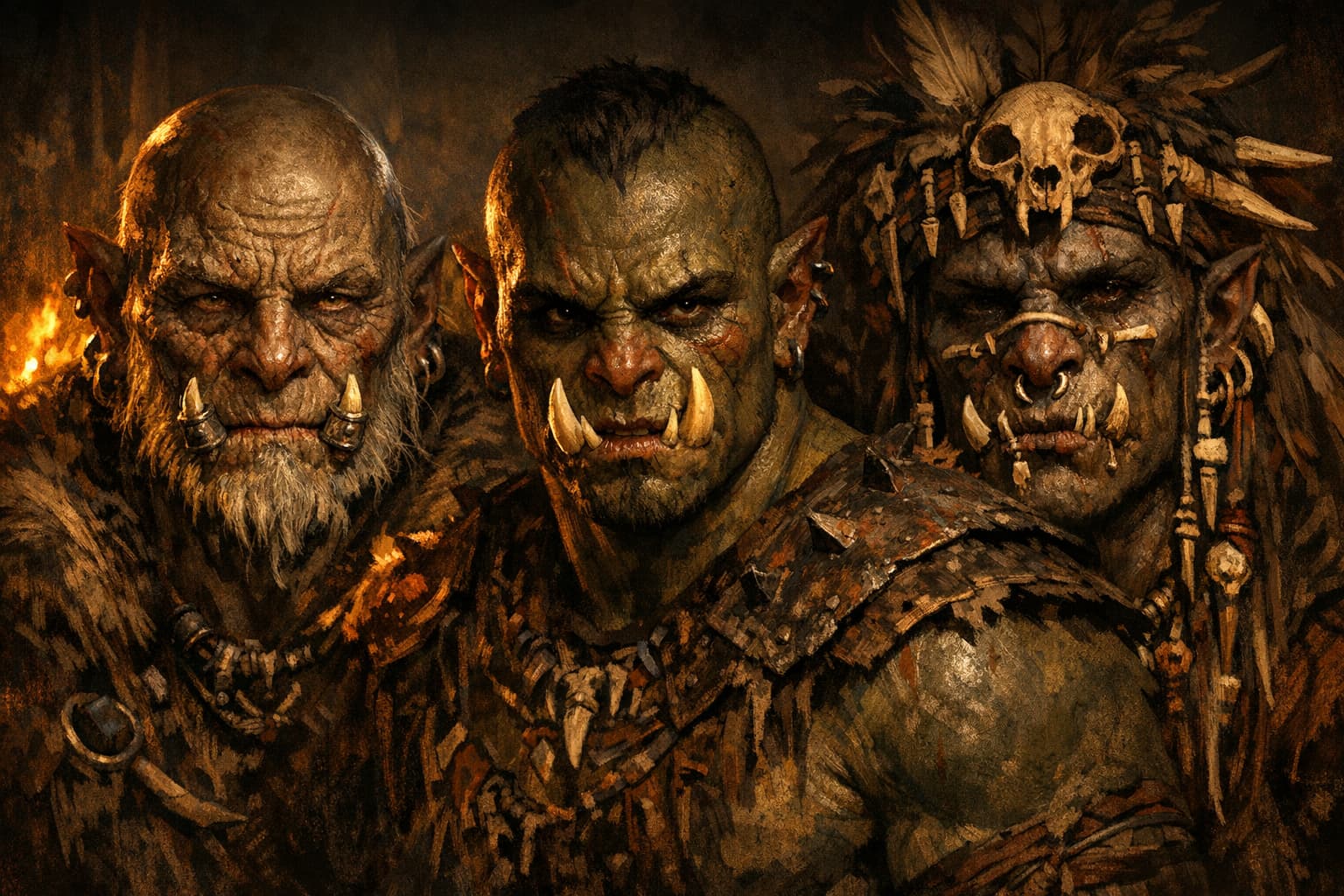
The lower canines that extend past the lip are the most recognizable orc feature, and the most misunderstood. They're not purely weapons — they're display structures, social signals, and tools. Orc societies read tusk condition, size, and scarring the way humans read facial expressions. Filing, capping, or decorating tusks carries cultural meaning that varies by tribe.
Darkvision & Sensory Adaptation
Orc darkvision isn't the refined low-light perception of elves. It's a blunt instrument — effective to 60 feet, washed out, heavily motion-dependent. Orcs see movement in darkness better than detail, which makes them excellent sentries and terrible librarians. Bright light doesn't impair them mechanically in 5e, but older editions imposed daylight penalties that reinforced the underground-raider archetype.
Endurance & Recovery
Relentless Endurance isn't just a class feature — it's species identity distilled into a mechanic. Orcs don't go down easy. They recover from wounds faster than humans, function on less food and sleep, and maintain combat effectiveness under conditions of deprivation that would render other species useless. This resilience defines the species more than aggression does.
Psychology & Worldview
Here's the thing about orcs that most fantasy gets wrong: they're not stupid. The -2 Intelligence penalty that haunted them through multiple editions was game design reflecting cultural assumptions, not the other way around. A species that survives in hostile environments, develops complex tribal hierarchies, creates oral traditions spanning centuries, and adapts warfare to diverse terrains is not unintelligent. They're differently educated.
Orc psychology centers on scarcity thinking. When resources are uncertain, you take what you can, defend what you have, and view outsiders as either threats or opportunities. This isn't moral failure — it's rational behavior under specific conditions. Human communities under resource pressure develop identical patterns. The difference is that orcs have been written as though scarcity-driven behavior is genetic rather than environmental.
The shift in recent editions toward treating orc psychology as culturally shaped rather than biologically determined isn't just political correctness. It's better worldbuilding. An orc raised in abundance might be generous. An orc who's never been threatened might be trusting. An orc with access to education might pursue scholarship. If orc behavior is purely biological, none of this works. If it's cultural, everything opens up.
“Survival is not a philosophy you choose. It is the philosophy that chooses you when every other option has been stripped away.”
— Orc proverb (attributed)
Daily Life & Tribal Structure
Orc tribes are meritocracies with the emphasis on "merit" defined very broadly. Yes, the strongest warrior often leads. But "strongest" encompasses tactical intelligence, spiritual authority, diplomatic skill, and the ability to keep the tribe fed. A war chief who wins battles but can't manage supply lines doesn't last. The chieftain who feeds the tribe through a hard winter earns more loyalty than the one who takes a neighboring village.
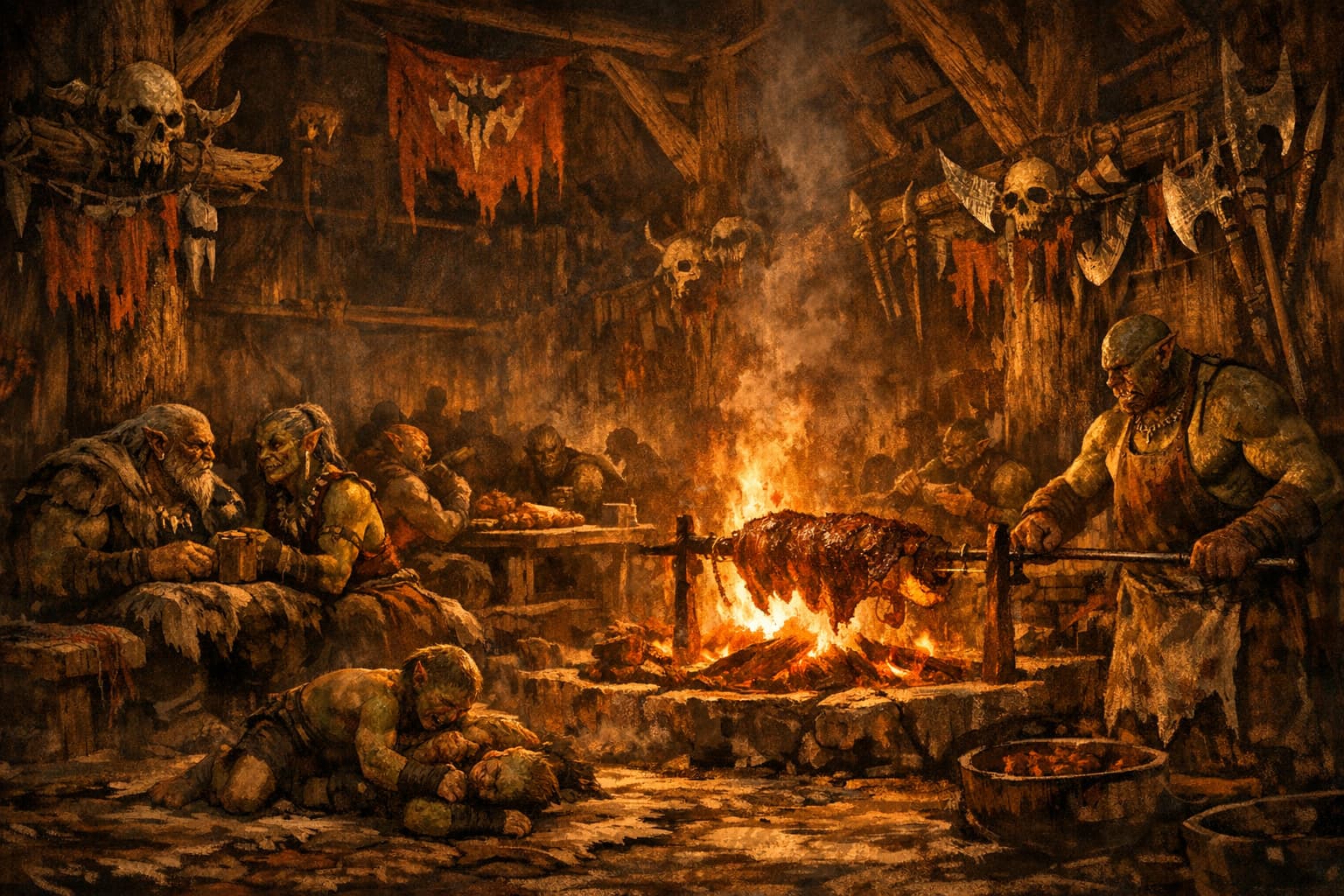
Daily life in a functioning orc tribe looks less like a war camp and more like any subsistence community. Hunters range out at dawn. Crafters maintain weapons, tools, and shelters. Elders teach children. Shamans tend the sick and interpret omens. The military readiness that outsiders find alarming is not all-consuming — it's one function among many, like a medieval village maintaining its militia alongside its farms.
Gender roles vary dramatically between tribes and settings, which is itself a sign of cultural complexity. Some tribes restrict combat roles by gender. Others assign roles purely by demonstrated capability. A few maintain matriarchal structures where mothers control territory while war chiefs handle external threats. Treating all orc societies as identical is as reductive as treating all human societies as identical.
When building orc societies for your game, resist the temptation to make every aspect revolve around war. Real cultures have economies, art, cuisine, humor, child-rearing practices, and disagreements about religion. An orc tribe that feels three-dimensional gives your players something to engage with beyond combat. The tribe that trades medicinal herbs, raises worg pups, and argues about whose grandmother's battle hymn is the canonical version is more interesting than the tribe that just attacks.
Culture & Governance
The orc political spectrum is wider than most sourcebooks suggest. Traditional tribal governance — rule by the strongest, validated by a council of elders and a chief shaman — is only one model. Orc societies in established settings have produced theocracies, military juntas, democratic war councils, and at least one attempt at constitutional monarchy (Many-Arrows under Obould's later reforms).
The interesting question isn't whether orcs can govern themselves — obviously they can. The interesting question is what happens when orc governance collides with the expectations of neighboring powers. A human kingdom that accepts dwarven clans and elven councils as legitimate political entities may still refuse to treat an orc tribe as anything other than a raiding party with pretensions.
Traditional Tribal
War chief leads with the backing of the strongest warriors. Shaman provides spiritual legitimacy and practical counsel. Council of veteran warriors advises on major decisions. Succession by combat or acclamation. Works well for mobile, small-to-medium groups where rapid decision-making matters more than institutional stability.
The weakness is volatility. Leadership transitions are violent. Policy changes with each new chief. Long-term projects rarely survive a change in leadership. Tribes that thrive under a brilliant chief may collapse under an average successor.
Reformed & Integrated
Some orc communities have adopted or adapted governance models from neighboring cultures. Written law, hereditary succession tempered by councils, trade agreements instead of raids. These communities trade military flexibility for stability and diplomatic legitimacy.
The weakness is cultural erosion. Orcs who integrate too fully into neighboring civilizations risk losing distinctive traditions. Young orcs in integrated communities may face identity crises — too orc for human society, too human for traditional tribes. This tension drives excellent character stories.
Religion & Gruumsh One-Eye
Gruumsh One-Eye is one of D&D's most complex deities, and he's usually reduced to "angry war god." The actual myth is richer. In the foundational story, Gruumsh demands territory for his people during the divine division of the world. The other gods — Corellon Larethian, Moradin, Yondalla — claim the forests, mountains, and meadows. Gruumsh gets nothing. His response isn't merely rage. It's a declaration: if the world won't give orcs a place, orcs will take one.
This origin myth reframes everything about orc aggression. Orcs don't conquer because they're evil. They conquer because their creation story tells them the world was divided without them, that every other species was given gifts they were denied, and that the only territory they'll ever hold is territory they seize. When your god lost his eye fighting for your right to exist, pacifism feels like betrayal.
The orc pantheon beyond Gruumsh is underdeveloped in most sourcebooks, which is itself revealing. Luthic the Cave Mother governs healing, home, and survival. Ilneval handles strategy and military planning. Bahgtru represents pure physical strength. Shargaas oversees darkness and stealth. Together they form a pantheon that reflects a people perpetually at war — not because they want to be, but because the story they tell about themselves says they have no other choice.
What happens to orc theology when orcs achieve lasting peace? If Gruumsh's mandate is "take what the world denied you," does that mandate expire once you have enough? Reformed orc communities might develop new theological interpretations — Gruumsh as a protector of what's already been won rather than a driver of endless expansion. Orthodox tribes would call this heresy. There's your campaign conflict.
War Magic & Combat Traditions
Orc magical traditions prioritize immediate, practical effects over theoretical elegance. Where elven magic aims for beauty and dwarven magic aims for permanence, orc magic aims for results right now, under pressure, with limited resources. This isn't a deficit — it's a specialization that produces battlefield magic of devastating efficiency.
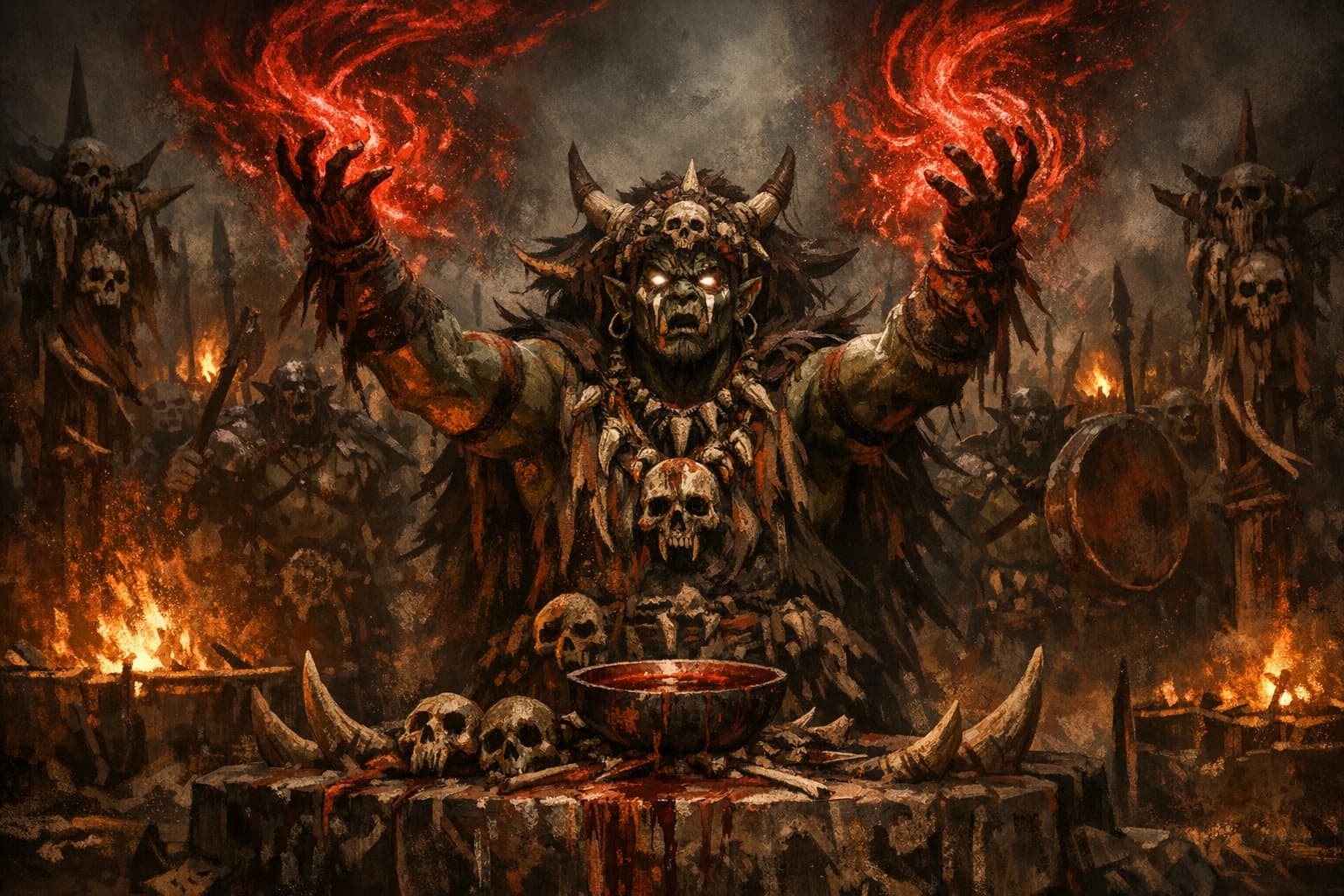
War shamans are the backbone of orc magical practice. Part cleric, part sorcerer, part battlefield medic, they occupy a role that other cultures would split across three or four specialists. A war shaman might bless weapons at dawn, treat wounds at midday, call lightning during an assault, and commune with ancestral spirits at nightfall. The breadth is the point — orc communities can't afford specialists who only do one thing.
Blood Fury Rites
Pre-battle rituals that heighten aggression and pain tolerance through a combination of herbalism, chanting, and divine invocation. Mechanically adjacent to the barbarian's rage but spiritually framed as communion with Gruumsh. The best war shamans can extend this state to an entire warband, creating units that fight with coordinated ferocity rather than individual frenzy.
Bone Reading & Ancestor Communion
Divination through carved bones, beast entrails, and smoke patterns. Less precise than arcane scrying but faster to deploy and requiring no expensive material components. Orc diviners specialize in immediate tactical intelligence — enemy numbers, weather shifts, terrain hazards — rather than grand prophecy. Ancestor spirits consulted for strategic guidance carry their own biases and grudges, making orc divination unreliable in entertaining ways.
Siege Shamanism
Specialized destruction magic developed by orcs who spent centuries assaulting dwarven and human fortifications. Earth-shaking, wall-cracking, gate-shattering magic that trades subtlety for raw force. Siege shamans are rare and highly valued — a single skilled practitioner can replace weeks of conventional siege work. Other cultures find this magic crude. They also find it terrifyingly effective.
Inter-species Relationships
Orcs occupy a unique position in D&D's species hierarchy: they're the species other species define themselves against. Dwarves are stalwart defenders — against orcs. Elves are graceful guardians of civilization — against orcs. Humans build walls and raise armies — against orcs. Remove orcs from the equation and half the setting's cultures lose a core piece of their identity.
This is the "always evil" problem distilled. For decades, D&D needed a species that could be attacked without moral consequence. Orcs filled that role because they were written to fill it — inherently aggressive, divinely mandated to destroy, incapable of the kind of civilization that might make killing them complicated. It was convenient. It was also, as the hobby gradually recognized, a framework with some deeply uncomfortable implications.
The racial coding debate is real and worth engaging with directly. When a fantasy species is described as inherently violent, culturally primitive, less intelligent, and suitable only for killing or "civilizing," the parallels to real-world colonial rhetoric are not subtle. This doesn't mean everyone who ran orcs as mindless enemies was racist. It means the framework they were using carried assumptions worth examining.
Modern D&D handles this by treating orcs as culturally diverse rather than biologically determined. Some orc communities are aggressive and territorial. Others are diplomatic and trade-oriented. The same range you'd expect from any sentient species. This is better worldbuilding regardless of political considerations — a world where an entire species shares a single personality is less interesting than a world where they don't.
The most productive version of orc-vs-civilization conflict isn't "evil monsters attack good people." It's competing claims to the same resources by groups with incompatible worldviews and historical grievances. The orc tribe raiding farmsteads might be doing so because those farms were built on land the tribe used for seasonal hunting. The farmers aren't wrong to defend themselves. The orcs aren't wrong to resent the displacement. Nobody has to be a monster for the conflict to be real.
Literature & Notable Figures
Named orc characters in D&D fiction are rarer than they should be, which is itself a symptom of the species' long treatment as an anonymous threat rather than a source of protagonists. The ones who do exist tend to be exceptions that prove uncomfortable rules — orcs who succeed because they're "not like other orcs," which implicitly validates the stereotyping of the rest.
The best orc characters in D&D fiction and gameplay challenge the framework rather than accepting it. They force the question: if this orc can be honorable, strategic, and complex, why are we treating the rest of the species as disposable?
Notable Orcs in D&D Lore & Fiction
| Figure | Source | Significance |
|---|---|---|
| Obould Many-Arrows | R.A. Salvatore's Drizzt novels | Orc king who built a recognized nation through diplomacy and military genius. Elevated to Exarch of Gruumsh. The most important orc character in D&D fiction. |
| Vhok (Kaanyr Vhok) | Thomas Reid's novels | Cambion-orc hybrid warlord of the Scourged Legion. Demonstrates orc-fiend alliances. |
| Taark Shanat | Forgotten Realms lore | Ancient orc chieftain known as the Crusader, who led migrations into the Underdark. Historical figure. |
| Grommash Hellscream | Warcraft (cross-reference) | Not D&D, but the defining modern orc character. His arc from enslaved berserker to liberator reshaped how all fantasy orcs are written. |
The relative scarcity of named orc characters compared to elf or dwarf characters reflects decades of the species being treated as antagonist material rather than protagonist material.
D&D Mechanics Across Editions
The mechanical history of playable orcs tells a story about what the game valued in each era. Early editions said: orcs are monsters, and the half-human compromise is the closest you get to playing one. Middle editions said: you can play a full orc, but you'll pay for it with crippling penalties. Modern editions say: orcs are people, and their mechanics should reflect strengths without encoding inferiority.
The evolution from -2 Intelligence to no penalties at all isn't just number-balancing. It's a design philosophy shift from "orcs are inherently lesser" to "orcs are differently adapted." Whether you think that shift was overdue or unnecessary probably depends on whether you've ever had a player ask to play an orc scholar and had to explain why the rules say their character is constitutionally unable to be as smart as a human.
Orc Mechanical Evolution
| Feature | 3.5e | 5e Volo's | 5e Half-Orc | 2024 |
|---|---|---|---|---|
| Ability Scores | +4 STR, triple mental -2 | +2 STR, +1 CON | +2 STR, +1 CON | Flexible |
| Signature Mechanic | Light Sensitivity | Aggressive | Savage Attacks | Adrenaline Rush |
| Darkvision | 60 ft. | 60 ft. | 60 ft. | 120 ft. |
| Design Philosophy | Monster with stats | Playable warrior | Compromise species | Full protagonist |
| Mental Stats | Penalized | Neutral | Neutral | Player choice |
The trajectory from "Light Sensitivity" to "Adrenaline Rush" encapsulates fifty years of design evolution. Orcs went from creatures punished for being in the light to creatures rewarded for charging forward.
- Darkvision 60 ft.
- Light Sensitivity (-1 to attacks in bright light)
- Automatic language: Orc
- Favored Class: Barbarian
The triple mental penalty made full orcs nearly unplayable outside barbarian. The message was clear: orcs fight, they don't think. Half-orcs (+2 STR, -2 INT, -2 CHA) were the "playable" compromise.
- Darkvision 60 ft.
- Aggressive (bonus action to move toward enemy)
- Powerful Build
- Primal Intuition (two skill proficiencies)
No penalties. Aggressive perfectly captures orc combat psychology without implying stupidity. Primal Intuition quietly acknowledged that orcs have knowledge traditions worth mechanical representation.
- Darkvision 120 ft.
- Adrenaline Rush (Dash as bonus action + temp HP)
- Relentless Endurance (drop to 1 HP instead of 0, 1/long rest)
Core species. No fixed ability scores. Adrenaline Rush replaces Aggressive with a more versatile feature. Relentless Endurance, formerly a half-orc feature, now belongs to all orcs. The mechanical message: orcs endure.
Across Franchises
Orcs appear in nearly every major fantasy franchise, but each version reveals different priorities. Tolkien's orcs are industrial corruption — nature perverted by evil will. Warhammer's orcs are gleeful anarchists driven by a biological imperative to fight. Warcraft's orcs are displaced warriors seeking honor after generations of manipulation. Elder Scrolls' Orsimer are marginalized outsiders whose cities keep getting sacked by the "civilized" races.
The comparison reveals what each franchise uses orcs to say about violence, civilization, and otherness. D&D's version has been the most inconsistent because it's been the most long-running — fifty years of different designers with different values producing different answers to the same question: what are orcs for?
Orcs Across Major Fantasy Franchises
| Franchise | Orc Identity | Core Theme | Key Distinction |
|---|---|---|---|
| D&D | Evolving — monster to protagonist | Survival against a world that denied them | Most mechanically detailed; most politically debated |
| Tolkien | Corrupted elves / manufactured soldiers | Industrial evil, corruption of nature | No redemption arc; orcs serve as embodiment of Morgoth's malice |
| Warcraft | Shamanistic warriors from Draenor | Honor, addiction, and colonial guilt | Full protagonist species with complex political factions |
| Warhammer | Greenskins — fungal, anarchic, joyful | Violence as comedy and force of nature | No moral framework; orcs fight because fighting is fun |
| Elder Scrolls | Orsimer — Malacath's pariah people | Marginalization and cultural resilience | The "civilized" races destroy orc cities repeatedly; orcs rebuild |
| Shadow of Mordor | Nemesis System individuals | Emergent personality through gameplay | First franchise where individual orcs become memorable through mechanics |
The Elder Scrolls Orsimer may be the most interesting modern orc interpretation — a species whose oppression is acknowledged in-setting rather than justified by alignment charts.
FAQ
Common Questions
Start with specifics rather than generalities. What does your orc care about beyond fighting? What was their childhood like? What do they think about the cultures that treated their people as monsters? An orc scholar studying the history of orc-human conflicts, an orc chef obsessed with recreating ancestral recipes, an orc diplomat trying to prove that treaties work better than raids — any of these creates a character defined by choices rather than species defaults.
You don't have to make it the center of your game, but ignoring it entirely means running orcs as cardboard villains, which is a waste. At minimum, establish during Session Zero whether orcs in your setting are culturally diverse (recommended) or monolithically aggressive (simpler but less interesting). If players want to engage with the complexity, give them orc NPCs with competing perspectives. If they just want to dungeon crawl, make the antagonist orcs antagonistic for specific reasons rather than racial destiny.
Barbarian is the obvious choice and it works — Relentless Endurance plus rage creates a character who simply will not go down. But don't sleep on paladin (an orc sworn to protect rather than conquer is a great concept), cleric of Luthic (healer-protector archetype), or warlock (a pact with Gruumsh-adjacent entities). The 2024 rules with flexible ability scores mean any class works mechanically. Pick the class that tells the best story.
Give them opinions, not just stat blocks. The orc blacksmith who insists human steel is garbage and spends ten minutes explaining why. The orc scout who uses terrain and deception rather than brute force. The orc elder who remembers when the "civilized" races burned their previous settlement and has opinions about the current peace treaty. Personality and history make NPCs memorable; species is just the starting point.