

Satyrs
Joy as philosophy, revelry as resistance, and the fey who refuse to take anything seriously — because taking things seriously is how the music stops
Greek Myth & the Wild God
Satyrs are older than fantasy gaming, older than modern literature, older than most of the gods people still worship. They appear in Greek art from the sixth century BCE — squat, hairy, phallic figures capering around Dionysus with wine cups and reed pipes. They weren't cute. Early satyrs were wild men of the woods, half-animal spirits who embodied the aspects of nature that polite Greek society found alarming: uncontrolled desire, ecstatic music, the dissolution of the self in drink and dance. They were comedy and terror braided together.
The satyr's patron was Dionysus, and understanding Dionysus is essential to understanding what satyrs actually represent. Dionysus wasn't just the party god. He was the god of wine, yes, but also of madness, of theater, of the boundary between civilization and wilderness. His worship involved ecstatic ritual — the Dionysian Mysteries — where participants danced themselves into altered states, shed their social identities, and confronted something raw and primal. Satyrs were Dionysus's entourage, the embodiment of that ecstatic dissolution. They didn't attend the party. They were the party, given hooves and horns.
The satyr chorus in Greek theater served a specific dramatic function. Satyr plays were performed after tragic trilogies — three heavy, devastating dramas followed by one bawdy, ridiculous satyr play that used the same mythological material for comedy. The structure was deliberate. After three plays about suffering and fate, the audience needed release, and satyrs provided it. Joy after sorrow wasn't escapism. It was the fourth act of a complete emotional cycle, and the Greeks considered the satyr play as essential as any tragedy. Laughter wasn't the absence of depth. It was depth's necessary counterweight.
This is the piece that most D&D interpretations miss. Satyrs aren't hedonists in the shallow, modern sense of the word. In Greek thought, the satyr represented an existential position: that the ecstatic, the musical, the sensual are as fundamental to a complete life as reason, duty, and restraint. Nietzsche called it the Dionysian principle — the force that dissolves the boundaries of the individual ego and reconnects it to something larger. Satyrs embody that principle with hooves on.
Satyrs in Greek Tradition
| Aspect | Classical Depiction | Common Misconception |
|---|---|---|
| Appearance | Human torso, horse or goat legs, small horns, tail, often bearded | Cute goat-people with tiny horns and waistcoats |
| Role | Entourage of Dionysus; embodied ecstatic wildness | Harmless pranksters who like wine |
| Theater | The satyr play was a dramatic genre — bawdy comedy following tragic trilogies | Just comic relief, no structural purpose |
| Sexuality | Openly, aggressively sexual; associated with fertility and desire | Sanitized in modern fantasy into vague "mischief" |
| Relationship to Nature | Spirits of wild, untamed woodland — dangerous and free | Forest hippies who play flutes |
| Music | Ecstatic music that altered consciousness and dissolved social boundaries | Pleasant background entertainment |
The distance between the classical satyr and the D&D satyr is measured in several centuries of sanitization. Both versions are valid — but only one would terrify you at a crossroads at midnight.
Etymology of Revelry
The word "satyr" derives from the Greek "satyros," whose etymology is genuinely uncertain — a fitting ambiguity for creatures who resist pinning down. Some scholars connect it to a pre-Greek substrate language, suggesting that satyrs as a concept predate Greek civilization entirely. Others link it to the verb "sathein," meaning to have an erection, which is honest about what the early iconography depicts. A third camp connects it to the Peloponnesian word for "the full ones" — beings who are completely, excessively themselves, unedited and unashamed.
The related term "faun" comes from the Roman Faunus, a pastoral god of forests and plains. Romans encountered Greek satyrs and mapped them onto their own woodland deity, creating a softer, more pastoral version of the same archetype. Where Greek satyrs were wild and dangerous, Roman fauns were rustic and gentle — Pan's children rather than Dionysus's. This split persists in modern fantasy. When someone imagines a gentle, flute-playing forest dweller, they're imagining a faun. When they imagine something wilder, more chaotic, more dangerously magnetic — that's a satyr. D&D uses the word "satyr" but frequently delivers a faun.
The word "panic" comes from Pan, the satyr god of the wild. Pan could induce irrational, overwhelming terror in travelers who stumbled into his domain — a fear so specific the Greeks named it after him. Panic wasn't just being startled. It was the primal terror of being alone in wild nature, suddenly aware that something was watching you, something that didn't operate by human rules. That a species associated with music and joy is also the etymological root of irrational fear tells you everything about what satyrs actually represent: they hold both ends of the emotional spectrum simultaneously, and they don't let you pretend only one end exists.
“The Greeks didn't have separate words for sacred madness and regular madness. They had satyrs — which is to say, they understood that the difference is volume, not category.”
— Professor Elena Maris, "The Dionysian Chorus and Its Discontents"
Satyrs in D&D Mythology
Satyrs appeared in D&D's first Monster Manual in 1977, filed alongside other creatures borrowed wholesale from Greek mythology. The original entry was thin — small fey creatures who lived in forests, played pipes, and could charm people with their music. They were neutral aligned, uninterested in mortal affairs, and primarily served as wandering encounters or comic interludes in dungeon-adjacent wilderness. For decades, satyrs in D&D were scenery. Background fey you might spot between the actual threats.
The first meaningful upgrade came with 3rd Edition and the Faeries supplement from various third-party publishers, but it was 4th Edition that began treating satyrs as something more than animated furniture. 4e's fey-focused worldbuilding established the Feywild as a parallel plane — not just a source of monsters but a fully realized alternate reality with its own politics, ecology, and cultures. Satyrs found a home there, positioned as one of the Feywild's native peoples rather than random forest encounters.
Then Mythic Odysseys of Theros arrived in 2020 and changed everything. Theros, a setting inspired directly by Greek mythology, made satyrs a playable species for the first time. The design team had to answer questions D&D had been avoiding for forty years: What do satyrs value? How do they organize? What does a satyr PC actually look like mechanically? The answers were elegant — Magic Resistance, Mirthful Leaps, and a suite of Charisma-forward traits that captured the species' essence without reducing it to "goat bard." Satyrs went from monster entry to one of the most mechanically distinctive player options in the game.
The critical design decision in Theros was making satyrs fey rather than humanoid. This single type classification separates satyrs from nearly every other playable species and has enormous mechanical consequences. Spells that target humanoids — Hold Person, Charm Person, Dominate Person — don't work on satyrs. They're immune to an entire category of magic that defines low-to-mid level play. Combined with their innate Magic Resistance (advantage on saving throws against spells and magical effects), satyrs are the most anti-magic species in 5e by a wide margin. The party animal is also the hardest party member to control with magic, which is either perfect irony or perfect design.
Original Monster Manual (AD&D 1e)
Satyrs debut as fey woodland creatures with pipe-charm abilities. Treated as curiosities rather than threats or allies — the D&D equivalent of park wildlife.
Monstrous Manual (2e)
Expanded ecology section gives satyrs rudimentary culture: they gather in revels, avoid civilization, and can be bargained with using wine and music. Still not a player option.
4th Edition — Manual of the Planes
The Feywild becomes an official plane of existence. Satyrs gain a homeland and context beyond "forest encounter." Fey politics begin to develop.
Mythic Odysseys of Theros (5e)
Satyrs become playable for the first time. Fey creature type, Magic Resistance, Mirthful Leaps. The species leaps from monster to PC in a single sourcebook.
Monsters of the Multiverse
Satyr traits are updated with proficiency-bonus scaling. Magic Resistance preserved, cementing satyrs as the premier anti-magic species option.
The Feywild & Satyr Groves
The Feywild is the satyr homeland in most D&D cosmologies, and understanding the Feywild is essential to understanding why satyrs are the way they are. The Feywild isn't just a magical forest. It's a plane where emotion is geography — where joy literally makes flowers bloom, where grief can turn a meadow to marsh, where a sufficiently powerful feeling reshapes the landscape around the person feeling it. In a place where reality responds to mood, a species that cultivates joy isn't being frivolous. It's performing ecological maintenance.
Satyr groves occupy the Feywild's celebratory spaces — clearings where the land has been shaped by centuries of music and revelry into something between a natural amphitheater and a living festival ground. Trees grow in circles. Streams flow in rhythmic patterns. Bioluminescent fungi pulse in time with music that may or may not be playing. These groves aren't built. They're grown through sustained collective emotion, which makes them simultaneously architecture and art and worship.
The Material Plane counterparts of satyr groves are subtler but no less real. Where the Feywild overlay is thin — in ancient forests, at crossroads, near standing stones — satyrs establish reveling grounds that bleed fey energy into the mortal world. Local humans notice the effects without understanding the cause: farmers report bumper crops in fields near certain woods; travelers hear distant music on moonless nights; children who wander too close come back knowing songs nobody taught them. These aren't haunted places. They're places where the membrane between joy and reality has worn thin.
Satyr communities don't have fixed populations the way a human town does. A grove might host forty satyrs during a major festival and three during a quiet season. Satyrs wander constantly — between groves, between planes, between the moment's whim and last week's commitment — and a given satyr might call four different groves home in a single year. Permanence is for stone. Satyrs are more like weather.
A satyr grove on the Material Plane makes an extraordinary campaign location. The party hears music on the wind and follows it to a clearing where satyrs are mid-revel. Joining the celebration is easy — leaving is the challenge. Not because the satyrs trap anyone, but because time passes differently in fey-touched spaces. A night of dancing might cost a week in the outside world. The satyrs didn't warn you because, to them, time isn't something you spend. It's something you dance through.
Fey-touched Physiology
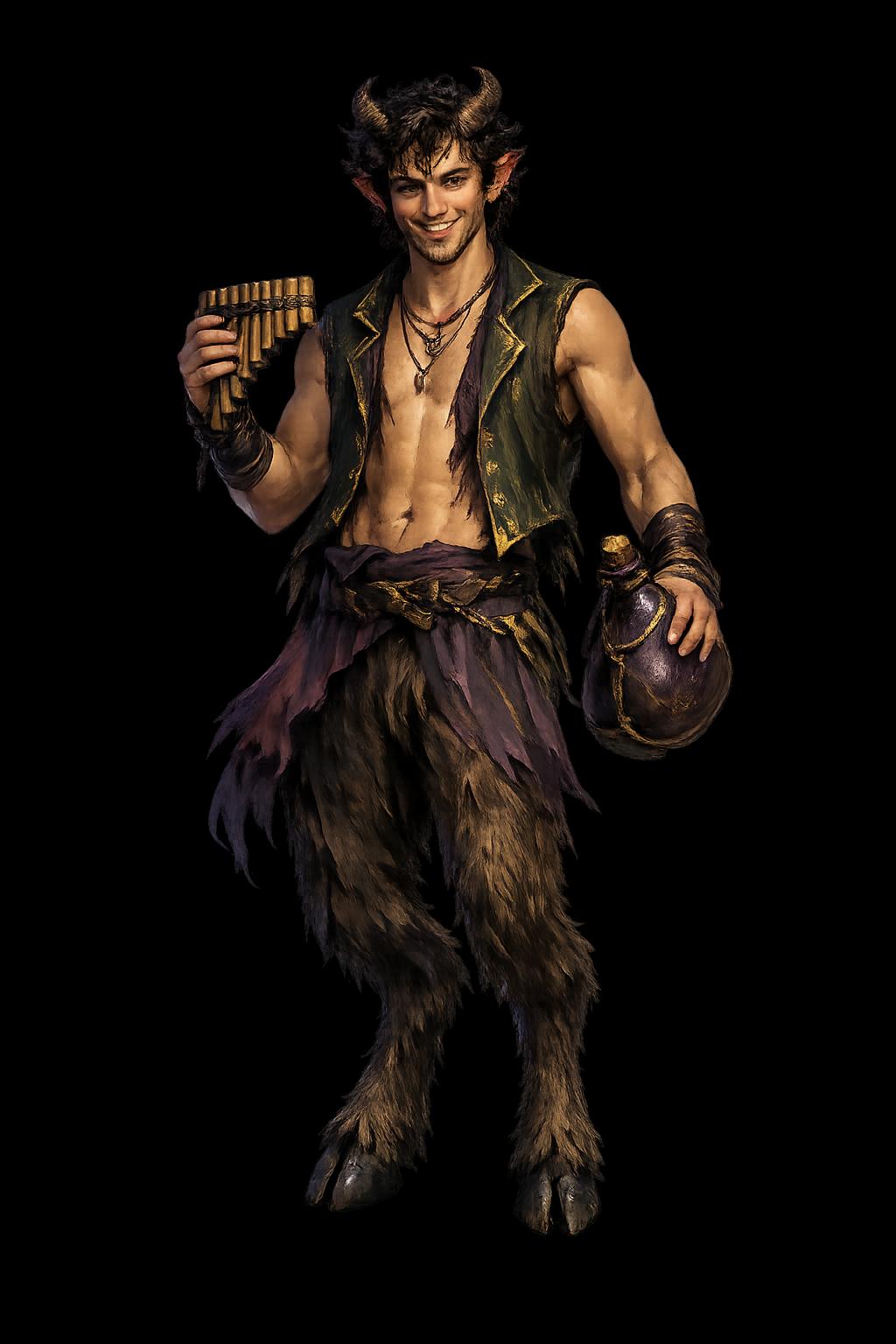
Satyrs are immediately recognizable and stubbornly difficult to categorize. From the waist up, they read as humanoid — lean, expressive faces with sharp features, pointed ears, and horns that range from short, swept-back curves to elaborate spiraling racks depending on the individual. From the waist down, they're ungulate: digitigrade legs covered in coarse fur, ending in cloven hooves that can grip terrain, leap extraordinary distances, and produce a percussive rhythm on any hard surface. The overall effect is less "half-goat" than "person who never fully separated from the animal kingdom and doesn't see why they should."
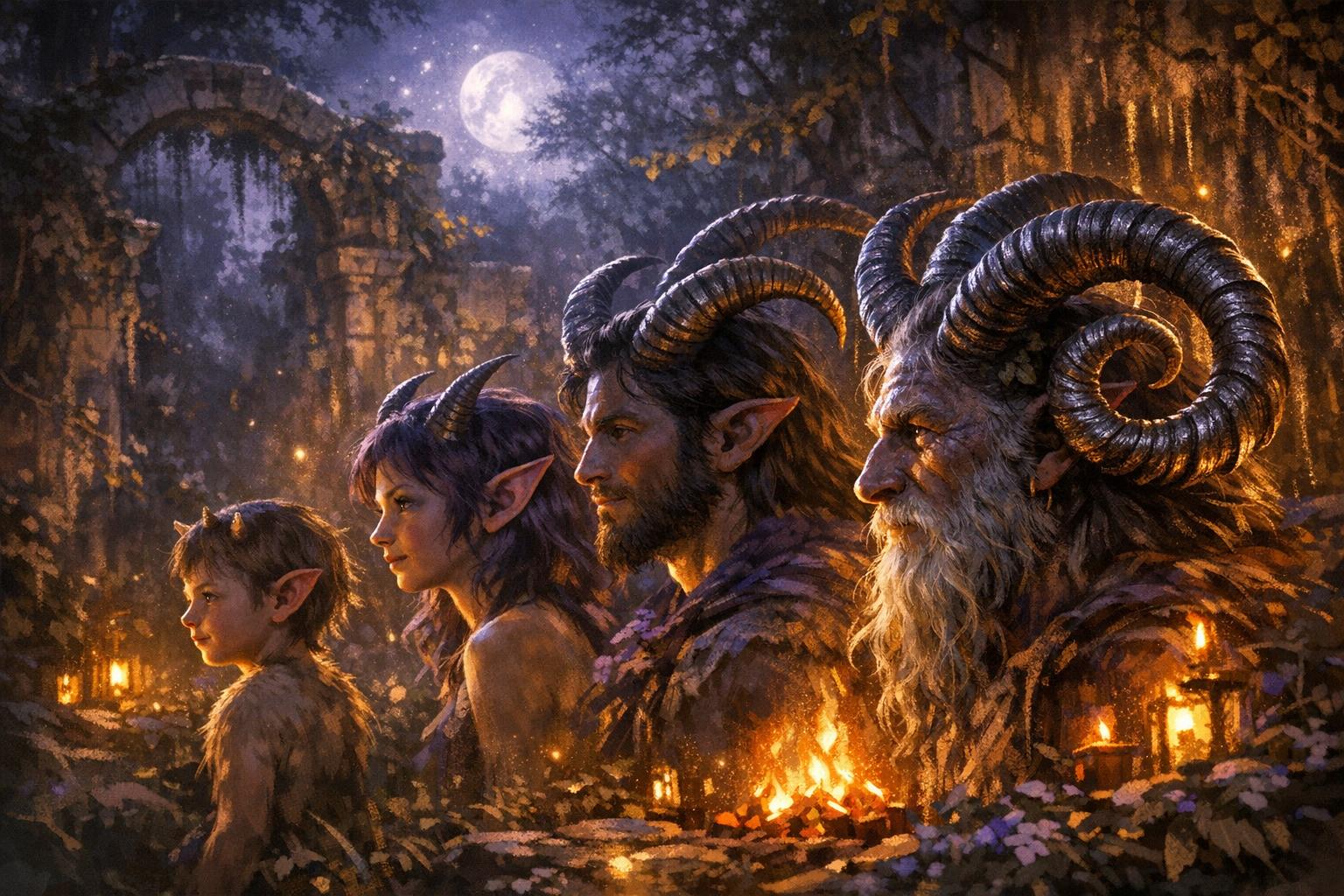
The horns deserve attention. Satyr horns are not decorative. They're bone wrapped in a keratin sheath, grown continuously and shaped by both genetics and personal grooming. Horns indicate age, health, and — in some cultural readings — emotional history. A satyr who has endured deep grief may grow asymmetrical horns. One who lives in constant joy tends toward smooth, symmetrical curves. Whether this is biology or fey-magic remains debated even among satyrs, who consider the question interesting but ultimately unimportant. The horns look how the horns look. Draw your own conclusions.
Satyr senses lean toward the synaesthetic. They hear color in music, taste emotion in wine, feel the texture of a story well-told as a physical sensation on their skin. This isn't metaphorical — it's neurological, or whatever passes for neurology in a fey creature. A satyr listening to a truly beautiful song might weep not from emotional resonance but because the music literally produces a sensation of warmth spreading across their chest. Their sensory experience of the world is richer and more entangled than humanoid perception, which goes a long way toward explaining why they find mortal existence both fascinating and slightly flat.
Horns & Hooves
The horns grow throughout a satyr's life, reaching their full expression around age sixty — which, given a fey lifespan measured in centuries, constitutes early adulthood. Young satyrs sport small nubs that they're intensely self-conscious about. Elders carry sweeping curves or branching spirals that catch light and cast dramatic shadows. The hooves are harder than iron, capable of cracking stone, and serve as both locomotion and instrument — satyr dances produce complex percussive rhythms that are as much music as movement.

Mirthful Leaps
Satyrs can jump distances that physics shouldn't permit for their body mass. Mirthful Leaps adds their proficiency bonus to the distance of any jump — not spectacular on paper, but in practice it means a satyr can clear a twenty-foot chasm from a standing start while playing a flute. The trait's name is the key: the leap isn't purely muscular. It's partially emotional, partially fey, powered by a joy so fundamental it translates into kinetic energy. A depressed satyr jumps normally. A delighted one practically flies.
The Philosophy of Joy
Here is the thing that separates a well-played satyr from a caricature: for satyrs, joy is not a mood. It is a discipline. An ethical position. A practiced skill that requires as much training and commitment as a paladin's devotion or a wizard's study. The hedonist stereotype imagines satyrs as creatures who pursue pleasure because they lack the depth for anything else. The reality — at least as the lore supports it — is precisely the opposite. Satyrs pursue joy because they understand, with a clarity most mortals never achieve, that the alternative is not sobriety but despair.
The Feywild teaches this lesson with geological patience. In a plane where emotion shapes reality, sustained sorrow creates wastelands. Sustained fear creates shadow. Sustained joy creates gardens, music, light, and life. Satyrs evolved in an environment where happiness had survival value in the most literal sense — a joyful satyr grove flourishes, and a despairing one withers into the domain of an archfey of shadow. Their relentless cheerfulness isn't naivete. It's an immune response to existential entropy, as vital and as hard-won as any warrior's battle discipline.
This distinction matters at the table because it determines whether a satyr character has depth. A satyr who is just "the funny one" gets old by session three. A satyr who actively cultivates joy — who works at it, who struggles with it, who occasionally fails — is a character with an inner life as complex as any brooding rogue or conflicted paladin. The most interesting satyr characters are the ones who know exactly how much effort goes into making everything look effortless. The ones who keep playing music not because they feel nothing but because they feel everything and the music is how they survive it.
Satyr philosophy, such as it is, doesn't produce formal texts or doctrines. It produces songs, stories, and arguments around campfires that last until dawn. The closest thing to a satyr philosophical tradition is a set of recurring debates that every satyr has participated in: Is joy an end in itself or a means to something else? Can you be joyful about someone else's joy, or is that just envy wearing a mask? If the music stops and the wine runs dry and you're alone in the dark — can you still be a satyr? That last question is the one they never quite resolve, and the not-resolving is the point.
“Mortals think we drink to forget. We drink to remember. The wine remembers the vine, the vine remembers the sun, and we remember that everything alive is just sunlight in a temporary shape, dancing because it can.”
— Thessaly Two-Songs, satyr philosopher, three drinks into a five-drink argument
Festivals & Daily Chaos
The distinction between a satyr festival and a satyr Tuesday is thinner than most outsiders realize. Satyr daily life already involves music, communal meals, improvisational theater, competitive storytelling, and at least one activity that a human observer would describe as "a very athletic argument." A festival simply scales these activities up, adds visitors from other groves, and continues until collective exhaustion produces a natural pause. There are no scheduled endings. A satyr festival ends when it ends, the way a river reaches the sea when it reaches the sea.
The major festivals follow celestial and seasonal markers — solstices, equinoxes, full moons, eclipses, and any astronomical event that a satyr elder decides is interesting enough to celebrate. But the minor festivals are where satyr culture reveals its real structure. A grove might declare a festival because someone composed a new song, because a dryad neighbor's tree bloomed early, because the wine from last autumn's pressing turned out particularly well, or because it's been three days since the last festival and that feels like an uncomfortable gap. The threshold for "sufficient reason to celebrate" approaches zero without quite reaching it.
Food at a satyr gathering is abundant, foraged, and served with an enthusiasm that compensates for any lack of culinary technique. Satyrs are omnivores with a strong preference for fruit, cheese, bread, honey, and anything fermented. They're competent hunters when the need arises but prefer not to kill animals they've been dancing next to. Wine is central — not as intoxicant but as sacrament, the original Dionysian offering rendered domestic. A satyr who doesn't drink isn't unusual, but a satyr who doesn't appreciate what wine represents — transformation, patience, the marriage of wild grape and cultivated craft — would be considered philosophically illiterate.
Major Satyr Festivals
| Festival | Timing | Tradition | Duration |
|---|---|---|---|
| The Greening | Spring equinox | New songs are premiered; any satyr may challenge any other to a musical duel; the grove votes on the year's best composition by volume of applause | 3 days minimum, 7 days average |
| Midsummer Revel | Summer solstice | Open invitation to all fey; mortals who stumble in are welcomed but warned about time dilation; the longest uninterrupted dance is attempted | Until the last dancer stops |
| The Pressing | Autumn equinox | Grape harvest and wine-making; every satyr participates in crushing; songs of gratitude to the dryads whose groves provided the fruit | 1 day of work, 4 days of celebration |
| Midwinter Howl | Winter solstice | Bonfires against the longest night; horror stories told competitively; the best storyteller earns the right to open the spring Greening | Dusk to dawn, then recovery |
| Moon-catch | Each full moon | Informal gathering; music, debate, and the ongoing argument about whether moonlight has a flavor (most satyrs say yes, they disagree on what it is) | 1 evening |
The festival calendar accounts for roughly 70 of the 365 days in a year. The remaining 295 days include enough spontaneous celebrations that the actual non-festive count is closer to 180.
Running a satyr festival at the table is an opportunity for character development disguised as comic relief. The party's paladin is challenged to a drinking contest — but the satyr challenger wants to discuss theodicy between rounds. The rogue is invited to a storytelling competition — and the satyrs expect emotional honesty, not clever lies. The wizard is offered a debate partner — and the satyr makes better arguments without any formal education. Satyr festivals reveal character by removing armor, literal and figurative.
No Kings — Only Stories
Satyrs have no government. This isn't an oversight or a sign of primitive social development — it's a deliberate philosophical position maintained with the same intensity that other species maintain their monarchies. Satyrs find the concept of political authority genuinely baffling. Not offensive (they don't get offended easily), just incoherent. Why would you give one person the right to make decisions for everyone else? What happens to the decisions that person is wrong about? Who decides they were wrong? It's turtles all the way down, and satyrs would rather dance.
What satyrs have instead of governance is influence, and influence is earned exclusively through two currencies: artistry and storytelling. A satyr who composes a song that moves the grove to tears has more sway than one who can lift a boulder. A satyr who tells a story that reframes how the grove understands a problem has done more leading than any king. This isn't a formal system — there are no elections, no councils, no terms of office. It's closer to how a band works: everyone plays, but the person with the best song at any given moment sets the key.
Disputes are resolved through competitive performance. Two satyrs who disagree about whether to move a grove's reveling ground closer to a river will each make their case through story, song, or argument — presented to the assembled grove, which expresses its preference through applause, laughter, or the devastating satyr judgment of simply walking away mid-performance. Losing an argument this way carries no shame. It just means your song wasn't good enough yet. Come back with a better one.
The one exception to the no-authority principle is the relationship between satyrs and powerful archfey. A satyr grove that falls within the domain of a fey lord or lady acknowledges that lord's authority — not because they believe in hierarchical governance but because angering an archfey is unpleasant in ways that transcend political philosophy. Even this acknowledgment is distinctly satyr: they obey the letter of any commands while finding the most entertaining possible interpretation of the spirit. Archfey who govern satyrs learn quickly that giving specific orders produces specific compliance and spectacular creative insubordination everywhere else.
The Song-Speaker
The closest thing satyrs have to a leader is the Song-Speaker — the grove member whose artistry is currently considered the strongest. The position shifts fluidly, sometimes changing multiple times in a single season. A Song-Speaker doesn't command. They suggest, and the suggestion carries weight because the grove trusts their judgment the way an orchestra trusts its first violin. When the Song-Speaker says "we should move the revel east," the grove considers it seriously — not because of authority but because someone who can compose songs that beautiful probably sees something the rest of them don't.
The role has no formal inauguration. One day, people just start deferring to a particular satyr's opinions. The previous Song-Speaker doesn't step down; they simply notice that the grove's attention has shifted. Most handle this with grace and the observation that being the second-best musician in the grove is still an excellent way to spend a century.
The Thorn
Every grove has at least one Thorn — a satyr whose role is to disagree. Not to oppose for its own sake, but to ensure that the grove's consensus isn't just collective laziness. The Thorn asks the uncomfortable questions: What if the Song-Speaker is wrong? What if the revel is actually an avoidance mechanism? What if joy has become habit instead of practice? The Thorn's function is to keep the grove honest by making comfortable agreement uncomfortable.
Thorns are valued precisely because they're annoying. A grove without a Thorn risks becoming self-congratulatory — a danger that satyrs, with their emphasis on celebration, are particularly susceptible to. The position isn't appointed or elected. Certain satyrs simply have the temperament for productive disagreement, and the grove recognizes and tolerates this the way a body tolerates an immune system: necessary, occasionally painful, ultimately protective.
Fey Politics & Mortal Relations
Satyrs occupy a peculiar position in the Feywild's political landscape: everyone likes them and nobody takes them seriously. This is, from the satyr perspective, an ideal arrangement. The Summer Court invites satyrs to perform at state functions. The Gloaming Court tolerates their presence because a revel lightens even the darkest halls. Eladrin appreciate their artistry. Dryads consider them entertaining neighbors. Even the more dangerous fey — redcaps, hags, quicklings — tend to leave satyr groves alone, partly because satyrs rarely have anything worth stealing and partly because picking a fight with a creature that responds to threats by writing a satirical song about you is a losing proposition.
This universal tolerance is itself a form of power, though satyrs would reject the framing. A satyr who moves freely between the Summer and Gloaming courts, welcome in both, carries information that neither court's spies can match. A satyr grove positioned between two rival archfey domains becomes neutral ground by default — the one place where tensions relax because everyone's too busy enjoying the music to maintain their political positions. Satyrs don't seek this mediating role. They simply occupy it by being themselves, and more politically minded fey have learned to use satyr gatherings as informal diplomatic channels.
Relations with mortals are warmer and more complicated. Satyrs genuinely like humans, elves, halflings, and most other mortal species — they find mortal urgency charming, mortal art surprisingly moving, and mortal food a fascinating study in doing a lot with limited ingredients. The complication is that satyrs don't always understand mortal boundaries. A satyr who crashes a human wedding to improve the music doesn't intend disrespect. They genuinely believe the wedding needs better music, and they're usually right, which makes the offense worse somehow.
The most fraught satyr-mortal interactions involve time. Satyrs think in fey time, where a century is a season and an evening can contain a lifetime's worth of experience. When a satyr befriends a human, they forget — repeatedly, genuinely — that the human is aging at a rate the satyr finds shocking. The satyr who visits their mortal friend every fifty years, always surprised to find them older, is a trope in fey literature, and it's played for comedy and tragedy in equal measure. Satyrs don't mean to be careless with mortal lifespans. They just can't hold the concept of mortality in their heads for more than a few minutes before something distracts them, which is either fey nature or a coping mechanism, depending on how generous you're feeling.
Satyr Relations Across Fey & Mortal Societies
| Group | Relationship | Basis |
|---|---|---|
| Summer Court Eladrin | Entertainer-guests; welcome but not politically significant | Shared appreciation for beauty and art |
| Gloaming Court Fey | Tolerated anomalies; their joy disrupts but also relieves the darkness | Satyrs are too cheerful to be useful pawns, too harmless to be threats |
| Dryads | Neighbors and frequent collaborators; dryads provide groves, satyrs provide celebration | Mutualistic symbiosis — dryads need the land tended, satyrs need groves to revel in |
| Humans | Fond but careless; satyrs enjoy mortal company without grasping mortal constraints | Genuine affection complicated by incompatible timescales |
| Elves | Deep mutual respect; the two species share enough lifespan to maintain lasting relationships | Common ground in art, magic, and the long view |
| Centaurs | Rivals and drinking partners; frequent arguments about philosophy, resolved by dawn | Both species are half-ungulate and fully opinionated |
The pattern: satyrs get along with everyone, commit to no one, and are forgiven for this because they bring the wine.
Legendary Satyrs in Myth
Pan is the satyr who transcended the species to become a god — or possibly a god who chose to manifest as a satyr, depending on which mythological tradition you follow. In Greek religion, Pan was born in Arcadia, the son of Hermes by some accounts and of Penelope (Odysseus's wife, improbably) by others. He governed wild places, shepherds, rustic music, and the particular terror that overtakes people in isolated landscapes. His worship was real and widespread: Pan had temples, festivals, and a cult following that persisted from archaic Greece into the Roman period. When the historian Plutarch reported that "Great Pan is dead," the announcement was treated as a world-historical event. A god of wildness dying meant something fundamental about the relationship between civilization and nature had shifted.
Silenus, the eldest satyr, served as Dionysus's tutor and foster father — a role that should challenge anyone who thinks satyrs are incapable of responsibility. Silenus was perpetually drunk, famously ugly, and possessed of a wisdom so profound that King Midas literally captured him to extract his secrets. When forced to speak, Silenus delivered one of the bleakest philosophical statements in ancient literature: that the best thing for a human is never to have been born, and the second best is to die quickly. This from a creature who spent every waking moment drinking and dancing. The juxtaposition isn't contradictory. It's the entire point. Silenus celebrates because he knows the truth about existence, and the truth is terrible, and dancing is what you do anyway.
Marsyas represents the satyr who overreached. A satyr (or silenus, depending on the source) who found Athena's discarded aulos — a double-reeded instrument — Marsyas became so skilled that he challenged Apollo to a musical contest. He lost, because you always lose against Apollo, and Apollo's punishment was to flay Marsyas alive. The myth encodes a warning about hubris, but it also encodes something darker: the idea that mortal artistry is beautiful precisely because it can't compete with divine artistry, and the gods will remind you of this violently if you forget. Satyrs tell the Marsyas story more than any other, and they always root for Marsyas, and they always know how it ends.
The Silenus paradox — that the being most devoted to joy also holds the darkest view of existence — is the key to writing satyrs with depth. A satyr who is unaware of suffering is boring. A satyr who is acutely aware of suffering and chooses joy anyway is one of the most compelling character concepts in fantasy. The music isn't denial. It's defiance.
Theros to the Feywild — Mechanical Evolution
The Theros satyr and the Feywild satyr are mechanically identical but narratively different in ways that affect how you play them. Theros is a setting modeled on Greek mythology, where satyrs live alongside humans in a world governed by gods who are present, active, and dangerously interested in mortal affairs. The Theros satyr exists in a world where the divine is inescapable, where every forest might contain a sacred site, and where the line between mortal and myth is porous. These satyrs revel because the gods expect it. Dionysian joy is a religious obligation, and the consequences of failing to celebrate are as real as the consequences of failing to pray.
The Feywild satyr, by contrast, exists in D&D's standard cosmology where the Feywild is a parallel plane of heightened emotion and wild magic. These satyrs revel because it's their nature, not because a god commands it. The Feywild has archfey instead of gods — powerful but not divine, impressive but not omniscient. A Feywild satyr's relationship with authority is more negotiated and less absolute than a Theros satyr's relationship with Nylea or Purphoros. The joy is the same. The metaphysical context is different, and that difference produces different kinds of characters.
Mechanically, the satyr species stands out for three traits that no other playable species matches. First, the Fey creature type makes satyrs immune to any spell that specifies "humanoid" as a target — a category that includes some of the game's most powerful control spells. Second, Magic Resistance grants advantage on all saving throws against spells and other magical effects, a defensive ability so powerful it was previously reserved for monsters. Third, Mirthful Leaps adds the proficiency bonus to jump distances, granting mobility that scales with level. Taken together, these traits produce a species that is extraordinarily difficult to control with magic, surprisingly mobile, and socially devastating. The satyr's mechanical identity is freedom — freedom from magical coercion, freedom of movement, freedom to be exactly as charming and annoying as they want to be.
- Creature Type: Fey (not Humanoid)
- Magic Resistance (advantage on saves vs. spells & magical effects)
- Mirthful Leaps (add proficiency bonus to jump distance)
- Reveler (proficiency in Performance and Persuasion)
The original playable satyr. CHA/DEX pushed toward bard, warlock, and sorcerer. Magic Resistance was immediately flagged as the strongest species trait in the game — and the design team kept it anyway.
- Creature Type: Fey (unchanged)
- Magic Resistance (unchanged — advantage on saves vs. spells & magical effects)
- Mirthful Leaps (scaling: add proficiency bonus to jump distance)
- Reveler (proficiency in Performance and Persuasion)
Flexible ability scores opened satyr to every class. Magic Resistance survived the revision intact, confirming it as a deliberate design choice rather than an oversight. Satyrs remain the hardest species to lock down with magic.
Satyrs Across Fantasy Media
Satyrs appear across fantasy media, but the treatment varies so dramatically that the word barely refers to the same creature from franchise to franchise. C.S. Lewis's Mr. Tumnus in The Chronicles of Narnia is the most culturally ubiquitous faun/satyr: gentle, domestic, fond of tea and toast, harboring a secret shame. Tumnus is essentially a satyr stripped of everything that makes satyrs interesting — the wildness, the music-as-magic, the philosophical depth — and replaced with English coziness. He's charming. He's also about as Dionysian as a church picnic.
Percy Jackson and the Olympians takes a different approach, treating satyrs as nature guardians who can sense ecological damage and are tasked with finding and protecting demigods. Rick Riordan's satyrs are more connected to the environmental tradition — satyrs as protectors of the wild rather than embodiments of it. Grover Underwood, the series' primary satyr, is anxious, loyal, and devoted to the search for Pan. The characterization is more nuanced than Tumnus but still fundamentally domesticated — the satyr as sidekick rather than force of nature.
Magic: The Gathering, particularly the Theros block that directly inspired D&D's Theros setting, presents satyrs closest to their mythological roots. MtG satyrs are hedonistic, dangerous, magically potent, and thoroughly inhuman in their values. Cards like Satyr Reveler, Boon Satyr, and Xenagos — the satyr planeswalker who ascended to godhood through a world-spanning revel so intense it broke divine law — capture the species' full range from comic to cosmic. Xenagos in particular is the satyr archetype taken to its logical extreme: what happens when the party gets so good it rewrites the laws of the universe?
Video games have been kinder to satyrs than most media. The God of War series uses satyrs as challenging enemies that fight with feral grace. World of Warcraft features satyr as corrupted night elves, twisting the classical archetype into something demonic. Hades, the roguelike, presents a Dionysus who is essentially a satyr in god form — charming, boisterous, and surprisingly kind beneath the party-boy exterior. Each adaptation emphasizes different aspects of the satyr myth, and none of them captures the whole. The original is too contradictory — too simultaneously joyful and terrifying, too generous and too dangerous — to survive adaptation intact. Every version is a simplification. D&D's version, to its credit, preserves more of the contradiction than most.
Run a one-shot where the party attends a satyr revel that recreates a Greek satyr play. Three tragic acts — real danger, real stakes, real consequence — followed by a fourth act where the satyrs perform a comedy about everything that just happened. The party's failures become punchlines. Their victories become songs. The satyrs aren't mocking them. They're integrating the party's story into the grove's mythology through the oldest dramatic structure in Western civilization. If the players get it — if they laugh at themselves and join the dance — the satyrs offer a real reward. If they get offended, the satyrs shrug. Not everyone's ready for the fourth act.
The Seldarine Connection & Fey Worship
Satyrs don't worship gods in the conventional sense, which is consistent with their general policy of not submitting to authority. What they do is acknowledge, appreciate, and occasionally bargain with powerful beings — a relationship that looks more like a musician's respect for a particularly talented colleague than a worshipper's devotion to a deity. The Seldarine, the elven pantheon, receives the most satyr attention because several Seldarine gods have portfolios that overlap with satyr values: Hanali Celanil (love and beauty), Erevan Ilesere (trickery and mischief), and Corellon Larethian (art and magic).
Satyr "prayer" is performance. A satyr who wants Hanali Celanil's favor doesn't kneel and recite liturgy. They compose a love song so beautiful that the goddess takes notice — or at least, that's the theory. Whether the Seldarine actually listen to satyr performances is a theological question that satyrs find less interesting than the performances themselves. The act of creating beauty is the point. If a god happens to appreciate it, that's a pleasant bonus rather than a spiritual necessity.
The Feywild's archfey occupy a more immediate place in satyr spiritual life. Titania, the Summer Queen, and the Queen of Air and Darkness both have satyr populations within their courts, though the relationship differs dramatically. Titania's satyrs celebrate openly, their revels integrated into the Summer Court's endless pageantry. Satyrs in the shadow court — and they exist, because fey don't divide neatly into light and dark — practice a different kind of revelry: desperate, defiant, joy held up against darkness like a candle in a hurricane. Both versions are authentic. Both are satyr.
The most religiously engaged satyrs are those who follow the path of the Bacchae — an archaic term borrowed from Dionysian worshippers, applied to satyrs who pursue ecstatic experience as a formal spiritual discipline. Bacchae satyrs seek the dissolution of individual identity in collective revelry, the moment where the self becomes porous and something larger moves through it. In mechanical terms, these satyrs gravitate toward cleric (Trickery or Nature domain), druid (Circle of Dreams), or warlock (Archfey patron). In narrative terms, they're the satyrs who take joy most seriously — so seriously that it stops being fun and starts being transcendent.
A satyr cleric has lost the ability to feel joy — a curse, a trauma, a magical affliction. In mortal terms, this would be depression. In satyr terms, it's a spiritual crisis on par with a paladin losing their oath. The satyr can still cast spells, still technically perform, but the music sounds hollow and the wine tastes like water. The party watches their most vibrant member go grey. Restoring the satyr's joy becomes the quest — and the answer isn't a spell. It's the party demonstrating, through action, that the world contains things worth celebrating.
Music Magic & Enchantment
Satyr music is magic. Not metaphorically — literally. When a satyr plays their pipes, the sound carries fey energy that can charm, compel, inspire, or terrify listeners. The Monster Manual's satyr entry includes this as a specific ability: any creature within 60 feet that can hear the pipes must make a Wisdom saving throw or be charmed, frightened, or incapacitated. This isn't a spell that happens to use music as a component. It's music that happens to produce magical effects, an important distinction that places satyr artistry in a category all its own.
The instrument most associated with satyrs is the syrinx — Pan's pipes, the pan flute, a set of graduated tubes bound together and played by blowing across the open ends. The mythology behind the instrument is characteristically dark: Pan pursued the nymph Syrinx, who fled his advances and begged the river nymphs to transform her. They turned her into water reeds, and Pan, in grief or obsession or both, cut the reeds and fashioned them into the first pan pipes. The instrument is literally made from someone who tried to escape the musician. Satyrs know this story. They play the pipes anyway. The relationship between beauty and its costs is a tension they inhabit rather than resolve.
Not all satyr magic comes through instruments. Satyr voice carries fey power — their laughter can lift spirits (sometimes literally), their insults can wound (sometimes literally), and their storytelling can produce vivid illusions in the minds of listeners that blur the line between narrative and hallucination. A satyr telling a ghost story around a campfire might cause listeners to actually hear footsteps in the dark. A satyr describing a feast might cause listeners to smell roasting meat. These aren't deliberate magical effects — they're the satyr's fey nature leaking through their art, enchantment as a byproduct of enthusiasm.
The mechanical expression of this in 5e is elegant: satyrs get proficiency in Performance and Persuasion, reflecting their natural ability to captivate audiences. Combined with their Charisma-forward ability scores, this makes satyrs the game's premier social species — not through manipulation or intimidation but through sheer magnetic presence. A satyr doesn't convince you they're right. They make you want to be in the room where they're talking, and once you're there, agreement follows naturally. It's charm in every sense of the word.

The Pipes of Pan
A satyr's pan pipes are not a standard instrument. Each set is hand-crafted by the satyr who plays it, tuned to their specific vocal range and fey resonance. Breaking a satyr's pipes is not the same as breaking a bard's lute — it's closer to breaking a wizard's familiar bond. The satyr can make new pipes, but the old ones carried years of accumulated fey energy, and the replacement will take months to reach the same potency. Enemies who understand satyr culture target the pipes first. Friends who understand satyr culture guard them with their lives.
Fey Court Politics & Revels
Satyr involvement in the politics of the Feywild courts is simultaneously deep and fundamentally unserious, which drives the archfey absolutely mad. Satyrs attend court functions, participate in the endless intrigues between the Summer and Winter Courts, form alliances and betrayals with fey nobles — and treat the entire apparatus as the most entertaining game they’ve ever played. A satyr who betrays an archfey’s confidence does so not from malice but from an inability to resist a better story.
The revels themselves are political events disguised as parties, or possibly parties disguised as political events — even the participants can’t always tell. A satyr revel hosted near a disputed border serves as neutral ground, intelligence-gathering opportunity, and diplomatic function simultaneously. Enemies dance together. Spies share wine. Alliances form and dissolve between one song and the next. The revel’s power lies in its informality: things said while dancing carry no official weight, which means everything can be said.
Mortal adventurers who stumble into fey court politics through satyr connections find themselves in a world where the rules change between sentences and sincerity is the most dangerous weapon anyone can wield. A satyr guide through court intrigue is invaluable and terrifying in equal measure — they know every player, every grudge, every secret, and they consider sharing all of it to be excellent entertainment.
A satyr ally invites the party to a fey revel where a critical negotiation is happening between two archfey. The satyr’s actual goal isn’t diplomacy — it’s to create the most entertaining chaos possible while the party tries to accomplish something serious. The satyr isn’t an enemy. They’re a friend with fundamentally different priorities, and those priorities will collide with the mission at the worst possible moment.
FAQ
Common Questions
The cliche exists because it's easy — just play the satyr as the comic relief who drinks too much and flirts with everything. The fix is giving your satyr's joy a cost and a cause. Why do they celebrate so intensely? What happens when they can't? A satyr who cultivates joy as a philosophical discipline — who works at happiness the way a monk works at serenity — is a fundamentally different character than one who's simply having a good time. Give your satyr a moment of real sorrow in their backstory, something they carry quietly beneath the music. Then make the music their response to it, not their escape from it. The party animal becomes a party philosopher, and the table stops treating them as background entertainment.
By most optimization metrics, yes. Advantage on all saving throws against spells and other magical effects is a defensive ability that scales with the campaign — the more magic your DM throws at the party, the more powerful it becomes. At low levels, it's already strong: advantage on a save against Hold Person turns a potential combat-ending debuff into a coin flip. At high levels, when enemies are casting Feeblemind and Psychic Scream, it's potentially campaign-defining. Combined with the Fey creature type (which makes satyrs immune to spells that target humanoids specifically), satyrs are the most magic-resistant playable species in the game. This was controversial when Theros released, and the design team's decision to preserve it through Monsters of the Multiverse suggests they consider it a feature, not a bug. The tradeoff is that satyrs get no damage resistance, no darkvision, and no combat-oriented traits. Their defense is supreme. Their offense is entirely player-driven.
Mechanically, nothing — the stat block is identical. Narratively, the difference is context. A Theros satyr lives in a world where gods walk the earth, where mythic destiny is real, and where the satyr's role in cosmic drama is defined by beings more powerful than they are. Their revelry exists within a religious framework, and defying the gods has tangible consequences. A Feywild satyr lives in D&D's standard cosmology, where the Feywild is a parallel plane of wild magic and heightened emotion. Their revelry is self-motivated rather than divinely mandated, and their relationship with archfey is more negotiated than ordained. Theros satyrs are mythological — they exist in a story that has gods and heroes and inevitable tragedy. Feywild satyrs are picaresque — they exist in a story they're making up as they go. Choose based on whether your character's joy is an act of worship or an act of will.
Bard is the obvious choice, and it's obvious because it's excellent — Charisma synergy, musical flavor, and the combination of Magic Resistance with Bardic Inspiration creates a support character who is extremely difficult to shut down. Warlock (Archfey patron) is narratively perfect and mechanically strong; a satyr who made a deal with Titania or an archfey of the Feywild has a built-in story engine. Paladin is the sleeper pick: high Charisma, Aura of Protection stacked with Magic Resistance makes you functionally immune to magical saves, and the concept of a satyr who swore an oath — a creature of freedom choosing to be bound — is compelling roleplay. Sorcerer (Wild Magic) leans into the fey chaos angle. Rogue works if you play up the trickster archetype, using Reveler proficiencies and fey charm as infiltration tools. The flexible ability scores from Monsters of the Multiverse mean any class is viable, but satyrs reward Charisma-forward builds because their entire cultural identity is about being magnetic.