

Tieflings
Fiend-touched outcasts who carry hell in their blood and spend their lives deciding what that means
Mythological Foundations
The idea of humans bearing infernal heritage is older than fantasy gaming by several thousand years. Every major mythological tradition includes figures who are part mortal, part something from below. The cambion of medieval demonology, the nephilim of Genesis, the rakshasas of Hindu mythology. These aren't the same creature, but they share a premise: what happens when the infernal and the mortal produce offspring? The answer, across cultures, is consistent. Something powerful, something feared, and something that doesn't belong anywhere.
D&D's tieflings draw most directly from European demonological traditions, where pacts with devils produced tainted bloodlines that persisted across generations. The sin wasn't the child's. The sin belonged to an ancestor who made a deal, and every descendant paid the price. This inherited guilt is the emotional engine of the tiefling concept, and it's worth understanding where it comes from before you bring it to the table.
What makes the mythological roots useful for play is the tension between the mark and the person bearing it. Cambions in medieval literature weren't automatically evil. Merlin, in several traditions, was the son of an incubus. The nephilim were mighty but not inherently wicked. The assumption that infernal blood equals evil character is a prejudice within the fiction, not a fact. That distinction matters enormously for how tieflings function in a campaign.
Infernal Heritage in Mythology
| Tradition | Figure | Nature | Cultural Role |
|---|---|---|---|
| Christian demonology | Cambion | Half-human, half-demon offspring | Warning against infernal pacts; inherited corruption |
| Hebrew/Christian | Nephilim | Children of angels and mortals | Mighty but transgressive; erased in the Flood |
| Hindu mythology | Rakshasas | Shape-shifting fiends with mortal ties | Antagonists whose humanity makes them dangerous |
| Arthurian legend | Merlin (some versions) | Son of an incubus and mortal woman | Power from infernal source turned toward good |
| European folklore | Changeling / devil-marked | Mortals bearing infernal signs | Community scapegoats; visible otherness as proof of sin |
The through-line across traditions: infernal heritage produces power, fear, and social exclusion. D&D tieflings inherit all three.
Etymology & Name Origins
"Tiefling" comes from the German word "tief," meaning "deep" or "low." The suffix "-ling" denotes a diminutive or one characterized by the root word. A tiefling, then, is literally a "deep one" or "low one" — someone from below. It's a name imposed by others, not one chosen by the bearers, and that matters. Tieflings don't call themselves tieflings in most settings. Other people call them that.
The naming convention for individual tieflings varies by setting, but D&D's Player's Handbook established a tradition where tieflings often adopt "virtue names" — single concepts like Despair, Torment, Hope, or Glory. These aren't birth names. They're names tieflings choose for themselves, often during adolescence, as declarations of intent. A tiefling named Hope isn't describing their past. They're describing what they refuse to surrender.
This naming practice is one of the best-designed cultural details in D&D. It communicates character instantly, reflects the tiefling experience of self-definition against expectation, and gives players a tool for expressing who their character wants to be rather than what they are. A tiefling named Carrion has made a very different statement than a tiefling named Poetry, and both names tell you more about the character than any stat block.
“A tiefling named Hope isn't describing their past. They're describing what they refuse to surrender. Virtue names are declarations of intent — acts of self-definition in a world that already decided what you are.”
History in D&D Settings
Tieflings weren't part of the original D&D lineup. They entered the game through Planescape in 1994, one of several planetouched species designed to populate Sigil's cosmopolitan streets. In that context, tieflings were interesting but not exceptional — in a city connected to every plane of existence, having a fiendish grandparent was unusual but not shocking. Planescape tieflings were outsiders by degree, not by kind.
The transformation came in 4th Edition (2008), where tieflings became a core Player's Handbook race with a specific origin story: the human empire of Bael Turath made a collective pact with Asmodeus, and every citizen bore the infernal mark from that point forward. This was a dramatic reimagining. Tieflings went from "individuals with fiendish ancestry" to "an entire people cursed by their rulers' ambition." The pact was involuntary for most. The consequences were permanent.
5th Edition (2014) softened the specifics while keeping the emotional core. Tieflings became one of the most popular player races, consistently ranking in the top five of D&D Beyond character creation data. The 2024 Player's Handbook expanded tiefling options with three fiendish legacies — Abyssal, Chthonic, and Infernal — reflecting different types of infernal connection. The species evolved from niche Planescape oddity to mainstream fantasy staple in thirty years.
Planescape Campaign Setting
Tieflings debut as one of several planetouched species in Sigil. They are distinctive but not core — one of many strange peoples in a strange city.
4th Edition Player's Handbook
Tieflings become a core PHB race. The Bael Turath origin establishes tieflings as a cursed civilization, not just individuals with fiendish blood.
5th Edition Player's Handbook
Tieflings retain core status. Simplified mechanics and Charisma-based spellcasting make them popular choices for warlocks, sorcerers, and bards.
Mordenkainen's Tome of Foes / XGTE
Expanded tiefling subraces tied to specific archdevils (Zariel, Dispater, Glasya, etc.) give mechanical variety to infernal bloodlines.
2024 Player's Handbook
Three fiendish legacies (Abyssal, Chthonic, Infernal) replace the Asmodeus default. Tieflings are no longer tied to a single devil lord.
Key Settlements & Homelands
Tieflings don't have homelands in the way elves have forests or dwarves have mountains. They have places where they're tolerated, places where they've gathered in sufficient numbers to build community, and places where their infernal heritage is an asset rather than a liability. The distinction matters. A tiefling "home" is usually somewhere they chose to stop running, not somewhere they belong by right.
The exception is Bael Turath — the fallen empire whose pact with Asmodeus created the tiefling bloodline in 4th Edition lore. In settings that use this origin, Bael Turath's ruins represent both ancestral homeland and original sin. Tieflings who seek out these ruins are looking for identity in the same place their curse began. It's a powerful narrative hook precisely because the answer to "where do I come from?" is also the answer to "why am I like this?"
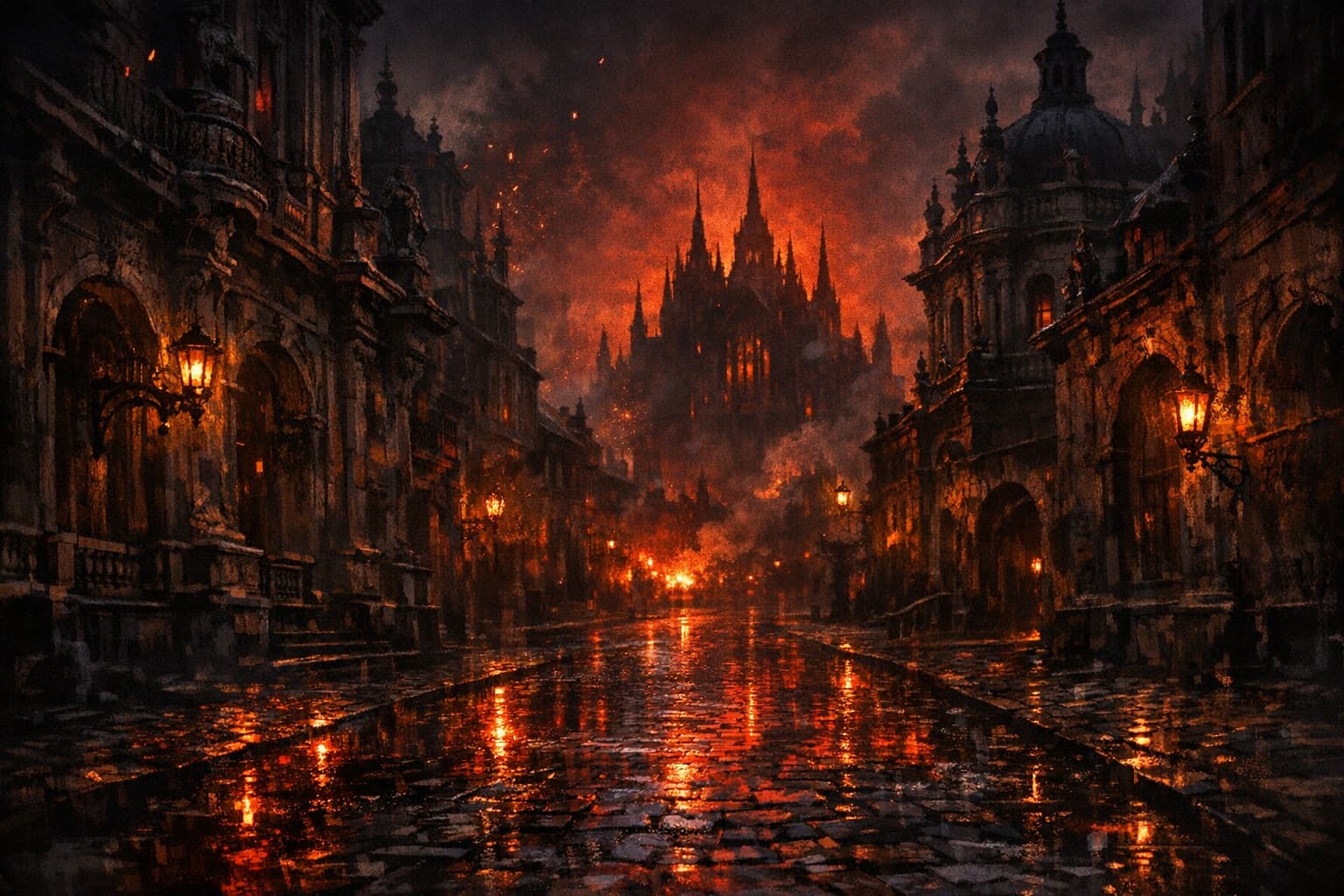
In practice, tieflings cluster in cosmopolitan cities where diversity provides cover. Sigil's Lower Ward, Baldur's Gate's Outer City, Waterdeep's Dock Ward — places where being visibly different is unremarkable because everyone is visibly different. These aren't tiefling neighborhoods by design. They're tiefling neighborhoods by gravitational pull: go where the other outcasts go.
Notable Tiefling Settlements & Gathering Places
| Location | Setting | Significance |
|---|---|---|
| Bael Turath (ruins) | Points of Light / Nentir Vale | Fallen empire that made the original pact with Asmodeus; ancestral homeland and source of the curse |
| Sigil, Lower Ward | Planescape | Where tieflings first appeared in D&D; the most accepting city in the multiverse, because everyone is strange |
| Dis, Second Layer | Nine Hells | Iron city of Dispater; tieflings with Dispater bloodlines may feel an unsettling pull toward this place |
| Elturel | Forgotten Realms | Dragged to Avernus in Descent into Avernus; a city where tieflings experienced both prejudice and vindication |
| Baldur's Gate, Outer City | Forgotten Realms | Refuge for outcasts of all kinds; tieflings blend into the city's chaotic diversity |
Tiefling "homelands" are adopted, not inherited. The absence of a true homeland is itself a defining feature of tiefling identity.
Biology & Physicality
Tiefling biology is where the infernal heritage becomes impossible to hide. Horns, tails, unusual skin colors, solid-colored eyes, the faint smell of brimstone. These aren't optional. Every tiefling carries visible markers of their bloodline, and those markers ensure that first impressions are never neutral. A tiefling walks into a village and everyone knows what they are before a word is spoken.
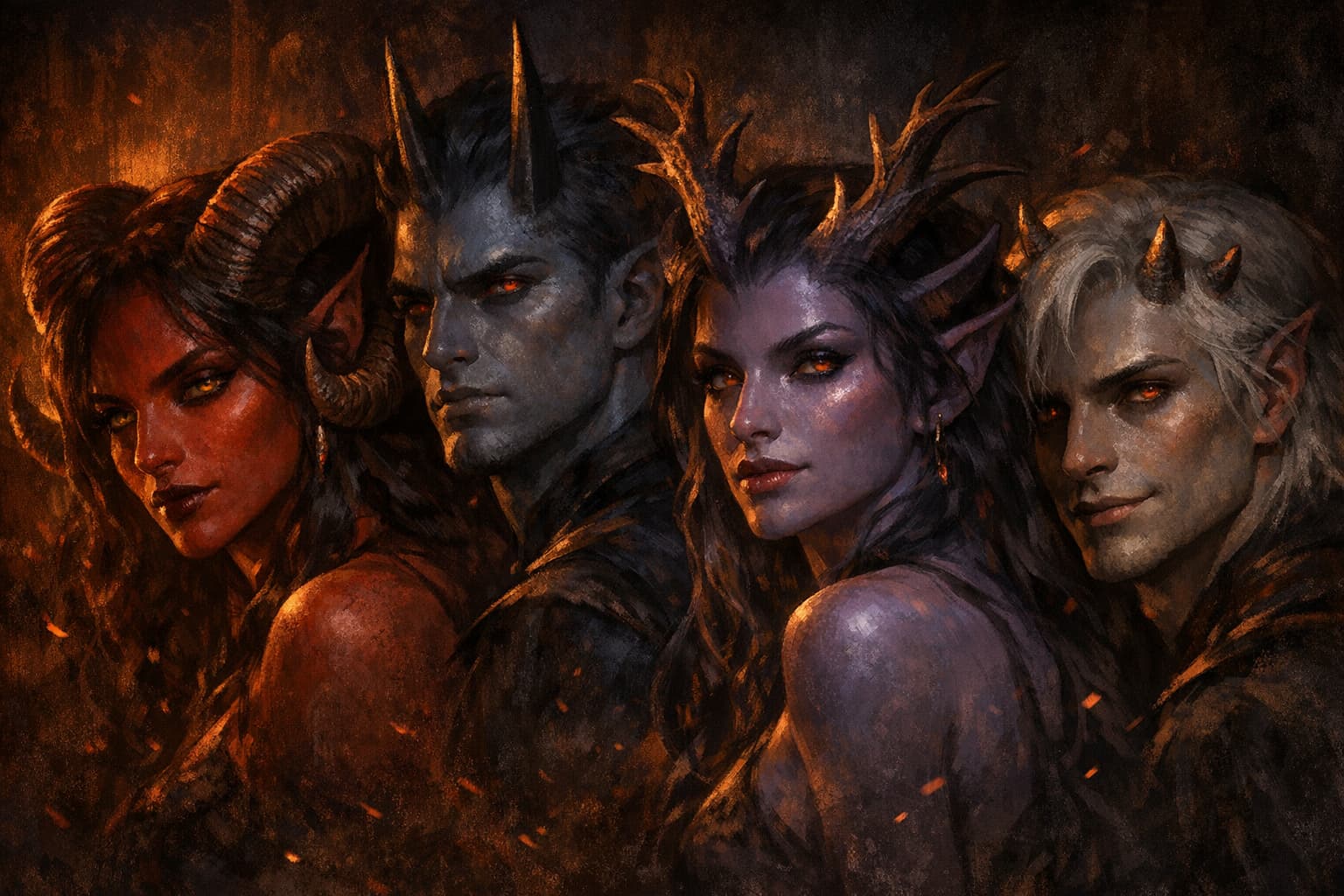
The specifics vary enormously. Some tieflings have small, subtle horns that can be hidden under a hat. Others have massive ram-curved horns that cast shadows. Skin tones range from human-normal to deep red, blue, or purple. Tails can be thin and prehensile or thick and blunt. Eyes might be solid gold, black, or red. No two tieflings look quite the same, but all of them look like something happened to the human template.
Horns & Tail
The most immediately visible tiefling traits. Horns grow in patterns that sometimes echo specific devil lords — curved like a ram for Asmodeus, straight and sharp for Zariel, spiraling for Glasya. The tail is prehensile in some depictions, vestigial in others. Both are impossible to conceal for long, making disguise difficult and anonymity nearly impossible.
These features aren't decorative. They're the physical manifestation of infernal energy running through mortal biology. Some tieflings report that their horns ache near planar boundaries or that their tails react to the presence of celestial beings. The body knows what it is even when the mind would rather forget.
Skin, Eyes & Coloring
Tiefling skin tones sit on a spectrum from human-passing to unmistakably infernal. The classic deep red is most associated with Asmodeus-lineage tieflings, but blues, purples, and even ashen grays appear depending on the fiendish bloodline. Eyes are typically solid colors without visible pupils — a detail that unsettles people more than the horns do, because it makes eye contact feel like staring into something rather than at someone.
The coloring isn't uniform across the body. Some tieflings have human-toned skin with infernal coloring only at the extremities — fingers, ears, the base of the horns. Others are solid throughout. This variance means tieflings from the same family can look dramatically different, which further undermines the idea of tieflings as a unified "race" and reinforces their identity as individuals marked by the same curse in different ways.
Infernal Resistance
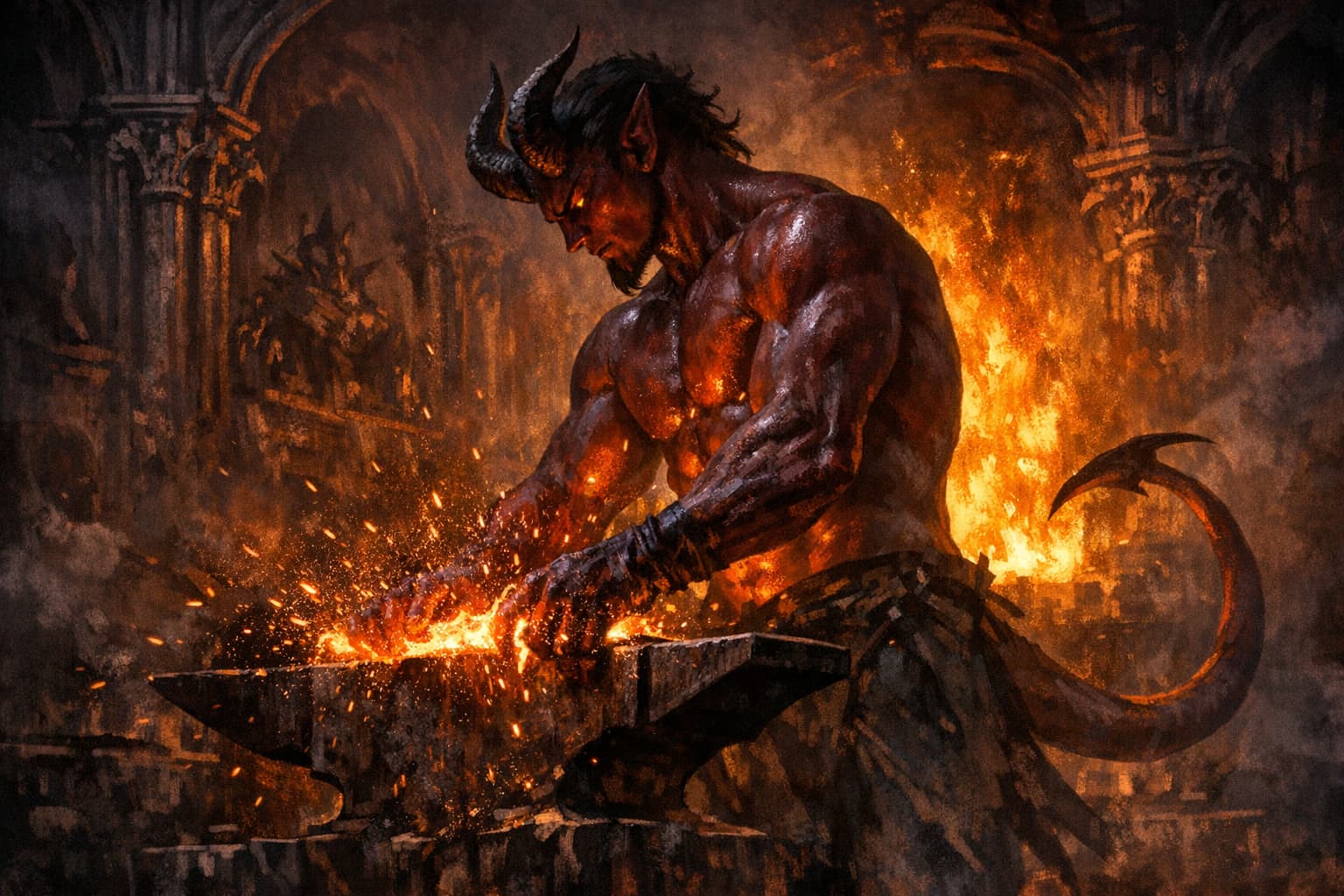
Fire resistance is the mechanical expression of something that runs deeper. Tiefling bodies process heat differently. They run warm, they're comfortable in temperatures that make humans sweat, and they can handle direct flame in ways that would scar anyone else. This isn't immunity — a bonfire will still burn a tiefling. But the threshold is higher, and the recovery is faster.
In play, fire resistance is one of the most consistently useful racial features in 5e. Fireball is everywhere. Lava is everywhere. Environmental fire damage is everywhere. A tiefling shrugging off half the damage from a fireball isn't just mechanically useful — it's a character moment. The fire that terrifies their companions is something they've lived with their entire lives.
Psychology & Worldview
Growing up as a tiefling means learning, early and permanently, that the world has already decided what you are. Not who. What. The shopkeeper who watches you more carefully. The parent who pulls their child away. The guard who asks for your papers twice. None of this requires active malice. Passive suspicion is more than sufficient to shape a person.
This produces a psychology organized around a central question: do you fight the assumption or fulfill it? Most tieflings navigate somewhere between these poles, but the tension never fully resolves. The tiefling who becomes a paladin is still proving something. The tiefling who becomes a criminal is still responding to something. Neither choice happens in a vacuum.
The result is characters with strong opinions about fairness, justice, and the gap between what people say they believe and how they actually behave. Tieflings are excellent bullshit detectors because they've been on the receiving end of polite prejudice their entire lives. They know what it looks like when someone smiles at you while reaching for the lock on their strongbox.
This doesn't mean every tiefling is angry or bitter. Some develop armor of charm and humor. Others cultivate deliberate inscrutability. A few lean into the demonic aesthetic because if people are going to fear you anyway, you might as well control the narrative. The healthiest tieflings find communities that see them as people first. The unluckiest never do.
“Tieflings are excellent bullshit detectors because they've been on the receiving end of polite prejudice their entire lives. They know what it looks like when someone smiles at you while reaching for the lock on their strongbox.”
Daily Life & Social Reality
The daily reality of being a tiefling is a series of small negotiations that other species never have to make. Choosing clothes that minimize or emphasize your horns. Deciding whether to enter a new town openly or after dark. Calculating whether a particular merchant's friendliness is genuine or a setup. These aren't dramatic moments. They're Tuesday.
Tieflings who grow up in cosmopolitan cities have it easier, but "easier" is relative. Baldur's Gate might not run you out of town, but the Patriar families still won't invite you to dinner. Waterdeep's laws protect you, but the Watch still knows your face. Even tolerant cities have limits to their tolerance, and tieflings learn those limits through experience rather than instruction.
Community-building among tieflings is complicated by the fact that they don't share a culture. Two tieflings from different cities have no more in common than two humans from different continents, except for the horns and the suspicion. Tiefling solidarity, where it exists, is solidarity of experience rather than tradition. You don't share customs. You share the knowledge of what it's like to walk into a room and watch the mood change.
Tiefling social dynamics work best when prejudice is specific and systemic rather than cartoonish. The innkeeper who charges them double "for insurance" is more useful narratively than the mob with pitchforks. Institutional discrimination creates richer story hooks than open hostility because it forces tiefling characters to decide which battles are worth fighting and which injustices to absorb.
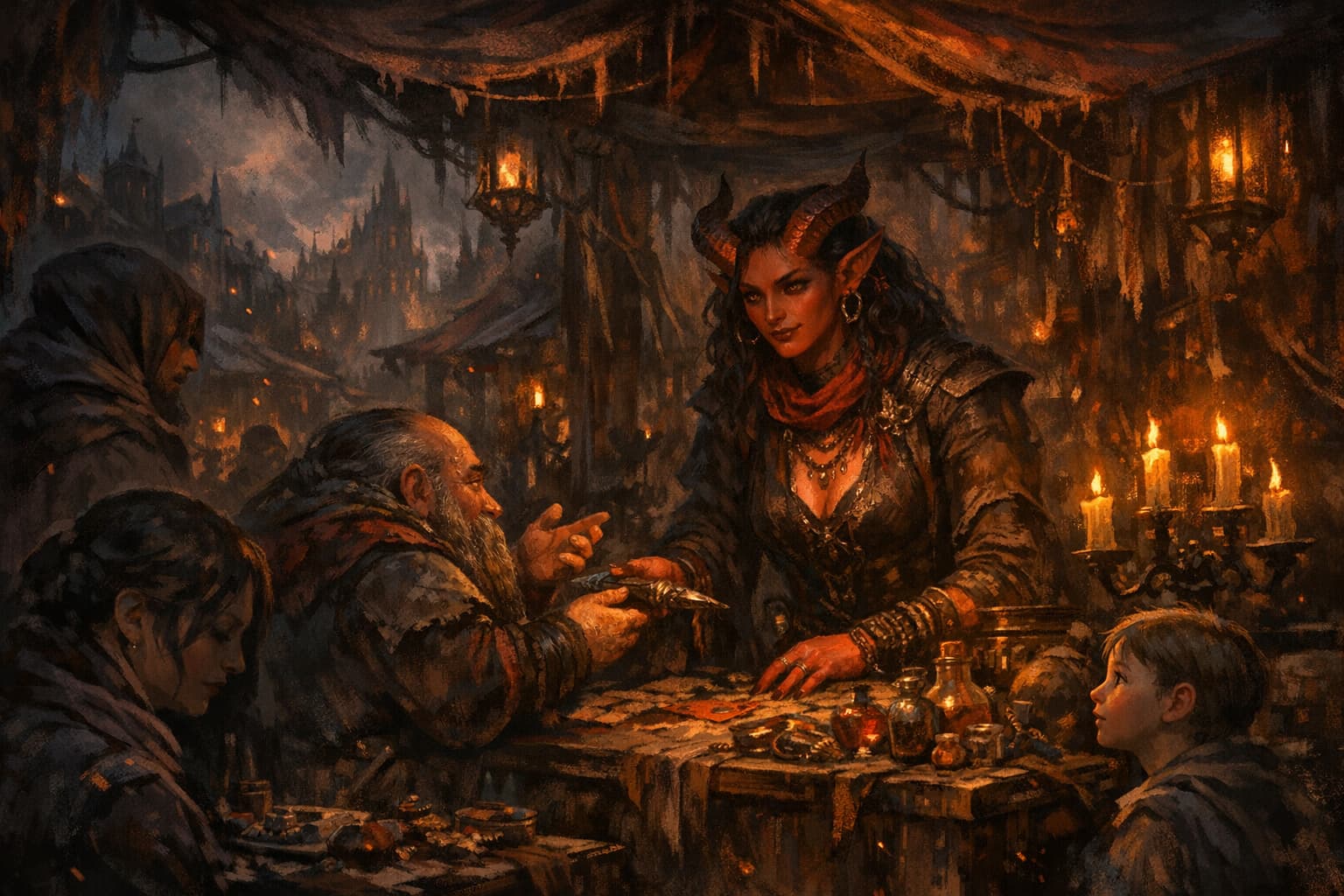
Culture & Identity
The central tension of tiefling identity is the relationship with infernal heritage. Every tiefling must decide what their blood means to them, and this decision shapes everything else. The answers tend to cluster around two poles, though individual tieflings scatter across the entire spectrum.
Embracing the Heritage
Some tieflings decide that if the world insists on seeing them as infernal, they'll own it. This isn't necessarily evil — it's pragmatic identity politics. Infernal aesthetic becomes armor. Fiendish heritage becomes a source of pride rather than shame. If your great-grandmother made a deal with Asmodeus, well, she was ambitious enough to negotiate with a god. That's not nothing.
Tieflings who embrace their heritage often study infernal languages, research their specific bloodline, and cultivate the magical abilities that come with their ancestry. Some seek out other tieflings to build community around shared heritage. A few go further, actively pursuing connections with their fiendish ancestors — a path that ranges from scholarly curiosity to genuinely dangerous pact-making.
The risk is that embracing the heritage can become performing it. A tiefling who leans too hard into the demonic persona may find they've built a character rather than a life, and that the character has become a cage of its own.
Rejecting the Heritage
Other tieflings define themselves aggressively against their bloodline. They become paladins, priests, healers — professions that loudly declare "I am not what I look like." These tieflings often work harder than anyone else in their chosen fields because they feel they have to. Every good deed is a counter-argument. Every act of kindness is evidence for the defense.
This approach works socially but can be psychologically exhausting. The tiefling cleric who has to be visibly, performatively good at all times is carrying a burden their human colleagues never face. They can never have a bad day without someone attributing it to their blood. They can never lose their temper without confirming someone's suspicions.
The deepest trap here is that defining yourself against something still lets that thing define you. The tiefling whose entire identity is "not evil" hasn't actually figured out who they are. They've only established who they aren't. The healthiest path usually involves moving past both embrace and rejection toward simple acceptance — but that's the hardest path of all.
Religion & the Tiefling Paradox
Tiefling spirituality sits at a unique intersection: they carry the blood of beings that most religions classify as enemies of the divine order. A tiefling worshipping Lathander isn't just a devotee — they're a living contradiction, channeling divine power through a body that's partly made of what that divinity opposes. Some gods find this fascinating. Others find it offensive. Most don't comment, which leaves tiefling clergy to navigate the ambiguity alone.
In practice, tieflings gravitate toward deities who emphasize redemption, transformation, or the rejection of inherited destiny. Ilmater (suffering and endurance), Tymora (luck and fortune-making), and Selune (change and acceptance) attract tiefling followers because their doctrines offer answers to the question tieflings live with: "Am I defined by what I was born with, or what I choose?"
A smaller but significant number of tieflings worship fiendish patrons directly. This isn't a moral failing — it's acknowledging a real connection. The tiefling warlock who makes a pact with their ancestral devil lord isn't falling to evil. They're negotiating with family. Whether that negotiation ends well depends entirely on the individual and the devil, which is exactly the kind of tension that makes for excellent play.
The most interesting tiefling religious characters are those who hold contradictions without resolving them. The tiefling paladin who feels the pull of Avernus during prayer but channels divine smite anyway. The tiefling cleric who heals with one hand while their infernal fire burns in the other. Faith, for tieflings, is never simple. That complexity is a feature, not a bug.
How does a temple react when a tiefling walks in and asks to join the clergy? The answer says more about the religion than about the tiefling. Faiths that turn tieflings away reveal their theology is about purity rather than redemption. Faiths that welcome them reveal they take their own doctrines of mercy seriously. This is an excellent worldbuilding test for any divine institution in your campaign.
Infernal Magic & Combat
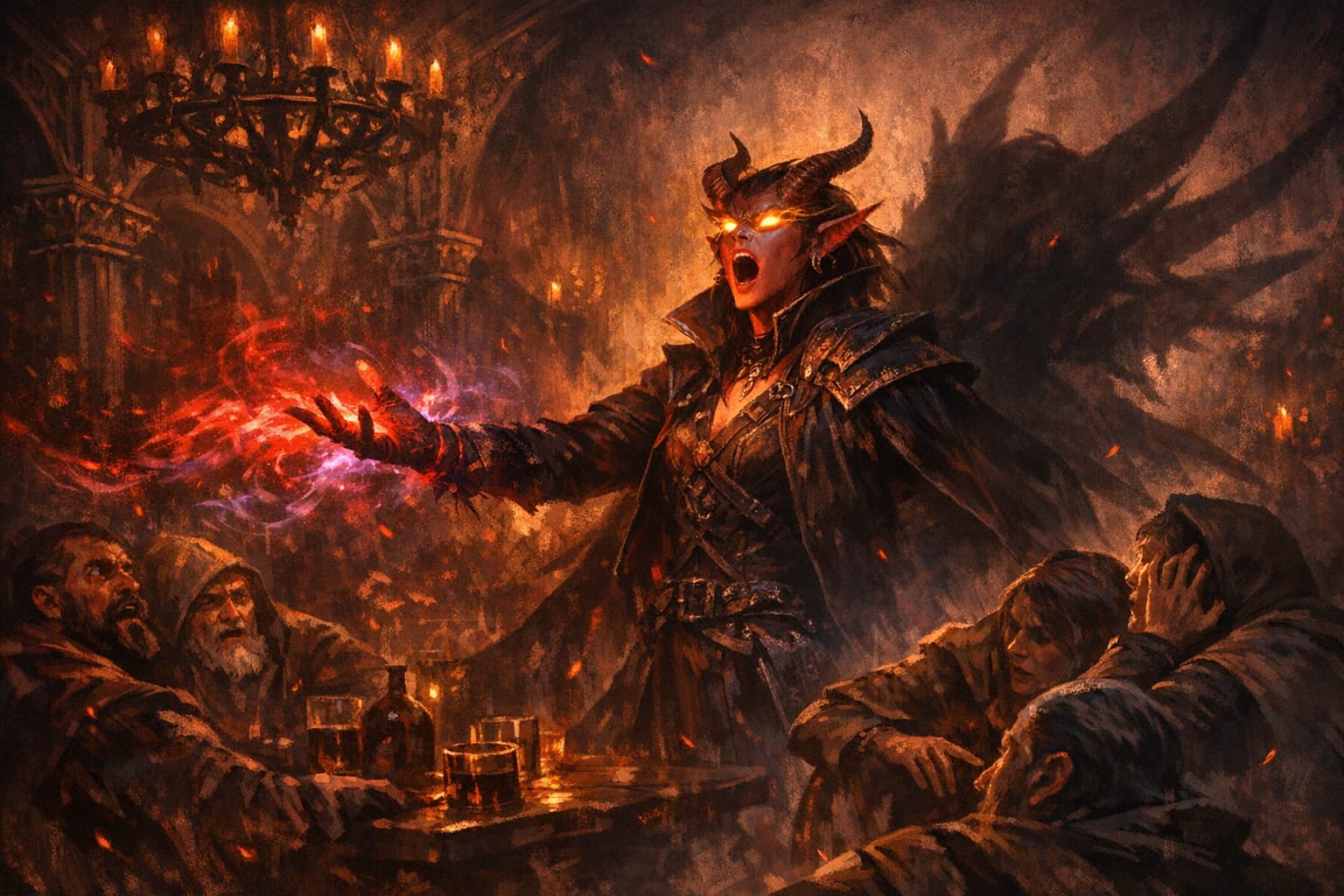
Tiefling magic comes from blood rather than study. The thaumaturgy cantrip, hellish rebuke, darkness — these spells don't require a spellbook or a patron. They're hardwired into tiefling biology, surfacing during adolescence like a second puberty that occasionally sets the curtains on fire. Learning to control innate infernal magic is a formative tiefling experience, and the lack of formal training makes it more volatile and personal than wizard-school spellcasting.
In combat, tieflings occupy an interesting design space. Fire resistance makes them naturally resilient against one of the game's most common damage types. Infernal legacy spells provide utility without requiring class levels. Charisma bonuses in 5e pushed tieflings toward face-role classes — warlock, sorcerer, bard, paladin — creating a statistical tendency toward tiefling characters who talk as much as they fight.
Innate Spellcasting
Tieflings get spells for free. Thaumaturgy at 1st level, hellish rebuke at 3rd, darkness at 5th — no class features required. This makes even a tiefling fighter or rogue feel magical in ways that human equivalents don't. The spells themselves are thematically perfect: thaumaturgy for dramatic presence, hellish rebuke for punishing attackers, darkness for controlling environments.
The Mordenkainen's Tome of Foes variants swap these defaults for spells tied to specific archdevils. A Zariel tiefling gets smite spells befitting a fallen angel. A Glasya tiefling gets charm and illusion magic reflecting the Princess of Hell's manipulation. These variants turn bloodline into a mechanical identity that shapes how the character plays.
Combat Identity
The Charisma bonus that 5e tieflings receive pushed an entire generation of players toward Charisma-based classes. Tiefling warlocks became so common they're practically a stereotype. Tiefling sorcerers, bards, and paladins followed. The result is that tieflings are disproportionately represented among party faces, leaders, and frontline Charisma casters — a mechanical tendency that created a cultural identity.
The 2024 PHB's flexible ability scores change this dynamic. A tiefling can now be an effective barbarian, ranger, or wizard without fighting the stat block. Whether this diversifies tiefling character concepts or simply removes an interesting constraint remains to be seen. Sometimes limitations create identity. Sometimes they just limit.
Inter-species Relationships
Tieflings interact with other species through a lens that other species don't share: the assumption of guilt. A dwarf meets a human and the interaction starts at neutral. A tiefling meets anyone and the interaction starts at a deficit. This isn't universal — cosmopolitan NPCs, experienced adventurers, and genuinely good people look past the horns. But the default assumption in most settings is suspicion, and tiefling characters navigate that constant headwind.
Tieflings and aasimar represent an obvious narrative pairing — the fiend-touched and the celestial-touched, living proof that heritage doesn't determine destiny (or does it?). In settings where both exist, their interactions range from mutual understanding to intense rivalry. Some aasimar treat tieflings with compassion born of shared outsider status. Others treat them as natural enemies, celestial authority manifesting as righteous prejudice.
Half-orcs and tieflings often find common ground as species that face prejudice based on appearance. The camaraderie of the visibly different can be a powerful party dynamic. Similarly, tieflings and drow share the experience of being assumed evil on sight, though their histories and cultures are entirely different. These alliances of circumstance rather than culture create some of the most interesting inter-species relationships in D&D.
Prejudice against tieflings works as a campaign element because it mirrors real dynamics without mapping onto real-world categories. The tiefling who is judged by their appearance, denied services, or watched by guards generates empathy without requiring players to engage with specific real-world politics. It's a safe space to explore what prejudice feels like, which is why tieflings resonate so strongly with players who have experienced being visibly different.
Literature & Notable Figures
Tieflings entered the D&D canon later than most core species, which means their literary history is shorter but remarkably concentrated. The characters who defined tiefling identity in popular imagination arrived through video games and novels in a compressed timeframe, and each one pushed the archetype in a different direction.
What's striking about the list is how many of these characters are defined by the tension between their nature and their choices. Annah is prickly and defensive because the world made her that way. Farideh is heroic despite — or because of — her warlock pact. Karlach is literally burning with infernal energy and uses it to protect people she loves. Zariel fell from grace and serves as a warning about what happens when righteous anger becomes infernal power. Each represents a different answer to the core tiefling question.
Notable Tiefling Characters
| Character | Source | Defining Trait | Significance |
|---|---|---|---|
| Annah | Planescape: Torment (1999) | Street-tough survivor with a barbed tongue | First major tiefling character in a video game; established the "prickly outcast" template |
| Farideh | Brimstone Angels novels (Erin M. Evans) | Warlock torn between fiendish pact and personal morality | Most developed tiefling protagonist in D&D fiction; explored heritage as ongoing negotiation |
| Karlach | Baldur's Gate 3 (2023) | Infernal engine-hearted barbarian with fierce loyalty | Introduced millions of players to tiefling identity; fan-favorite character worldwide |
| Zariel | Descent into Avernus (2019) | Fallen angel turned Archduke of Avernus | Not a tiefling but the source of a tiefling bloodline; embodies the angel-to-fiend fall |
| Lorcan | Brimstone Angels novels | Cambion who manipulates through genuine affection | Complicated the tiefling-fiend relationship beyond simple antagonism |
Karlach's popularity in Baldur's Gate 3 did more for mainstream tiefling recognition than two decades of tabletop play. Her story — a good person with an infernal heart, literally — distilled the tiefling concept into something millions of players immediately understood.
D&D Mechanics Across Editions
Tiefling mechanics tell the story of a species moving from oddity to icon. In Planescape, they had no standardized stat block — DMs improvised. By 5e, they were one of the most mechanically coherent and popular player races in the game. The mechanical evolution tracks the cultural one: as tieflings became more central to D&D's identity, their game statistics became more refined and more powerful.
Tiefling Mechanical Evolution
| Feature | 3.5e | 5e (2014) | 2024 |
|---|---|---|---|
| Key Ability | DEX/INT (+2) | CHA (+2), INT (+1) | Flexible |
| Creature Type | Outsider (native) | Humanoid | Humanoid |
| Damage Resistance | Cold 5, Electricity 5, Fire 5 | Fire only | Varies by legacy |
| Innate Spells | Darkness 1/day | 3 spells by 5th level | 3 spells by 5th level (varies) |
| Playability Cost | +1 Level Adjustment | None | None |
| Design Role | Niche outsider | Core Charisma race | Flexible fiendish heritage |
The shift from -2 Charisma (3.5e) to +2 Charisma (5e) fundamentally changed what kind of character tieflings became. The skulking outsider became the charismatic leader, and that mechanical shift drove a cultural one.
- Darkvision 60 ft.
- Darkness 1/day as spell-like ability
- +2 bonus to Bluff and Hide checks
- Resistance to cold 5, electricity 5, fire 5
- Native outsider type
- Level Adjustment +1
The 3.5e tiefling was an outsider type rather than humanoid, which had significant mechanical consequences — they couldn't be targeted by charm person or hold person. The -2 Charisma penalty contrasted sharply with 5e's +2 Charisma bonus, producing very different character archetypes.
- Darkvision 60 ft.
- Hellish Resistance (fire resistance)
- Infernal Legacy: thaumaturgy (1st), hellish rebuke (3rd), darkness (5th)
- Languages: Common, Infernal
The 5e tiefling is one of the best-designed player races in the edition. Fire resistance is consistently useful, the spell progression feels natural, and the Charisma bonus encourages face-role play. Clean, thematic, effective.
- Darkvision 60 ft.
- Fiendish Legacy choice: Abyssal, Chthonic, or Infernal
- Each legacy grants different damage resistance and spells
- Otherworldly Presence: thaumaturgy cantrip (all legacies)
- Size: Small or Medium
The 2024 tiefling splits into three legacies, each with different damage resistances (poison, necrotic, or fire) and spell lists. This is the first mechanical acknowledgment that not all tieflings descend from the same type of fiend.
Across Franchises
The tiefling concept — mortals bearing visible infernal heritage — is more D&D-specific than elves or dwarves, which appear in nearly every fantasy franchise. Most other systems have equivalent concepts but rarely use the same framework. The comparison reveals how D&D's specific choices (inherited curse, visible marks, core PHB race) shaped a trope that plays differently elsewhere.
What distinguishes D&D's tieflings is the combination of visibility and playability. In most settings, half-demon characters are either hidden (passing as human) or monstrous (unplayable). D&D made tieflings visibly fiendish but socially functional, which created the specific tension that makes them compelling: you can't hide what you are, but you're still a person who lives in the world.
Infernal Heritage Across Franchises
| Franchise | Equivalent | Defining Trait | Key Distinction |
|---|---|---|---|
| D&D | Tiefling | Visible infernal heritage, core playable species | The original; defined the archetype for tabletop RPGs |
| Pathfinder | Tiefling (heritage) | Modular fiendish bloodline system | More granular ancestry options; less cultural baggage |
| World of Darkness | Demon: The Fallen characters | Fallen angels in mortal shells | The fiend IS the character, not the heritage; inverted dynamic |
| Warhammer Fantasy | Chaos-touched mutants | Mutation from Chaos exposure | No social integration; mutation means execution or exile |
| Elder Scrolls | Dremora-influenced (lore only) | Daedric influence on mortal bloodlines | Rarely playable; the concept exists but isn't codified as a species |
| Baldur's Gate 3 | Tiefling | D&D 5e implementation with cinematic depth | Introduced the tiefling concept to millions outside the tabletop community |
D&D's tieflings occupy a unique niche: visibly marked by heritage but fully integrated into the playable species roster. Most other franchises make their fiend-touched either invisible or unplayable.
FAQ
Common Questions
The edgelord tiefling is a character whose entire personality is "dark and misunderstood." Avoid this by giving your tiefling specific interests, relationships, and opinions that have nothing to do with their heritage. A tiefling who loves cooking, has strong opinions about bridge architecture, or is weirdly knowledgeable about birds is more interesting than one whose every sentence references their infernal blood. The heritage matters, but it shouldn't be the only thing about them.
Three reasons: mechanical strength (fire resistance and free spells are excellent), visual distinctiveness (players love characters who look dramatic), and narrative hook (built-in backstory tension without requiring homework). Tieflings also benefit from being outsiders by default, which appeals to players who enjoy roleplay centered on identity and belonging. Baldur's Gate 3 amplified all of this by making tiefling NPCs central to the game's emotional core.
Make prejudice systemic rather than constant. Higher prices, restricted access, suspicious guards — institutional friction rather than every NPC screaming "demon." Establish safe spaces where the tiefling is accepted so they aren't dealing with hostility in every scene. Most importantly, let the tiefling player set the tone for how much prejudice they want in the campaign. Some players want to explore discrimination narratives. Others just want to play a cool character with horns.
In 5e, warlock and sorcerer are the mechanical optimum thanks to the Charisma bonus. Paladin tieflings create excellent narrative tension between infernal heritage and divine oath. Bard tieflings lean into the charismatic outsider archetype. But don't sleep on unconventional picks: a tiefling cleric wrestling with faith, a tiefling druid connected to nature despite infernal blood, or a tiefling artificer who approaches their heritage through science rather than magic. The 2024 rules make any class viable.