
Tortles
Wanderers who carry their home on their back and measure a lifetime in a single great journey
Turtle Folk in World Mythology
The turtle carries the world. That image repeats across cultures with a frequency that borders on suspicious. Hindu cosmology places the earth on the back of Akupara, a cosmic turtle swimming through an infinite ocean. Lenape and Haudenosaunee traditions describe North America as Turtle Island, land formed on the shell of a great turtle that offered its back when Sky Woman fell. Chinese mythology assigns the turtle cardinal-direction authority — the Black Turtle of the North, guardian of winter, death, and water. The Mayans built Palenque's Temple of the Inscriptions with a turtle-shell motif because turtles represented rebirth and the earth itself.
What connects these traditions isn't coincidence but observation. Turtles are among the oldest surviving vertebrate body plans on the planet — 220 million years of largely unchanged design. They carry their shelter, live extraordinary lifespans, and move with a deliberation that looks like wisdom if you're inclined to read intention into animal behavior. Humans have always been so inclined.
Tortles inherit this mythological weight. They aren't just turtle-people; they're turtle-people in a fantasy tradition where turtles already mean something. Patience, endurance, wisdom earned through slow observation rather than quick study — these associations arrive before anyone writes a single line of game text. The archetype does half the worldbuilding for you.
The name "tortle" is exactly what it sounds like: a portmanteau of "tortoise" and "turtle" with the ending filed down to sound like a fantasy species rather than a biology lesson. It first appeared in the 1984 D&D module "Tortles of the Purple Sage" for the Basic/Expert rules. No elaborate etymology. No linguistic archaeology. Someone at TSR needed a name for turtle-people and the obvious answer was the right one.
Tortle personal names in published material tend toward simple, rounded sounds — Gura, Lim, Quott, Xelbuk. Two syllables is the norm. Harsh consonant clusters are rare. The naming conventions suggest a culture that values clarity over ornamentation, which tracks with everything else about tortles. They don't embellish.
Many tortles also carry a journey-name: a descriptive title earned through experience rather than given at birth. "Mud-Walker" for a tortle who crossed a vast swamp. "Tide-Counter" for one who spent years mapping coastal patterns. "Shell-Marked" for a tortle whose carapace bears the scars of a notable encounter. These names accumulate over a lifetime, and an elderly tortle's full introduction can take several minutes.
Turtle Symbolism Across World Cultures
| Culture | Figure or Concept | Symbolic Role |
|---|---|---|
| Hindu | Akupara / Kurma | Cosmic turtle bearing the earth; avatar of Vishnu |
| Haudenosaunee / Lenape | Turtle Island | North America formed on a turtle's shell |
| Chinese | Black Turtle (Xuanwu) | Guardian of the North; water, endurance, longevity |
| Mayan | Temple of the Inscriptions | Turtle shell as symbol of earth and rebirth |
| Japanese | Minogame | Sacred turtle with trailing seaweed tail; 10,000-year lifespan |
| West African / Yoruba | Ijapa the Tortoise | Trickster figure; cleverness through patience |
Every culture that encountered turtles independently concluded they meant something cosmic. Tortles walk around inside that meaning.
“A tortle who has only one name has not yet lived. A tortle with a dozen names has lived enough for anyone.”
— Tortle naming proverb
From Mystara to the Multiverse
Tortles have one of the stranger publication histories in D&D. They debuted in 1984's "Tortles of the Purple Sage," a module for the BECMI (Basic/Expert/Companion/Master/Immortal) rules set in the Known World of Mystara. For most of D&D's history, that was it — a single module in a single setting, largely forgotten as the game moved to AD&D 2nd Edition and the Forgotten Realms dominated the spotlight.
Then, thirty-three years later, tortles resurfaced in the most unexpected way possible. The 2017 "Tortle Package" was a DMs Guild supplement released as a charity tie-in with the Tomb of Annihilation adventure. It was a paid PDF on a third-party platform, making tortles the first 5e player species published outside of official hardcover books. All proceeds went to the Extra Life charity. Tortles became playable again because someone at Wizards of the Coast thought turtle-people would sell well for a good cause.
The strategy worked. The Tortle Package was a bestseller on DMs Guild. Tortles showed up in Mordenkainen's Monsters of the Multiverse (2022), finally receiving a proper hardcover entry. The species went from a Mystara curiosity to a charity experiment to a multiverse staple in three moves spanning four decades.
Tortles of the Purple Sage
First appearance in a BECMI D&D module set in Mystara. Tortles introduced as peaceful coastal dwellers with natural armor and simple tribal societies. Illustrated with a distinctly 80s aesthetic.
The Long Silence
Tortles effectively vanish from D&D. No AD&D 2e, 3e, 3.5e, or 4e support. The species survives in Mystara nostalgia circles and nowhere else.
The Tortle Package (DMs Guild)
A charity supplement for 5e published on DMs Guild alongside Tomb of Annihilation. Tortles become the first 5e species sold through a third-party platform. All proceeds to Extra Life.
Mordenkainen Presents: Monsters of the Multiverse
Tortles receive an official hardcover entry with revised mechanics. Natural Armor set at 17, Shell Defense codified, Hold Breath expanded. A proper multiverse species at last.
Coastal Settlements & Nesting Grounds
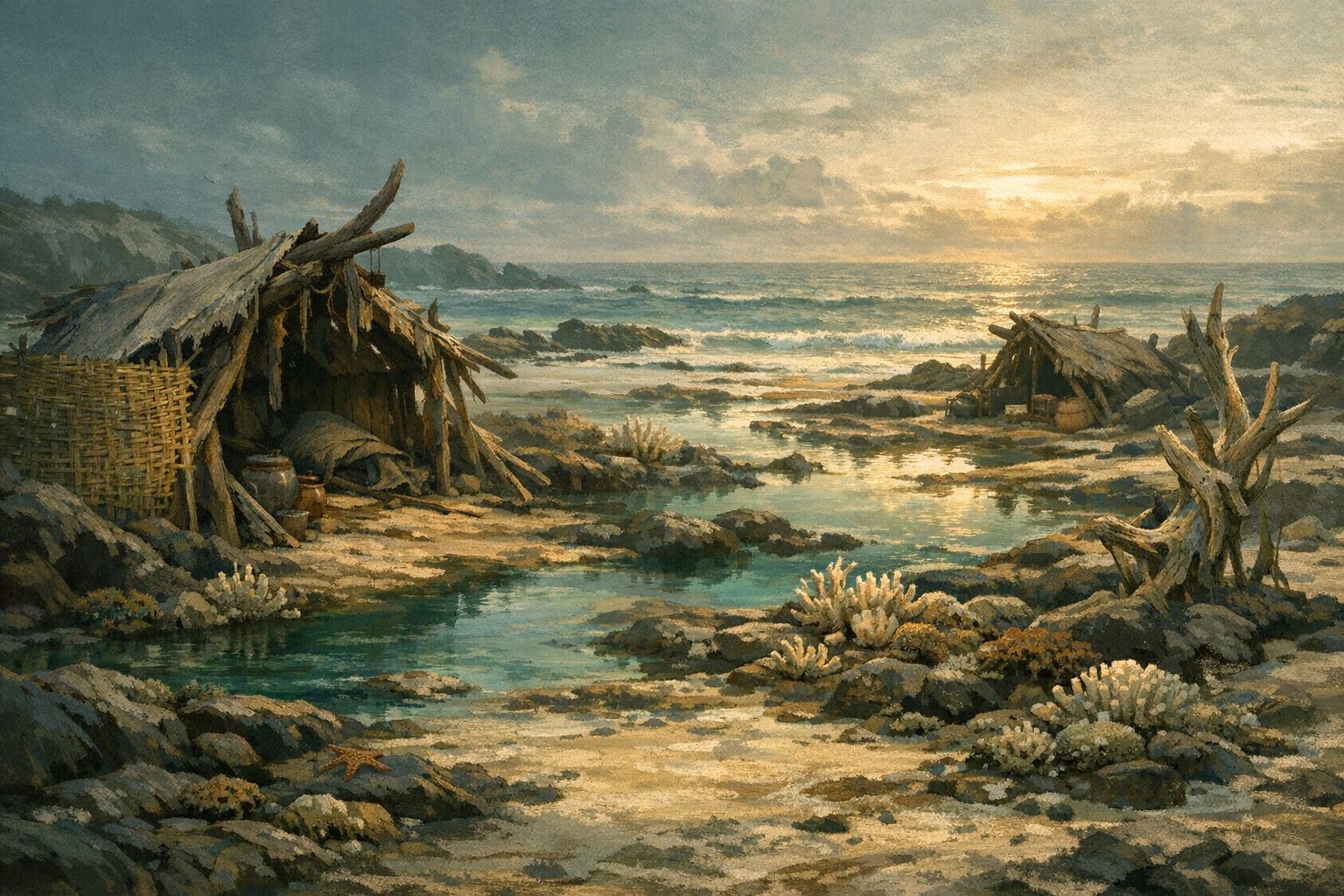
Tortles don't build cities. They barely build villages. A tortle settlement is a gathering place — a stretch of coastline where tortles return seasonally, a sheltered cove where elders pass down stories, a nesting beach where eggs are laid and the cycle begins again. The structures are temporary because tortles are temporary in any given place. Their shell is their permanent architecture; everything else is scenery.
Nesting grounds hold a significance that approaches the sacred. These are the beaches where tortles are born and, eventually, where they return to lay their own eggs before dying. A tortle might spend fifty years wandering the world, but the pull of the nesting beach is constant — a compass needle that always points home even when home is decades of travel away.
Tortle communities near nesting grounds tend to be multigenerational only briefly. Young tortles leave within a year of hatching, driven by an instinct to wander that no amount of parental attachment can override. The elders who guard the nesting beach are typically in their final years, having returned from their own great journey to ensure the next generation has a safe place to begin theirs.
What happens when a nesting beach is destroyed — consumed by coastal erosion, claimed by a port city, or corrupted by magical pollution? Tortles across the world would feel the pull toward a home that no longer exists. A campaign could center on finding or consecrating a new nesting ground, with the party navigating the politics of coastal land claims while a generation of tortles approaches the end of their journey with nowhere to go.
Shell, Claws & Natural Defenses
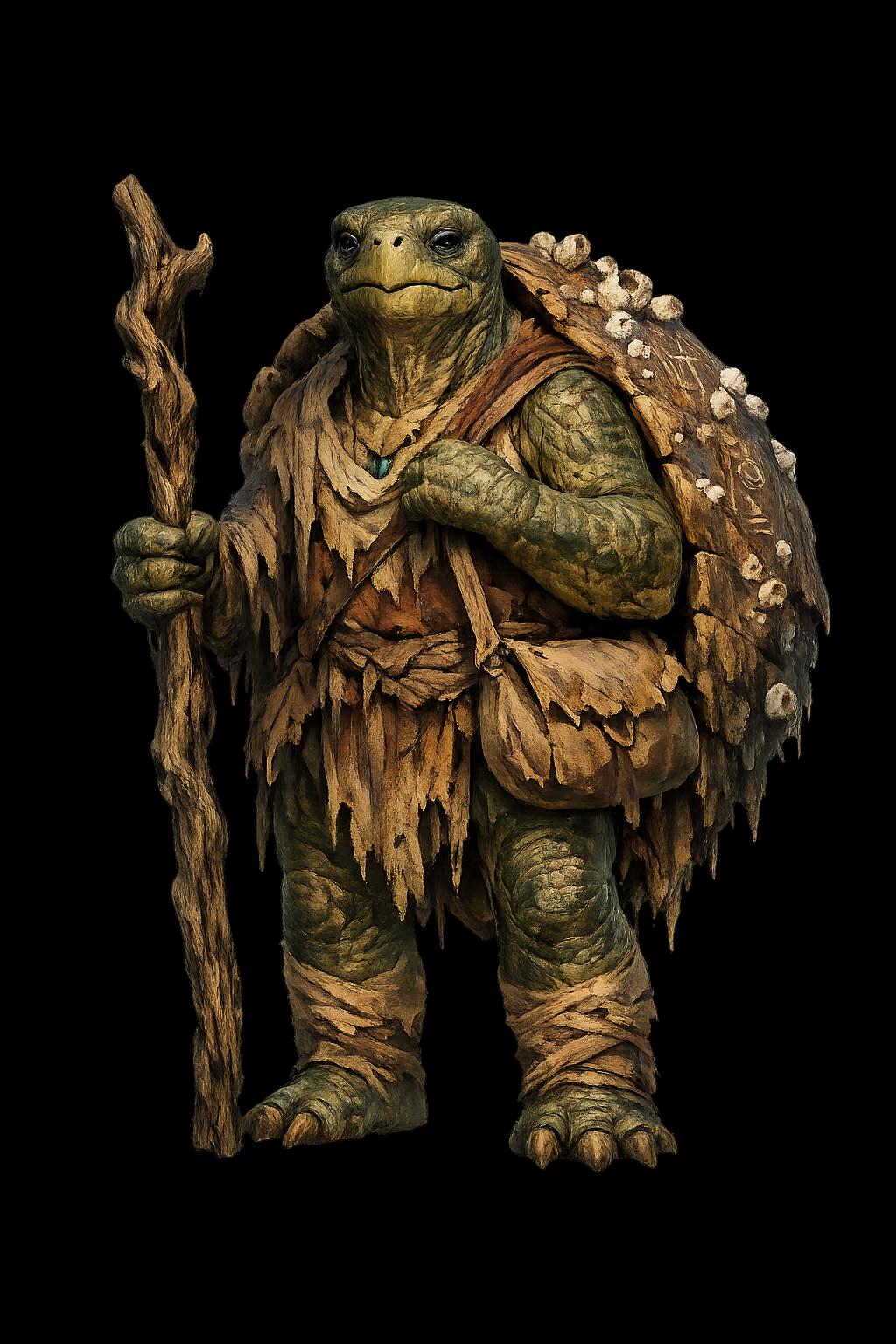
The shell is the defining feature of tortle biology and the foundation of their mechanical identity. It isn't clothing or equipment — it's skeleton, home, and identity fused into a single structure. A tortle's shell grows with them from hatching, develops unique patterns of ridges and coloration, and accumulates scars and weathering that function as a biographical record readable by other tortles.
Natural Armor 17 makes tortles one of the most durable unarmored species in D&D. For context, that's equivalent to splint mail — heavy armor that costs 200 gold and imposes disadvantage on Stealth checks. Tortles get it for free, from birth, forever. This isn't a minor perk. It fundamentally changes how tortle characters interact with the equipment economy and class design.
Shell Defense — withdrawing into the shell as an action — provides a further defensive option. While withdrawn, a tortle gains +4 AC (effectively AC 21 without any equipment), is prone, has speed 0, and has disadvantage on Dexterity saving throws. It's a last resort, not a combat strategy, and it perfectly captures the real-world turtle defensive posture: total commitment to protection at the cost of all mobility and awareness.
The Living Shell
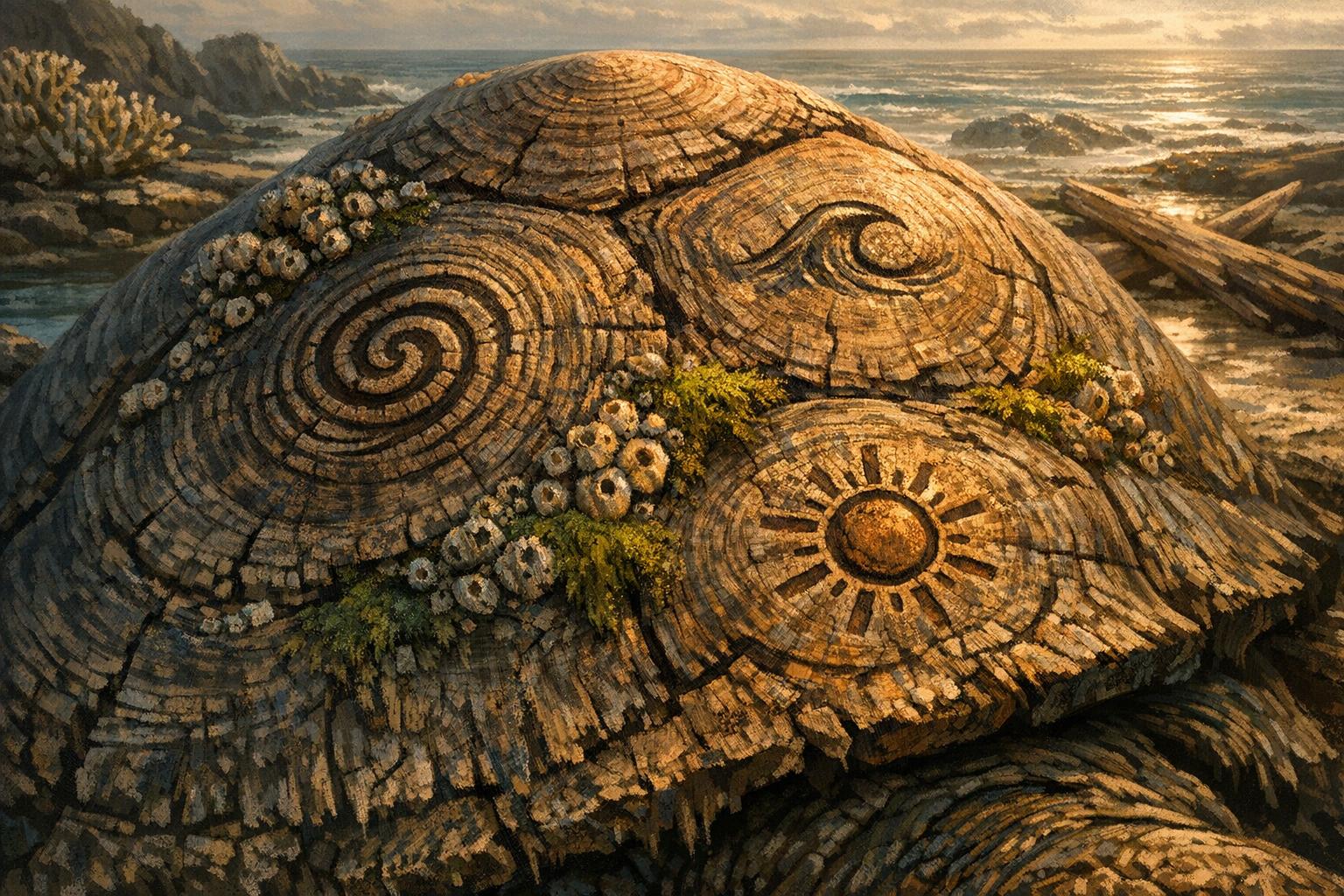
A tortle's carapace is bone covered by keratinous scutes, the same material as human fingernails but orders of magnitude thicker. It grows continuously, adding layers over decades. Shell patterns are as unique as fingerprints — no two tortles share the same arrangement of scute shapes and ridge lines. Damage to the shell heals slowly, leaving visible scar tissue that other tortles read like a map of someone's life.
Claw Weapons
Tortle claws deal 1d6 + Strength slashing damage — respectable natural weapons that ensure a tortle is never truly unarmed. The claws serve dual purpose: they're digging tools as much as weapons. Tortles excavate nesting hollows, dig for shellfish, and carve trails through dense undergrowth with the same appendages they use to defend themselves. Practicality defines every aspect of tortle biology.
Hold Breath
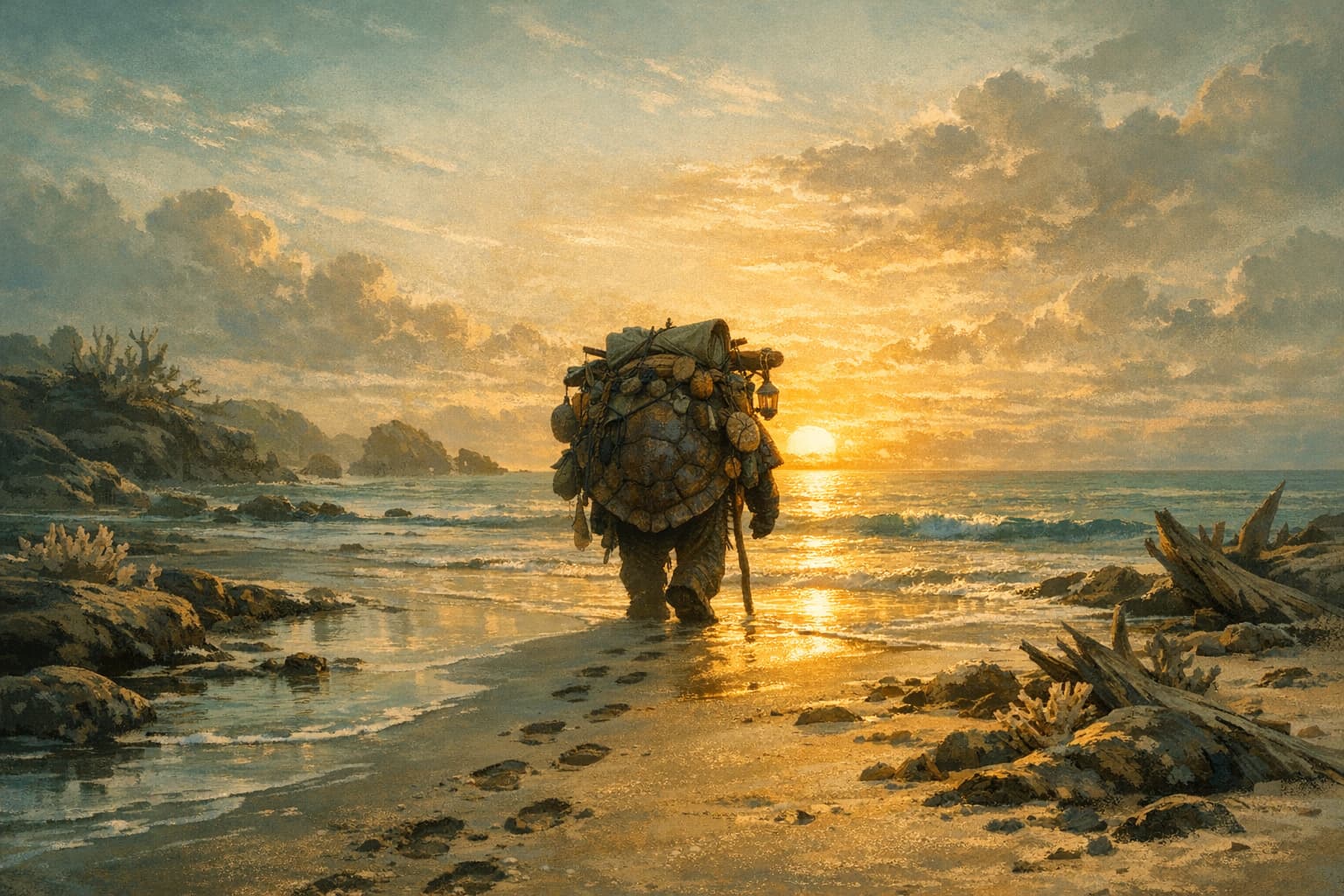
Tortles can hold their breath for up to one hour. Not ten minutes — an hour. This makes them superb underwater explorers, salvage divers, and smugglers of the coastal world. Combined with their natural armor and claws, a tortle submerged in water is arguably more capable than on land. Many tortle communities build their expertise around underwater resource gathering: pearl diving, coral harvesting, shipwreck salvage.
The Wanderer's Mind
Tortles don't understand the concept of a permanent home — not because they're incapable of the idea, but because it strikes them as fundamentally wasteful. Why build a house when you carry one? Why accumulate possessions you'll have to leave behind? Why invest emotional energy in a place when the world is full of places you haven't seen yet?
This isn't rootlessness. It's a philosophy of sufficiency. A tortle carries what they need and needs what they carry. Everything else is the landscape passing by — beautiful, interesting, worth stopping to examine, but not worth anchoring to. The freedom isn't from responsibility; it's from the particular form of anxiety that comes with owning things that can be lost.
Other species frequently misread tortle detachment as apathy. It isn't. A tortle who pauses to watch a sunset isn't being lazy — they're doing exactly what they believe life is for. A tortle who refuses to fight over territory isn't a coward — they simply don't understand why anyone would kill for ground they can walk away from. The confusion cuts both ways: tortles genuinely struggle to understand why other species hoard, fortify, and wage war over land that none of them will outlive.
A tortle's daily routine is governed by simplicity. Wake with the sun, walk, observe, eat what the land provides, sleep in your shell. There's no morning routine of armor-donning and camp-breaking because the tortle is the camp. Possessions fit in a belt pouch or a simple pack: a carving tool, a waterskin, perhaps a musical instrument or a journal. Anything heavier than what can be comfortably carried gets left behind or traded away.
Meals are opportunistic and omnivorous. Coastal tortles eat shellfish, seaweed, and fish caught by wading into tidal pools. Inland wanderers forage for roots, berries, insects, and the occasional egg. Tortles are slow but extraordinarily efficient foragers — their patience and methodical scanning of an area means they find food sources that faster-moving species walk right past.
Social interaction among wandering tortles follows chance-meeting protocols. When two tortles encounter each other on the road, they stop, share a meal, exchange stories about where they've been and what they've seen, then continue in their separate directions. There's no obligation to travel together unless both want to. The meeting is its own reward — two walking libraries comparing notes.
Playing a tortle means playing someone who travels light in every sense. Your character doesn't rush. They notice things other party members walk past — the wildflower that only grows near underground water, the bird call that means a predator is nearby, the stone formation that suggests this path was a riverbed a thousand years ago. Slow observation is your superpower. Use it to give your GM hooks they didn't plan.
“You spend your whole life building walls, and for what? The walls stay. You don't.”
— Tortle elder to a human merchant
Stories Instead of Possessions
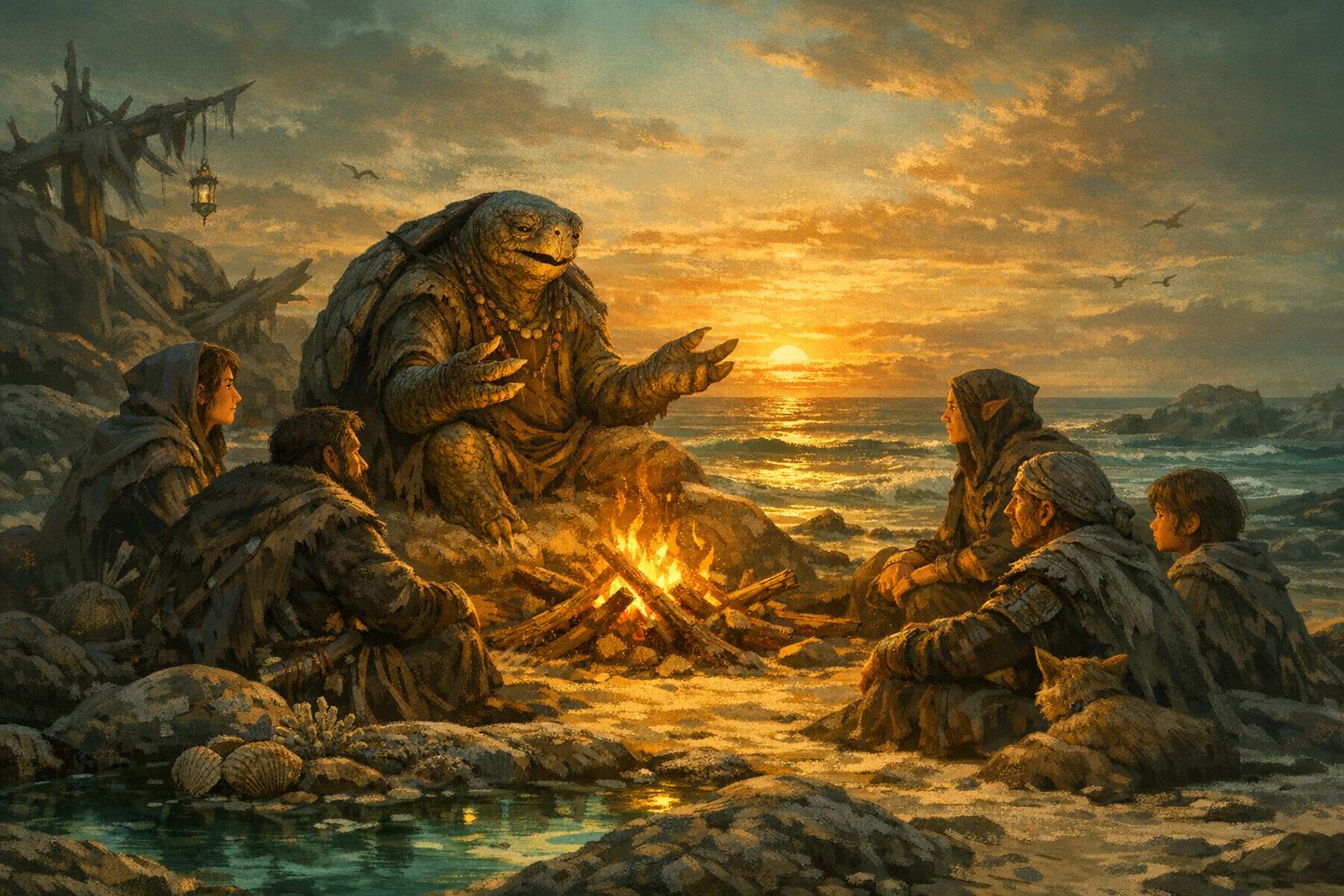
Tortles don't accumulate wealth. They accumulate stories. Every tortle is expected to spend their life gathering experiences worthy of telling, and the richest tortle in any gathering is the one with the most stories, not the one with the most gold. Material wealth is a convenience at best and a burden at worst — it's heavy, it attracts thieves, and you can't take it into your shell.
The oral tradition functions as both entertainment and education. Young tortles learn geography, survival skills, natural history, and ethics through stories told by elders and passing wanderers. A story about a tortle who trusted a river crossing during spring thaw teaches hydrology. A story about a tortle who shared food with a stranger and received guidance in return teaches reciprocity. The narrative format makes information sticky in a way that dry instruction doesn't.
Each tortle's life is understood as a story being written in real time, with the tortle as both author and protagonist. The question "what is your story?" isn't small talk — it's the most important question one tortle can ask another. Your story is your identity, your contribution to the species' collective knowledge, and the only thing that survives after your shell returns to the earth.
The Spoken Record
Tortle oral histories are structured around journeys rather than dates. Events are located in narrative space — "during the walk along the Amber Coast" or "the winter I sheltered in the dwarf-hold" — rather than calendar time. This makes tortle history richly detailed about geography and experience but frustratingly vague about chronology.
A tortle elder serving as keeper of stories might hold hundreds of journey-narratives in memory, each one a thread in the species' collective autobiography. Losing an elder before their stories are passed on is a cultural catastrophe equivalent to a library burning.
Shell Carving
The one material art form tortles universally practice is shell carving — etching symbols, maps, and story-glyphs into their own carapace or into found shells and driftwood. These carvings serve as mnemonic devices, supplementing oral tradition with visual records that can survive the death of the storyteller.
Shell-carving styles vary by region. Coastal tortles favor wave-patterns and tidal charts. Mountain wanderers carve elevation profiles and pass routes. The carvings are simultaneously practical maps, artistic expression, and spiritual practice — marking the shell is marking the self.
Faith of the Open Sky
Tortle spirituality doesn't organize itself into churches, hierarchies, or systematic theology. It organizes itself around attention. The sacred is whatever you're looking at when you're truly paying attention — the tide pool, the thunderhead, the way light moves through forest canopy in late afternoon. Tortles don't worship nature in the sense of performing rituals directed at nature deities. They worship nature in the sense of treating careful observation of the natural world as the highest form of devotion.
This isn't pantheism so much as practiced reverence. A tortle who watches the stars for an hour isn't stargazing — they're praying. A tortle who describes the exact color of mud after rain isn't being pedantic — they're testifying. The divine, for most tortles, isn't a being to be petitioned but a pattern to be noticed. You honor creation by paying attention to it.
Tortle druids and clerics who do connect with specific deities tend toward those associated with nature, the sea, and the cycle of life and death. Eldath, Silvanus, and Umberlee in the Forgotten Realms. The Storm Lord or the Wildmother in Exandria. But even deity-aligned tortles maintain the species' characteristic emphasis on observation over supplication. Their prayers look like long walks. Their rituals look like sitting quietly near water.
A tortle philosopher proposes that the gods themselves are wanderers — that divinity is the universe paying attention to itself through beings that move, observe, and remember. The idea catches on among younger tortles and alarms every organized religion within earshot. Is it heresy, insight, or just the kind of thing tortles say when they've been walking too long alone? Your players might have to decide.
The Nomadic Year
Every tortle's life follows the same arc, and every tortle knows it. They are born on a beach, spend their youth learning to walk, spend their adulthood walking, and return at the end to the same beach to lay eggs and die. The cycle takes roughly fifty years. There are no exceptions. No tortle has ever beaten the timeline. No tortle has ever wanted to.
This certainty — this absolute foreknowledge of how and roughly when your story ends — shapes everything about tortle psychology. There is no midlife crisis because there is no mystery about what comes next. There is no fear of death because death is the known final chapter, not an ambush. There is only the question that defines every tortle life: what will you do with the journey between the beach and the beach?
Other species find this acceptance either deeply moving or profoundly unsettling. Elves, who measure life in centuries, cannot fathom choosing not to fight mortality. Humans, who fear death precisely because of its unpredictability, don't know what to do with a species that has scheduled theirs. Dwarves respect the stoicism. Halflings pity the brevity. Only tortles themselves seem at peace with it, which is perhaps the most alien thing about them.
The Hatching
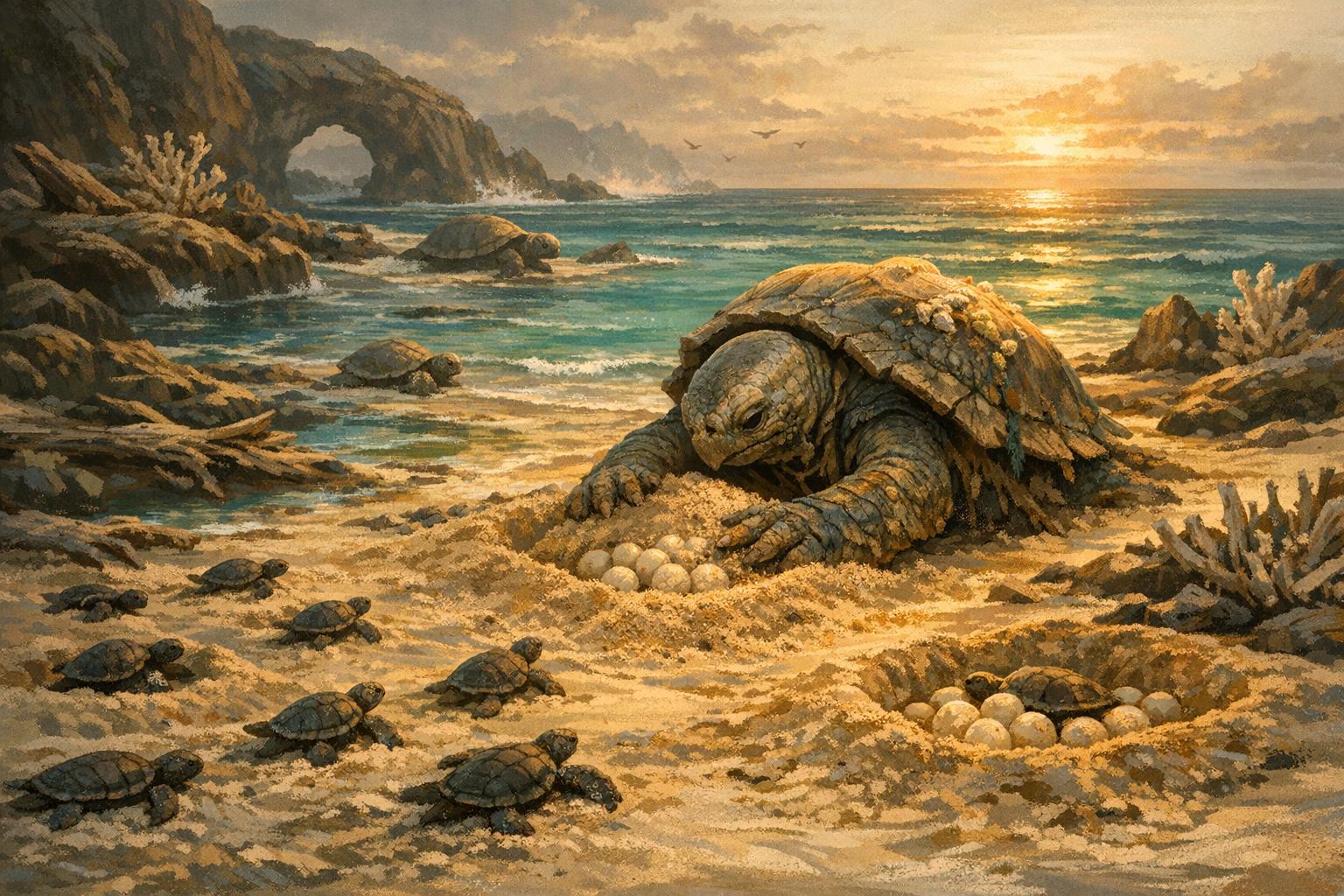
Tortle eggs are laid in clutches of four to six in shallow sand nests on ancestral beaches. Hatchlings emerge after three months, already shelled, already mobile, already drawn toward the waterline. Parents rarely survive to see the hatching — egg-laying is the final act of the tortle lifecycle.
The Sheltered Time
Young tortles remain near the nesting beach under the guidance of elders who have not yet begun their return journey. They learn to forage, swim, read tides, and — most importantly — listen to stories. By age five, the wanderlust is undeniable. They leave, usually alone, usually without looking back.
The Green Roads
Adolescent tortles travel coastal regions, building survival skills and beginning to collect their own stories. Many attach themselves briefly to settlements, trading labor for knowledge. First encounters with other species shape lasting attitudes. Shell patterns are still developing, identity still forming.
The Long Walk
The heart of the tortle life. Decades of wandering, exploring, experiencing. Some tortles cross continents. Others circle the same beloved coastline for twenty years, learning every tidal pool by name. Friendships form and dissolve as paths diverge. Stories accumulate. The shell weathers and scars and becomes a record of everywhere the tortle has been.
The Turning
A biological certainty that every tortle recognizes when it arrives: the pull toward home. The nesting beach calls with increasing urgency. Wandering becomes purposeful — the tortle is no longer exploring outward but navigating back. Final stories are gathered. Final goodbyes are said. The pace, always deliberate, becomes reverent.
The Return
The tortle reaches the nesting beach, lays eggs in the sand where they themselves hatched, and dies within weeks. The body is left for the tide. The shell remains longest, sometimes for years, bleaching in the sun beside the nests it died to fill. The cycle begins again.
Survival Without Swords
Tortles are not warriors. They can fight — claws deal respectable damage, the shell stops most attacks, and a cornered tortle is a surprisingly dangerous opponent — but combat is not their first response to threat. Their first response is to withdraw. Their second response is to leave. Fighting is what happens when leaving isn't possible, and a tortle who fights frequently has probably made a series of poor decisions about where to walk.
This pacifism-by-preference makes tortles unusual in a game system built around combat. A tortle character isn't a pacifist in the moral-commitment sense; they'll fight to protect companions or innocent creatures. But they're unlikely to start fights, unlikely to escalate confrontations, and unlikely to celebrate violence after the fact. The party's tortle is the one who checks whether the goblins can be talked to before the barbarian charges.
Natural Armor 17 changes the economics of character building in ways that benefit spellcasters and unarmored classes disproportionately. A tortle wizard has better AC than most fighters at level 1. A tortle monk ignores Unarmored Defense entirely. A tortle cleric skips medium armor proficiency and puts their gold toward something more interesting. The shell isn't just defensive — it's liberating.
Lean into the contradiction. Your tortle has AC 17 and would rather not be attacked at all. They're walking around in biological plate mail while trying to de-escalate every encounter. The humor writes itself, and the moments when your peaceful tortle finally decides something is worth fighting are dramatically powerful precisely because they're rare.
Gentle but Immovable
Tortles get along with almost everyone, which is less a personality trait than a survival strategy. A species that wanders alone through other people's territory cannot afford to make enemies. Courtesy, curiosity, and a willingness to share stories and labor earn passage through lands where a more aggressive species would face resistance.
The relationship with halflings is particularly warm. Both species value simple pleasures, communal stories, and a good meal over material ambition. A tortle who stops in a halfling village might stay for a season, trading travel stories for home cooking, before the road calls again. With dwarves, tortles share an appreciation for craftsmanship and patience, though dwarven attachment to stone halls baffles creatures who carry their home with them.
Elves and tortles regard each other across an enormous lifespan gulf. An elf watches a tortle age and die within what feels like a single elven afternoon, which produces either compassion or a reluctance to invest emotionally. Tortles, for their part, don't envy elven longevity — they find the idea of living for centuries vaguely exhausting. Fifty years of walking is enough. More would just be repetition.
The species that tortles struggle with most are those that claim territory aggressively. Tortle wandering routes occasionally cross through lands that new owners have fenced off, fortified, or declared restricted. A tortle's response to being told "this land is mine" is genuine confusion — the land was here before either of us and will be here after. Ownership of ground strikes them as a category error.
Tortle Mechanics Across Editions
Tortles have a remarkably thin mechanical history compared to core species. They existed in BECMI D&D with minimal stats, vanished for three decades, reappeared as a 5e charity product, and only received a proper revised entry in 2022. The through-line across all versions is the shell: high natural armor, a defensive withdrawal option, and the sense that you're playing someone who was designed to survive rather than to fight.
The 5e version established tortles as mechanically unique in ways that ripple through character optimization. Natural Armor 17 that doesn't stack with other armor calculations (it replaces them) means tortles interact with the equipment system differently than every other species. You don't buy armor. You don't worry about Dexterity for AC purposes. Your defensive floor is higher than most characters' ceiling at low levels.
Tortle Mechanical Evolution
| Feature | BECMI (1984) | 5e Tortle Package (2017) | 5e MotM (2022) |
|---|---|---|---|
| Natural Armor | AC 3 (plate equivalent) | AC 17 (flat) | AC 17 (flat) |
| Shell Defense | AC 1 (retreat) | +4 AC, prone, speed 0 | +4 AC, prone, speed 0 |
| Claw Damage | 1d4 | 1d4 + STR | 1d6 + STR |
| Hold Breath | Unspecified | 1 hour | 1 hour |
| Ability Scores | Minor +CON/+WIS | +2 STR, +1 WIS | Flexible (+2/+1 or +1/+1/+1) |
The shell has been the constant. Everything else adapted to the edition. Tortles are their armor — the mechanics have always understood that.
- Shell provides AC 3 (equivalent to plate mail)
- Retreat into shell for AC 1
- Claw attacks: 1d4 damage
- Cannot wear armor
- Swim speed equal to land speed
The original design was straightforward: slow, tough, aquatic. The shell AC was exceptional for the era. No Hold Breath duration specified — the rules simply noted tortles were comfortable underwater.
- Natural Armor: AC = 17 (flat, no Dex modifier)
- Shell Defense: withdraw as action for +4 AC, prone, speed 0
- Claws: 1d4 + STR slashing
- Hold Breath: up to 1 hour
- Survival proficiency
The charity product that brought tortles back. Natural Armor 17 immediately became one of the most discussed species features in 5e — too strong for some tables, perfectly thematic for others. Shell Defense was rarely used in practice but added tremendous flavor.
- Natural Armor: AC = 17 (unchanged)
- Shell Defense: withdraw as action for +4 AC (unchanged)
- Claws: 1d6 + STR slashing (upgraded from 1d4)
- Hold Breath: up to 1 hour (unchanged)
- Nature's Intuition: proficiency in one of Animal Handling, Medicine, Nature, Perception, or Survival
The revision kept everything that worked and polished the edges. Flexible ability scores opened up non-STR/WIS builds. Claw damage increased to 1d6, making natural weapons more viable. Nature's Intuition replaced the fixed Survival proficiency with meaningful choice.
Turtle Folk Beyond D&D
Turtle-people appear across fantasy and gaming with surprising frequency, though D&D's tortles are the most mechanically developed version. The archetype taps the same mythological reservoir every time: patience, wisdom, defensive strength, and an association with water and earth that positions turtle folk as grounded counterpoints to more volatile species.
The Teenage Mutant Ninja Turtles, while not fantasy in the traditional sense, did more to popularize anthropomorphic turtles in pop culture than any other single property. Their influence on how people imagine turtle-people — as fighters rather than pacifists, as team-oriented rather than solitary — creates an expectation that D&D's tortles deliberately subvert. Your tortle is not a ninja. They're a philosopher who happens to have natural armor.
Video games have explored the archetype from different angles. The Koopa Troopas of the Mario franchise are turtle folk reduced to obstacle. The Tortoise Monks of various Eastern-influenced RPGs lean into the wisdom-and-patience angle. Morrowind's Argonians aren't turtles specifically but occupy a similar ecological niche as amphibious, patient, nature-aligned reptilian humanoids. Each interpretation borrows from the same mythological well but draws different water.
Turtle Folk Across Media
| Franchise | Representation | Core Theme | Key Distinction |
|---|---|---|---|
| D&D (Tortles) | Nomadic turtle humanoids | Simplicity, the journey as life purpose | Only version with a defined lifecycle ending in death at the nesting beach |
| TMNT | Mutated warrior turtles | Found family, martial arts, pizza | Combat-first; popularized turtle-people in mainstream culture |
| Discworld (Great A'Tuin) | World-bearing cosmic turtle | Cosmology as absurdist philosophy | Not humanoid but directly references Hindu/Lenape world-turtle myths |
| Avatar: The Last Airbender | Lion Turtles | Ancient wisdom, origin of bending | Godlike beings rather than a playable species; source of power |
| One Piece (Fish-Man Island) | Various turtle fish-men | Racial discrimination, undersea civilization | Turtle traits distributed across a broader aquatic-humanoid species |
D&D tortles are the only version built around the idea that the journey itself — not combat, not cosmic burden — is the point of being alive.
FAQ
Common Questions
Because it solves the squishiest problem in D&D. A wizard or sorcerer typically starts with AC 10-13 and has to burn spell slots on Shield or Mage Armor to survive melee. A tortle wizard starts at AC 17 — better than medium armor and a shield — without spending a single resource. This lets caster tortles invest in offensive spells, utility, and concentration effects instead of constantly patching their defenses. It's arguably the single strongest species feature for full casters in the game.
With clarity rather than sadness. Tortles don't experience their lifespan as tragic — they experience it as complete. Your tortle has a built-in narrative arc: born on a beach, walk the world, return to the beach. This means your character makes decisions with an awareness of finality that other species lack. They don't procrastinate. They don't say "I'll do that next century." Every experience matters because there is a known, finite number of them. Play this as focus, not melancholy.
Mechanically, they can wear armor, but their Natural Armor feature means they use either their shell AC (17) or the armor's AC — whichever is higher. Since AC 17 beats everything except half-plate with good Dexterity or full plate (AC 18), most tortles skip armor entirely. Narratively, the idea of strapping metal plates over a living shell strikes most tortles as absurd and uncomfortable, like a human wearing a second ribcage. Some tortle characters might decorate their shells with paint or carvings, but covering the shell feels wrong to them on a deep, instinctive level.