

Tritons
Noble guardians of the deepest trenches who rose to the surface expecting gratitude — and found a world that had no idea they existed
Poseidon's Children & Ocean Mythology
The original Triton — singular, capital T — was a Greek god, son of Poseidon and Amphitrite, ruler of the deep and herald of the sea. He carried a conch shell whose sound could calm or raise the waves, and ancient mariners invoked his name when the water turned hostile. Over centuries the singular Triton fragmented into tritons, plural, lowercase: a whole species of fish-tailed ocean spirits who served as Poseidon's attendants, riding hippocampi through underwater palaces and policing the borders between the mortal sea and the divine deep.
What makes the triton myth distinctive is the assumption of authority. These weren't sea creatures who happened to live underwater. They were governors. Managers. The divine bureaucracy of the ocean, appointed by a god to maintain order in an environment humans couldn't even visit. That administrative self-image carried directly into D&D: tritons don't just live in the ocean. They run it. Or they believe they do, which amounts to the same thing when you're standing on a beach talking to one.
The Roman inheritors of the Greek tradition multiplied tritons further, turning them into a common decorative motif — fountain sculptures, mosaic borders, architectural ornamentation. By the Renaissance, tritons were everywhere in European art, usually depicted as muscular, bearded figures blowing conch shells while riding sea monsters. The visual language was consistent: these beings were regal, powerful, and faintly ridiculous in the way that any authority figure becomes ridiculous when you put a fish tail on them.
D&D's tritons drew from the authoritative end of this tradition rather than the decorative end. When the species appeared in the game, designers chose the "noble ocean guardians" interpretation over the "ornamental fountain figures" one. This was a consequential decision, because it meant tritons entered the game with a built-in personality: proud, dutiful, convinced of their own importance, and perpetually confused by the surface world's failure to recognize it.
Triton Roots in Mythology & Literature
| Source | Depiction | Legacy in D&D Tritons |
|---|---|---|
| Greek mythology (Triton) | Son of Poseidon, herald of the sea, conch-blower | Noble bearing, authority over water, the superiority complex |
| Roman mosaics | Plural tritons as ocean attendants and cavalry | A whole species of guardians, not just one demigod |
| Renaissance art | Decorative figures on fountains and facades | Visual template: muscular humanoids with aquatic features |
| Pliny the Elder (Natural History) | Sea-men reported by sailors and coastal peoples | The idea of an undersea civilization hiding just out of sight |
| Hans Christian Andersen (The Little Mermaid) | Undersea royalty with rigid social structure | Hierarchical ocean society that views the surface as lesser |
| Tolkien (Ulmo, Lord of Waters) | Valar of the sea who communicates through water | The concept of aquatic beings who protect the world in secret |
D&D tritons are the mythological ocean guardian stripped of divine status but not of divine self-regard.
Triton Naming — Tides in Syllables
Triton names follow patterns that sound like water moving. Consonant clusters built around liquid sounds — L, R, and the softer N — combined with open vowels that echo the way voices carry through water. Vhaldris. Zurathal. Nemiria. Kylethon. The names don't just sound aquatic; they sound ceremonial, which tracks with a culture that treats every official interaction as if it were being recorded for posterity. Because it probably is. Tritons keep meticulous records.
The naming convention distinguishes between given names and tide-names. A given name is personal, chosen by parents shortly after birth and often reflecting the conditions of the ocean at the time — a child born during a calm might be named Selutha (still water), while one born during a storm might be called Torathis (breaking wave). Tide-names are earned through service and function like titles: they're appended after the given name and describe the triton's primary contribution to the community. A warrior might carry the tide-name Deepward. A diplomat might carry Surfacewalker. A failure might carry nothing at all, which is its own kind of punishment.
Surface-worlders routinely mangle triton names, which tritons take as a personal insult roughly sixty percent of the time and a charming surface-world eccentricity the other forty percent. The phonemes that come naturally underwater — the glottal stops, the sustained vowels that carry through dense water — don't translate well to air-breathing speech. Most tritons who spend extended time on the surface eventually accept a shortened version of their name for daily use while insisting on the full version for anything official. This is not them being flexible. This is them being diplomatic, and they will tell you the difference.
“A triton's name isn't just identification. It's a resume, a weather report from the day they were born, and a judgment from their community about whether they've earned the right to a second name.”
— On triton naming customs
Tritons in D&D History
Tritons have been in D&D almost since the beginning, but for most of that history they were NPCs — the aquatic civilization that existed in the background of underwater adventures, providing quest hooks and occasionally showing up to be imperious at surface-dwellers. Their promotion to playable species didn't happen until 2016, which means tritons spent over forty years as set dressing before anyone at Wizards of the Coast decided players might want to be one.
The original Monster Manual triton (1977) was a straightforward aquatic warrior: lawful good, armed with tridents and nets, living in underwater cities built from coral and stone. They fought sahuagin (their eternal enemies), cooperated reluctantly with surface navies, and generally behaved like an underwater military that had been fighting the same war for so long they'd forgotten what peace looked like. The lore was thin but the foundation was solid: tritons were the good guys of the deep ocean, defined by what they opposed rather than who they were.
Volo's Guide to Monsters (2016) changed everything by making tritons a playable race and, more importantly, by giving them a personality. The Volo's triton was noble, protective, self-important, and spectacularly bad at understanding surface customs. The book explicitly called out their tendency toward arrogance and their genuine confusion when surface-dwellers didn't treat them with the deference they believed they deserved. This wasn't a flaw added for comedy — it was a logical consequence of a species that had spent millennia sacrificing everything to protect a world that didn't know they existed.
The 2024 Player's Handbook confirmed tritons as a core species, completing a journey from Monster Manual entry to PHB headliner that took nearly fifty years. The revised triton keeps the guardian identity and the social awkwardness intact while streamlining the mechanics. Swimming speed, amphibious breathing, cold resistance, and the ability to cast fog cloud, gust of wind, and wall of water — the spell list alone tells you everything about what tritons are supposed to be doing in a game.
AD&D 1e Monster Manual
Tritons debut as lawful good aquatic warriors who dwell in underwater cities and wage constant war against sahuagin and other deep-sea threats. NPC-only.
AD&D 2e Monstrous Compendium
Expanded triton society details: coral architecture, conch-horn communication, alliances with sea elves. Still NPCs, but the culture is deepening.
D&D 3e — Stormwrack Supplement
Tritons receive detailed underwater civilization lore and stat blocks suitable for cohorts. The Elemental Plane of Water connection is formalized.
Volo's Guide to Monsters
Tritons become a playable race for the first time. The arrogant-but-earnest personality is codified. Emissary of the Sea, Guardian of the Depths, and Control Air and Water define the mechanical identity.
Mythic Odysseys of Theros
Tritons appear as a major species in the Greek-mythology-inspired Theros setting, reinforcing the Poseidon-adjacent identity and giving them a homeland that feels mythologically grounded.
2024 Player's Handbook
Core PHB species. Flexible ability scores, streamlined spellcasting progression (fog cloud, gust of wind, wall of water), and confirmed amphibious physiology.
The Elemental Plane of Water & Deep Trenches
Triton origin stories begin on the Elemental Plane of Water — an infinite expanse of ocean without surface or floor, where water itself is the terrain, the weather, and the political boundary. Triton civilization thrived there for ages, building cities in the currents and maintaining order in a realm where chaos elementals, aboleths, and kraken waged constant territorial wars. The tritons were not the most powerful beings on the Plane of Water. They were the most organized, which in an infinite ocean turns out to be more valuable than raw power.
The migration to the Material Plane was not voluntary in any comfortable sense. It was a strategic withdrawal driven by the encroachment of forces from the Elemental Evil — krakens, aboleths, and elemental princes who had grown too powerful to contain. The tritons pursued these threats through planar rifts and into the deep ocean trenches of the Material Plane, setting up fortified outposts around the portals to prevent incursions. What was supposed to be a temporary military deployment became permanent. The trenches became home. The outposts became cities. And the tritons, far from their original civilization, built a new one from coral and stubbornness.
The deep ocean trenches where tritons settled are among the most hostile environments on any Material Plane world. Crushing pressure, absolute darkness, freezing temperatures, and proximity to planar rifts that periodically vomit elemental horrors into the surrounding water. The fact that tritons not only survive there but maintain functioning cities with art, governance, and record-keeping is a testament to either extraordinary resilience or extraordinary stubbornness. Most tritons would tell you there's no difference.
The connection to the Elemental Plane of Water gives triton magic its character. Their innate spellcasting — fog cloud, gust of wind, wall of water — draws on elemental forces rather than divine or arcane sources. A triton casting wall of water isn't performing a spell in the traditional sense. They're reasserting authority over an element their species has governed for millennia. The magic feels less like casting and more like issuing a command that the water remembers how to obey.
The planar rifts that tritons guard don't just produce monsters. They produce influence. Prolonged exposure to Elemental Plane energy subtly changes the surrounding ocean — water near a rift is colder, saltier, and occasionally behaves as though it's alive. Ships that sail over a deep trench sometimes report the water pushing them away. That's not a current. That's a triton ward, and the tritons would very much like a thank-you note.
Aquatic Physiology
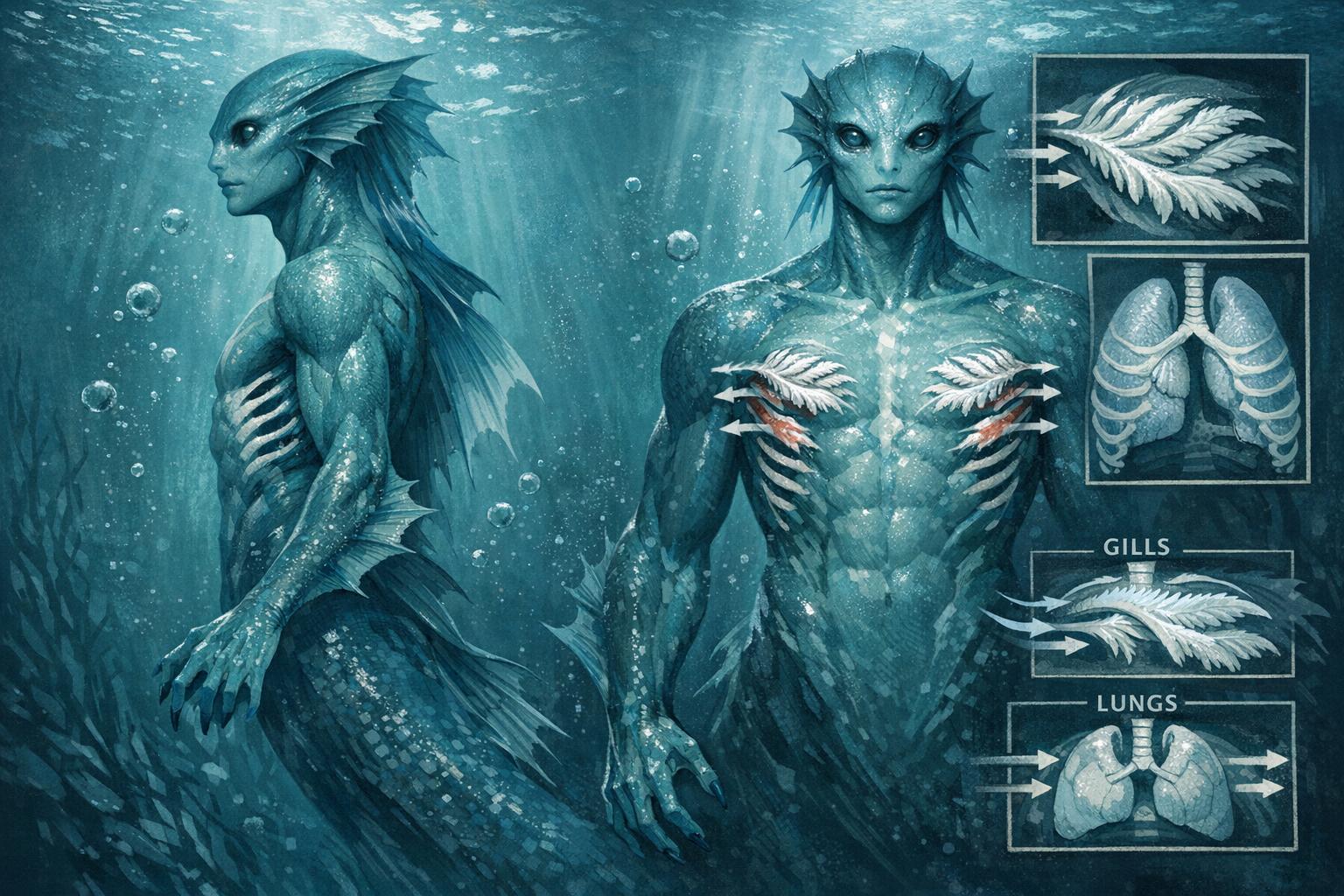
Tritons are amphibious humanoids, which sounds straightforward until you consider what that actually requires from a biological perspective. They breathe both water and air through a dual respiratory system — gills along the ribcage for aquatic breathing, lungs for surface breathing. The transition between systems is automatic but not instantaneous. A triton bursting out of the water takes a sharp, audible breath as the lung system activates, a sound that surface-worlders sometimes mistake for distress. It's not distress. It's a biological gear change, and it works perfectly. Tritons just wish it were quieter.
Their skin ranges from silver-blue to deep teal, with undertones that shift depending on emotional state and water temperature — a triton embarrassed on the surface flushes to a darker blue-green in a way that other tritons can read instantly and that surface-dwellers usually miss entirely. The skin itself is subtly scaled, smooth to the touch but hydrodynamically efficient. It dries out faster than human skin in arid environments, which makes deserts and dry climates genuinely uncomfortable rather than merely unpleasant.
Triton eyes are adapted for deep-ocean vision: large, dark-adjusted, and capable of detecting bioluminescence at distances that would look like empty darkness to a human. On the surface, bright light is uncomfortable rather than blinding — tritons squint in full sunlight in a way that surface-dwellers sometimes interpret as hostility when it's actually just photosensitivity. Their hearing is extraordinary underwater, where sound travels four times faster than in air, but adequate on the surface. Many tritons report that the surface world sounds muffled, as if they're perpetually listening through a wall.
The swimming speed is the headline ability — 30 feet, equal to walking speed, which makes a triton in water as mobile as a human on land. But the real advantage is three-dimensional movement. Tritons don't just swim forward. They fight in all three axes, attacking from above and below with a spatial awareness that surface-dwellers, accustomed to gravity keeping combat on a flat plane, find disorienting. An underwater battle with tritons isn't a fight. It's being surrounded.
Dual Respiratory System
The biological mechanism that makes tritons truly amphibious rather than merely water-breathing with surface capability. Gill slits along the lower ribcage extract oxygen from water with near-perfect efficiency, while conventional lungs handle air breathing. The switching mechanism is involuntary, triggered by the medium surrounding the body. A triton walking in heavy rain doesn't accidentally switch to gill breathing — the system requires full submersion to activate. This is a source of occasional triton humor: the idea of a triton drowning in a rainstorm is their equivalent of a dad joke.
Extended time on the surface doesn't degrade gill function, but tritons who spend years away from the ocean report a psychological discomfort that goes beyond homesickness. There's a somatic need to breathe water periodically, the way a human might need to stretch after sitting too long. Landlocked tritons often seek out large bodies of fresh water — lakes, rivers, even bathhouses — for what they describe as respiratory maintenance and what surface observers describe as a really intense bath.
Deep-Pressure Adaptation
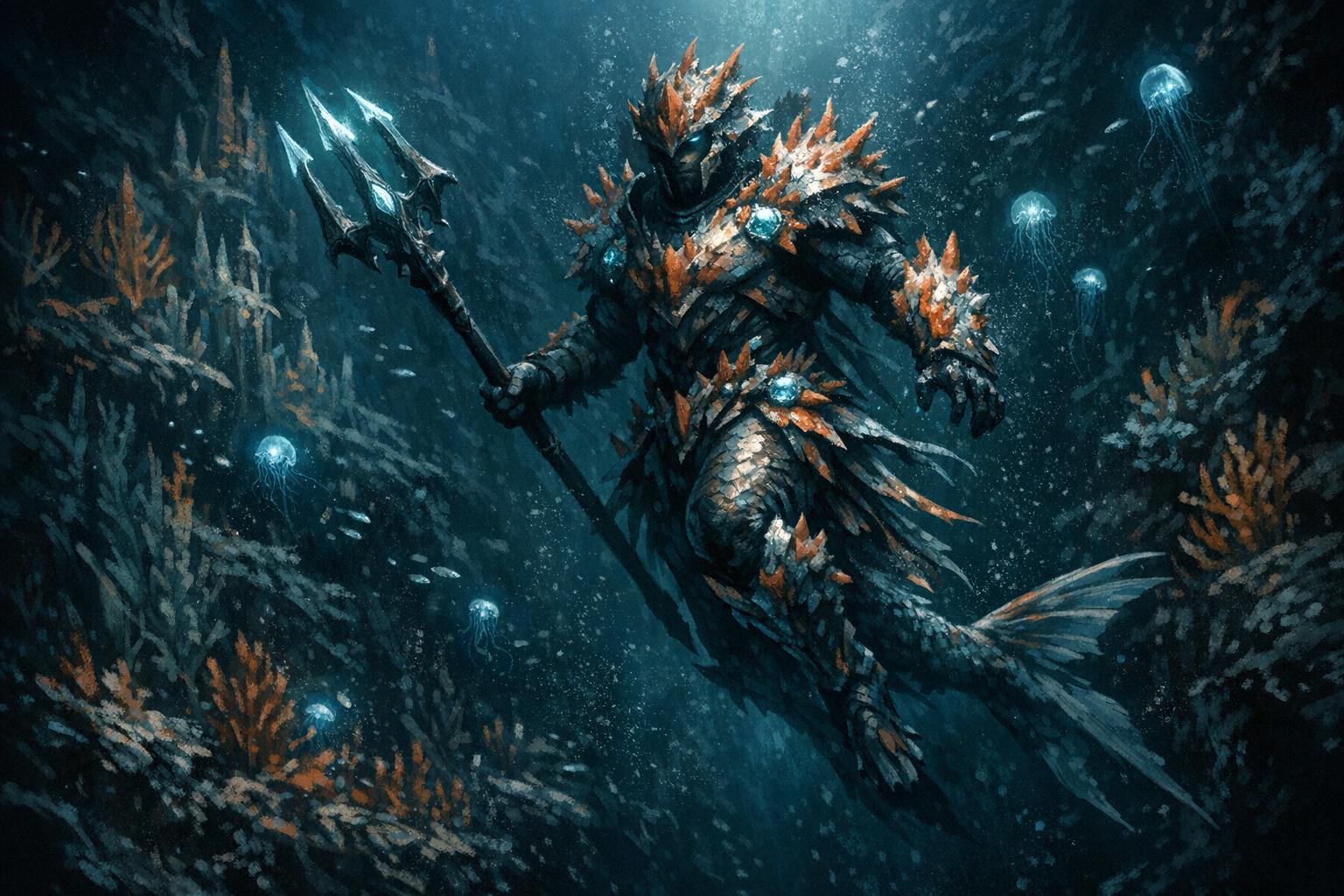
Tritons evolved in ocean trenches where the pressure would crush an unprotected human in seconds. Their skeletal structure is denser than any surface species, their organs surrounded by pressure-regulating tissue that compensates automatically as depth changes. This adaptation has a surface-world side effect: tritons are heavier than they look. A triton who appears to be a lean, athletic humanoid of about 160 pounds actually weighs closer to 220. They sink in freshwater faster than surface-worlders expect, and they hit harder than their frames suggest.
The cold resistance granted by their deep-ocean heritage is genuine thermoregulation, not magical protection. Triton body temperature runs lower than human baseline — they're comfortable in water that would induce hypothermia in an unprotected human within minutes. On the surface, this manifests as a cool handshake and a tendency to overdress in environments that surface-dwellers consider mild. A triton in a light jacket on a summer day is not making a fashion statement. They're cold.
The Guardian Worldview
To understand tritons, you need to understand that they genuinely believe they have been protecting the surface world from existential threats for millennia. This is not a myth they tell themselves. It is, by any reasonable assessment, true. The aboleths, krakens, and elemental horrors that tritons fight in the deep ocean trenches would, if unchecked, eventually make their way to coastal populations and do catastrophic damage. The triton military has been the first and often only line of defense against threats that surface civilizations don't know exist.
The problem is what this knowledge does to a species psychologically. Imagine you've spent your entire cultural history sacrificing lives to protect people who have never heard of you. Your soldiers die fighting abominations in lightless trenches so that surface fishermen can complain about low catches. Your cities exist in the most hostile environment on the planet because someone had to guard the rifts, and your ancestors volunteered. You have saved the world — repeatedly, verifiably — and the world's response is a blank stare and the question "what's a triton?"
The resulting psychology isn't arrogance in the traditional sense. It's a deep, abiding frustration that has calcified into something that looks like arrogance from the outside. When a triton walks onto a surface dock and announces themselves as an emissary of the deep realms, and the dockworker says "good for you, the fish market's that way," the triton isn't offended because they think they're better than the dockworker. They're offended because they've been dying for that dockworker's safety for three thousand years, and a little acknowledgment would be nice.
This worldview creates the signature triton personality: earnest, self-important, slightly bewildered by surface customs, and fundamentally decent in a way that's hard to argue with even when the delivery is insufferable. A triton who tells you that you should be grateful for their protection isn't being condescending. They're being accurate. The delivery needs work. The content doesn't.
A triton PC discovers that a coastal city has built a thriving tourist industry around "the legend of the sea guardians" — a romanticized, wildly inaccurate version of triton history that depicts them as mystical merfolk who grant wishes to sailors. Paintings of "tritons" in gift shops look nothing like actual tritons. The triton must decide whether to correct the record, lean into the myth for diplomatic advantage, or simply walk into the ocean and scream underwater for a while.
Coral City Life
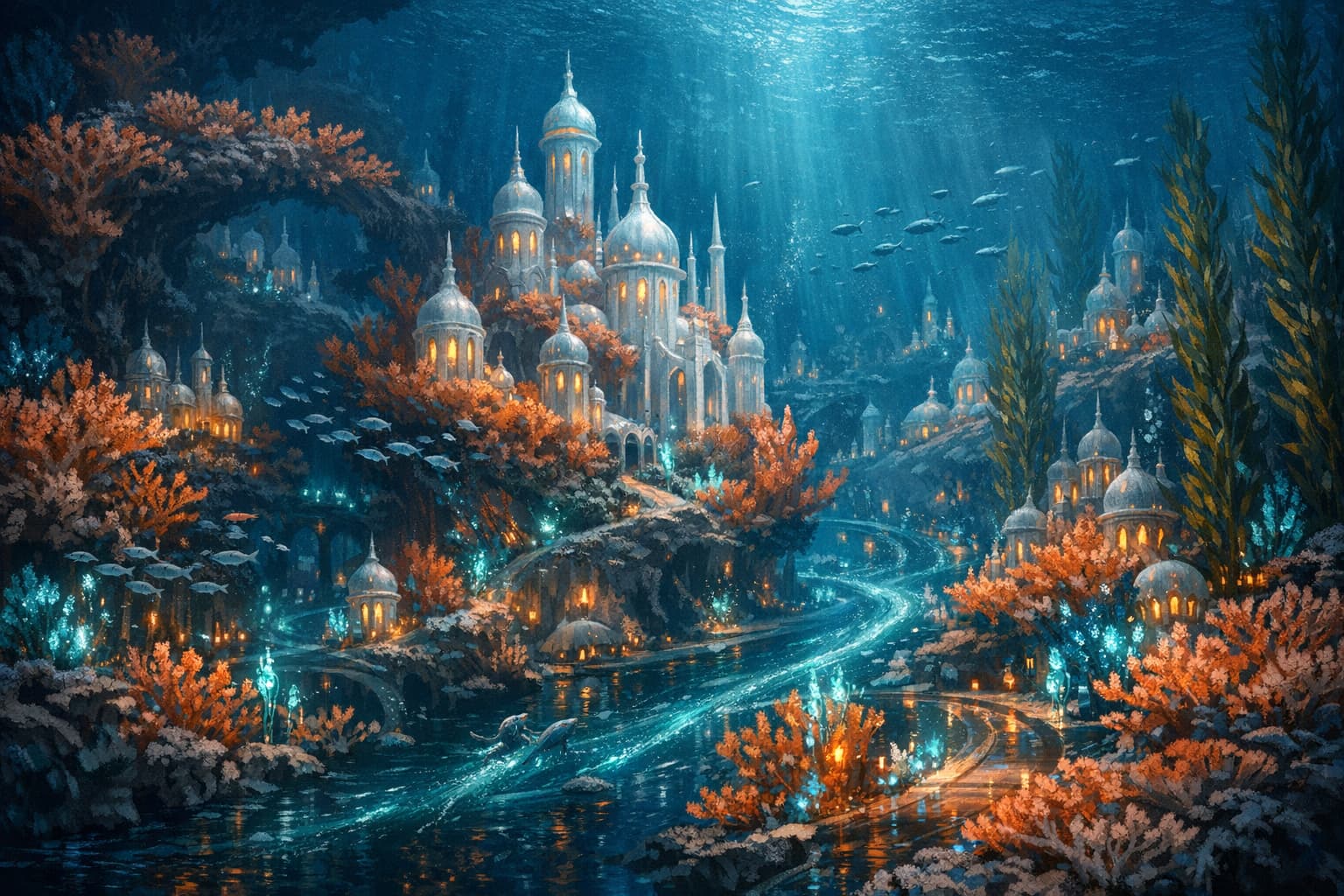
Triton cities are grown as much as they're built. The primary construction material is living coral, cultivated over decades into structural forms using techniques that combine aquatic agriculture with what surface-dwellers would recognize as architecture. A triton building doesn't have walls in the conventional sense. It has coral formations guided into arches, domes, and partitions that are still alive, still growing, and still adapting to the currents. The result is a city that looks organic from a distance — like a reef that happened to organize itself into streets and plazas — but reveals deliberate, sophisticated engineering on closer inspection.
The interior of a triton city operates on a vertical axis that surface visitors find disorienting. There is no "ground floor" and "upstairs." There is simply three-dimensional space, navigated by swimming. Important buildings are centrally located not in a horizontal sense but in a volumetric one — the council hall might be at the exact center of the city's three-dimensional footprint, reachable from any direction. Residential quarters radiate outward in all directions, including directly above and below the civic center. Maps of triton cities are not flat. They're spherical, and reading them is a skill that takes surface cartographers years to learn.
Light in a triton city comes from cultivated bioluminescence — organisms bred and positioned to provide consistent illumination in colors that range from pale blue to deep amber. The aesthetic effect is stunning by any standard: a triton city at full luminescence looks like a living constellation embedded in the ocean floor. Tritons take enormous pride in their cities' beauty, which is part of why their interactions with surface architecture tend to involve a lot of diplomatic silence and carefully neutral facial expressions.
Trade within and between triton cities relies on current networks — engineered water flows that function as roads, moving goods and messages along predictable routes. A package placed in the right current at the right time will arrive at its destination without anyone having to carry it. The postal service, essentially, is the ocean itself, trained to deliver. Surface visitors who learn this tend to have a moment of quiet awe that tritons enjoy enormously.
Council of Elders
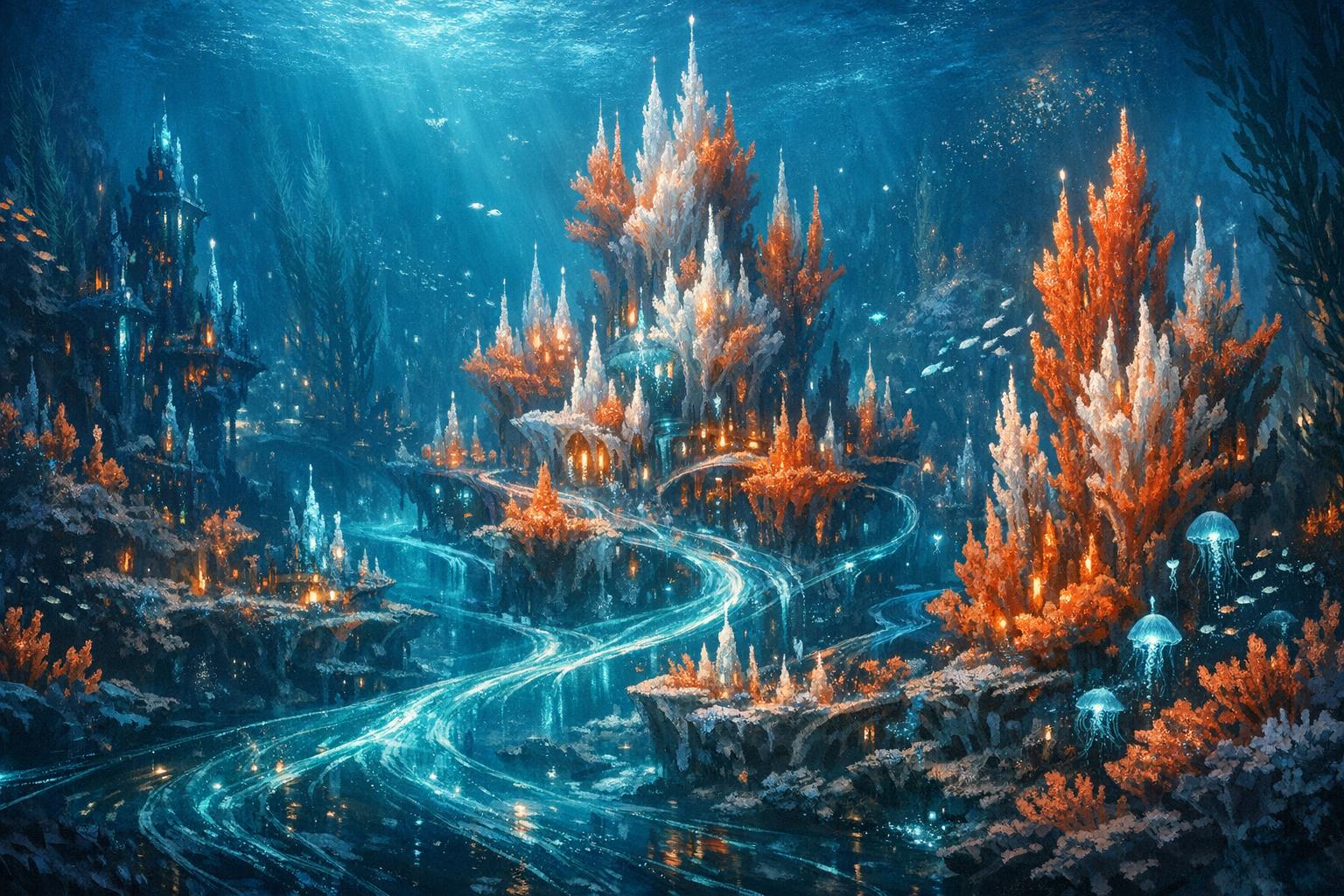
Triton governance is structured around councils that operate on a model surface-worlders would recognize as a meritocratic gerontocracy — rule by elders whose authority derives from demonstrated competence rather than age alone, though age helps. Each triton settlement is governed by a council whose members have earned their positions through a combination of military service, civic contribution, and the accumulation of tide-names that document their achievements. You cannot buy, inherit, or politic your way onto a triton council. You have to have done things, and those things have to have names.
Life Beneath the Waves
Underwater triton governance moves at the pace of tidal cycles — deliberate, predictable, and resistant to sudden change. Council sessions can last for days, with members debating in the measured, formal register that triton political language requires. Every argument must be sourced. Every claim must reference precedent. A triton council debate resembles a legal proceeding more than a political discussion, and tritons see nothing wrong with this because they believe governance is too important for improvisation.
Military decisions, however, are exempt from the deliberative process. When a threat emerges from the deep trenches, the senior military commander has absolute authority for the duration of the crisis. This dual system — glacial in peacetime, dictatorial in war — has served tritons well for millennia, primarily because the threats they face don't negotiate. You cannot filibuster a kraken.
Succession on a triton council happens through a formal challenge process that is competitive but not violent. A triton who believes they deserve a council seat presents their record — tide-names earned, services rendered, battles survived — and the community votes. Campaigning is considered vulgar. If your record doesn't speak for itself, you haven't done enough yet.
Adaptation on the Surface
Tritons who serve as surface emissaries quickly discover that surface governance is, from their perspective, chaos with elected officials. Decisions are made quickly, reversed capriciously, and based on considerations — popularity, wealth, family connections — that tritons find baffling. The idea that someone could lead a city because their father led the city, regardless of their own qualifications, strikes most tritons as a form of institutional madness.
Surface-posted tritons adapt to this chaos with varying degrees of success. Some learn to operate within surface political systems by treating them as a code to be cracked — if humans respect wealth, acquire wealth; if they respect titles, earn titles. Others never adapt and spend their surface postings in a state of low-level diplomatic exasperation, filing reports home that read like anthropological studies of an improbable civilization.
The most successful surface diplomats are tritons who learn to translate between systems — explaining triton governance in terms surface-worlders understand, and surface governance in terms that don't make the Council of Elders lose faith in the surface world entirely. This is harder than it sounds. Explaining democracy to a triton elder is like explaining jazz to a metronome.
Deep-Water Architecture
Triton cities are built to withstand pressures that would crush surface structures like paper. The architecture uses living coral frameworks reinforced with enchanted stone, creating buildings that grow and self-repair over centuries. A triton city viewed from above looks organic — flowing curves, spiral towers, structures that seem to bloom from the ocean floor rather than being placed upon it. This isn't aesthetic choice. It's engineering. Curved surfaces distribute pressure more effectively than flat walls, and organic growth fills structural gaps that conventional masonry would leave vulnerable.
Light in triton cities comes from bioluminescent organisms cultivated over generations. Specific species of deep-sea coral, jellyfish, and plankton are bred for brightness, color, and reliability, creating an illumination system that requires no fuel, produces no heat, and responds to the city's needs. Battle-readiness is signaled by shifting the lights from warm blue-green to cold white. Festivals bring out cultivated displays of color that surface artists would recognize as living light shows, choreographed by triton illuminators who treat bioluminescence as both craft and art.
The most impressive architectural achievement in triton culture is the pressure lock — a series of chambers that gradually adjust pressure to allow surface-dwellers to visit deep-water cities without being crushed. These locks represent centuries of engineering and magical innovation, and they serve a diplomatic function: a triton city with good pressure locks is a city that welcomes surface visitors, which means it values trade and alliance over isolation. Cities without locks are making an equally clear statement.
A triton city makes an extraordinary adventure location. The party enters through pressure locks, descends into a bioluminescent metropolis, and navigates a three-dimensional environment where buildings exist above, below, and beside them. Combat underwater follows different rules. Social dynamics shift when the party is completely dependent on their hosts for breathable air. The setting itself becomes a character.
Pressure & Light Below
Tritons inhabit the deep ocean — not the sunlit shallows where merfolk play, but the crushing depths where light doesn't reach and pressure would kill an unprotected human in seconds. Their biology is adapted to this environment so thoroughly that the surface world feels thin and insubstantial to them. The air is too light. The pressure is too low. Colors are too bright and too numerous. A triton's first experience of the surface is sensory overload followed by a persistent, nagging feeling that the world might break if they step too hard.
The deep ocean is not empty. It's full of things that surface-dwellers don't know about because no surface-dweller survives long enough at those depths to report back. Triton settlements exist in a constant state of vigilance against threats that the surface world considers mythological — krakens, aboleths, dragon turtles, and entities from the Elemental Plane of Water that use the deep ocean as a staging ground for incursions. This is why tritons consider themselves guardians: they're holding a line that surface-dwellers don't even know exists.
The relationship between depth and triton culture is more than practical — it's philosophical. Tritons associate depth with truth, seriousness, and importance. Shallow water is for play and commerce. Deep water is for governance, worship, and the defense of the world. When a triton says something is 'deep,' they mean it carries weight. When they call something 'shallow,' it's a dismissal. Surface-dwellers who fail to understand this depth-based value system frequently offend tritons without knowing why.
“The surface world thinks the ocean is a road. We know it is a fortress, and we are the ones who walk its walls.”
— Triton elder, on the guardian mandate
The Deep Gods & Elemental Reverence
Triton religious practice is organized around reverence for elemental forces rather than worship of personified deities in the surface-world sense. The ocean itself is the closest thing tritons have to a supreme being — not as a conscious entity, but as a force that sustains, threatens, and defines their existence. Triton prayers are directed at the water around them, which makes surface-posted tritons look peculiar when they pray toward the nearest body of water regardless of whether it's a sacred ocean or a decorative fountain. The water is the water. Tritons don't rank it.
That said, tritons do acknowledge specific divine figures. Persana is the most commonly cited triton deity — a god of tritons, architecture, and the guardianship of the deep. Persana's temples are the grandest structures in most triton cities, grown from rare deep-coral varieties that take centuries to cultivate. Worship of Persana emphasizes duty, construction, and the maintenance of civilization against chaos. Persana doesn't demand passionate devotion. Persana demands that you do your job well and maintain the infrastructure.
The elemental reverence extends to a complex relationship with water elementals and other Plane of Water natives. Tritons view these beings as something between distant relatives and unruly neighbors. A water elemental isn't a god to be worshiped or a beast to be tamed — it's a manifestation of the same fundamental force that tritons have sworn to steward. Interactions with elementals are conducted with a formality that surface observers sometimes mistake for worship but is closer to the way a park ranger might address a particularly large bear: respectfully, carefully, and with full awareness that the relationship could become violent at any moment.
Triton funeral rites reflect the elemental theology. The dead are returned to the deepest current the community can safely reach — a point where the water pressure is so great that the body is, essentially, unmade and returned to the ocean as dissolved matter. There is no burial site to visit, no grave to maintain. The dead become water. Tritons find this comforting. Surface-worlders who learn about the practice tend to find it less so.
“The ocean doesn't care about your prayers. It doesn't care about anything. But it sustains everything, and that's worth more than caring. Triton theology is reverence without the expectation of reciprocity.”
— On triton faith
Tidal Magic & Elemental Command
Triton innate spellcasting is elemental rather than arcane or divine — a distinction that matters more to scholars than to the tritons themselves, who regard their magic as a natural extension of their relationship with water and air. The spell progression tells a story: fog cloud at 1st level (obscuring the battlefield, creating the ocean's murk on land), gust of wind at 3rd level (commanding air, the element they learned to negotiate when they came to the surface), and wall of water at 5th level (asserting direct control over their native element). Each spell is a statement of authority over the environment, not a request.
The mechanical implementation of triton magic in 5e and the 2024 rules is subtle but effective. Fog cloud creates an area of heavy obscuration — on a battlefield, this is the triton saying "I will now make this fight happen on my terms, in conditions I'm comfortable with and you're not." Gust of wind is battlefield control that rewards tactical thinking. Wall of water is both defense and statement: here is a wall made of the element I control. Deal with it.
Beyond the innate spellcasting, triton communities produce accomplished spellcasters across multiple traditions. Triton druids are common and powerful, their connection to water magic making Circle of the Land (coast or underwater) a natural fit. Triton clerics of Persana or other ocean deities channel divine magic flavored with elemental force — a triton cleric's healing word might manifest as a warm current wrapping around the injured party. Triton wizards are rarer but exist, and their spellbooks are waterproof by necessity, written on treated kelp or inscribed into coral tablets.
The most distinctive triton magical tradition is current-singing — a non-mechanical, purely narrative practice where triton spellcasters harmonize with the natural water currents to amplify their effects. A current-singer can't cast spells that a wizard couldn't, but they can make the ocean cooperate in ways that feel less like spellcasting and more like conducting an orchestra. A current-singer asking the tide to come in early doesn't use a spell slot. They use a relationship with the water that took decades to build.
Triton Innate Spellcasting Progression
| Character Level | Spell | Effect | Tactical Role |
|---|---|---|---|
| 1st | Fog Cloud | Creates a 20-ft radius sphere of heavy obscuration | Battlefield denial; equalizer against ranged attackers |
| 3rd | Gust of Wind | 60-ft line of strong wind that pushes creatures and disperses gas | Area control; forces movement; extinguishes flames |
| 5th | Wall of Water | 30-ft long, 10-ft high wall of swirling water | Defensive barrier; disadvantage on ranged attacks through it; cold damage interaction |
Each spell can be cast once per long rest using Charisma as the spellcasting ability. The progression represents escalating elemental authority.
Surface Relations & Culture Shock
The triton experience of the surface world is defined by a single, overwhelming fact: nobody up here knows who they are or what they've done. A triton walking into a tavern expects — on some level, despite knowing better — that the bartender will recognize the coral-embossed armor, understand the significance of the trident, and offer the drink on the house as thanks for millennia of undersea protection. What actually happens is the bartender asks if they're from the coast, charges full price for the ale, and pronounces their name wrong. Every triton's surface experience begins with this collision between expectation and reality.
The culture shock runs deeper than unrecognized heroism. Triton society is structured, formal, and fundamentally collective — every triton exists in relation to their community's mission. Surface societies, by comparison, are chaotic, informal, and aggressively individualistic. A triton encountering a human marketplace for the first time sees a hundred people pursuing a hundred different goals with no central coordination, and their first instinct is to identify who's in charge so they can report the disorder. Learning that nobody is in charge — that the disorder is the system — takes time to process.
Food is a reliable source of culture shock. Triton cuisine is based on raw seafood, cultivated kelp, and mineral-infused water. Surface cooking involves fire, which tritons find conceptually offensive on a level that's hard to articulate. You take food and you burn it. On purpose. And then you eat the burned food. The idea of cooking fish over an open flame strikes a triton the way taxidermy strikes a human — technically a skill, but why would you?
The tritons who adapt most successfully to surface life are the ones who learn to find the culture shock funny rather than distressing. A triton who can laugh at their own bewilderment when confronted with stairs, weather, or the concept of property insurance becomes the kind of character that a surface community actually enjoys having around. The ones who can't laugh tend to retreat into formality as a defense mechanism, which makes them seem even more arrogant, which makes surface-dwellers less sympathetic, which makes the triton more formal. The cycle is difficult to break.
Romantic relationships between tritons and surface-dwellers are rare but not unheard of, and they produce a reliable set of comedic and dramatic complications. The triton partner keeps forgetting that their beloved can't breathe underwater. The surface partner keeps forgetting that their beloved needs to submerge periodically or gets physically uncomfortable. First meetings with family are complicated by the fact that one set of in-laws lives at the bottom of the ocean. These relationships work when both partners treat the cultural gap as an adventure rather than an obstacle.
First-time-on-the-surface tritons are reliably bewildered by rain. The concept — water falling from the sky onto land — is fine. The experience is disorienting. The water comes from above, it's fresh instead of salt, and it stops. Tritons understand weather intellectually. Experiencing it firsthand produces an existential wobble that even well-briefed emissaries aren't fully prepared for.
Notable Tritons in D&D Lore
Tritons don't have the deep bench of named NPCs that elves or dwarves enjoy, partly because they spent most of D&D's history as background species and partly because their most impressive achievements happened underwater where surface-world chroniclers couldn't observe them. The triton heroes who do appear in published material tend to fall into two categories: emissaries who ventured to the surface and did something noteworthy, and military commanders whose battles against deep-sea horrors were too significant to ignore.
In the Forgotten Realms, the triton presence is concentrated around the Sea of Fallen Stars and the Trackless Sea, where triton outposts guard deep-ocean rifts and maintain uneasy alliances with surface coastal nations. Named triton NPCs in Forgotten Realms material are rare, which is itself a lore-consistent detail — tritons don't seek surface fame, and surface historians don't dive deep enough to record triton accomplishments.
The Theros setting gives tritons their most prominent cultural role in any published D&D material. In the Greek-mythology-inspired setting, tritons are a major species with established communities, political relationships, and individual heroes. The Theros tritons feel like the fullest expression of the species concept: a proud, ancient people whose relationship with the sea is both literal and mythological. Theros is where tritons feel most like a culture rather than a stat block.
At the table, the most memorable triton characters are the ones who lean into the culture clash. The triton paladin who keeps accidentally insulting people by assuming they should know triton protocol. The triton ranger who is an expert tracker underwater and completely lost in a forest. The triton bard who performs epic ballads about undersea battles that the audience politely pretends to understand. The species is at its best when the player commits to the gap between what the triton expects from the surface world and what the surface world actually delivers.
Tritons Across D&D Settings
| Setting | Triton Role | Cultural Emphasis | Notable Detail |
|---|---|---|---|
| Forgotten Realms | Deep-ocean guardians, rare surface emissaries | Military duty, sahuagin wars | Sea of Fallen Stars patrols; alliance with Waterdeep |
| Greyhawk | Scattered ocean communities, minimal surface contact | Isolationist guardianship | Deep-trench settlements near undersea portals |
| Theros | Major surface-interacting species with mythological gravitas | Greek-style noble warriors | Most fully realized triton culture in published D&D |
| Eberron | Rare; Elemental Plane of Water connections emphasized | Planar origins, elemental politics | Potential ties to the Thunder Sea and elemental powers |
| Exandria (Critical Role) | Deep-ocean settlements near dangerous rifts | Duty-bound isolationists emerging cautiously | Menagerie Coast encounters; Uk'otoa-adjacent concerns |
The setting that gives tritons the most room to breathe is Theros, where the mythological source material aligns perfectly with the species concept.
Mechanical Identity Across Editions
Triton mechanics across D&D editions tell a consistent story: this is a species designed for underwater superiority and surface-world versatility. The core kit — swimming speed, amphibious breathing, cold resistance, and elemental spellcasting — has remained remarkably stable since tritons became playable in 2016. What's changed is the flexibility around that core, as the game has moved from fixed ability scores to customizable ones and from subrace-dependent features to universal species traits.
The Volo's Guide (2016) triton was mechanically solid but narrowly optimized. Strength, Constitution, and Charisma bonuses of +1 each pushed tritons toward paladin, fighter, and martial builds. Emissary of the Sea (communication with sea creatures) and Guardian of the Depths (cold resistance and deep-ocean adaptation) provided ribbon abilities that were situational but flavorful. Control Air and Water gave the innate spellcasting progression: fog cloud, gust of wind, and wall of water over five levels. The package was good but not great — tritons were competitive but never optimal for any single build.
The 2024 PHB revision addressed the flexibility issue by adopting the standard ability score customization (+2/+1 or +1/+1/+1 to any abilities), which immediately opened tritons to every class build. The Emissary of the Sea and Guardian of the Depths features survived, the spellcasting progression remained the same, and the swimming speed stayed at 30 feet. The net effect was to preserve the triton identity while removing the barriers that had kept them from competing with more versatile species choices.
- Speed: 30 ft. walking, 30 ft. swimming
- Amphibious (breathe air and water)
- Control Air and Water (fog cloud / gust of wind / wall of water)
- Emissary of the Sea (communicate simple ideas with water-breathing creatures)
- Guardian of the Depths (cold resistance, ignore deep-ocean pressure)
- Darkvision 60 ft.
The triple +1 spread was unique but limiting. It made tritons solid at several things without excelling at any, which was thematically appropriate — tritons are generalists in a species lineup of specialists — but mechanically frustrating for optimization-focused players.
- Speed: 30 ft. walking, 30 ft. swimming
- Amphibious (breathe air and water)
- Control Air and Water (fog cloud / gust of wind / wall of water, Charisma-based)
- Emissary of the Sea (communicate simple ideas to beasts, elementals, monstrosities that breathe water)
- Guardian of the Depths (resistance to cold damage, pressure adaptation)
- Darkvision 60 ft.
- Size: Medium
The 2024 version is a clean refinement. Flexible ability scores open every class. The spellcasting remains Charisma-based. Emissary of the Sea is slightly expanded in creature type coverage. The core identity is untouched — tritons are still the amphibious guardian species with elemental spellcasting.
Merfolk & Tritons in Other Fantasy
The aquatic humanoid is one of fantasy's oldest archetypes, and D&D tritons occupy a specific niche within it: the authoritative, civilization-building, duty-bound variant. Most other fantasy traditions treat aquatic humanoids as either mysterious and unknowable (Lovecraft's Deep Ones), beautiful and tragic (Andersen's Little Mermaid), or monstrous and hostile (countless sea-creature horror traditions). Tritons are none of these. They're bureaucrats with tridents, and that's what makes them distinctive.
The merfolk distinction matters. In D&D, merfolk and tritons are separate species with different physiologies, cultures, and attitudes. Merfolk are the closer analogue to classical mermaids — fish-tailed, ocean-bound, and largely uninterested in surface affairs. Tritons are fully bipedal, amphibious, and very interested in surface affairs, primarily because they want the surface to acknowledge what they've been doing for the past three thousand years. Conflating the two species is a reliable way to irritate a triton, which is like irritating a hall monitor: the consequences are formal and thoroughly documented.
In Pathfinder, aquatic ancestries include azarketi (the analog to tritons) and merfolk, with a similarly clean separation between the amphibious, surface-interacting variant and the purely aquatic one. The azarketi share the triton's cultural pride but lack the specific guardian-of-the-deep motivation that gives D&D tritons their signature personality. Without the "we've been saving you and you don't even know" angle, the species becomes noble but generic.
Magic: The Gathering's tritons — which predate the 5e playable version — are scholars and mystics rather than warriors, particularly in the Theros setting that D&D later adopted. MTG tritons are curious and intellectual where D&D tritons are martial and duty-bound. When Wizards of the Coast created the Mythic Odysseys of Theros sourcebook, they had to reconcile these two versions of the species, and the result leans more toward the D&D martial tradition than the MTG scholarly one, which is either a missed opportunity or a necessary focusing decision depending on your perspective.
Video games have produced their own aquatic humanoid variants, from World of Warcraft's naga (corrupted, hostile, snake-tailed) to Subnautica's precursor aliens (technologically advanced, long-dead, hauntingly absent). What none of these capture is the triton's specific emotional register: the guardian who is simultaneously selfless and insufferable, whose heroism is genuine and whose desire for recognition is also genuine, and who can't understand why those two things seem to be in tension. That combination is uniquely D&D, and it's what makes tritons worth playing.
The decision to make tritons fully amphibious rather than water-dependent was the single most important design choice in making them a viable PC species. A character who can't walk into a dungeon is a character with a massive practical limitation. By giving tritons legs that work equally well on land and a respiratory system that handles air without penalty, designers ensured that triton PCs could participate in every standard D&D scenario while retaining their aquatic identity. The amphibious trait isn't just a feature. It's the entire reason tritons work as player characters.
FAQ
Common Questions
Triton arrogance isn't vanity — it's the emotional residue of millennia spent protecting a world that doesn't know they exist. The key to playing it well is treating the superiority complex as a coping mechanism rather than a personality trait. Your triton genuinely has saved countless surface lives through ancestral sacrifice. That's real. The awkwardness comes from expecting the bartender to know that, which is where the comedy lives. Play the gap between the triton's expectations and reality as a source of humor and vulnerability, not dominance. Let the character learn, be surprised by surface kindness, and occasionally be genuinely hurt when their sacrifices are dismissed. The best triton PCs are the ones whose arrogance cracks open to reveal earnestness underneath. Set a personal rule: for every moment of triton superiority, include a moment of triton wonder or confusion. The fish-out-of-water comedy (literally) keeps the table laughing with the character instead of at them.
This is the logistical question every triton player faces, and the answer has two layers. First, mechanically: the triton's Emissary of the Sea and swimming speed make them an invaluable party member in aquatic scenarios but don't solve the breathing problem for everyone else. Water breathing spells, potions, or magic items become necessary party equipment, and the triton PC naturally becomes the guide and navigator in these environments — which is a satisfying role reversal from the surface adventures where they're the confused newcomer. Second, narratively: underwater sessions should feel fundamentally different. Combat in three dimensions, communication challenges (most spells with verbal components work differently underwater), and environments where the triton is the expert and everyone else is the novice. DMs should plan underwater adventures as set pieces rather than campaign-length arcs unless the whole group is on board. Two or three sessions in a triton's home city, meeting their family, defending against a sahuagin raid — that's enough to give the triton player their spotlight without making the rest of the party feel like they're holding their breath the entire campaign.
Control Air and Water gives you one casting each of fog cloud (1st level), gust of wind (3rd level), and wall of water (5th level), once per long rest, using Charisma. In practice, fog cloud is the workhorse — dropping heavy obscuration on a group of archers or covering a retreat is always useful. Gust of wind is situational but excellent when it applies: clearing poison gas, pushing enemies off ledges, or disrupting flying creatures. Wall of water is the sleeper hit — it imposes disadvantage on ranged attacks that pass through it and can be combined with cold damage to create a wall of ice. The spellcasting doesn't scale, so these are early-game powerhouses that become utility options at higher levels. Emissary of the Sea sounds like a ribbon ability until you're the only party member who can ask the shark where the shipwreck is. Guardian of the Depths gives cold resistance, which is always-on passive defense. The swimming speed is the real star — 30 feet in water makes you dominant in any aquatic scenario. The total package is a versatile toolkit rather than a single powerful ability, which matches the triton identity perfectly.
Paladin is the marquee choice and has been since tritons became playable. Charisma-based spellcasting aligns with the triton's innate casting ability, the guardian flavor maps perfectly onto the paladin's oath structure, and there's something deeply satisfying about a triton paladin who has literally been protecting the world for their entire cultural history. Oath of the Watchers (guarding against extraplanar threats) is almost too on-brand. Fighter works for tritons who lean into the military tradition — a triton Battle Master directing allies with the precision of someone raised in a chain of command is excellent. Cleric (Tempest domain) turns the elemental connection into divine spellcasting, and the Channel Divinity to maximize lightning or thunder damage is thematically impeccable for an ocean species. Druid (Circle of the Land — coast) gives tritons access to the broader nature magic tradition while keeping water at the center. Warlock is the wild card: a triton whose patron is a being from the deep ocean — perhaps a reformed aboleth or an archfey of the tides — creates a character whose guardian identity conflicts with their patron's demands. For something truly unexpected, try a triton bard. The combination of Charisma synergy, the current-singing tradition, and the image of a triton performing epic undersea ballads for a tavern full of bewildered surface-dwellers is comedy gold that also happens to be mechanically sound.
Triton settlements are built into coral formations, volcanic vents, and underwater cliff faces at crushing depths that would kill most surface-dwellers instantly. Their communities operate on a strict military hierarchy — every citizen has a rank, every family maintains a watch rotation, and communal decisions are made by councils of veteran protectors rather than hereditary rulers. Resources are shared according to need rather than wealth, because in the deep ocean, hoarding supplies while your neighbor goes without means one fewer soldier on the perimeter when the next aboleth probe arrives.
Most tritons arrive on the surface as emissaries or scouts, sent by their communities to monitor threats that have migrated upward from the deep or to establish diplomatic ties with coastal civilizations that don't know they exist. The adaptation is harder than tritons typically admit — dry air irritates their skin, the sun is painfully bright after a lifetime in the twilight zone, and surface social customs are baffling to someone raised in a rigid military meritocracy. Tritons who stay on the surface long-term develop rituals to cope: sleeping in water-filled basins, wearing damp scarves against their necks, and seeking out rainstorms the way a homesick traveler seeks out familiar food.
Tritons regard themselves as the senior authority of the deep ocean, which creates predictable friction with merfolk and sea elves who have their own ancient civilizations and no interest in being patronized. Merfolk are the most common neighbors — relations are generally cooperative but strained, because merfolk view tritons as self-appointed police who take credit for security that merfolk were managing fine on their own. Sea elves and tritons share a mutual respect rooted in their overlapping guardian instincts, though sea elves find triton formality exhausting and tritons find sea elf mysticism impractical. With locathah, sahuagin, and other aquatic peoples, the dynamic ranges from uneasy alliance to open warfare depending entirely on whether the other group threatens the deep-ocean borders that tritons consider their sacred responsibility.