
Yuan-ti
Serpentine manipulators who shed their warmth for cold ambition, pursuing scaled perfection through ritual, venom, and the patience of snakes
Serpent Deity Mythology
Snakes have been divine since before divinity had a name. The serpent wrapped around the world-tree in Norse cosmology, the nagas guarding treasure in Hindu and Buddhist tradition, Quetzalcoatl feathered and radiant above Mesoamerican temples, the Uraeus cobra crowning Egyptian pharaohs. No animal in human mythology carries more symbolic weight than the snake, and no D&D species draws from that well more deliberately than the yuan-ti.
What makes serpent mythology relevant to the yuan-ti specifically is the recurring theme of transformation through forbidden knowledge. The Genesis serpent offers fruit from the tree of knowledge. The nagas guard wisdom too dangerous for mortals. Quetzalcoatl taught humanity arts and sciences that the other gods wanted kept secret. Serpents in mythology are gatekeepers of power that comes at a cost, and the yuan-ti are what happens when an entire civilization pays that cost willingly.
The South Asian naga tradition deserves particular attention. Nagas in Hindu and Buddhist mythology are shape-shifters who move between serpent and humanoid form, guard underground kingdoms full of treasure and magic, and maintain complex hierarchies based on spiritual purity. The parallels to yuan-ti society are direct enough that the naga influence on D&D's serpent-people is difficult to overstate. Yuan-ti temple-cities, caste systems, and shape-shifting abilities all echo naga lore.
The name "yuan-ti" has no clear real-world etymology. Unlike "tiefling" (German "tief" for deep) or "dragonborn" (self-explanatory), "yuan-ti" appears to be a constructed term designed to sound vaguely East Asian without mapping to any specific language. This is worth acknowledging directly: the name was coined in the early 1980s when D&D's approach to non-European cultural borrowing was less considered than it would later become. The name stuck because it sounds distinctive, not because it means something.
Yuan-ti personal names in published D&D material follow a sibilant pattern heavy on S, Z, and Sh sounds — Sseth, Zehir, Sshass, Nhyris. The naming convention reinforces the serpentine theme phonetically: speaking a yuan-ti name should feel like a hiss. This is clever sound design even if the cultural sourcing is thin. Players creating yuan-ti characters instinctively reach for names that slither off the tongue.
Titles matter more than names in yuan-ti society. A pureblood infiltrator operating in a human city uses a human name and discards it when the mission ends. An abomination temple guardian may be known only by title — Vrael Olo ("sacred guardian"), Ssa'mith ("venom speaker"). Identity among yuan-ti is functional rather than personal. You are what you do for the serpent cause, not who your parents were.
Serpent Figures in World Mythology
| Tradition | Figure | Domain | Yuan-ti Parallel |
|---|---|---|---|
| Hindu/Buddhist | Nagas | Shape-shifting serpent guardians of treasure and sacred knowledge | Caste hierarchy, shape-shifting, underground temple-cities |
| Mesoamerican | Quetzalcoatl / Kukulkan | Feathered serpent god of wind, learning, and creation | Serpent divinity, civilization-building, sacrifice rituals |
| Norse | Jormungandr | World-serpent encircling Midgard, agent of cosmic destruction | Apocalyptic ambition, patience measured in ages |
| Egyptian | Apophis / Wadjet | Chaos serpent vs. protective cobra goddess | Duality of serpent as destroyer and guardian |
| Greek | Python / Echidna | Oracular serpent / mother of monsters | Prophecy, monstrous progeny, sacred sites guarded by serpents |
The yuan-ti draw from nearly every major serpent mythology simultaneously, making them one of the most mythologically dense species in D&D.
“Identity among yuan-ti is functional rather than personal. You are what you do for the serpent cause, and a name is just the sound the role makes when you speak it aloud.”
Publishing History in D&D
Yuan-ti debuted in the 1st Edition Monster Manual (1977) as one of D&D's original monstrous civilizations. From the start, they were more than wandering monsters — they had castes, cities, and agendas. This was unusual for 1e creatures, most of which existed primarily as combat encounters. The yuan-ti arrived with lore attached, and that lore has only deepened across five decades of publication.
The species received its definitive treatment in the 2004 supplement "Serpent Kingdoms" (3.5e), which devoted an entire sourcebook to serpentine civilizations in the Forgotten Realms. Serpent Kingdoms established the yuan-ti as a fallen empire — once the dominant civilization of Faerun, now reduced to jungle ruins and hidden enclaves. This "fallen greatness" narrative gave the yuan-ti their emotional core: they remember being supreme, and they intend to be supreme again.
5th Edition's "Volo's Guide to Monsters" (2016) made yuan-ti purebloods a playable race for the first time, which created an interesting design tension. How do you make a species defined by emotionless supremacism playable without either sanitizing their identity or making every yuan-ti PC a villain? The answer varied by table, and the debate itself revealed how much yuan-ti identity depends on their unsettling psychology.
1st Edition Monster Manual
Yuan-ti debut with three castes (pureblood, halfblood, abomination) already defined. One of the few 1e monsters with a built-in civilization.
Dwellers of the Forbidden City (Module I1)
The first dedicated yuan-ti adventure. Established the jungle temple-city archetype and positioned yuan-ti as puppet-masters rather than frontline fighters.
Serpent Kingdoms (3.5e)
Definitive yuan-ti sourcebook. Detailed the fallen Sarrukh empire, yuan-ti theology, breeding programs, and infiltration networks across Faerun.
Volo's Guide to Monsters (5e)
Yuan-ti purebloods become a playable race. Expanded lore on yuan-ti psychology, society, and their emotionless worldview.
Tomb of Annihilation (5e)
Yuan-ti serve as major antagonists in Chult. Ras Nsi and the Fane of the Night Serpent became iconic yuan-ti story content for a generation of players.
Temple-Cities & Hidden Territories
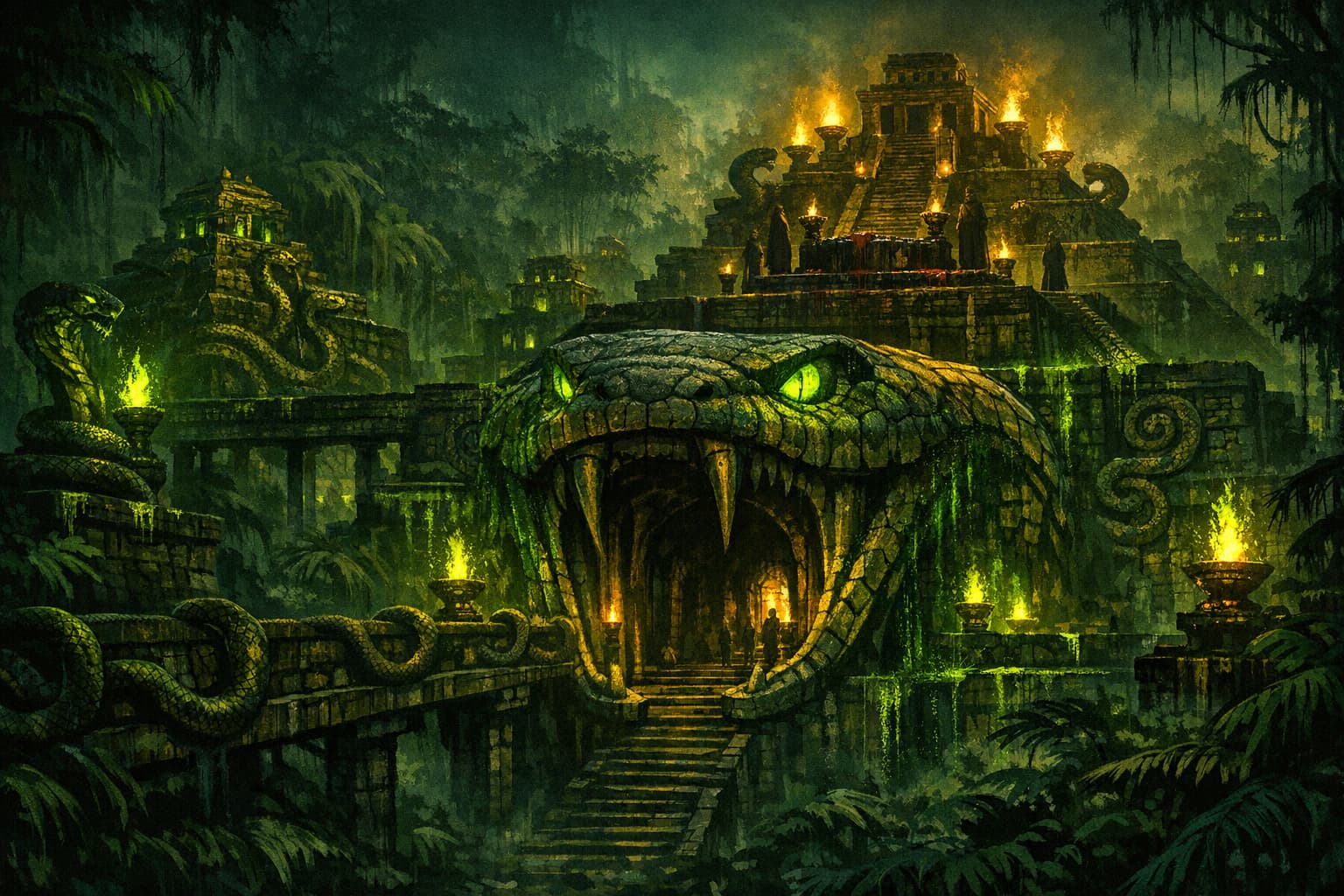
Yuan-ti don't build cities the way humans or dwarves do. They build temples, and then the temple becomes a city. The religious structure is literally the architectural foundation — every yuan-ti settlement is organized around a central shrine, with residential, military, and breeding quarters radiating outward like the coils of a serpent. Form follows theology.
Most yuan-ti settlements are deliberately hidden. Jungle canopy, underground cavern networks, or the ruins of older civilizations repurposed with serpentine efficiency. The yuan-ti don't want neighbors. They want buffer zones, early warning systems, and the strategic advantage of being difficult to find. A yuan-ti temple-city that you can see from the road is either a trap or has already been abandoned.
The Forgotten Realms places major yuan-ti territories in Chult (the Fane of the Night Serpent), the jungles south of the Vilhon Reach, and the ruined Sarrukh cities scattered across southern Faerun. In Greyhawk, yuan-ti control sections of the Amedio Jungle and the Hepmonaland peninsula. The pattern is consistent: hot, densely vegetated, and far from the centers of human civilization.
Notable Yuan-ti Settlements
| Settlement | Setting | Type | Significance |
|---|---|---|---|
| Fane of the Night Serpent | Chult (Forgotten Realms) | Active temple-city | Major antagonist location in Tomb of Annihilation; ruled by the disgraced Ras Nsi |
| Ss'thar'tiss'ssun | Underdark (Forgotten Realms) | Subterranean city | One of the largest yuan-ti settlements; rivals drow cities in ambition and paranoia |
| Hlondeth | Vilhon Reach (Forgotten Realms) | Surface city (covert control) | Rare example of yuan-ti ruling a human city through infiltration rather than isolation |
| Forbidden City | Greyhawk | Ruined temple complex | Setting of the classic module I1; the archetypal yuan-ti ruin adventure |
| Hisari | Forgotten Realms | Ruined Sarrukh city | Ancient progenitor site; contains magic and breeding vats from before the yuan-ti existed in their current form |
Hlondeth is the most unsettling yuan-ti settlement because it looks like a normal city. The serpent-people run everything from behind human facades.
Biology of the Three Castes
Yuan-ti biology is not a spectrum — it's a hierarchy encoded in flesh. The three castes (pureblood, halfblood, abomination) represent increasing degrees of serpentine transformation, and each degree carries specific biological capabilities that determine social rank, religious significance, and daily function within yuan-ti society.
Purebloods — The Human Mask
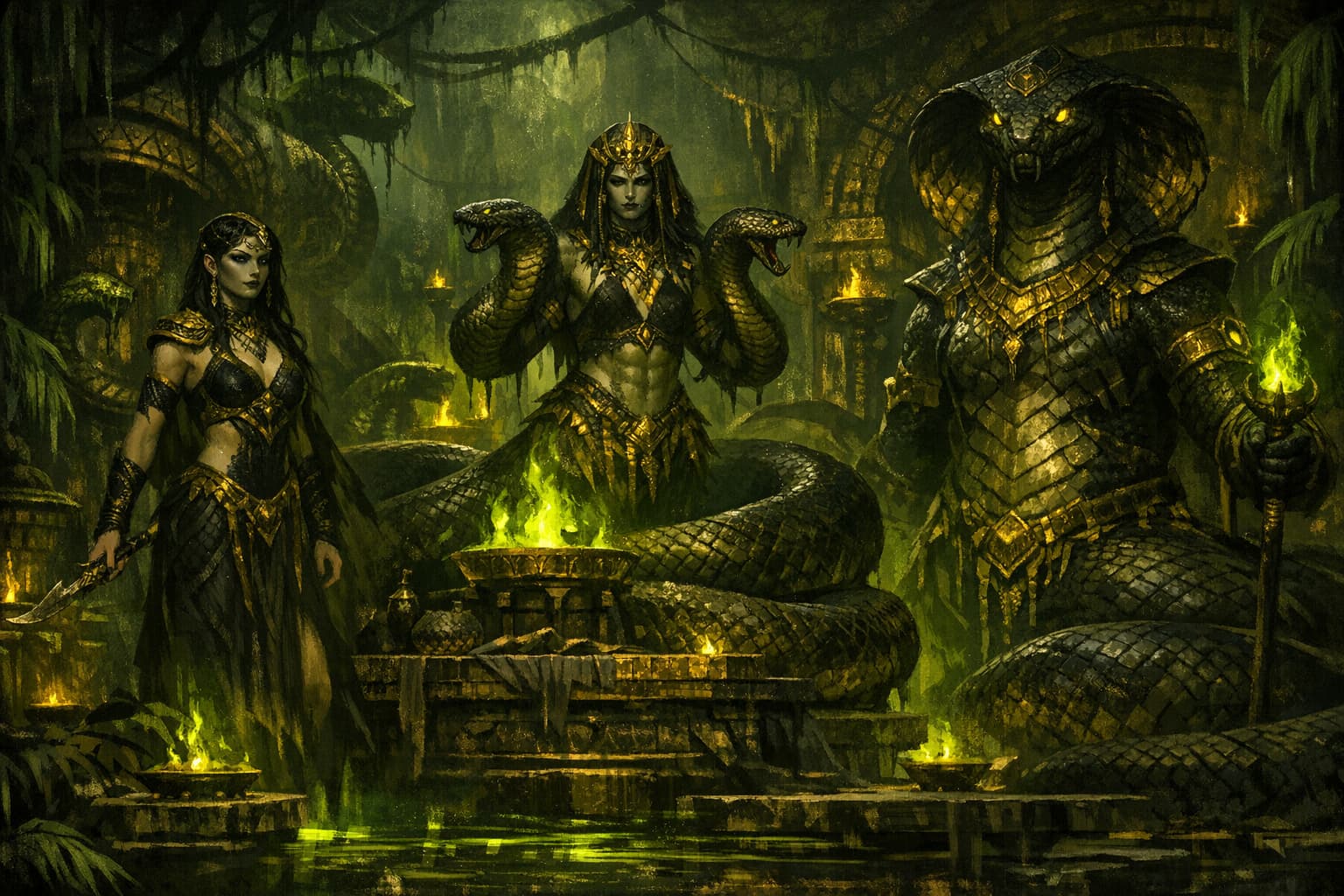
Purebloods are the most humanoid yuan-ti, bearing only subtle serpentine markers: slit pupils, patches of scales along the torso or limbs, a forked tongue, or slightly elongated canines. From a distance, they pass for human. Up close, something feels wrong — the eyes are too steady, the skin too smooth, the emotional affect slightly flattened. Purebloods are living camouflage, designed by selective breeding to infiltrate humanoid societies.
Their subtlety is their value and their shame. In yuan-ti theology, proximity to the serpent form is sacred. Purebloods are the least serpentine and therefore the lowest caste, despite being the most useful. They're sent into human cities precisely because they're considered expendable. Every pureblood carries this contradiction: essential to the mission, contemptible in the hierarchy.
Halfbloods — Between Worlds
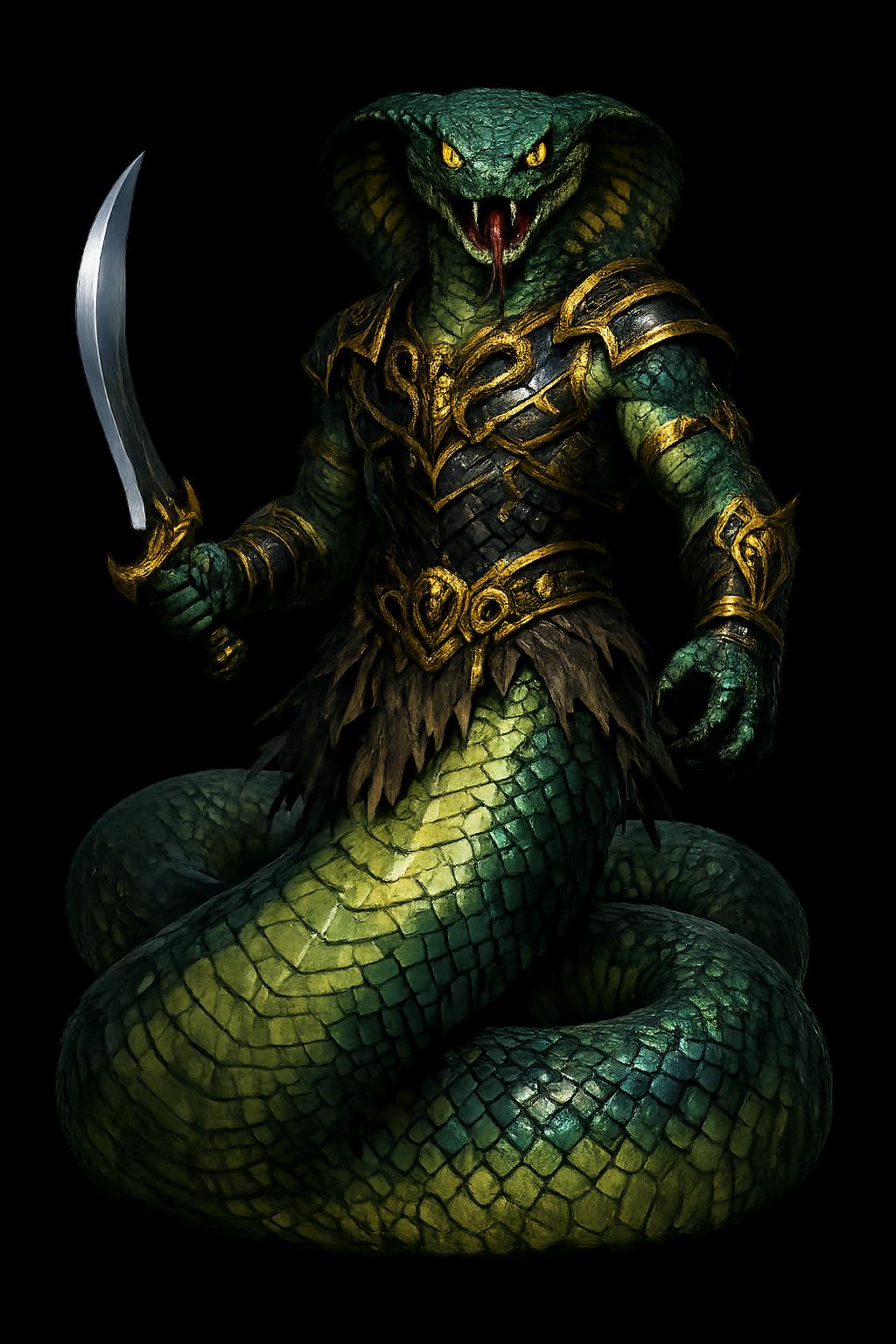
Halfbloods occupy the middle ground: visibly serpentine but still partially humanoid. A halfblood might have a human torso with a snake's lower body, or fully human limbs with a serpent head, or arms replaced by constrictor coils. The variations are enormous because halfblood biology is inherently unstable — the fusion of human and serpent form produces different results with every generation.
This instability gives halfbloods a desperate energy that purebloods and abominations lack. They're close enough to the divine serpent form to taste it, but not there yet. Many halfbloods pursue further transformation through ritual, alchemy, or breeding programs, hoping to push their bloodline toward abomination status within a few generations. The ambition is biological as much as spiritual.
Abominations — The Sacred Form
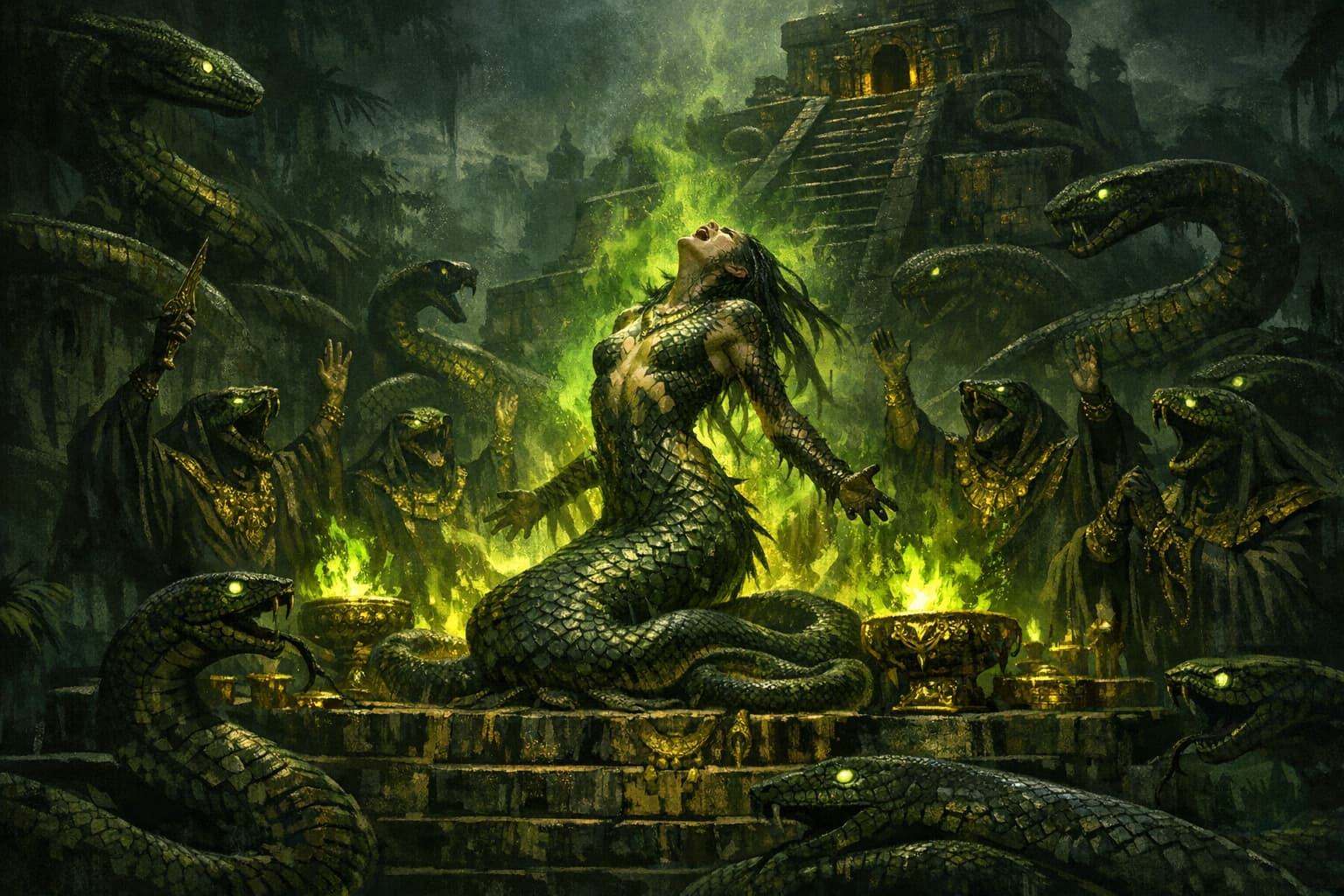
Abominations are almost entirely serpentine: massive snake bodies with vestigial humanoid features — perhaps arms, perhaps a face that retains some human structure, but dominated by scales, fangs, and constrictor muscle. They are the priests, the rulers, the living embodiments of what yuan-ti theology considers divine perfection. An abomination doesn't walk among purebloods — it is worshipped by them.
The biological reality is that abominations are also the least adaptable. They can't infiltrate, can't use most humanoid tools, and can't navigate human architecture. Their power is spiritual and magical rather than practical. An abomination rules through religious authority and arcane might, relying on halfbloods for enforcement and purebloods for intelligence. The caste system isn't just social — it's operational.
Psychology of Cold Logic
Yuan-ti don't feel emotions the way mammals do. This isn't a metaphor or an exaggeration — the transformation rituals that created the yuan-ti species involved the deliberate excision of emotional capacity. Fear, love, guilt, joy — these were stripped away as impurities, weaknesses that prevented the serpent-mind from operating at full efficiency. What remains is cold, calculating intelligence driven by ambition and the will to dominate.
This emotional void is the yuan-ti's greatest strength and their most profound limitation. Without fear, they take risks that terrify other species. Without empathy, they exploit allies and enemies with equal efficiency. Without guilt, they pursue breeding programs and ritual sacrifice as logistical problems rather than moral ones. But without love, they can't inspire loyalty — only obedience. Without joy, their victories are hollow. Without grief, their losses teach them nothing about what matters.
Playing or writing yuan-ti psychology requires resisting the urge to make them robotic. They're not emotionless machines. They have drives — hunger for power, aesthetic appreciation for elegant plans, satisfaction when a long scheme bears fruit. These aren't emotions in the mammalian sense, but they're not nothing. A yuan-ti savoring the moment when a decades-long infiltration finally collapses a human kingdom feels something. It's just not what a human would feel.
The most chilling aspect of yuan-ti psychology is their attitude toward other sentient beings. Humans, elves, dwarves — these aren't enemies. They're resources. The yuan-ti don't hate warm-blooded species. Hate would require emotional investment. They simply regard them as tools, food, or breeding stock, depending on current need. This indifference is more disturbing than malice because malice at least acknowledges the victim's personhood.
“The yuan-ti don't hate warm-blooded species. Hate would require emotional investment. They simply regard them as tools, food, or breeding stock, depending on current need. Indifference is more disturbing than malice.”
Daily Life in the Temple-Cities
A yuan-ti temple-city operates with the synchronized precision of a colony organism. Every individual has a function, every function serves the serpent cause, and deviation is not punished so much as it is simply unthinkable. The emotional excision that defines yuan-ti psychology extends to their social organization: there is no dissent because there is no passion from which dissent could arise.
Purebloods handle external operations — infiltration, trade, intelligence gathering, and the management of humanoid slave populations. They leave the temple-city for months or years at a time, maintaining cover identities in human settlements while feeding information and resources back to the temple. A pureblood's daily life in the field looks remarkably human: buying groceries, attending social events, cultivating friendships. The difference is that every interaction is data collection.
Halfbloods manage internal security, ritual preparation, and the breeding programs. Their daily routines involve patrol schedules, alchemical work, maintaining the temple's magical wards, and overseeing the slave pens where humanoid captives are held for sacrifice or transformation. A halfblood's day is regimented, purposeful, and entirely devoid of leisure. The concept of recreation doesn't translate into yuan-ti thinking.
Abominations spend their days in meditation, magical research, communion with serpent deities, and the slow work of plotting on timescales that other species can barely comprehend. An abomination might spend a decade refining a single ritual or a century maneuvering political pieces across three human kingdoms. They don't hurry. Snakes don't.
The most effective yuan-ti adventures start in an ordinary human city. The players' favorite merchant is a pureblood. The city council's wisest adviser has been feeding intelligence to a temple-city for thirty years. The orphanage on the corner is a screening facility for children with latent serpentine bloodlines. By the time the party realizes what's happening, the infiltration is generations deep.
Blood Purity & the Caste System
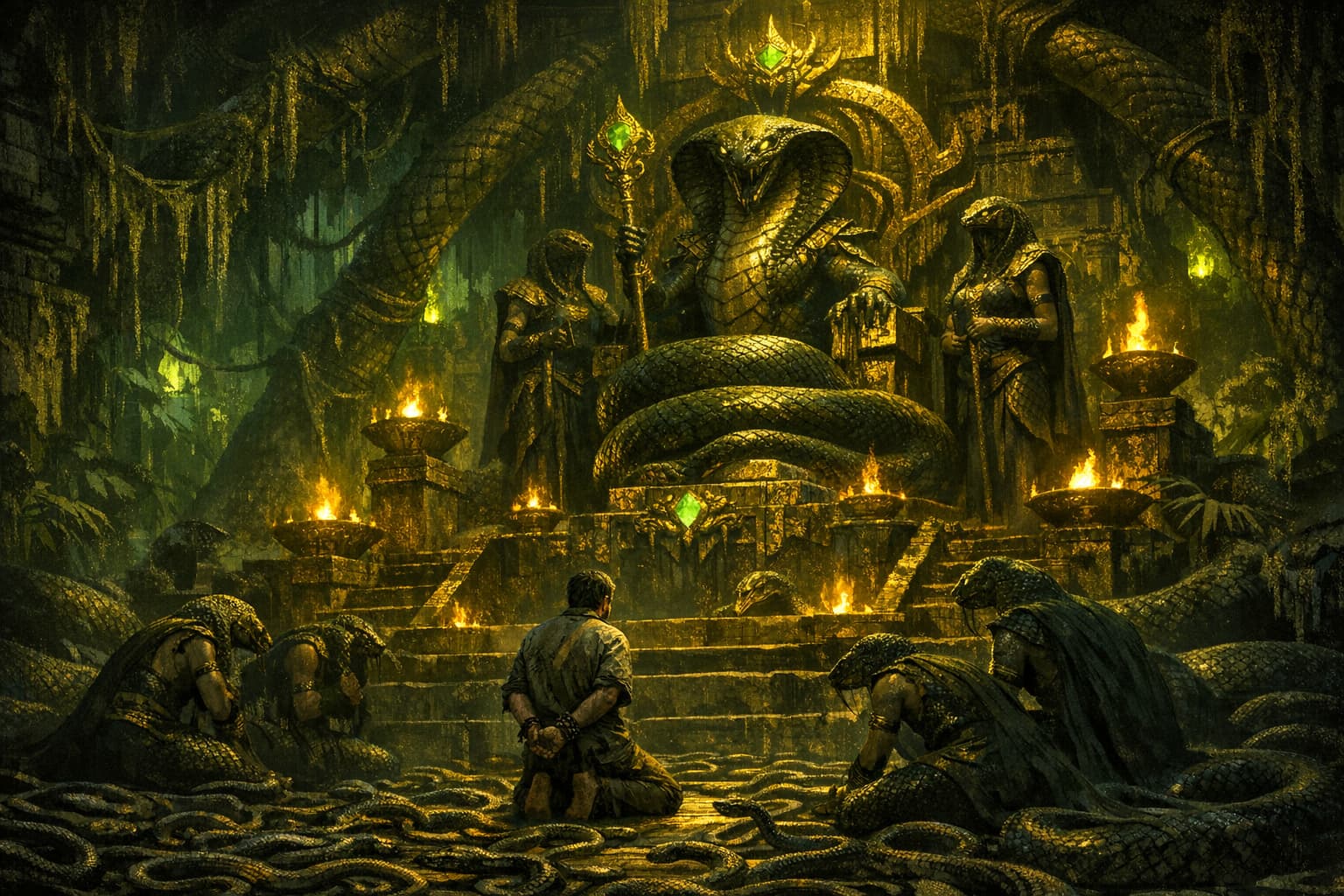
The yuan-ti caste system is biology made theology. How much of you is serpent determines everything: your social rank, your access to sacred spaces, your breeding rights, your proximity to the divine. Purebloods serve. Halfbloods enforce. Abominations rule. There is no social mobility through merit, wealth, or cunning — only through physical transformation. You ascend the hierarchy by becoming less human.
This creates a society where the most horrifying rituals are also the most aspirational. A pureblood who undergoes the Ritual of Rebirth — a process involving venomous serpent bites, alchemical immersion, and the surgical grafting of serpentine tissue — might emerge as a halfblood. The process is agonizing, frequently fatal, and considered the highest honor a pureblood can receive. Candidates compete for the privilege of risking death to become something less human and more sacred.
Breeding programs operate alongside ritual transformation. Yuan-ti reproduction is managed with the same strategic calculation they apply to everything else. Pairings are arranged to maximize serpentine traits in offspring. Purebloods with strong serpentine markers are bred aggressively; those who present as too human are assigned to infiltration duty where their appearance is useful but their bloodline is considered a dead end. Children are evaluated at birth and sorted by caste potential before they can open their eyes.
The system's cruelty is invisible to its participants because cruelty requires empathy — the ability to recognize suffering as wrong. Yuan-ti see the caste system as natural law, no more cruel than gravity. Water flows downhill. Serpent blood flows toward perfection. A pureblood who dies in a transformation ritual hasn't been victimized. They've been purified. The distinction between these two interpretations is exactly the kind of horror that makes yuan-ti effective villains.
What makes the caste system compelling for worldbuilding is its internal consistency. It doesn't have hypocrites at the top exploiting a false ideology. The abominations genuinely believe they're superior because by yuan-ti theological standards, they are. The pureblood servants genuinely accept their inferiority because the evidence is written on their too-human skin. The system is self-reinforcing, self-justifying, and utterly sincere. That sincerity is what makes it monstrous.
Ascension Rituals
The Ritual of Rebirth is the primary mechanism for caste advancement. The candidate is immersed in a vat of alchemical solutions derived from serpent venom, yuan-ti blood, and extracts from sacred jungle plants. Over a period of days to weeks, the body undergoes forced metamorphosis. Bones reshape. Skin thickens into scales. Internal organs rearrange to accommodate new biology.
Success rates vary by source material, but the consistent theme is that most candidates die. Those who survive emerge fundamentally changed — not just physically but psychologically. The transformation strips away additional emotional capacity with each degree of serpentine progression. A halfblood who becomes an abomination loses whatever residual warmth remained. The ascension is real, and the cost is everything that made you relatable.
The Breeding Calculus
Yuan-ti breeding programs operate on generational timescales. Specific pureblood-halfblood pairings are arranged to produce offspring with target trait profiles. Records are maintained across centuries, tracking which bloodlines produce the strongest serpentine expressions. The language used in yuan-ti breeding documents reads like livestock management because that is exactly what it is.
Human captives factor into the breeding program as raw genetic material. Yuan-ti regularly introduce human bloodlines to prevent the genetic bottlenecks that plague isolated populations, then selectively breed the offspring back toward serpentine dominance over subsequent generations. This means that somewhere in nearly every human population near yuan-ti territory, there are people carrying dormant serpentine genes who have no idea what they are.
Serpent Gods & Yuan-ti Theology
Yuan-ti religion is not faith in the human sense. There's no hope, no comfort, no promise of salvation. Yuan-ti theology is a transaction: worship the serpent gods, perform the prescribed rituals, and receive power. The gods are not loved. They are obeyed because obedience produces results and disobedience produces annihilation.
Sseth, the yuan-ti aspect of Merrshaulk, is the primary deity for most yuan-ti. In Forgotten Realms cosmology, Merrshaulk was the original serpent god who fell into a divine slumber, and Sseth — a winged yuan-ti who achieved divinity — serves as his proxy. The theological confusion between Merrshaulk and Sseth mirrors real-world syncretic religious traditions where older gods are absorbed into newer ones. For yuan-ti at the temple level, the distinction barely matters: the serpent god demands sacrifice, and sacrifice is provided.
Dendar the Night Serpent represents the apocalyptic thread in yuan-ti theology. She feeds on the nightmares of mortal beings and grows stronger as the world's suffering increases. Some yuan-ti factions work to hasten Dendar's awakening, believing that the destruction of the current world order will produce a new serpent-dominated age. Other factions consider this insane even by yuan-ti standards. The theological split between Dendar cults and mainstream Sseth worship is one of the few genuine sources of internal yuan-ti conflict.
Zehir, prominent in 4th Edition cosmology, offers a cleaner power relationship: worship through assassination and poison. Zehir's yuan-ti followers are less concerned with cosmic transformation and more focused on practical dominance — eliminating rivals, controlling trade routes, and building shadow empires through murder. This makes Zehir-aligned yuan-ti the most likely to interact with other villainous factions and the most dangerous in urban environments.
The layered theology of Merrshaulk/Sseth/Dendar/Zehir reflects decades of different D&D designers adding serpent gods without fully reconciling the existing ones. The result, intentionally or not, mirrors real-world religious complexity where local traditions and imported doctrines coexist uncomfortably. A yuan-ti priest arguing about whether Sseth is Merrshaulk's avatar or a separate deity entirely is having the same conversation human theologians have had for millennia.
Serpentine Magic & the Art of Venom
Yuan-ti magic doesn't work like wizard magic or cleric magic. It works like venom: slow, targeted, and devastating once it reaches the bloodstream. The yuan-ti magical tradition emphasizes enchantment, divination, and transmutation — schools of magic that infiltrate, observe, and change rather than schools that destroy. A yuan-ti sorcerer doesn't throw fireballs. They plant suggestions that bloom into betrayals three years later.
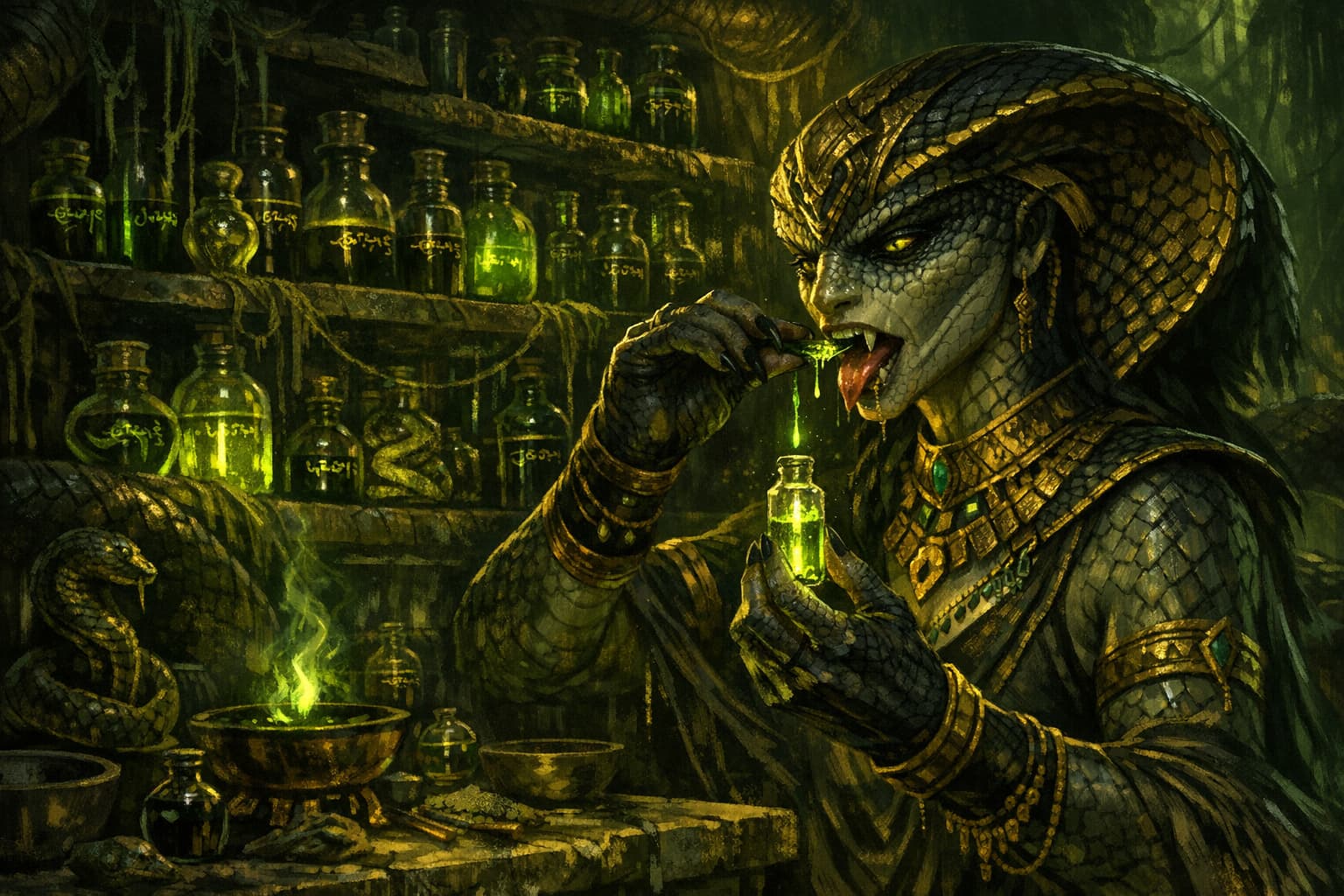
Poison is both weapon and sacrament in yuan-ti culture. The preparation of venoms is a sacred art, practiced by halfblood alchemists who maintain vast libraries of toxin recipes handed down across centuries. Some poisons kill. Others paralyze, induce hallucinations, suppress willpower, or trigger slow biological transformation. The most sophisticated yuan-ti poisons are barely distinguishable from magic — and that's the point.
Suggestion & Domination
The yuan-ti magical specialty is bending minds without breaking them. Suggestion, charm person, dominate person — these are the yuan-ti spellbook's core curriculum. The goal is not to overpower a victim's will but to redirect it so subtly that the victim believes the new direction was their own idea. A well-enchanted human agent doesn't feel controlled. They feel inspired.
This approach to mind magic reflects yuan-ti operational doctrine. Brute-force domination is wasteful because dominated creatures are obviously compromised. Subtle suggestion is efficient because the target does your work while believing they're acting freely. The best yuan-ti enchantments are indistinguishable from good advice.
Sacred Venomcraft
Yuan-ti alchemy blurs the line between poison and potion. Their most prized concoctions alter biology over weeks or months: a serum that gradually introduces serpentine traits into a human subject, a toxin that erodes emotional capacity in preparation for a willing transformation, a venom that grants temporary prophetic visions at the cost of permanent neurological damage.
Venomcraft is treated as high art within yuan-ti culture. Master alchemists hold status rivaling priests, and their workshop-laboratories are considered sacred spaces. The finest venoms are named, catalogued, and discussed with the same reverence that human cultures reserve for legendary blades or holy relics.
Inter-species Relations & Notable Figures
Yuan-ti don't have relationships with other species. They have operations. Every interaction with a non-yuan-ti civilization is evaluated through the lens of strategic utility: can this species be exploited, subjugated, or converted? If not, can they be ignored? If not, can they be eliminated? There is no fourth option because friendship, alliance, and mutual respect are not concepts that survive the emotional excision.
Humans are the primary target of yuan-ti infiltration because human societies are large, fractious, and easily manipulated through greed and fear — emotions the yuan-ti understand intellectually without experiencing personally. Pureblood agents embedded in human cities cultivate positions of influence: trusted advisers, merchant guild leaders, temple functionaries, lovers of powerful people. The infiltration can persist for decades before the yuan-ti make any overt move.
Elves are difficult targets because they live long enough to notice patterns. A yuan-ti agent who successfully infiltrates a human court for thirty years would be detected in an elven community because the elves remember what the agent looked like when they arrived and notice that they haven't aged quite right. Dwarves are difficult targets because their clan structures and underground settlements make outsider infiltration nearly impossible. Yuan-ti generally leave both species alone unless forced to engage.
The most complicated yuan-ti relationship is with the naga. In D&D lore, nagas are serpentine immortals who may share distant ancestry with yuan-ti but have evolved in radically different directions. Some nagas are guardians of knowledge, others are malevolent tyrants, and the yuan-ti regard them with a rare emotion: something approaching respect, tinged with the bitter recognition that nagas achieved true serpent form without needing to lose their humanity in the process.
Yuan-ti don't produce heroes in the traditional sense. Their notable figures are schemers, fallen powers, and puppet-masters whose significance is measured in the scope of their manipulation rather than the nobility of their actions. This makes them less popular as player characters but enormously effective as campaign villains.
What's notable about yuan-ti in D&D's broader media presence is how consistently they appear as antagonists in published adventures. From the original Forbidden City module to Tomb of Annihilation, yuan-ti are D&D's go-to civilization of intelligent, organized evil. They fill the niche between mindless monsters and relatable villains — inhuman enough to fight without moral qualms, intelligent enough to plan and scheme across entire campaign arcs.
Notable Yuan-ti Figures
| Figure | Source | Role | Significance |
|---|---|---|---|
| Ras Nsi | Tomb of Annihilation (2017) | Fallen Chultan paladin turned yuan-ti warlord | The most prominent yuan-ti NPC in 5e; tragic figure who sacrificed humanity for power and regrets nothing |
| Sseth | Forgotten Realms lore | Winged yuan-ti who ascended to godhood | Embodiment of yuan-ti ambition — a mortal who became divine through ruthless self-transformation |
| Nhyris D'Hothek | Serpent Kingdoms (3.5e) | Crown Prince of Ss'thar'tiss'ssun | Exemplar of yuan-ti political complexity; navigated abomination court politics for centuries |
| Dendar the Night Serpent | D&D cosmology | Primordial entity fed by mortal nightmares | Yuan-ti apocalyptic theology made manifest; the endpoint of serpentine ambition |
| Zaltys Serrar | Various FR novels | Pureblood infiltrator and intelligence operative | Represents the boots-on-the-ground reality of yuan-ti operations among humans |
Ras Nsi in Tomb of Annihilation gave a generation of 5e players their defining yuan-ti encounter, much as the Forbidden City module did for players in the early 1980s.
Hlondeth, in the Forgotten Realms' Vilhon Reach, represents yuan-ti infiltration taken to its logical conclusion. The city's ruling family, the Extaminos, are yuan-ti purebloods who have governed openly for generations. The human population knows their rulers are serpent-people and has simply... adapted. Hlondeth proves that yuan-ti infiltration doesn't always need to stay secret. Given enough time, the host society learns to accept the parasite as normal.
D&D Mechanics Across Editions
Yuan-ti mechanics have always reflected their dual nature as both monsters and a playable concept. The three castes provide a natural difficulty scaling for encounters — purebloods as low-tier infiltrators, halfbloods as mid-tier combatants, abominations as boss-tier threats. This built-in encounter design is one reason yuan-ti have remained popular with DMs across every edition.
Yuan-ti Mechanical Evolution
| Feature | 1e/2e | 3.5e | 5e |
|---|---|---|---|
| Caste System | Three castes defined | Detailed with transformation rules | Three castes + specialist variants |
| Spellcasting | Basic spell-like abilities | Charisma-based, extensive lists | Innate spellcasting, Suggestion at 3rd |
| Signature Trait | Poison immunity | Spell resistance + poison immunity | Magic Resistance + poison immunity |
| Player Option | Monster only | Playable (Savage Species rules) | Pureblood playable (Volo's) |
| Encounter Design | Simple combat | Social + combat + infiltration | CR 1–12 spread, lair actions |
Magic Resistance is the yuan-ti signature across editions — representing their ancient magical heritage and making them uniquely frustrating opponents for spellcaster-heavy parties.
- Pureblood: SR 14, detect poison, animal trance, cause fear, darkness, entangle
- Halfblood: SR 16, produce acid/poison breath, constrict
- Abomination: SR 18, all pureblood abilities + dominate person, fear aura
- All castes: Charisma-based spellcasting, poison immunity
3.5e provided the most granular yuan-ti mechanics, with detailed stat blocks for each caste and explicit rules for the transformation rituals between them. Serpent Kingdoms remains the gold standard for yuan-ti mechanical depth.
- Darkvision 60 ft.
- Innate Spellcasting: poison spray, animal friendship (snakes), suggestion (3rd)
- Magic Resistance (advantage on saves vs. spells)
- Poison Immunity
The 5e pureblood was widely considered overpowered as a player race. Magic Resistance alone put them ahead of most PHB options. This contributed to yuan-ti purebloods being banned at many organized play tables and eventually excluded from the 2024 PHB races.
- Malison variants: Type 1 (snake head), Type 2 (snake arms), Type 3 (snake lower body)
- Abomination: Large serpent, 6+ attacks per round, spellcasting
- Anathema: Huge serpent demigod, legendary actions, constrict/swallow
- All yuan-ti: Magic Resistance, Shapechanger (pureblood/malison)
The monster stat block spread from CR 1 to CR 12 makes yuan-ti usable across an entire campaign arc. Few monster civilizations offer this range of challenge ratings with built-in narrative escalation.
Serpent-People Across Franchises
The serpent-people concept predates D&D and appears across nearly every major fantasy and science fiction franchise. What varies is whether the serpent-folk are ancient decadent empires, alien infiltrators, or corrupted humans — and the choice reveals what each franchise considers most frightening about the snake-person concept.
D&D's yuan-ti distinguish themselves through the combination of infiltration, caste biology, and emotional void. Other franchise equivalents tend to emphasize one of these elements but rarely all three. The Skrulls infiltrate but have emotions. Warhammer's Chaos cultists transform but don't organize into rational hierarchies. Howard's serpent-men are ancient but lack the yuan-ti's patience and strategic depth. Yuan-ti are terrifying because they combine every unsettling aspect of the serpent-person archetype into a single, coherent civilization.
Serpent-People Across Franchises
| Franchise | Species | Core Concept | Key Distinction from Yuan-ti |
|---|---|---|---|
| D&D | Yuan-ti | Emotionless serpent supremacists with infiltration networks | The original TTRPG serpent civilization; caste system + emotional void |
| Conan / Robert E. Howard | Serpent Men of Valusia | Pre-human civilization ruling through shape-shifting disguise | More ancient and decadent; less organized, more individually powerful |
| Warhammer Fantasy | Lizardmen / Skinks | Reptilian servants of the Old Ones, ordered by the Great Plan | Benevolent (mostly); organized by divine purpose rather than supremacist ideology |
| Elder Scrolls | Tsaesci | Serpentine Akaviri race that may have "eaten" the men of Akavir | Deeply mysterious; more legend than documented species |
| Pathfinder | Serpentfolk | Ancient empire of Ydersius seeking to reclaim the surface world | Similar to yuan-ti but with a specific decapitated god mythology |
| X-COM / Sci-fi | Thin Men / Reptilians | Alien infiltrators in human disguise | Science fiction framing; technology instead of magic, same paranoia |
Robert E. Howard's Serpent Men of Valusia (1929) are the likely literary ancestor of D&D's yuan-ti, filtered through decades of pulp fantasy.
FAQ
Common Questions
The most effective approach is playing a pureblood who has been separated from yuan-ti society long enough for emotional capacity to partially return — or one who was born with an unusual degree of it, making them defective by yuan-ti standards. A pureblood exile who is slowly learning to feel things they were never supposed to feel is a compelling character arc. Alternatively, lean into the cold pragmatism as a character trait rather than a moral alignment: a yuan-ti who helps the party because cooperation is strategically optimal, gradually discovering that they care about these people for reasons they can't rationalize.
Magic Resistance — advantage on saving throws against spells and magical effects — is an extraordinarily powerful trait that no other playable race received. Combined with poison immunity and innate spellcasting (including Suggestion), yuan-ti purebloods had a feature budget significantly higher than PHB races. Many organized play tables banned them, and the 2024 PHB revision did not include them as a playable option, effectively acknowledging the balance issue.
Three things: timescale, infiltration, and the built-in encounter ladder. Yuan-ti plans operate across decades or centuries, which means the players are always discovering a scheme that started before they were born. The infiltration element means any NPC could be a pureblood agent, creating paranoia that enhances every social encounter. And the caste system provides natural encounter scaling — purebloods at low levels, halfbloods at mid-tier, abominations as the campaign climax. Few villain factions offer this combination of narrative depth and mechanical variety.
The Sarrukh were the ancient Creator Race of reptilian beings who created the yuan-ti (along with nagas, lizardfolk, and other scaled species) during Faerun's earliest ages. They're the yuan-ti's gods-before-gods — the original serpent masters whose empire makes the yuan-ti look like recent arrivals. Use Sarrukh ruins and artifacts as the deepest layer of your yuan-ti campaign: the discovery that the yuan-ti themselves are servants of something older and more alien raises the stakes beyond anything the party expected. Sarrukh work best as backstory and ancient threat rather than active NPCs.