
Moon Elves
Nocturnal mystics whose lives cycle with the moon, finding power in silver light and patient timing
Mythological Foundations
Moon elves trace their conceptual roots to the oldest strata of European mythology. The Norse ljósálfar inhabited Álfheimr, a realm of radiance presided over by the god Freyr. These "light elves" were not simply bright — they occupied a cosmological position between gods and mortals, existing in a liminal state that modern fantasy has translated into the elven affinity for twilight and moonlight.
The Irish Tuatha Dé Danann and their later diminishment into the sídhe provide the other major tributary. These were not small creatures but a divine race driven underground — into hollow hills where time moved differently. The idea of elves as beings displaced from the surface world, retreating into hidden realms, maps directly onto Forgotten Realms moon elf history: the Retreat to Evermeet, the abandonment of Myth Drannor, the slow withdrawal from a world that no longer belonged to them.
What distinguishes the moon elf synthesis is the specific binding of these mythological currents to lunar cycles. Neither the ljósálfar nor the sídhe were explicitly lunar, but fantasy worldbuilding compressed the "light elf" radiance and the "hidden realm" mysticism into creatures whose power waxes and wanes with the moon itself.
Mythological Origins of Moon Elf Archetypes
| Tradition | Source Figure | Key Trait | Moon Elf Echo |
|---|---|---|---|
| Norse | Ljósálfar | Radiant, dwell in Álfheimr | Inherent luminescence, superior realm |
| Irish | Tuatha Dé Danann / Sídhe | Divine race driven underground | The Retreat, hidden cities |
| Welsh | Tylwyth Teg | Fair folk of twilight hills | Twilight affinity, glamour magic |
| Proto-Germanic | *albh- (to shine) | Etymological root = brightness | Silver hair, pale skin, moonlit glow |
Cross-cultural elf mythology consistently associates these beings with liminal light — not full daylight, but dawn, dusk, and moonrise.
Etymology & The Light Connection
The word "elf" descends from Proto-Germanic *albiz, itself from Proto-Indo-European *albh-, meaning "to shine" or "white." This is not incidental etymology. The oldest conception of elves was inseparable from luminosity. They were beings of inherent brightness, and the entire tradition of pale skin, silver hair, and affinity for moonlight flows from this linguistic root.
The connection runs deeper than aesthetics. In Old English, ælf-sciene meant "beautiful as an elf" — beauty defined through radiance rather than form. When Tolkien built his Eldar, he drew on this same well: the Quendi, "those who speak," awoke under starlight at Cuiviénen before sun or moon existed. Their first experience of light was celestial, not solar.
“From Proto-Indo-European *albh-, to shine — the oldest word for "elf" is indistinguishable from the oldest word for "light." Moon elves are not creatures who happen to like moonlight. They are moonlight given form.”
— Etymological synthesis
Forgotten Realms History
In the Forgotten Realms, moon elves (also called silver elves or Teu-tel-quessir) are the most common and most tolerant of the elven subraces. Their history spans tens of thousands of years, from the first migrations through the devastating Crown Wars to the founding and fall of their greatest cities.
The Crown Wars (−12000 to −9000 DR) shattered elven unity. Five wars fought over millennia left deep scars — the dark elves were driven underground and cursed by Corellon Larethian, becoming the drow. Moon elves, who had largely opposed the Vyshaan sun elf empire that instigated the wars, emerged as advocates for restraint and cooperation. This positioning — moderate, diplomatic, willing to engage with other races — became their defining political identity.
Myth Drannor represents both the highest achievement and deepest wound of moon elf civilization. Founded in 261 DR as Cormanthor, the city was opened to non-elves under Coronal Eltargrim in 261 DR — a radical act that sun elves bitterly opposed. For centuries, Myth Drannor was the greatest city on Faerûn: a place where elf, human, dwarf, and halfling lived and studied together. Its fall to fiends in 714 DR was not merely a military defeat but the collapse of the moon elf vision of a multiracial civilization.
First Sundering
Elven high magic tears the supercontinent apart, creating Evermeet as a refuge in the west. Moon elves are among those who remain on Faerûn.
Crown Wars Begin
The Vyshaan sun elf empire provokes five millennia of elven civil war. Moon elves largely oppose Vyshaan expansionism.
Descent of the Drow
Corellon curses the dark elves for their role in the Crown Wars. They are driven into the Underdark, becoming the drow.
Myth Drannor Opens
Coronal Eltargrim opens Cormanthor to non-elves, creating the greatest multiracial city in Faerûn — a defining moon elf achievement.
Fall of Myth Drannor
An army of fiends from the Abyss overwhelms the city. The mythal holds but the population scatters. The moon elf dream of coexistence lies in ruins.
The Retreat Begins
Elves across Faerûn begin withdrawing to Evermeet. Moon elves are divided — many refuse to abandon the mainland entirely.
Second Sundering
The world reshapes. Moon elves who remained on Faerûn find their choice validated as Evermeet becomes harder to reach.
Key Settlements
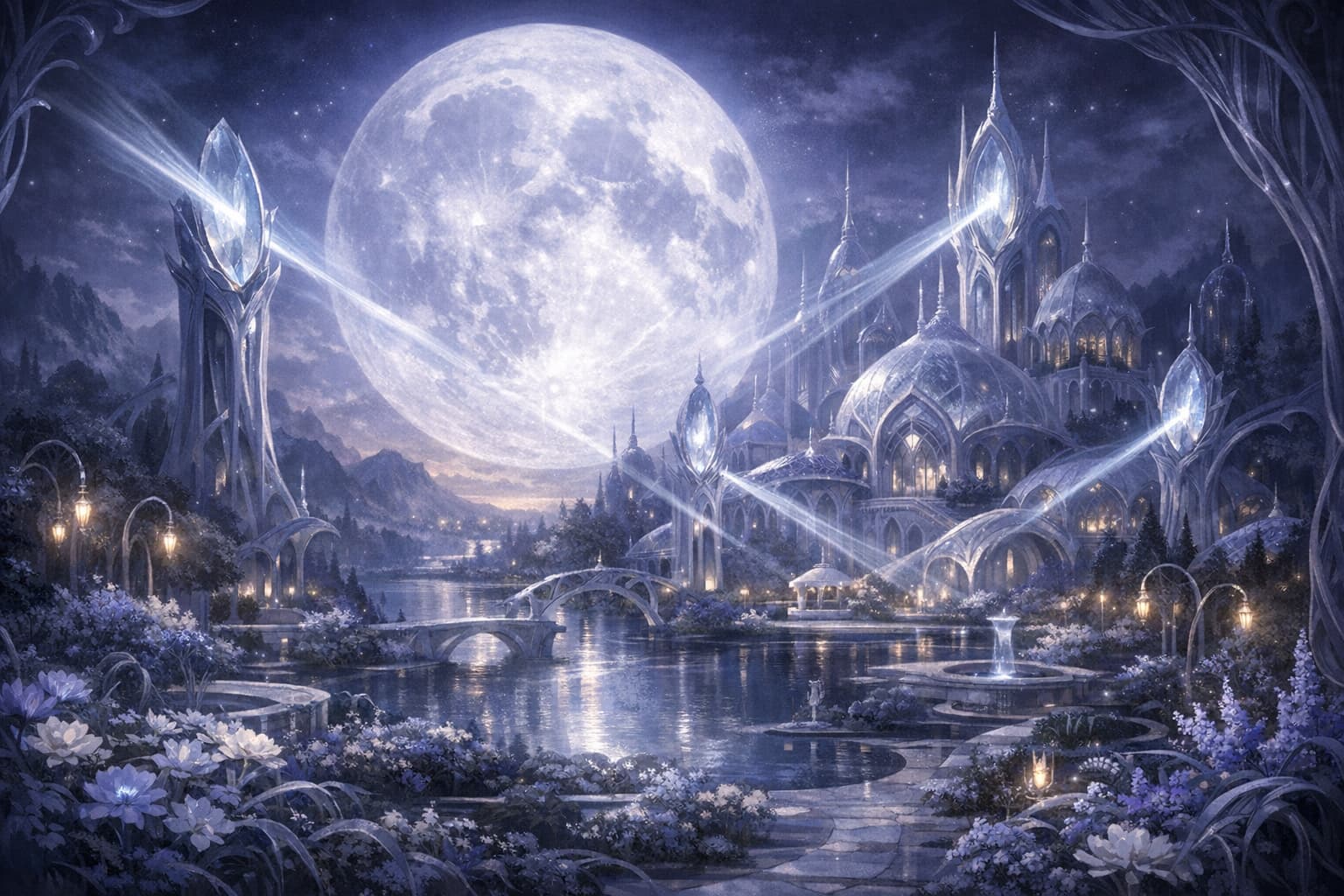
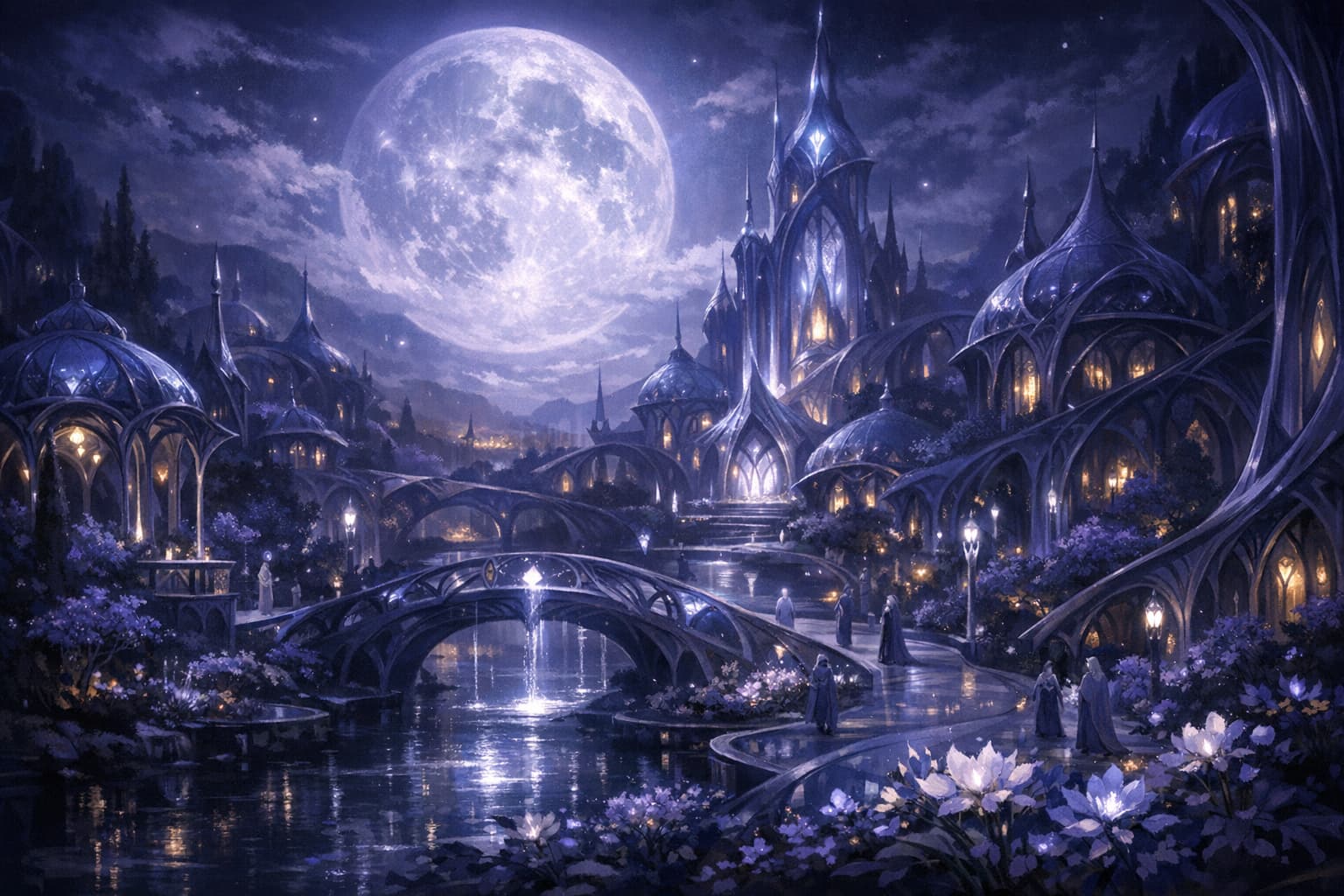
Moon elf settlements tend toward the inclusive rather than the exclusive. Where sun elf cities close their gates, moon elf cities — at their best — open them. This pattern repeats across Faerûn, from the ancient forest capitals to the surviving strongholds of the present day.
Major Moon Elf Settlements
| Settlement | Region | Status | Significance |
|---|---|---|---|
| Myth Drannor | Cormanthor | Fallen (714 DR), partially restored | Greatest multiracial city in elven history |
| Evereska | Greycloak Hills | Active, hidden | Last major moon elf city on the mainland, protected by mythals |
| Silverymoon | Silver Marches | Active, multiracial | Moon elf cultural influence in a human-led city; founded by Alustriel |
| Evermeet | Western Ocean | Active, restricted | Elven refuge island; moon elves hold significant political presence |
| Orishaar | Ancient Aryvandaar | Destroyed | Pre-Crown Wars moon elf city, destroyed by Vyshaan expansion |
Evereska remains the primary moon elf homeland for most campaign settings.
Biology & Physicality
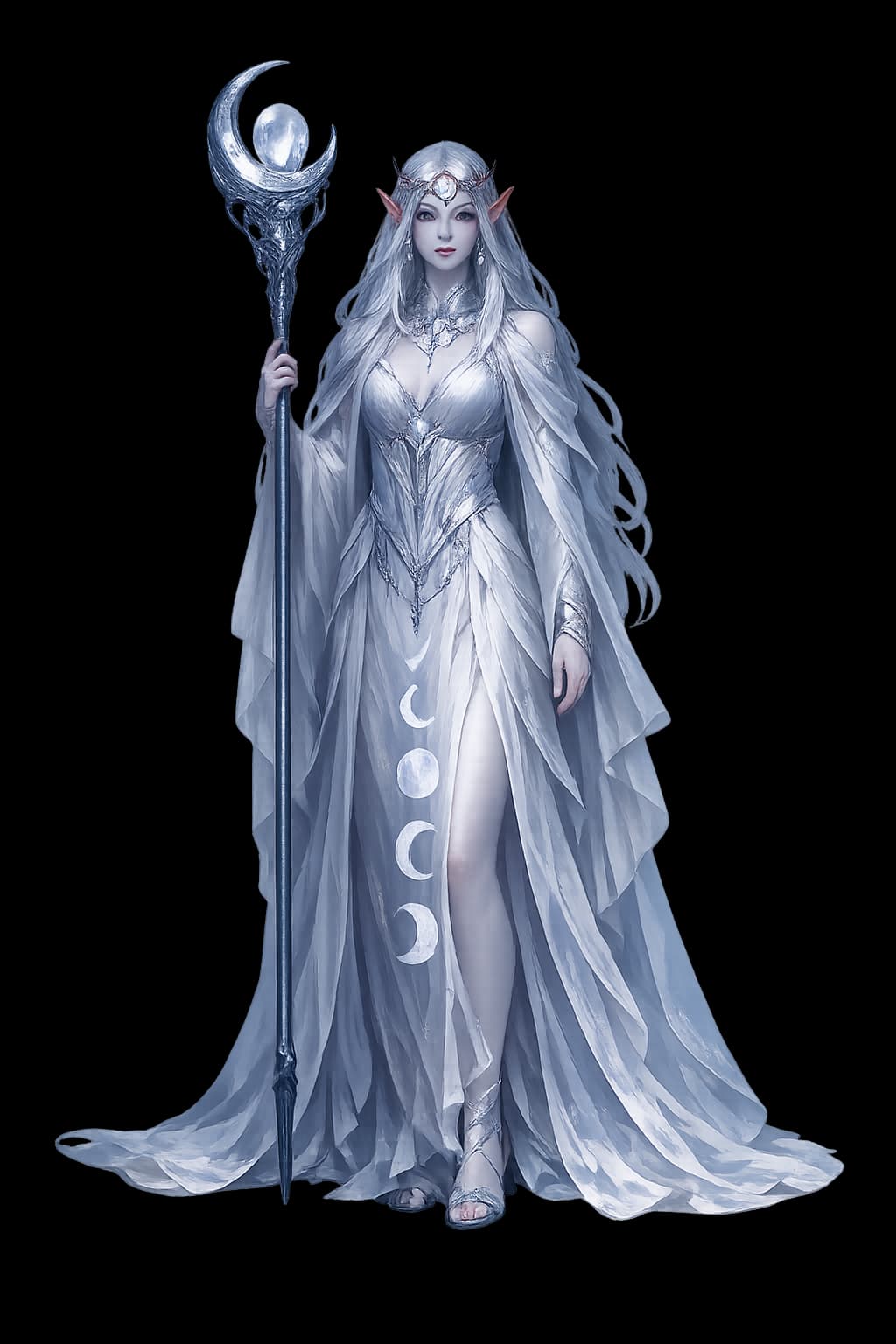
Moon elf biology reflects millennia of adaptation to nocturnal environments. Their physical traits are not cosmetic — each one serves a function in low-light conditions and connects to the deeper mythology of elves as beings of inherent radiance.
Complexion & The Blue Tint
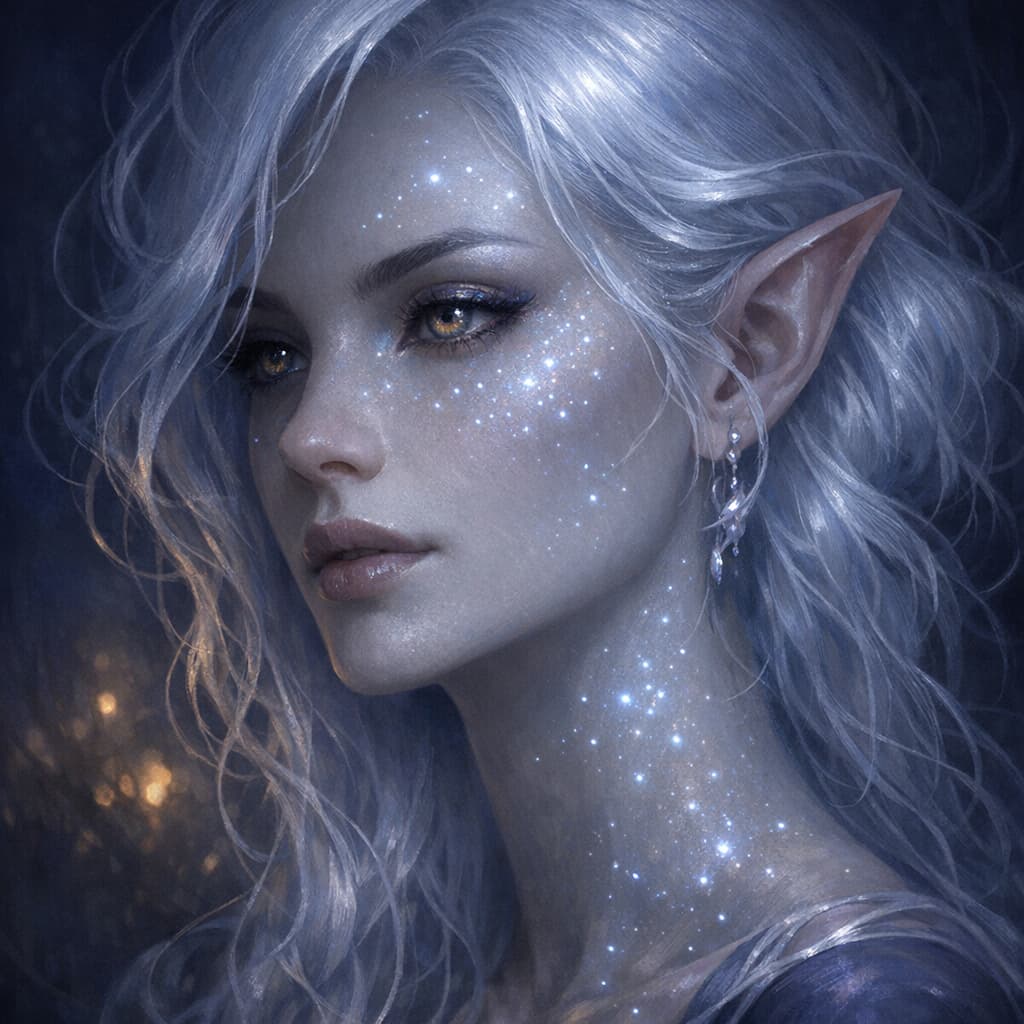
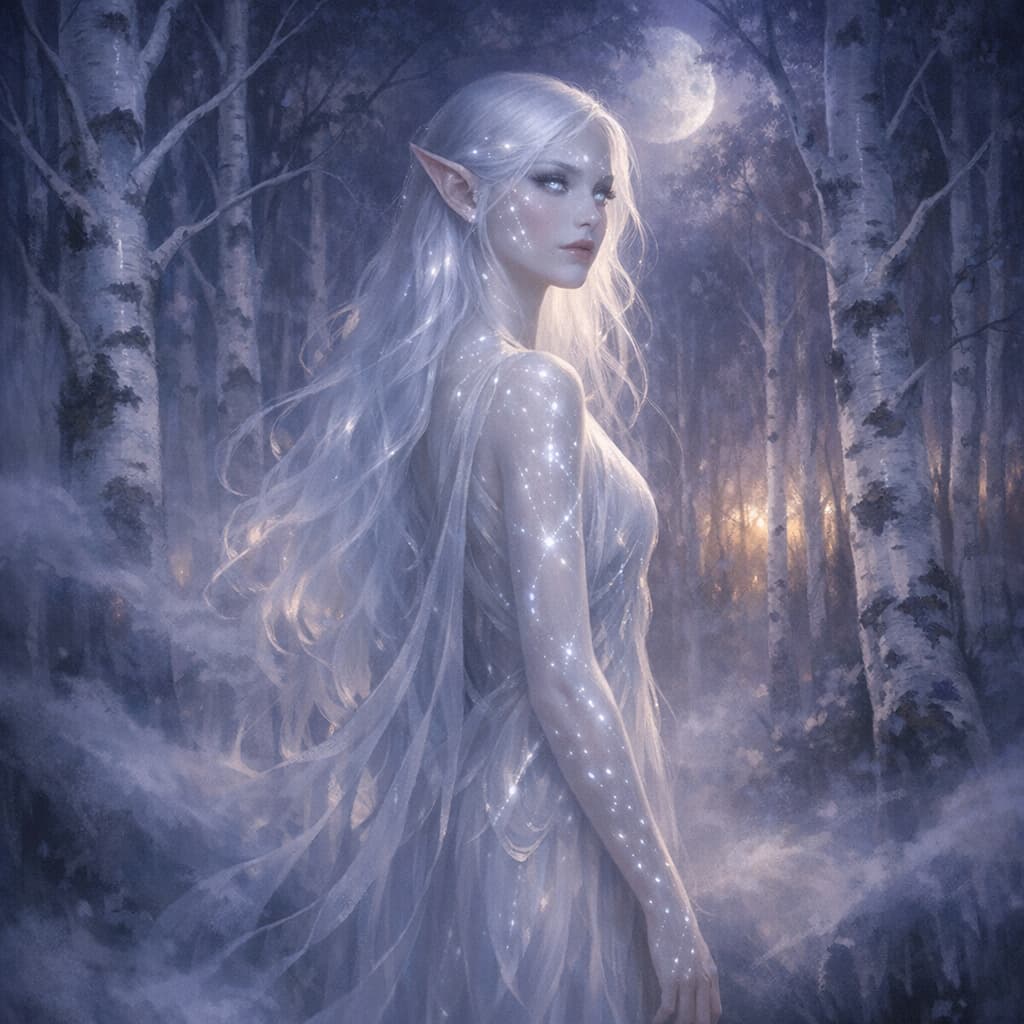
Moon elf skin ranges from pale white to faintly blue-tinged, a coloration that appears silver under moonlight. This is not albinism but an active adaptation: their skin contains trace amounts of a bioluminescent compound that responds to moonlight exposure, producing the faint glow that other races find unsettling.
The blue tint deepens with age and magical exposure. Elder moon elves — those past their fifth century — may exhibit a visible luminescence in darkness, their skin casting enough light to read by.
Eyes & The Reverie
Moon elf eyes are typically pale blue, silver, or gold — and flecked with metallic points that catch light like scattered mica. Their darkvision extends further than other elven subraces (120 feet versus the standard 60), and they perceive moonlight with a richness of color that approximates human daylight vision.
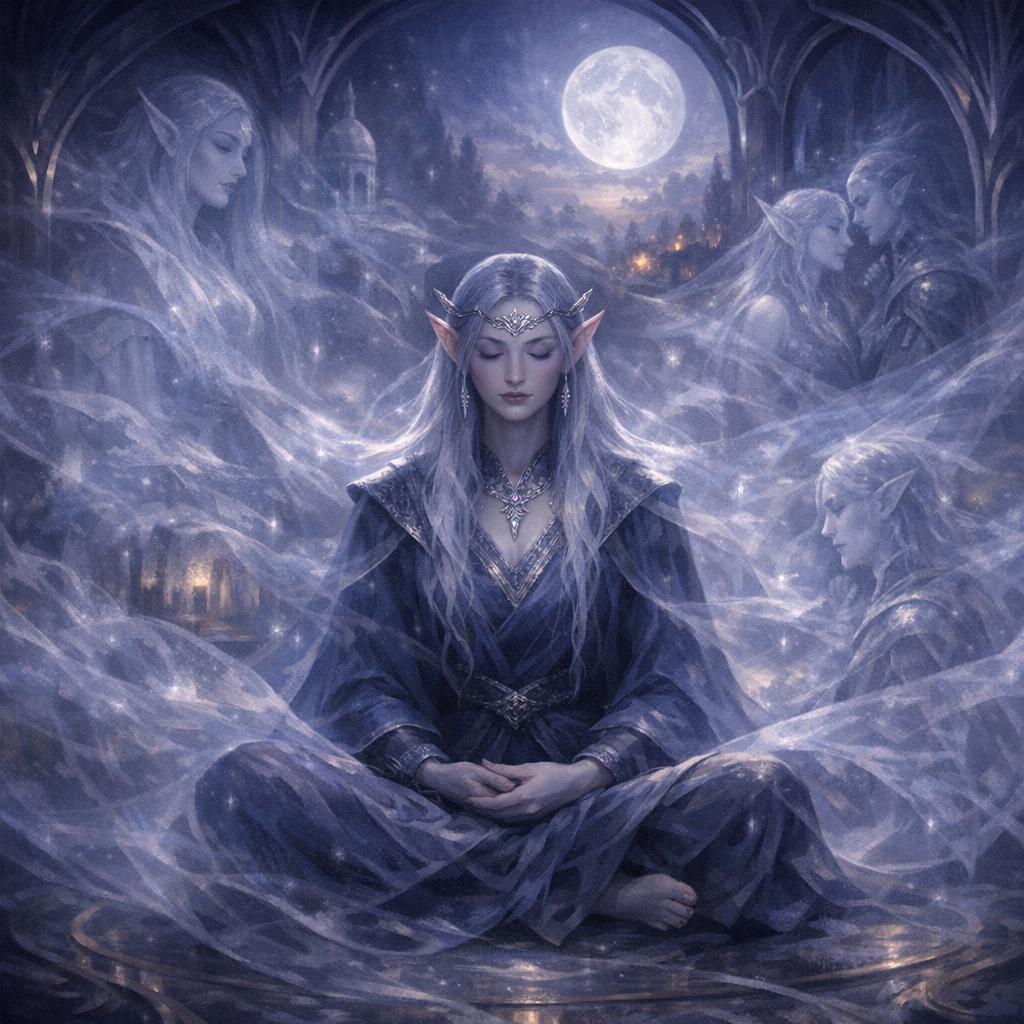
The Reverie — the elven trance that replaces sleep — takes on particular significance for moon elves. During their four-hour meditation, moon elves relive memories with hallucinatory clarity. Elder moon elves report that these memories begin to blur with ancestral recollections, as though the Reverie connects them to the experiences of their forebears.
Lifespan & Bioluminescent Freckles
Moon elves live 750 years on average, with some reaching over a millennium. As they age, scattered points on their skin — resembling freckles or constellations — develop increasing bioluminescence. These markings are unique to each individual, as distinctive as fingerprints, and moon elf cultures have developed elaborate systems of reading them as indicators of magical potential, destiny, and emotional state.
Among moon elves, the phrase "reading someone's stars" refers to interpreting these luminous markings — a practice somewhere between palm reading and genuine magical diagnosis.
Cycles as Psychology
Moon elves experience time as recurring patterns rather than linear progression. This sounds abstract until you think through what it means for decision-making.
A species that thinks in cycles doesn't fear endings the same way. The dark moon always returns to full. The full moon always wanes. Loss is temporary because nothing is truly lost, only transformed into a different phase. This creates resilience against despair but also potential passivity. Why fight against the cycle? It will come around again.
The same psychology makes moon elves better at patience than even other long-lived elves. Wood elves wait because they have time. Moon elves wait because they understand that timing matters more than action. The full moon is when rituals have power. The new moon is when secrets are safe. Acting at the wrong phase wastes effort or worse, invites disaster.
This cyclical thinking affects relationships. Moon elves don't experience friends leaving as permanent separation. They've internalized that people, like moons, go through phases of closeness and distance. The friend who's distant now will be close again later. The partner who seems perfect during one phase might be incompatible during another. Moon elves measure compatibility across cycles, not moments.
The Nocturnal Reality
Moon elves are nocturnal, and this should matter beyond "we adventure at night." Their entire civilization developed for nighttime operation. Their cities don't need the same lighting infrastructure. Their agriculture uses different crops. Their social rhythms put important activities when other species are sleeping.
The nocturnal lifestyle also affects perception. Moon elves developed in low-light conditions. Their senses adapted accordingly. They might find daylight genuinely painful, not just uncomfortable. Bright environments that other species find pleasant might be overwhelming for moon elves the way a loud nightclub overwhelms people used to quieter settings.
Consider how nocturnal species develop socially. Night is when predators hunt in many ecosystems. Moon elves evolved in environments where darkness meant danger from things they couldn't easily see. This produces cultures that value vigilance, that developed sophisticated warning systems, that learned to read subtle signs in limited light. Their traditional enemies were creatures of the deep night, things that hunted when even the moon was dark.
This creates practical problems for mixed-species cooperation. Moon elves at peak alertness when humans are struggling to stay awake. Important moon elf ceremonies happening when other species desperately need rest. Trade negotiations where one party is fighting their circadian rhythm while the other is at their sharpest.
Culture & Governance
Democratic Bands & Rotating Leadership
Moon elf governance tends to work in cycles, mirroring their understanding of natural rhythms. Leadership rotates among qualified individuals rather than concentrating in single figures. The same position holds different responsibilities during different phases.
The waxing moon leader handles expansion and development. The full moon leader handles peak-capacity challenges. The waning moon leader handles consolidation and conclusion. The dark moon leader handles secrets and necessary endings.
This rotating structure has advantages: no single individual accumulates too much power, different skills are valued at different times, and the system is resilient because removing any single leader does not cripple governance. The disadvantage is continuity — long-term projects require coordination across multiple leaders who might have different priorities.
Bardic Traditions & Animal Companions
Moon elves maintain the strongest bardic tradition among the elven subraces. Their bards serve as historians, diplomats, and keepers of the oral tradition that preserves knowledge across their long lifespans. A moon elf bard who has lived six centuries carries an encyclopedic memory of events, alliances, betrayals, and promises.
Animal companionship runs deep in moon elf culture. Owls, silver foxes, and moonhares (a breed of large hare with luminous fur) serve as familiars, messengers, and companions. These relationships are not domestication but partnership — moon elves consider their animal companions as equals operating in a different sensory world.
The bardic-companion bond is particularly notable: moon elf bards often compose and perform alongside their animal partners, creating duets that combine elven song with animal calls in ways other races find hauntingly beautiful.
Theology & Sehanine Moonbow
Sehanine Moonbow is the moon elf deity in the truest sense — not merely a goddess they worship, but the divine embodiment of everything their culture values. She is the goddess of moonlight, dreams, travel, death, and the full moon. Her portfolio reads like a description of moon elf civilization itself.
Sehanine teaches that the journey matters more than the destination, that moonlight reveals truths daylight conceals, and that death is not an ending but a transition into the next phase. These are not abstract theological positions for moon elves. They are lived principles that shape how communities make decisions, how individuals face mortality, and how the culture relates to the passage of time.
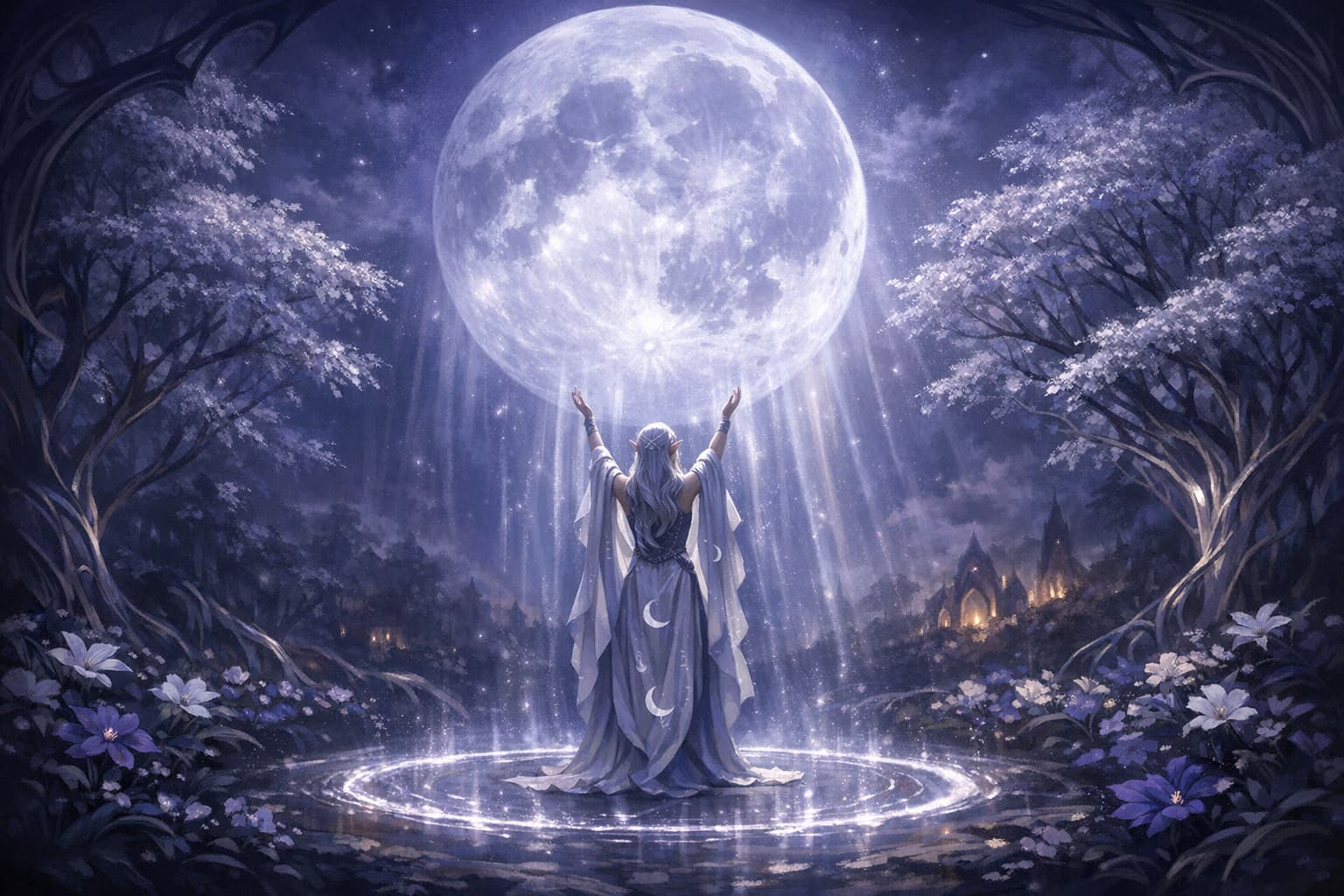
The Lunar Hallowings are the holiest ceremonies in moon elf religion — rituals performed during each full moon that combine worship, magic, and community celebration. These are not solemn affairs. They involve music, dance, shared visions during communal Reverie, and the casting of powerful protective spells that strengthen the mythals guarding moon elf settlements.
Sehanine is part of the Angharradh — the elven triple goddess alongside Hanali Celanil (love) and Aerdrie Faenya (air). This triune doctrine means moon elf theology is inherently pluralistic: their primary goddess is herself a facet of a greater whole, reinforcing the moon elf instinct that no single perspective captures complete truth.
Lunar Magic Systems
Moon elf magic varies with lunar phases. This is not flavor. It is a fundamental mechanic that shapes how moon elves approach every problem that magic might solve.
At full moon, evocation and divination spells reach maximum potency. Moon elves plan important magical workings around these peak periods the way other cultures schedule major events around holidays. A moon elf mage does not cast their most powerful spell whenever convenient. They wait for the right phase, which might be days or weeks away.
During the new moon, different magic becomes accessible. Concealment, shadow work, necromancy that communes with the departed — things that thrive in darkness. Moon elves do not see the dark moon as a time of weakness but as a time of different strength.
The waxing and waning crescents have their own specialties. Waxing favors growth magic: healing, enchantment, the strengthening of wards. Waning favors diminishment: dispelling, curse-breaking, the unraveling of hostile enchantments. A moon elf healer knows that a wound treated during the waxing crescent heals faster than one treated during the waning.
This creates strategic complexity that other cultures find obsessive. Moon elf armies time campaigns around lunar phases. Moon elf assassins strike during optimal concealment conditions. The entire society thinks about timing in ways that would exhaust a human strategist's patience.
Bladesinging
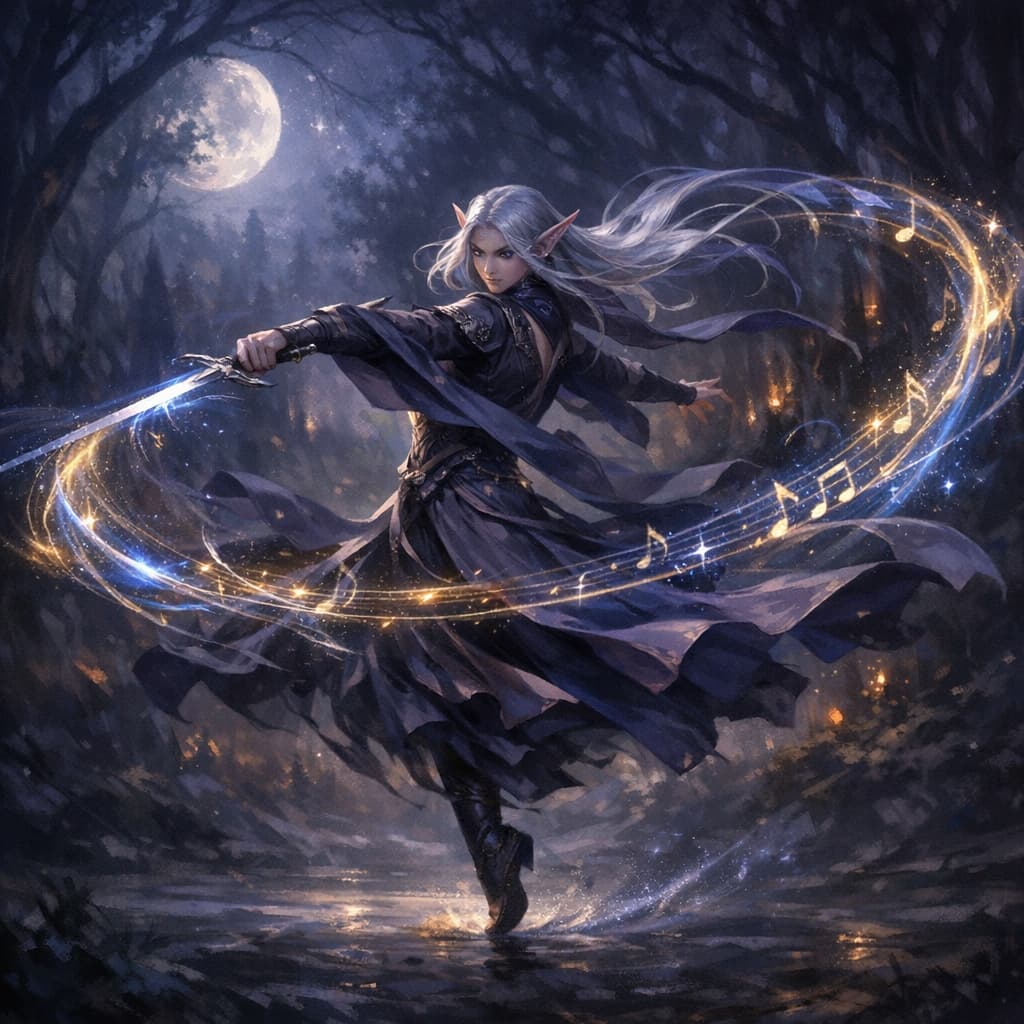
Bladesinging is the martial art most closely associated with moon elves, and it represents something rare in fantasy: a combat style that is genuinely beautiful without being impractical. The bladesinger fights by singing — not metaphorically, but literally channeling arcane energy through melody while executing sword techniques that look like choreography and kill like warfare.
The style was developed by moon elf warriors who needed to defend their communities against threats that purely martial or purely magical approaches could not handle alone. A bladesinger occupies the exact intersection: casting spells while fighting, fighting while casting spells, using movement as both tactical positioning and somatic component.
Traditionally, bladesinging was restricted to elves — a cultural practice as much as a combat technique. In the Forgotten Realms, the art was closely guarded, with non-elves rarely permitted to learn even its basic forms. This exclusivity reflects the moon elf view that bladesinging is not a transferable skill but an expression of elven nature, requiring the elven relationship with music, magic, and movement that other races simply do not share.
The Sword-Magic Fusion
A bladesinger in combat moves with a fluidity that observers compare to dance — but every movement serves a dual purpose. A spin that looks decorative is actually a somatic component for Shield. A lunge that seems overextended is the delivery mechanism for Booming Blade. The song itself provides verbal components while simultaneously disrupting enemy concentration.
At higher levels, bladesingers achieve a state called the Bladesong — a sustained harmonic resonance between weapon, body, and magic that grants supernatural reflexes, enhanced armor, and the ability to maintain concentration on spells that would shatter under normal combat conditions.
The Relationship with Sun Elves
Moon elves and sun elves represent complementary opposites, but the relationship is more complex than simple rivalry.
Some moon elf communities see sun elves as siblings who chose a different path. Same elven nature, different relationship with time and light. These communities maintain diplomatic relations, recognize shared heritage, and cooperate when interests align.
Other moon elf communities see sun elves as fundamentally other. The split was not merely adaptation but rejection. Sun elves abandoned the truths available only in darkness for the comfortable illusions of daylight. These communities treat sun elves with the wariness reserved for people who have made a choice you consider deeply wrong.
Both subspecies descended from common ancestors. At some point, different elven populations adapted to different temporal niches. The divergence might have been gradual ecological adaptation or sudden magical transformation. Either origin creates history that current moon elves and sun elves interpret differently.
Literature & Moonblades
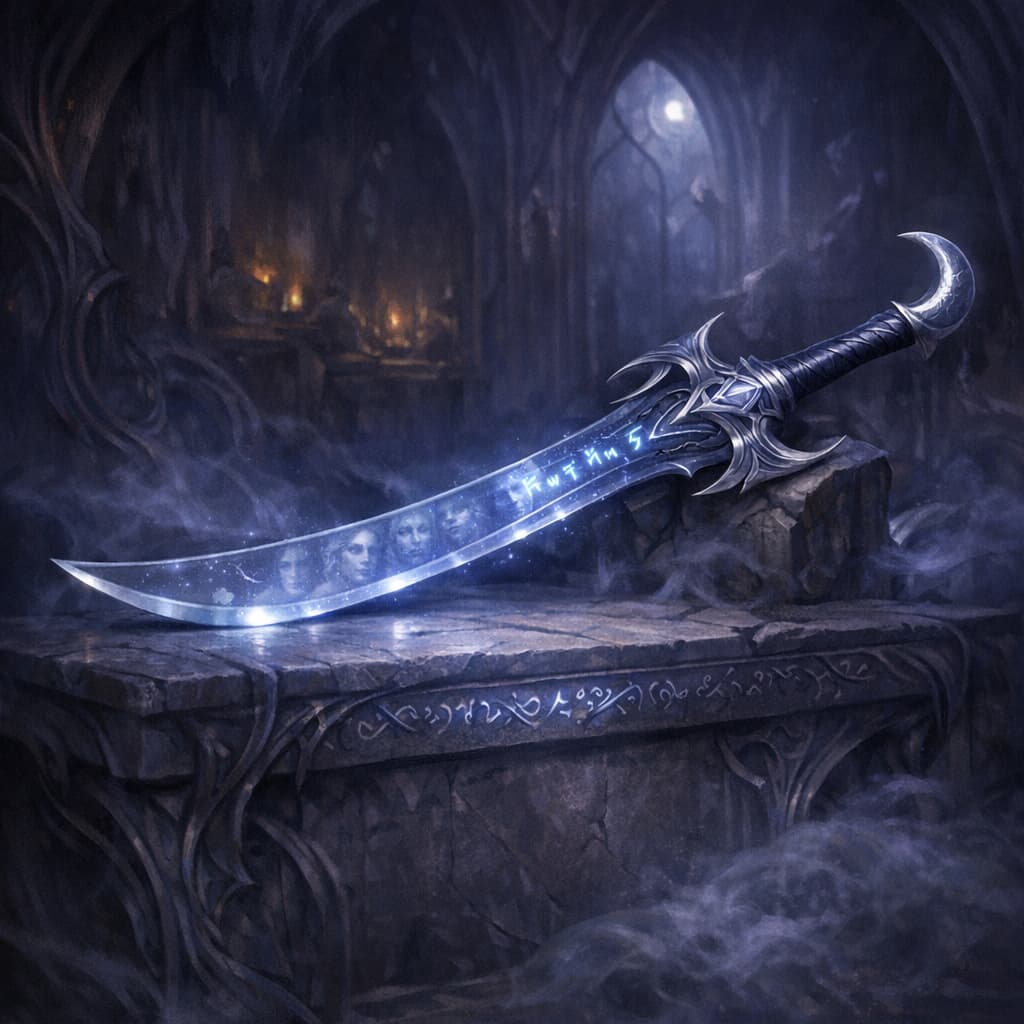
Moonblades are sentient elven swords that choose their wielders through a magical trial — the blade either accepts you or kills you. There is no middle ground. These weapons accumulate powers over generations as each wielder adds a new magical ability, making ancient moonblades among the most powerful weapons in the Forgotten Realms.
Elaine Cunningham's "Evermeet: Island of Elves" and her Arilyn Moonblade series established moonblades as central to moon elf identity in the Forgotten Realms novels. Arilyn's half-elven heritage made her moonblade acceptance revolutionary — proof that the weapons responded to worthiness rather than pure bloodline, a deeply moon elf principle.
The moonblade concept captures something essential about moon elf culture: power is inherited but must be re-earned. Each generation faces the same lethal test. Aristocratic birth provides opportunity, not guarantee. This meritocratic element within a hereditary framework mirrors the moon elf approach to governance — cyclical authority that must be continually validated.
The Moonblade Legacy
Each moonblade contains the accumulated consciousness of every previous wielder. When drawn, the blade can communicate with its bearer through emotions, visions, and — for the most attuned — direct speech. A moonblade that has passed through twenty generations carries twenty lifetimes of experience, tactical knowledge, and magical ability.
The cost of this inheritance is real. Failed claimants die. Worthy claimants carry the weight of their ancestors' expectations. The blade's accumulated personalities can conflict with the wielder's own judgment, creating internal struggles that play out during critical moments.
Moonblade Literary Appearances
| Feature | Narrative Impact | Source |
|---|---|---|
| Sentient selection | Creates tension: will the blade accept or kill? | Elfshadow (1991) |
| Accumulated powers | Each generation adds abilities, making old blades legendary | Elfsong (1994) |
| Half-elf acceptance | Challenges elven racial purity dogma | Evermeet (1998) |
| Moonblade communion | Wielder can speak with previous owners' spirits | Silver Shadows (1996) |
D&D Mechanics Across Editions
Moon elf mechanical representation has evolved substantially across D&D editions, reflecting changing design philosophies about how much racial identity should influence character capabilities.
Mechanical Evolution Comparison
| Feature | 3.5e | 5e (2014) | 2024 |
|---|---|---|---|
| Ability Scores | Fixed (+2 DEX, +2 INT) | Fixed (+2 DEX, +1 INT) | Flexible (choose) |
| Subrace Identity | Default elf | High Elf subrace | No subraces |
| Unique Mechanic | Secret door detection | Wizard cantrip | None specific |
| Darkvision | 60 ft. | 60 ft. | 60 ft. |
| Sleep Immunity | Yes | Yes | Yes |
| Design Philosophy | Race as class modifier | Race as minor variant | Race as narrative flavor |
The trend toward deracializing mechanics means moon elf identity increasingly depends on worldbuilding and roleplay rather than stat blocks.
- Immunity to sleep effects
- +2 save vs. enchantment
- Darkvision 60 ft.
- Proficiency with longsword, rapier, longbow, shortbow
- Automatic Search check within 5 ft. of secret door
The 3.5e moon elf (called "high elf" in the PHB) was the default elf. No mechanical distinction from sun elves beyond lore.
- Darkvision 60 ft.
- Keen Senses (Perception proficiency)
- Fey Ancestry (advantage vs. charm, immune to magic sleep)
- Trance (4 hours replaces 8 hours sleep)
- Extra cantrip from wizard spell list (High Elf subrace)
Moon elves use the "High Elf" subrace in 5e. The wizard cantrip represents their stronger arcane tradition compared to wood elves.
- Darkvision 60 ft.
- Keen Senses
- Fey Ancestry
- Trance
- Flexible ability scores (no fixed bonuses)
- Elf subraces collapsed into single "Elf" lineage
The 2024 revision removes subraces entirely. Moon elf identity becomes purely narrative, with no mechanical distinction from other elves.
Across Franchises
The moon elf archetype appears across multiple fantasy franchises, though the name and specific lore vary. Comparing these implementations reveals which elements are considered essential to the concept and which are franchise-specific invention.
What remains consistent across all implementations: nocturnal preference, arcane affinity, a connection to celestial bodies, and a culture that values beauty and learning. What varies: the degree of isolationism, the specific relationship to other elven subraces, and whether their lunar connection is biological, magical, or purely cultural.
Moon Elf Archetype Across Franchises
| Franchise | Name | Lunar Connection | Key Distinction |
|---|---|---|---|
| D&D / Forgotten Realms | Moon Elf / Silver Elf | Cultural & magical; phases affect spellcasting | Most tolerant elven subrace, multiracial cities |
| Dragon Age | Dalish (Mythal-devoted clans) | Mythological; Mythal as moon-associated goddess | Nomadic, lost civilization, recovering ancient lore |
| Elder Scrolls | Altmer / Bosmer (partial) | Astronomical; Aetherius-connected magic | Racial supremacism (Altmer) or wild adaptation (Bosmer) |
| World of Warcraft | Night Elf (Kaldorei) | Direct; Moon goddess Elune grants power | Matriarchal warrior culture, immortality lost |
| Baldur's Gate 3 | High Elf (moon elf option) | Narrative; default elf player character | Most relatable entry point, defined by tolerance |
BG3 made moon elves the default player elf, introducing millions of players to the subrace through Alfira, Astarion (high elf), and character creation.
Related
Other Elven Kindred
 01
Sun Elves
Radiant lords of golden splendor whose light is both genuine power and blinding expecta...
Read More 02
Night Elves
Ancient guardians of dark places whose vigilance spans millennia and whose roots run de...
Read More 03
Astral Elves
Cosmic wanderers who perceive reality from between the stars, where time bends and know...
Read More 04
High Elves
Scholars and spire-builders whose institutions outlast empires and whose magic spans mi...
Read MoreFAQ
Common Questions
Moon Elves are nocturnal and attuned to lunar cycles. Give them a rhythm: active at night, gaining bonuses or abilities during new moon or full moon phases. Tie restorative effects to moonlight, and impose penalties in bright daylight. For character mechanics, grant a 'Lunar Phase' tracker that alters spell slots, stealth bonuses, or perception checks. Provide ritual actions at moonrise, and let daylight fatigue accumulate again at dawn. This creates a clear, codified rhythm that players can remember and plan around.
Emphasize lunar devotion, silvery magic, and a nomadic or semi-nomadic tribal structure that follows moonlit routes. Distinct rituals include moonwatch, silver-tide greetings, and a night-bleed myth where they believe the moon stains the sea with light. Avoid overusing forest motifs; instead center on night markets, moonlit ships, or cliffside observatories. Give factions with goals tied to lunar events (eclipses, tides, comet passes) to create clear NPC alignments and potential party tensions.
Give a blend of utility, control, and self-defense tied to lunar phases: e.g., Phase-Wend: during new moon, enhanced stealth and darkvision; full moon: radiant or silver spells with limited uses; quarter moon: heightened perception and reaction. Include a cost or cooldown to prevent spam, like needing moonlight or a night ritual to recharge. Tie their spell list to moonlight, tides, and starlight to reinforce the theme without overpowering other casters.
Hooks hinge on lunar lore: a prophecy tied to a lunar eclipse, a lost lunar temple, or a debt owed to a moon goddess. Residence can be a cliffside citadel, a ship that sails under moonlit skies, or a forest where night never truly ends. Give a personal flaw connected to the moon, such as dependence on its cycles or a guilt over a night-bound decision. Use one or two future goals (rebuilding a shrine, stopping a ritual) to drive player choices.