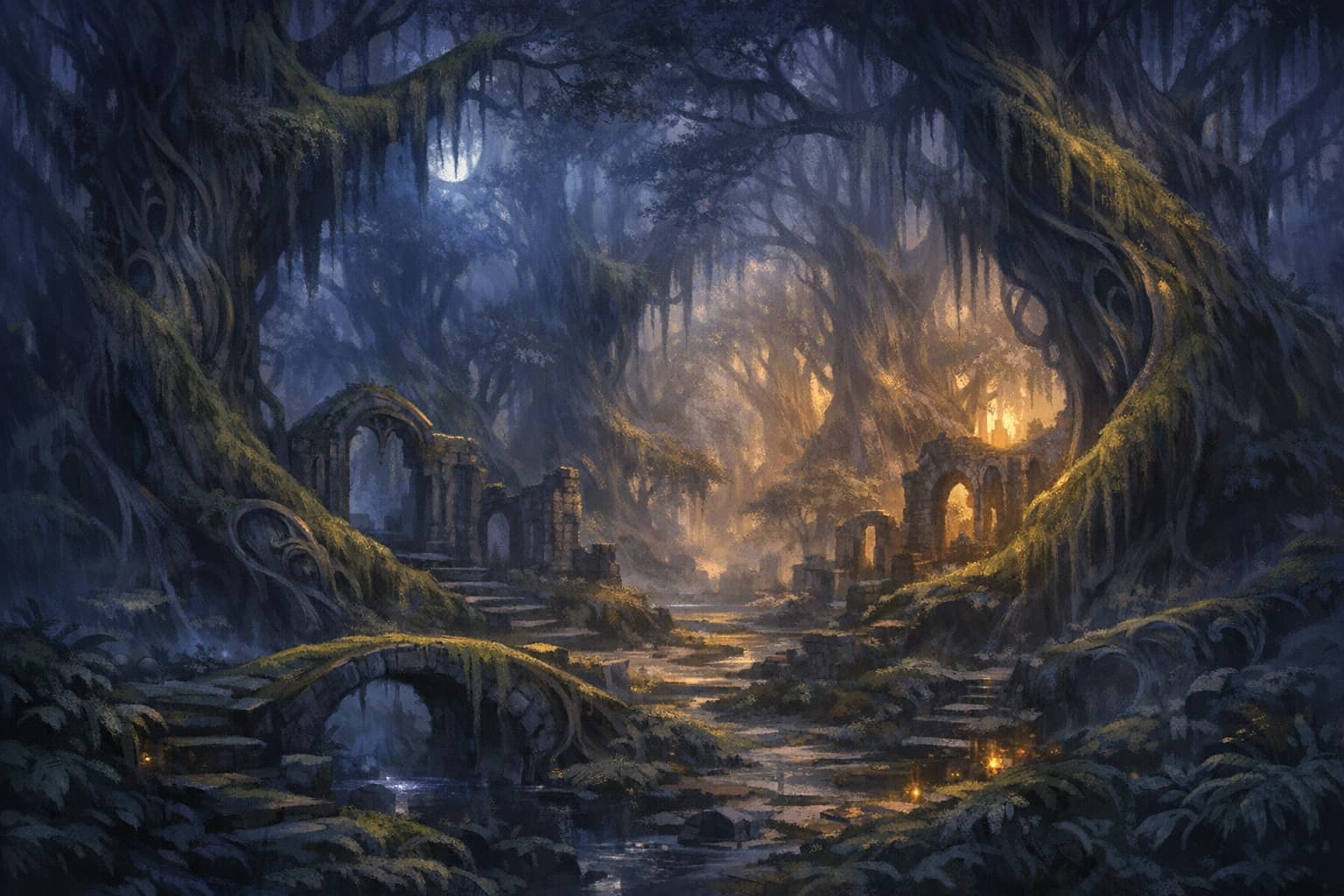
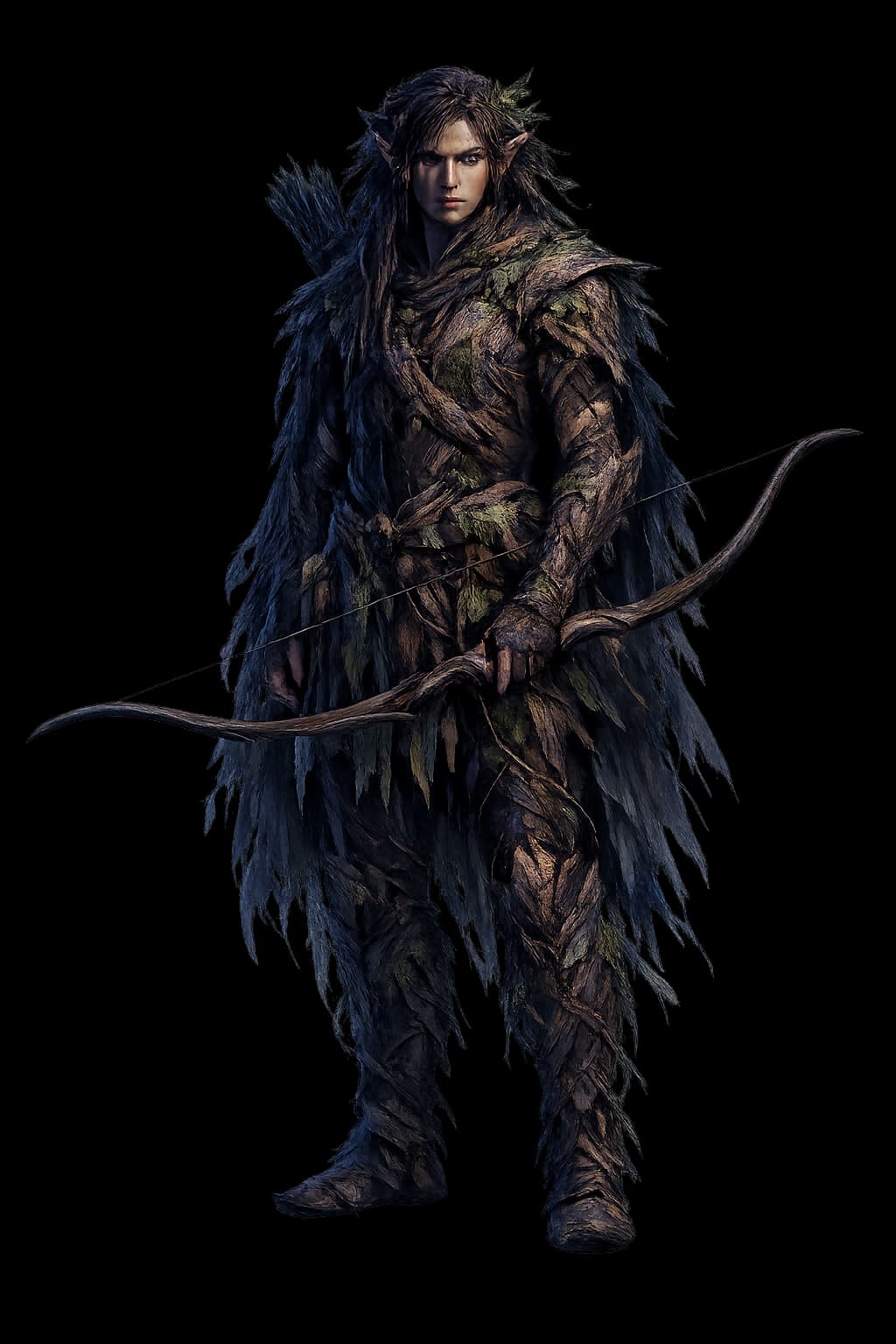

Wood Elves
Forest stewards who measure time in growth rings, whose patience runs as deep as ancient roots
Stewardship Versus Isolation
Wood elf cultures face a fundamental tension between protecting their forests and engaging with the wider world. Different wood elf communities resolve this tension differently, and the disagreements can be severe.
Isolationist wood elves want minimal contact with outsiders. They view other species as threats to forest health, whether through direct exploitation, accidental damage, or simply the chaos that follows wherever humans go. Their forests have borders that outsiders don't cross. Those who try don't return. This approach works until external threats become too large to ignore alone.
Steward wood elves believe they should extend forest ethics outward. They trade with human communities, advise other species on sustainable practices, and form alliances to protect natural systems beyond their forest's borders. This approach works until the alliances require compromises that conflict with forest values or until other species prove incapable of following through on their commitments.
Most wood elf communities contain both factions in varying proportions. The political conflict between them provides rich material for stories. The isolationist elder who's watched three human cities rise and fall in her lifetime has reason for her position. So does the young diplomat who argues that the threats facing forests now are bigger than any single forest can address.
Patience as Weapon
High elves accumulate knowledge. Dark elves cultivate ruthlessness. Wood elves weaponize patience.
Their timescale advantage is enormous. When humans encroach on forest territory, wood elves don't need to fight them directly. They can wait. The humans will overextend, make mistakes, suffer reverses. The forest will reclaim abandoned clearings within a generation. Wood elves who remember the forest before humans arrived can remember it after humans leave.
This patience manifests as strategic thinking that humans find maddening. The wood elf scout who watches human loggers for three months before acting. The wood elf diplomat who makes no counteroffers during a negotiation, simply restating the original position until the other side either accepts or leaves. The wood elf warrior who spends years learning an enemy's patterns before striking once, perfectly.
The weakness of patience is that it fails against threats that move faster than the patient response can track. A forest fire doesn't wait. An invading army with magical support doesn't wait. A plague that kills trees across a continent doesn't wait. Wood elves who've learned to solve problems through patience sometimes struggle when problems require immediate action.
Their timescale advantage is enormous. When humans encroach on forest territory, wood elves don't need to fight them directly. They can wait. The humans will overextend, make mistakes, suffer reverses. The forest will reclaim abandoned clearings within a generation. Wood elves who remember the forest before humans arrived can remember it after humans leave.
The Living Forest
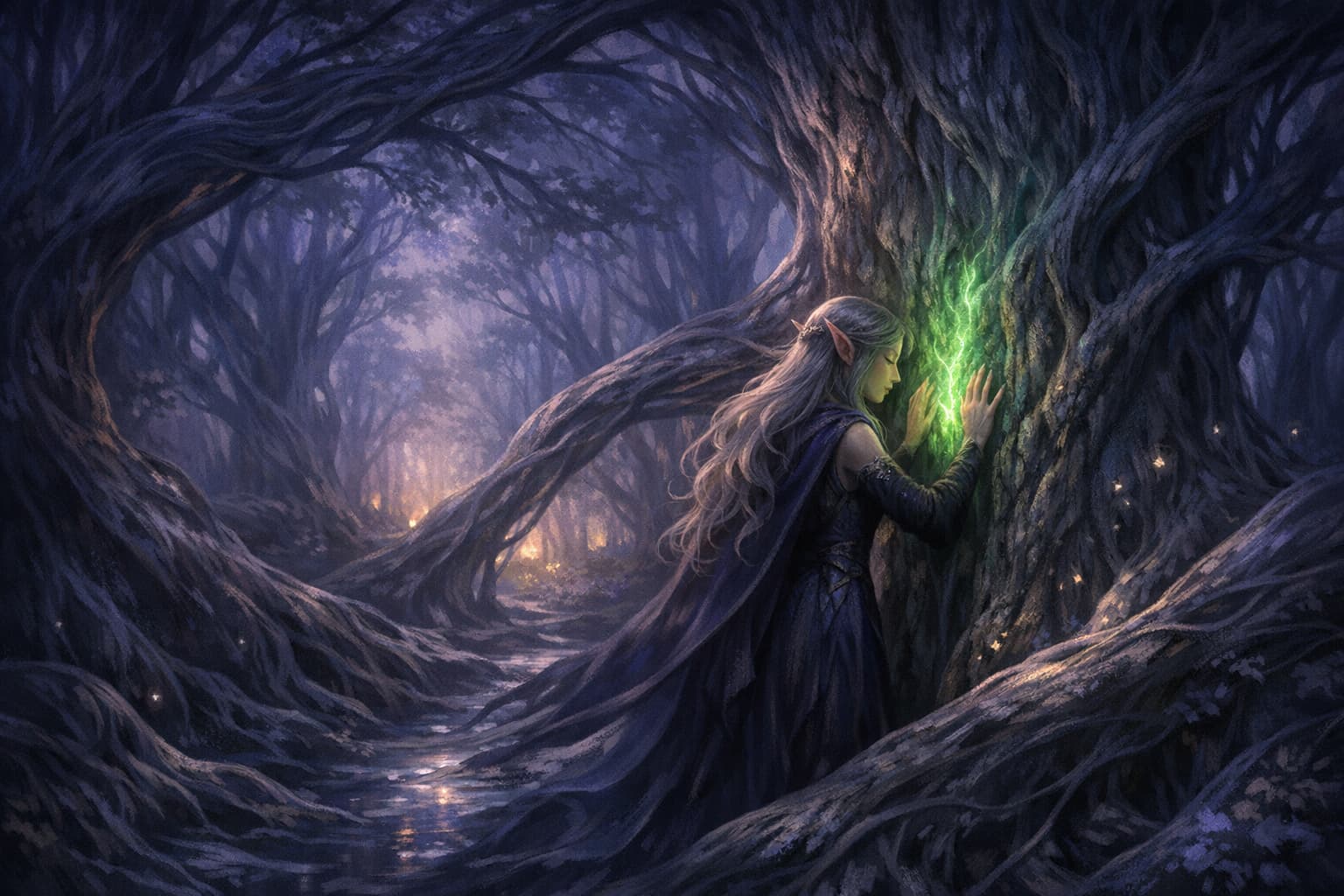
Most fantasy settings treat forests as collections of trees. Wood elf settings should treat forests as organisms.
The mycelial networks that connect tree roots actually exist and actually transfer nutrients and chemical signals between trees. A forest where this network has been active for thousands of years, with wood elves cultivating and protecting it, becomes something like a distributed nervous system. The forest knows when it's been injured. The forest responds to threats. The forest remembers.
This changes what it means to live in a wood elf forest. The forest isn't neutral territory that happens to contain wood elves. It's the wood elves' ally, partner, and in some sense their god. They serve the forest, and the forest serves them. Outsiders who harm the forest harm the wood elves in ways that go beyond mere property damage. They've wounded something the wood elves love.
For gameplay, this means the forest should respond to events. Cut down enough trees and the survivors grow thornier, their sap becoming toxic. Kill enough animals and the forest grows dark and dangerous for all warm-blooded creatures. Heal the forest's wounds and it offers aid: paths that open, food that appears, predators that look the other way.
Politics Among the Trees
Wood elf politics often organize around geography. Different groves, valleys, or watersheds develop distinct communities with distinct traditions. They're all wood elves, but they're not identical wood elves.
The wood elves of the ancient heartwood have tended their grove since before human civilizations existed. They're deeply conservative, suspicious of change, and confident in traditions that have worked for millennia. They're also isolated, inbred, and increasingly unable to address threats that originate outside their territory.
The wood elves of the border marches live where forest meets farmland. They've negotiated with humans for generations, developed hybrid practices, and accepted that pure isolation is impossible. They're adaptable and diplomatically skilled. They're also compromised, having made deals that heartwood purists consider betrayals.
The wood elves of the young forest planted their grove after a fire destroyed the previous one three centuries ago. They're experimental, less bound by tradition, more willing to try new approaches. They're also inexperienced, lacking the deep knowledge that older communities possess.
The wood elves of the ancient heartwood have tended their grove since before human civilizations existed. They're deeply conservative, suspicious of change, and confident in traditions that have worked for millennia. They're also isolated, inbred, and increasingly unable to address threats that originate outside their territory.
What Wood Elves Want
A species defined by defending their home needs threats to defend against. Wood elf stories work when the forest faces genuine danger.
The most obvious threats are external: human expansion, logging operations, mining that poisons waterways, monsters that corrupt natural systems. These threats create clear adventure hooks where the party's goals align with wood elf interests.
More interesting threats are ambiguous. The human settlement that's grown too large to relocate but whose removal would mean displacing families who've lived there for generations. The mining operation that provides metals wood elves actually need. The logging that clears deadwood and reduces fire risk. These situations force choices that don't have clean solutions.
Internal threats provide the richest material. The faction that wants to expand the forest by magical force, creating conflicts with neighboring communities. The elder whose strategies worked two hundred years ago but fail against current threats. The young leader who's right about needing new approaches but wrong about which new approaches will work.
Playing Wood Elves
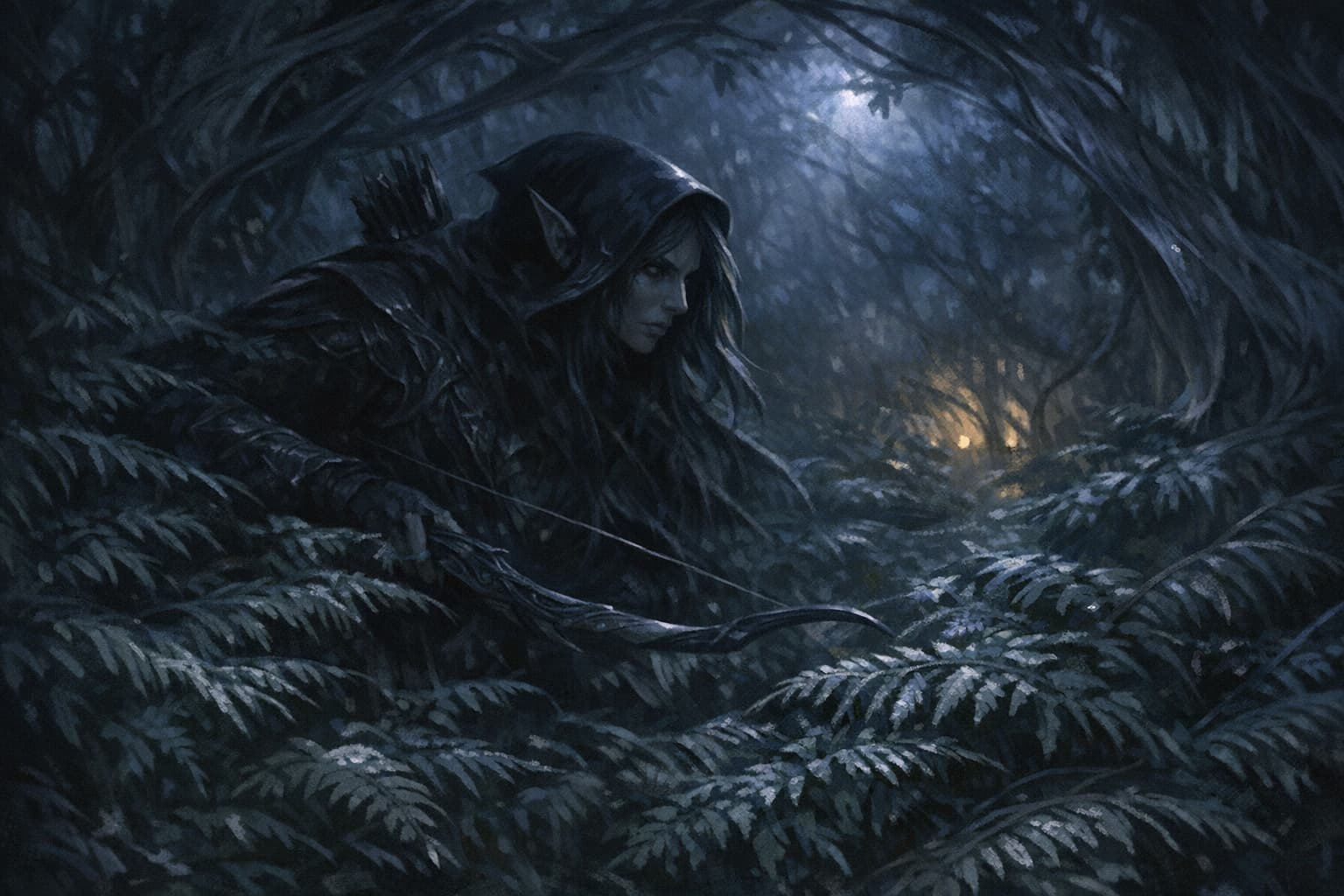
Wood elf characters need reasons to leave the forest and work with non-wood-elves. Otherwise they're just pining for home throughout the campaign, contributing reluctantly to goals they don't share.
The most straightforward approach: the character is young enough to still be curious about the outside world. Wood elf adolescents might be expected to travel, learn about other cultures, and return with useful knowledge. This explains why they'd adventure without requiring elaborate justification.
More interesting: the character is in exile. They did something that got them expelled from their community, and adventuring is how they survive outside the forest they can't return to. The exile might be unjust (political enemies maneuvered against them) or earned (they genuinely violated sacred principles). Either creates story opportunities.
Most interesting: the character represents their community's interests in the wider world. They're diplomats, scouts, or troubleshooters whose job requires working with outsiders. They haven't abandoned wood elf values. They're pursuing those values through unusual means.
From Sylvan Elves to Wood Elves
The wood elf archetype predates D&D — Tolkien's Silvan Elves of Mirkwood and Lórien were the template. These were elves who never made the journey to Valinor, who chose the forest over civilization, whose power was organic rather than learned. Thranduil's Woodland Realm was explicitly less sophisticated than Rivendell or Gondolin, but it survived when those greater powers fell. The lesson was clear: the elf who stays close to the land outlasts the elf who builds towers.
In AD&D 1st Edition (1978), the "wood elf" didn't exist as a formal subrace in the Player's Handbook. Elves were elves. Unearthed Arcana (1985) introduced the "sylvan elf" as a distinct subrace — taller, more wilderness-oriented, with bonuses to Strength rather than Intelligence. The name itself signaled the connection to classical woodland mythology: sylvan, from the Latin silva, meaning forest.
Second Edition's Complete Book of Elves (1992) expanded the sylvan elf into a fully developed culture with its own kit options. The "Wilderness Runner" and "Tribal Defender" kits gave mechanical expression to wood elf gameplay fantasies that had previously existed only in flavor text. But the real transformation came in 3rd Edition (2000), which renamed "sylvan elf" to "wood elf" in the PHB — a change that prioritized clarity over etymology and permanently established the name.
By 5th Edition (2014), wood elves had achieved co-equal status with high elves in the PHB as one of two core elf subraces. Their mechanical identity — Wisdom bonus, Fleet of Foot, Mask of the Wild — cemented the ranger/druid archetype that had been building for decades. The wood elf was no longer the lesser variant. It was the other half of the elven identity.
“Thranduil's Woodland Realm was explicitly less sophisticated than Rivendell or Gondolin, but it survived when those greater powers fell. The lesson: the elf who stays close to the land outlasts the elf who builds towers.”
— On Tolkien's Silvan Elves
The Ranger's Best Friend
Wood elves and the ranger class share a bond so deep that many players consider them inseparable. This bond is mechanical — the 5e wood elf's +2 DEX/+1 WIS perfectly matches the ranger's ability score priorities, and Mask of the Wild synergizes with the ranger's stealth-focused features. But the bond is also cultural. When players imagine a ranger, they imagine a wood elf ranger. When they imagine a wood elf, they imagine a ranger. The archetype has collapsed into near-identity.
This creates the optimization culture problem. In communities focused on character optimization, wood elf ranger is often dismissed as "default mode" — the choice you make when you don't have a more creative idea. This stigma is unearned but persistent. The combination works well precisely because the design intent is coherent: wood elves and rangers emerged from the same mythological space (Aragorn-as-Ranger meets Legolas-as-woodland-warrior) and were designed to complement each other.
The Drizzt factor complicates things further. R.A. Salvatore's iconic character is a drow ranger, not a wood elf ranger, but his playstyle — dual-wielding, wilderness survival, animal companion — is pure wood elf fantasy. Drizzt's popularity pulled the ranger archetype toward the dark elf, but the mechanical home remains with the wood elf. Players who want to play "like Drizzt" without the drow baggage often end up as wood elf rangers by default.
Beyond rangers, wood elves have strong mechanical synergy with druids (Wisdom bonus, nature themes) and monks (DEX/WIS combo, Fleet of Foot stacking with Unarmored Movement). The subrace's mechanical flexibility is actually broader than its cultural reputation suggests. But ranger remains the gravitational center.
- Immunity to sleep effects
- +2 save vs. enchantment
- Low-light vision
- Weapon proficiency: longsword, rapier, longbow, shortbow
- +2 racial bonus on Listen, Search, and Spot checks
The 3.5e wood elf traded the high elf's balanced stats for +2 STR/-2 INT, making them uniquely suited to fighter and ranger builds but penalized as wizards.
- Darkvision 60 ft.
- Keen Senses (Perception proficiency)
- Fey Ancestry
- Trance
- Fleet of Foot (35 ft. base speed)
- Mask of the Wild (hide in light obscurement from natural phenomena)
Fleet of Foot and Mask of the Wild defined the 5e wood elf as the mobile, stealthy option. The +1 WIS made them the optimal ranger/druid race at launch.
Forgotten Realms: The Wild Elves & the High Forest
The Forgotten Realms complicates wood elves by splitting them into three distinct cultures: wood elves proper (Sy-tel-quessir), wild elves (green elves, Or-tel-quessir), and copper elves — each occupying a different niche on the civilization-to-wilderness spectrum.
Wood elves in the Realms are the moderate position: less civilized than moon or sun elves, but far more organized than the wild elves. Their traditional homeland is the High Forest, a vast ancient woodland in the North that also hosts treants, centaurs, and green dragon lairs. The wood elf settlements there are hidden but substantial — fortified communities with generations of established custom, not primitive camps.
Wild elves represent the extreme of the archetype: elves who actively rejected civilization after the Crown Wars devastated elven kingdoms. They live in small tribal bands, practice a more primal form of magic tied directly to the land, and are hostile to outsiders including other elves. Wild elves are what happens when the wood elf philosophy of "nature over civilization" becomes absolute.
The Cormanthor forest — home to the ruins of Myth Drannor — represents the intersection of wood elf and moon elf history. Wood elves lived in Cormanthor long before moon elves built Myth Drannor. When the city fell, wood elves remained. This creates a layered relationship: the wood elves are the true inheritors of Cormanthor, while moon elves mourn a city that was built on wood elf territory in the first place.
Across Franchises
The wood elf archetype — nature-bonded, stealthy, suspicious of civilization, deadly with a bow — is one of the most consistent across fantasy franchises. Every major setting needs an elf-of-the-forest, and the implementations are more similar than different. The variation comes in how each franchise resolves the tension between "one with nature" and "capable of organized warfare."
Wood Elf Archetype Across Franchises
| Franchise | Name | Defining Trait | Key Distinction |
|---|---|---|---|
| D&D (generic) | Wood Elf | Fleet of Foot, Mask of the Wild | PHB core subrace; ranger/druid optimized |
| Forgotten Realms | Sy-tel-quessir / Wild Elf | Split into settled wood elves and feral wild elves | The Cormanthor and High Forest traditions |
| Elder Scrolls | Bosmer (Wood Elves) | Green Pact: cannot harm vegetation, obligate carnivores | Cannibalism is culturally acceptable; most alien version |
| Warhammer Fantasy | Asrai (Wood Elves of Athel Loren) | Symbiotic bond with a sentient, hostile forest | The forest itself is a character; not "friendly" nature |
| Dragon Age | Dalish Elves | Nomadic clans preserving lost elven heritage | Colonized people, not forest guardians by choice |
| Pathfinder 2e | Elf (Woodland heritage) | Returned exiles reconnecting with nature | Alien perspective; wood elf identity is chosen, not inherited |
The Elder Scrolls Bosmer and Warhammer Asrai stand out for making the "nature bond" genuinely disturbing rather than idyllic — a useful corrective to the sanitized wood elf of most D&D campaigns.
Subtypes
Other Elven Kindred
 01
High Elves
Scholars and spire-builders whose institutions outlast empires and whose magic spans millennia
Read More 02
Night Elves
Ancient guardians of dark places whose vigilance spans millennia and whose roots run deep
Read More 03
Half Elves
Children of two worlds who belong fully to neither, carrying the gifts and burdens of both
Read More 04
Frost Elves
Ice-forged survivors whose endurance was tempered by millennia of scarcity in the frozen wastes
Read MoreFAQ
Common Questions
Start with a few core traits: lithe build, keen senses, and a deep quiet affinity with forests. Give them a distinctive walking cadence and a soft, observant gaze. For quick creation, pick 2-3 cultural cues (tribal markings, preferred weapon, forest clan) and a signature quirk (speaks to trees, collects acorns, or avoids iron). Use these as windows into their identity rather than heavy backstory, then expand in-session through roleplay and interactions.
Give them a clan-based social system, with rituals tied to seasons and wildlife. Common traits: reverence for the woods, subtle magic tied to growth or camouflage, and a preference for living in natural allies (treehouses, glades). Distinguish them with attire like bark-pattern cloaks or feather-adorned weapons. Emphasize a tendency to migrate with animal patterns or to respect territorial boundaries in the forest.
Give the NPC a specific forest specialty (pathfinding at night, herbal lore, or animal speech). Tie their goals to a tangible forest issue (protect a glade, recover a sacred seed, broker a fragile peace). Provide 2-3 flaws that clash with their idealism (stubbornness, distrust of outsiders, guilt over a failed harvest). Let players reveal depth through small, consistent actions rather than long exposition.
Use brief, impactful beats: birthplace in a sacred grove, a mentor who vanished, a vow to protect a hidden spring, or a rift with a rival clan. Keep it to 2-3 lines that can be expanded in play. Include a soft tie to nature (guardian of a glade, keeper of a weathered totem). This provides motivation and hooks for quests without heavy metaplots.